
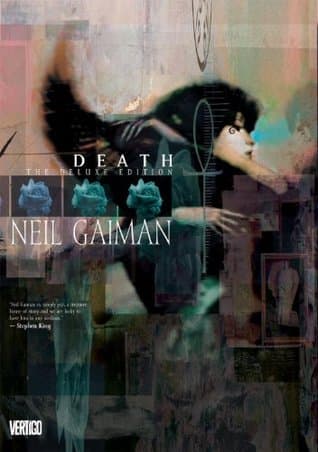
Synopsis
Covers the whole plot, including the ending.
- Difficulty
- Medium
- Pacing
- Moderate
- Mood
- Philosophical, Poignant, Hopeful, Whimsical, Bittersweet
- Read it if
- You enjoy philosophical urban fantasy, character-driven stories with a unique take on death, or are a fan of Neil Gaiman's 'Sandman' universe.
- Skip it if
- You prefer fast-paced action, strictly plot-driven narratives, or are uncomfortable with themes of death and grief.
Death Plot Summary
Covers the whole plot, including the ending.
The Day of Didi
Once every century, Death, one of the Endless, takes human form for a day to better understand humanity. On this day, she becomes a young, pale girl named Didi. She wakes up in a run-down apartment building in London, initially confused by her mortal senses. She soon meets Sexton Furnival, a young man struggling with suicidal thoughts who has been evicted. Didi, with her cheerful manner, immediately talks to him, showing a surprising lack of judgment despite her eternal nature. She helps him with his immediate sadness, offering a unique view on life's value, even as she experiences the everyday frustrations and small joys of human life.
Sexton's Encounter
Didi, in her human disguise, walks with Sexton through the streets of London. Sexton is initially dismissive and cynical, but Didi's steady optimism and unusual insights begin to soften him. She shares simple observations about life's beauty and sadness, often comparing them to the larger cosmic order she oversees, though Sexton does not fully grasp her true identity. Their journey includes small, seemingly random encounters that show how fragile and resilient human existence is. Didi's presence encourages Sexton, making him confront his reasons for wanting to end his life and, more importantly, consider reasons for choosing to live.
Hazel's Lost Heart
While walking through a market, Didi and Sexton meet Hazel, an eccentric, homeless woman who claims to be 250 years old and has literally lost her heart. Hazel believes her heart was stolen by a magician named Mad Hettie centuries ago, and she now exists without joy. Didi, recognizing Hazel's unique situation, takes an interest in her story. This meeting shifts the focus from Sexton's personal problem to a broader look at what it means to truly live and feel. Hazel's search for her lost heart becomes a metaphor for the emotional and spiritual emptiness many people experience, even if they haven't literally lost an organ.
The Search for Mad Hettie
Didi, with Sexton reluctantly following, decides to help Hazel find Mad Hettie. Their search takes them through different parts of London, exploring its hidden areas and unusual subcultures. Along the way, Didi continues to share her wisdom about life, death, and how everything is connected. Sexton, initially just watching, becomes more involved in Hazel's search, finding a purpose beyond his own sadness. The journey is not just about finding a physical object, but about restoring hope and meaning to Hazel's long, empty life, and in doing so, subtly changing Sexton's view on his own future.
Confronting Mad Hettie
Eventually, they find Mad Hettie, a decrepit but sharp old woman who is more than she seems. Hettie confirms that she does have Hazel's 'heart,' but it is not a literal organ. Instead, she reveals that Hazel, in her youth, had made a deal to escape the pain of love and loss, effectively giving away her ability for deep emotion. Hettie explains that the 'heart' she holds is a collection of Hazel's past experiences and feelings, which Hazel chose to abandon. This revelation makes Hazel confront her own choices and the results of her desire to avoid suffering.
Hazel's Reawakening
Mad Hettie, with Didi's subtle encouragement, returns Hazel's 'heart' — not as a physical object, but as the reawakening of her ability to feel. Hazel experiences a deep emotional rebirth, overwhelmed by centuries of suppressed joy and sorrow. She understands that to truly live means embracing both the beauty and the pain of existence. This moment transforms Hazel, who finally accepts the full range of human experience. Sexton sees this rebirth, further strengthening his own changed view on the value and meaning of life, realizing that even sorrow is a part of living.
Death Returns to Herself
As the sun sets, marking the end of her day as a mortal, Didi begins to feel the familiar pull of her true form. She has a final, emotional conversation with Sexton, reinforcing the lessons of life and the importance of cherishing every moment. With a gentle touch and her usual smile, Didi changes back into Death, the Endless, leaving Sexton alone but fundamentally changed by their meeting. He is left with a renewed sense of purpose and an understanding that life, even with its difficulties, is a precious gift. Death then returns to her duties, having once again gained insight into the lives she will one day guide.
Didi's Legacy
After Didi leaves, Sexton processes the extraordinary events of the day. He no longer considers suicide and begins to actively seek meaning and connection in his life. The encounter with Didi, Hazel, and Mad Hettie has given him a deep appreciation for the fragility and beauty of existence. He remembers Didi's infectious optimism and her unique view on life and death, using it as a guiding principle. His life, though still ordinary in many ways, now has a sense of purpose and a deeper understanding of the 'high cost of living' and the value of every moment.
Rainie's Dilemma
In the second story, 'The Time of Your Life,' we meet Rainie, a successful pop star dealing with the pressures of fame and the secret of her true sexual orientation. She is deeply in love with her girlfriend, Foxglove, a fellow musician, but their relationship remains hidden from the public and their managers due to career concerns. Rainie is torn between her desire for honesty and the demands of her public image. The story explores the anxieties of living a double life, the fear of judgment, and the desire for acceptance, setting the stage for a dramatic turning point in her life.
Foxglove's Illness
Foxglove, Rainie's beloved partner, suddenly becomes very ill. Her condition quickly worsens, and doctors cannot provide a diagnosis or effective treatment. As Foxglove weakens, Rainie is consumed by fear and desperation, realizing she might lose the person she loves most. This crisis makes Rainie confront her deepest fears and the true value of her relationship with Foxglove, pushing her to consider revealing their secret to the world before it's too late. The shadow of Death begins to hang over their lives, threatening to take Foxglove away.
The Appearance of Death
As Foxglove lies on her deathbed, Death herself appears to her, not in her mortal Didi form, but as the Endless. Death speaks to Foxglove calmly and kindly, explaining the nature of her upcoming transition. Death does not come as a terrifying figure but as a comforting presence, offering Foxglove a chance to reflect on her life and find peace with her journey. This meeting gives Foxglove a unique view on her mortality and the 'miracle of death,' allowing her to face her fate with some serenity, even as Rainie struggles with the impending loss.
Rainie's Confession and Foxglove's Choice
Driven by the fear of losing Foxglove and the desire to honor their love, Rainie bravely decides to publicly reveal her relationship with Foxglove, despite potential career consequences. This act of love and defiance is a key moment for Rainie, marking her acceptance of authenticity. Meanwhile, Foxglove, having spoken with Death, is presented with a choice or an understanding of her path. The story ends with Foxglove's final decision about her life, and its deep impact on Rainie, showing that love, even with death, can bring about deep change and a deeper appreciation for 'the time of your life.'
Principal Figures
Death (Didi)
Protagonist
The personification of Death, who walks among mortals.
Death is one of the Endless, an ancient, cosmic entity who embodies the end of all things. Despite her immense power and eternal nature, she is depicted as a perky, compassionate, and genuinely likable young woman with a Gothic fashion sense. She takes her duties seriously but approaches them with empathy and a profound understanding of life's value. Her one-day-a-century walk among mortals is a ritual she undertakes to maintain her connection to humanity and better understand the lives she eventually ends.
Relationships: Sexton Furnival (mentor/guide); Hazel (helper/savior); Foxglove (cosmic guide/facilitator)
Sexton Furnival
Supporting
A young man contemplating suicide, guided by Didi.
Sexton is a cynical, despairing young man who has been evicted from his apartment and is contemplating suicide at the beginning of 'The High Cost of Living.' He is initially resistant to Didi's optimism and finds her peculiar, but he is gradually drawn into her orbit. His journey with Didi and Hazel forces him to confront his own despair and re-evaluate his reasons for living. He represents the common human struggle with meaning and purpose in the face of life's hardships.
Relationships: Death (Didi) (mentee/friend); Hazel (fellow traveler/companion)
Hazel
Supporting
A 250-year-old homeless woman who literally lost her heart.
Hazel is an eccentric, ancient homeless woman encountered by Didi and Sexton. She claims to have lost her literal heart centuries ago to a magician, Mad Hettie, and has been existing in a state of emotional numbness ever since. Her quest to reclaim her heart is a powerful metaphor for the desire to feel and experience life fully, even with its inherent pain. She represents the long-term consequences of avoiding emotional vulnerability and the yearning for true connection.
Relationships: Death (Didi) (helper/savior); Sexton Furnival (fellow traveler/companion); Mad Hettie (past acquaintance/antagonist (initially))
Mad Hettie
Supporting
An ancient, enigmatic magician who holds Hazel's 'heart.'
Mad Hettie is a very old, seemingly mad woman who is revealed to be a powerful, ancient magician. She is the one who 'holds' Hazel's heart, which is actually a collection of Hazel's past emotions and experiences. Hettie acts as a gatekeeper to Hazel's past and a catalyst for her emotional reawakening. She possesses a deep, ancient wisdom and a cynical but ultimately benevolent view of human nature, challenging Hazel to confront her own choices.
Relationships: Hazel (past acquaintance/keeper of her emotional past); Death (Didi) (fellow ancient entity (implied recognition))
Rainie
Protagonist
A pop star struggling with her secret relationship and public image.
Rainie is a successful pop star in 'The Time of Your Life' who is secretly in love with her girlfriend, Foxglove. She is under immense pressure to maintain a certain public image, which conflicts with her desire for authenticity and to openly express her love. Her struggle highlights the challenges faced by LGBTQ+ individuals in the public eye and the internal conflict between personal truth and professional demands. Her journey is one of courage and self-acceptance.
Relationships: Foxglove (lover/partner)
Foxglove
Supporting
Rainie's girlfriend, a musician who falls gravely ill.
Foxglove is Rainie's girlfriend and a fellow musician in 'The Time of Your Life.' She is the catalyst for Rainie's emotional journey when she falls gravely ill. Her impending death brings Death into their lives and forces Rainie to confront her fears and make difficult choices. Foxglove's calm acceptance of her fate after her encounter with Death contrasts with Rainie's initial desperation, offering a profound perspective on mortality and the beauty of a life lived fully.
Relationships: Rainie (lover/partner); Death (recipient of guidance/cosmic interaction)
Dream (Morpheus)
Mentioned
Death's brother, the personification of dreams.
Dream is Death's brother and the protagonist of 'The Sandman' series. While not directly appearing, he is mentioned as one of the Endless, highlighting Death's place within a larger cosmic family. His presence is subtly felt through Death's occasional references to her siblings, providing context to her eternal existence and her unique role among her powerful brothers and sisters. His character underscores the vast, interconnected universe of the Endless.
Relationships: Death (sibling)
Destiny
Mentioned
Death's brother, the personification of fate.
Destiny is another of Death's brothers, the eldest of the Endless, who carries a book containing all that ever was, is, or will be. He is mentioned briefly, further establishing the familial context of the Endless. His existence reminds readers that Death operates within a predetermined cosmic order, even as she interacts with the free will of mortals. His role emphasizes the grand, overarching narrative that governs the universe.
Relationships: Death (sibling)
Themes & Insights
The Value of Life and the Acceptance of Death
The main theme in both stories is that life's preciousness is linked to its finite nature. Death, in her cheerful and kind way, consistently shows that death is not an ending to fear, but a natural, unavoidable part of existence that gives life its meaning. In 'The High Cost of Living,' Didi helps Sexton realize that even suffering is part of the human experience, and avoiding it is avoiding living. In 'The Time of Your Life,' Foxglove's acceptance of her fate, helped by Death, allows Rainie to fully embrace their love and live honestly. The stories argue that accepting mortality allows one to truly appreciate and live life fully.
“You get a lifetime. No more. No less. You get a lifetime.”
Authenticity vs. Performance
This theme is particularly clear in 'The Time of Your Life' with Rainie's struggle. Rainie, as a pop star, must maintain a public image that contradicts her true identity and her love for Foxglove. The pressure to perform a role for her career conflicts with her desire to live honestly. Her eventual decision to publicly acknowledge her relationship, despite the potential consequences, highlights the importance of living truthfully, even when it is difficult. This struggle also subtly reflects Hazel's earlier choice to numb her emotions, living a life without feeling, which ultimately led to emptiness.
“Sometimes you have to stop living someone else's life and start living your own.”
The Nature of Love and Connection
Both stories emphasize the power of love and human connection. In 'The High Cost of Living,' Didi's genuine empathy and connection with Sexton and Hazel help them overcome their sadness and emotional numbness. Hazel's 'lost heart' represents a broken connection to her own ability to love and grieve. In 'The Time of Your Life,' the deep love between Rainie and Foxglove drives Rainie's courage and her final decision to live honestly. The stories suggest that true love, whether romantic or platonic, is a vital force that gives meaning to life and helps people face their greatest challenges, including death.
“Every person is a universe. Every person is a world.”
Finding Meaning in Mundane Existence
Through Didi's human experience, the story highlights the beauty and importance found in everyday life. Didi, experiencing human senses and emotions for the first time in a century, finds wonder in simple things like a cup of coffee or a street market. This perspective helps Sexton, who initially sees only despair, to recognize the small joys and connections that make life worthwhile. The stories encourage readers to appreciate the 'high cost of living' by finding meaning and beauty in the ordinary, rather than constantly seeking grand, external validations. Even with cosmic entities, the most important lessons come from human interaction.
“It's all part of the big picture, Sexton. The little bits and the big bits. They all matter.”
Plot Devices & Literary Techniques
Anthropomorphic Personification
Abstract concepts, like Death, are given human form and personality.
This is the core plot device of the series. Death, an abstract cosmic force, is personified as a charming, empathetic young woman. This allows Gaiman to explore profound philosophical questions about life and death through relatable human interactions. By making Death a character with agency and a unique perspective, the narrative demystifies and humanizes the concept of mortality, making it less terrifying and more understandable. Her human form, Didi, further grounds these cosmic ideas in everyday reality.
The 'Walkabout' Narrative
Death's century-long ritual of experiencing mortality.
Death's tradition of spending one day a century as a mortal, known as the 'walkabout,' serves as a narrative framework for 'The High Cost of Living.' This device allows Death to gain fresh insights into humanity, directly experiencing the joys, sorrows, and frustrations of life. It provides a unique lens through which to examine human existence from both an eternal and a mortal perspective, and it facilitates her encounters with characters like Sexton and Hazel, whose lives she profoundly impacts during her brief time as Didi.
The Metaphorical Lost Heart
Hazel's literal 'lost heart' symbolizes emotional numbness.
Hazel's claim of having literally lost her heart to Mad Hettie is a powerful metaphor for emotional detachment and the avoidance of pain. It functions as a tangible representation of her centuries-long state of emotional numbness. The quest to retrieve it becomes a journey of self-discovery and re-engagement with the full spectrum of human feeling, illustrating that true living requires embracing both joy and sorrow. Its resolution is not a physical retrieval but an emotional reawakening.
The Looming Illness/Mortality
Foxglove's illness acts as a catalyst for Rainie's growth.
In 'The Time of Your Life,' Foxglove's sudden, unexplained illness and impending death serve as a potent plot device. It acts as an external pressure that forces Rainie to confront her deepest fears, her secret relationship, and her desire for authenticity. The threat of loss accelerates Rainie's personal growth and leads to her courageous public confession. It also provides the direct impetus for Death's appearance, bringing the cosmic and the personal together in a poignant exploration of love and loss.
Death Quotes
“I'm Death. I come at the end. But I'm not the end. I'm just a part of the cycle.”
“You get a little life, and then it's over.”
“You lived what anybody gets, Marge. You lived a life. No more, no less.”
“Everyone lives, Marge. And everyone dies. It's the order of things.”
“It's a gift. That's what it is. A gift. And it's a privilege to be alive.”
“You don't get to choose when. You just get to choose how.”
“There are things in life that are worth dying for.”
“Every person has a world inside them. A whole world, Marge. And when they die, that world dies with them.”
“I don't take anything away. I just make sure it's over.”
“The end of one thing is just the beginning of another.”
“I'm not the enemy. I'm just part of the process.”
“It's important to live, Marge. Really live. While you can.”
“There are no easy answers. Just the journey.”
“People live and people die. That's the way it's always been, and that's the way it always will be.”
“We all have a story, Marge. And every story has an ending.”
Quiz
10 questions on the plot and the characters. Each answer comes with a short explanation.
Question 1
What is the name Death uses when she walks the Earth as a mortal once every century?
- Dee Dee
- Didi
- Dawn
- Daisy
Show answer
B. Didi In 'The High Cost of Living,' Death takes on the mortal form of a young girl named Didi to walk among humanity.
Question 2
How often does Death walk the Earth as a mortal to understand humanity better?
- Once a year
- Once a decade
- Once a century
- Once a millennium
Show answer
C. Once a century The synopsis states that 'One day in every century, Death walks the Earth to better understand those to whom she will be the final visitor.'
Question 3
What is one of the key themes explored in Death's solo adventures, as mentioned in the description?
- The nature of good versus evil
- The power of magic and sorcery
- A sincere musing on love, life and death
- The pursuit of eternal youth
Show answer
C. A sincere musing on love, life and death The description explicitly states that the first story is 'a sincere musing on love, life and (of course) death.'
Question 4
In the first story, whom does Death, as Didi, help find her missing heart?
- A young child
- A heartbroken teenager
- A 250-year-old homeless woman
- A cynical old man
Show answer
C. A 250-year-old homeless woman The synopsis mentions that Death, as Didi, 'helps a 250-year old homeless woman find her missing heart.'
Question 5
What characteristic best describes Death's personality, as introduced in the stories?
- Morose, grim, and terrifying
- Young, pale, perky, and genuinely likable
- Aloof, indifferent, and ancient
- Mischievous, cruel, and unpredictable
Show answer
B. Young, pale, perky, and genuinely likable The description introduces Death as 'the young, pale, perky, and genuinely likable Death.'
Question 6
The second story features a rising star in what profession?
- Acting
- Literature
- Music
- Art
Show answer
C. Music The second story is about 'a rising star of the music world' who 'wrestles with revealing her true sexual orientation.'
Question 7
What specific internal conflict does the rising music star face in the second story?
- Deciding to pursue a different career path
- Wrestling with revealing her true sexual orientation
- Overcoming stage fright before a major performance
- Dealing with the pressures of fame
Show answer
B. Wrestling with revealing her true sexual orientation The description states, 'a rising star of the music world wrestles with revealing her true sexual orientation.'
Question 8
What is the primary reason Death assumes a mortal form for a day once a century?
- To escape her duties for a brief period
- To gather information for her brother, Dream
- To better understand those to whom she will be the final visitor
- To experience the joys and sorrows of human love
Show answer
C. To better understand those to whom she will be the final visitor The text clearly states, 'One day in every century, Death walks the Earth to better understand those to whom she will be the final visitor.'
Question 9
The collection includes which two specific miniseries?
- DEATH: THE HIGH COST OF LIVING and DEATH: AT DEATH'S DOOR
- DEATH: THE HIGH COST OF LIVING and DEATH: THE TIME OF YOUR LIFE
- DEATH: THE ENDLESS NIGHT and DEATH: THE JOURNEY
- DEATH: A FAREWELL and DEATH: THE ETERNAL MOMENT
Show answer
B. DEATH: THE HIGH COST OF LIVING and DEATH: THE TIME OF YOUR LIFE The last sentence of the description specifies: 'This new hardcover collects the DEATH: THE HIGH COST OF LIVING and DEATH: THE TIME OF YOUR LIFE miniseries.'
Question 10
What concept does the second story specifically aim to illuminate?
- The burden of immortality
- The miracle of death
- The allure of fame
- The struggle for artistic integrity
Show answer
B. The miracle of death The description states the second story is 'a practical, honest, and intelligent story that illuminates 'the miracle of death.'
Death FAQ
What is the central premise of 'Death: The High Cost of Living'?
'The High Cost of Living' follows Death of the Endless as she takes on human form for one day every century to better understand mortality. During this particular day, she is a young woman named Didi and befriends a despondent teenager named Sexton, helping him confront his suicidal thoughts, and aids a centuries-old homeless woman, Hazel, in finding her lost heart.
Who are the primary human companions Death interacts with during her 'day off' in 'The High Cost of Living'?
Death, in her mortal guise as Didi, primarily interacts with Sexton, a brooding and suicidal young man who becomes her traveling companion, and Hazel, an ancient homeless woman who believes her heart was stolen by a succubus. She also encounters Mad Hettie, a wise and very old woman who recognizes Death.
What significant object is Hazel searching for in 'The High Cost of Living' and what does it symbolize?
Hazel is searching for her missing heart, which she believes was stolen by a succubus centuries ago. This 'heart' is not a literal organ but rather her capacity for love, joy, and emotional connection, which she feels she lost after a traumatic past experience involving her lover and a supernatural entity.
What is the main plot of 'Death: The Time of Your Life'?
'The Time of Your Life' centers on a rising rock star named Foxglove and her girlfriend, Wanda. Foxglove is struggling with her public image and her relationship with Wanda, who is a transgender woman. The plot intensifies when Wanda is lured into the realm of Death by a mysterious entity, prompting Death herself to intervene.
How does Death resolve the conflict surrounding Wanda in 'The Time of Your Life'?
Wanda is lured into a dream-like state by a creature seeking to possess her, blurring the lines between life and death. Death intervenes to explain that Wanda's time is not yet up and helps her return to the living world, emphasizing the preciousness of life and the importance of living authentically.
What is the significance of the ankh pendant Death wears?
The ankh is an ancient Egyptian hieroglyphic symbol representing 'life.' Death wears it as a constant reminder of her purpose, which is not just to end life, but to celebrate and understand it. It signifies her unique perspective as the end of life, yet also its constant companion and observer.
Are there any subtle connections to the broader Sandman universe in these stories?
Yes, beyond Death herself, characters like Mad Hettie are established figures in the Sandman mythology, having appeared in other stories. The concept of the Endless and their realms is also implicitly acknowledged, even if other Endless siblings don't make direct appearances. The stories reinforce Death's unique relationship with humanity.
What is the significance of the character Sexton's name in 'The High Cost of Living'?
A sexton is traditionally a church officer responsible for maintaining the church building and grounds, often including digging graves. This name is highly symbolic for a character contemplating suicide and interacting with Death, subtly linking him to themes of mortality, burial, and the transition between life and death.
How does Death's appearance challenge traditional grim reaper imagery?
Death is depicted as a perky, pale, young goth girl with an ankh, far removed from the skeletal, hooded, scythe-wielding figure. This design choice subverts expectations, making her approachable and empathetic, reflecting Gaiman's philosophy that death is a natural and often kind part of existence, not a terrifying one.
What psychological journey does Sexton undergo in 'The High Cost of Living'?
Sexton begins as deeply depressed and suicidal, feeling isolated and purposeless. Through his interactions with Didi (Death), he is confronted with the beauty and fragility of life, and the inherent value of his own existence. He moves from despair to a renewed, albeit cautious, appreciation for life.
How does 'The High Cost of Living' explore the psychological impact of immortality or extreme longevity, as seen through Hazel?
Hazel, having lived for centuries, carries immense emotional baggage, including the trauma of losing her heart/love. Her longevity has made her detached and jaded, illustrating how endless life can lead to profound loneliness and a loss of personal identity if not continually renewed with meaning and connection.
What is the psychological significance of Wanda's journey in 'The Time of Your Life'?
Wanda's journey into a liminal state reflects her internal struggle for acceptance, both from society and from herself as a transgender woman. Her near-death experience forces her to confront her fears and embrace her true identity, reinforcing the psychological importance of authenticity and self-worth.
How does Death's human experience (as Didi) influence her understanding of mortality?
By living as a mortal for a day, Death experiences the small joys, frustrations, and pains of human existence firsthand. This allows her to empathize more deeply with the souls she eventually collects, reinforcing her compassionate nature and providing her with fresh insights into the 'high cost of living' and the preciousness of life.
What message do these stories convey about the nature of death itself?
The stories consistently portray Death not as an antagonist, but as a compassionate, understanding, and even cheerful entity. They suggest that death is a natural, inevitable, and often kind transition, not something to be feared, but rather a final, necessary part of the 'miracle of life' that gives it meaning and urgency.
How do the narratives address themes of identity and self-acceptance, particularly through characters like Wanda?
Through Wanda, 'The Time of Your Life' directly explores themes of gender identity, societal acceptance, and self-worth. Wanda's struggle with her gender and her girlfriend's public acknowledgment of their relationship highlights the importance of living authentically and the courage required to be true to oneself, regardless of external pressures.
What is the 'high cost of living' referred to in the first miniseries title?
The 'high cost of living' refers to the emotional toll and inherent struggles that come with being alive: the pain of loss, the fear of death, the burden of memories, and the effort required to find meaning and connection. It implies that life, despite its joys, is a challenging and often expensive endeavor, emotionally speaking.
What role does art and music play in 'The Time of Your Life'?
Music, particularly Foxglove's career as a rock star, serves as a backdrop for the narrative, highlighting themes of public image versus private life. Art, in a broader sense, is shown as a means of expression and connection, capable of conveying profound emotions and shaping identity, even as it sometimes creates pressures.
How does the narrative challenge the reader's preconceived notions about 'the end'?
By presenting Death as a vibrant, empathetic, and even friendly character, the stories force readers to re-evaluate their ingrained fears and negative perceptions of death. They encourage a perspective where death is a natural and integral part of the cycle of existence, rather than a terrifying finality.
About the author

Neil Richard MacKinnon Gaiman is an English author of short fiction, novels, comic books, graphic novels, audio theatre, and a screenwriter. His works include the comic book series The Sandman and the novels Good Omens, Stardust, Anansi Boys, American Gods, Coraline, and The Graveyard Book. He has won numerous awards, including the Hugo, Nebula, and Bram Stoker awards, as well as the Newbery and Carnegie medals. He is the first author to win both the Newbery and the Carnegie medals for the same work, The Graveyard Book (2008). In 2013, The Ocean at the End of the Lane was voted Book of the Year in the British National Book Awards. It was later adapted into a critically acclaimed stage play at the Royal National Theatre in London.
Similar books
- A Monster Calls
Patrick Ness
4.3 (208k) average on GoodreadsFantasyDeals with grief and loss through a fantastical lens, with a strong emotional core.
- Stardust
Neil Gaiman
4.1 (359k) average on GoodreadsFantasyFeatures a whimsical, fantastical journey with a unique perspective on life and love.
- On a Pale Horse
Piers Anthony
4.1 (36k) average on GoodreadsFantasyPiers Anthony's On a Pale Horse (the first book in his Incarnations of Immortality series) also features a human taking on the role of Death. However, the comparison largely highlights Gaiman's unique approach. Anthony's narrative is more focused on the adventure and magical bureaucracy of the afterlife, with the protagonist, Zane, learning the rules and responsibilities of being Death, often with a humorous and pulpy tone. Gaiman's "Death," while having its lighthearted moments, is far more introspective and philosophical, less concerned with the mechanics of the job and more with the emotional and spiritual impact of mortality on both the living and the entity of Death itself. Anthony's Death is a job to be done; Gaiman's Death is a being of profound empathy and understanding. Gaiman's work generally possesses a greater literary depth and character development in its exploration of the theme, as opposed to Anthony's more plot-driven, high-concept fantasy.
- Harry Potter and the Sorcerer's Stone
J.K. Rowling
4.5 (7M) average on GoodreadsFantasyRescued from a miserable life under the stairs, an orphaned boy discovers he's a wizard destined for a magical school, where he uncovers a dangerous secret tied to the dark wizard who murdered his parents.
- The Hunger Games
Suzanne Collins
4.3 (6.4M) average on GoodreadsFantasyIn a future where children fight to the death on live television, Katniss Everdeen volunteers for the arena, turning a death sentence into a fight for survival and a spark of rebellion.
- 1984
George Orwell
4.2 (3.1M) average on GoodreadsPoliticsIn a future where surveillance and thought control are absolute, a man's search for truth clashes with the Party, showing that hope can be a form of rebellion.




Enjoyed the summary?
A summary gives you the shape of the book. The book itself has the detail, the examples and the voice.
Find Death on AmazonAs an Amazon Associate, BookBrief earns from qualifying purchases. How we're funded