
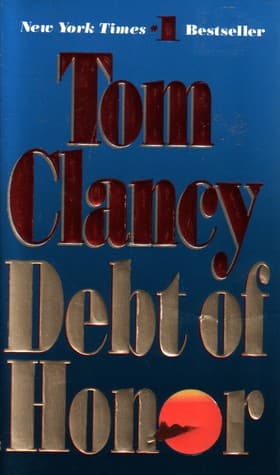
Synopsis
Covers the whole plot, including the ending.
- Difficulty
- Hard
- Pacing
- Variable
- Mood
- Intense, Geopolitical, Suspenseful, Strategic
- Read it if
- You enjoy complex geopolitical thrillers with detailed military and political strategy, and a protagonist who rises to unexpected challenges.
- Skip it if
- You prefer fast-paced action over extensive political and technical detail, or find long books daunting.
Debt of Honor Plot Summary
Covers the whole plot, including the ending.
The Catalyst: The Fatal Car Accident
The story opens with a car crash in rural Tennessee. A family dies when their Japanese-made car's faulty gas tank ignites. Congressman Gerry Hendley, a protectionist politician, uses the public outrage and media attention to push through a punitive trade bill targeting Japan. Hendley's bill aims to impose severe tariffs and restrictions on Japanese imports, ostensibly to protect American jobs and consumers, but also to punish Japan for perceived unfair trade practices. This legislative action, intended to economically squeeze Japan, inadvertently provides the spark for a much larger, more sinister plan being orchestrated by a powerful Japanese industrialist.
Yamata's Motivation and Plan
Raizo Yamata, a wealthy Japanese industrialist, views the new American trade bill as a direct insult to Japan's honor and economic sovereignty. Driven by a deep personal mission to avenge his parents, who he believes were victims of American post-WWII policies, Yamata has meticulously crafted a multi-pronged plan to humble the United States. His scheme involves economic warfare and a strategic military component designed to cripple American capabilities in the Pacific and elevate Japan to a dominant position. He sees the trade bill as the perfect justification and cover to launch his intricate and long-prepared operation, leveraging his vast resources and connections.
Economic Sabotage Begins
Following the passage of the Hendley Bill, Yamata puts the first phase of his plan into action. Using his vast financial network and influence over other Japanese companies, he orchestrates a massive, coordinated sell-off of US Treasury bonds and other American securities. This sudden withdrawal of capital from the US market sends shockwaves through Wall Street, causing the stock market to plummet and the dollar to weaken significantly. The American economy begins to reel, facing a severe financial crisis as confidence in its stability erodes. This economic attack is designed to create chaos and weaken the US's ability to respond to further threats.
The Cyber Attack and Infrastructure Disruption
At the same time as the economic assault, Yamata's network initiates a series of sophisticated cyberattacks targeting critical American infrastructure. These attacks are designed to cause widespread disruption, focusing on financial networks, transportation systems, and even military communications. While not immediately catastrophic, they sow confusion and make it difficult for the US government to coordinate a response to the unfolding crisis. The cyber warfare is a key part of Yamata's strategy, aiming to blind and disorient the United States, preventing it from fully grasping the scope and origin of the attacks, and creating an environment for further escalation.
President Durling's Response and Ryan's Role
President Roger Durling finds himself in an unprecedented national crisis. The economic collapse and cyber disruptions baffle the administration, as the source and coordination of the attacks remain unclear. Recognizing the gravity of the situation, President Durling turns to Dr. Jack Ryan, who has recently returned to government service. Ryan is appointed as the new National Security Advisor, tasked with unraveling the complex web of attacks and advising the President on a response. Ryan immediately begins to connect the dots, seeing patterns that suggest a deliberate, coordinated assault rather than isolated incidents, and starts to suspect a foreign adversary.
Military Escalation in the Pacific
As the US grapples with its internal crises, Yamata's plan enters its military phase. Japanese Self-Defense Forces, under the influence of Yamata's allies within the government, conduct a series of coordinated and unexpected military actions in the Pacific. These include the seizure of the Mariana Islands, including Guam, a strategic US territory, and attacks on US naval vessels and airbases in the region. These actions are executed with precision and speed, catching the US off guard and demonstrating Japan's enhanced military capabilities. The goal is to establish Japanese dominance in the Pacific and further humiliate and cripple the American military presence.
Ryan Uncovers the Conspiracy
Working tirelessly, Jack Ryan and his team at the CIA and NSA begin to piece together intelligence from various sources. They analyze financial data, cyberattack signatures, and decrypted communications. Ryan's analytical mind connects the economic attacks, the cyber warfare, and the military moves in the Pacific, realizing they are all part of a single, integrated operation. He identifies Raizo Yamata as the central figure, recognizing his immense influence and the historical grievances that drive him. Ryan presents his findings to President Durling, confirming that the United States is under a full-scale, undeclared war initiated by Japan.
The President's Death and Ryan's Succession
In a shocking and devastating turn of events, President Durling, along with most of the US Cabinet and Congress, is killed when a Japanese commercial airliner, piloted by a kamikaze terrorist, crashes into the Capitol Building during an emergency joint session of Congress. This horrific act of terrorism decapitates the US government. Due to a complex chain of succession and the elimination of other eligible officials, Jack Ryan, as the recently appointed Vice President (a position he reluctantly accepted prior to the Capitol attack), is suddenly sworn in as the President of the United States. He now leads a nation in crisis and war.
President Ryan's Leadership and Counter-Offensive
Immediately upon assuming the presidency, Jack Ryan demonstrates resolve and leadership. He addresses the stunned nation, vowing to avenge the fallen and restore American sovereignty. He quickly consolidates power and begins to organize a military and economic counter-offensive. Ryan's first priority is to stabilize the economy and re-establish national morale. He then authorizes a daring plan to reclaim the Mariana Islands and neutralize the Japanese military threat. His leadership style is direct and pragmatic, focusing on intelligence-driven decisions and leveraging the full might of the American military, despite the severe losses and disruptions.
The War in the Pacific
Under President Ryan's command, the US military launches a counter-offensive in the Pacific. Naval and air forces engage in battles with the Japanese Self-Defense Forces, particularly around the Mariana Islands. The fighting is intense and costly, but American forces, driven by a desire for vengeance and guided by superior intelligence, gradually begin to push back the Japanese. The conflict highlights the advanced capabilities of both sides, but the US eventually gains the upper hand through strategic planning and overwhelming force, beginning to dismantle Yamata's territorial gains and military objectives.
Yamata's Downfall and Japan's Retreat
As the US counter-offensive gains momentum, Yamata's plan begins to unravel. The economic pressure from the US, combined with the military setbacks, starts to create dissent within Japan's political and military establishment. International pressure also mounts against Japan. Yamata's allies within the Japanese government begin to distance themselves as the true cost and illegality of his actions become undeniable. Ultimately, facing overwhelming American military might and internal collapse, Yamata's scheme fails. The Japanese government, under pressure, is forced to concede defeat and retreat from its occupied territories, ending the military conflict.
The Aftermath and Rebuilding
With the war concluded, President Ryan faces the task of rebuilding a shattered nation. The economic damage is immense, the political landscape is in turmoil, and the psychological scars of the attacks run deep. Ryan immediately focuses on restoring economic stability, ensuring national security, and bringing to justice those responsible for the attacks. He initiates efforts to repair diplomatic relations and re-establish America's position on the world stage. The book concludes with Ryan firmly in charge, facing the challenges of a post-war presidency, but with a clear vision for the future and a commitment to protecting the United States.
Debt of Honor Characters
Jack Ryan
Protagonist
Analyst turned President, leading the US through its darkest hour.
Dr. Jack Ryan is initially the National Security Advisor to President Durling, renowned for his sharp intellect, analytical skills, and integrity. He is a former Marine, intelligence analyst, and history professor. He is pragmatic, detail-oriented, and possesses an uncanny ability to connect disparate pieces of information. Though he prefers a quieter life, his deep sense of duty consistently pulls him into the highest echelons of power. He is a family man, deeply devoted to his wife Cathy and their children, which grounds him amidst the chaos of his professional life.
Relationships: President Roger Durling (Subordinate and trusted advisor); Cathy Ryan (Wife, source of stability and support); Mary Pat Foley (CIA colleague, professional respect)
Raizo Yamata
Antagonist
A powerful Japanese industrialist driven by a quest for national vengeance.
Raizo Yamata is a brilliant, ruthless, and immensely wealthy Japanese industrialist who harbors a profound resentment against the United States. He believes America is responsible for the suffering of his parents during and after World War II, fueling his 'debt of honor.' He is a master strategist, meticulous in his planning, and possesses the resources and connections to orchestrate a multi-front attack against the US. His motivations are deeply personal, yet he frames his actions as a patriotic duty to restore Japan's honor and global dominance. He is cold, calculating, and utterly committed to his vision.
Relationships: Japanese Government Officials (Influenced allies and subordinates)
President Roger Durling
Supporting
The US President who faces the initial onslaught of Yamata's attacks.
President Roger Durling is the incumbent President of the United States at the onset of the crisis. He is a seasoned politician, but initially struggles to comprehend the coordinated nature of the attacks on the American economy and infrastructure. He relies heavily on his advisors, particularly Jack Ryan, to make sense of the unfolding events. Durling is depicted as a man under immense pressure, trying to navigate an unprecedented national emergency. He is a symbol of the American government's initial vulnerability and the devastating impact of Yamata's plan.
Relationships: Jack Ryan (President and National Security Advisor)
Congressman Gerry Hendley
Supporting
An opportunistic politician whose protectionist bill serves as Yamata's catalyst.
Gerry Hendley is a US Congressman who embodies political opportunism and protectionist sentiment. He leverages a tragic car accident to push through a punitive trade bill against Japan, believing it will benefit American industries and his political career. Unbeknownst to him, his actions play directly into Raizo Yamata's hands, providing the perfect pretext for the Japanese industrialist to launch his devastating plan. Hendley is self-serving and myopic, failing to see the wider international implications of his legislative agenda.
Robbie Jackson
Supporting
A skilled Naval aviator and friend of Jack Ryan.
Admiral Robby Jackson is a highly capable and experienced Naval aviator, a close friend and trusted ally of Jack Ryan. He serves in a crucial military leadership role during the crisis, providing strategic advice and leading combat operations in the Pacific. Jackson is a pragmatic and courageous officer, dedicated to his country and his men. He represents the military's strength and resolve in the face of overwhelming odds, and his friendship with Ryan provides a personal anchor for the new President.
Relationships: Jack Ryan (Close friend and military subordinate)
Scott Adler
Supporting
A seasoned diplomat and Secretary of State.
Scott Adler is the US Secretary of State, a career diplomat with extensive experience in international relations. He is tasked with managing the diplomatic fallout of the crisis, engaging with allies, and attempting to de-escalate tensions. Adler is intelligent and cautious, often advocating for diplomatic solutions, but also understands the need for strength when diplomacy fails. He provides a crucial voice of reason and experience within the Cabinet as the crisis unfolds.
Relationships: President Roger Durling (Secretary of State); Jack Ryan (Cabinet colleague and later President)
Dr. Cathy Ryan
Supporting
Jack Ryan's wife, a brilliant eye surgeon and source of emotional support.
Dr. Caroline 'Cathy' Ryan is Jack Ryan's devoted wife, a highly respected ophthalmic surgeon. She represents the personal life and stability that Jack often struggles to maintain amidst his demanding career. Her strength and independence are evident, and she provides Jack with emotional support and a grounding perspective. While not directly involved in the political or military machinations, her presence underscores the personal sacrifices made by those in public service and the human cost of the conflict.
Relationships: Jack Ryan (Wife)
Mary Pat Foley
Supporting
A sharp CIA analyst who aids Ryan in uncovering the conspiracy.
Mary Pat Foley is a highly competent and dedicated CIA analyst. She works closely with Jack Ryan, providing critical intelligence and analysis that helps him piece together the complex nature of Yamata's plot. Her expertise in intelligence gathering and interpretation is invaluable to Ryan as he races against time to understand the enemy's intentions. She is resourceful and possesses a keen understanding of international affairs, making her a vital asset to the US intelligence community.
Relationships: Jack Ryan (CIA colleague and trusted collaborator)
Debt of Honor Themes
The Peril of Economic Interdependence and Protectionism
The novel explores how global economies can be weaponized. Yamata's initial attack is financial, leveraging Japan's vast holdings of US debt to destabilize the American economy. This highlights the vulnerability in economic interdependence. Congressman Hendley's protectionist trade bill, intended to 'protect' American interests, inadvertently provides Yamata with the justification for his full-scale assault. The theme suggests that short-sighted economic nationalism can have catastrophic international consequences, turning economic partners into adversaries and triggering unforeseen military conflict, as seen when the US stock market crashes after Yamata's sell-off.
“The greatest armies in the world could not protect a nation whose economic heart had been ripped out.”
The Burden of Leadership and Unforeseen Succession
A central theme is the sudden burden of leadership, particularly when thrust upon an unprepared individual. Jack Ryan, a man who avoids political power, finds himself abruptly elevated to the presidency after a devastating attack decapitates the US government. The narrative explores his struggle to adapt from an analytical role to that of a wartime commander-in-chief, making life-or-death decisions for an entire nation. His initial reluctance and eventual resolve highlight the personal sacrifice and pressure associated with such a position, especially in a time of unprecedented crisis, as he addresses the nation from a makeshift command center.
“He had never wanted this. Never sought it. But now, it was his, and there was no turning back.”
The Nature of 'Debt of Honor' and Revenge
'Debt of Honor' is both the title and a driving force behind the antagonist, Raizo Yamata. His actions are motivated by a personal and culturally significant 'debt' he feels towards his parents and his nation, believing they suffered at the hands of the United States after World War II. This theme explores how historical grievances, even generations old, can fester and be twisted into a justification for extreme acts of revenge and aggression. Yamata's interpretation of honor leads him to orchestrate a global conflict, demonstrating the destructive power of unresolved historical wounds and the distortion of cultural values when seeking retribution.
“A man's honor, his family's honor, his nation's honor... these were things for which a man would sacrifice everything.”
The Evolution of Warfare: Economic, Cyber, and Conventional
The novel portrays a multi-faceted approach to modern warfare that extends beyond traditional military engagements. Yamata's strategy begins with economic sabotage (massive sell-offs of US bonds) and cyberattacks targeting critical infrastructure, before escalating to conventional military action in the Pacific. This shows the increasing complexity of conflict in the modern era, where financial markets and digital networks are as vulnerable as military bases. The US's initial struggle to identify the source and coordinated nature of these attacks highlights the challenge of defending against a 'total war' that encompasses economic, informational, and kinetic dimensions.
“The first shots of this war were not fired with bullets, but with keystrokes and financial transactions.”
The Resilience of the American Spirit
Despite facing catastrophic losses, including the decapitation of its government and severe economic and military setbacks, the United States ultimately shows resilience. The theme explores the nation's ability to rally, adapt, and fight back in the face of overwhelming adversity. This is personified by Jack Ryan's unexpected leadership, the unwavering dedication of the military, and the public's eventual resolve. It suggests that while external forces can inflict immense damage, the underlying strength of a nation lies in its people, its institutions, and its capacity to overcome despair and unite against a common threat, as seen in the national response after the Capitol attack.
“They had struck us hard, but they had not broken our spirit. Not now, not ever.”
Plot Devices & Literary Techniques
The MacGuffin (Hendley Bill)
A seemingly minor legislative act that triggers a global conflict.
The Hendley Bill, a protectionist trade law targeting Japan, serves as a crucial MacGuffin. While its immediate intent is economic, its true function in the plot is to provide Raizo Yamata with the 'justification' and catalyst he needs to launch his pre-planned, multi-pronged attack against the United States. The bill itself is not the central conflict, but it is the object that sets the entire intricate plot in motion, allowing Yamata to frame his aggressive actions as a response to American provocation, rather than unprovoked aggression.
Deus ex Machina (Presidential Succession)
A sudden, unexpected event that dramatically alters the protagonist's role.
The catastrophic attack on the Capitol Building, which eliminates the President, Vice President, and most of the line of succession, is a classic Deus ex Machina. It unexpectedly thrusts Jack Ryan, who was only recently appointed Vice President, into the highest office. This event is not directly caused by the ongoing conflict in a conventional sense (though it is a terrorist act by Yamata's allies) but fundamentally changes the protagonist's position and the trajectory of the plot, placing the analytical Jack Ryan in a position of ultimate executive power and responsibility that he otherwise would not have attained.
Red Herring (Initial Economic Focus)
Misdirection that initially focuses attention on an economic dispute.
The initial focus on the economic dispute between the US and Japan, exacerbated by the Hendley Bill and Yamata's subsequent financial maneuvers, acts as a red herring. While the economic warfare is real and damaging, it initially distracts both the characters and the reader from the true, broader scope of Yamata's plan, which includes cyber warfare and military aggression. This misdirection makes it harder for the US government to immediately grasp the full scale of the threat and allows Yamata to gain significant strategic advantages before his true intentions are fully understood by Jack Ryan.
The Unreliable Ally (Japanese Government Factions)
Internal divisions within an enemy nation that complicate the conflict.
The plot device of the 'unreliable ally' is manifested through the factions within the Japanese government and military who are either complicit with or manipulated by Raizo Yamata. While not all of Japan is actively hostile to the US, Yamata's influence allows him to commandeer significant portions of the nation's resources and personnel for his own agenda. This creates a complex situation where the US is fighting not just a nation, but a powerful, internal conspiracy within that nation, making diplomatic solutions difficult and complicating the understanding of the enemy's true intent and control.
Debt of Honor Quotes
“The greatest enemy of a good plan is the dream of a perfect plan.”
“You can't be a little bit pregnant, and you can't be a little bit dead.”
“The price of freedom is eternal vigilance.”
“Power is never given, it is taken.”
“There are no easy answers, only hard choices.”
“Diplomacy without arms is music without instruments.”
“The most dangerous thing in the world is a man with nothing to lose.”
“Mistakes are a fact of life. It is the response to error that counts.”
“You never really know a man until you've stood in his shoes and walked around in them.”
“The world is a dangerous place, not because of those who do evil, but because of those who look on and do nothing.”
“War is not a game. War is a lot of people dying.”
“Sometimes you have to break a few eggs to make an omelet.”
“Trust but verify.”
“There is no substitute for victory.”
Quiz
10 questions on the plot and the characters. Each answer comes with a short explanation.
Question 1
Who is Razio Yamata in 'Debt of Honor'?
- A high-ranking Japanese politician
- An influential Japanese industrialist
- A former Japanese military general
- The head of Japan's intelligence agency
Show answer
B. An influential Japanese industrialist Razio Yamata is described as one of Japan's most influential industrialists, wielding tremendous authority in the Pacific Rim's economic powerhouse.
Question 2
What is Razio Yamata's primary motivation for his plan against the United States?
- To gain personal wealth and power
- To establish a new global economic order
- To pay off a 'Debt of Honor' to his parents and Japan, believing America is responsible for their deaths
- To retaliate for a past military conflict
Show answer
C. To pay off a 'Debt of Honor' to his parents and Japan, believing America is responsible for their deaths Yamata's motivation is clearly stated as his desire to pay off a 'Debt of Honor' to his parents and to the country he feels is responsible for their deaths—America.
Question 3
What event serves as the catalyst that allows Yamata to put his plan into action?
- A major stock market crash in the US
- The assassination of a prominent US diplomat
- A new US trade law designed to squeeze Japan economically, passed after a fatal car accident
- A declaration of war by a rival nation
Show answer
C. A new US trade law designed to squeeze Japan economically, passed after a fatal car accident The new trade law, rushed through by an opportunistic congressman after a family's fiery death due to a faulty gas tank, provides Yamata with the leverage he needs.
Question 4
What is the ultimate goal of Razio Yamata's plan?
- To establish a military alliance with China
- To cripple American greatness, humble the US military, and elevate Japan to world dominance
- To privatize all major industries in Japan
- To initiate a cultural exchange program with the US
Show answer
B. To cripple American greatness, humble the US military, and elevate Japan to world dominance Yamata's plan is explicitly stated to be designed to cripple American greatness, humble the US military, and elevate Japan to a position of dominance on the world stage.
Question 5
Who is tasked with identifying the culprit behind the integrated operation against the United States?
- The Director of the CIA
- The Secretary of State
- Jack Ryan, the new President's National Security Advisor
- A joint task force of international investigators
Show answer
C. Jack Ryan, the new President's National Security Advisor The text states, 'There's only one man to find out who the culprit is—Jack Ryan, the new President's National Security Advisor.'
Question 6
What specific detail about the fatal car accident is mentioned as leading to the new trade law?
- The driver was under the influence of alcohol.
- The car had a faulty gas tank.
- The accident was caused by reckless driving.
- The car was an imported model from Japan.
Show answer
B. The car had a faulty gas tank. The incident that triggers the trade law is described as 'the faulty gas tank on one Tennessee family's car leads to their fiery death.'
Question 7
What is the political role of the individual who uses the car accident to rush through a new trade law?
- A U. S. Senator
- A U. S. Congressman
- The President of the United States
- A Supreme Court Justice
Show answer
B. A U. S. Congressman An 'opportunistic U. S. congressman' is identified as the one who uses the occasion to rush a new trade law through the system.
Question 8
How is the operation launched by Yamata described once it begins to unfold?
- A series of random, uncoordinated attacks
- A localized economic dispute
- A fully-integrated operation against the United States
- A diplomatic protest over trade imbalances
Show answer
C. A fully-integrated operation against the United States The text states, 'As Yamata's plan begins to unfold, it becomes clear to the world that someone is launching a fully-integrated operation against the United States.'
Question 9
What is the significance of the phrase 'Debt of Honor' in relation to Yamata's motivations?
- It refers to a financial debt Japan owes to the US.
- It represents a moral obligation Yamata feels to avenge his parents' deaths and restore Japan's pride against America.
- It is the title of a historical document Yamata is trying to recover.
- It signifies a secret pact between Japan and another nation.
Show answer
B. It represents a moral obligation Yamata feels to avenge his parents' deaths and restore Japan's pride against America. The explanation details that Yamata's motivation 'lies in his desire to pay off a Debt of Honor to his parents and to the country he feels is responsible for their deaths—America,' indicating a deep-seated moral and nationalistic obligation.
Question 10
Before becoming President's National Security Advisor, what is implied about Jack Ryan's previous expertise or role that makes him suitable for this investigation?
- He was a renowned economist specializing in Asian markets.
- He had a background in military command and strategy.
- His role as National Security Advisor implies deep intelligence and geopolitical expertise, making him the logical choice for complex investigations.
- He was a legal expert in international trade law.
Show answer
C. His role as National Security Advisor implies deep intelligence and geopolitical expertise, making him the logical choice for complex investigations. While not explicitly stated in the provided text, Jack Ryan's recurring role in Tom Clancy novels as a CIA analyst and later as National Security Advisor and President consistently positions him as the expert in complex intelligence and geopolitical threats, making him the 'only man' for such an investigation.
Debt of Honor FAQ
What is the central conflict driving the plot of 'Debt of Honor'?
The central conflict revolves around Razio Yamata's elaborate plan to cripple the American economy and military, elevating Japan to global dominance, as a means to repay a 'Debt of Honor' to his parents whom he blames America for. This plan is catalyzed by a new, economically punitive U.S. trade law against Japan, which Yamata manipulates to his advantage.
Who is Razio Yamata and what is his primary motivation?
Razio Yamata is a highly influential Japanese industrialist, part of a powerful elite in the Pacific Rim. His primary motivation is to pay off a 'Debt of Honor' to his deceased parents and to Japan, seeking revenge against America which he holds responsible for their deaths, by humbling the U.S. and asserting Japanese global dominance.
How does a car accident in Tennessee link to Yamata's grand scheme?
A tragic car accident in Tennessee, caused by a faulty gas tank, leads to a family's fiery death. An opportunistic U.S. congressman exploits this incident to push through a new, punitive trade law designed to economically squeeze Japan. This law, ironically, provides Razio Yamata with the perfect leverage and catalyst to initiate his complex plan against the United States.
What role does Jack Ryan play in uncovering Yamata's operation?
Jack Ryan, serving as the new President's National Security Advisor, is the key figure tasked with identifying the mastermind behind the fully integrated operation against the United States. He must connect the seemingly disparate events and uncover Razio Yamata's hidden hand and elaborate scheme before it's too late.
What kind of 'Debt of Honor' does Yamata believe he owes?
Yamata believes he owes a 'Debt of Honor' to his parents and his country, rooted in the perceived injustices and suffering inflicted upon Japan by the United States, particularly during and after World War II. He views his actions as a justified retribution and a way to restore Japan's pride and power.
Are there any subtle foreshadowing elements regarding Yamata's deep-seated resentment towards America?
The narrative subtly hints at Yamata's profound historical grievances through his interactions and internal monologues, often referencing past events or cultural slights. His intense focus on 'honor' and 'debt' suggests a long-held, carefully nurtured resentment that predates the immediate plot catalysts, indicating a deeper historical context to his motivations.
How does the 'opportunistic U.S. congressman' unknowingly facilitate Yamata's plan?
The congressman, driven by political gain and a desire to appear tough on trade, rushes through a law intended to economically weaken Japan. This shortsighted act, however, is precisely the trigger Yamata needs. It provides him with a legitimate grievance and a perceived justification to launch his retaliatory, fully-integrated operation against the U.S., turning American policy against itself.
Are there any specific cultural or historical references that underpin Yamata's ideology beyond the obvious WWII context?
Beyond the explicit WWII context, Yamata's ideology is subtly infused with elements of traditional Japanese bushido and a modern interpretation of national pride, emphasizing self-sufficiency and strategic dominance. His meticulous planning and willingness to sacrifice are rooted in a long-standing cultural narrative of honor and a desire to reclaim perceived lost glory, reflecting a complex blend of historical and contemporary Japanese identity.
How does Razio Yamata's personal history inform his extreme actions?
Yamata's personal history, particularly the circumstances surrounding his parents' deaths and his perception of America's role in it, deeply informs his extreme actions. His profound sense of loss and injustice has festered over decades, evolving into a singular, all-consuming drive for retribution and national vindication, making his plan not just political but profoundly personal.
What psychological traits make Yamata such a formidable antagonist?
Yamata possesses an intricate blend of intelligence, patience, and ruthless determination. His ability to plan meticulously over long periods, coupled with his deep-seated psychological motivation for 'honor' and 'debt,' makes him an exceptionally formidable antagonist. He is not driven by simple greed, but by a powerful, almost spiritual, conviction.
How does the novel explore the concept of 'honor' from both American and Japanese perspectives?
The novel subtly explores the concept of 'honor' by contrasting Yamata's traditional, vengeance-driven interpretation with American ideals of justice and fairness. While Yamata's actions are fueled by a perceived historical slight to his nation's honor, Jack Ryan's pursuit of justice is also driven by a sense of duty and national honor, highlighting the cultural differences in how this concept manifests.
In what ways does Jack Ryan's role as National Security Advisor challenge his personal ethics?
As National Security Advisor, Jack Ryan is often faced with morally ambiguous decisions and the harsh realities of international politics. His pursuit of Yamata's plot forces him to confront the potential for vast civilian casualties and economic devastation, challenging his usual academic and ethical framework and pushing him to make tough calls under immense pressure.
Is Yamata truly a villain, or a patriot acting on deeply held beliefs?
This is a central interpretive question. While Yamata's actions are undeniably destructive and malicious from a global perspective, his internal motivation is rooted in a profound, albeit twisted, sense of patriotism and a desire to avenge his family and nation. The novel presents him as a complex character, forcing the reader to consider the subjective nature of 'villainy' when driven by such convictions.
To what extent does the novel critique American foreign policy or economic practices?
The novel implicitly critiques certain aspects of American foreign policy and economic practices, particularly through the character of the opportunistic congressman and the hastily passed trade law. It suggests that shortsighted or self-serving political actions can have unforeseen and dangerous international repercussions, inadvertently fueling resentments that antagonists like Yamata can exploit.
How does the 'fully-integrated operation' against the United States reflect real-world geopolitical concerns of the time?
The 'fully-integrated operation' mirrors real-world geopolitical concerns about economic warfare, cyber warfare, and the potential for non-state actors or influential industrialists to wield immense power. It reflects anxieties about global interdependence, the vulnerabilities of advanced economies, and the blurred lines between traditional military conflict and economic sabotage, which were prominent themes in the era.
What moral dilemma does Jack Ryan face regarding the eventual resolution of Yamata's plan?
Jack Ryan faces the moral dilemma of how to neutralize Yamata's threat with minimal loss of life and without escalating global tensions into a full-blown war. He must balance the need for decisive action against the imperative to preserve peace and avoid further bloodshed, especially when dealing with an adversary whose motivations are deeply personal and nationalistic.
Could Yamata's plan have been averted if the U.S. had acted differently regarding the trade law?
The novel strongly suggests that the hasty and punitive U.S. trade law was the direct catalyst Yamata needed to activate his plan. While Yamata's resentment was long-standing, the specific timing and scale of his operation were directly enabled by this perceived provocation. A more measured diplomatic approach might not have eliminated his underlying grievances but could have denied him the immediate leverage.
How does the novel explore the concept of collateral damage, both economic and human?
The novel vividly explores collateral damage through the direct consequences of Yamata's actions, from the initial car accident to the broader economic instability and potential for military conflict. It highlights how political decisions and retaliatory actions can have far-reaching human and economic costs, affecting innocent civilians and global stability, emphasizing the interconnectedness of the modern world.
About the author

Tom Clancy was an American author known for his military and espionage-themed novels. His notable works include The Hunt for Red October, Patriot Games, Clear and Present Danger, Red Storm Rising, Rainbow Six, and Executive Orders, which often feature intricate plots and detailed technical descriptions. Clancy's writing has significantly influenced the genre of techno-thrillers.
Similar books
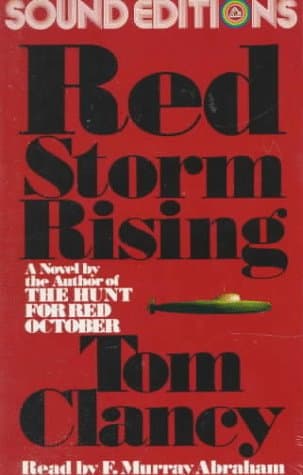
- Red Storm Rising
Tom Clancy
4.2 (70k) average on GoodreadsThrillerA large-scale, detailed military conflict novel, similar in scope and detail.
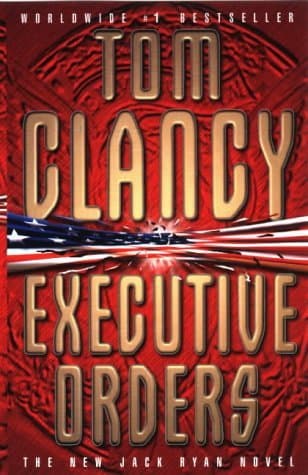
- Executive Orders
Tom Clancy
4.1 (46k) average on GoodreadsPoliticsFeatures Jack Ryan's presidency and the challenges of leading a nation through crisis.
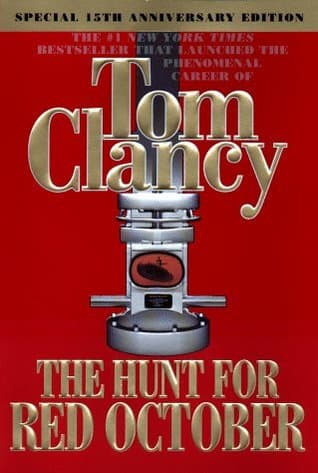
- The Hunt for Red October
Tom Clancy
4.1 (336k) average on GoodreadsThrillerWhile Debt of Honor features Clancy's signature technical detail, it lacks the tightly focused, submarine-centric tension of The Hunt for Red October. Red October benefits from a more contained plot and a clearer moral ambiguity surrounding Captain Ramius, making for a more sophisticated thriller in terms of character and narrative focus. Debt of Honor expands the scope significantly, sacrificing some of that focused intensity for a broader, more ambitious, but also more sprawling narrative.
- Angels & Demons
Dan Brown
3.9 (2.7M) average on GoodreadsThrillerA Harvard symbologist races through Rome's ancient sites, deciphering cryptic clues to unmask the Illuminati and stop a vengeful plot to destroy the Vatican with a stolen antimatter weapon.
- Gone Girl
Gillian Flynn
4.1 (2.3M) average on GoodreadsThrillerA wife's sudden disappearance on her fifth anniversary reveals a web of lies and psychological warfare, exposing the secrets within a seemingly perfect marriage.
- The Girl on the Train
Paula Hawkins
3.9 (2.1M) average on GoodreadsThrillerA woman’s fascination with a seemingly perfect couple she watches from her daily train commute leads her into a dark investigation when she witnesses something that shatters their idyllic image.



Enjoyed the summary?
A summary gives you the shape of the book. The book itself has the detail, the examples and the voice.
Find Debt of Honor on AmazonAs an Amazon Associate, BookBrief earns from qualifying purchases. How we're funded