

Estimated read time: 10 min read
One Sentence Summary
"Deconstruction in a Nutshell" presents Jacques Derrida's philosophy of deconstruction, exploring how meaning is always unstable and how texts endlessly defer definitive interpretation.
Table of Contents
Introduction
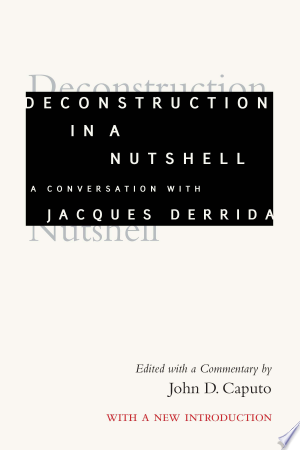
Imagine taking apart a watch—not to break it, but to understand every cog and spring, every hidden secret. That’s the spirit of "Deconstruction in a Nutshell: A Conversation with Jacques Derrida," a book that doesn’t just explain deconstruction but lets you feel its pulse. Edited by John D. Caputo, this book captures Derrida’s famously elusive thought in a way that’s accessible, engaging, and yes, even a little playful. For college students and lecturers, it’s a rare chance to see a philosophical heavyweight unpack his own ideas, live and unscripted.
Why does "deconstruction" matter? Because it’s more than a method—it’s a way of questioning everything, from texts to institutions, from language to law. Derrida’s work has rippled through literary studies, philosophy, theology, and even pop culture. This book, with its conversational style and sharp insights, is the perfect primer for anyone who’s ever wondered what all the fuss is about.
Historical Context
Deconstruction emerged in the tumultuous landscape of 20th-century French philosophy, a time of upheaval in politics, art, and thought. The post-World War II era saw intellectuals challenging traditional structures—of power, language, and meaning.
At the heart of this ferment was Jacques Derrida, born in colonial Algeria in 1930, who arrived in Paris just as existentialism and structuralism were shaking up the old guard. While existentialists wondered about meaning in a godless world, and structuralists mapped the rules behind language and culture, Derrida asked: What if those rules aren’t as stable as we think? His arrival on the scene in the late 1960s—alongside figures like Foucault, Lacan, and Barthes—sparked a revolution that changed the face of the humanities.
Deconstruction didn’t just critique literary texts; it challenged the very foundations of Western thought, from Plato to Saussure. By the 1990s, Derrida was a global academic celebrity, his dense, poetic style both celebrated and parodied. "Deconstruction in a Nutshell" distills decades of debate into a lively, digestible form, making Derrida’s ideas accessible just as they were entering mainstream academic (and even public) consciousness.
Brief Synopsis
Plot Overview
Unlike a traditional narrative, "Deconstruction in a Nutshell" is structured around a series of interviews, essays, and reflective commentaries. The book’s core is a lively dialogue between Derrida and John D. Caputo, with Derrida responding to questions about deconstruction, ethics, religion, and justice.
The book’s structure mirrors its subject: instead of a straight line, it’s a spiral, circling around key concepts and returning to them from different angles. The result is a text that’s both rigorous and refreshingly clear, making Derrida’s notoriously complex ideas approachable.
Setting
The "setting" of this book is intellectual—think seminar rooms, lecture halls, and late-night conversations. The dialogue takes place in the vibrant world of academic philosophy, where ideas are tested, teased, and turned inside out. The book also situates deconstruction within the broader debates of contemporary thought, referencing philosophy, literature, theology, and politics.
Main Characters
Here’s a handy table of the key players in "Deconstruction in a Nutshell":
| Name | Role | Key Traits | Importance to Plot |
|---|---|---|---|
| Jacques Derrida | Philosopher, Interviewee | Brilliant, elusive, witty, deeply ethical | Central figure, source of deconstruction’s insights |
| John D. Caputo | Philosopher, Interviewer | Thoughtful, clear, enthusiastic, interpretive | Makes Derrida accessible to readers |
| Deconstruction | Concept/Method | Questioning, playful, critical, open-ended | Subject and method of the book |
| Western Philosophy | Tradition/Context | Structured, binary, logocentric | The tradition Derrida critiques and reinterprets |
Plot Summary
The Arrival of Deconstruction
The book opens with Caputo’s introduction—an invitation to relax, breathe, and let Derrida’s ideas wash over you. Forget what you’ve heard about Derrida being impossible to read, Caputo says; just listen. Derrida himself then enters the conversation, explaining how deconstruction is not a destructive act, but a careful, loving interrogation of texts, traditions, and assumptions.
What is Deconstruction?
Derrida describes deconstruction as a way of revealing the hidden contradictions and tensions within texts. It’s about showing how meaning is never fixed, always deferred, always in play. For example, when we try to define a word, we inevitably rely on other words—which themselves need defining. Meaning is never complete; it’s always under construction.
Deconstruction and Ethics
The conversation turns to ethics. Derrida insists that deconstruction is not nihilistic; it doesn’t mean “anything goes.” Instead, it opens us to the other—to those voices and possibilities that our systems of meaning have excluded. Justice, for Derrida, is always “to come”—an ideal that can never be fully realized, but must always be pursued.
Deconstruction and Religion
Caputo and Derrida explore the religious dimensions of deconstruction. Derrida is fascinated by the concept of the “messianic”—the promise of something wholly new, beyond our current understanding. This isn’t about religion in the traditional sense, but about a kind of radical openness to the future.
The Double Session: Texts and Contexts
Throughout the book, Derrida emphasizes the importance of context. Words, he says, don’t have meaning in isolation; they get their sense from the web of relations in which they’re embedded. This leads to the famous concept of différance—a playful French word suggesting both difference and deferral. Meaning is always deferred, always just out of reach.
A (Non-)Conclusion
In keeping with his philosophy, Derrida refuses to offer a neat conclusion. Instead, he invites readers to participate in deconstruction: to question, to wonder, to keep the conversation going. The book ends not with a period, but with an ellipsis—the promise of more to come.
Themes and Motifs
Central Themes
| Theme | Description | Broader Significance |
|---|---|---|
| Undecidability | Meaning is never fixed; every decision involves risk and uncertainty. | Challenges certainty in knowledge. |
| Différance | Meaning arises through difference and deferral; it is never present in full. | Undermines binary thinking. |
| The Other | Deconstruction calls us to attend to what is excluded or marginalized. | Ethical openness and hospitality. |
| Justice | True justice is always “to come”—an impossible ideal that motivates ethical action. | Links deconstruction to activism. |
| Messianicity | Radical openness to the future, the coming of the new or unexpected. | Connects philosophy and religion. |
Motifs
- Playfulness: Derrida’s writing style is full of puns, jokes, and surprises. He wants readers to play with language, not just use it.
- Margins and Centers: Deconstruction pays attention to what’s on the margins—what’s left out or taken for granted.
- Hospitality: Welcoming the other, both in text and in life, is a recurring ethical motif.
Literary Techniques and Style
Narrative Structure
The book is a hybrid—part interview, part essay, part philosophical meditation. This mirrors Derrida’s method: instead of laying out a thesis, he circles around ideas, approaching them from multiple angles.
Symbolism and Wordplay
Derrida is famous for his inventive use of language. Words like différance don’t just mean something; they do something, disrupting our expectations. He often uses etymology, puns, and double meanings to show how language resists closure.
Realism and Irony
While Derrida’s ideas are abstract, they’re always grounded in real texts—Plato, Rousseau, Freud, and others. He reads closely, exposing the ironies and contradictions that run through the canon.
Style
Derrida’s style is famously difficult, but in this book, his warmth and humor shine through. Caputo’s questions help clarify complex points, making the conversation lively and accessible.
Author's Background
Jacques Derrida: Life and Influence
Born in 1930 in French Algeria, Derrida moved to Paris for his education, where he became a leading figure in philosophy and literary theory. His early work critiqued structuralism, and by the 1960s, he was at the forefront of what became known as post-structuralism.
Key Influences
- Heidegger: Questioning the metaphysics of presence.
- Saussure: The structure of language and meaning.
- Levinas: The ethics of the other.
Major Works
- Of Grammatology (1967)
- Writing and Difference (1967)
- Speech and Phenomena (1967)
Legacy
Derrida’s influence stretches across philosophy, literature, law, theology, and even architecture. His thought has inspired both passionate followers and fierce critics. Deconstruction has become a buzzword in popular culture, though often misunderstood. "Deconstruction in a Nutshell" is one of the best entry points for understanding what Derrida actually meant.
Key Takeaways
- Meaning is never fixed or final; every text contains contradictions and tensions.
- Deconstruction is not destruction; it’s a careful, ethical interrogation of texts and traditions.
- Justice and ethics are central: Deconstruction opens us to the excluded, the marginalized, the “other.”
- Language is slippery: Words gain meaning only through their differences from other words.
- Deconstruction is an ongoing process: There are no final answers, only more interesting questions.
- Deconstruction applies to more than texts: It’s a way of thinking about institutions, politics, law, and life.
Reader's Takeaway
"Deconstruction in a Nutshell" isn’t just for philosophy majors. It’s for anyone who’s ever questioned an assumption, wondered about the hidden biases in a story, or felt the thrill of discovering something unexpected between the lines. The book invites you to look more closely—not just at texts, but at the world around you. It’s a call to intellectual humility, curiosity, and hospitality.
On an emotional level, deconstruction can be unsettling—it shakes up your certainties and opens you to the unknown. But it’s also liberating. By showing that meaning is always in play, Derrida invites us to imagine new possibilities, to welcome the future, and to pursue justice even when it seems impossible.
Conclusion
"Deconstruction in a Nutshell" is a rare gem: a book that captures the spirit of one of the most influential thinkers of the 20th century in a form that’s readable, lively, and deeply thought-provoking. For college students, lecturers, or anyone curious about the big questions—What is meaning? What is justice? How should we live?—it’s an essential guide.
Derrida doesn’t give us easy answers. Instead, he gives us better questions. In a world that often demands certainty, "Deconstruction in a Nutshell" is a refreshing reminder that the richest insights often come from embracing complexity, ambiguity, and difference.
So, pick up the book. Let yourself be challenged—and inspired. The conversation is just beginning.
Ready to explore deconstruction’s deeper mysteries? "Deconstruction in a Nutshell" is your doorway to one of philosophy’s most fascinating conversations. Whether you’re writing a paper, leading a seminar, or just curious about what makes meaning tick, this book will help you see the world—and your own thinking—with new eyes.
Deconstruction in a Nutshell FAQ
What is 'Deconstruction in a Nutshell' about?
'Deconstruction in a Nutshell' is a collection of lectures and interviews by Jacques Derrida, edited by John D. Caputo. The book introduces Derrida's philosophical approach known as deconstruction, explaining its main concepts, implications, and relevance to philosophy, literature, and theology.
Who is Jacques Derrida?
Jacques Derrida was a French philosopher best known for developing the concept of deconstruction. His work has had a profound influence on philosophy, literary theory, and cultural studies.
What is deconstruction?
Deconstruction is a philosophical approach developed by Derrida that involves critically examining texts and ideas to reveal assumptions, contradictions, and ambiguities. It challenges the idea of fixed meaning and highlights the fluidity and complexity of language.
Is 'Deconstruction in a Nutshell' suitable for beginners?
Yes, the book is considered an accessible introduction to Derrida's ideas. John D. Caputo's editorial notes and commentary help clarify Derrida's sometimes dense and complex language, making it approachable for those new to deconstruction.
What are the main topics covered in the book?
The book covers the basics of deconstruction, Derrida's views on language and meaning, the 'gift,' hospitality, and the relationship between deconstruction and religion, particularly Christianity.
Does the book include interviews with Derrida?
Yes, the book features an extended interview with Derrida where he clarifies his ideas and responds to questions about deconstruction, making his philosophy more accessible.
How does this book relate to Derrida's other works?
'Deconstruction in a Nutshell' serves as an introduction and companion to Derrida’s more technical writings, such as 'Of Grammatology' and 'Writing and Difference.' It distills his key ideas in a concise and approachable format.
What is the significance of the 'nutshell' in the title?
The term 'nutshell' signifies that the book seeks to present Derrida's complex ideas in a condensed and simplified form, making them easier to understand for a wider audience.
Is prior knowledge of philosophy required to read this book?
While some background in philosophy is helpful, the book is designed to be accessible to readers without specialized training, thanks to Caputo's explanations and the clear structure of the text.
How can this book be useful for students or researchers?
'Deconstruction in a Nutshell' provides a clear overview of Derrida's thought and methodology, making it a valuable resource for students and researchers in philosophy, literary theory, theology, and related fields.