
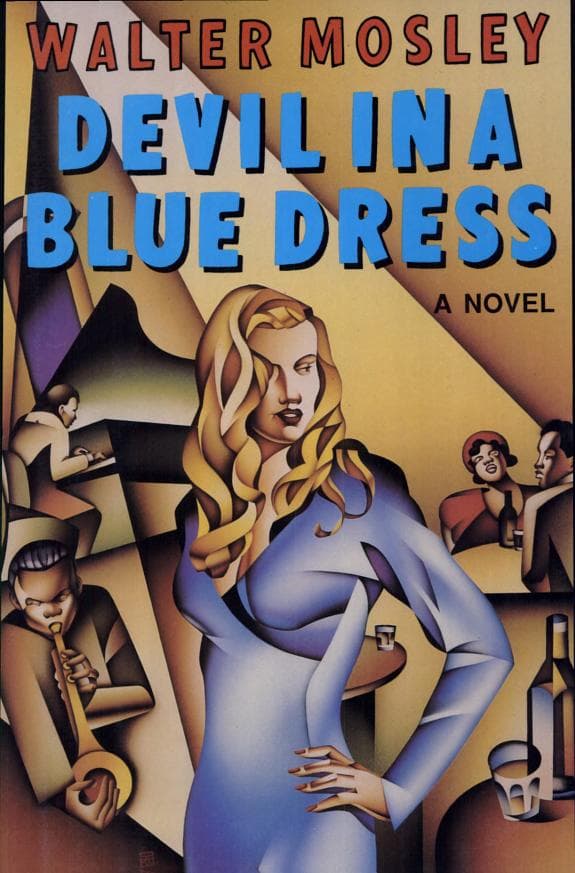
Synopsis
Covers the whole plot, including the ending.
- Difficulty
- Easy
- Pacing
- Moderate
- Mood
- Gritty, Suspenseful, Atmospheric, Reflective
- Read it if
- you enjoy hard-boiled detective novels with a strong sense of place, explore themes of race and class in post-WWII America, or appreciate a protagonist who is an outsider navigating a corrupt world.
- Skip it if
- you prefer fast-paced action thrillers, are sensitive to racial slurs and violence, or dislike morally ambiguous characters.
Devil in a Blue Dress Plot Summary
Covers the whole plot, including the ending.
The Pink Slip and the Proposition
Ezequiel 'Easy' Rawlins, a Black war veteran and homeowner in 1948 Los Angeles, loses his factory job, making it hard to pay his mortgage. At Joppy's bar, a friend introduces him to DeWitt Albright, a smooth but threatening white man. Albright offers Easy $100 to find Daphne Monet, a white woman known to visit Black jazz clubs on Central Avenue. Desperate for money, Easy accepts, even though he's wary of the dangers for a Black man in this part of white society.
First Steps and First Blood
Easy starts looking for Daphne Monet at clubs she supposedly frequents. His questions quickly draw unwanted attention from both Black and white people. He meets Coretta James, who says she knows Daphne, but their talk ends when two white men beat Easy and warn him to drop the case. Later, Easy finds Coretta murdered. He realizes he's in a more dangerous situation than just finding a missing woman. The police, especially Detective Mason, suspect Easy in Coretta's death.
Joppy's Betrayal and the Mayor's Son
Feeling the pressure, Easy confronts Joppy, who admits he connected Easy with Albright, but claims he didn't know how dangerous it was. Easy keeps investigating, learning that Daphne Monet was involved with Todd Carter, the son of a mayoral candidate, Matthew Teran. It becomes clear that Daphne's disappearance is linked to a larger political scandal. Easy finds a satchel in Coretta's apartment containing a large sum of money and a photo of Daphne and Todd Carter, connecting them to the missing funds.
Mouse Arrives and the Truth About Daphne
Overwhelmed, Easy calls his childhood friend Raymond 'Mouse' Alexander, a ruthless killer from Houston, for help. Mouse's arrival immediately intensifies things, but his brutal efficiency gives Easy protection and leverage. Mouse quickly gets information, revealing that Daphne Monet is a femme fatale with a past. They learn she is a light-skinned Black woman passing as white, a secret that could ruin Todd Carter's father's political ambitions if exposed.
The Confrontation with Albright
Easy and Mouse track down Albright, confronting him about his true intentions and his role in Coretta's murder. Albright tries to intimidate them, believing he's untouchable. However, Mouse's coldness and readiness to use violence put Albright on the defensive. In a tense standoff, Mouse shoots and kills Albright, removing a major threat but further entangling Easy in murder and cover-ups. Easy now knows he's directly involved in a killing.
The Search for Frank Green
With Albright dead, Easy and Mouse focus on finding Frank Green, another dangerous person connected to Daphne and the missing money. They learn Green is a former associate of Daphne's and has information that could expose the conspiracy. Their search leads them deeper into the criminal underworld, where they find more violence and deceit. Easy begins to understand the network of lies and betrayals surrounding Daphne Monet and the politicians involved.
Daphne's Revelation and the Money
Easy eventually finds Daphne Monet, who reveals her true identity and the full extent of the conspiracy. She confesses she stole money from Matthew Teran, the mayoral candidate, not just to disappear, but to expose his corrupt dealings and protect Todd Carter. The money was meant for illegal land deals and bribing officials. Daphne explains she was trying to escape a dangerous situation and that passing as white was a way to survive and escape her past.
Confronting the Powers That Be
Armed with the truth, Easy confronts Matthew Teran and his enforcers. He learns that Teran will do anything to protect his political career, including eliminating anyone who threatens his secrets. Easy, with Mouse's help, navigates a dangerous game, trying to protect Daphne and himself while exposing the corruption. The stakes are high, as Easy's life and the lives of those he cares about are at risk.
The Resolution and the Aftermath
The conspiracy ends violently. Easy exposes some of the truth and helps Daphne to some extent, but the resolution is not clean. More people die, and Easy makes difficult moral choices. The missing money is recovered, but its fate is unclear. Easy emerges changed, having seen the realities of power, race, and corruption in Los Angeles. He is a reluctant hero, scarred but wiser, and has a reputation as a man who gets things done in the shadows.
Easy's New Path
Afterward, Easy cannot return to his old life. The case has pushed him into a new role as an unofficial private investigator, a person the Black community turns to when official channels fail. He uses his wit, street smarts, and contacts to solve problems, often in a morally gray area. He longs for a simpler life but accepts his destiny, understanding his unique position lets him navigate Los Angeles's complex racial and social environment, protecting his community in ways others cannot.
Principal Figures
Ezequiel 'Easy' Rawlins
Protagonist
A reluctant detective and war veteran navigating 1940s Los Angeles.
Easy Rawlins is a Black homeowner and war veteran in post-WWII Los Angeles. He's intelligent, observant, and deeply rooted in his community, but also pragmatic and somewhat cynical. Initially seeking only to pay his mortgage, he is drawn into a dangerous world of crime and corruption. Easy possesses a strong moral compass but is willing to bend rules and make difficult choices to survive and protect those he cares about. He's a keen observer of human nature and the racial dynamics of his era, often using his perceived invisibility as a Black man to his advantage.
Relationships: Raymond 'Mouse' Alexander (Best friend/Enforcer); Daphne Monet (Client/Object of investigation/Brief romantic interest); Joppy (Acquaintance/Informant/Betrayer); Coretta James (Informant/Victim)
Raymond 'Mouse' Alexander
Supporting
Easy's unpredictable and violent childhood friend.
Mouse is Easy's childhood friend from Houston, a small, unassuming man with a chillingly calm demeanor and a propensity for extreme violence. He is fiercely loyal to Easy but operates by his own brutal code of ethics. Mouse is a pragmatic killer, utterly without remorse when it comes to dealing with threats. His presence provides Easy with much-needed protection and leverage in the dangerous world he finds himself in, though Easy often struggles with Mouse's methods. He represents the darker, more ruthless side of survival.
Relationships: Ezequiel 'Easy' Rawlins (Best friend/Partner in crime)
Daphne Monet
Supporting
The mysterious missing woman at the center of the conspiracy.
Daphne Monet is a beautiful, enigmatic woman of mixed race who passes as white. She is intelligent, manipulative, and driven by a desire for independence and justice, or perhaps just survival. Her allure is undeniable, and she uses it to her advantage. Daphne is at the heart of the political scandal, having stolen money and information from a powerful white mayoral candidate. She embodies the racial complexities and societal pressures of the era, forced to navigate a dangerous world by concealing her true identity.
Relationships: Ezequiel 'Easy' Rawlins (Object of investigation/Brief romantic interest); DeWitt Albright (Associate/Antagonist); Todd Carter (Lover/Complicated relationship); Matthew Teran (Antagonist/Target of theft)
DeWitt Albright
Antagonist
The smooth, menacing white man who hires Easy.
DeWitt Albright is a well-dressed, seemingly charming white man who is, in reality, a ruthless and dangerous operative. He initially hires Easy to find Daphne Monet, but his true intentions are far more sinister. Albright represents the corrupt white power structure that operates with impunity in 1940s Los Angeles. He views Easy and other Black individuals as expendable tools, underestimating Easy's intelligence and resourcefulness, a miscalculation that ultimately leads to his downfall. He is a key catalyst for Easy's involvement in the conspiracy.
Relationships: Ezequiel 'Easy' Rawlins (Employer/Antagonist); Daphne Monet (Associate/Target)
Joppy
Supporting
The bar owner who connects Easy to Albright.
Joppy is the owner of the local bar where Easy often drinks. He is a well-connected figure in the Black community, privy to various rumors and dealings. While seemingly friendly, Joppy is ultimately opportunistic and self-serving, willing to put Easy in danger for his own benefit. He initially introduces Easy to DeWitt Albright, setting the entire plot in motion. Joppy represents the morally ambiguous figures Easy encounters, individuals who are part of the community but also capable of betrayal.
Relationships: Ezequiel 'Easy' Rawlins (Acquaintance/Informant/Betrayer); DeWitt Albright (Associate)
Coretta James
Supporting
A woman connected to Daphne, whose murder deepens the mystery.
Coretta James is a lively and somewhat reckless woman who knows Daphne Monet and is involved in the fringes of the criminal underworld. Her brief encounter with Easy provides crucial information about Daphne's whereabouts and connections. Coretta's brutal murder quickly elevates the stakes of Easy's investigation, making him a potential suspect and forcing him to confront the deadly reality of the situation. Her death underscores the danger Easy is in and the disposable nature of certain lives in the eyes of the powerful.
Relationships: Ezequiel 'Easy' Rawlins (Informant); Daphne Monet (Acquaintance)
Matthew Teran
Antagonist
A powerful and corrupt mayoral candidate.
Matthew Teran is a prominent white mayoral candidate whose political aspirations are threatened by Daphne Monet's actions and the exposure of his corrupt dealings. He is a powerful figure, willing to use violence and intimidation to protect his public image and illegal schemes. Teran represents the entrenched corruption and racial hypocrisy within the Los Angeles political elite. His actions drive much of the conspiracy, and he is the ultimate target of Daphne's theft and Easy's investigation.
Relationships: Daphne Monet (Target of theft/Threat); Todd Carter (Son)
Todd Carter
Supporting
The son of Matthew Teran, romantically involved with Daphne.
Todd Carter is the son of the powerful mayoral candidate Matthew Teran. He is a troubled young white man who had a romantic relationship with Daphne Monet. His involvement with Daphne, particularly his discovery of her true racial identity and her subsequent theft of his father's money, complicates the political landscape. Todd is caught between his loyalty to his father and his feelings for Daphne, becoming a pawn in the larger power struggle. He represents the vulnerability of individuals caught in the crosshairs of powerful interests.
Relationships: Daphne Monet (Lover/Complicated relationship); Matthew Teran (Father)
Themes & Insights
Racial Identity and Passing
The novel explores racial identity, especially through Daphne Monet, a light-skinned Black woman who passes as white. This theme shows the societal pressures and dangers Black individuals faced in 1940s America, where passing offered some advantages but also the burden of a hidden identity and fear of exposure. Easy, as a Black man, constantly deals with racial prejudice and stereotypes, often using them to his benefit. Daphne's choices highlight the desperate measures some took to survive or escape their circumstances. The theme reveals the arbitrary and often brutal nature of racial classifications.
“It was a white man's world, and I was just a colored man in it. But I knew how to move in the shadows.”
Corruption and Power
Corruption is common in 'Devil in a Blue Dress,' from political power to street-level hustlers. The mayoral candidate, Matthew Teran, represents political corruption, using illegal land deals and violence to keep his power and image. DeWitt Albright and his associates are the enforcers of this corrupt system. Easy Rawlins constantly sees how power, especially white power, operates without consequences, often at the expense of marginalized communities. The novel exposes the moral decay beneath post-war Los Angeles's glamorous surface.
“Money was the root of all evil, and in Los Angeles, it had grown into a mighty oak.”
Justice vs. Law
The novel contrasts what is legally right with what is morally just. Easy Rawlins often acts outside the law to achieve some justice, especially when the official legal system is corrupt, ineffective, or biased against Black individuals. Mouse, with his brutal methods, further shows this theme, acting as a force of raw, violent justice. The police often seem uninterested in crimes against Black people or hostile towards Easy, forcing him to create his own moral code and justice in a world that denies it to him through official channels.
“When the law don't work for you, you gotta make your own.”
The American Dream Disillusioned
The American Dream is contrasted with the realities Easy Rawlins and his community face in post-WWII Los Angeles. While the city promises opportunity, Easy, despite being a veteran and homeowner, is laid off and struggles financially, showing the racial barriers to economic stability. Hollywood's glamour and the promise of prosperity hide a darker side of crime, racism, and political corruption. The novel suggests that for many, especially Black Americans, the American Dream is either out of reach or comes at a high moral cost.
“Los Angeles was a city of angels, they said, but most of them were fallen.”
Plot Devices & Literary Techniques
Femme Fatale
Daphne Monet as the alluring and dangerous woman.
Daphne Monet embodies the classic femme fatale, a beautiful and mysterious woman who lures the protagonist into a dangerous situation. Her allure is undeniable, and her motives are initially ambiguous, making Easy question her trustworthiness. She is a catalyst for the plot, drawing Easy deeper into the conspiracy with her charm and the secrets she holds. However, Mosley subverts the traditional trope by revealing Daphne's complex motivations, rooted in racial identity and survival, making her more than just a dangerous temptress but a product of her society.
The Reluctant Detective
Easy Rawlins, an ordinary man drawn into extraordinary circumstances.
Easy Rawlins is initially a reluctant detective, a regular man trying to pay his mortgage, not a seasoned investigator. He is drawn into the case out of financial desperation and a series of escalating circumstances. This device allows the reader to experience the dangerous underworld of Los Angeles through the eyes of an ordinary person, making the threats feel more immediate and the moral dilemmas more poignant. Easy's reluctance highlights his vulnerability and accentuates his growth into a capable, albeit unofficial, detective.
Racial Invisibility/Visibility
The strategic use of Easy's race in his investigation.
This device highlights how Easy's race simultaneously makes him 'invisible' and 'visible' in different contexts. As a Black man in a predominantly white power structure, he is often dismissed or underestimated, allowing him to gather information without drawing immediate suspicion from white antagonists. Conversely, his race makes him highly visible and vulnerable to police scrutiny or racial violence in other situations. Easy cleverly uses this duality, navigating the racial landscape to his advantage, demonstrating how systemic racism can inadvertently create unique opportunities for observation and action.
The Loyal Enforcer
Mouse Alexander as Easy's violent, but dependable, ally.
Mouse Alexander serves as the loyal enforcer, a common trope in hardboiled fiction, but with a unique racial and moral dimension. He is Easy's childhood friend and a man capable of extreme violence without hesitation. Mouse's presence offers Easy protection and a means to exert force when legal avenues are closed or dangerous. This device allows Easy to operate in a morally ambiguous world, using Mouse's brutality as a tool while maintaining his own moral center, albeit often strained. Mouse represents the raw, uncompromising survival instinct necessary in their world.
Devil in a Blue Dress Quotes
“I was a fool, and I was a coward, and I was a liar, and I was a cheat. But I was not a murderer.”
“Every man has a place in his life when he has to make a stand. And it is not always a place where he can win.”
“When you live in the shadows, you learn to see in the dark.”
“I had to get used to the idea that I was going to die. And I was going to die alone.”
“She was a woman of beauty and grace, but there was a darkness in her eyes that warned me to stay away.”
“The blues is a song of sorrow. But it's also a song of hope. It's a song of survival.”
“He was a man who had seen too much, and it had marked him.”
“Sometimes you have to get your hands dirty to come out clean.”
“You can't outrun your past. It always catches up with you.”
“She was a queen in her own kingdom, and I was just a peasant trying to survive in her court.”
“The city was a jungle, and I was just trying to find my way out of the trees.”
“He was a wolf in sheep's clothing, and I was a lamb led to the slaughter.”
“In this town, the truth was a slippery thing, always changing its shape.”
“I learned that day that the past is never dead. It's not even past.”
Quiz
10 questions on the plot and the characters. Each answer comes with a short explanation.
Question 1
What is the name of the protagonist in "Devil in a Blue Dress"?
- Easy Rawlins
- Mouse
- Deacon Muse
- Frankie "The Fixer" Smith
Show answer
A. Easy Rawlins Easy Rawlins is the central character and narrator of the novel.
Question 2
In what city is "Devil in a Blue Dress" primarily set?
- New York City
- Chicago
- Los Angeles
- New Orleans
Show answer
C. Los Angeles The novel is set in post-World War II Los Angeles, specifically in the Watts neighborhood.
Question 3
What is the initial reason Easy Rawlins is hired by the woman in the blue dress?
- To find a missing person
- To investigate a murder
- To recover stolen goods
- To deliver a secret message
Show answer
A. To find a missing person Easy is hired to find a white woman named Daphne Montgomery, who has disappeared.
Question 4
What is the significance of the "blue dress" in the title?
- It's the color of the detective's car
- It's the color of the missing woman's favorite outfit
- It refers to the dress worn by the woman who hires Easy
- It symbolizes the blues music prevalent in the era
Show answer
C. It refers to the dress worn by the woman who hires Easy The title refers to the striking blue dress worn by Coretta, the woman who initially hires Easy Rawlins.
Question 5
Which of these is NOT a theme explored in "Devil in a Blue Dress"?
- Racial tensions and discrimination
- The complexities of post-war American society
- The pursuit of the American Dream
- Interstellar travel and alien encounters
Show answer
D. Interstellar travel and alien encounters The novel focuses on realistic social and racial issues of the time, not science fiction elements.
Question 6
What is the primary occupation of Easy Rawlins at the beginning of the novel?
- Private Investigator
- Factory Worker
- Musician
- Politician
Show answer
B. Factory Worker Easy is unemployed and struggling to make ends meet after returning from World War II, working odd jobs before becoming involved in detective work.
Question 7
Who is Mouse Alexander, and what is his relationship with Easy?
- A corrupt police detective who is Easy's informant
- Easy's childhood friend, known for his criminal activities
- A rival private investigator
- A politician involved in the conspiracy
Show answer
B. Easy's childhood friend, known for his criminal activities Mouse is Easy's volatile and dangerous childhood friend, who often gets involved in the criminal underworld.
Question 8
The novel draws comparisons to Raymond Chandler for its 'hard-boiled poetry'. What is a characteristic of hard-boiled detective fiction?
- Focus on psychological introspection and emotional vulnerability
- Elaborate plot twists involving supernatural elements
- Cynical, tough, and often morally ambiguous protagonists navigating gritty urban settings
- Emphasis on romantic relationships and societal etiquette
Show answer
C. Cynical, tough, and often morally ambiguous protagonists navigating gritty urban settings Hard-boiled fiction typically features a tough, cynical detective operating in a corrupt urban environment, often dealing with violence and moral ambiguity.
Question 9
The description mentions "racial realism of Richard Wright." What does this suggest about the novel's portrayal of race?
- It idealizes race relations in post-war America
- It presents a nuanced and often harsh depiction of the Black experience and racial prejudice
- It avoids discussing race altogether to maintain neutrality
- It focuses exclusively on the positive achievements of the Black community
Show answer
B. It presents a nuanced and often harsh depiction of the Black experience and racial prejudice Referencing Richard Wright implies the novel grapples with the difficult realities of racism, discrimination, and the struggles faced by African Americans.
Question 10
What societal context is crucial for understanding the events and characters in "Devil in a Blue Dress"?
- The Roaring Twenties and Prohibition
- The Great Depression and the Dust Bowl
- Post-World War II America, including the Great Migration and burgeoning civil rights issues
- The Cold War and the McCarthy era
Show answer
C. Post-World War II America, including the Great Migration and burgeoning civil rights issues The novel is set in the late 1940s, a period marked by the return of soldiers from WWII, significant migration of Black Americans to cities like Los Angeles, and the early stirrings of the Civil Rights Movement, all of which influence the narrative.
Devil in a Blue Dress FAQ
What is Devil in a Blue Dress about?
Devil in a Blue Dress is a detective novel set in 1940s Los Angeles. It follows Easy Rawlins, a Black man struggling to find work, who gets drawn into a dangerous investigation involving a missing white woman.
Who is Easy Rawlins?
Easy Rawlins is the protagonist of the novel and a series of books by Walter Mosley. He is a Black World War II veteran trying to make a life for himself in post-war Los Angeles.
What is the setting of Devil in a Blue Dress?
The novel is set in Los Angeles during the 1940s, specifically in the Watts neighborhood. This setting is crucial to the story, highlighting the racial tensions and social dynamics of the time.
What makes Devil in a Blue Dress unique?
The book blends the hard-boiled detective style, reminiscent of Raymond Chandler, with a strong focus on racial realism and the Black experience in America, drawing comparisons to Richard Wright.
Is Devil in a Blue Dress part of a series?
Yes, Devil in a Blue Dress is the first novel in the Easy Rawlins series by Walter Mosley, which continues his adventures through various periods of Los Angeles history.
What are the main themes in Devil in a Blue Dress?
Key themes include racial prejudice, the challenges faced by Black veterans returning from war, corruption, and the search for identity and belonging in a discriminatory society.
How does Devil in a Blue Dress compare to other detective novels?
It stands out by offering a fresh perspective from a Black protagonist and by deeply exploring the social and racial landscape of its time, moving beyond typical hard-boiled tropes.
Is Devil in a Blue Dress a difficult read?
While it deals with complex social issues, Walter Mosley's writing is often described as accessible and engaging. The narrative flows well, making it a compelling read for fans of mystery and historical fiction.
What historical context is important for understanding Devil in a Blue Dress?
Understanding the post-World War II era in America, particularly the Great Migration of Black Americans to cities like Los Angeles and the pervasive racial segregation and discrimination they faced, enriches the reading experience.
Where can I find Devil in a Blue Dress?
Devil in a Blue Dress is widely available in bookstores, online retailers, and libraries. It has also been adapted into a popular film.
About the author

Walter Mosley is an American author known for his contributions to fiction, particularly in the mystery and crime genres. His notable works include "The Man in My Basement," which explores themes of identity and morality, and "Fortunate Son," a narrative that delves into race and class in America. Mosley's writing often reflects social issues and the complexities of the human experience.
Similar books
- The Big Sleep
Raymond Chandler
4.0 (126k) average on GoodreadsThrillerFeatures a classic hard-boiled detective navigating a complex web of crime and corruption in Los Angeles.
- One for the Money
Janet Evanovich
4.0 (483k) average on GoodreadsMysteryComparing "Devil in a Blue Dress" to Janet Evanovich's "One for the Money" highlights the vast tonal and thematic differences within the detective genre. Evanovich's Stephanie Plum series is characterized by its lighthearted, humorous tone, quirky characters, and often slapstick situations, with mysteries serving primarily as vehicles for comedic exploits. In contrast, Mosley's novel is serious, gritty, and deeply rooted in social realism. While both feature protagonists who are somewhat accidental detectives, Easy Rawlins's struggles are existential and driven by systemic oppression, whereas Stephanie Plum's are more often personal foibles and comedic incompetence. Mosley uses the genre to expose profound societal injustices, while Evanovich uses it for entertainment and escapism.
- Harry Potter and the Sorcerer's Stone
J.K. Rowling
4.5 (7M) average on GoodreadsFantasyRescued from a miserable life under the stairs, an orphaned boy discovers he's a wizard destined for a magical school, where he uncovers a dangerous secret tied to the dark wizard who murdered his parents.
- The Hunger Games
Suzanne Collins
4.3 (6.4M) average on GoodreadsFantasyIn a future where children fight to the death on live television, Katniss Everdeen volunteers for the arena, turning a death sentence into a fight for survival and a spark of rebellion.
- Nineteen Eighty-Four
George Orwell
4.2 (5.5M) average on GoodreadsFictionWinston Smith dreams of truth and rebellion in a world where Big Brother watches all, but he confronts the terrifying power of a regime that controls not just actions, but thoughts.
- Pride & Prejudice
Jane Austen
4.3 (4.9M) average on GoodreadsElizabeth Bennet and Mr. Darcy navigate love and misunderstanding, learning that first impressions can be wrong.





Enjoyed the summary?
A summary gives you the shape of the book. The book itself has the detail, the examples and the voice.
Find Devil in a Blue Dress on AmazonAs an Amazon Associate, BookBrief earns from qualifying purchases. How we're funded