
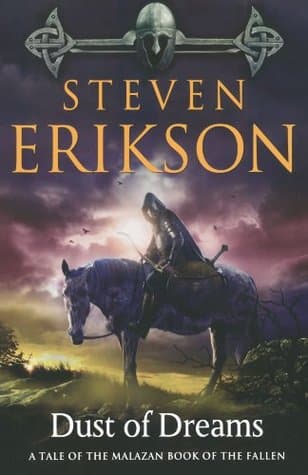
Synopsis
Covers the whole plot, including the ending.
- Difficulty
- Hard
- Pacing
- Slow
- Mood
- Dark, Epic, Philosophical, Grim, Despairing, Grand
- Read it if
- You crave an epic, complex fantasy with a massive cast, intricate world-building, and a focus on the grim realities of war and philosophical depth, even at the cost of immediate plot clarity.
- Skip it if
- You prefer fast-paced, character-driven narratives with clear protagonists and straightforward plots, or if you are easily daunted by extremely long books with challenging prose and a high demand for reader engagement.
Dust of Dreams Plot Summary
Covers the whole plot, including the ending.
The Bonehunters' March to the Wastelands
Adjunct Tavore Paran leads the Malazan Fourteenth Army, the Bonehunters, east into the vast Wastelands of Lether. Their march is marked by hardship and a feeling of pointlessness, as the soldiers do not know their destination or enemy. Squint, the sapper, deals with the weight of past wars and his squad's growing tiredness. Fiddler, the Bridgeburner Sergeant, keeps order and morale among his company. Bottle, the scout and mage, struggles with his growing powers and the dark signs he senses. The army's purpose remains a mystery, adding to the psychological strain of their journey.
Barghast's New Path and Tool's Burden
The Barghast, led by Hetan, are at a crossroads after their failed revenge against the Tiste Edur. Their traditions are challenged, and they must find new lands and enemies. Meanwhile, Onos Toolan, the T'lan Imass who chose mortality, struggles as commander of the White Face clan. His attempts to lead are met with resistance, especially from younger, more aggressive warriors. Toolan carries the burden of his past and responsibility for his clan's future, as old traditions clash with a changing world.
The Perish Grey Helms' Pilgrimage
The Perish Grey Helms, led by their High Chieftain, journey through the treacherous kingdom of Bolkando. Their mission is to meet the Malazan Bonehunters, to whom they have sworn loyalty. Their passage through Bolkando involves diplomatic challenges and the constant threat of betrayal from the court. The Grey Helms' vows and honor are tested by Bolkandan schemes and the land's dangers. Their loyalty to the Malazan cause drives them, despite mounting obstacles and losses.
The K'Chain Che'Malle and the Nah'ruk Threat
Ancient K'Chain Che'Malle face a threat from the Nah'ruk. The last K'Chain Che'Malle stronghold, a sky-keep, is under attack. In a desperate move, some of these Elder Races turn to humans for help, believing humanity holds a key to their future. K'Chain Che'Malle matriarchs and soldiers prepare for a final stand, using their advanced technology and ancient knowledge against the Nah'ruk. The fate of an entire race is at stake.
The Unwitnessed Stand
The Malazan Bonehunters, after many trials, are ready for one final stand. Their purpose, though mostly unknown to them, is framed as a quest for redemption. This upcoming battle raises questions about heroism and sacrifice. If their deeds are unwitnessed, can they still be considered heroic? This thought weighs on many soldiers, including Fiddler and Tavore, as they prepare for what they believe will be a catastrophic fight. The weight of their past and uncertain future affects the entire army.
The Deck of Dragons' Unveiling
The ancient Deck of Dragons is read, unleashing a power that no one fully understands. This reading starts a chain of catastrophic events, linking the fates of various groups across the continent. The consequences affect the Malazans, Barghast, Perish Grey Helms, and even the Elder Races. The mystical forces reshape the land and destinies, hinting at a cosmic struggle beyond mortal understanding. The world is on the edge of a transformation.
The Arrival of the Shake
Toc the Younger, now an ascendant and the Mortal Sword of the Shake, arrives in the Wastelands with his warriors. Their presence adds a new, mysterious element to the forces gathering in the region. Toc, having changed greatly, carries the burden of his past and his new responsibilities. The Shake, with their unique customs and connection to ancient powers, become an important, though unpredictable, factor in the conflict. Their loyalty and goals remain somewhat unclear, adding to the tension.
Whispers of the Forkrul Assail
Whispers and signs of the Forkrul Assail, an ancient and powerful Elder Race known for their strict justice, appear across the Wastelands. Their presence signals their upcoming involvement in the conflicts. The Forkrul Assail are powerful and seemingly unstoppable, their motives often unclear to mortals. Their arrival promises to escalate the war's scale and brutality, bringing a terrifying, uncompromising judgment. The various groups, especially the Malazans, become aware of this threat, understanding that their war is about to become far more complicated and deadly.
Internal Conflicts and Despair
As the Bonehunters continue their march, internal conflicts and despair begin to weaken morale. Many soldiers question the point of their journey and the sacrifices they make. Casualties from skirmishes, exhaustion, and the harsh environment increase the despondency. Officers like Stormy and Gesler struggle to maintain order and prevent mutiny. Tavore remains silent, adding to the army's uncertainty. The emotional and psychological toll on the Bonehunters is immense, showing the brutal realities of war where purpose is lost and suffering is constant.
Converging Destinies
All major groups—the Malazan Bonehunters, the Barghast, the Perish Grey Helms, the Shake, and the Elder Races—are drawn to a single confrontation in the desolate Wastelands. Their journeys, motives, and struggles converge, setting the stage for a monumental clash that will decide many fates. The ancient powers unleashed by the Deck of Dragons and the Forkrul Assail's arrival ensure this will be a battle of epic proportions, with consequences beyond any single army or race. Destinies intertwine, leading to a violent end.
Principal Figures
Adjunct Tavore Paran
Protagonist
The enigmatic commander of the Malazan Fourteenth Army.
Adjunct Tavore Paran is the stoic and enigmatic commander of the Malazan Fourteenth Army, the Bonehunters. Driven by a deep, unspoken purpose, she leads her army on a seemingly endless march into the Wastelands. Her motivations are shrouded in mystery, even to her closest subordinates, which often causes frustration and despair among her troops. Despite her perceived coldness, Tavore carries immense burdens and makes profound sacrifices for a cause she believes is vital for the world's survival. Her leadership is characterized by an unwavering resolve and a profound sense of duty, even when it means making unpopular decisions.
Relationships: Fiddler (subordinate, trusted sergeant); Bottle (subordinate, mage/scout); Ganoes Paran (brother (mentioned))
Fiddler
Supporting
A veteran Bridgeburner sergeant leading a Malazan squad.
Fiddler is a seasoned Malazan Bridgeburner sergeant, a veteran of countless brutal campaigns. He serves as a moral compass and a voice of reason within his squad, often struggling with the immense psychological toll of war. Despite his weariness, he maintains a strong sense of duty and loyalty to his comrades. Fiddler is a pragmatic and compassionate leader, deeply concerned for the well-being of his soldiers. He often reflects on the futility and horror of war, but continues to fight for the bonds he shares with his fellow Bonehunters. His quiet strength and empathy make him a beloved figure among the troops.
Relationships: Adjunct Tavore Paran (commander); Bottle (squadmate, friend); Gesler (fellow veteran, friend)
Bottle
Supporting
A Malazan scout and mage with growing, unsettling powers.
Bottle is a Malazan scout and mage whose powers are rapidly expanding and becoming increasingly unsettling. He possesses a unique connection to the spirit world and the land, allowing him to perceive hidden truths and communicate with animals. This connection often overwhelms him, making him a sensitive and somewhat withdrawn individual. Bottle struggles to control his abilities, which are both a gift and a curse, often leaving him vulnerable to dark influences and disturbing visions. He is a loyal member of Fiddler's squad, providing crucial intelligence and magical support, but his internal battles are a constant source of tension.
Relationships: Fiddler (squadmate, friend); Adjunct Tavore Paran (commander)
Onos Toolan
Supporting
A mortal T'lan Imass commander facing clan insurrection.
Onos Toolan is a former T'lan Imass, an ancient, immortal race, who chose mortality. He now commands the White Face clan of the Barghast, grappling with the challenges of mortal leadership and the insubordination of younger, more aggressive warriors. Toolan is burdened by the weight of his long past and the responsibilities of his present. He strives to guide his clan through a changing world, often clashing with their traditional, more violent ways. His internal struggle between ancient wisdom and mortal limitations defines his character, as he tries to find a new purpose in his chosen mortality.
Relationships: Hetan (Barghast leader, ally); Kallor (ancient enemy (mentioned))
Hetan
Supporting
A powerful Barghast leader seeking new direction for her people.
Hetan is a formidable and respected leader among the Barghast. After their failed vengeance against the Tiste Edur, she guides her people in search of a new purpose and new territories. Hetan embodies the strength and resilience of the Barghast, but also grapples with the need for change and adaptation in a world that is rapidly evolving. She is a pragmatic and courageous warrior, deeply devoted to her clan's survival and honor. Her leadership is crucial in navigating the political landscape and ensuring the Barghast find their place in the shifting power dynamics of the continent.
Relationships: Onos Toolan (ally, fellow leader)
Toc the Younger
Supporting
An ascendant and Mortal Sword of the Shake, navigating new powers and responsibilities.
Toc the Younger returns as an ascendant, having endured immense suffering and transformation. He is now the Mortal Sword of the Shake, a powerful and ancient people. Toc carries the weight of his past experiences and struggles to reconcile his former self with his new, powerful identity. He is a tragic figure, marked by loss and sacrifice, yet driven by a deep sense of duty and a desire to protect. His presence brings a unique perspective and formidable power to the unfolding conflicts, as he navigates the complex politics of the Elder Races and his own burgeoning abilities.
Relationships: Lady Envy (former companion (mentioned)); The Shake (leader)
K'Chain Che'Malle Matriarch
Supporting
The ancient leader of the last K'Chain Che'Malle bastion.
The K'Chain Che'Malle Matriarch is the ancient and wise leader of the last surviving bastion of her race, a formidable sky-keep. She embodies the collective knowledge and desperate hope of her people, facing an existential threat from the Nah'ruk. Her leadership is characterized by strategic brilliance and a fierce determination to ensure the survival of her kind, even if it means seeking alliances with unexpected allies like humans. She is a symbol of ancient power and fading glory, fighting a losing battle against overwhelming odds, yet never surrendering her resolve.
Relationships: The K'Chain Che'Malle (leader of her race)
Squint
Supporting
A cynical but loyal Malazan sapper.
Squint is a veteran Malazan sapper, known for his cynical wit and his expertise with explosives. He is deeply weary of war and its endless cycle of destruction, but his loyalty to his squad and the Bonehunters remains unwavering. Squint often expresses his despair through dark humor, using it as a coping mechanism for the horrors he has witnessed. Despite his outwardly gruff demeanor, he cares deeply for his comrades and is always ready to put himself in harm's way for them. His pragmatic approach to combat and his sardonic observations provide moments of grim levity.
Relationships: Fiddler (squadmate, friend); Gesler (fellow veteran, friend)
Themes & Insights
The Futility and Cost of War
This theme is central to 'Dust of Dreams,' exploring the physical and psychological toll war takes on soldiers and civilians. The Malazan Bonehunters' endless march into the Wastelands, without a clear goal, shows this futility. Characters like Fiddler and Squint constantly question their sacrifices, and the narrative highlights the despair and exhaustion within the army. The Barghast's struggles after their failed revenge also show how war often leaves participants with only loss and a search for new meaning. The book vividly portrays the destruction of lives and lands, emphasizing that even in victory, there is great loss.
“In war everyone loses. This brutal truth can be seen in the eyes of every soldier in every world…”
Redemption and Sacrifice
Despite the despair, redemption and the need for sacrifice are deep themes. Adjunct Tavore Paran's mission is ultimately a monumental act of sacrifice for the greater good, a desperate attempt to redeem humanity and the world. The Bonehunters, though unaware of the full scope, participate in this quest for redemption through their loyalty and willingness to face an unknown enemy. The Perish Grey Helms' loyalty to their vows, even through hardship, also speaks to this theme, as does the K'Chain Che'Malle Matriarch's desperate fight for her race. The book explores whether deeds are heroic when unwitnessed, suggesting that true sacrifice does not require recognition.
“And this last great army of the Malazan Empire is resolved to make one final defiant, heroic stand in the name of redemption.”
The Nature of Witnessing and Memory
A significant philosophical theme is the importance of witnessing and memory in defining heroism and historical truth. The narrative repeatedly asks: 'Can deeds be heroic when no one witnesses them? And can what is not witnessed forever change the world?' This challenges the usual understanding of heroism, suggesting that actions' impact may not need an audience or a chronicler. The Bonehunters' march into the desolate Wastelands, far from any civilization, directly addresses this idea. The book implies that even forgotten acts of bravery and sacrifice can profoundly shape the future, leaving a lasting mark, regardless of human memory.
“But can deeds be heroic when there is no one to witness them? And can that which is not witnessed forever change the world?”
Identity and Transformation
Many characters change greatly or deal with their changing identities. Onos Toolan, a T'lan Imass who chose mortality, struggles to lead his Barghast clan while balancing his ancient past with his current vulnerabilities. Toc the Younger's return as an ascendant and Mortal Sword of the Shake means a complete transformation, forcing him to adapt to new powers and responsibilities while carrying his past suffering. Even the Barghast people, led by Hetan, must redefine their identity and purpose after their traditional path of revenge is blocked. These individual and group journeys highlight the dynamic nature of self and constant adaptation in a changing world.
“Destines are rarely simple, truths never clear but one certainty is that time is on no one's side.”
Plot Devices & Literary Techniques
The March into the Wastelands
A symbolic and literal journey into the unknown.
The Malazan Fourteenth Army's relentless march into the vast, desolate eastern Wastelands serves as a central plot device. Literally, it isolates the army from known civilization and resources, intensifying their physical and psychological hardships. Symbolically, it represents a journey into the unknown, a quest for an unclear purpose, and a descent into the depths of despair and sacrifice. This setting amplifies the themes of futility, unwitnessed heroism, and the ultimate cost of war, as the barren landscape mirrors the emotional desolation of the soldiers. It also serves to converge all major plotlines and characters towards a single, isolated point of confrontation.
The Deck of Dragons
A powerful divinatory tool that unleashes cosmic forces.
The reading of the Deck of Dragons acts as a critical plot device, unleashing ancient and powerful forces that drive the narrative forward. While its specific revelations are often cryptic, its influence is profound, setting in motion a chain of events that intertwine the fates of mortals and ascendants alike. It signifies the involvement of cosmic powers and ancient entities in the unfolding conflicts, elevating the stakes beyond mere mortal warfare. The Deck's prophecies and pronouncements serve as harbingers of doom and catalysts for destiny, ensuring that the characters' actions are part of a much larger, predetermined, yet still malleable, cosmic game.
The Unseen Enemy/Unknown Cause
A source of existential dread and narrative tension.
The Malazan army's march towards an unknown enemy for an unknown cause is a pervasive plot device that generates significant narrative tension and psychological depth. This lack of clear objective fuels the soldiers' despair and questioning of their purpose, highlighting the theme of the futility of war. It forces the characters to rely on faith in their command, particularly Adjunct Tavore, and to find meaning in their bonds with each other rather than in an external goal. The slow reveal of the enemy and the true cause of the war builds suspense, transforming the conflict from a simple military campaign into a profound existential struggle.
The K'Chain Che'Malle Sky-Keep
A last bastion of an ancient race, symbolizing fading power and desperate survival.
The K'Chain Che'Malle sky-keep, under siege by the Nah'ruk, functions as a powerful plot device representing the fading power of ancient races and their desperate struggle for survival. It provides a focal point for the conflict between Elder Races and introduces the formidable Nah'ruk as a major threat. The sky-keep, with its advanced technology and ancient inhabitants, serves as a literal and symbolic anchor for the past, connecting the present conflicts to the deep history of the world. Its precarious existence highlights the themes of extinction, unexpected alliances, and the universal drive for preservation against overwhelming odds.
Dust of Dreams Quotes
“The past is a road, not a destination.”
“Hope is a coin. You can spend it for a season, or for a lifetime.”
“We are not the sum of our mistakes, but the sum of what we learned from them.”
“There is no justice in war. There is only the game.”
“The world is not always what it seems. Sometimes, it is more.”
“To forget is to forgive. To remember is to punish.”
“A hero is someone who has nothing to lose, but chooses to fight anyway.”
“The heart of darkness is not a place, but a choice.”
“Love is a wound. A beautiful, agonizing wound.”
“The true measure of a civilization is not its monuments, but its compassion.”
“Silence is not empty. It is full of answers.”
“Every step taken is a step closer to the end. Or a new beginning.”
“To suffer is to live. To live is to suffer. The two are intertwined.”
“There is no greater burden than a secret, unless it is a shared one.”
Quiz
10 questions on the plot and the characters. Each answer comes with a short explanation.
Question 1
Which Malazan commander leads the exiled Malazan army into the eastern Wastelands?
- Fiddler
- Kellanved
- Adjunct Tavore
- Dujek Sorkhan
Show answer
C. Adjunct Tavore The synopsis explicitly states that 'the exiled Malazan army commanded by Adjunct Tavore begins its march into the eastern Wastelands'.
Question 2
What is Onos Toolan's current status and role among the T'lan Imass?
- He is an immortal T'lan Imass chieftain of the Grey Helms.
- He is a mortal commander of the White Face clan, facing insurrection.
- He is a mortal commander of the Barghast, seeking vengeance.
- He is an immortal T'lan Imass leading the Perish into Bolkando.
Show answer
B. He is a mortal commander of the White Face clan, facing insurrection. The synopsis describes Onos Toolan as 'once immortal T'lan Imass now mortal commander of the White Face clan, faces insurrection'.
Question 3
What is the primary motivation of the Barghast in 'Dust of Dreams'?
- To join the Malazan army in their march.
- To find salvation among an Elder Race.
- To seek new enemies beyond the border after thwarted vengeance against the Tiste Edur.
- To parlay passage through the kingdom of Bolkando.
Show answer
C. To seek new enemies beyond the border after thwarted vengeance against the Tiste Edur. The synopsis states, 'The warlike Barghast, thwarted in their vengeance against the Tiste Edur, seek new enemies beyond the border'.
Question 4
What is the ultimate goal of the Perish Grey Helms, despite their arduous journey?
- To conquer the kingdom of Bolkando.
- To join the Barghast in their hunt for new enemies.
- To rendezvous with the Bonehunters and uphold their vow of allegiance to the Malazans.
- To find an ancient enclave of the K'Chain Che'Malle.
Show answer
C. To rendezvous with the Bonehunters and uphold their vow of allegiance to the Malazans. The text explains: 'Their intention is to rendezvous with the Bonehunters but their vow of allegiance to the Malazans will be sorely tested.'
Question 5
Where are the ancient enclaves of an Elder Race searching for salvation?
- Among their own kind, in a hidden bastion.
- Among humans, as an old enemy approaches the last K'Chain Che'Malle bastion.
- Within the eastern Wastelands, alongside Adjunct Tavore's army.
- In the treacherous kingdom of Bolkando.
Show answer
B. Among humans, as an old enemy approaches the last K'Chain Che'Malle bastion. The synopsis details that 'ancient enclaves of an Elder Race are in search of salvation--not among their own kind, but among humans--as an old enemy draws ever closer to the last surviving bastion of the K'Chain Che'Malle.'
Question 6
What overarching theme is introduced regarding the Malazan army's final stand?
- The certainty of victory through superior numbers.
- The question of heroism and impact when deeds are unwitnessed.
- The simplicity of destinies and clarity of truths.
- The power of the Deck of Dragons to ensure a swift resolution.
Show answer
B. The question of heroism and impact when deeds are unwitnessed. The text poses, 'But can deeds be heroic when there is no one to witness them? And can that which is not witnessed forever change the world?' highlighting the theme of unwitnessed heroism.
Question 7
What significant magical event has been 'read' and unleashed, impacting the narrative?
- The Book of the Fallen, revealing all future events.
- The K'Chain Che'Malle prophecies, predicting salvation.
- The Deck of Dragons, unleashing a dread power.
- The Barghast war chants, summoning ancient spirits.
Show answer
C. The Deck of Dragons, unleashing a dread power. The synopsis concludes with 'For the Deck of Dragons has been read, unleashing a dread power that none can comprehend…'
Question 8
What is the 'brutal truth' mentioned at the beginning of the synopsis that can be seen in the eyes of every soldier?
- That victory is always assured for the valiant.
- That in war, everyone loses.
- That destiny is simple and truths are clear.
- That courage alone is enough to change the world.
Show answer
B. That in war, everyone loses. The very first sentence of the synopsis establishes: 'In war everyone loses. This brutal truth can be seen in the eyes of every soldier in every world…'
Question 9
What is the state of the Malazan army's knowledge regarding their cause and enemy as they march into the Wastelands?
- They are fully aware of their cause and have faced this enemy before.
- They are fighting for an unknown cause against an enemy they have never seen.
- They know their cause but are surprised by the appearance of a new enemy.
- They are fighting for a known cause against a familiar enemy, but in a new location.
Show answer
B. They are fighting for an unknown cause against an enemy they have never seen. The text specifies the Malazan army is marching 'to fight for an unknown cause against an enemy it has never seen'.
Question 10
What is explicitly stated about the nature of destinies and truths in the narrative?
- Destinies are always simple, and truths are always clear.
- Destinies are rarely simple, truths never clear, and time is on no one's side.
- Destinies are complex, but truths are always revealed in the end.
- Destinies are predetermined, and truths are absolute.
Show answer
B. Destinies are rarely simple, truths never clear, and time is on no one's side. The synopsis states: 'Destines are rarely simple, truths never clear but one certainty is that time is on no one's side.'
Dust of Dreams FAQ
What is the primary objective of Adjunct Tavore's Malazan army at the beginning of 'Dust of Dreams'?
Adjunct Tavore's exiled Malazan army, known as the Bonehunters, begins a gruelling march into the eastern Wastelands. Their objective is an unknown cause, to fight an unseen enemy, driven by Tavore's enigmatic purpose to confront the Crippled God.
What is the current state and goal of the Barghast White Face clan, led by Onos Toolan?
The Barghast, having been thwarted in their vengeance against the Tiste Edur, are now seeking new enemies beyond their borders. Onos Toolan, a once immortal T'lan Imass now mortal, commands the White Face clan and faces significant internal insurrection and challenges to his authority.
Who are the Perish Grey Helms, and what is their intention regarding the Bonehunters?
The Perish Grey Helms are a southern army attempting to parlay passage through the treacherous kingdom of Bolkando. Their ultimate intention is to rendezvous with the Malazan Bonehunters, but their vow of allegiance is expected to be severely tested by the journey and unfolding events.
What role do ancient Elder Races play in 'Dust of Dreams', specifically the K'Chain Che'Malle?
Ancient enclaves of Elder Races, particularly the K'Chain Che'Malle, are in search of salvation, not from their own kind but from humans. This becomes crucial as an old, powerful enemy draws ever closer to the last surviving bastion of the K'Chain Che'Malle, the Sky Keep.
What is the significance of the Deck of Dragons being read at the novel's onset?
The reading of the Deck of Dragons at the beginning of 'Dust of Dreams' signifies the unleashing of a dread, incomprehensible power. This event sets the stage for the cataclysmic conflicts and world-altering events that will define the final two books of 'The Malazan Book of the Fallen'.
How does the notion of 'unwitnessed heroism' resonate through the narrative, particularly with the Malazan army?
The concept of 'unwitnessed heroism' is a central theme, questioning if deeds can be heroic without an audience and if unobserved actions can still change the world. This directly applies to the Malazan army's march into the desolate Wastelands, where their sacrifices may go unrecorded by history.
What hidden connection exists between the various converging armies and the ultimate goal of Tavore Paran?
While seemingly disparate, all the converging armies – the Bonehunters, Barghast, Perish Grey Helms, and even the K'Chain Che'Malle – are unknowingly or knowingly drawn into the orbit of Tavore Paran's ultimate goal: to confront and free the Crippled God. Their paths are converging towards a single, cataclysmic battlefield.
What is the underlying purpose of the Malazan Empire's 'last great army' in this book, beyond simple conquest?
The Malazan Empire's 'last great army' is resolved to make a final, defiant, heroic stand in the name of redemption, rather than conquest. Their purpose, guided by Tavore, is to address a cosmic injustice and bring an end to the suffering caused by the Crippled God, even if it means their own annihilation.
How does the psychological burden of being 'exiled' affect the Malazan Bonehunters?
The Malazan Bonehunters carry the profound psychological burden of being exiled, fighting for an unknown cause far from their homeland. This isolation fosters a deep sense of camaraderie and fatalism, as they believe they have been abandoned and are marching towards an inevitable, perhaps unwitnessed, end.
Explore the psychological impact of Onos Toolan's mortality on his leadership of the White Face clan.
Onos Toolan's transition from immortal T'lan Imass to mortal commander profoundly impacts his leadership. He grapples with newfound vulnerabilities, the fear of death, and the challenge of leading a people who once revered him as an immortal, now facing his human flaws and the potential for insurrection.
How does the concept of 'war everyone loses' manifest psychologically in the characters of 'Dust of Dreams'?
'The brutal truth that in war everyone loses' permeates the psychological landscape of the characters, especially the soldiers. It manifests as profound weariness, disillusionment, and a sense of futility, as they witness endless suffering and sacrifice with little hope of true victory or peace.
What is the psychological toll on characters who are aware of the 'Deck of Dragons' readings and the dread power unleashed?
Characters aware of the Deck of Dragons' readings and the unleashed dread power experience significant psychological toll, marked by anxiety, a sense of impending doom, and the weight of cosmic responsibility. They understand the stakes are higher than ever, leading to increased fatalism or desperate resolve.
Is Tavore's 'unknown cause' justifiable given the immense suffering and sacrifices of her army?
Whether Tavore's 'unknown cause' is justifiable is a major interpretive debate. While her ultimate goal is to free the Crippled God and prevent cosmic destruction, the immediate suffering and sacrifices of her army, who are kept in the dark, raise questions about the ethics of her leadership and the cost of such a grand, secretive mission.
How does the book challenge traditional notions of heroism and villainy, particularly with its focus on 'grey' morality?
'Dust of Dreams' deeply challenges traditional notions of heroism and villainy by presenting characters with complex motivations and forcing them into morally ambiguous situations. The 'grey' morality highlights that even those fighting for a 'good' cause commit terrible acts, and enemies may have understandable grievances, blurring clear distinctions.
What is the ultimate 'redemption' that the Malazan army seeks, and is it achievable?
The ultimate 'redemption' sought by the Malazan army, under Tavore's leadership, is cosmic: to right the ancient wrong done to the Crippled God and thus save the world from his lingering influence. Whether this redemption is truly achievable, or if it simply leads to a different form of sacrifice, remains a central question for the series' conclusion.
Discuss the significance of 'time being on no one's side' as a thematic element in the narrative.
The declaration that 'time is on no one's side' signifies the accelerating pace of cosmic events and the dwindling opportunities for resolution. It heightens the urgency of the various factions' quests and underscores the inevitability of the coming cataclysm, pushing characters to make desperate choices.
How does the isolation of the Wastelands contribute to the overall atmosphere and themes of the book?
The vast, desolate Wastelands contribute significantly to the book's atmosphere of isolation, futility, and existential dread. This harsh environment mirrors the internal struggles of the characters, emphasizing their detachment from civilization, the enormity of their task, and the potential for their efforts to be forgotten.
What is the implied fate of the Bonehunters if they succeed in their mission to free the Crippled God?
The implied fate of the Bonehunters, if they succeed in freeing the Crippled God, is likely their own destruction or profound transformation. Their mission is framed as a final, self-sacrificing act to rectify a cosmic imbalance, suggesting that their success might preclude their return to a normal existence or even life itself.
About the author

Steven Erikson is a Canadian author known for his epic fantasy series, "Malazan Book of the Fallen." His notable works include "Deadhouse Gates," "House of Chains," "Midnight Tides," "The Bonehunters," "Toll the Hounds," and "Dust of Dreams." Erikson's writing is characterized by its complex narratives and extensive world-building.
Similar books
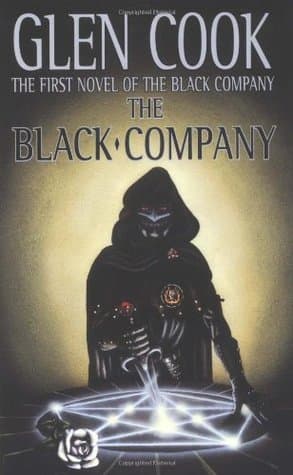
- The Black Company
Glen Cook
3.9 (42k) average on GoodreadsFantasyFeatures a similar grim, military fantasy aesthetic with morally ambiguous characters and a focus on the soldier's perspective.
- A Storm of Swords
George R.R. Martin
4.5 (666k) average on GoodreadsFantasyWhile both Dust of Dreams and A Storm of Swords are epic fantasy novels known for their large casts and grim portrayals of war, Erikson's work tends to be more philosophically dense and less focused on political intrigue and dynastic struggles. Martin's narrative is more character-centric in its immediate impact, often following POV characters through more conventional arcs of betrayal and triumph, whereas Erikson frequently uses his characters as conduits to explore broader sociological and historical themes. Erikson's prose is also often more abstract and poetic, compared to Martin's more direct and accessible style. Both share a willingness to kill off major characters, but Erikson's scope is arguably grander, encompassing ancient races and cosmic conflicts to a greater degree than Martin's more human-centric conflict.
- The Way of Kings
Brandon Sanderson
4.6 (305k) average on GoodreadsFantasyBrandon Sanderson's The Way of Kings also features an expansive world and multiple POV characters, but its narrative structure is generally more accessible and focused on character-driven arcs of heroism and self-discovery. Sanderson is known for his 'hard magic systems' and intricate plotting that often builds to satisfying, explosive conclusions, whereas Erikson's magic is more ethereal and his plot resolutions are often more ambiguous and melancholic. While both authors excel at world-building, Sanderson's approach is often more explicit and systematic, providing clear explanations for his world's mechanics, while Erikson prefers to reveal his world through immersion, leaving much to be inferred. The Way of Kings often has a more optimistic tone regarding the potential for heroes, contrasting with Dust of Dreams's often bleak and cynical view of heroism and empire.
- Harry Potter and the Sorcerer's Stone
J.K. Rowling
4.5 (7M) average on GoodreadsFantasyRescued from a miserable life under the stairs, an orphaned boy discovers he's a wizard destined for a magical school, where he uncovers a dangerous secret tied to the dark wizard who murdered his parents.
- The Hunger Games
Suzanne Collins
4.3 (6.4M) average on GoodreadsFantasyIn a future where children fight to the death on live television, Katniss Everdeen volunteers for the arena, turning a death sentence into a fight for survival and a spark of rebellion.
- 1984
George Orwell
4.2 (3.1M) average on GoodreadsPoliticsIn a future where surveillance and thought control are absolute, a man's search for truth clashes with the Party, showing that hope can be a form of rebellion.





Enjoyed the summary?
A summary gives you the shape of the book. The book itself has the detail, the examples and the voice.
Find Dust of Dreams on AmazonAs an Amazon Associate, BookBrief earns from qualifying purchases. How we're funded