
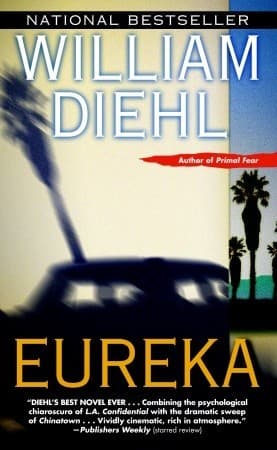
Synopsis
Covers the whole plot, including the ending.
- Difficulty
- Medium
- Pacing
- Variable
- Mood
- Gritty, Suspenseful, Atmospheric, Intriguing
- Read it if
- You enjoy historical thrillers with a strong sense of place, complex mysteries spanning decades, and political intrigue.
- Skip it if
- You prefer fast-paced, contemporary thrillers without extensive historical detail or a slower build-up.
Eureka Plot Summary
Covers the whole plot, including the ending.
The Mysterious Death of Verna Wilensky
In 1941 Los Angeles, detective Zeke Bannon is called to the apartment of Verna Wilensky, an ordinary woman found electrocuted in her bathtub. The initial assessment suggests an accident, but Bannon's observations lead him to question the scene. He finds a hidden bank account with nearly one hundred thousand dollars, a surprising sum for Wilensky. Further investigation reveals a long history of regular, large checks deposited into her account, all from a bank in San Pietro, a town once called Eureka. This financial detail, with the suspicious circumstances of her death, convinces Bannon that Verna's death was not accidental and points to a deeper secret.
The Eureka Connection and Sheriff Culhane
Zeke Bannon's search for the source of Verna Wilensky's money leads him to San Pietro, the modern city that was once the bootlegging town of Eureka. There, he meets Sheriff Thomas Culhane, a charismatic figure campaigning for governor. Culhane, a World War I veteran, presents himself as a champion of law and order, credited with transforming Eureka's past into San Pietro's respectable present. Bannon senses a hidden tension beneath Culhane's polished appearance, especially as the sheriff shows little interest in Bannon's questions about old Eureka and Wilensky's funds.
Flashback to Lawless Eureka (1920s)
The story goes back two decades to the Prohibition era, showing the true nature of Eureka, a remote town built on illegal alcohol. Young Thomas Culhane, a resourceful youth, returns from World War I to find his hometown controlled by ruthless bootleggers. He quickly becomes involved in the town's criminal world, navigating the dangerous environment ruled by figures like Johnny 'The Frog' Frogharty. This period establishes Culhane's early life, his struggles, and the moral compromises he made to survive and succeed where corruption was the only rule.
The Bootlegger Wars and the Speakeasy
In 1920s Eureka, Thomas Culhane becomes more involved in bootlegging. He sees firsthand the brutal turf wars between Johnny Frogharty's gang and rivals fighting for control of the alcohol trade. Culhane's intelligence, bravery, and willingness to get involved quickly make him a valuable, though unwilling, participant. He is often at the center of the town's speakeasies and distilleries, where deals are made and violence often breaks out. These experiences shape his character, hardening him to the realities of power and survival in a morally complex world.
The Birth of a Secret Partnership
Amid Eureka's violence, Thomas Culhane, along with several key figures, including Verna Wilensky, forms a secret partnership. This alliance, based on a shared desire for wealth and control, involves a sophisticated bootlegging operation that generates huge profits. Verna Wilensky, initially a minor figure, plays a role in handling finances and maintaining secrecy. The group establishes a system of regular payouts, explaining the consistent checks found in Wilensky's bank account years later. This secret pact becomes the foundation of their future fortunes and a dangerous secret that binds them.
The Great Eureka Shootout
The growing tensions in Eureka lead to a massive, brutal shootout between rival bootlegging gangs and, eventually, corrupt law enforcement. This event is a bloodbath that leaves many dead and changes the town's power dynamics. Thomas Culhane, caught in the crossfire, shows remarkable courage and strategic thinking, securing his position and his group's survival. The shootout effectively removes many of Eureka's most obvious criminal elements, creating a void that Culhane and his partners are ready to fill. It marks the end of Eureka's most lawless period and the start of its transformation into San Pietro.
The Cover-Up and the New Order
After the devastating shootout, Thomas Culhane and his partners orchestrate a careful cover-up, removing witnesses, fabricating evidence, and manipulating the story to present the event as a necessary cleansing of Eureka's criminal element. They use their new power to establish a new order, transforming Eureka into San Pietro, a town that appears respectable. Culhane, having played a key role in 'pacifying' the town, strategically positions himself within the emerging legitimate power structure, preparing for his political ambitions. The secret of the shootout and the true source of their wealth is buried deep, known only to the surviving conspirators.
Bannon Unearths the Past
Back in 1941, Zeke Bannon, undeterred by the lack of cooperation from San Pietro authorities and the resistance from Thomas Culhane's associates, continues to dig. He interviews old residents, sifts through archives, and cross-references information, gradually piecing together Eureka's violent history. He connects the names of the original conspirators to the present, realizing that Verna Wilensky was not just a recipient of money, but an important part of the original scheme. Bannon begins to understand the immense power of Culhane and his allies, and how far they would go to protect their legacies.
The Threat to Culhane's Ambition
As Zeke Bannon gets closer to the truth, his investigation becomes a direct threat to Thomas Culhane's political career. Culhane, about to become California's next governor, cannot afford any scandal or revelation of his criminal past. Exposing the Eureka shootout, the illegal origins of his wealth, and his involvement in Verna Wilensky's death would destroy his image. Culhane and his remaining partners become desperate to silence Bannon, using intimidation and threats to deter him, making it clear the stakes are high.
Confrontation and Revelation
Zeke Bannon, with strong evidence and an understanding of the Eureka conspiracy, finally confronts Thomas Culhane. The confrontation is tense, a battle between the relentless detective and the powerful politician. Culhane, cornered, admits to parts of his past, revealing the full scope of the bootlegging operation, the brutal shootout, and the cover-up. The revelation exposes the moral compromises and criminal acts that led to Culhane's rise, shattering his respectable persona and threatening to unravel his legacy.
The Unveiling of Verna's Murder
During the confrontation, the truth behind Verna Wilensky's murder is revealed. Verna, a key, though silent, partner in the original Eureka scheme, had become a risk. With Culhane's political ambitions growing, her continued existence and the knowledge she possessed posed too great a threat. Her death was not an accident, but a calculated murder orchestrated by one of the remaining conspirators, or perhaps by Culhane himself, to ensure Eureka's secrets remained buried. The details reveal a cold decision to eliminate anyone who could threaten their empire.
Justice and Consequences
The revelations from Zeke Bannon's investigation have significant consequences. Thomas Culhane's gubernatorial campaign is damaged, and his reputation is shattered. While the full legal outcomes may vary, his political career is effectively over, and San Pietro's carefully constructed facade is exposed. The truth about Eureka's past and the dark origins of power in California are unveiled, forcing a reckoning with the state's history. Bannon, having risked his career and life, achieves justice, ensuring the truth is no longer buried.
Eureka Characters
Zeke Bannon
Protagonist
A meticulous and tenacious Los Angeles police detective.
Zeke Bannon is a sharp, observant, and dedicated detective in Los Angeles. He possesses an innate curiosity and a refusal to accept easy answers, which drives him to dig deeper into the seemingly accidental death of Verna Wilensky. Bannon is methodical, intelligent, and morally driven, often finding himself at odds with superiors and powerful figures who prefer to sweep inconvenient truths under the rug. He is a man of integrity, committed to justice regardless of the personal cost or the influence of those he investigates.
Thomas Culhane
Antagonist/Complex Protagonist
A charismatic, ambitious sheriff with a dark, criminal past.
Thomas Culhane is a complex and formidable figure. Starting as a young, resourceful man in the lawless town of Eureka, he rises through the ranks of the criminal underworld and then transitions to a respected public servant, becoming Sheriff of San Pietro and campaigning for governor. He is charismatic, intelligent, and ruthlessly ambitious, capable of both great courage and profound moral compromise. Culhane is driven by a desire for power, respectability, and to leave his impoverished past behind, even if it means burying secrets and eliminating threats.
Relationships: Verna Wilensky (Criminal partner, later a liability); Johnny Frogharty (Criminal rival/associate in Eureka); Zeke Bannon (Investigator and adversary)
Verna Wilensky
Supporting/Victim
The victim whose mysterious death unravels a decades-old conspiracy.
Verna Wilensky is initially presented as an unassuming, lower-middle-class woman whose electrocution appears to be a tragic accident. However, her hidden bank account and the consistent, large deposits reveal her deeper connection to the past. Verna was a key, albeit quiet, partner in the original Eureka bootlegging operation, likely handling financial aspects or maintaining secrecy. Her character embodies the lingering shadows of the past, as her death acts as the catalyst for Zeke Bannon's investigation, exposing the secrets she helped keep for decades.
Relationships: Thomas Culhane (Criminal partner); Zeke Bannon (The detective investigating her death)
Johnny 'The Frog' Frogharty
Supporting/Antagonist (past)
A ruthless bootlegger and gangster in Prohibition-era Eureka.
Johnny 'The Frog' Frogharty is a violent and dominant figure in the lawless Eureka of the 1920s. He is a quintessential gangster, controlling a significant portion of the town's illicit alcohol trade through intimidation, brutality, and murder. Frogharty represents the raw, unbridled criminality that defined Eureka before its transformation. His interactions with young Thomas Culhane highlight the dangerous environment Culhane navigated and the moral compromises required to survive and gain power in that era.
Relationships: Thomas Culhane (Rival/associate in the criminal underworld)
Captain Miller
Supporting
Zeke Bannon's pragmatic superior officer.
Captain Miller is Zeke Bannon's superior in the LAPD. He is a more pragmatic and politically aware officer, often urging Bannon to be careful and not stir up trouble with powerful figures. While he respects Bannon's abilities, he is also concerned with maintaining order and avoiding political fallout. Miller represents the institutional resistance Bannon faces, highlighting the difficulty of pursuing justice when it clashes with established power structures.
Relationships: Zeke Bannon (Superior officer)
Various Conspirators (Unnamed/Minor)
Mentioned/Supporting
The other individuals involved in the original Eureka bootlegging scheme and cover-up.
These are the shadowy figures who, alongside Thomas Culhane and Verna Wilensky, were integral to the original bootlegging empire in Eureka and the subsequent cover-up. Their exact identities and roles may vary, but they represent the collective force that helped establish the new order in San Pietro and protect the secrets of their past. They act as a collective antagonist, supporting Culhane and actively working to thwart Bannon's investigation to protect their own interests and legacies.
Relationships: Thomas Culhane (Criminal partners/allies)
Eureka Themes
The Corrosive Nature of Secrets
The novel shows how long-buried secrets, especially those involving violence and illegal gain, eventually resurface with destructive results. The central secret of Eureka—the violent origins of San Pietro's wealth and Thomas Culhane's power—haunts the present. Verna Wilensky's murder happens because of the fear these secrets might be exposed, and Zeke Bannon's investigation uncovers them. The theme suggests that while secrets can build empires, they also carry the seeds of their own destruction, ultimately harming reputations and lives.
“Some truths are buried so deep, they almost become part of the earth itself. But even the earth shifts.”
The Illusion of Respectability
William Diehl skillfully contrasts the polished appearance of San Pietro and Sheriff Thomas Culhane's gubernatorial campaign with the brutal reality of Eureka's past. The theme highlights how individuals and communities can create elaborate illusions of legitimacy to hide their dark beginnings. Culhane's transformation from a bootlegger to a revered public figure is a prime example, showing how far people will go to sanitize their pasts. Bannon's investigation systematically dismantles this illusion, revealing the moral compromises and criminal acts that support the current 'respectable' order.
“San Pietro was built on gold, but the foundation was laid in blood and whiskey.”
Justice vs. Power
A central conflict of the novel is the struggle between an individual's pursuit of justice and the overwhelming force of established power. Zeke Bannon, a lone detective, stands against the immense political and social power of Thomas Culhane and his allies, who represent the entrenched interests of a powerful state. The theme explores the challenges and dangers of seeking truth when it threatens those in authority, suggesting that power often tries to suppress justice. Bannon's persistence in the face of intimidation underscores the moral need to pursue justice, even when the odds are against it.
“Truth has a way of finding its own path, no matter how many walls you build around it.”
The Weight of the Past
The novel consistently shows how past events, particularly the violent and corrupt Prohibition-era Eureka, influence the present. The characters, especially Thomas Culhane, are defined by their past actions and the secrets they carry. Verna Wilensky's death is a direct result of a decision made decades earlier. The narrative structure, moving between 1941 and the 1920s, clearly illustrates this connection, showing how history is not just a bygone era but a living force that shapes destinies and demands accountability. The story argues that one cannot truly escape their origins.
“The past isn't dead. It's not even past.”
Plot Devices & Literary Techniques
Dual Timeline Narrative
Alternating between 1941 and the 1920s.
The novel employs a dual timeline, seamlessly shifting between Zeke Bannon's 1941 investigation into Verna Wilensky's death and flashbacks to Thomas Culhane's early life in Prohibition-era Eureka. This device is crucial for gradually revealing the layers of the conspiracy. The past timeline provides context and explanation for the present-day mysteries, creating a sense of suspense as the reader pieces together how the two eras connect. It allows Diehl to build character depth for Culhane and illustrate the origins of San Pietro's hidden corruption.
The Unreliable Narrative of History
The discrepancy between official history and the hidden truth.
This device highlights how historical events can be deliberately manipulated and rewritten by those in power. The official narrative of Eureka's transformation into San Pietro, spearheaded by Thomas Culhane, is one of progress and cleansing. However, Bannon's investigation uncovers the violent, criminal truth beneath this polished version. The novel demonstrates how history is often told by the victors, and how individuals like Culhane actively shape public perception to serve their own interests, creating a false historical record that must be deconstructed.
The Catalyst of the Unassuming Victim
A seemingly insignificant death triggers a profound investigation.
Verna Wilensky, an ordinary woman living a quiet life, serves as the perfect catalyst. Her seemingly accidental death, combined with the unexpected discovery of her hidden wealth, provides the initial spark for Zeke Bannon's investigation. Had she been a more prominent figure, her death might have been handled differently or quickly covered up. Her unassuming nature allows the true depth of the conspiracy to be uncovered gradually, as no one initially suspects her connection to such powerful secrets, making her a potent, if unwitting, key to unlocking the past.
The Charismatic Antagonist
A villain whose public persona belies his true nature.
Thomas Culhane functions as a charismatic antagonist, a figure who is outwardly admirable and respected, making his true nature all the more shocking. His public image as a war hero, a strong leader, and a gubernatorial candidate stands in stark contrast to his past as a ruthless bootlegger and his willingness to commit murder to protect his secrets. This device creates strong tension and moral ambiguity, as the reader grapples with how such a figure could rise to power and maintain widespread public support despite his dark origins.
Eureka Quotes
“The past is never dead. It's not even past.”
“There are no secrets that time does not reveal.”
“Fear is a powerful motivator, but hope is the one that truly endures.”
“Sometimes the greatest treasures are found not in gold, but in the truth.”
“Every man has his price, but some prices are higher than others.”
“The line between genius and madness is often blurred, especially when obsession takes hold.”
“History is written by the victors, but the truth is often whispered by the vanquished.”
“Even in the darkest times, there is always a flicker of light, if you know where to look.”
“Justice is not always swift, but it is relentless.”
“The most dangerous lies are the ones we tell ourselves.”
“A man's true character is revealed not in moments of comfort, but in moments of crisis.”
“The past is a labyrinth, and without a thread, you are doomed to wander lost.”
“Sometimes, the greatest discoveries are made by accident, by those not even looking for them.”
“Power corrupts, and absolute power corrupts absolutely. But desperation... desperation can turn saints into devils.”
Quiz
10 questions on the plot and the characters. Each answer comes with a short explanation.
Question 1
What is the primary setting for the initial investigation of Verna Wilensky's death?
- San Pietro, California
- One hundred miles north of Los Angeles
- New York City
- A deceptively peaceful area north of Los Angeles
Show answer
D. A deceptively peaceful area north of Los Angeles The book description states that the seamy past of America’s most glamorous state lies in this deceptively peaceful area, one hundred miles north of Los Angeles, where Zeke Bannon investigates a death.
Question 2
Who is the police detective investigating Verna Wilensky's death?
- Thomas Culhane
- Zeke Bannon
- William Diehl
- Verna Wilensky
Show answer
B. Zeke Bannon The synopsis clearly states that police detective Zeke Bannon investigates a death that seems a sad accident.
Question 3
What is the suspicious circumstance surrounding Verna Wilensky's death?
- She was found with a large amount of gold.
- She had a mysterious bank account with almost a hundred thousand dollars.
- She was a known bootlegger in Eureka.
- She had just inherited a large sum of money.
Show answer
B. She had a mysterious bank account with almost a hundred thousand dollars. Verna Wilensky was electrocuted in her bathtub, leaving a lower-middle-class life and a bank account packed with almost a hundred thousand dollars, which is highly suspicious given her background.
Question 4
What was the previous reputation of the town now known as San Pietro?
- A quiet farming community
- A bootlegger’s paradise and a gangster’s dream
- A hub for technological innovation
- A prestigious academic center
Show answer
B. A bootlegger’s paradise and a gangster’s dream The text explicitly states: 'Eureka was a town that used to be a bootlegger’s paradise and a gangster’s dream. Now it is the rebuilt metropolis where Sheriff Thomas Culhane is launching a bid to be the golden state’s next governor.'
Question 5
What is Sheriff Thomas Culhane's current political ambition?
- To become the mayor of San Pietro
- To be the next governor of California
- To run for president of the United States
- To return to fighting in World War I
Show answer
B. To be the next governor of California The description mentions: 'Now it is the rebuilt metropolis where Sheriff Thomas Culhane is launching a bid to be the golden state’s next governor.'
Question 6
How long have mysterious checks been consistently coming to Verna Wilensky?
- For a few months
- For over twenty years
- Since World War I
- Since she moved to California
Show answer
B. For over twenty years The text states: 'Mysterious checks have consistently come to her for more than twenty years, most drawn from a bank in San Pietro, a town once known as Eureka.'
Question 7
What historical period is the novel primarily set in, regarding the investigation?
- The Roaring Twenties
- The present day
- 1941
- The post-World War I era
Show answer
C. 1941 The synopsis clearly states, 'The year is 1941. Verna Wilensky has been electrocuted in her bathtub...'
Question 8
What is the central theme connecting the past and present in the novel?
- The rise of Hollywood stardom
- A decades-old secret involving a shootout and a bloodbath
- The challenges of post-war economic recovery
- The development of new criminal investigation techniques
Show answer
B. A decades-old secret involving a shootout and a bloodbath The description highlights: 'As Bannon digs deeper into Wilensky’s demise, he unearths a decades-old secret that starts in a shootout, builds to a bloodbath, and could end up within the upper echelons of California’s elite...'
Question 9
How did Thomas Culhane's past in Eureka relate to his service in World War I?
- He established a bootlegging operation during the war.
- He escaped the lawless place of Eureka to fight in the war.
- He was recruited for the war by gangsters from Eureka.
- He returned to Eureka immediately after the war to become sheriff.
Show answer
B. He escaped the lawless place of Eureka to fight in the war. The text states: 'It was the lawless place from which young, rugged Thomas Culhane escaped to fight World War I.'
Question 10
What is the potential impact of Zeke Bannon's investigation on California's future?
- It could lead to the discovery of a new gold mine.
- It could forever change the destiny of the state.
- It might expose a network of current bootleggers.
- It will likely result in Thomas Culhane's guaranteed election.
Show answer
B. It could forever change the destiny of the state. The synopsis concludes by stating that the unearthed secret 'could end up within the upper echelons of California’s elite, forever changing the destiny of a state.'
Eureka FAQ
What is the central mystery that Detective Zeke Bannon investigates at the beginning of the novel?
Zeke Bannon investigates the apparent accidental electrocution of Verna Wilensky in her bathtub in 1941. The mystery deepens when Bannon discovers her modest life contrasts sharply with a bank account containing nearly a hundred thousand dollars, accumulated through mysterious checks over two decades.
Who is Thomas Culhane and what is his role in the story's present-day narrative?
Thomas Culhane is the Sheriff of San Pietro (formerly Eureka) in 1941 and is actively campaigning for the governorship of California. His past in the lawless town of Eureka, from which he escaped to fight in World War I, becomes critically relevant as Bannon's investigation unearths a decades-old secret connected to that era and place.
What is the significance of the town name 'Eureka' and 'San Pietro' in the novel?
Eureka was the original name of the town, known as a haven for bootleggers and gangsters in the past. It was later rebuilt and renamed San Pietro, where Thomas Culhane serves as Sheriff. The change in name symbolizes an attempt to bury a violent, lawless past, which Bannon's investigation threatens to expose.
How does the past of Eureka connect to the present-day investigation?
The mysterious checks received by Verna Wilensky for twenty years were drawn from a bank in San Pietro, formerly Eureka. This financial trail directly links Wilensky's death to the town's lawless past, specifically to events that occurred when it was a hotbed for organized crime and corruption, implicating figures who are now part of California's elite.
What kind of historical context does the novel provide?
The novel is set against the backdrop of 1941, just before America's entry into World War II, and delves into the Prohibition era and its aftermath in California. It richly details the lawlessness, bootlegging, and gangster activities prevalent in specific regions, showcasing how these historical events shaped characters and their ambitions.
What specific event in Eureka's past is central to the secret Bannon unearths?
Bannon unearths a decades-old secret that began with a shootout and escalated into a bloodbath in Eureka's past. This violent event likely involved key figures, including Thomas Culhane, and was instrumental in shaping the fortunes and secrets of those who survived and prospered.
What is the implied connection between Verna Wilensky and the powerful figures in California?
Verna Wilensky, despite her lower-middle-class life, possessed a large sum of money from checks spanning two decades. This strongly implies she was either being paid off for her silence regarding a past crime, or she held information that powerful figures, potentially including Thomas Culhane, wished to keep buried, making her death suspicious.
How does Thomas Culhane's past as a young, rugged man who escaped Eureka foreshadow his potential involvement?
Culhane's past as someone who 'escaped' the lawless Eureka suggests he was intimately familiar with its illicit activities, and perhaps a participant. His subsequent rise to Sheriff and gubernatorial candidate indicates a successful, yet potentially compromised, reinvention, making him a prime candidate for having secrets tied to the town's violent history.
What role does the 'golden state's next governor' ambition play in concealing the truth?
Thomas Culhane's ambition to become governor provides a powerful motive to suppress any scandal or revelation from his past. The stakes are incredibly high, meaning he and his allies would likely go to great lengths to ensure Bannon's investigation does not derail his political aspirations, potentially leading to further cover-ups or intimidation.
How does Zeke Bannon's character demonstrate resilience and determination in the face of powerful opposition?
Zeke Bannon, as a police detective, shows resilience by refusing to accept a death as a simple accident when anomalies arise. His persistence in digging deeper, despite the growing implications that his investigation could threaten powerful figures, showcases his commitment to justice and his refusal to be intimidated by the elite.
What psychological impact does a buried secret have on characters like Thomas Culhane?
A deeply buried secret from a violent past likely creates a constant undercurrent of anxiety and paranoia for characters like Culhane. His ambition to achieve high office might be driven by a desire for power to protect his secret, or perhaps a desperate need to outrun his past and redefine himself, leading to internal conflict.
How does the novel explore themes of corruption and moral compromise?
The novel explores corruption through the historical lens of Eureka, a 'gangster's dream,' and its lasting impact on present-day California elite. Characters like Culhane likely made moral compromises in their past to survive or thrive, and these compromises continue to influence their actions and decisions in the present, highlighting the pervasive nature of corruption.
In what ways do characters attempt to escape or redefine their pasts?
Thomas Culhane explicitly attempts to escape his past by leaving Eureka for World War I and later becoming Sheriff of the rebuilt San Pietro, aiming for governorship. This redefinition involves adopting a respectable public persona, which contrasts sharply with the lawless origins of his rise, illustrating the human desire to shed burdensome histories.
Is the title 'Eureka' purely geographical, or does it hold symbolic meaning for the revelations in the story?
While 'Eureka' is a geographical town name, it also holds symbolic meaning. It's what one says upon 'striking gold' or making a significant discovery. This dual meaning suggests that Bannon's investigation will lead to a profound discovery of truth, or 'gold,' buried within the town's history, even if that truth is dark and dangerous.
Does the novel suggest that true justice is achievable, or is it often overshadowed by power and ambition?
The narrative, with its focus on a detective uncovering secrets that threaten high-ranking officials, strongly suggests a tension between justice and power. The outcome will likely explore whether Bannon can overcome the immense influence of figures like Culhane, or if the truth will remain partially buried to preserve the ambitions of the elite.
How does the connection between past and present contribute to the novel's overall message?
The strong connection between past and present emphasizes that history is not easily forgotten or buried; it inevitably resurfaces. This contributes to a message that the foundations of prosperity and power can often be built upon dark secrets, and that understanding the past is crucial for truly comprehending the present state of affairs and its moral landscape.
What is the potential 'destiny of a state' that could be changed by Bannon's findings?
If Bannon's findings expose deep-seated corruption or criminal acts involving a gubernatorial candidate like Thomas Culhane, it could drastically alter the political landscape of California. It might lead to a scandal that discredits the powerful, changes public trust in institutions, and potentially shifts the state's leadership and moral direction.
Could Verna Wilensky's death have been an act of deliberate silencing rather than an accident?
Given the large, mysterious sums of money and the decades-long duration of payments, it is highly plausible that Verna Wilensky's death was not an accident but a deliberate act of silencing. Her knowledge of past events, sustained by these payments, would make her a significant liability to powerful individuals if she ever decided to speak out.
Similar books
- The Black Dahlia
James Ellroy
3.8 (81k) average on GoodreadsThrillerA dark, intricate mystery set in post-war Los Angeles, exploring police and political corruption.
- Mystic River
Dennis Lehane
4.2 (128k) average on GoodreadsThrillerExplores how a violent past affects characters and unfolds in the present, with a strong sense of consequences.
- The Lincoln Lawyer
Michael Connelly
4.2 (193k) average on GoodreadsThriller"The Lincoln Lawyer" is a highly regarded procedural thriller focused on contemporary legal battles. While excellent in its genre, it lacks the rich historical fiction element and dual timeline structure that provides "Eureka" with its unique depth and context. Connelly's strength lies in legal realism, whereas Diehl's is in historical immersion and the long-term impact of past events.
- Angels & Demons
Dan Brown
3.9 (2.7M) average on GoodreadsThrillerA Harvard symbologist races through Rome's ancient sites, deciphering cryptic clues to unmask the Illuminati and stop a vengeful plot to destroy the Vatican with a stolen antimatter weapon.
- Gone Girl
Gillian Flynn
4.1 (2.3M) average on GoodreadsThrillerA wife's sudden disappearance on her fifth anniversary reveals a web of lies and psychological warfare, exposing the secrets within a seemingly perfect marriage.
- The Girl on the Train
Paula Hawkins
3.9 (2.1M) average on GoodreadsThrillerA woman’s fascination with a seemingly perfect couple she watches from her daily train commute leads her into a dark investigation when she witnesses something that shatters their idyllic image.



Enjoyed the summary?
A summary gives you the shape of the book. The book itself has the detail, the examples and the voice.
Find Eureka on AmazonAs an Amazon Associate, BookBrief earns from qualifying purchases. How we're funded