
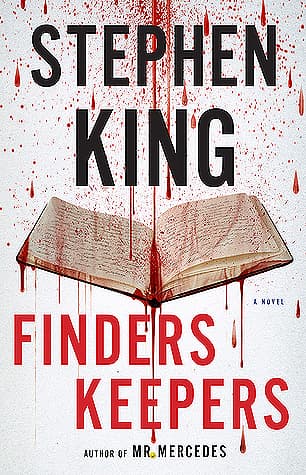
Synopsis
Covers the whole plot, including the ending.
- Difficulty
- Medium
- Pacing
- Moderate
- Mood
- Suspenseful, Obsessive, Dark, Thrilling
- Read it if
- You enjoy thrillers with a cat-and-mouse dynamic, literary themes, and a focus on obsession and revenge.
- Skip it if
- You prefer pure horror, or are looking for a lighthearted read without intense psychological suspense.
Finders Keepers Plot Summary
Covers the whole plot, including the ending.
The Murder of John Rothstein
In 1978, Morris Bellamy, a disgruntled and obsessive fan, breaks into the isolated home of author John Rothstein. Bellamy is furious that Rothstein, creator of the character Jimmy Gold, has stopped publishing and, in Bellamy's view, allowed Gold to 'sell out' in advertising. After a heated confrontation, Bellamy murders Rothstein. He ransacks the house, stealing a significant amount of cash and, more importantly, a collection of notebooks containing Rothstein's unpublished work, including at least one complete Jimmy Gold novel. Bellamy buries the treasure, the money and the notebooks, behind his mother's house before being arrested for an unrelated crime and sentenced to life imprisonment.
Pete Saubers' Discovery
In 2009, twelve-year-old Pete Saubers and his younger sister, Tina, struggle after their father is severely injured during the Mercedes Killer massacre, leaving him with permanent brain damage and the family in financial ruin. Desperate to help, Pete decides to bury his prized baseball glove and bat for safekeeping but finds a rusted, buried trunk in the woods behind his house. Inside, he discovers a large sum of money and a trove of handwritten notebooks. Unaware of their origin or value, Pete secretly begins using the cash to alleviate his family's financial burdens, anonymously sending them money.
The Literary Inheritance
As Pete continues to use the found money to help his family, he also starts reading the notebooks. He quickly becomes captivated by John Rothstein's unpublished works, particularly the new Jimmy Gold novel, 'The Runner.' Pete, a bright and sensitive boy, finds solace and inspiration in Rothstein's writing, which contrasts with his family's difficult reality. He keeps the notebooks a secret, cherishing them as his personal literary treasure, unaware of the dangerous history and the original owner's violent obsession.
Morris Bellamy's Release
After serving thirty-five years in prison for his original crime, Morris Bellamy, now elderly but still fiercely obsessive, is paroled. His first thought upon release is to retrieve the buried trunk containing Rothstein's money and the invaluable notebooks. He returns to his old family home, only to discover the house has been sold and the land developed. The exact spot where he buried the trunk is now part of the Saubers' property, near where Pete had his hidden spot. Bellamy's desperate search begins, fueled by his lifelong obsession.
The Saubers' Secret Revealed
Pete's anonymous financial contributions improve his family's situation, allowing them to pay off debts and avoid foreclosure. However, his parents, especially his mother, become suspicious of the mysterious cash. They press Pete, who eventually confesses to finding the money and the notebooks. While relieved by the financial help, they worry about the unknown origin of the items and the potential dangers. Pete's father, Tom, still recovering from his injuries, struggles to grasp the full implications, while his mother fears for their safety.
Bellamy Closes In
Morris Bellamy, unable to find the trunk at its original burial site, investigates the new residents of his old property. Through observation and deduction, he realizes the Saubers family must have found his treasure. He learns about their sudden financial improvement and the son, Pete. Bellamy's obsession intensifies, and he begins to stalk Pete and his family, planning how to recover his 'property,' specifically the Rothstein notebooks, at any cost. His long-dormant rage and possessiveness resurface with alarming intensity.
Pete's Plea to Hodges
Pete Saubers, now a teenager, has been receiving increasingly menacing letters and threats from an anonymous sender, demanding the return of 'the notebooks.' Recognizing the danger, and remembering the story of the Mercedes Killer, Pete writes a letter to retired Detective Bill Hodges, who, along with Holly Gibney and Jerome Robinson, runs the private investigation agency Finders Keepers. Pete explains his discovery, the anonymous threats, and his fear for his family's safety, hoping Hodges can protect them from the unknown stalker.
Hodges Investigates
Bill Hodges, Holly Gibney, and Jerome Robinson are intrigued and concerned by Pete's letter. They quickly connect the dots between the discovered money and notebooks, the murder of John Rothstein, and the recently paroled Morris Bellamy. Hodges realizes Bellamy's obsession with Rothstein's work drives the threats. The team gathers information on Bellamy, his past crimes, and his current whereabouts, understanding they are dealing with a dangerous and disturbed individual who will stop at nothing to reclaim his literary prize.
The Confrontation at the Lake House
Morris Bellamy, having planned his move, ambushes Pete and his family at their remote lake house. He takes them hostage, demanding the immediate return of the notebooks. The situation is tense, with Bellamy's unstable mental state and violent history creating extreme danger. He threatens Pete's family, particularly his younger sister Tina, to coerce Pete into revealing where he has hidden the remaining notebooks. Bellamy's true objective is the literary treasure, not the money, and he is prepared to be ruthless to get it back.
Hodges' Intervention and Rescue
Having tracked Bellamy to the lake house, Bill Hodges, Holly Gibney, and Jerome Robinson arrive just as the situation reaches its boiling point. A violent confrontation ensues between the investigators and Bellamy. Hodges, using his experience and quick thinking, creates a diversion, allowing Holly and Jerome to help the Saubers family to safety. In the struggle, Bellamy is subdued, but not without significant danger to all involved. The Saubers family is rescued, physically unharmed but deeply traumatized by the ordeal.
The Aftermath and the Notebooks' Fate
Morris Bellamy is recaptured and returned to prison, facing new charges for kidnapping and assault. The Saubers family, while safe, grapples with the psychological aftermath of their ordeal. The fate of John Rothstein's notebooks becomes a central issue. After much discussion and with input from Hodges and Pete, a decision is made to publish 'The Runner' and other select works from the notebooks, ensuring Rothstein's legacy lives on and the world can finally read the stories Bellamy coveted so fiercely. Pete, having grown through the experience, finds a new appreciation for literature and his own resilience.
Principal Figures
Pete Saubers
Protagonist
A young boy who discovers a hidden treasure and faces a dangerous obsession.
Pete Saubers is a sensitive and intelligent young boy, initially twelve, who grows into a thoughtful teenager. Devoted to his family, he is driven by a desire to alleviate their financial hardship after his father's debilitating injury. His discovery of John Rothstein's money and notebooks marks a turning point, exposing him to both wealth and profound danger. He becomes deeply engrossed in Rothstein's writing, demonstrating an early appreciation for literature. Pete is courageous and resourceful, ultimately seeking help from Bill Hodges when his family's safety is threatened.
Relationships: Tina Saubers (Younger sister, whom he protects); Tom Saubers (Father, whose injury motivates him); Linda Saubers (Mother, with whom he shares his secret); Morris Bellamy (Obsessive antagonist, who targets him); Bill Hodges (Protector and mentor)
Morris Bellamy
Antagonist
An obsessive and violent fan who murders an author and later targets the boy who found his treasure.
Morris Bellamy is a deeply disturbed and highly intelligent man consumed by an obsessive love for John Rothstein's Jimmy Gold novels. His resentment over Rothstein's silence and perceived 'selling out' leads him to murder the author and steal his unpublished works. Bellamy is manipulative, violent, and possesses a terrifying single-mindedness, believing the notebooks are his rightful property. Despite decades in prison, his obsession remains undimmed, driving him to extreme measures to reclaim what he believes is his literary inheritance. He represents the dark side of fandom and entitlement.
Relationships: John Rothstein (Author he idolizes and then murders); Pete Saubers (The boy who finds his treasure and becomes his target)
Bill Hodges
Supporting
A retired detective who runs a private investigation agency and protects Pete Saubers.
Bill Hodges is a retired police detective who, along with Holly Gibney and Jerome Robinson, operates the private investigation agency Finders Keepers. A seasoned investigator with a strong moral compass, Hodges is initially drawn to Pete Saubers' case due to its connection to the Mercedes Killer incident. He is empathetic, determined, and possesses a keen understanding of human nature, which allows him to quickly grasp the danger posed by Morris Bellamy. Hodges acts as a protector and a surrogate grandfather figure to Pete, demonstrating a deep commitment to justice and safeguarding the innocent.
Relationships: Holly Gibney (Business partner and trusted friend); Jerome Robinson (Junior partner and valued team member); Pete Saubers (Young client whom he protects and mentors)
Holly Gibney
Supporting
Hodges's intelligent but socially awkward partner in Finders Keepers.
Holly Gibney is Bill Hodges's partner in Finders Keepers. She is highly intelligent, detail-oriented, and possesses an almost savant-like ability to notice patterns and recall facts, making her an invaluable asset to the team. Despite her social anxieties and quirks, Holly is fiercely loyal and brave, particularly when those she cares about are in danger. Her unique perspective often provides crucial insights that Hodges might miss. She demonstrates significant personal growth throughout the series, becoming more confident and assertive, though her idiosyncratic nature remains a core part of her character.
Relationships: Bill Hodges (Business partner and close friend); Jerome Robinson (Colleague and friend)
Jerome Robinson
Supporting
A tech-savvy and loyal member of the Finders Keepers agency.
Jerome Robinson is a bright, tech-savvy young man who works with Bill Hodges and Holly Gibney at Finders Keepers. He provides crucial technical support, from research to surveillance, and serves as a grounded, often humorous, presence within the team. Jerome is loyal, intelligent, and possesses a strong sense of right and wrong. He respects Hodges and Holly and is always ready to lend his skills to help those in need, even when facing dangerous situations. He represents the younger generation's contribution to the investigation.
Relationships: Bill Hodges (Boss and mentor); Holly Gibney (Colleague and friend)
John Rothstein
Mentioned
The reclusive, murdered author whose unpublished works drive the plot.
John Rothstein is a legendary, reclusive author, creator of the iconic character Jimmy Gold. His decision to stop publishing and his perceived 'selling out' enrages Morris Bellamy, leading to his murder in 1978. Though deceased for much of the story, Rothstein's legacy and his unpublished notebooks are the central object of desire and conflict. His writing, particularly 'The Runner,' profoundly impacts Pete Saubers, demonstrating the enduring power of literature even beyond the author's life. He represents artistic integrity and the elusive nature of genius.
Relationships: Morris Bellamy (His murderer and obsessive fan); Pete Saubers (The boy who discovers and cherishes his unpublished work)
Tina Saubers
Supporting
Pete's younger sister, who is also endangered by Bellamy.
Tina Saubers is Pete's younger sister, a sweet and innocent child. Her well-being is a primary concern for Pete and her parents. She is largely unaware of the extent of the danger they are in but becomes a hostage during Bellamy's confrontation at the lake house. Her vulnerability serves to heighten the stakes and underscore the ruthlessness of Bellamy's character. She represents the innocent victims caught in the crossfire of adult obsessions.
Relationships: Pete Saubers (Older brother who protects her); Tom Saubers (Father); Linda Saubers (Mother)
Tom Saubers
Supporting
Pete's father, injured in the Mercedes Killer attack, whose struggles impact the family.
Tom Saubers is Pete's father, a victim of Brady Hartsfield's Mercedes Killer attack. He suffers severe brain damage, leaving him with physical and cognitive impairments that significantly alter his family's life. His injury creates the initial financial crisis that prompts Pete's discovery of the treasure. Despite his limitations, he cares deeply for his family and struggles to come to terms with the dangerous situation they find themselves in. He represents the lingering trauma of past events.
Relationships: Pete Saubers (Son, whose actions help the family); Linda Saubers (Wife); Tina Saubers (Daughter)
Linda Saubers
Supporting
Pete's mother, who struggles with the family's financial hardship and later the danger.
Linda Saubers is Pete's mother, a strong and resilient woman who bears the brunt of the family's financial and emotional struggles after her husband's injury. She is initially suspicious of Pete's anonymous money but ultimately grateful for the relief it provides. Her primary concern is the safety and well-being of her children. She is a pragmatic and protective figure, trying to navigate the extraordinary circumstances thrust upon her family, demonstrating a mother's unwavering love and courage.
Relationships: Pete Saubers (Son); Tom Saubers (Husband); Tina Saubers (Daughter)
Themes & Insights
The Power of Literature and Obsession
The novel explores how literature impacts individuals, from inspiring young Pete Saubers to driving Morris Bellamy to murder. Rothstein's works, especially the Jimmy Gold series, are objects of intense emotional connection. Bellamy's obsession shows the dangerous potential when fandom crosses into entitlement and delusion. Pete's experience shows how literature can offer solace, escape, and even a path to self-discovery, as he reads 'The Runner' and connects to its themes amid his family's struggles.
“A good book is a good book is a good book. It doesn't matter if it's a best-seller or a forgotten classic.”
Consequences of Past Actions
The entire plot is a direct consequence of past actions. Morris Bellamy's murder of John Rothstein and the subsequent burial of the notebooks in 1978 sets in motion a chain of events that unfolds decades later. Similarly, the Mercedes Killer attack, committed by Brady Hartsfield in the previous novel, directly impacts the Saubers family, creating the circumstances that lead Pete to discover the treasure. The novel emphasizes how unresolved crimes and buried secrets can resurface with devastating effects, impacting innocent lives many years later. The past is never truly buried.
“The past is never dead. It's not even past.”
The Value of Art vs. Material Wealth
A central theme is the contrasting values placed on art and money. Morris Bellamy values the Rothstein notebooks far above the stolen cash, seeing them as a sacred treasure. For Pete Saubers, the money initially provides crucial relief for his family, but he quickly becomes captivated by the literary value of the notebooks, finding them inspiring. The conflict arises from Bellamy's belief that he is the rightful heir to Rothstein's literary genius, contrasting with the Saubers family's practical need for the money and Pete's genuine appreciation for the stories. The novel suggests that true value often lies beyond monetary gain.
“The books were his. The money was just a bonus, a way to make sure he had a comfortable place to read them.”
Heroism and Resilience in Ordinary People
The novel shows heroism not just in the actions of the experienced investigators Bill Hodges and his team, but also in the courage and resilience of ordinary people like Pete Saubers and his family. Pete's initial drive to help his family, his decision to confess his secret, and his bravery in facing Bellamy demonstrate a quiet heroism. The Saubers family, despite their trauma and vulnerability, show remarkable strength in enduring their hardships and standing up to a dangerous threat. This theme emphasizes that bravery can emerge from unexpected places and in extraordinary circumstances.
“He was just a kid, but he knew what he had to do. And he was scared, but he did it anyway.”
Plot Devices & Literary Techniques
MacGuffin
The unpublished notebooks of John Rothstein.
The unpublished notebooks containing John Rothstein's final Jimmy Gold novel, 'The Runner,' serve as the primary MacGuffin. While their literary content is explored, their main function is to drive the plot, creating conflict and motivation for both Morris Bellamy (who obsessively covets them) and Pete Saubers (who discovers them). The notebooks' existence, discovery, and subsequent pursuit by Bellamy propel the narrative forward and unite the disparate timelines and characters.
Deus ex Machina (subverted)
Pete's anonymous money saving his family.
Pete Saubers' discovery of Morris Bellamy's buried cash initially functions as a benevolent Deus ex Machina for the Saubers family, miraculously solving their financial woes. However, this device is quickly subverted, as the 'solution' itself becomes the source of an even greater and more personal danger. The sudden relief is temporary and comes with a severe cost, transforming the lucky break into a catalyst for the main conflict rather than a true resolution, highlighting that easy solutions often have hidden complexities.
Epistolary Elements
Pete's letter to Bill Hodges and Bellamy's threatening notes.
The use of letters plays a crucial role in advancing the plot and character development. Pete Saubers' desperate letter to Bill Hodges is the catalyst that brings the Finders Keepers team into the narrative, bridging the gap between the Saubers family's plight and the investigative arm of the story. Conversely, Morris Bellamy's anonymous, increasingly menacing notes to Pete serve to escalate the tension, reveal Bellamy's growing desperation, and instill fear, directly leading Pete to seek help. These written communications are vital for conveying information and driving the conflict.
Intergenerational Conflict
The clash between Morris Bellamy and Pete Saubers.
The central conflict between Morris Bellamy and Pete Saubers represents a stark intergenerational clash. Bellamy, an older man consumed by a decades-old obsession, represents a past crime and a fixed, violent worldview. Pete, a young boy coming of age, represents the future and a more innocent, appreciative perspective on the stolen literary works. Their struggle highlights not just a battle over physical property, but a collision of different eras, values, and understandings of what truly matters, with the older generation's unresolved issues directly threatening the younger's future.
Finders Keepers Quotes
“Books were his friends, and he had always treated his friends well.”
“The past is a stubborn thing.”
“You can kill a writer, but you can't kill his words.”
“Sometimes the things you lose find their way back to you.”
“There's no such thing as an innocent bystander in this world.”
“The world had moved on, but some people never did.”
“A book is a loaded gun in the house next door.”
“Life can be a real bitch, can't it? Especially when you're just trying to get by.”
“Some things are better left buried.”
“The greatest treasure is often hidden in plain sight.”
“Reading was a kind of magic, a way to travel without moving.”
“He understood that sometimes, you had to fight for what you loved.”
“Revenge is a dish best served cold, and Bellamy had been marinating for a long time.”
“Every story has an ending, but not every ending is happy.”
Quiz
10 questions on the plot and the characters. Each answer comes with a short explanation.
Question 1
Who is the iconic author whose unpublished works are central to the plot of 'Finders Keepers'?
- Stephen King
- Jimmy Gold
- John Rothstein
- Morris Bellamy
Show answer
C. John Rothstein John Rothstein is the reclusive author whose unpublished notebooks become the target of Morris Bellamy and are later found by Pete Saubers.
Question 2
What is the name of the famous character created by John Rothstein?
- Bill Hodges
- Jimmy Gold
- Morris Bellamy
- Pete Saubers
Show answer
B. Jimmy Gold Jimmy Gold is the iconic character whose perceived 'sell-out' to advertising enrages Morris Bellamy.
Question 3
Why does Morris Bellamy initially kill John Rothstein?
- To steal his money only.
- Because Rothstein stopped writing and 'sold out' his character, Jimmy Gold.
- To get revenge for a past personal slight.
- He was hired by someone else to do it.
Show answer
B. Because Rothstein stopped writing and 'sold out' his character, Jimmy Gold. Morris Bellamy's primary motivation for killing Rothstein stems from his rage over Rothstein's decades-long silence and the perceived betrayal of the Jimmy Gold character.
Question 4
What does Morris Bellamy consider the 'real treasure' he takes from Rothstein's safe?
- A large sum of cash.
- Rare first edition books.
- A trove of notebooks containing new Jimmy Gold novels.
- Rothstein's personal journal.
Show answer
C. A trove of notebooks containing new Jimmy Gold novels. While Morris takes cash, the description explicitly states 'the real treasure is a trove of notebooks containing at least one more Gold novel.'
Question 5
Who is the young boy who discovers the hidden treasure (money and notebooks) decades after Morris hides it?
- Jerome Robinson
- Pete Saubers
- Bill Hodges
- Holly Gibney
Show answer
B. Pete Saubers Pete Saubers is the boy who stumbles upon Morris Bellamy's hidden stash of Rothstein's notebooks and money.
Question 6
For what reason is Morris Bellamy initially imprisoned for decades?
- The murder of John Rothstein.
- Robbery of a bank.
- Another crime, separate from Rothstein's murder.
- Assault on a police officer.
Show answer
C. Another crime, separate from Rothstein's murder. The synopsis states Morris 'is locked away for another crime,' implying it's not the Rothstein murder that gets him imprisoned for 35 years.
Question 7
Which of the following characters is NOT part of the detective team trying to rescue Pete Saubers and his family?
- Bill Hodges
- Morris Bellamy
- Holly Gibney
- Jerome Robinson
Show answer
B. Morris Bellamy Morris Bellamy is the antagonist, the one from whom Pete and his family need rescuing. Bill Hodges, Holly Gibney, and Jerome Robinson are the investigative team.
Question 8
What is the primary theme explored through Morris Bellamy's obsession with John Rothstein's work?
- The danger of misplaced fan loyalty and entitlement.
- The importance of financial security.
- The redemptive power of literature.
- The challenges of raising a family.
Show answer
A. The danger of misplaced fan loyalty and entitlement. Morris's extreme reaction to Rothstein's artistic choices, including murder, highlights the dangerous side of fan obsession and the sense of entitlement some fans feel over an author's creations.
Question 9
How long is Morris Bellamy imprisoned before his release, leading to him seeking his hidden treasure?
- Ten years
- Fifteen years
- Twenty-five years
- Thirty-five years
Show answer
D. Thirty-five years The text explicitly states Morris is released from prison 'after thirty-five years'.
Question 10
What critical element motivates Morris Bellamy's 'ever-more deranged and vengeful' actions upon his release from prison?
- A desire to publish his own novel.
- The recovery of the hidden Rothstein notebooks and money.
- Seeking revenge against the police who arrested him.
- To find and kill anyone else who read Rothstein's books.
Show answer
B. The recovery of the hidden Rothstein notebooks and money. Upon his release, Morris's entire focus shifts to retrieving the treasure he hid decades ago, which he believes is rightfully his, leading to his vengeful pursuit of Pete Saubers.
Finders Keepers FAQ
What is the central premise of 'Finders Keepers'?
'Finders Keepers' revolves around the murder of reclusive author John Rothstein by Morris Bellamy, who steals Rothstein's money and, more importantly, a treasure trove of unpublished notebooks featuring the iconic character Jimmy Gold. Decades later, a young boy named Pete Saubers discovers this buried treasure, unknowingly placing himself and his family in grave danger when Morris is released from prison and seeks to reclaim what he believes is rightfully his.
Who are the main protagonists trying to protect Pete Saubers?
The main protagonists protecting Pete Saubers are the detective trio from the Bill Hodges series: Bill Hodges, a retired police detective; Holly Gibney, his intelligent but socially awkward partner; and Jerome Robinson, a tech-savvy young man who often assists them. They become involved when Pete's family faces threats from the recently paroled and increasingly deranged Morris Bellamy.
What motivates Morris Bellamy to kill John Rothstein?
Morris Bellamy's primary motivation for killing John Rothstein is a deep-seated rage and sense of betrayal. He is furious that Rothstein stopped writing new Jimmy Gold novels and, even more so, that the character of Jimmy Gold, whom Morris idolized as a nonconformist, 'sold out' by appearing in advertising campaigns. Morris feels personally cheated out of the literary continuation of a character he deeply connected with.
How does Pete Saubers come into possession of Rothstein's notebooks and money?
Pete Saubers discovers Rothstein's notebooks and money when he and his sister, Tina, are exploring the woods near their home. Morris Bellamy had buried the stolen items there before his arrest. Pete stumbles upon the buried trunk and, unaware of its dangerous origins, decides to use the money to help his financially struggling family after his father is injured in a mass shooting.
What is the significance of the character Jimmy Gold in the story?
Jimmy Gold is a fictional character created by John Rothstein, revered by fans like Morris Bellamy for his anti-establishment ideals. For Morris, Gold represents a pure, uncompromised artistic vision, and his perceived 'selling out' for advertising campaigns is a personal affront. The unpublished notebooks contain new Jimmy Gold stories, making them the ultimate prize for Morris and a dangerous burden for Pete.
How does the mass shooting from 'Mr. Mercedes' connect to Pete Saubers's family situation?
The mass shooting perpetrated by Brady Hartsfield in 'Mr. Mercedes' directly impacts Pete Saubers's family. Pete's father is one of the victims, left with debilitating injuries. This financial hardship is what prompts Pete to use the money he finds, making him a vulnerable target for Morris Bellamy when he is released from prison and seeks his hidden treasure.
What is the 'treasure' Morris Bellamy values most, the money or the notebooks?
Morris Bellamy unequivocally values the unpublished notebooks containing new Jimmy Gold novels far more than the stolen cash. While he takes the money, his deep, obsessive connection to Rothstein's literary world means that the continuation of Gold's story is his true, almost spiritual, treasure. He sees the money as secondary, merely a means to an end.
Are there any subtle nods to other Stephen King works or themes in 'Finders Keepers'?
Beyond the direct connection to the Bill Hodges trilogy, 'Finders Keepers' echoes King's recurring themes of obsessive fandom, the power of literature, and the dark side of artistic creation. The idea of a dangerous fan taking extreme measures over an author's work is reminiscent of 'Misery,' highlighting King's exploration of the author-reader relationship.
What psychological condition does Morris Bellamy exhibit throughout the novel?
Morris Bellamy exhibits extreme obsessive-compulsive tendencies, particularly concerning John Rothstein's work and the character of Jimmy Gold. His inability to cope with Rothstein's cessation of writing and Gold's commercialization points to a deep-seated psychological fixation, bordering on delusional, where his personal identity is inextricably linked to the fictional world.
How does Pete Saubers's use of the money reflect his psychological state or moral compass?
Pete Saubers's decision to use the found money to help his family, particularly his injured father, demonstrates his strong sense of responsibility and love. Despite the questionable origins of the cash, his actions are driven by altruism and a desire to alleviate his family's suffering, highlighting his inherent goodness and resilience in a difficult situation.
How does Bill Hodges's deteriorating health affect his investigation in this book?
Bill Hodges's deteriorating health, specifically his battle with pancreatic cancer, adds a layer of urgency and personal stakes to his investigation. While he continues to be sharp and determined, his physical limitations and awareness of his mortality create a poignant backdrop, pushing him to resolve the case and protect Pete before his own time runs out.
What is the psychological impact of Rothstein's murder and the theft of his work on his legacy?
Rothstein's murder and the theft of his work, particularly the unpublished manuscripts, create a complicated legacy. It reinforces his reclusive genius but also highlights the vulnerability of an artist's creations to obsessive fans. The novel explores the idea that an author's final, unseen works can hold immense power, even posthumously, over those who covet them.
Is Morris Bellamy a sympathetic villain, or purely malevolent?
Morris Bellamy is largely portrayed as a malevolent villain, driven by a self-centered sense of entitlement and rage. While his initial motivation stems from a perceived artistic betrayal, his actions—murder, extreme violence, and a complete disregard for others' lives—firmly establish him as dangerous and unsympathetic. His obsession morphs into pure vengeance.
What is the novel's stance on the relationship between author and reader?
'Finders Keepers' offers a cautionary tale about the author-reader relationship, particularly when it becomes unhealthy or obsessive. It suggests that while readers can deeply connect with characters and stories, mistaking that connection for ownership or feeling personally betrayed by an author's choices can lead to dangerous consequences, as seen with Morris Bellamy.
Does the book suggest that art, once created, belongs to the public or remains the artist's property?
The book strongly leans towards the idea that art, even after publication, remains fundamentally the artist's property and vision. Morris Bellamy's belief that Rothstein 'owed' him more Jimmy Gold novels, or that Gold 'sold out,' is presented as a dangerous delusion. The unpublished notebooks are Rothstein's private creations, not a public entitlement.
How does the ending of 'Finders Keepers' resolve the fate of the Jimmy Gold notebooks?
The ending of 'Finders Keepers' sees the Jimmy Gold notebooks recovered from Morris Bellamy. While their immediate future isn't definitively detailed, the narrative implies they are secured, potentially for future publication or to be handled according to Rothstein's estate. The important resolution is that they are out of Bellamy's destructive possession and Pete's dangerous orbit.
What role does technology, specifically the internet and social media, play in the narrative?
While not as central as in 'Mr. Mercedes,' technology plays a supporting role, particularly through Jerome Robinson's character. His tech skills are crucial for research, tracking information, and providing surveillance, which aids Hodges and Holly in their efforts to protect Pete and track Morris. It underscores the modern tools available for investigation.
How does the theme of 'finding' and 'keeping' manifest throughout the story?
The theme of 'finding' and 'keeping' is central and multifaceted. Pete 'finds' the physical treasure (money and notebooks) and attempts to 'keep' his family safe with it. Morris 'finds' Rothstein's hidden work and believes he has the right to 'keep' it, even through murder. The Hodges team 'finds' the truth and works to 'keep' Pete and his family from harm, highlighting different interpretations of ownership and discovery.
About the author

Stephen Edwin King is an American author of horror, supernatural fiction, suspense, crime, science-fiction, and fantasy novels. Described as the "King of Horror", his books have sold more than 350 million copies as of 2006, and many have been adapted into films, television series, miniseries, and comic books. King has published over 65 novels/novellas, including seven under the pen name Richard Bachman, and five non-fiction books. He has also written approximately 200 short stories, most of which have been published in book collections.
Similar books
- Misery
Stephen King
4.2 (499k) average on GoodreadsThrillerFeatures an obsessed fan, a famous author, and intense psychological suspense.
- The Silent Patient
Alex Michaelides
4.1 (507k) average on GoodreadsThrillerA character-driven thriller with a focus on psychological depth and unexpected twists.
- Gone Girl
Gillian Flynn
4.1 (2.3M) average on GoodreadsThrillerUnlike Gone Girl, which focuses on marital deception, unreliable narration, and the psychological games between a couple, Finders Keepers grounds its suspense in the physical pursuit of a tangible object (the notebooks) and the psychological torment of a character driven by intellectual property and a twisted sense of literary ownership. King's focus is less on domestic secrets and more on the external consequences of past crimes.
- The Secret Place
Tana French
3.9 (63k) average on GoodreadsThrillerWhile French's The Secret Place explores adolescent struggles, secrets, and the complexities of school life within a crime framework, King's Finders Keepers takes a more direct and less atmospheric approach. King's novel is more concerned with the direct, long-term repercussions of a specific past crime and how it directly impacts a young protagonist, rather than the broader, more nuanced exploration of group dynamics and hidden truths within an insular community.
- Harry Potter and the Sorcerer's Stone
J.K. Rowling
4.5 (7M) average on GoodreadsFantasyRescued from a miserable life under the stairs, an orphaned boy discovers he's a wizard destined for a magical school, where he uncovers a dangerous secret tied to the dark wizard who murdered his parents.
- The Hunger Games
Suzanne Collins
4.3 (6.4M) average on GoodreadsFantasyIn a future where children fight to the death on live television, Katniss Everdeen volunteers for the arena, turning a death sentence into a fight for survival and a spark of rebellion.





Enjoyed the summary?
A summary gives you the shape of the book. The book itself has the detail, the examples and the voice.
Find Finders Keepers on AmazonAs an Amazon Associate, BookBrief earns from qualifying purchases. How we're funded