
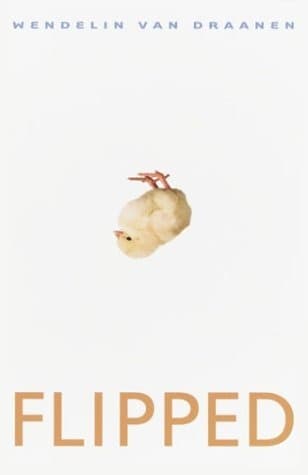
Synopsis
Covers the whole plot, including the ending.
- Difficulty
- Easy
- Pacing
- Moderate
- Mood
- Heartwarming, Sweet, Humorous, Reflective
- Read it if
- You enjoy heartwarming coming-of-age stories about first crushes, changing perspectives, and the journey to truly see someone for who they are. Perfect for a quick, feel-good read.
- Skip it if
- You prefer complex plots, high-stakes drama, or mature romance. This is a simple, sweet story about young love.
Flipped Plot Summary
Covers the whole plot, including the ending.
Juli's Infatuation Begins
Juli Baker clearly remembers the day the Loski family moved in across the street when she was in second grade. She was immediately drawn to Bryce Loski's 'dazzling' blue eyes and felt an instant, deep connection. From then on, Juli tried to get Bryce's attention, often following him, sitting near him at school, and making herself known. Bryce, however, found her intense attention overwhelming and strange, often trying to avoid her. This set up their early relationship: Juli's constant pursuit and Bryce's equally constant avoidance.
Bryce's Perspective: Annoyance and Avoidance
Bryce Loski tells his side of meeting Juli, calling her 'pushy' and 'loud' from the start. He was immediately put off by her forwardness and felt constantly bothered by her attempts to touch his hand, smell his hair, or just be near him. His main goal through elementary school was to get away from Juli's attention, often hiding or making excuses. He found her passion for things like the sycamore tree or her chickens confusing and embarrassing. This view shows his early dislike and misunderstanding of Juli's real affection, seeing her as an annoyance.
The Sycamore Tree and Juli's Sanctuary
Juli Baker loves an old sycamore tree on a vacant lot near her house. She enjoys climbing it, finding it a calm place and a spot from which she can see the world, including her neighborhood and Bryce's house, with new clarity. She believes the view from the tree is 'greater than the sum of its parts.' One day, the lot owner decides to cut down the tree. Juli protests, refusing to come down, but her father eventually makes her get off. Losing the tree deeply affects her, representing a loss of innocence and her unique way of seeing life.
The Egg Incident and Bryce's Disgust
Juli's family raises chickens, and she regularly brings fresh eggs to the Loski family, thinking it is a kind act. However, Bryce and his father believe the Baker's yard is dirty and that the eggs might carry salmonella. Bryce, pressured by his father, secretly starts throwing Juli's eggs away, fearing they might make his family sick. When Juli eventually finds Bryce throwing away the eggs, she is deeply hurt and upset, feeling betrayed. This event is a big change, lessening Juli's perfect view of Bryce.
Grandpa Chet's Influence
Bryce's grandfather, Chet Duncan, moves in with the Loskis. Chet takes an interest in Juli, seeing her unique spirit and intelligence. He often sees Juli working in her yard and, unlike Bryce's father, praises her effort and character. Chet tells Bryce to look past outward appearances and truly see Juli for who she is, pointing out her strength, honesty, and passion. He even helps Juli clean up her yard, building a connection that helps Bryce begin to question his own biased views of Juli and her family.
The Basket Boy Auction
The school has a 'Basket Boy' auction, where boys auction off picnic lunches. Juli, still having a small crush, hopes Bryce will bid on her basket. However, Bryce, encouraged by his friends, bids on another girl's basket. When Juli's friend, Shelly Stalls, outbids him for Juli's basket, Bryce gets jealous and, in a moment of panic, says he would never eat Juli's lunch. Later, at the picnic, Bryce tries to kiss Juli, but she pulls away, feeling his actions are not real and are driven by his friends' dares, not true affection. This public embarrassment deeply hurts Juli.
Juli's Realization and Bryce's Regret
After the Basket Boy event, Juli is upset. She realizes that her perfect idea of Bryce was just that — an idea — and the real Bryce has been unkind and shallow. She decides she is 'done' with him. Meanwhile, Bryce feels bad about what he did. He starts to truly see Juli, noticing her kindness, her passion for helping her mentally challenged uncle, and her real character, especially after talks with his grandfather. He realizes he has been a coward and that Juli is far more remarkable than he thought, feeling a growing attraction and respect for her.
The Yard Project and a New Understanding
Juli, with her father and grandfather Chet, starts to clean up and landscape her neglected front yard. Bryce watches her work, wanting to help and make things right. He sees her strong character and spirit. One day, he goes to Juli's house and offers to help her with her yard work. Juli is at first hesitant and careful, but she lets him help. As they work together, a new understanding and connection start to form between them, moving past their old misunderstandings into a place of mutual respect and early affection.
Bryce Plants a Sycamore Tree
Bryce, wanting to show Juli how much he truly cares and to apologize for his past behavior, decides to plant a sycamore tree in her front yard, replacing the one she loved and lost. He digs the hole himself, a difficult and meaningful act, and then gives the sapling to Juli. Juli is very touched by this gesture, understanding its meaning and the effort Bryce put in. This kind act shows a big change in Bryce's character and their relationship, indicating that he is finally seeing her and valuing her perspective. Juli joins him, and together, they plant the tree, symbolizing the growth of their new connection.
Principal Figures
Juli Baker
Protagonist
A passionate, perceptive, and fiercely independent girl who falls for Bryce Loski.
Juli is an intelligent, sensitive, and deeply empathetic girl with a strong sense of integrity and a unique perspective on the world. From a young age, she is 'flipped' by Bryce Loski, and her relentless pursuit of him forms the initial backbone of the story. She is passionate about nature, especially her beloved sycamore tree, and is fiercely loyal to her family, including her special needs uncle. Juli's journey involves learning to differentiate between her idealized image of Bryce and his real, often flawed, self, ultimately finding her own worth beyond his approval.
Relationships: Bryce Loski (Childhood crush, then complex neighborly relationship, evolving into mutual respect and affection); Richard Baker (Father) (Loving, supportive, and wise father figure); Chet Duncan (Bryce's Grandfather) (Mentor and friend who sees and appreciates her true character); David Baker (Uncle) (Beloved uncle with special needs, whom she cares for deeply)
Bryce Loski
Protagonist
A handsome, initially superficial boy who struggles with Juli's attention and his own insecurities.
Bryce is introduced as the object of Juli's affection, but from his perspective, he finds her attention annoying and embarrassing. He is initially driven by a desire to fit in and avoid public scrutiny, often succumbing to peer pressure and his father's judgmental attitudes. He struggles with his own cowardice and superficiality, particularly in how he treats Juli. Through the influence of his grandfather and his own growing maturity, Bryce begins to see Juli for her true worth, leading to a profound shift in his understanding of kindness, integrity, and love.
Relationships: Juli Baker (Neighbor who initially annoys him, then becomes the object of his respect and affection); Steven Loski (Father) (Overbearing and judgmental father); Chet Duncan (Grandfather) (Wise mentor who guides him towards greater understanding); Garrett (Best friend who often encourages his superficiality)
Chet Duncan
Supporting
Bryce's wise and empathetic grandfather who sees the best in Juli.
Chet Duncan moves in with the Loski family and quickly becomes a pivotal character. He is a kind, perceptive, and morally upright man who sees through the superficiality of his son and grandson. He recognizes Juli's intelligence, passion, and genuine spirit, becoming a mentor figure to Bryce and helping him to understand what truly matters in a person. Chet's calm wisdom and appreciation for Juli's character are instrumental in Bryce's personal growth and his eventual change of heart towards Juli.
Relationships: Bryce Loski (Grandfather and mentor); Juli Baker (Friend and confidante); Steven Loski (Son) (Son, whose judgmental nature he often disapproves of)
Richard Baker
Supporting
Juli's supportive and philosophical father.
Juli's father is a deeply caring and understanding man who encourages her unique spirit and provides her with sound advice. He teaches her the importance of seeing the 'whole' of a person, rather than just the sum of their parts, a philosophy that profoundly influences Juli. He is a steadfast presence in Juli's life, offering comfort and wisdom, especially after the sycamore tree incident and her heartbreak over Bryce. He is also a devoted brother to his special needs sibling, David, setting a strong example for Juli.
Relationships: Juli Baker (Loving and wise father); Patsy Baker (Wife) (Husband); David Baker (Brother) (Caring brother)
Steven Loski
Supporting
Bryce's judgmental and class-conscious father.
Steven Loski is Bryce's father, who holds strong, often negative, opinions about the Baker family due to their perceived lower social status and the messy appearance of their yard. He is critical and judgmental, influencing Bryce's initial disdain for Juli and her family. He is concerned with appearances and social standing, which creates tension within his own family, especially with his father, Chet. His prejudice and narrow-mindedness serve as a foil to Juli's open-heartedness and Chet's wisdom.
Relationships: Bryce Loski (Father, who often pressures Bryce); Chet Duncan (Father) (Son, whose views often clash with his father's); Trina Loski (Wife) (Husband)
Patsy Baker
Supporting
Juli's kind and patient mother.
Juli's mother is a hardworking and understanding woman who supports her family through various challenges. She is patient and loving, providing a stable home environment for Juli and her brothers. She works to make ends meet and helps care for her brother-in-law, David. While not as overtly philosophical as Juli's father, she offers emotional support and practical guidance, often mediating and providing comfort when Juli is upset.
Relationships: Juli Baker (Loving mother); Richard Baker (Husband) (Wife)
Trina Loski
Supporting
Bryce's emotionally distant and somewhat passive mother.
Trina Loski is Bryce's mother, who often tries to maintain peace within the family but struggles to stand up to her husband's strong opinions. She is generally kind but seems to lack the conviction to challenge the judgmental attitudes prevalent in her household. She often observes the family dynamics, particularly her husband's prejudice against the Bakers, but rarely intervenes effectively. She represents a quieter, less impactful presence in Bryce's moral development.
Relationships: Bryce Loski (Mother); Steven Loski (Husband) (Wife)
Garrett
Supporting
Bryce's best friend, often a bad influence.
Garrett is Bryce's best friend throughout much of the story. He is portrayed as somewhat shallow and easily influenced by social status and appearances. He often encourages Bryce's negative behavior towards Juli, particularly during the Basket Boy auction, and is not above making cruel jokes. Garrett represents the kind of peer pressure that Bryce struggles to overcome, and their friendship eventually fractures as Bryce begins to mature and prioritize genuine values over superficial popularity.
Relationships: Bryce Loski (Best friend, whose influence Bryce eventually outgrows)
David Baker
Mentioned
Juli's beloved special needs uncle.
David Baker is Juli's mentally challenged uncle, who lives in an institution. Although he only appears briefly, his presence is significant. Juli's deep love and compassion for him highlight her empathetic nature and her ability to see the inherent worth in all people, regardless of their perceived 'normalcy.' The family's dedication to caring for him also provides a contrast to the Loskis' more superficial concerns.
Relationships: Juli Baker (Beloved uncle); Richard Baker (Brother) (Brother)
Themes & Insights
Perception vs. Reality
This is a main idea, explored through Juli's and Bryce's different views. Juli at first sees Bryce as perfect, not seeing his insecurity and unkindness. Bryce, on the other hand, sees Juli as annoying and strange, not seeing her passion, honesty, and depth. The story's structure shows how two people can experience the same events and understand them completely differently. The sycamore tree also shows this idea, as Juli sees the 'whole' view from its branches, while others only see a tree.
“'A painting is more than the sum of its parts,' he'd said. 'A cow by itself is just a cow. A sun by itself is just a sun. But a cow and a sun together... that's art.'”
Identity and Self-Discovery
Both Juli and Bryce learn a lot about themselves. Juli at first defines herself by her crush on Bryce, but through losing the sycamore tree and the egg event, she learns to value her own perspective and honesty more than his approval. Bryce, however, struggles with who he is, caught between his father's expectations, his friends' influence, and his own conscience. His journey is about finding the courage to be true to himself and to act with kindness, instead of being swayed by outside pressures. His grandfather, Chet, helps him a lot in this.
“'Some of us get dipped in flat, some in satin, some in gloss.... But every once in a while, you find someone who's iridescent, and when you do, nothing will ever compare.'”
Integrity and Courage
The novel shows the importance of honesty, especially through Juli's strong commitment to her beliefs and her family. She stands up for the sycamore tree and cares for her uncle David without shame, showing her courage. Bryce, in contrast, at first lacks honesty, throwing away Juli's eggs and taking part in the Basket Boy auction out of fear. His story involves finding the courage to act with honesty, to apologize, and to show real affection, even if it means going against his friends or his father.
“''But every once in a while you find someone who's iridescent, and when they're gone, nothing will ever compare.' And the thing is, she was right. Juli Baker was iridescent.”
Social Class and Prejudice
The clear differences between the Baker and Loski families, especially their money situations and how they keep their homes, cause much of the conflict and bias in the story. Bryce's father, Steven Loski, judges the Bakers' messy yard and their perceived lower class, influencing Bryce's early negative views. This idea explores how outward appearances and money can lead to unfair judgments, and how characters like Chet and Juli's father challenge these narrow views by valuing character over possessions.
“'The Bakers are... different. I mean, they're not like us.'”
The Nature of Love
The book explores different kinds of love: Juli's early perfect, almost obsessive crush, Bryce's slow realization of real affection and respect, and the strong love within Juli's family. It compares superficial attraction with a deeper, more meaningful connection built on understanding and shared values. The story shows that true love means seeing and appreciating the 'whole' person, including their flaws and quirks, and having the courage to act on that appreciation.
“'You have to look at the whole landscape. And if you don't, then what you're seeing is just a detail. You're missing the whole point.'”
Plot Devices & Literary Techniques
Dual Perspective Narrative
The story is told alternating between Juli Baker and Bryce Loski's first-person viewpoints.
This is the primary structural device of 'Flipped.' Each chapter is narrated by either Juli or Bryce, often recounting the same event from their individual, contrasting perspectives. This allows the reader to deeply understand the internal thoughts, motivations, and misunderstandings of both protagonists. It effectively highlights the theme of perception versus reality, showing how two people can experience the same situation entirely differently and how their internal biases shape their understanding of events and each other.
The Sycamore Tree
A powerful symbol of Juli's unique perspective, resilience, and connection to nature.
The sycamore tree serves as a significant symbol throughout the novel. For Juli, it represents a place of peace, clarity, and a unique vantage point from which she gains a broader understanding of the world. Its eventual cutting down symbolizes a loss of innocence and a turning point for Juli, forcing her to confront reality and find new ways to connect with her sense of self. Bryce's act of planting a new sycamore tree for Juli at the end is a powerful symbol of his growth, remorse, and his newfound understanding and respect for her.
The Eggs
A symbol of Juli's generosity and Bryce's immaturity and his father's prejudice.
Juli's fresh eggs, brought as a genuine gesture of kindness, become a key symbol of the communication breakdown and class prejudice between the families. For Juli, they represent hard work and a gift from nature. For Bryce and his father, they become a symbol of the Bakers' perceived unsanitary conditions and lower social standing. Bryce's act of secretly discarding them highlights his cowardice and the negative influence of his father, ultimately leading to Juli's disillusionment and marking a turning point in her feelings towards him.
The Basket Boy Auction
A turning point that publicly humiliates Juli and catalyzes Bryce's regret.
The Basket Boy auction is a pivotal plot device that brings the simmering tensions and misunderstandings between Juli and Bryce to a head. It's a public event where Bryce's lack of courage and his susceptibility to peer pressure are starkly revealed, leading to Juli's profound humiliation and the shattering of her idealized view of him. Conversely, the aftermath of the auction, particularly Bryce's attempt to kiss Juli and his subsequent guilt, serves as the catalyst for his own introspection and his journey towards genuine appreciation for Juli.
Flipped Quotes
“Some of us get dipped in flat, some in satin, some in gloss... But every once in a while you find someone who's iridescent, and when you do, nothing will ever compare.”
“All I've ever wanted is for Juli Baker to leave me alone. For her to back off—you know, just give me some space.”
“The first day I met Bryce Loski, I flipped. Honestly, one look at him and I became a lunatic. It's his eyes. Something in his eyes.”
“A painting is more than the sum of its parts. A cow by itself is just a cow. A meadow by itself is just grass, flowers. And the sun peeking through the trees is just a beam of light. But you put them all together and it can be magic.”
“I never been embarrassed by where I live before. But all of a sudden I was.”
“One's character is set at an early age, son. The choices you make now will affect you for the rest of your life.”
“And I realized Garrett was right about one thing: I had flipped. Completely.”
“The way she talked about what she felt was so... simple. So honest. It made my head spin.”
“Sometimes you have to look at the whole landscape, not just the one tree.”
“I had to face the fact that I was never going to have a normal life. Not with Juli Baker around.”
“It's not what you look at that matters, it's what you see.”
“For the first time in my life, I felt like I was seeing things clearly. And it was terrifying.”
“She wasn't just a girl. She was Juli Baker. And she was amazing.”
“The sycamore tree wasn't just a tree. It was a kingdom. And I was its queen.”
Quiz
10 questions on the plot and the characters. Each answer comes with a short explanation.
Question 1
What is the first thing Juli Baker notices about Bryce Loski when she meets him in second grade?
- His blue eyes
- His smile
- His hair
- His eyes and smile together
Show answer
D. His eyes and smile together In the book, Juli describes being immediately captivated by Bryce's 'dazzling' eyes and smile when she first sees him in second grade, which makes her 'flip' for him instantly.
Question 2
Why does Bryce initially avoid Juli throughout their childhood?
- He thinks she is too loud and aggressive
- He is embarrassed by her family's messy yard
- He finds her intense affection overwhelming and annoying
- He dislikes that she is smarter than him in school
Show answer
C. He finds her intense affection overwhelming and annoying Bryce feels smothered by Juli's persistent crush and enthusiastic attention from a young age, leading him to avoid her and even hide from her at times.
Question 3
What significant event causes Juli to start questioning her feelings for Bryce in eighth grade?
- Bryce insults her family's chickens
- Bryce throws away the eggs she gives him
- Bryce laughs at her science project
- Bryce ignores her at school
Show answer
B. Bryce throws away the eggs she gives him Juli discovers that Bryce has been throwing away the eggs from her beloved chickens that she's been giving to his family for years, which shatters her idealized view of him.
Question 4
What does Juli's father compare people to when explaining the importance of looking at the whole picture?
- A jigsaw puzzle
- A painting
- A tree
- A painting and its individual brushstrokes
Show answer
D. A painting and its individual brushstrokes Juli's father tells her that some people are like paintings - you have to step back to see the whole picture rather than focusing on individual brushstrokes. This helps Juli understand people more deeply.
Question 5
What does Bryce do to try to win Juli back after she distances herself from him?
- He writes her a long apology letter
- He plants a sycamore tree in her yard
- He buys her a new chicken
- He publicly defends her at school
Show answer
B. He plants a sycamore tree in her yard Bryce plants a sycamore tree sapling in Juli's yard as a symbolic gesture, referencing the beloved sycamore tree she had to give up earlier in the story, showing he finally understands what matters to her.
Question 6
What is the significance of the sycamore tree to Juli?
- It was planted by her grandfather
- It's where she first kissed Bryce
- It represents her perspective on the world from above
- It's the only tree that grows in her neighborhood
Show answer
C. It represents her perspective on the world from above The sycamore tree becomes important to Juli because climbing it gives her a new perspective - she can see how everything fits together from above, which becomes a metaphor for understanding people and situations.
Question 7
How does Bryce's grandfather, Chet, influence Bryce's changing view of Juli?
- He tells Bryce to ignore Juli completely
- He points out Juli's admirable qualities that Bryce has overlooked
- He arranges for Bryce and Juli to work together
- He criticizes Bryce for not being more like Juli
Show answer
B. He points out Juli's admirable qualities that Bryce has overlooked Chet Duncan, Bryce's grandfather, helps Bryce see Juli's true worth by pointing out her character, integrity, and the beauty of her family's closeness, which contrasts with Bryce's superficial judgments.
Question 8
What realization does Bryce come to about his own family versus Juli's family?
- That his family is wealthier but less happy
- That his family is more educated but less kind
- That his family is more traditional but less loving
- That his family is smaller but closer
Show answer
A. That his family is wealthier but less happy Bryce gradually realizes that while his family appears perfect on the surface with their nice house and possessions, Juli's family - though messy and unconventional - has genuine love, integrity, and happiness that his own family lacks.
Question 9
What is the symbolic meaning behind the book's title 'Flipped'?
- It refers to flipping houses, like Juli's family does
- It describes how the characters' perspectives reverse
- It refers to flipping through the alternating chapters
- It describes Juli literally flipping over Bryce
Show answer
B. It describes how the characters' perspectives reverse The title represents how Juli and Bryce's perspectives 'flip' - Juli goes from idolizing Bryce to seeing his flaws, while Bryce goes from dismissing Juli to appreciating her true worth, showing their reversed journeys of understanding.
Question 10
What crucial lesson do both Juli and Bryce learn by the end of the novel?
- That first impressions are always correct
- That popularity matters more than character
- That love requires looking beyond surface appearances
- That family expectations should determine relationships
Show answer
C. That love requires looking beyond surface appearances Both characters learn that true understanding and connection come from seeing the whole person - their character, values, and inner qualities - rather than judging based on superficial appearances or initial impressions.
Flipped FAQ
What is 'Flipped' about?
'Flipped' is a dual-perspective romance novel following neighbors Juli Baker and Bryce Loski from second through eighth grade. Juli is immediately infatuated with Bryce, while he finds her overwhelming, but their perceptions gradually reverse as they mature, leading to a deeper understanding of each other beyond superficial judgments.
Why should I read 'Flipped'?
The book offers a charming, insightful exploration of adolescent growth, first love, and perspective-taking through its alternating narration. Its relatable themes of social pressure, family values, and learning to see people's true character make it both heartwarming and thought-provoking for readers of all ages.
What is the background/setting of 'Flipped'?
Set in a suburban American neighborhood from the late 1990s to early 2000s, the story unfolds primarily at the characters' homes, school, and community events. Key locations include Juli's beloved sycamore tree, Bryce's meticulously maintained house, and the school science fair, which all symbolize the characters' evolving values.
What are the most memorable quotes?
Notable quotes include Juli's realization, 'Some of us get dipped in flat, some in satin, some in gloss... But every once in a while, you find someone who's iridescent, and when you do, nothing will ever compare,' and Bryce's reflection, 'All I've ever wanted was for Juli Baker to leave me alone. For her to back off—you know, just give me some space.'
What writing style does the author use?
Wendelin Van Draanen employs a first-person, alternating chapter structure between Juli and Bryce's perspectives, using clear, accessible prose that captures their distinct voices. The narrative blends humor, introspection, and poignant moments, with a linear timeline marking their growth from childhood to early adolescence.
What minor details add significant meaning?
Small details like Bryce's family discarding Juli's eggs due to fears of salmonella symbolize their superficial judgment of her family, while Juli's devotion to the sycamore tree represents her appreciation for beauty and resilience. Bryce's grandfather's subtle guidance through shared interests in photography and nature highlights themes of wisdom and connection.
What are some subtle foreshadowing moments?
Early scenes where Bryce avoids Juli and mocks her tree-climbing foreshadow his later regret and desire to make amends. Juli's initial idolization of Bryce's 'azure eyes' hints at her eventual realization that his character matters more than appearance, mirrored by Bryce's growing admiration for her integrity.
What unexpected character connections exist?
Bryce's grandfather, Chet, forms a quiet bond with Juli over shared values, subtly influencing Bryce's perspective. The Loski family's strained dynamics contrast with the Bakers' closeness, revealing how family environments shape the teens' worldviews. Secondary characters like Shelly Stalls and Garrett highlight social pressures that affect Juli and Bryce's relationship.
What are unspoken character motivations?
Bryce is driven by a desire for social acceptance and fear of embarrassment, leading him to hide his growing feelings for Juli. Juli is motivated by a deep-seated belief in seeing the good in people and nature, rooted in her family's values, which fuels her persistence despite Bryce's rejection.
What psychological complexities do characters exhibit?
Juli struggles with disillusionment as she realizes Bryce may not live up to her idealized image, while Bryce grapples with guilt and cognitive dissonance as he recognizes Juli's worth but fears peer judgment. Both characters undergo significant internal conflict as they navigate self-discovery and societal expectations.
What are the major emotional turning points?
Key moments include Juli's devastation when the sycamore tree is cut down, symbolizing loss of innocence; Bryce's shame after throwing away her eggs, sparking his moral awakening; and the school auction where Bryce attempts to apologize, leading to their heartfelt confrontation and eventual reconciliation.
How do relationship dynamics evolve?
The relationship shifts from Juli's one-sided infatuation and Bryce's avoidance to a mutual misunderstanding in middle school, where Juli withdraws and Bryce becomes intrigued. Ultimately, it matures into a genuine connection based on respect and shared values, culminating in Bryce's symbolic gesture of planting a sycamore tree for Juli.
Which parts remain ambiguous or open-ended?
The story ends with Bryce planting a tree for Juli, leaving their future relationship open to interpretation—whether they become friends or romantic partners is not specified. Additionally, the full impact of their families' differing values on their long-term dynamics is left for readers to ponder.
What are controversial scenes or decisions?
Bryce's decision to discard Juli's eggs without telling her, driven by his family's elitism, sparks debate about honesty and empathy. Some readers also question Juli's prolonged idealization of Bryce, viewing it as naive, while others see it as a testament to her optimistic character.
'Flipped' ending explained: how it ends & what it means
The novel concludes with Bryce planting a sycamore sapling in Juli's yard as a gesture of apology and growth, symbolizing his changed perspective and commitment to valuing what matters. This ending emphasizes themes of redemption, personal transformation, and the idea that true connection requires seeing beyond superficial traits.
About the author

Wendelin Van Draanen is an American author known for her works of children's and young adult fiction. Her notable books include "Flipped," "The Running Dream," and several titles in the "Sammy Keyes" series, such as "Sammy Keyes and the Sisters of Mercy" and "Sammy Keyes and the Skeleton Man." Her stories often explore themes of friendship, resilience, and self-discovery.
Similar books
- Stargirl
Jerry Spinelli
3.8 (296k) average on GoodreadsChildren'sFeatures an eccentric, free-spirited female protagonist who challenges social norms and changes the perspective of the male lead.
- The Princess Diaries
Meg Cabot
4.0 (624) average on GoodreadsYoung AdultA lighthearted, first-person narrative of a young girl navigating school, crushes, and self-discovery, with a focus on internal monologue and relatable teen angst.
- The Truth About Forever
Sarah Dessen
4.1 (209k) average on GoodreadsYoung AdultWhile both explore adolescent relationships, Flipped is less overtly dramatic and focuses more on the subtle shifts in perception and judgment over time, whereas Dessen's novel often delves into more intense emotional arcs surrounding grief and self-discovery, with a greater emphasis on external events shaping internal change.
- The Fault in Our Stars
John Green
4.2 (3.6M) average on GoodreadsYoung AdultBoth novels tackle profound aspects of love and human connection, but Flipped does so through the lens of everyday adolescent misunderstandings and evolving perspectives, offering a more grounded, less high-stakes narrative. Green's work, conversely, often explores existential themes and intellectual discourse within the context of life-threatening illness, aiming for a more profound and often tragic emotional impact.
- Harry Potter and the Sorcerer's Stone
J.K. Rowling
4.5 (7M) average on GoodreadsFantasyRescued from a miserable life under the stairs, an orphaned boy discovers he's a wizard destined for a magical school, where he uncovers a dangerous secret tied to the dark wizard who murdered his parents.
- The Hobbit, or There and Back Again
J.R.R. Tolkien
4.3 (2.9M) average on GoodreadsFantasyA comfort-loving hobbit named Bilbo Baggins is whisked away by a mischievous wizard and a band of dwarves on an unexpected journey to reclaim stolen treasure from a fearsome dragon, discovering courage and a magical ring along the way.





Enjoyed the summary?
A summary gives you the shape of the book. The book itself has the detail, the examples and the voice.
Find Flipped on AmazonAs an Amazon Associate, BookBrief earns from qualifying purchases. How we're funded