

Synopsis
Covers the whole plot, including the ending.
- Difficulty
- Medium
- Pacing
- Moderate
- Mood
- Adventurous, Inventive, Optimistic, Grand
- Read it if
- You enjoy classic science fiction, tales of grand adventure and scientific ambition, or are fascinated by the historical context of space exploration.
- Skip it if
- You prefer modern, scientifically accurate hard sci-fi, or are put off by a slower, more descriptive narrative style common in 19th-century literature.
From the Earth to the Moon Plot Summary
Covers the whole plot, including the ending.
The Gun Club's Bold Proposition
After the American Civil War, the Baltimore Gun Club, a group of artillery lovers, has no worthy project. Their president, Impey Barbicane, calls a meeting to suggest a new plan: firing a projectile to the Moon. The idea brings shock and excitement. Barbicane shows his calculations and a detailed plan, inspiring his audience and bringing back their passion for big scientific goals. The club members, mostly former military men, quickly support the seemingly impossible project. They are eager to use their wartime skills for a peaceful, but groundbreaking, goal.
Public Enthusiasm and International Rivalry
Barbicane's idea quickly becomes famous worldwide, capturing the public's imagination in America and Europe. Donations arrive from various countries, all wanting to be part of such a big scientific achievement. But not everyone supports it. J. T. Maston, a strong-willed Philadelphia armor plate maker and Barbicane's former rival, publicly questions if the project can be done, especially the choice of aluminum for the projectile. Maston, known for being direct and confrontational, sends Barbicane a series of critical telegrams. This starts a long-distance argument that adds personal drama to the scientific effort and keeps the public interested.
Selecting the Launch Site
The Gun Club must choose the best place to build their giant cannon, the 'Columbiad.' After looking at things like latitude, weather, and ground stability, Barbicane and his team narrow down the choices. People debate between Texas and Florida. Florida is chosen, specifically near the 27th parallel. This decision is based on needing a location close to the equator to use the Earth's spin to help the projectile's path to the Moon. This choice prepares for the huge building project, turning a quiet Florida area into a busy industrial site.
Construction of the Columbiad
With the launch site picked, the huge job of building the Columbiad begins. Thousands of engineers, workers, and experts arrive in Florida. The project is enormous: a huge pit is dug, and the giant cannon is cast right into the earth using a new vertical casting method. Barbicane carefully watches every detail, making sure the precision and strength needed for such a powerful tool are there. The building site becomes very busy, a sign of human cleverness and resolve, as the Gun Club works fast to solve engineering problems and make their Moon dream happen.
Ardan's Daring Proposal
As the Columbiad is almost finished, a surprising telegram arrives from Michel Ardan, a showy and brave French adventurer, sportsman, and artist. Ardan, known for his bold stunts and optimism, says he wants to travel *inside* the projectile to the Moon. This idea excites the public and at first shocks the Gun Club. Barbicane and his colleagues are hesitant because of the great risks, but Ardan's charm and his good reasons for a manned mission eventually convince them. His involvement changes the project from just a science experiment into an exciting human adventure, adding new danger and thrill.
Maston's Reconciliation and Inclusion
After Ardan's announcement, J. T. Maston, the Gun Club's biggest critic, makes a sudden and unexpected appearance in Florida. Despite his past arguments, Maston is fascinated by Ardan's bravery. He publicly makes up with Barbicane, saying he admires the project. To everyone's surprise, he volunteers to join Ardan and Barbicane on the Moon trip. His inclusion completes the three-man crew. He adds a practical, but odd, balance to Ardan's romance and Barbicane's scientific focus. The once-skeptical Maston now fully commits to the mission, showing how the project can bring together even very different people.
Preparing the Projectile
With the three adventurers ready, the focus shifts to preparing the aluminum projectile, now a small space capsule. Barbicane, Ardan, and Maston carefully supervise the installation of what they need: air-recycling equipment, food, water, scientific tools, and even a small library. The inside is designed to handle the huge G-forces of launch and provide a place to live for the journey. Engineers work hard to make sure every part is perfect, knowing the three men's lives depend on their accuracy and foresight. The projectile becomes an engineering wonder, a self-contained world for space travel.
The Grand Launch
On the chosen day, a huge crowd, estimated to be hundreds of thousands, gathers in Florida to see the historic launch. The atmosphere is full of excitement. Reporters, scientists, and regular people from around the world watch as the three brave travelers, Barbicane, Ardan, and Maston, enter the projectile. The last preparations are made, the huge pyroxylin charge is lit, and with a loud roar and big recoil, the Columbiad fires its human cargo toward the sky. The projectile, a tiny spot against the big sky, begins its dangerous journey, leaving behind a stunned world.
Journey Through Space
Inside the projectile, Barbicane, Ardan, and Maston survive the huge G-forces of launch, though they are uncomfortable. Once stable, they get used to being weightless. They watch Earth move away below them and are amazed by space, with its many stars. Using the projectile's windows, they make scientific observations, talk about the cosmos, and have lively discussions. The journey has challenges, like managing their air supply and keeping their scientific tools working, but the crew stays positive, driven by their shared goal of reaching the Moon.
A Close Encounter with the Moon
As the projectile nears the Moon, the travelers feel excited and worried. They make detailed observations of the Moon's surface, finding features and discussing where they might land. But because of a small change in their path, maybe from an earlier encounter with a small meteoroid or unexpected gravity, the projectile does not land on the Moon. Instead, it goes into an oval orbit around the Moon, becoming a satellite itself. The crew realizes their problem: they are now stuck in orbit, unable to land or go back to Earth directly, leaving their future unknown.
The Return Journey
Stuck in Moon orbit, the three adventurers face a bad situation with less and less supplies. But the Moon's gravity, combined with Earth's, eventually changes their path. To their surprise and relief, the projectile slowly starts to fall back toward Earth. The trip back is full of worry as they get ready for impact. They figure out where they will likely land and prepare for the splashdown, hoping their clever design and cushioning will be enough to keep them alive when they re-enter Earth's atmosphere.
Rescue at Sea
The projectile splashes down in the Pacific Ocean. Observers on Earth, especially from the Gun Club, watched its descent anxiously. After a long search, the American warship 'Susquehanna' finds the floating capsule. A rescue operation quickly starts, and the three travelers — Impey Barbicane, Michel Ardan, and J. T. Maston — are brought safely aboard. Even though they did not land on the Moon, their journey is called a huge scientific success. They are celebrated as heroes. They pushed the limits of human exploration and showed that space travel is possible, inspiring future generations to aim high.
From the Earth to the Moon Characters
Impey Barbicane
Protagonist
President of the Gun Club and the visionary behind the lunar project.
Barbicane is the brilliant and determined president of the Baltimore Gun Club. A former artillery general during the American Civil War, he is characterized by his scientific rigor, meticulous planning, and unshakeable resolve. He conceives the audacious plan to send a projectile to the Moon and dedicates himself entirely to its execution, overseeing every engineering detail from the cannon's construction to the projectile's design. His pragmatism and unwavering focus on scientific principles drive the entire project forward, making him the intellectual and organizational backbone of the mission. He is driven by a desire to push the boundaries of human achievement and scientific knowledge.
Relationships: Michel Ardan (Fellow traveler, friend, and ideological opposite (science vs. adventure)); J. T. Maston (Initially a rival, later a fellow traveler and friend); Gun Club Members (Leader and respected colleague)
Michel Ardan
Protagonist
A flamboyant French adventurer who volunteers for the lunar voyage.
Michel Ardan is a charismatic, optimistic, and fearless French adventurer, sportsman, and artist. He embodies a romantic and daring spirit, completely unafraid of danger and driven by an insatiable curiosity and love for exploration. His decision to volunteer for the Moon trip transforms the scientific endeavor into a human drama. Ardan's infectious enthusiasm and wit often serve as a foil to Barbicane's seriousness and Maston's gruffness, bringing levity and a sense of wonder to the journey. He is a man of action and grand gestures, driven by the pure joy of discovery and the thrill of the impossible.
Relationships: Impey Barbicane (Fellow traveler, friend, and ideological opposite (adventure vs. science)); J. T. Maston (Fellow traveler and friend)
J. T. Maston
Protagonist
A skeptical Philadelphia manufacturer who becomes the third lunar traveler.
J. T. Maston is a cantankerous but ultimately good-hearted Philadelphian, known for his directness, skepticism, and expertise in armor plating. Initially, he is Barbicane's fierce rival, publicly challenging the practicality and safety of the Moon project. His character represents the voice of caution and pragmatism, often providing a humorous counterpoint to Ardan's boundless enthusiasm. Despite his initial opposition, Ardan's daring spirit eventually wins him over, leading him to volunteer for the mission. Maston brings a grounded, if sometimes gruff, perspective to the crew, and his eventual participation underscores the project's unifying appeal.
Relationships: Impey Barbicane (Initially a rival, later a fellow traveler and friend); Michel Ardan (Fellow traveler and friend)
Captain Nicholl
Supporting
Barbicane's rival in the art of artillery, specializing in armor plating.
Captain Nicholl is presented as Barbicane's professional rival in the field of artillery, specifically concerning the development of armor plating. While Barbicane focused on projectile power, Nicholl dedicated his expertise to creating impenetrable defenses. Though he does not join the lunar voyage, his initial rivalry with Barbicane during the Civil War is mentioned as a backdrop to the Gun Club's competitive spirit and the broader scientific debates of the time. His inclusion highlights the theme of progress through competition, even if his direct involvement in the lunar project is minimal.
Relationships: Impey Barbicane (Professional rival)
The Secretary (Gun Club)
Supporting
The diligent and formal secretary of the Baltimore Gun Club.
The Secretary of the Baltimore Gun Club is a diligent and formal character responsible for recording the minutes of meetings and managing the club's communications. While largely unnamed, he represents the administrative and organizational backbone of the Gun Club. He is present at crucial meetings, documenting Barbicane's initial proposal and the subsequent debates, ensuring the club's procedures are followed. His role is to provide structure and order to the often-boisterous proceedings of the club, reflecting the scientific community's need for meticulous record-keeping and formal process, even in the pursuit of fantastic endeavors.
Relationships: Gun Club Members (Administrator and record-keeper)
General Morgan
Supporting
A prominent member of the Gun Club, offering opinions and support.
General Morgan is one of the more vocal and supportive members of the Baltimore Gun Club. He is present at the initial meeting where Barbicane proposes the lunar project and contributes to the discussions regarding the feasibility and logistics of the mission. Morgan represents the collective enthusiasm and expertise of the Gun Club's members, many of whom are former military men eager to apply their skills to a new challenge. His presence helps to illustrate the widespread support and excitement within the scientific and military communities for Barbicane's ambitious plan.
Relationships: Impey Barbicane (Colleague and supporter); Gun Club Members (Fellow member)
The Public/International Donors
Mentioned
The global audience and financial backers of the lunar project.
While not a single character, 'The Public' and 'International Donors' play a crucial role as a collective force in the narrative. Their widespread enthusiasm, financial contributions from various nations (including the famous 'dollar from every man' campaign), and intense media scrutiny fuel the project's momentum and provide its necessary funding. Their reactions, from initial skepticism to fervent support and global celebration, reflect the human fascination with exploration and the unifying power of grand scientific endeavors. They represent the world watching, investing emotionally and financially in the dream of reaching the Moon.
Relationships: Impey Barbicane (Benefactor and audience); Michel Ardan (Admirer and audience)
The Columbiad
Plot Device
The colossal cannon designed to launch the projectile to the Moon.
The Columbiad, while an inanimate object, functions almost as a character due to its immense scale and central role in the narrative. It is the engineering marvel at the heart of the project, representing the pinnacle of the Gun Club's artillery expertise. Its construction, casting, and firing are meticulously detailed, showcasing human ingenuity and determination. The cannon embodies both the scientific ambition and the incredible power required to overcome Earth's gravity, making it a symbol of the audacious dream of space travel. Its successful firing is the climax of the terrestrial part of the story.
Relationships: Impey Barbicane (Its creator and operator); The Projectile (Its payload)
From the Earth to the Moon Themes
Scientific Ambition and Progress
A main theme of the novel is humanity's constant effort to push the limits of science and engineering. Barbicane's project, which comes from a wish to use wartime skill for peaceful goals, shows this. The careful calculations, the new way of casting the Columbiad, and the projectile's design all show the power of human intelligence and teamwork. The global response, with countries giving money, shows a shared human desire for progress and exploration. This suggests that science can bring people together for a common, inspiring goal. The journey itself, despite its result, shows the pursuit of knowledge.
“What had been impossible for the ancestors became easy for their descendants.”
The Spirit of Adventure and Exploration
Michel Ardan shows the theme of adventure, adding a human element to Barbicane's purely scientific project. His bold offer to travel inside the projectile turns the mission from an experiment into a grand journey. The novel celebrates the human desire to explore the unknown, to face danger for discovery, and to experience wonder. Ardan's optimism and love for life inspire even the practical Barbicane and the skeptical Maston. This shows that real progress often needs both scientific rigor and an adventurous spirit.
“The Moon! What a prodigious leap for humanity!”
International Cooperation vs. Rivalry
Verne explores the two sides of international relations. While the initial rivalry between Barbicane and Maston (and the implied rivalry with Nicholl) shows competition, the project eventually leads to global cooperation. Countries from around the world give money, showing a shared investment in human progress. This theme suggests that big scientific projects can go beyond national borders and political differences, uniting humanity for common exploration. The global celebration of the launch and the rescue further emphasize this sense of shared achievement and destiny.
“A universal subscription was opened for the purpose of aiding the enterprise.”
Human Ingenuity and Determination
The huge size of the Columbiad's construction, the projectile's complex design, and the detailed calculations for the Moon trip all show the theme of human cleverness. The Gun Club members, especially Barbicane, show strong determination to overcome what seem like impossible problems. From choosing materials to the casting process, every problem is met with new solutions and hard work. This theme celebrates human ability to solve problems, to keep trying, and to turn big dreams into real, though amazing, things through sheer will and intelligence.
“To conquer the unknown, to penetrate the impenetrable, to reach the unapproachable—that was the problem.”
Plot Devices & Literary Techniques
Exposition through Dialogue and Debate
Scientific details and character motivations are revealed through discussions.
Verne frequently uses detailed conversations and debates among the characters, particularly within the Gun Club meetings and between Barbicane, Ardan, and Maston, to convey complex scientific principles, engineering challenges, and the various arguments for and against the project. This allows for natural exposition of technical information without resorting to lengthy narrative summaries. It also serves to develop character by showcasing their personalities, expertise, and points of view through their interactions, such as Maston's initial skepticism or Ardan's boundless enthusiasm.
Forecasting and Scientific Speculation
Verne's narrative often predicts future scientific and technological realities.
A hallmark of Verne's writing, this device sees the author incorporating detailed scientific and technological forecasts that, in many cases, remarkably align with future actualities. From the launch site in Florida, the three-person crew, the use of aluminum, to the splashdown in the ocean, Verne's story often reads like a blueprint for future space exploration. This device not only adds a layer of realism and prescience to the fantasy but also encourages readers to consider the future potential of science and engineering, blurring the lines between fiction and plausible scientific advancement.
The Unreliable Trajectory
A minor plot deviation that prevents a direct lunar landing.
Instead of a direct landing on the Moon, the projectile enters an orbit around it, a subtle but significant plot twist. This 'unreliable trajectory' serves as a device to heighten suspense and introduce an unexpected challenge for the crew, testing their resourcefulness and resilience in space. It also allows Verne to describe the Moon's far side, which was unknown at the time, and provides a plausible reason for their return to Earth, avoiding the complexities of a lunar landing and takeoff for the scope of this particular novel. It adds an element of scientific realism to the unpredictable nature of space travel.
The MacGuffin (The Moon)
The ultimate destination that drives the entire plot.
While the Moon is a tangible celestial body, within the narrative of 'From the Earth to the Moon,' it functions as a classic MacGuffin. It is the ultimate goal, the object of desire that motivates Barbicane, unites the Gun Club, and inspires Ardan's audacious journey. The specific characteristics of the Moon are less important than its role as the catalyst for the grand endeavor. It drives the plot forward, justifies the immense scientific and financial effort, and provides the narrative's central conflict and resolution, even if the characters don't physically reach its surface in the way they intended.
From the Earth to the Moon Quotes
“I believe that what we cannot do in the present century will be done in the next.”
“There is no such thing as an impossible obstacle; there are only insufficient means.”
“The gun will be the agent of our departure; the projectile will be our vehicle.”
“We shall be the Columbus of this unknown world.”
“Science, my dear sir, is made up of mistakes, but they are mistakes which it is useful to make, because they lead little by little to the truth.”
“The moon is a world like our own, and it must be studied as such.”
“Imagination is the eye of the soul.”
“We are about to become the ambassadors of the human race to another world.”
“The cost is nothing; the glory is everything.”
“Let us calculate everything, foresee everything, and then act.”
“The stars are not beyond our reach if we dare to dream.”
“Every great achievement requires a touch of madness.”
“We shall write our names in the annals of the sky.”
“The silence of space will be our companion on this journey.”
Quiz
10 questions on the plot and the characters. Each answer comes with a short explanation.
Question 1
What is the name of the cannon used to launch the projectile to the moon?
- The Apollo
- The Columbiad
- The Florida
- The Verne Cannon
Show answer
B. The Columbiad The cannon is named the Columbiad, which is a direct parallel to the Apollo 11 command module named Columbia, as noted in the book description.
Question 2
How many crew members are aboard the projectile in Verne's story?
- Two
- Three
- Four
- Five
Show answer
B. Three The book description mentions that Verne's crew had three persons, mirroring the three-person crew of Apollo 11.
Question 3
From which American state does the projectile launch in the story?
- Texas
- California
- Florida
- New York
Show answer
C. Florida The launch occurs from Florida, which is highlighted in the description as a similarity to the Apollo 11 mission's launch site.
Question 4
What method is used to propel the projectile to the moon in Verne's story?
- A rocket engine
- A giant slingshot
- A cannon
- A steam-powered catapult
Show answer
C. A cannon The projectile is shot out of a cannon, as described in the book summary, which contrasts with real-life rocket technology.
Question 5
According to the description, what aspect of the moon mission did Verne accurately predict in terms of cost?
- The exact materials needed
- The cost adjusted for inflation
- The funding sources
- The profit from the mission
Show answer
B. The cost adjusted for inflation The description notes that Verne had the cost, when adjusted for inflation, almost exactly right, showcasing his eerie accuracy.
Question 6
What is a key theme highlighted in the book description regarding Verne's predictions?
- The impossibility of space travel
- The dangers of technological advancement
- The blend of fantasy and near-reality
- The superiority of 19th-century science
Show answer
C. The blend of fantasy and near-reality The description emphasizes how Verne's story mixes fantastical elements (like a cannon launch) with predictions that turned out to be very near reality, such as cost and crew size.
Question 7
Which real-life space mission is compared to Verne's story in the description?
- Apollo 11
- Sputnik 1
- Space Shuttle Columbia
- Voyager 1
Show answer
A. Apollo 11 The description draws parallels between Verne's story and Apollo 11, noting similarities in crew size, launch location, and naming (Columbiad/Columbia).
Question 8
What does the description suggest about the return to Earth in Verne's story compared to reality?
- It landed in a different country
- It happened in more-or-less the same place
- It was never attempted
- It used parachutes for landing
Show answer
B. It happened in more-or-less the same place The description states that even the return to earth happened in more-or-less the same place, adding to the eerie similarities between fiction and reality.
Question 9
Based on the description, what is the tone of Verne's story as perceived by modern readers?
- Dull and outdated
- Great fun but a little strange
- Highly technical and accurate
- Frightening and suspenseful
Show answer
B. Great fun but a little strange The description describes the tale as 'great fun, even if bits of it now seem, in retrospect, a little strange,' capturing its entertaining yet quirky nature.
Question 10
What does the description imply about the naming coincidence between Verne's cannon and Apollo 11's command module?
- It was a deliberate homage by NASA
- It is purely coincidental
- Readers must judge if it's coincidence or fact
- It proves Verne predicted everything
Show answer
C. Readers must judge if it's coincidence or fact The description ends by saying 'Coincidence -- or fact!? We say you'll have to read this story yourself to judge,' leaving it open to interpretation.
From the Earth to the Moon FAQ
What is 'From the Earth to the Moon' about?
The novel follows the Baltimore Gun Club's ambitious project to build a massive cannon called the Columbiad and launch a projectile containing three passengers—Impey Barbicane, Captain Nicholl, and Michel Ardan—from Florida to the moon. It details the scientific planning, engineering challenges, and the dramatic launch, blending adventure with speculative science.
Why should I read 'From the Earth to the Moon'?
It's a pioneering work of science fiction that combines thrilling adventure with surprisingly accurate predictions, such as the launch location in Florida and a three-person crew. Jules Verne's imaginative yet detailed approach makes it a fascinating read for both entertainment and historical insight into early space exploration ideas.
What is the background/setting of 'From the Earth to the Moon'?
Set in post-Civil War America, the story centers on the Baltimore Gun Club, a group of artillery enthusiasts led by Impey Barbicane. The primary settings include Baltimore for planning, Florida for constructing the Columbiad cannon, and the projectile itself during the journey, reflecting 19th-century technological optimism.
What are the most memorable quotes from 'From the Earth to the Moon'?
Notable quotes include Barbicane's declaration, 'I do not believe in the impossible,' highlighting the novel's theme of human ambition. Another is Michel Ardan's whimsical remark about the journey, 'We are not going to the moon; we are going to visit it,' emphasizing the adventurous spirit over pure science.
What writing style does Jules Verne use in this book?
Verne employs a detailed, scientific narrative style with extensive calculations and descriptions of engineering, blended with humor and adventure. His prose is accessible yet informative, creating a sense of realism that grounds the fantastical premise in plausible 19th-century science.
What minor details add significant meaning to 'From the Earth to the Moon'?
Details like the precise cost calculations for the project, which Verne adjusted for inflation to near reality, underscore his commitment to scientific accuracy. The naming of the cannon 'Columbiad' and the crew's debates on oxygen supply add depth, highlighting themes of innovation and human survival.
What are some subtle foreshadowing moments in the book?
Early discussions about the risks of space travel, such as oxygen depletion and gravitational effects, foreshadow the crew's challenges during the journey. Barbicane's meticulous planning scenes hint at both the project's success and the unforeseen dangers they might face beyond Earth.
What unexpected character connections exist in 'From the Earth to the Moon'?
Impey Barbicane and Captain Nicholl start as rivals due to a bet over the cannon's feasibility, but their shared journey forces a partnership. Michel Ardan, a French adventurer, bridges their differences with his optimism, creating an unlikely trio united by a common goal.
What are the unspoken character motivations in the novel?
Barbicane is driven by a desire for scientific glory and redemption post-war, while Nicholl seeks to prove his skepticism wrong through action. Ardan's motivation is less about science and more about the thrill of exploration, representing the human spirit's curiosity beyond practical gains.
What psychological complexities do the characters exhibit?
Barbicane shows a blend of rational calculation and hidden passion for achievement, Nicholl embodies stubborn pride that evolves into camaraderie, and Ardan displays carefree bravery masking a deep respect for the unknown. Their interactions reveal tensions between logic, doubt, and optimism.
What are the major emotional turning points in the story?
Key moments include the crew's decision to embark despite risks, building suspense; the launch scene, filled with awe and fear; and mid-journey reflections on Earth, evoking loneliness and wonder. These shifts heighten the emotional stakes from planning to execution.
How do the relationship dynamics among the crew evolve?
Initially, Barbicane and Nicholl are adversaries due to their bet, but during the journey, they develop mutual respect and collaboration. Ardan acts as a mediator, using humor to ease tensions, leading to a bonded team focused on survival and discovery by the end.
Which parts of 'From the Earth to the Moon' remain ambiguous or open-ended?
The exact outcome of the moon landing is left unclear, as the story concludes with the projectile's trajectory, leaving readers to speculate on their fate. Details like the long-term effects of space travel on the crew are not fully resolved, inviting interpretation.
What are controversial scenes or decisions in the book?
The decision to use a cannon for launch, criticized even in Verne's time for its impracticality, sparks debate on scientific plausibility. Additionally, the crew's willingness to risk their lives without certainty of return raises ethical questions about exploration versus safety.
How does 'From the Earth to the Moon' end, and what does it mean?
The novel ends with the projectile en route to the moon, its success implied but not confirmed, leaving the crew's fate open. This ambiguous conclusion emphasizes themes of human ambition and the unknown, suggesting that the journey itself, not just the destination, holds value.
What parallels exist between Verne's story and real-life space exploration?
Verne predicted several aspects, such as a three-person crew (like Apollo 11), launch from Florida, and a spacecraft named Columbia (similar to Apollo 11's command module). These eerie accuracies highlight his visionary thinking and the novel's influence on actual space missions.
How does Verne blend fantasy and science in the book?
He combines fantastical elements like a cannon launch with rigorous scientific details, such as calculations for velocity and oxygen supply. This mix creates a believable yet imaginative narrative that explores the limits of 19th-century technology while inspiring future innovations.
About the author
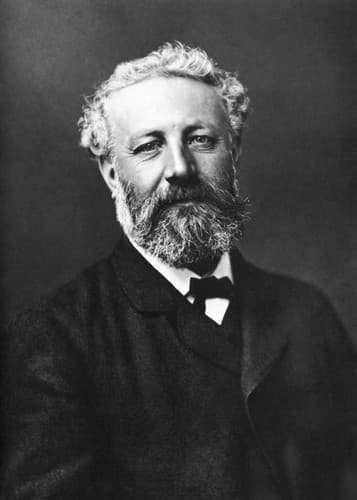
Jules Gabriel Verne was a French novelist, poet, and playwright. His collaboration with the publisher Pierre-Jules Hetzel led to the creation of the Voyages extraordinaires, a series of bestselling adventure novels including Journey to the Center of the Earth (1864), Twenty Thousand Leagues Under the Seas (1870), and Around the World in Eighty Days (1872). His novels, always well documented, are generally set in the second half of the 19th century, taking into account the technological advances of the time.
Similar books
- Around the World in Eighty Days
Jules Verne
3.9 (184k) average on GoodreadsLifestyleAnother classic Verne adventure showcasing human ingenuity and global travel.
- The War of the Worlds
H.G. Wells
3.8 (245k) average on GoodreadsFantasyEarly science fiction exploring humanity's place in the cosmos, though with a darker tone.
- A Journey to the Center of the Earth
Jules Verne
3.9 (227k) average on GoodreadsFeatures a similar premise of daring exploration and scientific speculation.
- Harry Potter and the Sorcerer's Stone
J.K. Rowling
4.5 (7M) average on GoodreadsFantasyRescued from a miserable life under the stairs, an orphaned boy discovers he's a wizard destined for a magical school, where he uncovers a dangerous secret tied to the dark wizard who murdered his parents.
- The Hunger Games
Suzanne Collins
4.3 (6.4M) average on GoodreadsFantasyIn a future where children fight to the death on live television, Katniss Everdeen volunteers for the arena, turning a death sentence into a fight for survival and a spark of rebellion.
- 1984
George Orwell
4.2 (3.1M) average on GoodreadsPoliticsIn a future where surveillance and thought control are absolute, a man's search for truth clashes with the Party, showing that hope can be a form of rebellion.





Enjoyed the summary?
A summary gives you the shape of the book. The book itself has the detail, the examples and the voice.
Find From the Earth to the Moon on AmazonAs an Amazon Associate, BookBrief earns from qualifying purchases. How we're funded