
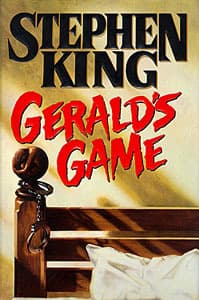
Synopsis
Covers the whole plot, including the ending.
- Difficulty
- Medium
- Pacing
- Moderate
- Mood
- Claustrophobic, Suspenseful, Psychological, Dark, Disturbing
- Read it if
- You want a deeply psychological, claustrophobic thriller that explores trauma, survival, and the dark corners of the human mind.
- Skip it if
- You are sensitive to graphic descriptions of gore, sexual abuse, or find confined settings too anxiety-inducing.
Gerald's Game Plot Summary
Covers the whole plot, including the ending.
The Game Begins
Jessie Mahout Burlingame and her husband, Gerald, arrive at their remote summer house on Dark Score Lake, Maine, for a weekend trip to improve their marriage. Gerald suggests a sexual role-playing game where he handcuffs Jessie to the bedposts. Jessie is uncomfortable at first but agrees, having played this game before. However, the game quickly turns sour as Gerald becomes aggressive, making comments about Jessie's past and her perceived frigidity. Jessie kicks him, and in the argument, Gerald has a heart attack and dies on the bed. Jessie is left alone, handcuffed, with her dead husband beside her.
The First Night and the Voices
After Gerald's death, Jessie's shock turns to terror as she realizes her situation. The remote location means no one will find her for days. Her attempts to free herself fail, causing her wrists to chafe and bleed. As night falls, her mind, lacking sleep and food, begins to break. She starts hearing voices: 'Goody,' a practical and encouraging alter ego; 'Ruth,' a critical and cynical voice; and the disembodied, mocking voice of Gerald himself. These internal dialogues reflect her rising panic and her struggle to stay sane while facing her grim reality.
The Dog and the Moonlight Man
As hours pass, a hungry stray dog, drawn by the smell of death, enters the house through an open door and begins to chew on Gerald's body. Jessie, horrified, tries to scare it away, but her efforts are useless. Her terror peaks when, in the middle of the night, she sees a figure in her bedroom doorway. This gaunt, disfigured man, whom she calls the 'Moonlight Man,' has glowing eyes and carries a box of trinkets and a glass of water. Jessie first believes him to be a hallucination, a manifestation of her darkest fears, but his presence is disturbingly real.
Memories of the Eclipse
The extreme stress and isolation bring back repressed memories from Jessie's childhood, particularly a disturbing event during a total solar eclipse when she was ten. Her father, Tom Mahout, had taken her boating on the lake to watch the eclipse. During the moments of totality, he molested her. This traumatic event, long buried, resurfaces clearly, mixed with her current situation. The memory of the eclipse's darkness and her father's betrayal mirrors her current feeling of entrapment and helplessness, showing the deep psychological scars that have shaped her life and her relationships with men, including Gerald.
The Glass of Water and the Ring
Dehydration becomes a serious threat, adding to Jessie's suffering. The Moonlight Man's glass of water taunts her. Driven by intense thirst, Jessie plans a desperate way to reach the glass of water on the bedside table. She realizes she needs to remove her wedding ring to create enough slack in the handcuff chain to extend her reach. Removing the ring becomes a symbolic breaking of her ties to Gerald and their shared life. Her attempts are agonizing, requiring her to dislocate her thumb and tear her flesh, but she eventually removes the ring.
The Escape Attempt
With her wedding ring off, Jessie now has just enough extra slack in the handcuff chain. She focuses all her remaining strength and resolve on dislocating her thumb and wrist to slip her hand out of the cuff. The process is agonizingly painful, tearing skin and muscle, but her will to survive overcomes the physical torment. The voices in her head, especially Goody, urge her on. After a brutal struggle, she manages to free her right hand, leaving her wrist mangled and bleeding but finally unbound. The immediate relief is immense, but her ordeal is not over.
Encounter with the Moonlight Man
After freeing herself, Jessie collapses on the floor, momentarily overwhelmed by pain and exhaustion. However, the Moonlight Man's presence quickly returns. She sees him clearly this time, a real, terrifying figure with a strong stench, confirming he is not a hallucination. He is a necrophile who collects 'trinkets' from his victims. He approaches her, and in a desperate act of self-preservation, Jessie shatters the glass of water she had finally obtained and uses a shard to slash his face, driving him away. This confrontation confirms the external danger she faces.
The Drive and the Aftermath
Wounded and traumatized, Jessie crawls out of the bedroom, past Gerald's decaying body, and into the living room. She finds Gerald's car keys and, despite her injuries and disorientation, manages to start the car. She drives away from the house, leaving the horror behind, but her journey is full of fear and pain. She eventually reaches a local store, where she collapses and is found by the owner. The physical ordeal is over, but the psychological trauma, especially the resurfacing memory of her father's abuse and the terror of the Moonlight Man, continues to haunt her.
Recovery and Investigation
Jessie is hospitalized for her injuries and severe dehydration. While recovering, she gives a partial account of the events to the authorities, carefully leaving out details about the handcuffs and Gerald's games to protect her reputation. The police investigate the lake house, finding Gerald's body and evidence of a struggle, including the dog's scavenging. The incident is initially ruled an accident. Jessie's mental state remains fragile, and she struggles to reconcile the reality of her ordeal with the public narrative and her own repressed memories.
The Truth About the Moonlight Man
Driven by a need for closure and to understand the reality of the Moonlight Man, Jessie begins her own investigation after her recovery. She searches newspaper archives and police reports, eventually discovering that the 'Moonlight Man' is Raymond Andrew Joubert, a serial killer and necrophile responsible for several unsolved murders and grave desecrations across Maine. He has acromegaly, a condition that explains his disfigured appearance. This discovery confirms her sanity and the reality of her terror, confirming that he was not a hallucination, but a very real and dangerous predator.
Confrontation and Closure
Jessie decides to attend Raymond Andrew Joubert's trial, not as a witness, but as an observer seeking a final confrontation with her fear. Seeing him in person, stripped of the terrifying mystique he held in her mind, helps her process the trauma. She realizes that while he was real and dangerous, he was also just a man. During the trial, she makes eye contact with Joubert, and in that moment, she feels a sense of power and closure. Her attendance marks a significant step in her healing process, allowing her to reclaim her agency and move past the victimhood she had experienced.
A New Beginning
Having confronted both the external horror of Raymond Andrew Joubert and the internal trauma of her childhood abuse, Jessie begins to rebuild her life. She writes a book, detailing her experiences, not just for herself but to help others who might have suffered similar fates. She acknowledges the lasting scars but also celebrates her resilience and survival. The experience, while horrific, leads her to a deeper understanding of herself and a new strength, allowing her to live authentically and free from the psychological chains that had bound her for so long.
Principal Figures
Jessie Mahout Burlingame
Protagonist
A woman trapped in a nightmare, forced to confront her past and fight for survival.
Jessie is a seemingly ordinary woman in her forties, married to Gerald Burlingame. Initially presented as somewhat passive and submissive in her marriage, she possesses a deep well of repressed trauma from her childhood sexual abuse. Her intelligence and resilience are slowly revealed as she faces extreme physical and psychological challenges. She is deeply introspective, and her internal monologues with her alter egos, Goody and Ruth, provide insight into her fragmented mental state and her struggle for self-preservation.
Relationships: Gerald Burlingame (Husband; abusive, controlling, ultimately deceased during their 'game'.); Tom Mahout (Father; her abuser, whose memory haunts her.); Sally Mahout (Mother; complicit in her father's abuse through inaction and denial.); Goody (An alter ego/inner voice; pragmatic, supportive, and encouraging.); Ruth (An alter ego/inner voice; cynical, critical, and realistic.); Raymond Andrew Joubert (The 'Moonlight Man'; a serial killer and necrophile who preys on her.)
Gerald Burlingame
Antagonist/Catalyst
Jessie's husband, whose death sets off the central conflict.
Gerald is a successful, controlling, and sexually aggressive lawyer. He enjoys power dynamics in the bedroom, often pushing Jessie beyond her comfort zone. Despite his affluence and apparent charm, he harbors a cruel streak, particularly evident in his taunts towards Jessie during their 'game.' His sudden death from a heart attack is the inciting incident, but his presence, both physical (as a corpse) and psychological (as a voice in Jessie's head), continues to torment Jessie throughout her ordeal.
Relationships: Jessie Burlingame (Wife; he is sexually controlling and emotionally manipulative towards her.)
Raymond Andrew Joubert (The Moonlight Man)
Antagonist
A real-life serial killer and necrophile who terrorizes Jessie.
Initially appearing as a terrifying hallucination, the Moonlight Man is later revealed to be Raymond Andrew Joubert, a real serial killer suffering from acromegaly, which gives him a disfigured, gaunt appearance and glowing eyes in the dark. He is a necrophile who collects 'trinkets' from his victims. His silent, menacing presence and the stench of decay he carries make him a horrifying external threat to Jessie, embodying a primal fear. He represents the ultimate violation, both physical and psychological.
Relationships: Jessie Burlingame (Victim (intended); he preys on her while she is helpless.)
Goody
Supporting/Inner Voice
Jessie's pragmatic and encouraging alter ego.
Goody is one of Jessie's internal voices, often serving as her practical, problem-solving, and encouraging alter ego. She represents Jessie's will to survive and her logical mind, offering advice on how to escape and pushing her through moments of despair. Goody embodies the strength and resilience Jessie possesses, helping her to focus on the immediate tasks required for survival, such as reaching the water or freeing her hand.
Relationships: Jessie Burlingame (An aspect of Jessie's own psyche, providing support and motivation.)
Ruth
Supporting/Inner Voice
Jessie's cynical and critical alter ego.
Ruth is another of Jessie's internal voices, often acting as the more cynical, critical, and sometimes self-pitying aspect of her personality. She represents Jessie's doubts, fears, and the part of her that wants to give up. While she can be harsh, Ruth also serves to ground Jessie in the grim reality of her situation, sometimes offering a dark humor or a stark assessment of her chances. Her presence highlights Jessie's internal conflict and despair.
Relationships: Jessie Burlingame (An aspect of Jessie's own psyche, representing her doubts and despair.)
Tom Mahout
Mentioned/Flashback Antagonist
Jessie's deceased father, the source of her childhood trauma.
Tom Mahout is Jessie's father, who sexually abused her during a solar eclipse when she was ten years old. Though deceased, his memory and the trauma he inflicted are central to Jessie's psychological journey. He represents the deep-seated psychological chains that have bound Jessie, influencing her relationships and her sense of self-worth. The resurfacing of this memory is crucial for Jessie's ultimate healing and understanding of her own past.
Relationships: Jessie Burlingame (Daughter; he is her abuser.); Sally Mahout (Wife; she is complicit through her denial and inaction.)
Sally Mahout
Mentioned/Flashback Character
Jessie's mother, complicit in her father's abuse through denial.
Sally Mahout is Jessie's mother, who, through her denial and inaction, was complicit in her husband Tom's abuse of Jessie. Her passive acceptance and subsequent erasure of the traumatic event further traumatized Jessie, making her feel unseen and unheard. Sally represents the societal pressures and family dynamics that allow abuse to fester and remain hidden, contributing to Jessie's repression and psychological damage.
Relationships: Jessie Burlingame (Daughter; she failed to protect Jessie.); Tom Mahout (Husband; she enabled his abuse through her silence.)
The Dog
Supporting
A stray dog that scavenges Gerald's corpse, adding to Jessie's horror.
A hungry stray dog, attracted by the scent of death, enters the lake house and begins to feed on Gerald's corpse. The dog's presence adds a visceral layer of horror and disgust to Jessie's ordeal. It symbolizes the brutal reality of death and decay, stripping away any dignity from Gerald's demise and intensifying Jessie's feelings of helplessness and revulsion. Its actions underscore the isolation and the animalistic nature of survival.
Relationships: Gerald Burlingame (Prey (as a corpse).); Jessie Burlingame (Tormentor (indirectly, by feeding on Gerald).)
Themes & Insights
Trauma and Repression
The novel explores the long-lasting effects of childhood trauma and psychological repression. Jessie's horrifying situation forces her childhood sexual abuse by her father during a solar eclipse to resurface. This repressed memory, symbolized by the 'eclipse' in her mind, has shaped her adult life, relationships, and sense of self. The book shows how buried trauma can appear in various forms, from emotional detachment to internal conflict, and how facing it is essential for healing and self-liberation. The voices in Jessie's head—Goody and Ruth—can be seen as fractured aspects of a mind dealing with unprocessed pain, finally brought to light.
“What you don't know can hurt you, what you do know can kill you.”
Survival and Resilience
At its heart, 'Gerald's Game' is a story of survival against overwhelming odds. Jessie faces not only physical threats like dehydration, injury, and the Moonlight Man, but also immense psychological pressure, including isolation, fear, and the resurfacing of deep trauma. Her journey from utter helplessness, handcuffed to a bed, to actively fighting for her life shows extraordinary human resilience. The detailed descriptions of her efforts to free herself, even dislocating her thumb, highlight the primal will to live. Her eventual escape and subsequent investigation into the Moonlight Man show her transformation from victim to an active participant in her own recovery.
“Sometimes you have to go a long, long way out of your way to come back a short way correctly.”
The Power of the Mind
Stephen King effectively uses Jessie's isolation to show the incredible and terrifying power of the human mind. Without external stimuli, Jessie's mind becomes her greatest ally and her worst enemy. Her hallucinations, including the critical 'Ruth' and the encouraging 'Goody,' illustrate the mind's ability to create internal support systems and process overwhelming information. The blurred lines between reality and hallucination—especially regarding the Moonlight Man—show the mind's fragility under extreme stress. Ultimately, Jessie's mental fortitude, her ability to analyze, plan, and endure, allows her to survive, demonstrating that the mind is both a prison and a key to freedom.
“The mind can be a wonderful tool, or it can be a terrible weapon.”
Control and Power Dynamics
The novel begins with a game of control, with Gerald asserting dominance over Jessie through handcuffs, and this theme runs through the entire narrative. Gerald's desire to control Jessie, and the subsequent loss of that control through his death, sets the stage. Jessie then struggles with her lack of control over her physical situation, her body, and her own mind as repressed memories surface. The Moonlight Man represents an external force of ultimate violation and control. The recurring handcuffs symbolize not just physical restraint but also the psychological chains of past trauma and societal expectations that have bound Jessie. Her journey is about reclaiming control over her body, her past, and her future.
“The only way to beat the game is to stop playing it.”
Plot Devices & Literary Techniques
The Handcuffs
A literal and symbolic restraint.
The handcuffs are the central physical plot device, directly trapping Jessie and initiating her entire ordeal. Beyond their literal function, they serve as a powerful symbol of Jessie's psychological entrapment: by her marriage, by her repressed trauma, and by her own passivity. Her struggle to free herself from them is not just a physical act of survival but a symbolic breaking of the chains of her past and a reclamation of her autonomy. The pain and effort involved in her escape underscore the difficulty of shedding psychological burdens.
Internal Monologue and Alter Egos
The fragmented voices within Jessie's mind.
Due to her extreme isolation, Jessie's primary interactions are with the voices in her head: 'Goody' and 'Ruth,' along with the imagined voice of Gerald. This internal monologue serves multiple purposes: it provides exposition, reveals Jessie's past and psychological state, drives the plot forward by having her debate survival strategies, and showcases the fracturing of her mind under duress. These alter egos represent different facets of her personality, allowing the author to explore her character depth without external dialogue, while also blurring the lines between sanity and hallucination.
The Solar Eclipse
A recurring motif linking past trauma to present horror.
The solar eclipse functions as a powerful, recurring motif that links Jessie's past trauma to her present horror. The original eclipse marked the moment of her childhood sexual abuse by her father, becoming a symbol of a 'darkness' that overshadowed her life. Its resurfacing in her memory during her entrapment connects the past violation with her current vulnerability and feeling of being exposed and consumed. The 'ring of light' during totality also subtly mirrors the wedding ring she must remove, further intertwining the themes of trauma, memory, and liberation.
The Moonlight Man
A manifestation of fear that blurs reality and hallucination.
The Moonlight Man initially appears as a terrifying hallucination, a grotesque figure that embodies Jessie's deepest fears of violation and death. This device effectively ratchets up the psychological horror, making the reader question Jessie's sanity. However, the eventual revelation that he is a real serial killer, Raymond Andrew Joubert, grounds the supernatural dread in a tangible, horrifying reality. This shift from imagined horror to concrete threat reinforces Jessie's resilience and provides a tangible enemy for her to overcome, ultimately validating her experience.
Dehydration
A physiological threat that intensifies desperation and hallucinations.
Dehydration is a critical physiological plot device that adds immense pressure and urgency to Jessie's struggle. The relentless thirst intensifies her physical suffering, making her pursuit of the glass of water a desperate, agonizing quest. Beyond the physical toll, dehydration contributes significantly to her mental deterioration, blurring the lines between reality and hallucination and making her more susceptible to the internal voices and the perceived presence of the Moonlight Man. It underscores the fragility of the human body and mind under extreme duress.
Gerald's Game Quotes
“The only thing you have to fear is fear itself... and a couple of other things, maybe.”
“The past is a wheel. If you don't learn from it, it will roll over you.”
“Sometimes the things that hurt you the most are the things you can't see.”
“There are no monsters under the bed, not really. But there are monsters inside us.”
“A man's got to do what a man's got to do. And a woman's got to do what a woman's got to do, especially when no man is around to help.”
“The silence was the worst. It was a silence that ate at you, gnawed at you, until there was nothing left but the silence itself.”
“Sometimes the only way out is through.”
“The world is full of things that can hurt you, but the most dangerous things are the ones you carry inside.”
“You can never truly escape your past, but you can learn to live with it.”
“That's what fear does. It makes you do things you never thought you'd do.”
“There are times when the only thing that matters is not giving up.”
“The mind is a powerful thing, capable of both creating and destroying.”
“Sometimes the greatest freedom is found in facing what you fear the most.”
Quiz
10 questions on the plot and the characters. Each answer comes with a short explanation.
Question 1
What is the name of the main character, who finds herself handcuffed to the bed?
- Jessie Burlingame
- Jessie Mahout
- Gerald Burlingame
- Ruth Neary
Show answer
A. Jessie Burlingame The main character is Jessie Burlingame, who is left handcuffed after her husband's death.
Question 2
How does Gerald Burlingame die at the beginning of the novel?
- He is stabbed by Jessie.
- He suffers a heart attack.
- He falls and hits his head.
- He is attacked by an intruder.
Show answer
B. He suffers a heart attack. Gerald dies of a heart attack shortly after handcuffing Jessie to the bed, leaving her stranded.
Question 3
What significant item is Jessie desperate to reach but is just out of her grasp for most of her ordeal?
- A glass of water
- The house phone
- Her car keys
- A box of matches
Show answer
A. A glass of water Jessie is tormented by the presence of a glass of water on the nightstand, just beyond her reach, as she suffers from extreme thirst.
Question 4
What recurring hallucination or vision does Jessie experience while trapped?
- Her childhood dog
- A benevolent spirit offering help
- A gaunt, seemingly deformed figure watching her
- Her mother comforting her
Show answer
C. A gaunt, seemingly deformed figure watching her Jessie repeatedly sees a figure she calls 'The Moonlight Man' or 'Space Cowboy,' a gaunt, deformed individual who she initially believes is real, but later questions.
Question 5
What is the primary psychological defense mechanism Jessie employs to cope with her traumatic situation?
- She sings songs to distract herself.
- She engages in elaborate fantasy scenarios.
- She splits into multiple internal personalities (Jessie, Ruth, Goody).
- She attempts to communicate with the outside world through telepathy.
Show answer
C. She splits into multiple internal personalities (Jessie, Ruth, Goody). Jessie's mind fragments into different personas—Jessie, Ruth (her more practical, cynical side), and Goody (her innocent, childlike self)—to process the trauma and find solutions.
Question 6
What childhood trauma does Jessie recall that is directly linked to her current predicament?
- Being lost in the woods during a family camping trip.
- Witnessing a fatal car accident.
- Being sexually abused by her father during a solar eclipse.
- Being abandoned by her mother at a young age.
Show answer
C. Being sexually abused by her father during a solar eclipse. Jessie's repressed memory of being sexually abused by her father during a solar eclipse is a central theme, and the psychological trauma resurfaces during her ordeal.
Question 7
How does Jessie ultimately free herself from the handcuffs?
- She picks the locks with a hairpin.
- She uses a piece of broken glass to cut her wrist and slip her hand out.
- She manages to unscrew the bedposts.
- A neighbor hears her screams and breaks in.
Show answer
B. She uses a piece of broken glass to cut her wrist and slip her hand out. In a desperate act, Jessie breaks a glass and uses a shard to severely cut her hand, allowing her to slip her hand free from the cuff.
Question 8
What is the true identity of the 'Moonlight Man' that Jessie saw, and how is it revealed?
- He was a figment of her imagination, a manifestation of her fear.
- He was a neighbor checking on the house, confirmed by police later.
- He was Raymond Andrew Joubert, a real necrophiliac serial killer, whom she recognizes in a newspaper article.
- He was Gerald's secret associate, attempting to retrieve something from the house.
Show answer
C. He was Raymond Andrew Joubert, a real necrophiliac serial killer, whom she recognizes in a newspaper article. After her escape, Jessie sees a newspaper article about Raymond Andrew Joubert, a necrophiliac serial killer, and recognizes him as the 'Moonlight Man' she saw, confirming he was a real person and not a hallucination.
Question 9
What does Jessie ultimately decide to do about her father's abuse?
- She confronts her mother about it, who denies everything.
- She writes a tell-all book, exposing her father's crimes.
- She decides to move on and forget about it, focusing on her recovery.
- She attends a support group and shares her story publicly, confronting her past.
Show answer
D. She attends a support group and shares her story publicly, confronting her past. Jessie's ordeal leads her to finally confront and accept her past trauma. She attends a support group for survivors of sexual abuse and shares her story, finding a path toward healing and justice.
Question 10
What is the significance of the solar eclipse in Jessie's memories and her present ordeal?
- It symbolizes a rare moment of peace and tranquility in her life.
- It marks the exact time Gerald died, making her feel cursed.
- It is the backdrop to her childhood sexual abuse, and the memory of it becomes a catalyst for understanding her current trauma.
- It is a recurring natural phenomenon that happens every time she feels trapped.
Show answer
C. It is the backdrop to her childhood sexual abuse, and the memory of it becomes a catalyst for understanding her current trauma. The solar eclipse is inextricably linked to Jessie's repressed memory of being sexually abused by her father. The 'black sun' and the 'diamond ring' effect become powerful, terrifying symbols that unlock her past trauma, which in turn helps her understand her current psychological state and find the strength to survive.
Gerald's Game FAQ
What is the core premise of 'Gerald's Game'?
Jessie Mahout and her husband, Gerald, go to their remote lake house for a weekend getaway. Gerald suggests a kinky game involving handcuffs, but during the act, he suddenly dies of a heart attack, leaving Jessie bound to the bed with no hope of immediate rescue.
How does Jessie's isolation contribute to the horror?
Jessie's isolation is extreme; the lake house is miles from civilization, and no one knows they are there. This lack of external help forces her to confront her inner demons and makes her physical predicament feel utterly inescapable, amplifying the psychological terror.
Who is the 'Space Cowboy' and what is his significance?
The 'Space Cowboy' is a hallucination Jessie experiences, a manifestation of her darkest fears and a symbolic representation of death itself. He appears as a gaunt, disfigured man, often accompanied by the smell of decay, and he serves as a constant, terrifying reminder of her impending demise.
What role does the stray dog play in Jessie's survival?
A stray dog enters the house and begins to devour Gerald's corpse, a gruesome detail that forces Jessie to confront her situation with extreme urgency. The dog's presence, while horrifying, also acts as a catalyst, pushing her to find a way to escape before she, too, becomes prey.
How does Jessie ultimately escape the handcuffs?
Driven by extreme thirst, hunger, and terror, Jessie devises a desperate plan to free herself. She purposely cuts her wrists on a broken glass of water, using the blood as lubrication to slip her hands out of the cuffs, enduring immense pain and risking severe injury.
What is the 'Moonlight Man' and how is he connected to Jessie's past?
The 'Moonlight Man' is actually Raymond Andrew Joubert, a real serial killer and necrophile who coincidentally enters Jessie's house during her ordeal. Later, Jessie recognizes him from her childhood, realizing he was the same man who stalked her and her family during her father's sexual abuse.
What is the significance of the eclipse in Jessie's childhood memory?
The eclipse occurs on the day Jessie's father sexually abuses her. The obscuring of the sun by the moon symbolizes the darkness that descends upon her life and the profound trauma she experiences, forever linking the celestial event to her deepest psychological wounds.
How do the voices in Jessie's head represent different aspects of her psyche?
Jessie's internal dialogue features distinct 'voices' – Goody, Ruth, and Nora – each representing a facet of her personality: Goody is her inner child, Ruth is her strong, protective side, and Nora is her pragmatic, rational self. These voices debate, console, and challenge her, helping her process her trauma and strategize her survival.
What psychological impact does Gerald's death have on Jessie beyond her immediate predicament?
Gerald's death, while accidental, triggers a profound psychological unraveling for Jessie, forcing her to confront years of suppressed memories and trauma. The physical binding mirrors her emotional bondage to her past and her husband, leading to a breakdown and eventual breakthrough.
How does the novel explore themes of memory and trauma?
The novel uses Jessie's extreme confinement to force her to relive repressed memories of childhood sexual abuse by her father, particularly during a solar eclipse. Her present trauma unlocks the past, showing how deeply ingrained and influential these early experiences are on her adult life and coping mechanisms.
In what ways does Jessie's relationship with Gerald reflect her past trauma?
Jessie's relationship with Gerald is subtly defined by her past trauma, particularly her father's abuse. Gerald's controlling nature and his desire for dominance during their sex games unconsciously mirror the power dynamics of her childhood abuse, keeping her in a state of psychological subjugation.
Is the 'Moonlight Man' a supernatural entity or a real person?
Initially, the 'Moonlight Man' appears to be a supernatural or hallucinated figure, adding to Jessie's terror. However, the novel later reveals he is a very real serial killer, Raymond Andrew Joubert, whose presence grounds the supernatural elements in a terrifying reality, making him even more menacing.
How does the ending of 'Gerald's Game' challenge traditional thriller tropes?
The ending of 'Gerald's Game' subverts expectations by shifting from a confined psychological thriller to a broader narrative about trauma and justice. Jessie's survival is not just physical; it's a profound psychological triumph, culminating in her confronting and exposing her abuser (the Moonlight Man) in court, rather than a simple escape.
What is the significance of the glass of water in Jessie's escape?
The glass of water, initially a symbol of her desperate thirst and unreachable salvation, becomes the instrument of her escape. By breaking it and using the shards to cut herself, Jessie transforms an object of desire into a tool of painful liberation, highlighting her extreme resolve and the novel's dark ingenuity.
How does the novel explore the concept of victimhood and empowerment?
Jessie begins as a victim, both physically bound and psychologically trapped by her past. However, through her ordeal, she actively reclaims her agency, not only by escaping the handcuffs but also by confronting her repressed trauma and ultimately testifying against the Moonlight Man, transforming her victimhood into a source of strength and empowerment.
Why does Stephen King dedicate so much time to Jessie's internal monologues?
King dedicates extensive time to Jessie's internal monologues to immerse the reader deeply into her psychological state. This allows for a nuanced exploration of her trauma, her coping mechanisms, and the unraveling of her mind, making her struggle intensely personal and the horror primarily psychological rather than external.
About the author

Stephen Edwin King is an American author of horror, supernatural fiction, suspense, crime, science-fiction, and fantasy novels. Described as the "King of Horror", his books have sold more than 350 million copies as of 2006, and many have been adapted into films, television series, miniseries, and comic books. King has published over 65 novels/novellas, including seven under the pen name Richard Bachman, and five non-fiction books. He has also written approximately 200 short stories, most of which have been published in book collections.
Similar books
- Misery
Stephen King
4.2 (499k) average on GoodreadsThrillerFeatures a protagonist held captive and forced to endure extreme physical and psychological torment.
- The Girl Who Loved Tom Gordon
Stephen King
3.6 (133k) average on GoodreadsThrillerExplores a female protagonist's struggle for survival and sanity against overwhelming odds in isolation.
- Room
Emma Donoghue
4.1 (714k) average on GoodreadsThrillerFocuses on a protagonist's experience of captivity and the psychological impact of confinement.
- Rosemary's Baby
Ira Levin
4.0 (112k) average on GoodreadsThrillerWhile both are psychological thrillers, Rosemary's Baby generates terror through external, conspiratorial threats and a growing sense of paranoia about those around the protagonist. Gerald's Game, in contrast, internalizes the horror, focusing on Jessie's battle with her own mind, memories, and the physical constraints of her situation. Levin's work relies on a slow-burn external menace, whereas King's emphasizes an internal psychological battle.
- Gone Girl
Gillian Flynn
4.1 (2.3M) average on GoodreadsThrillerBoth novels feature psychological suspense and explore dark aspects of relationships. However, Gone Girl is a mystery driven by external events, unreliable narrators, and a complex plot of manipulation and deception between two characters. Gerald's Game is primarily a survival story and a journey of psychological confrontation with past trauma, contained almost entirely within one character's experience and immediate surroundings, with less emphasis on external plot twists.
- Angels & Demons
Dan Brown
3.9 (2.7M) average on GoodreadsThrillerA Harvard symbologist races through Rome's ancient sites, deciphering cryptic clues to unmask the Illuminati and stop a vengeful plot to destroy the Vatican with a stolen antimatter weapon.




Enjoyed the summary?
A summary gives you the shape of the book. The book itself has the detail, the examples and the voice.
Find Gerald's Game on AmazonAs an Amazon Associate, BookBrief earns from qualifying purchases. How we're funded