
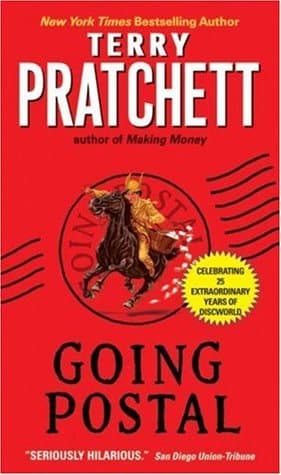
Synopsis
Covers the whole plot, including the ending.
- Difficulty
- Medium
- Pacing
- Moderate
- Mood
- Witty, Humorous, Hopeful, Satirical, Clever
- Read it if
- You enjoy satirical fantasy with clever wordplay, intricate world-building, and a heartwarming story about redemption and the power of human (and non-human) spirit.
- Skip it if
- You prefer serious, grimdark fantasy or dislike books that blend humor with social commentary.
Going Postal Plot Summary
Covers the whole plot, including the ending.
A New Life (Or Death) for Albert Spangler
The notorious con man Albert Spangler, known by many aliases, including Moist von Lipwig, is at the gallows, having been caught for his numerous frauds. After a seemingly successful hanging, he awakens in the office of Lord Vetinari, the Patrician of Ankh-Morpork. Vetinari offers Moist a stark choice: become the new Postmaster of the Ankh-Morpork Post Office, a position that has proven fatal for previous incumbents, or face a permanent, less comfortable end. With a golem named Mr. Pump assigned as his parole officer and a very persuasive Patrician, Moist reluctantly accepts, shedding his old identity for a seemingly impossible new one.
A Mountain of Mail and a Few Eccentrics
Moist is taken to the Ankh-Morpork Post Office, a crumbling, forgotten building filled with decades of undelivered mail. He meets his only staff: Tolliver Groat, the elderly, dedicated Senior Postman, and his assistant, Stanley Howler, a young man obsessed with pins. The sheer volume of mail is overwhelming, forming literal mountains within the building, and Moist hears whispers from it, a phenomenon attributed to the 'glom of nit.' He quickly realizes the monumental task ahead and the near-impossible odds of revitalizing the institution, especially against the dominant Grand Trunk clacks monopoly.
The First Deliveries and a Spark of Hope
Moist wants the Post Office to function and decides to tackle the oldest mail first. He employs a few temporary staff and a clever scheme involving a 'stamp' system to process the letters. During this, he meets Adora Belle Dearheart, a cynical but intelligent activist working for the Golem Trust. She is unimpressed by Moist, viewing him as just another con artist, but her sharp wit and independent spirit intrigue him. Moist's initial efforts begin to clear a small portion of the immense backlog, offering a glimmer of hope to the long-forgotten institution.
The Clacks Monopoly and Reacher Gilt's Influence
Moist investigates the Grand Trunk clacks company, which has completely monopolized communication in Ankh-Morpork and beyond. He discovers their predatory business practices, exorbitant prices, and their deliberate sabotaging of the Post Office to maintain their dominance. The company is run by the ruthless Reacher Gilt, a man who built his empire on ambition and a willingness to eliminate any competition. Moist realizes that reviving the Post Office means directly challenging Gilt and his powerful, corrupt organization, which controls the city's communication infrastructure.
Stamps, Publicity, and a Golem's Insight
Moist, drawing on his con artist past, creates an innovative system of collectible stamps, turning the mundane act of mailing into a fashionable trend. He uses elaborate, often theatrical, publicity stunts, including a staged 'Post Office robbery' to generate buzz. Mr. Pump, initially just a watchful guardian, begins to offer insightful advice and assistance, revealing a deeper understanding of human nature and the city's workings than Moist initially expected. The Post Office slowly starts to gain public attention and a trickle of new customers, to the chagrin of the Grand Trunk.
The Race Against the Clacks
To truly prove the Post Office's worth, Moist boldly challenges the Grand Trunk to a race: a letter carried by postal relay against a message sent via clacks to Genua and back. The stakes are high, with the reputation and future of the Post Office on the line. Moist meticulously plans the route, utilizing a network of postmen, horses, and even a golem, to ensure the fastest possible delivery. The race generates immense public interest and becomes a symbol of the underdog fighting against the corporate giant, captivating the entire city of Ankh-Morpork.
Sabotage and the Spirit of the Post
During the race, the Grand Trunk, under Gilt's orders, attempts to sabotage the Post Office's efforts. They employ various tactics, including tampering with the clacks towers and attempting to delay the postal carriers. However, the dedication of the postmen, the ingenuity of Moist, and the surprising assistance of other clacks operators (who are disillusioned with Gilt's regime) ensure the race continues. The 'glom of nit' — the collective memory of the undelivered mail — also seems to guide and protect the Post Office's efforts.
Victory, Revelations, and a New Era
Against all odds, the Post Office wins the race, delivering its message back to Ankh-Morpork before the Grand Trunk's clacks system. The victory galvanizes public opinion and exposes the Grand Trunk's inefficiency and corruption. Information about Gilt's past misdeeds and the deliberate downplaying of the clacks system's inherent flaws (including the death of the original inventors) comes to light, largely due to Adora Belle's investigations and the defection of some clacks operators. Reacher Gilt is disgraced and eventually 'reassigned' by Lord Vetinari, leaving the Grand Trunk vulnerable.
Facing the Glom of Nit
With the Post Office now thriving, Moist still faces the challenge of the 'glom of nit' – the sentient, whispering mass of undelivered mail. He discovers that the mail is not malevolent, but simply yearns to be delivered. He devises a plan to gradually burn the oldest, undeliverable letters in a ceremonial furnace, releasing their accumulated energy and satisfying their longing for completion. This act brings a sense of peace to the Post Office and allows the building to function without the oppressive weight of the past, fully embracing its new purpose.
The Future of the Post and a New Challenge
Under Moist's leadership, the Ankh-Morpork Post Office is a resounding success, a symbol of efficiency and public service. He embraces his new identity as Moist von Lipwig, finding genuine satisfaction in his work and a sense of purpose he never had as a con artist. His relationship with Adora Belle Dearheart deepens, evolving from mutual respect to genuine affection. Lord Vetinari, ever watchful, acknowledges Moist's triumph but subtly hints at new, equally impossible challenges awaiting him, ensuring that Moist's life in Ankh-Morpork will never be dull.
Principal Figures
Moist von Lipwig
Protagonist
A master con artist forced into a government job as Postmaster of Ankh-Morpork.
Moist von Lipwig is a charming, intelligent, and incredibly resourceful con man who, under the alias Albert Spangler, is caught and 'hanged.' Offered a choice between death and becoming the Postmaster by Lord Vetinari, he reluctantly accepts. Initially cynical and always looking for an angle, Moist gradually finds a genuine purpose in revitalizing the moribund Post Office. His past skills in manipulation, publicity, and understanding human psychology prove invaluable, but he slowly transforms from a self-serving fraudster into a dedicated public servant, driven by a desire to impress Adora Belle and a newfound sense of responsibility.
Relationships: Lord Vetinari (Employer/Manipulator); Adora Belle Dearheart (Love interest/Colleague); Mr. Pump (Golemic parole officer/Confidant); Tolliver Groat (Loyal subordinate)
Lord Vetinari
Supporting
The Patrician of Ankh-Morpork, a shrewd and manipulative ruler who orchestrates Moist's new life.
Lord Havelock Vetinari is the Patrician of Ankh-Morpork, a highly intelligent, pragmatic, and utterly ruthless ruler. He sees potential in Moist von Lipwig's unique skills and 'rehabilitates' him by forcing him into a position of public service. Vetinari is a master of psychological manipulation, never directly ordering but subtly guiding individuals to achieve his desired outcomes. He represents the overarching authority and the often-unseen hand that steers the city's destiny, always valuing efficiency and progress, even if it requires unconventional methods. His dry wit and calm demeanor mask a steel-trap mind.
Relationships: Moist von Lipwig (Employee/Pawn); Reacher Gilt (Opponent/Target of Vetinari's machinations)
Adora Belle Dearheart
Supporting
A cynical but passionate activist for the Golem Trust, who becomes Moist's love interest.
Adora Belle Dearheart is a sharp-witted, intelligent, and fiercely independent woman who runs the Golem Trust, advocating for golems' rights. She is initially highly suspicious of Moist, seeing through his charming facade to the con artist beneath. Her cynicism stems from past betrayals, particularly involving the Grand Trunk company, which caused her father's death. Despite her tough exterior, she is deeply compassionate and driven by a strong sense of justice. She becomes a crucial ally to Moist, providing him with information and a moral compass, and eventually develops a romantic relationship with him.
Relationships: Moist von Lipwig (Love interest/Colleague); Mr. Pump (Golemic friend/Client of the Golem Trust); Reacher Gilt (Personal enemy)
Mr. Pump
Supporting
A silent, observant golem assigned as Moist's parole officer and bodyguard.
Mr. Pump is a Golem 19,000, a large and imposing golem assigned by Lord Vetinari to ensure Moist von Lipwig does not try to escape his new job. Initially a stoic and seemingly emotionless guardian, Mr. Pump proves to be incredibly observant, intelligent, and surprisingly insightful. He speaks only when necessary, often in short, profound statements, and acts as Moist's silent confidant and moral anchor. He represents the evolving role of golems in Ankh-Morpork society and serves as a powerful symbol of duty, loyalty, and the potential for a deeper, non-human understanding of the world.
Relationships: Moist von Lipwig (Charge/Friend); Adora Belle Dearheart (Friend/Client of the Golem Trust)
Tolliver Groat
Supporting
The incredibly ancient and loyal Senior Postman, dedicated to the Post Office despite its decline.
Tolliver Groat is the oldest living Postman in Ankh-Morpork, a man of immense age and unwavering dedication to the Post Office. He has seen its glory days and its long, slow decline, yet his spirit remains unbroken. Groat is a repository of postal knowledge and tradition, deeply committed to the idea of the mail. He is initially skeptical of Moist but quickly becomes his most loyal and enthusiastic supporter, embodying the enduring spirit of public service. His simple, earnest nature provides a moral counterpoint to Moist's cynical past.
Relationships: Moist von Lipwig (Boss/Friend); Stanley Howler (Mentor/Colleague)
Stanley Howler
Supporting
A young, socially awkward Postman with an obsessive love for pins.
Stanley Howler is a young man with a peculiar obsession with pins, which he collects, sorts, and even categorizes with meticulous detail. He is socially awkward but possesses a keen eye for detail and an unexpected talent for organization, which Moist cleverly exploits for the Post Office's benefit. Stanley represents the younger generation of postal workers, initially overshadowed by the Post Office's decay but eager to contribute. His unique hobby becomes a metaphor for the careful sorting and delivery of mail, and he finds a sense of belonging and purpose under Moist's guidance.
Relationships: Moist von Lipwig (Boss/Mentor); Tolliver Groat (Colleague)
Reacher Gilt
Antagonist
The ruthless and corrupt chairman of the Grand Trunk clacks company.
Reacher Gilt is the primary antagonist, the cunning and avaricious chairman of the Grand Trunk clacks company. He built his empire through ruthless business practices, eliminating competition, and exploiting loopholes. Gilt is utterly devoid of scruples, prioritizing profit above all else, even at the cost of human lives (as seen with the clacks inventors). He embodies corporate greed and corruption, seeing the Post Office as an anachronism to be crushed. His downfall is brought about by Moist's ingenuity, public opinion, and the exposure of his unethical past, facilitated by Adora Belle.
Relationships: Moist von Lipwig (Rival/Opponent); Adora Belle Dearheart (Enemy (due to her father's death)); Lord Vetinari (Ultimate Authority/Judge)
Mr. Pony
Supporting
The head of the Grand Trunk's clacks operations, a victim of Gilt's manipulation.
Mr. Pony is the chief engineer and operational head of the Grand Trunk clacks system. He is a skilled technician and initially loyal to the company, but he is also aware of its flaws and the ethical compromises made under Reacher Gilt's leadership. Pony represents the disillusioned employees within the Grand Trunk who are tired of Gilt's corrupt practices. He eventually provides crucial information and assistance to Moist and Adora Belle, helping to expose Gilt's misdeeds and demonstrating that not everyone within the corporate giant is entirely evil.
Relationships: Reacher Gilt (Boss); Moist von Lipwig (Rival turned ally)
Themes & Insights
Redemption and Second Chances
The central theme revolves around Moist von Lipwig's forced redemption. From a life of fraud and self-interest, he is given a second chance by Lord Vetinari to become a productive member of society. Initially, he views it as another con, but through his efforts to revive the Post Office, he genuinely finds purpose and pride. This theme is explored through his internal conflict and his eventual embrace of his new identity, showing that even the most cynical individuals can find a path to doing good, as seen when he genuinely cares about delivering the mail and helping the city.
“You have been given a job, Mr. Lipwig. You may not like it, but you will do it. And you will do it well. Or you will be dead.”
The Power of Communication and Information
The novel shows the importance of communication, whether through physical letters or the clacks system. The Post Office's decay symbolizes a breakdown in personal connection, while the Grand Trunk's monopoly represents the control of information for profit. Moist's efforts to revive the Post Office are a fight for accessible, reliable communication, emphasizing its role in connecting people, building community, and enabling truth to spread. The 'glom of nit' itself is neglected communication, desperate to fulfill its purpose.
“People wanted to communicate. They wanted to know things. They wanted to be told things. They wanted to tell things.”
Corporate Greed vs. Public Service
This theme is shown by the direct conflict between the Grand Trunk clacks company, driven solely by profit and monopolistic control, and the Post Office, which, under Moist, strives to embody public service. Reacher Gilt represents the destructive nature of unchecked corporate greed, willing to sacrifice safety and ethics for financial gain. In contrast, Moist, despite his past, comes to champion the idea of providing a vital service to the community, showing that institutions can and should prioritize public good over private enrichment. The city's embrace of the Post Office's revival is a triumph of public interest.
“The Grand Trunk had ceased to be a service and become a power.”
Identity and Self-Invention
Moist von Lipwig is a master of reinventing himself, having used countless aliases. The book explores whether his new identity as Postmaster is just another con or a genuine transformation. He struggles with his past, but by genuinely committing to his role, he forges a new, authentic identity. This theme is also subtly reflected in the golems, who, despite being constructs, develop individual personalities and desires, pushing the boundaries of what it means to 'be' someone. Moist's journey is about finding an identity that is not just a mask, but a true reflection of his purpose.
“He wasn't Albert Spangler any more. He wasn't Moist von Lipwig. He was Postmaster.”
The Power of Belief and Hope
The revival of the Post Office is fueled by Moist's ability to inspire hope and belief, first in his few staff members, then in the wider public. The Post Office was a symbol of failure, but Moist's audacious schemes and genuine commitment inject a sense of possibility. This theme suggests that belief, even in seemingly impossible endeavors, can lead to real change. The very act of sending a letter, even if it is slow, carries an inherent hope that it will reach its destination, and Moist uses this fundamental human desire.
“Hope was a thing that could spread like a disease, but in a good way. It was infectious.”
Plot Devices & Literary Techniques
The Glom of Nit
The collective, semi-sentient entity formed by decades of undelivered mail.
The 'glom of nit' is a unique Pratchettian concept: the physical and metaphysical manifestation of all the undelivered letters in the Post Office. It whispers, groans, and sometimes even guides Moist, representing the immense weight of unfulfilled communication and forgotten stories. It acts as a symbolic antagonist, an oppressive force that Moist must appease, but also as a source of information and a reminder of the Post Office's true purpose. Its eventual 'release' through burning symbolizes the Post Office's catharsis and new beginning.
The Clacks System
A sophisticated semaphore-based communication network that dominates Ankh-Morpork's communication.
The clacks system is a network of tall towers with movable shutters, used to send messages across long distances. It serves as both a technological marvel and a symbol of corporate monopoly. Its efficiency is undeniable, but its control by the Grand Trunk highlights the dangers of unchecked power and the suppression of information. The clacks system provides the central challenge for the Post Office, forcing Moist to innovate and prove the enduring value of traditional mail, while also revealing the human cost of its development.
The 'Hanging' and Second Chance
Moist's orchestrated execution and subsequent 'resurrection' as a new man.
The 'hanging' of Albert Spangler is a literal and symbolic plot device. It serves as a dramatic opening, establishing the high stakes and Vetinari's absolute power. More importantly, it represents Moist's forced death of his old identity and the beginning of his new life as Moist von Lipwig. This 'second chance' is the catalyst for his entire character arc, providing him with a unique opportunity for redemption that he wouldn't have sought voluntarily. It underscores the theme of identity and the possibility of change.
The Collectible Stamps
Moist's ingenious scheme to popularize the Post Office and raise funds.
The introduction of collectible stamps is a brilliant plot device that showcases Moist's con artist ingenuity repurposed for good. It transforms a mundane postal service into a fashionable hobby, generating public interest and much-needed revenue. The rarity and design of the stamps become a source of community engagement, subtly educating the public about the Post Office's history and potential. This device directly counters the Grand Trunk's dominance by creating a new, desirable product that only the Post Office can offer, linking commerce with public service.
The Race to Genua
A direct competition between the Post Office and the Grand Trunk to prove communication speed.
The race to Genua is a classic narrative device that creates immediate, high-stakes conflict. It provides a clear, measurable goal for Moist and the Post Office, allowing them to directly challenge the Grand Trunk's perceived superiority. The race builds tension, showcases the dedication of the Post Office staff, and becomes a public spectacle that galvanizes the citizens of Ankh-Morpork. Its outcome serves as a definitive turning point in the plot, proving the Post Office's viability and exposing the Grand Trunk's vulnerabilities.
Going Postal Quotes
“It's still magic even if you know how it's done.”
“The world is, always has been, in the end, what we say it is.”
“I believe you find life such a problem because you think there are the good people and the bad people. You're wrong, of course. There are, always and only, the bad people, but some of them are on opposite sides.”
“The only thing the gods will not forgive is doing nothing.”
“It's not worth doing something unless someone, somewhere, would much rather you weren't doing it.”
“The truth is that people are capable of kindness and altruism and love and all those other things that don't get you a seat at the big table, but they're also capable of just about anything else.”
“You can't go around building a better world for people. Only people can build a better world for people. Otherwise it's just a cage.”
“The presence of those seeking the truth is infinitely to be preferred to the presence of those who think they've found it.”
“It's not the fall that kills you; it's the sudden stop at the end.”
“The only reason people get lost in thought is because it's unfamiliar territory.”
“Sometimes it's better to light a flamethrower than curse the darkness.”
“The whole of life is just like watching a film. Only it's as though you always get in ten minutes after the big picture has started, and no-one will tell you the plot, so you have to work it out all yourself from the clues.”
“It's not what you know, it's what you can prove.”
“The world is full of people who will help you manufacture tornados in order to blow out a match.”
Quiz
10 questions on the plot and the characters. Each answer comes with a short explanation.
Question 1
What is the name of the golem assigned to watch over Moist Van Lipwig as he takes on the role of Postmaster?
- Mr. Pump
- Mr. Iron
- Mr. Stone
- Mr. Clay
Show answer
A. Mr. Pump Mr. Pump is the golem assigned by Lord Vetinari to ensure Moist does not abandon his duties, serving as both a bodyguard and a constant reminder of his obligations.
Question 2
What is the name of the clacks communication monopoly that Moist must compete against to revive the Postal Service?
- The Grand Trunk
- The Fast Message Company
- The Signal Guild
- The Ankh-Morpork Telegraph
Show answer
A. The Grand Trunk The Grand Trunk is the powerful clacks (semaphore) communication network that holds a monopoly in Ankh-Morpork, led by the ruthless Mr. Reacher Gilt.
Question 3
What is the name of the pin-obsessed youth who works at the Post Office and becomes one of Moist's key allies?
- Stanley
- Jimmy
- Timothy
- Albert
Show answer
A. Stanley Stanley is a young, eccentric employee of the Post Office who is fascinated by pins and plays a crucial role in helping Moist sort and deliver the backlog of mail.
Question 4
What does Moist use to create a sense of urgency and public interest in the revived Postal Service, leading to long queues?
- Limited edition stamps
- Discount postage rates
- Free delivery for a week
- A lottery for gold coins
Show answer
A. Limited edition stamps Moist introduces collectible, limited edition stamps (like the 'Vetinari' issue) to generate excitement and demand, showcasing his skills as a showman and marketer.
Question 5
What is the name of the woman Moist becomes romantically involved with, who works at the bank and helps him with financial matters?
- Adora Belle Dearheart
- Sybil Ramkin
- Angua von Überwald
- Cheery Littlebottom
Show answer
A. Adora Belle Dearheart Adora Belle Dearheart, nicknamed 'Spike', is a sharp-tongued, no-nonsense character who works at the bank and eventually becomes Moist's love interest, aiding him in his schemes.
Question 6
What is the significance of the phrase 'Neither Rain Nor Snow Nor Glom of Nit' inscribed on the Post Office building?
- It's a corrupted version of the Post Office's motto, symbolizing its decay
- It's a magical incantation to protect the mail
- It's a warning from Lord Vetinari to Moist
- It's the official name of the Postal Service
Show answer
A. It's a corrupted version of the Post Office's motto, symbolizing its decay The phrase is a humorous, Discworld twist on the real-world Postal Service motto ('Neither snow nor rain nor heat nor gloom of night'), with missing letters (like 'Glom of Nit' instead of 'gloom of night') reflecting the building's neglected state.
Question 7
How does Moist ultimately defeat Reacher Gilt and the Grand Trunk clacks monopoly?
- By exposing Gilt's fraudulent financial schemes and criminal activities
- By sabotaging the clacks towers with golems
- By buying out the Grand Trunk with Post Office profits
- By challenging Gilt to a duel and winning
Show answer
A. By exposing Gilt's fraudulent financial schemes and criminal activities Moist uses his skills as a con artist to uncover and reveal Gilt's embezzlement, insurance fraud, and murderous tactics, leading to Gilt's arrest and the collapse of his monopoly.
Question 8
What theme in 'Going Postal' is highlighted by Moist's transformation from a selfish swindler to a public servant who delivers hope?
- Redemption and the power of second chances
- The inevitability of technological progress
- The dangers of government bureaucracy
- The superiority of magic over science
Show answer
A. Redemption and the power of second chances Moist's journey from facing execution for his crimes to finding purpose in revitalizing the Post Office underscores the novel's exploration of redemption, responsibility, and the impact of giving people hope.
Question 9
What unusual phenomenon does Moist experience that convinces him the mail in the Post Office is 'alive' or sentient?
- The letters whisper to him and seem to move on their own
- The stamps glow with magical energy
- The postmen report seeing ghosts in the building
- The mail automatically sorts itself into piles
Show answer
A. The letters whisper to him and seem to move on their own Moist hears the accumulated mail whispering and feels it pressing on him, a metaphorical representation of the weight of undelivered messages and the hopes they carry, which drives his commitment to the job.
Question 10
In the context of the novel, what does the 'invaluable commodity' that Moist delivers, as mentioned in the synopsis, primarily refer to?
- Hope, as a fundamental human need restored through communication
- Gold, as profit from the Postal Service
- Information, as a tool for defeating the clacks
- Justice, by exposing Reacher Gilt's crimes
Show answer
A. Hope, as a fundamental human need restored through communication The novel emphasizes that the Postal Service delivers more than just letters; it delivers hope by connecting people, fulfilling promises, and providing a sense of community, which Moist comes to value deeply.
Going Postal FAQ
What is 'Going Postal' about?
'Going Postal' follows Moist von Lipwig, a con artist who is hanged for his crimes but is secretly spared by Lord Vetinari, the ruler of Ankh-Morpork. Vetinari forces Moist to become Postmaster General and revive the city's defunct postal service, which involves battling the corrupt clacks communication monopoly led by Reacher Gilt, dealing with sentient mail, and ultimately delivering hope to the city.
Why should I read 'Going Postal'?
This book is a witty, satirical fantasy that blends humor with social commentary on bureaucracy, technology, and redemption. Terry Pratchett's clever writing, memorable characters like Moist and his golem watchdog Mr. Pump, and the high-stakes battle against corporate greed make it an engaging and thought-provoking read.
What is the background/setting of 'Going Postal'?
The story is set in Ankh-Morpork, a bustling, chaotic city in Pratchett's Discworld universe. It takes place in a fantasy world with elements like golems, trolls, and dwarves, but focuses on the postal service's revival amid the rise of the clacks (a semaphore-based communication system), reflecting themes of industrialization and progress.
What are the most memorable quotes?
Key quotes include the postal service motto 'Neither Rain Nor Snow Nor Glom of Nit...' (a humorous twist on the real-world version), Moist's realization 'It's not the crime, it's the cover-up,' and Vetinari's line 'The world is, always has been, in the end, what we make of it.' These capture the book's themes of hope, responsibility, and human ingenuity.
What writing style does Terry Pratchett use?
Pratchett employs a satirical, witty, and fast-paced style with footnotes for humorous asides and world-building. His prose blends fantasy elements with sharp social commentary, using irony and wordplay to explore themes like corruption, redemption, and the absurdities of modern life in a pre-industrial setting.
What minor details add significant meaning?
The stolen bronze letters from the post office motto symbolize the service's decay and Moist's task of restoring not just mail but public trust. The 'talking' mail, which whispers messages from the past, represents the weight of unfulfilled promises and the importance of communication in connecting people.
What are some subtle foreshadowing moments?
Early on, Moist's skill at 'reanimating' dead currencies hints at his ability to revive the postal service. The golem Mr. Pump's unwavering loyalty foreshadows Moist's own transformation from selfish conman to committed public servant, as he learns to value something beyond personal gain.
What unexpected character connections exist?
Moist discovers that Reacher Gilt, his rival, is essentially a more ruthless version of his former self—a swindler who exploits systems for profit. This mirroring forces Moist to confront his own past and choose a different path, highlighting the theme of redemption through contrast.
What are unspoken character motivations?
Lord Vetinari's motivation is not just bureaucratic efficiency but testing whether a criminal can be reformed for the public good, using Moist as an experiment in social engineering. Moist's initial drive is survival, but he secretly craves purpose and respect, which he finds in the postal service's revival.
What psychological complexities do characters exhibit?
Moist grapples with impostor syndrome, using his con artist skills to bluff his way through the job while slowly internalizing genuine responsibility. Reacher Gilt displays narcissistic traits, believing his greed is justified by 'progress,' which blinds him to the human cost of his actions.
What are the major emotional turning points?
Key moments include Moist's decision to fight for the post office after seeing the hope it brings to people, his confrontation with Gilt that solidifies his moral stance, and his relationship with Adora Belle Dearheart, which helps him embrace vulnerability and connection over manipulation.
How do relationship dynamics evolve?
Moist and Mr. Pump start as prisoner and warden but grow into a partnership based on mutual respect, with the golem's literal-mindedness balancing Moist's improvisation. Moist's romance with Adora Belle shifts from superficial attraction to deep trust as she challenges his dishonesty and supports his growth.
Which parts remain ambiguous or open-ended?
The exact nature of the 'talking' mail is left ambiguous—whether it's magical, psychological, or a metaphor. Additionally, Vetinari's long-term plans for Moist and the postal service are not fully revealed, leaving room for interpretation about his manipulative governance style.
What are controversial scenes or decisions?
Moist's use of deceptive tactics, like staging a 'gold rush' to fund the postal service, raises ethical questions about whether ends justify means. Some readers debate if Vetinari's manipulation of Moist—forcing him into the job under threat of death—is tyrannical or pragmatic for the city's benefit.
'Going Postal' ending explained: how it ends & what it means
The ending sees Moist successfully reviving the postal service, defeating Reacher Gilt by exposing his crimes, and embracing his role as Postmaster. It symbolizes redemption, as Moist chooses honesty and public service over crime, and highlights the power of hope and community in overcoming greed and corruption.
About the author

Sir Terence David John Pratchett was an English humorist, satirist, and author of fantasy novels, especially comical works. He is best known for his Discworld series of 41 novels.
Similar books
- Guards! Guards!
Terry Pratchett
4.3 (165k) average on GoodreadsFantasyAnother excellent entry in the Discworld series, showcasing Pratchett's signature humor and social commentary through the Ankh-Morpork City Watch.
- The Hitchhiker's Guide to the Galaxy
Douglas Adams
4.2 (1.4M) average on GoodreadsFantasyShares a similar brand of British absurdist humor, satire, and a protagonist thrust into extraordinary circumstances.
- Neverwhere
Neil Gaiman
4.2 (430k) average on GoodreadsFantasyWhile both feature an ordinary man thrust into an extraordinary, hidden world, Pratchett's Going Postal is more optimistic and focuses on systemic reform and redemption through agency, whereas Gaiman's Neverwhere is grittier, darker, and more focused on survival in a dangerous, forgotten reality.
- Harry Potter and the Sorcerer's Stone
J.K. Rowling
4.5 (7M) average on GoodreadsFantasyRescued from a miserable life under the stairs, an orphaned boy discovers he's a wizard destined for a magical school, where he uncovers a dangerous secret tied to the dark wizard who murdered his parents.
- The Hunger Games
Suzanne Collins
4.3 (6.4M) average on GoodreadsFantasyIn a future where children fight to the death on live television, Katniss Everdeen volunteers for the arena, turning a death sentence into a fight for survival and a spark of rebellion.
- 1984
George Orwell
4.2 (3.1M) average on GoodreadsPoliticsIn a future where surveillance and thought control are absolute, a man's search for truth clashes with the Party, showing that hope can be a form of rebellion.





Enjoyed the summary?
A summary gives you the shape of the book. The book itself has the detail, the examples and the voice.
Find Going Postal on AmazonAs an Amazon Associate, BookBrief earns from qualifying purchases. How we're funded