

Synopsis
Covers the whole plot, including the ending.
- Difficulty
- Medium
- Pacing
- Moderate
- Mood
- Dark, Psychological, Intense, Tragic
- Read it if
- You enjoy classic psychological dramas, character studies of complex anti-heroines, or plays that explore themes of societal constraint and personal freedom.
- Skip it if
- You prefer fast-paced plots, optimistic narratives, or find stories about destructive, self-absorbed characters frustrating.
Hedda Gabler Plot Summary
Covers the whole plot, including the ending.
A New Beginning, a Familiar Discontent
The play opens in George Tesman and Hedda Gabler's new villa. Miss Juliana Tesman, George's aunt, visits, expressing joy at George's academic success and marriage. Hedda, however, is unimpressed and distant, complaining about the house's expense and her boredom. She dismisses Aunt Juliana's comments and shows little interest in domestic matters or her husband's career. George, a kind but naive scholar, does not notice Hedda's unhappiness, focusing on his potential professorship and old slippers. Hedda's restlessness and dissatisfaction with her marriage are clear from the start.
The Arrival of Thea Elvsted
Thea Elvsted, a former schoolmate of Hedda's, arrives seeking George's help. She is timid and anxious, having left her husband to follow Eilert Lövborg to the city. Lövborg, a brilliant but troubled writer, was once involved with Hedda and has a history with George, who helped him during a period of addiction. Thea reveals she supported Lövborg, helping him overcome alcoholism and complete a manuscript. Hedda, at first dismissive, becomes interested in Thea's story and Lövborg, seeing a chance to manipulate the situation and feel some excitement and control.
Lövborg's Return and the Manuscript
Eilert Lövborg arrives, now seemingly reformed and sober, and presents his new manuscript, which he sees as his life's work. It is more advanced than anything George Tesman has written. This creates professional tension, as Lövborg is a rival for the professorship George wants. Hedda, watching Lövborg, begins to subtly influence him, recalling their past and questioning his relationship with Thea. Lövborg confides in Hedda, revealing the depth of his work with Thea, which sparks Hedda's jealousy and a desire to break their bond.
The Party and the Temptation
During a party at George's house, Hedda deliberately tempts Lövborg into drinking, despite his efforts to stay sober and Thea's pleas. She uses her charm and veiled challenges to weaken his resolve. Lövborg, affected by her manipulation and his own issues, gets drunk and leaves the party with Judge Brack. Thea is upset, sensing disaster. Hedda watches with a detached, almost cruel amusement, seeing her plan to disrupt Lövborg's stability succeed.
The Lost Manuscript
Lövborg returns to the Tesman house in despair, having lost his manuscript during his drunken night. He believes he destroyed it and feels defeated, thinking he betrayed Thea and his own potential. George, who found the manuscript without realizing what it was, hands it to Hedda. Instead of returning it or telling Lövborg, Hedda hides it. She sees this as a chance to gain great power over Lövborg and Thea, strengthening her control over their lives. George, still naive, does not know the full extent of Hedda's cunning.
The 'Beautiful Death'
Hedda confronts a despondent Lövborg, who admits his shame and belief that his life is ruined. Instead of offering comfort, Hedda gives him one of her father's pistols and urges him to commit suicide, specifically to do it 'beautifully' and 'with vine leaves in his hair,' romanticizing the act. She sees this as a way for him to escape his failure and regain some tragic grandeur. Lövborg, driven to desperation by Hedda's manipulation and his own despair, takes the pistol and leaves, intending to follow her macabre suggestion.
The Burning of the Child
After Lövborg leaves, Hedda, alone, takes his manuscript and burns it page by page in the fireplace. She says she is 'burning their child' – referring to the intellectual product of Lövborg and Thea, a symbol of their creative and emotional connection. This act shows her envy, her desire for destruction, and her desperate attempt to control the lives around her. She feels a perverse power and satisfaction in destroying the result of their shared effort, further separating Thea and Lövborg.
The Truth About Lövborg's Death
Judge Brack returns with shocking news: Eilert Lövborg is dead. However, his death was not the romantic suicide Hedda imagined. Brack reveals that Lövborg was found shot in a brothel, the bullet having passed through his gut, a messy and undignified end. Furthermore, Brack recognizes the pistol as one belonging to Hedda's father, which he knows she had. This discovery immediately puts Hedda in a difficult position, as Brack now has information that could lead to scandal and a legal investigation, giving him power over her.
Thea and George Reconstruct the Manuscript
Upset by Lövborg's death and the loss of his manuscript, Thea reveals she still has all of his notes, which she carefully kept. George, seeing the value of the work and wanting to restore Lövborg's legacy, offers to help Thea reconstruct the manuscript. They begin working together, finding purpose and a shared connection in the task. Hedda, watching them, realizes she failed to destroy Lövborg's legacy and that George and Thea have found a new, meaningful bond that excludes her, leaving her isolated and powerless.
Brack's Blackmail and Hedda's Despair
Judge Brack confronts Hedda, explaining he knows the pistol used in Lövborg's death belongs to her. He makes it clear that if this information becomes public, it would lead to scandal and a potential charge of complicity, giving him control over her reputation and her life. Hedda, who always wanted freedom and control, is horrified by this loss of autonomy. She realizes her destructive actions trapped her, leaving her no escape from Brack's influence or the dull, conventional life she dislikes. The thought of being at Brack's mercy is unbearable.
The Final Act
Overwhelmed by her situation – the loss of control, the messy reality of Lövborg's death, the growing bond between George and Thea, and Judge Brack's blackmail – Hedda goes to her inner room. After playing a short, defiant dance on the piano, she shoots herself in the head with her remaining pistol. The shot brings George, Thea, and Brack rushing in. Brack exclaims, 'But good God! People don't do such things!' Her suicide is a final, desperate act of rebellion against a life she found intolerable and a world that would not fit her romantic, destructive ideals, choosing ultimate control in death.
Hedda Gabler Characters
Hedda Gabler Tesman
Protagonist
A beautiful, aristocratic woman trapped by societal expectations and her own destructive impulses.
Hedda is the daughter of the late General Gabler, a woman of striking beauty and aristocratic background. She is intelligent, sophisticated, and deeply bored by her conventional marriage to George Tesman. Hedda harbors a profound disdain for domesticity and a yearning for beauty, power, and freedom, which she often expresses through manipulation and a destructive will. She is unable to find purpose or genuine connection, leading her to meddle in the lives of others, especially Eilert Lövborg, whom she once had a mysterious, intense relationship with. Her actions are often driven by a desire for control and a fear of scandal.
Relationships: George Tesman (Husband, whom she finds dull and uninspiring, marrying him for security rather than love.); Eilert Lövborg (Former intense acquaintance, intellectual rival, and object of her manipulation and destructive fascination.); Judge Brack (A cynical family friend and admirer who eventually blackmails her.); Thea Elvsted (Former schoolmate and rival for Lövborg's affections and influence, whom Hedda envies and torments.); Miss Juliana Tesman (George's aunt, whom Hedda treats with thinly veiled contempt and disdain.)
George Tesman
Supporting
Hedda's kind, scholarly, but naive husband, focused on his academic career.
George Tesman is an earnest, good-natured, and somewhat dim-witted academic. He is devoted to Hedda, though largely oblivious to her unhappiness and manipulative nature. His primary focus is on securing his professorship and meticulously documenting cultural history. He is kind to his Aunt Juliana and genuinely wishes for Hedda's happiness, but lacks the insight or strength to truly understand or challenge her. He is a conventional man, easily pleased by small comforts and academic pursuits, making him a stark contrast to Hedda's complex desires.
Relationships: Hedda Gabler (Wife, whom he adores but fails to understand.); Eilert Lövborg (Academic rival and former friend, whom he admires despite their competition.); Miss Juliana Tesman (Loving aunt and caretaker.); Thea Elvsted (Intellectual collaborator and eventual partner in reconstructing Lövborg's work.)
Eilert Lövborg
Supporting
A brilliant but troubled writer, Hedda's former confidant, and George's academic rival.
Eilert Lövborg is a highly intelligent and charismatic writer whose life has been plagued by alcoholism and scandal. He possesses a profound intellect and a passionate, poetic nature, which Hedda finds deeply appealing. With Thea Elvsted's help, he has achieved sobriety and written a groundbreaking manuscript. He represents the potential for both redemption and self-destruction, embodying a more bohemian and uninhibited spirit than George. His past with Hedda and his present with Thea make him a central figure in Hedda's destructive schemes.
Relationships: Hedda Gabler (Former intense confidant and object of her manipulative fascination, leading to his downfall.); George Tesman (Academic rival and former friend.); Thea Elvsted (His muse, caretaker, and intellectual partner, whom he deeply depends on.); Judge Brack (Acquaintance who witnesses his drunken antics.)
Thea Elvsted
Supporting
A timid but strong-willed woman who serves as Lövborg's muse and caretaker.
Thea Elvsted is a gentle, timid, and self-sacrificing woman who leaves her unhappy marriage to support Eilert Lövborg. She is genuinely devoted to him, acting as his muse, secretary, and emotional anchor, helping him overcome his addiction and complete his manuscript. Despite her outwardly fragile appearance, she possesses a quiet strength and a deep capacity for love and loyalty. She represents domesticity, nurturing, and creative collaboration, qualities that Hedda both despises and envies.
Relationships: Eilert Lövborg (His muse, caretaker, and intellectual partner, with whom she shares a deep bond.); Hedda Gabler (Former schoolmate and rival, whom Hedda torments out of envy.); George Tesman (Intellectual collaborator and eventual partner in reconstructing Lövborg's work.)
Judge Brack
Antagonist
A cynical, worldly family friend who represents the oppressive societal conventions.
Judge Brack is a smooth, sophisticated, and cynical family friend who frequently visits the Tesmans. He is a man of the world, well-versed in social maneuvering and gossip. Brack is attracted to Hedda and enjoys her company, seeing her as an intellectual equal and a source of intrigue. He represents the restrictive social norms and the potential for scandal that Hedda fears. His desire for control over Hedda ultimately makes him her antagonist, as he discovers her complicity in Lövborg's death and uses it to gain leverage over her.
Relationships: Hedda Gabler (Admirer and confidant, who eventually blackmails her and represents the societal cage she despises.); George Tesman (Family friend and acquaintance.); Eilert Lövborg (Acquaintance who witnesses his drunken escapades.)
Miss Juliana Tesman
Supporting
George's kind and devoted aunt, embodying traditional Victorian domesticity.
Miss Juliana Tesman, often called Aunt Julle, is George's kind, loving, and self-sacrificing aunt. She is a traditional Victorian woman, deeply devoted to her family and concerned with their well-being. She dotes on George and expresses sentimental joy over his marriage and potential academic success, despite her own modest circumstances. She represents the conventional, nurturing, and somewhat stifling domesticity that Hedda despises. Her simple good nature provides a stark contrast to Hedda's complex and destructive personality.
Relationships: George Tesman (Loving aunt and caretaker.); Hedda Gabler (Niece-in-law, whom she tries to befriend but is met with disdain.)
Berte
Mentioned
The Tesman's housemaid.
Berte is the Tesman's housemaid, a minor character who appears briefly to assist with domestic tasks. She is elderly and represents the working class and the established order of the household. Hedda finds her irritating and dismisses her as a 'servant,' further illustrating Hedda's aristocratic disdain for ordinary life and her desire for constant change and excitement.
Relationships: Hedda Gabler (Employer, whom Hedda finds irritating.); George Tesman (Employer.)
Hedda Gabler Themes
The Trappings of Society and Gender Roles
The play explores how societal expectations, especially for women in the late 19th century, can limit individual freedom and cause deep unhappiness. Hedda, an aristocratic woman, is confined to a domestic life she hates, expected to be a wife and mother, roles she rejects. Her inability to find a fulfilling outlet for her intelligence and ambition within these limits drives her destructive behavior. She longs for 'vine leaves' – symbols of artistic freedom and recognition – but is instead forced into the 'parlor.' Her fear of scandal and her reliance on a financially secure but uninspiring marriage show the limited choices for women of her class. This theme is clear in her complaints about her new house, her boredom with domestic life, and her manipulation of others as a substitute for direct action.
“Oh, these everlasting duties and responsibilities! That is what kills all the joy of life.”
Power and Manipulation
Hedda primarily interacts by exerting power and manipulating those around her. Lacking direct influence in her own life, she tries to control the destinies of others, especially Eilert Lövborg and Thea Elvsted. Her manipulation ranges from subtle suggestions, like encouraging Lövborg to drink, to direct actions, such as giving him a pistol and urging a 'beautiful death.' This theme shows her desperate need for control and her desire to shape human destiny, even if it means destruction. Her burning of Lövborg's manuscript, which she calls 'burning their child,' is a strong symbol of this destructive power over creation and relationships.
“I want for once in my life to have power to mould a human destiny.”
Boredom and Dissatisfaction
A constant sense of boredom and unhappiness drives many of Hedda's actions. She finds her marriage, her new home, and the conventional life expected of her dull and meaningless. This deep boredom, combined with her restless spirit and aristocratic upbringing, leads her to seek excitement through destructive means. She wants beauty, intensity, and purpose, but cannot find them in her mundane life. Her repeated complaints about the cost of the villa, her lack of interest in her husband's career, and her constant search for 'diversion' all highlight this central theme, ending in her self-destruction as an escape from an intolerable life.
“I've no doubt it's very charming out there. But I should find it so dreadfully dull.”
The Ideal vs. Reality
The play constantly contrasts Hedda's romanticized, often destructive, ideals with life's harsh realities. She dreams of a 'beautiful death' for Lövborg, imagining him with 'vine leaves in his hair,' only for him to die a messy death in a brothel. Her aristocratic background and aesthetic tastes clash with the mundane and often crude aspects of existence. This theme explores the tragic gap between her grand aspirations and the inescapable ordinariness and ugliness of the real world. Her inability to reconcile her idealized visions with reality ultimately leads to her despair and suicide, as she cannot bear the ignoble truth of her circumstances or Lövborg's end.
“Oh, it wasn't beautiful. He wasn't wearing vine-leaves in his hair.”
Plot Devices & Literary Techniques
General Gabler's Pistols
Symbols of Hedda's past, power, and destructive tendencies.
The pistols, inherited from Hedda's deceased father, General Gabler, serve as potent symbols throughout the play. They represent Hedda's aristocratic background, her masculine assertiveness, and her latent capacity for violence and destruction. They are a tangible link to a past where she felt more powerful and free. Hedda uses them to threaten, to play, and ultimately, to end her own life. The pistol given to Lövborg directly leads to his death, and its recognition by Judge Brack becomes the instrument of Hedda's blackmail, making them central to the plot's tragic climax.
Eilert Lövborg's Manuscript
Represents creativity, intellectual achievement, and the bond between Lövborg and Thea.
Lövborg's manuscript is more than just a book; it symbolizes his redemption, his intellectual genius, and the collaborative, nurturing relationship he shares with Thea Elvsted. For Hedda, its existence is a threat and an object of envy, representing the 'child' that she and Lövborg never had, and the bond she cannot share with anyone. Her act of burning it is a symbolic destruction of their 'child' and a desperate attempt to erase their shared creation and connection, highlighting her destructive jealousy and desire for control over their lives and legacies.
Hedda's New Villa
A gilded cage representing the societal expectations and financial burdens of her marriage.
The lavish villa, purchased by George Tesman to please Hedda, functions as a 'gilded cage.' It is beautiful and expensive, fulfilling the superficial requirements of her social standing, yet it simultaneously symbolizes her entrapment within a conventional, domestic life she despises. Hedda constantly complains about its cost and her boredom within its walls, seeing it as a burden rather than a home. It is the setting for all the play's action, physically confining Hedda and reflecting her internal state of being trapped by her circumstances and societal expectations.
The 'Vine Leaves'
Symbol of romanticized artistic freedom, beauty, and tragic grandeur.
The 'vine leaves' are a recurring motif, representing Hedda's romanticized ideal of beauty, artistic inspiration, and a heroic, tragic death. She imagines Eilert Lövborg returning 'with vine-leaves in his hair,' a classical image of a triumphant or divinely inspired artist. This ideal contrasts sharply with the sordid reality of Lövborg's actual death. The vine leaves symbolize the aesthetic and noble qualities Hedda craves but cannot achieve or impart, highlighting her detachment from reality and her desire to impose a beautiful, dramatic narrative onto life, even if it's destructive.
Hedda Gabler Quotes
“But it is all so ridiculous! To be without a penny! To have to live on one’s wits!”
“I will burn your hair off, Miss Tesman! I will burn it, I tell you!”
“Oh, what a liberation to know that he is dead.”
“I shall have one thing at least to amuse myself with.”
“To shoot oneself in the temple, that is not a beautiful death.”
“I have no gift for anything but boring myself to death.”
“People do not do such things!”
“And the manuscript... it's gone! He tore it up!”
“I want to have power to mould a human destiny.”
“Oh, if you only knew how terribly I have tried to be good!”
“He said I was a coward. He said I was afraid to live my own life.”
“There are times when one has to do things that are—that are not exactly beautiful.”
“I'm not going to sit here and be a laughing-stock for the whole town!”
“Fancy that, Hedda! To think of it! To be able to devote one's life to a great cause!”
Quiz
10 questions on the plot and the characters. Each answer comes with a short explanation.
Question 1
¿Cuál es el nombre completo del esposo de Hedda Gabler?
- Jørgen Tesman
- Ejlert Løvborg
- Judge Brack
- George Tesman
Show answer
A. Jørgen Tesman El esposo de Hedda se llama Jørgen Tesman, un académico que espera un puesto de profesor.
Question 2
¿Qué objeto personal de Ejlert Løvborg roba Hedda Gabler después de que él lo pierde?
- Su abrigo
- Su reloj de bolsillo
- Su manuscrito
- Su billetera
Show answer
C. Su manuscrito Hedda roba el manuscrito de Ejlert Løvborg, que él considera su 'hijo', y luego lo quema.
Question 3
¿Qué le da Hedda a Ejlert Løvborg antes de que él se vaya a la fiesta de la Sra. Elvsted y Brack, instándole a que lo use?
- Dinero
- Una copa de vino
- Una de sus pistolas
- Un pañuelo
Show answer
C. Una de sus pistolas Hedda le da una de sus pistolas a Løvborg, sugiriéndole que la use para 'terminar con todo hermosamente'.
Question 4
¿Cuál es el principal deseo insatisfecho de Hedda Gabler que impulsa gran parte de su comportamiento?
- Tener muchos hijos
- Una vida de emocion y libertad sin ataduras
- Ser una esposa devota
- Convertirse en una reconocida académica
Show answer
B. Una vida de emocion y libertad sin ataduras Hedda anhela una vida de emoción y libertad, pero se siente atrapada por las convenciones sociales y su matrimonio, lo que la lleva a manipular a los demás.
Question 5
¿Qué relación tiene la señorita Juliana Tesman con Jørgen Tesman?
- Es su hermana
- Es su tía
- Es su prima
- Es su madre
Show answer
B. Es su tía La señorita Juliana Tesman es la tía de Jørgen y una figura maternal para él, a quien Hedda trata con desdén.
Question 6
¿Qué destino le da Hedda al manuscrito de Løvborg después de robarlo?
- Lo esconde en un cajón
- Lo quema en la chimenea
- Se lo devuelve a la Sra. Elvsted
- Lo vende a un editor
Show answer
B. Lo quema en la chimenea Hedda quema el manuscrito en la chimenea, declarando que lo hace por Løvborg y por ella misma, y lo llama el 'hijo' de Løvborg y la Sra. Elvsted.
Question 7
¿Cuál es la principal razón por la que Hedda se casa con Jørgen Tesman, según se infiere de la obra?
- Estaba profundamente enamorada de él
- Para escapar de la presión social y asegurar una posición cómoda
- Para provocar a Ejlert Løvborg
- Para heredar una fortuna
Show answer
B. Para escapar de la presión social y asegurar una posición cómoda Hedda se casa con Tesman más por conveniencia y para asegurar una posición social estable que por amor, sintiéndose atrapada en un matrimonio que le aburre.
Question 8
¿Qué le sucede a Ejlert Løvborg al final de la obra, antes de que Hedda se suicide?
- Se reconcilia con Hedda y la Sra. Elvsted
- Es arrestado por un crimen menor
- Se dispara accidentalmente y muere, aunque Hedda cree que lo hizo 'bellamente'
- Se va del país para empezar de nuevo
Show answer
C. Se dispara accidentalmente y muere, aunque Hedda cree que lo hizo 'bellamente' Løvborg muere por una herida de bala en el abdomen, un accidente en un burdel, lo que contrasta con la visión idealizada de Hedda de una muerte 'bella' y heroica.
Question 9
¿Cuál es la profesión de Jørgen Tesman?
- Abogado
- Académico e historiador cultural
- Médico
- Militar
Show answer
B. Académico e historiador cultural Jørgen Tesman es un académico que se especializa en la historia cultural, esperando obtener un puesto de profesor.
Question 10
¿Cuál es el acto final de Hedda Gabler en la obra?
- Confiesa sus manipulaciones a su esposo
- Huye con el Juez Brack
- Se suicida disparándose con una de sus pistolas
- Decide dedicarse a la maternidad
Show answer
C. Se suicida disparándose con una de sus pistolas Al final de la obra, Hedda se suicida disparándose en la cabeza con una de sus pistolas, incapaz de soportar la vida que lleva y las implicaciones de las manipulaciones del Juez Brack.
Hedda Gabler FAQ
What is the central conflict in 'Hedda Gabler'?
The central conflict revolves around Hedda Gabler's struggle against the societal expectations placed upon her as a woman in late 19th-century Norway, particularly her inability to find purpose or exert influence in a meaningful way beyond manipulation. She feels trapped by her marriage to Jørgen Tesman and yearns for beauty and control, leading to destructive actions.
Who is Jørgen Tesman and what is his role in Hedda's life?
Jørgen Tesman is Hedda's newlywed husband, an academic focused on his historical research and securing a professorship. He represents the comfortable, conventional life Hedda despises but married into for security, and his earnest, somewhat naive nature contrasts sharply with her cynical and manipulative personality.
What is the significance of Eilert Løvborg's manuscript?
Eilert Løvborg's manuscript, described as his 'child' and a work of genius detailing the future of civilization, symbolizes his potential and his intellectual connection with Thea Elvsted. Hedda's burning of it is a deliberate act of destruction aimed at Løvborg's legacy and Thea's influence, showcasing her desire to control and ruin.
How does Judge Brack manipulate Hedda throughout the play?
Judge Brack, a family friend, subtly manipulates Hedda by observing her actions and leveraging his knowledge of her secrets, particularly her involvement in Løvborg's pistol incident. He uses this information to gain power over her, hinting at scandal and effectively cornering her into a situation where she feels trapped.
What prompts Hedda's final, desperate act?
Hedda's suicide is triggered by the realization that she is completely cornered by Judge Brack, who knows she gave Løvborg the pistol and that his death was not 'beautiful.' She foresees a future of scandal, public humiliation, and Brack's controlling influence, which she finds intolerable, preferring to escape through a 'beautiful death' of her own making.
What is the implied history between Hedda and Eilert Løvborg?
The play implies a complex, intense past between Hedda and Eilert Løvborg, characterized by a dangerous intellectual and emotional intimacy where Hedda enjoyed pushing Løvborg to confess his debaucheries. She found excitement in his wildness but refused to commit to him, fearing scandal and societal disapproval.
What does Hedda's fascination with pistols symbolize?
Hedda's fascination with her father's pistols symbolizes her desire for power, control, and a means to escape her confined life. They represent a masculine domain she cannot fully enter, yet she wields them as tools of manipulation and, ultimately, self-destruction, seeking a 'beautiful' and dramatic end.
How does Thea Elvsted serve as a foil to Hedda?
Thea Elvsted serves as a direct foil to Hedda, embodying warmth, nurturing, and creative collaboration, especially with Løvborg. Unlike Hedda, who destroys, Thea inspires and builds, demonstrating a capacity for genuine connection and purpose that highlights Hedda's barrenness and destructive tendencies.
What is the significance of Hedda's maiden name, Gabler?
The retention of Hedda's maiden name, Gabler, in the play's title, even after her marriage, subtly emphasizes her persistent identity as General Gabler's daughter, a woman of aristocratic background and military bearing, rather than as Tesman's wife. It underscores her resistance to being subsumed by her marital role.
How does Hedda's upbringing influence her psychological state?
Hedda's upbringing as General Gabler's daughter, likely in an environment of privilege but emotional austerity, fostered a sense of superiority, boredom, and a desire for control. This background, combined with a lack of genuine emotional outlets, contributes to her manipulative nature and her inability to find satisfaction in conventional life.
What psychological factors contribute to Hedda's destructive behavior?
Hedda's destructive behavior stems from deep-seated boredom, a craving for beauty and control, and a profound inability to engage with life constructively. Her unfulfilled desires, coupled with a fear of scandal and a cynical view of humanity, lead her to derive pleasure from manipulating and ruining others' lives.
Discuss Hedda's 'cowardice' as perceived by Løvborg.
Løvborg's accusation of Hedda's 'cowardice' refers to her unwillingness to fully embrace the scandalous or unconventional life she seemingly admired in him, particularly her refusal to commit to him or face societal judgment. This perceived cowardice highlights her internal conflict between her desires and her fear of social repercussions.
How does Hedda's fear of scandal shape her actions?
Hedda's fear of scandal is a powerful motivator, driving her to maintain appearances and avoid anything that could compromise her social standing. This fear prevents her from pursuing genuine passions or making bold choices, ultimately trapping her in a life she despises and contributing to her destructive choices to maintain control over her image.
Is Hedda Gabler a feminist play? Why or why not?
'Hedda Gabler' can be interpreted as a proto-feminist play by exposing the restrictive societal roles for women in the 19th century, which stifle Hedda's potential and lead to her tragedy. However, Hedda herself is not a champion of women's rights; rather, she is a victim of her circumstances who resorts to destructive, rather than constructive, means of rebellion.
Could Hedda have found happiness if she had made different choices?
It is debatable whether Hedda could have found happiness. Her inherent temperament, marked by boredom and a desire for control, suggests deep-seated issues. However, if she had been able to channel her intelligence and intensity into a more purposeful pursuit or found a partner who understood her complexities, her fate might have been different, but her societal constraints were significant.
What is the play's message about societal expectations and individual freedom?
The play powerfully critiques how rigid societal expectations can crush individual freedom and potential, particularly for women. Hedda's tragedy illustrates that when individuals are denied meaningful outlets for their talents and desires, they may turn inward, becoming destructive to themselves and others in a desperate bid for agency.
Was Hedda's burning of the manuscript an act of jealousy or a desire for power?
Hedda's burning of Løvborg's manuscript is a multifaceted act driven by both jealousy of Thea's influence and her own desire for destructive power. She envied the 'child' that Løvborg and Thea created together and wanted to assert her dominance by destroying what she could not possess or create herself.
How does Ibsen use symbolism to enhance the play's themes?
Ibsen masterfully uses symbolism, such as Hedda's pistols representing power and destruction, Løvborg's manuscript as his 'child' and legacy, and the 'vine leaves in his hair' symbolizing artistic glory. These symbols deepen the psychological complexity of the characters and underscore themes of freedom, control, and societal constraints.
About the author
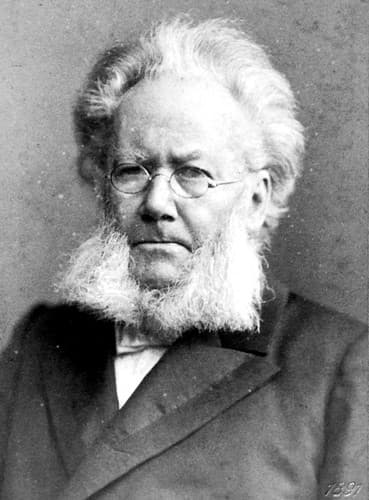
Henrik Johan Ibsen was a Norwegian playwright and theatre director. As one of the founders of modernism in theatre, Ibsen is often referred to as "the father of realism" and one of the most influential playwrights of his time. His major works include Brand, Peer Gynt, An Enemy of the People, Emperor and Galilean, A Doll's House, Hedda Gabler, Ghosts, The Wild Duck, When We Dead Awaken, Rosmersholm, and The Master Builder. Ibsen is the most frequently performed dramatist in the world after Shakespeare, and A Doll's House was the world's most performed play in 2006.
Similar books
- A Doll's House
Henrik Ibsen
3.7 (106k) average on GoodreadsFictionExplores similar themes of women's roles and societal expectations within marriage, by the same author.
- Anna Karenina
Leo Tolstoy
4.0 (682k) average on GoodreadsHistorical FictionFeatures a complex, morally ambiguous female protagonist struggling against societal norms and her own destructive desires.
- Miss Julie
August Strindberg
3.5 (11k) average on GoodreadsFictionWhile both plays explore female agency and societal constraints, Hedda Gabler offers a more psychologically nuanced and intellectually driven protagonist compared to Miss Julie, who is often portrayed as more overtly driven by primal urges and social determinism. Ibsen's realism is less starkly naturalistic than Strindberg's.
- Nineteen Eighty-Four
George Orwell
4.2 (5.5M) average on GoodreadsFictionWinston Smith dreams of truth and rebellion in a world where Big Brother watches all, but he confronts the terrifying power of a regime that controls not just actions, but thoughts.
- The Frozen River
Ariel Lawhon
4.4 (600k) average on GoodreadsFictionIn 1789 Maine, a heroic midwife's diary helps her expose a murder and get justice in a town that wants to silence her.
- A Man Called Ove
Fredrik Backman
4.4 (569k) average on GoodreadsFictionA stubborn widower, who lives by strict rules, finds his quiet world changed by a lively new family next door, making him face his past and find happiness in human connection.






Enjoyed the summary?
A summary gives you the shape of the book. The book itself has the detail, the examples and the voice.
Find Hedda Gabler on AmazonAs an Amazon Associate, BookBrief earns from qualifying purchases. How we're funded