
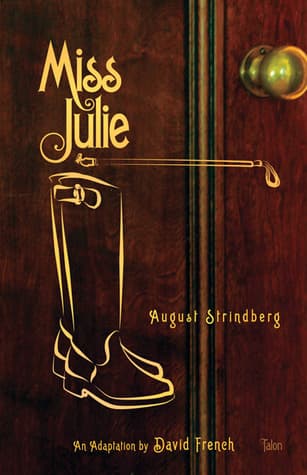
Synopsis
Covers the whole plot, including the ending.
- Difficulty
- Medium
- Pacing
- Fast
- Mood
- Intense, Psychological, Dark, Tense, Tragic
- Read it if
- You enjoy intense psychological dramas with a focus on class struggle, power dynamics, and the destructive nature of desire.
- Skip it if
- You prefer lighthearted stories or are sensitive to themes of manipulation, social degradation, and tragic endings.
Miss Julie Plot Summary
Covers the whole plot, including the ending.
Midsummer's Eve Preparations
The play starts in the Count's kitchen on Midsummer's Eve. Kristin, the cook, fries food and talks with Jean, the valet. She mentions Miss Julie's wild behavior, especially her dancing with the gamekeeper and acting below her station. Kristin disapproves of Julie's flirtation. Jean, though he pretends indifference, is aware of Julie's actions and subtly fascinated. He also hints at his own ambitions and desire to rise.
Julie's Arrival and Initial Flirtation
Miss Julie enters the kitchen, dressed festively, and immediately interacts with Jean. She is lively and capricious, aiming to provoke him. She demands he dance with her, despite his reluctance and Kristin's disapproval. Kristin leaves to change for church. Julie questions Jean's feelings, teases him, and dares him to drink beer. Their conversation is full of double meanings and power plays. Julie tries to assert her dominance but also seeks a closer connection. Jean subtly resists and manipulates her.
Kristin's Warning and Departure
Kristin, now changed, returns to the kitchen and sees Julie and Jean's growing flirtation. She is uncomfortable and tries to intervene, warning Julie about the impropriety and potential scandal. Kristin also distrusts Jean, but Julie, caught in the thrill, ignores her. Before leaving for church, Kristin makes a final plea for Julie to be careful, but Julie dismisses her, asserting her freedom. Kristin's departure leaves Julie and Jean alone.
Escalating Seduction and Confessions
Alone, Julie and Jean's interactions intensify. Julie talks about her troubled past, her mother's unconventional upbringing, and her engagement to a fiancé she humiliated. Jean shares his dreams of social ascent, including a childhood fantasy of entering the Count's house and a story about seeing Julie as a child, which he claims sparked his desire. Their talk shifts between attraction and class conflict. Julie, feeling vulnerable and drawn to Jean's perceived strength, allows herself to be seduced. Their passionate encounter happens offstage, implied by a brief absence and a change in their mood.
The Morning After: Shame and Desperation
As dawn breaks, Julie and Jean return to the kitchen. Their initial post-coital excitement is gone, replaced by shame, fear, and blame. Julie is horrified, recognizing the damage to her reputation and social standing. Jean, initially triumphant, becomes pragmatic and calculating. His dreams of rising seem closer but also bring complications. Julie is desperate to escape, suggesting they run away and start a new life, perhaps by opening a hotel. Jean focuses on practicalities and dangers, especially the Count's imminent return.
The Plan to Escape and the Canary
Julie, clinging to the idea of escape, suggests they take her canary, a symbol of her innocence. Jean, seeing the bird as a burden, coldly decapitates it, horrifying Julie. This act shatters Julie's remaining illusions about Jean and their future. Her despair deepens. She sees Jean's cruelty and the unbridgeable class divide. The incident shows Jean's ruthless ambition and his inability to understand Julie's emotional fragility.
Kristin's Return and Moral Judgment
Kristin returns from church and finds Julie and Jean in the kitchen, their disheveled state and the dead canary revealing the night's events. Kristin, devout and moral, is appalled. She denounces their actions, especially Julie's, as sinful and shameful, citing her religious beliefs. Kristin refuses to help with any escape plan and expresses loyalty to the Count. Her condemnation further isolates Julie, who is already in despair. Kristin acts as a moral compass, showing the societal and religious norms Julie and Jean have broken.
The Count's Return and Jean's Servility
The sound of the Count's bell ringing upstairs signals his return. This immediately affects Jean, who snaps back into his role as loyal valet. All his bravado, ambition, and intimacy with Julie disappear. He begins preparing the Count's boots and coffee, his demeanor completely changed. Julie, seeing this transformation, realizes her situation is hopeless. Jean, her lover and co-conspirator moments before, is now a distant servant, leaving her alone. The class hierarchy reasserts itself with brutal force.
Julie's Despair and Jean's Manipulation
Overwhelmed by shame, guilt, and the ruin of her life, Miss Julie falls into deep despair. She begs Jean for a command, a way out, admitting she cannot think or act for herself. Jean, still under the influence of the Count's bell and social order, and perhaps protecting himself, suggests she take her own life. He describes a dream he had of climbing a tree and seeing her there, subtly manipulating her and placing a razor in her hand. His words and actions are a perverse form of control, pushing her to self-destruction.
The Final Act
With the razor in her hand and Jean's suggestions in her mind, Miss Julie is broken. She expresses a desire for freedom and peace, succumbing to her shame and hopelessness. She asks Jean to command her, and he repeats the suggestion of suicide. Julie, in a trance, leaves the kitchen. The play ends with Jean, back in his role, awaiting the Count's orders. The audience infers Julie's suicide, the tragic result of her defiance of social norms and her disastrous encounter with Jean.
Principal Figures
Miss Julie
Protagonist
A young, aristocratic woman, caught between her desire for freedom and the constraints of her social class.
Miss Julie is the daughter of a Count, raised in an unconventional manner by her mother to despise men and embrace a form of radical independence. She is impulsive, volatile, and deeply unhappy, struggling with her identity and her place in society. Her actions are often contradictory, swinging between aristocratic hauteur and a desperate yearning for connection and even degradation. She is driven by a complex mix of boredom, sexual curiosity, a desire to defy societal expectations, and a profound inner turmoil stemming from her upbringing and the breakdown of her family life. She is both a victim of circumstance and her own flawed character.
Relationships: Jean (Lover, manipulator, class antagonist); Kristin (Servant, moral counterpoint, rival for Jean's affections); The Count (Absent father, symbol of patriarchal authority and social order)
Jean
Antagonist/Supporting
The Count's valet, ambitious and cunning, who seeks to rise above his station through manipulation.
Jean is the Count's valet, intelligent, ambitious, and deeply resentful of his social position. He is a master of manipulation, capable of projecting different personas to suit his aims. He harbors a long-standing fascination with Miss Julie, seeing her as both an object of desire and a means to climb the social ladder. He is pragmatic, ruthless, and ultimately self-serving, revealing a cruel streak beneath his polished exterior. He understands the unspoken rules of class and power better than Julie, using them to his advantage. His past experiences, including seeing Julie as a child, fuel his complex desires.
Relationships: Miss Julie (Lover, victim, means to social advancement); Kristin (Fiancée, fellow servant, represents stability and conventionality); The Count (Master, symbol of authority he both serves and resents)
Kristin
Supporting
The devout cook and Jean's fiancée, representing the stable, moral, and conservative working class.
Kristin is the Count's cook and Jean's fiancée. She is a practical, hardworking, and deeply religious woman who embodies the traditional values and social norms of the working class. She is a foil to Miss Julie's impulsiveness and Jean's ambition, representing stability, morality, and common sense. Kristin is deeply disturbed by Miss Julie's behavior and sees it as a transgression against God and proper order. While she loves Jean, she is also aware of his flaws and ambitions. Her faith provides her with a strong moral compass and a sense of resignation to her place in the world.
Relationships: Jean (Fiancée, fellow servant, stable partner); Miss Julie (Mistress, object of disapproval, social superior)
The Count
Mentioned
Miss Julie's absent father and the owner of the estate, representing patriarchal authority and the rigid class system.
The Count is Miss Julie's father and the unseen, yet ever-present, authority figure of the estate. He is a symbol of the rigid aristocratic class system and patriarchal power. Although he never appears onstage, his presence is constantly felt through his bell, his boots, and the reverence/fear he inspires in Jean and Kristin. His return is the ultimate catalyst for the play's tragic climax, as his authority immediately forces Jean back into his subservient role and seals Julie's fate. He represents the immovable force of tradition and social order that ultimately crushes Miss Julie.
Relationships: Miss Julie (Daughter, source of her aristocratic status and some of her psychological issues); Jean (Master, employer, symbol of the power he aspires to)
Themes & Insights
Class Struggle and Social Hierarchy
The play explores the rigid class distinctions of 19th-century Sweden and the conflict between aristocracy and the working class. Miss Julie, despite her birth, is trapped by her position and destroyed when she crosses its boundaries. Jean, a servant, wants to rise but is bound by his station, returning to servility at the sound of the Count's bell. Kristin shows the stability and resignation of the working class. The play shows how class dictates behavior, opportunities, and destiny, making a true connection across the divide impossible, seen in Jean's cruelty to Julie after their transgression.
“A servant is a servant... I'm only a servant, and I can't think of anything but your master's boots.”
Gender Roles and Power Dynamics
Strindberg examines power dynamics between men and women, especially in Victorian society. Miss Julie, raised to be 'half-woman, half-man' by her mother, struggles with her sexuality and identity, leading to her downfall. She tries to dominate Jean but ultimately falls to his manipulative power. Jean, despite his lower social status, gains control over Julie through his assertiveness and cunning. The play highlights the vulnerability of women, particularly those who defy traditional roles, in a patriarchal society, and the destructive results of such defiance, as Julie is left with suicide after her 'fall'.
“You are a woman, and a woman always falls.”
Nature vs. Nurture / Heredity and Environment
The play explores how heredity and environment influence character. Miss Julie's erratic behavior and fragility are linked to her mother's unconventional upbringing and her parents' dysfunctional marriage. Her mother's feminist ideals and dislike of men contributed to Julie's internal conflicts. Jean attributes his ambition and cunning to his working-class background and drive to overcome his circumstances. The play suggests that individuals are largely products of their birth and upbringing, with little ability to escape predetermined fates, leading to fatalism, especially in Julie's tragic end.
“That's what comes of letting women bring up children.”
Desire and Destructive Passion
Desire, both sexual and social, is a destructive force in the play. Miss Julie's desire for excitement, for connection outside her class, and for sexual liberation leads her to Jean. Jean's desire for social advancement and for Julie fuels his manipulative actions. This passion is predatory and destructive, not romantic. The brief, intense encounter between Julie and Jean shatters Julie's world and reveals the harsh realities of their incompatible desires and social positions. Their passion is a transgression that brings only shame, despair, and ultimately, death for Julie.
“I feel as if I were falling, falling... down, down, down...”
Fatalism and Inevitability
A strong sense of fatalism runs through 'Miss Julie'. From the start, characters seem driven by forces beyond their control – heredity, social class, and innate drives. The Midsummer's Eve setting, a time of ancient rituals and heightened emotions, adds to this sense of inevitable destiny. Julie's downfall feels predetermined, a tragic result of her birth, upbringing, and unyielding societal structures. Jean's actions, while cunning, also follow a predictable pattern for a lower-class man seizing an opportunity. The play suggests that humans are largely powerless against the combined forces of biology, psychology, and social order.
“It's awful! But there's no way out.”
Plot Devices & Literary Techniques
The Count's Bell
An offstage sound that symbolizes patriarchal authority and the rigid class system.
The Count's bell is a powerful auditory symbol throughout the play. It signals the unseen Count's presence and demands, instantly forcing Jean back into his subservient role, regardless of his prior actions or ambitions. For Miss Julie, it represents the inescapable power of her father and the social order that ultimately crushes her. Its ringing at the climax underscores the reassertion of hierarchy and the finality of Julie's downfall, acting as a hypnotic command for Jean and a death knell for Julie's hopes of escape.
Midsummer's Eve Setting
A traditional folk holiday that creates an atmosphere of heightened emotion, transgression, and blurred boundaries.
The setting of Midsummer's Eve, a night of revelry, superstition, and ancient pagan traditions, serves as a crucial plot device. It provides a natural justification for the servants to be celebrating and for Miss Julie to be more unrestrained than usual, blurring the lines of social propriety. This atmosphere of heightened emotion and temporary freedom allows the transgression between Julie and Jean to occur. It also adds a sense of fatefulness and inevitability to the events, as if the characters are acting under the influence of ancient, uncontrollable forces, rather than purely rational decisions.
The Canary
Miss Julie's pet bird, symbolizing her innocence, fragility, and her last connection to her former life.
Miss Julie's canary represents her last vestige of innocence, her connection to her privileged past, and her emotional vulnerability. When she insists on taking it with them as they plan to escape, it highlights her naiveté and her inability to grasp the harsh realities of their situation. Jean's brutal act of decapitating the bird is a pivotal moment: it shatters Julie's remaining illusions about him, reveals his cruel and pragmatic nature, and symbolizes the complete destruction of Julie's former life, innocence, and any hope of a gentle future.
Jean's Dream of the Tree
A recurring metaphorical image used by Jean to manipulate Julie and suggest her predetermined fate.
Jean recounts a dream of climbing a tall tree and seeing Julie lying at its base. This dream serves multiple functions. Initially, it's a romanticized memory of his childhood fascination with Julie. Later, it becomes a powerful, almost hypnotic, tool of manipulation. When Julie is in despair, Jean uses the image of her falling from a height and lying dead to subtly suggest suicide, effectively planting the idea in her mind. The tree itself can be seen as a symbol of the social hierarchy, with Julie at the top and Jean aspiring to climb, and her eventual 'fall' from it.
Miss Julie Quotes
“I don't hate men, I hate myself.”
“The rich are always right.”
“You're a woman, and I'm a man. That's the difference.”
“It's horrible how one's will dissolves away.”
“A servant is a servant.”
“If I can only get out of here, I'll go to Rome, buy a villa, and become a count.”
“You are my enemy.”
“Love is a game, and the one who plays best wins.”
“I've seen the world, and I know what it is.”
“It's not good to think too much.”
“The air is heavy with sin.”
“I'm not a man, I'm a lackey.”
“We are all tied to the wheel.”
“There are no secrets between us anymore.”
Quiz
10 questions on the plot and the characters. Each answer comes with a short explanation.
Question 1
What is the primary social class of Miss Julie at the beginning of the play?
- Working class
- Aristocracy
- Middle class
- Peasantry
Show answer
B. Aristocracy Miss Julie is the daughter of a Count, placing her firmly in the aristocracy.
Question 2
What is Jean's profession in the Count's household?
- Gardener
- Coachman
- Valet
- Cook
Show answer
C. Valet Jean is the Count's valet, a position that gives him a certain level of authority and proximity to the upper class.
Question 3
During which celebration does the main action of the play take place?
- Christmas Eve
- Midsummer's Eve
- New Year's Day
- Harvest Festival
Show answer
B. Midsummer's Eve The play is set on Midsummer's Eve, a traditional night of revelry and blurred social boundaries, which contributes to the unfolding drama.
Question 4
What specific item does Jean suggest Miss Julie steal to help them escape?
- The Count's watch
- Money from the Count's desk
- Jewelry from her mother's room
- Silverware from the kitchen
Show answer
B. Money from the Count's desk Jean explicitly instructs Miss Julie to retrieve money from the Count's desk, highlighting his pragmatic and somewhat opportunistic nature.
Question 5
What is Kristin's relationship to Jean?
- His sister
- His cousin
- His fiancée
- His former lover
Show answer
C. His fiancée Kristin is Jean's fiancée, and her presence underscores the social and moral boundaries that Miss Julie and Jean transgress.
Question 6
What animal does Jean kill on stage, symbolizing a turning point in Miss Julie's emotional state?
- A dog
- A cat
- A bird
- A rabbit
Show answer
B. A cat Jean kills Miss Julie's pet finch, Serine, which is a brutal act that deeply traumatizes Miss Julie and signifies her complete degradation and loss of innocence.
Question 7
What does Strindberg suggest about Miss Julie's 'half-woman' nature in his preface?
- She is physically weaker than other women.
- She embodies a mix of masculine and feminine traits, leading to her downfall.
- She is literally half-human, half-animal.
- She is incapable of bearing children.
Show answer
B. She embodies a mix of masculine and feminine traits, leading to her downfall. In his preface, Strindberg describes Miss Julie as a 'half-woman,' suggesting she possesses a blend of masculine and feminine characteristics that he believes contribute to her psychological instability and tragic fate.
Question 8
What is the ultimate fate of Miss Julie at the end of the play?
- She runs away with Jean.
- She is reunited with her father.
- She commits suicide with a razor.
- She is arrested for theft.
Show answer
C. She commits suicide with a razor. Under Jean's hypnotic suggestion and feeling utterly humiliated and without hope, Miss Julie takes a razor and commits suicide offstage.
Question 9
How does the sound of the Count's returning bell influence Jean's behavior and Miss Julie's fate?
- It inspires Jean to defy the Count and protect Miss Julie.
- It reminds Jean of his subservient position and reasserts his fear of the Count, making him abandon Miss Julie.
- It signals a new opportunity for Jean to rise in social status.
- It causes Miss Julie to suddenly regain her composure and assertiveness.
Show answer
B. It reminds Jean of his subservient position and reasserts his fear of the Count, making him abandon Miss Julie. The sound of the Count's bell acts as a powerful symbol of his authority and Jean's ingrained subservience. It immediately breaks Jean's temporary delusion of equality and forces him back into his role as a servant, ultimately leading him to push Miss Julie towards her tragic end.
Question 10
What is the significance of the kitchen setting in 'Miss Julie'?
- It represents a sterile, emotionless environment for the characters.
- It symbolizes the domestic harmony and traditional values of the household.
- It serves as a liminal space where social boundaries are blurred and transgressions occur, away from the formal parts of the house.
- It is merely a practical setting for the servants to prepare food.
Show answer
C. It serves as a liminal space where social boundaries are blurred and transgressions occur, away from the formal parts of the house. The kitchen is a crucial symbolic setting. It is a 'no man's land' between the servants' quarters and the master's domain, where the rigid social order temporarily breaks down, allowing Miss Julie and Jean's forbidden encounter to unfold.
Miss Julie FAQ
What is the central conflict in 'Miss Julie'?
The central conflict revolves around the class and gender struggle between Miss Julie, an aristocratic woman, and Jean, her father's valet. Their illicit encounter during Midsummer's Eve shatters social boundaries and exposes their deep-seated desires and resentments, leading to a tragic downfall for Julie.
When and where does the play 'Miss Julie' take place?
The play is set entirely in the kitchen of Count's manor house on Midsummer's Eve, a night associated with revelry and abandoned inhibitions. The confined setting intensifies the psychological drama and the claustrophobic atmosphere surrounding the characters.
Who are the main characters in 'Miss Julie' and what are their roles?
The main characters are Miss Julie, the young aristocratic daughter of the Count; Jean, the ambitious and manipulative valet; and Kristin, the cook and Jean's fiancée. Julie represents the declining aristocracy, Jean the rising working class, and Kristin the pragmatic, religious working class.
What is the significance of Midsummer's Eve in the play?
Midsummer's Eve is traditionally a time of pagan celebration, magic, and blurred boundaries, which perfectly mirrors the unraveling of social order and the characters' inhibitions. It provides a chaotic backdrop for Julie and Jean's transgressive encounter, making their actions seem both fated and impulsive.
How does Strindberg use symbolism in the play, particularly with the birds?
Strindberg uses the symbolism of birds to represent freedom, confinement, and vulnerability. Miss Julie's pet finch, killed by Jean, symbolizes her own entrapment and eventual destruction, while the idea of escaping 'like birds' to Switzerland highlights their futile dreams of freedom.
What is the role of the Count, even though he never appears on stage?
The Count, though unseen, is a constant, oppressive presence through his boots, bell, and reputation. He represents the patriarchal authority and the rigid social structure that Miss Julie attempts to defy but ultimately cannot escape, serving as a powerful external force influencing the characters' actions.
What is the significance of the dream sequences shared by Miss Julie and Jean?
The dream sequences reveal their subconscious desires and anxieties. Julie dreams of falling from a height, symbolizing her social descent, while Jean dreams of climbing a tree, representing his ambition for social ascent. These dreams foreshadow their intertwined fates and the reversal of their social positions.
How does Strindberg portray the psychological power dynamics between Julie and Jean?
Strindberg masterfully portrays a fluctuating power dynamic: initially, Julie holds the upper hand due to her class, but Jean subtly gains control through his cunning, masculinity, and understanding of social conventions. Their interactions are a constant struggle for dominance, marked by seduction, manipulation, and degradation.
What psychological factors contribute to Miss Julie's ultimate demise?
Miss Julie's demise is driven by a complex mix of factors: her mother's unconventional upbringing, her unstable mental state, her inability to reconcile her aristocratic pride with her passionate desires, and her deep-seated shame and fear of public humiliation following her transgression with Jean.
How does Jean's past influence his interactions and motivations with Miss Julie?
Jean's impoverished background and his childhood fantasies of rising above his station fuel his ambition and resentment. He is driven by a desire for social mobility and revenge against the upper class, which manifests in his calculated manipulation and ultimate subjugation of Miss Julie.
Discuss the 'naturalism' of the play and how it applies to the characters.
Strindberg's naturalism aims to depict humans as products of heredity and environment. Miss Julie's 'sick soul' is a result of her mother's influence and aristocratic decadence, while Jean's cunning and pragmatism are products of his struggle for survival in a lower-class environment, illustrating deterministic forces at play.
Is Miss Julie a victim, or does she bear responsibility for her fate?
This is a key debate. While she is clearly a victim of societal constraints, Jean's manipulation, and her own psychological fragility, she also actively seeks out the transgression and makes choices that lead to her downfall. Strindberg presents her as both a product of forces beyond her control and a participant in her own destruction.
How does Strindberg's preface to 'Miss Julie' inform our understanding of the play?
Strindberg's preface is crucial, outlining his theories on naturalism, character psychology, and the 'battle of the brains' between the sexes. He describes Julie as a 'sick soul' and Jean as a 'stronger' character, guiding the audience toward his intended interpretation of the characters' motivations and the play's themes.
What is the significance of the ending, with Jean giving Julie the razor?
The ending is profoundly tragic and symbolic. Jean, stripped of his own ambition by the Count's returning presence, gives Julie the razor, effectively commanding her to commit suicide. This act solidifies his psychological dominance and her complete subjugation, illustrating the inescapable power of class and circumstance.
How does Kristin's character serve as a foil to Miss Julie?
Kristin, Jean's fiancée, serves as a grounded, pragmatic foil to Miss Julie's volatile and aristocratic nature. Her simple faith, common sense, and focus on practical matters highlight Julie's impulsiveness and emotional instability, representing a stable, albeit conventional, working-class perspective.
What role does gender play in the power struggle between Miss Julie and Jean?
Gender is central to the power struggle, with Strindberg exploring traditional and inverted gender roles. Julie attempts to assert masculine dominance, while Jean, despite his lower status, uses his masculinity and societal expectations to ultimately dominate her, reflecting the era's patriarchal norms.
How does the setting of the kitchen contribute to the play's themes?
The kitchen, a traditionally domestic and subordinate space, becomes the battleground for class and gender warfare. Its utilitarian nature contrasts sharply with Julie's aristocratic world, and its confinement amplifies the intense psychological drama, trapping the characters in their escalating conflict.
What is the 'battle of the brains' that Strindberg refers to in his preface, and how is it depicted?
Strindberg's 'battle of the brains' refers to the intellectual and psychological struggle for dominance between characters. In 'Miss Julie,' it's evident in the verbal sparring and manipulative tactics between Julie and Jean, where their intelligence and cunning are weaponized to gain control over the other, ultimately leading to Julie's defeat.
About the author
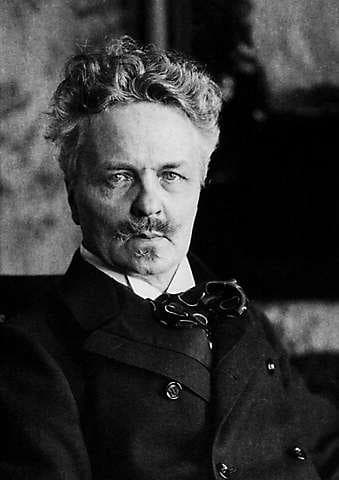
Johan August Strindberg was a Swedish playwright, novelist, poet, essayist and painter. A prolific writer who often drew directly on his personal experience, Strindberg wrote more than sixty plays and more than thirty works of fiction, autobiography, history, cultural analysis, and politics during his career, which spanned four decades. A bold experimenter and iconoclast throughout, he explored a wide range of dramatic methods and purposes, from naturalistic tragedy, monodrama, and history plays, to his anticipations of expressionist and surrealist dramatic techniques. From his earliest work, Strindberg developed innovative forms of dramatic action, language, and visual composition. He is considered the "father" of modern Swedish literature and his The Red Room (1879) has frequently been described as the first modern Swedish novel. In Sweden, Strindberg is known as an essayist, painter, poet, and especially as a novelist and playwright, but in other countries he is known mostly as a playwright.
Similar books
- A Doll's House
Henrik Ibsen
3.7 (106k) average on GoodreadsFictionExplores societal expectations, gender roles, and a woman's struggle for identity within a restrictive marriage.
- Hedda Gabler
Henrik Ibsen
3.8 (30k) average on GoodreadsFictionFeatures a complex, manipulative female protagonist struggling with boredom and societal constraints, leading to tragic outcomes.
- The Master Builder
Henrik Ibsen
3.8 (3k) average on GoodreadsFictionDeals with power struggles, ambition, and psychological manipulation within a confined setting.
- The Cherry Orchard
Anton Chekhov
3.7 (29k) average on GoodreadsFictionBoth plays depict the decline of the aristocracy, but Chekhov's approach is more elegiac and nuanced, focusing on the gradual, often melancholic, erosion of an old order. Strindberg's Miss Julie is more explosive and violent, portraying a direct, brutal clash between social classes that culminates in immediate tragedy, rather than a slow, contemplative decline. Chekhov's naturalism is subtle; Strindberg's is confrontational.
- Nineteen Eighty-Four
George Orwell
4.2 (5.5M) average on GoodreadsFictionWinston Smith dreams of truth and rebellion in a world where Big Brother watches all, but he confronts the terrifying power of a regime that controls not just actions, but thoughts.
- The Frozen River
Ariel Lawhon
4.4 (600k) average on GoodreadsFictionIn 1789 Maine, a heroic midwife's diary helps her expose a murder and get justice in a town that wants to silence her.






Enjoyed the summary?
A summary gives you the shape of the book. The book itself has the detail, the examples and the voice.
Find Miss Julie on AmazonAs an Amazon Associate, BookBrief earns from qualifying purchases. How we're funded