
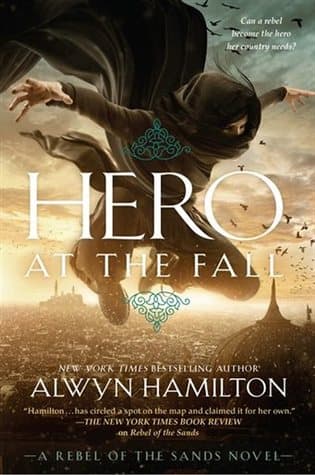
Synopsis
Covers the whole plot, including the ending.
- Difficulty
- Medium
- Pacing
- Fast
- Mood
- Epic, Action-packed, Tense, Hopeful
- Read it if
- You love high-stakes desert fantasy with a strong, morally complex heroine, magical gunfights, and a touch of romance.
- Skip it if
- You prefer low-stakes fantasy or are looking for a standalone story.
Hero at the Fall Plot Summary
Covers the whole plot, including the ending.
Amani's Desperate Plan to Rescue Ahmed
After 'Traitor to the Throne,' Amani Al'Hiza faces a difficult situation. Prince Ahmed, the rebellion's leader, has been captured and taken to Eremot, a city outside known maps, said to be a prison for Djinn and magic. With the rebellion scattered and spirits low, Amani becomes the leader, despite her doubts and grief over the loss of Jin and others. She gathers the remaining rebels, including Shira, Sam, and her Demdji cousin, Delia, and plans a rescue mission. Their journey will go through the desert, facing the Sultan's forces and supernatural dangers, to reach a place no one is sure how to find or enter.
The Perilous Journey Across the Desert
The journey to Eremot is dangerous. Amani and her small group of rebels, including former Sultan's soldiers who have joined them, struggle with low supplies and the desert. The Sultan's army, led by General Qadir, hunts them. During a skirmish, they lose many people, and the group's unity is tested. Amani's leadership is challenged, but her resolve to save Ahmed and continue the fight for Miraji's freedom keeps them moving. She uses her Demdji powers, still not fully understood or controlled, to get past supernatural obstacles and protect her companions, all while carrying the burden of responsibility.
Encountering the Old Gods and Djinn
As they go deeper into uncharted areas, Amani and her group meet Old Gods and other powerful Djinn, remnants of Miraji's ancient past. These meetings are scary and informative, giving clues about Eremot and the power within it. They learn that Eremot is not just a prison but a place of Djinn power, where the barrier between worlds is thin. Amani's Demdji heritage becomes more important, as her powers connect with these ancient forces. She starts to understand that her link to the Djinn might be how to enter Eremot, but also a danger.
The Betrayal and the Path to Eremot
Just as they get close to Eremot, a betrayal in their group causes problems for the mission. One of the former Sultan's soldiers, loyal to Qadir, tries to stop them and capture Amani. This leads to a tense situation and a battle, where Amani's powers are pushed to their limits. Despite the problem, the fight accidentally shows the hidden entrance to Eremot, a place hidden by illusions and ancient magic. The rebels, now fewer in number but more determined, get ready for the last, most dangerous part of their journey, knowing that what is inside could save them or doom them.
Infiltrating the Mythical City
Amani, Delia, Shira, and a few others get past Eremot's defenses. The city is unlike anything they have seen, built by Djinn, with strange buildings, shifting scenery, and magic. The air has ancient energy. They find magical traps and guardians, testing their minds and Demdji abilities. Amani's connection to the Djinn helps her navigate some dangers, but it also makes her a target for the city's protections. They must move quietly, avoiding the Sultan's elite guards inside and Eremot's unpredictable magic, all while looking for Ahmed.
The Horrors Within and Ahmed's Fate
Deep inside Eremot, Amani and her companions find out the Sultan's plans. He has been using the city's properties to drain the power of captured Djinn and Demdji, including Ahmed, to become invincible and control all magic in Miraji. They find Ahmed, imprisoned and weakened, his Demdji powers suppressed. This sight makes Amani angry and determined. She realizes the Sultan's cruelty and the threat he is. The rescue mission quickly becomes a race against time, not just to free Ahmed, but to stop the Sultan from finishing his ritual and getting ultimate power.
Confrontation with the Sultan's Forces
Amani and her small group are found by the Sultan's elite guards and General Qadir, leading to a fight inside Eremot's passages. Amani, using her Demdji powers, fights with a strength she did not know she had. Delia, Shira, and the remaining rebels fight with her. The battle is hard, with many losses on both sides. Amani faces General Qadir, a strong opponent who has been a constant threat. She uses her sharpshooting skills and growing magic to win, driven by the desire to protect her friends and free Ahmed.
Amani's Sacrifice and the Djinn's Power
To save Ahmed and stop the Sultan's ritual, Amani realizes she must make a choice. She uses the raw power of the Djinn within Eremot, a power that could destroy her. In a moment of sacrifice, she connects with the ancient magic, using it to stop the Sultan's ritual and release a wave of power that frees Ahmed and defeats the Sultan. This act costs her much, pushing her Demdji nature to its limits and leaving her weak. The act is scary and exciting, showing her strength and her willingness to do anything for those she loves and for Miraji.
The Fall of the Sultan and the Aftermath
With Amani's sacrifice, the Sultan's power is broken, and he is defeated, but with more bloodshed. The battle leaves Eremot in ruins, its ancient magic temporarily stopped. Ahmed, though weakened, is free. However, the victory is not completely happy. Many rebels have died, and Amani is changed by her experience, her Demdji powers now stronger but also more unstable. The Sultan is gone, but the long-term effects of the war and the fight for a free Miraji remain. The surviving rebels must now decide their next steps, with Amani, despite her trauma, still a key figure in their future.
Forging a New Future for Miraji
After, Amani and Ahmed, with the remaining rebels, start the hard work of rebuilding and planning for Miraji's future. The Sultan's defeat has left a power vacuum and a country damaged by war. Amani, now a leader, works with Ahmed to unite the different groups and give hope to tired people. Her Demdji powers, though feared by some, are also a symbol of strength and a new kind of leadership. The road ahead is long and unclear, but with Amani's courage and Ahmed's vision, they work to create a Miraji where all, human or Demdji, can live free. The fight for true freedom has just begun.
Principal Figures
Amani Al'Hiza
Protagonist
Gunslinging Demdji leader of the rebellion, seeking to free Miraji and rescue Ahmed.
Amani is the fiercely independent and resilient protagonist, a skilled sharpshooter with latent Demdji powers she inherited from her mother. Initially driven by a desire to escape her small town, she reluctantly embraces her role as a leader in the rebellion against the Sultan. Throughout 'Hero at the Fall,' she grapples with immense loss, the weight of leadership, and the terrifying expansion of her own magical abilities. Her love for Ahmed is a strong motivator, but her ultimate drive is to see Miraji free. She is courageous, pragmatic, and fiercely loyal, often putting herself in harm's way for her friends.
Relationships: Ahmed (Love interest, fellow rebel leader); Delia (Cousin, fellow Demdji); Shira (Close friend, fellow rebel); Jin (Former love interest, deceased rebel, whose memory guides her)
Ahmed
Supporting/Love Interest
The imprisoned Rebel Prince, a Demdji whose freedom is central to the rebellion's cause.
Ahmed is one of the Sultan's sons and the legitimate heir to the throne, having been outcast for his Demdji heritage. He is intelligent, compassionate, and a charismatic leader who inspires loyalty. Captured and imprisoned in Eremot, his suffering fuels Amani's desperate rescue mission. Despite his weakened state, he remains a symbol of hope and a strategic mind for the rebellion. His vision for a free Miraji, where humans and Demdji can coexist, is what the rebels fight for. His love for Amani is deep and unwavering, providing her with emotional support.
Relationships: Amani Al'Hiza (Love interest, fellow rebel leader); Sultan (Father, tyrannical antagonist); Jin (Half-brother, deceased rebel)
Delia
Supporting
Amani's quiet cousin and fellow Demdji, whose powers grow alongside Amani's.
Delia is Amani's younger cousin and another Demdji, though initially more timid and less confident in her powers. She possesses a unique connection to the land and its ancient magic, which becomes increasingly vital during their journey to Eremot. She is quiet, observant, and fiercely loyal to Amani. Throughout the mission, she grows in confidence and mastery of her own abilities, becoming a crucial asset to the team, particularly in navigating magical obstacles and understanding the Djinn's influence. Her bond with Amani strengthens as they face shared dangers.
Relationships: Amani Al'Hiza (Cousin, fellow Demdji); Shira (Friend, fellow rebel)
Shira
Supporting
A resourceful and loyal rebel, a close friend and confidante to Amani.
Shira is a practical, resourceful, and loyal member of the rebellion, and one of Amani's closest friends. She is a skilled fighter and survivor, always ready to lend a hand and provide moral support. Though not a Demdji, she is brave and dedicated to the cause of freeing Miraji. She acts as a grounded presence for Amani, offering advice and a listening ear amidst the chaos. Her unwavering loyalty and common sense are invaluable to the small rebel group, particularly when Amani is grappling with the immense pressure of leadership and her own powers.
Relationships: Amani Al'Hiza (Close friend, fellow rebel); Delia (Friend, fellow rebel)
Sultan
Antagonist
The tyrannical ruler of Miraji, seeking ultimate power through the exploitation of Demdji and Djinn.
The Sultan is the ruthless and power-hungry ruler of Miraji, obsessed with eradicating Demdji and consolidating his own magical power. He is a cruel and manipulative figure who views all Demdji as tools or threats. His ultimate goal in 'Hero at the Fall' is to harness the power of Eremot and the Djinn within it to become an invincible ruler, effectively becoming an Old God himself. He is relentless in his pursuit of Ahmed and Amani, seeing them as direct threats to his dominion. His actions drive the entire conflict of the story.
Relationships: Ahmed (Son, target of his tyranny); Amani Al'Hiza (Enemy, target of his tyranny)
General Qadir
Antagonist
The Sultan's loyal and formidable military commander, relentlessly pursuing the rebels.
General Qadir is the Sultan's chief military commander, a highly skilled and ruthless strategist. He is fiercely loyal to the Sultan and serves as a constant, tangible threat to Amani and the rebels throughout their journey. Qadir is pragmatic and relentless, often anticipating the rebels' moves and cornering them. He represents the Sultan's oppressive military might and is a formidable opponent in battle, especially against Amani. His presence ensures that the rebels face not only magical dangers but also trained, organized human opposition.
Relationships: Sultan (Superior, object of loyalty); Amani Al'Hiza (Military adversary)
Sam
Supporting
A pragmatic and loyal rebel, skilled in desert survival and logistics.
Sam is a member of the rebel group, known for his practical skills and knowledge of the desert. He is a steadfast and reliable presence, often tasked with ensuring the group's survival and managing resources during their arduous journey. While not a fighter in the same vein as Amani or Shira, his contributions to navigation, foraging, and maintaining morale are invaluable. He provides a sense of normalcy and grounding amidst the supernatural chaos, embodying the resilience of the common people fighting for their freedom.
Relationships: Amani Al'Hiza (Fellow rebel); Shira (Fellow rebel)
Jin
Mentioned/Supporting (through memory)
Amani's former love interest and Ahmed's half-brother, whose death deeply impacts Amani.
Jin, though deceased before the events of 'Hero at the Fall,' casts a long shadow over Amani. He was Ahmed's half-brother and Amani's first love, a charming and roguish Demdji. His death in the previous book serves as a major source of grief and motivation for Amani. His memory often inspires her to fight harder and reminds her of the sacrifices made for the rebellion. His death also contributes to Amani's initial reluctance to embrace leadership, as she fears losing more people she cares about.
Relationships: Amani Al'Hiza (Former love interest); Ahmed (Half-brother); Sultan (Father)
Themes & Insights
Leadership and Sacrifice
This theme explores the burden of leadership and the sacrifices needed to lead a rebellion. Amani, despite her doubts and grief, leads the rebels, often wondering if she is right for the role. Her journey to Eremot involves difficult decisions, losses, and a personal sacrifice to save Ahmed and the rebellion. The book shows that true leadership often means putting the greater good before personal desires and facing one's own end, as Amani does when she uses the Djinn power.
“She was a hero, a leader, a legend. She was also just Amani, and Amani was scared. But Amani would do what needed to be done.”
Identity and Demdji Heritage
Amani's journey is tied to her understanding and acceptance of her Demdji heritage. She first sees her powers as a way to escape or a curse, but she gradually accepts them as a source of strength and part of who she is. Eremot, a place of Djinn power, makes her confront her abilities and her connection to Miraji's ancient magic. The theme also includes Ahmed and other Demdji, showing their fight for acceptance and freedom in a world that fears them. It promotes harmony between human and magical identities.
“She was the desert, she was the dust, she was the sun. She was a Demdji, and she was done hiding it.”
Hope in Despair
Despite facing great odds, constant losses, and the hard task of rescuing Ahmed from Eremot, the rebels hold onto hope. Amani, though often sad, finds strength in her love for Ahmed and her vision for a free Miraji. The theme shows how hope can keep a movement going and inspire people to continue fighting against control. The rebels' journey through the desert to a mythical city represents their belief in a better future, even when it seems impossible. It shows the power of shared hope against great despair.
“Hope was a stubborn weed, growing in the cracks of the desert, refusing to die.”
The Price of Freedom
The novel explores the cost of fighting for freedom. The rebels suffer many deaths, physical and emotional difficulties, and personal sacrifices. Ahmed's capture, the loss of lives, and Amani's near-fatal use of power all show that freedom is not easy to get. It shows the reality of rebellion and war, where every step towards freedom costs blood and pain. The victory against the Sultan comes at a high price, leaving a damaged but hopeful Miraji to rebuild.
“Freedom wasn't free. It was paid for in blood and dust and the ghosts of those who had fought for it.”
Plot Devices & Literary Techniques
Eremot
A mythical, magically hidden city serving as both prison and nexus of power.
Eremot functions as the ultimate destination and a central plot device. It is a mythical city, unmapped and magically concealed, rumored to be a prison for powerful Djinn. Its existence challenges the known world and forces the rebels into uncharted territory. As a plot device, it raises the stakes by making Ahmed's rescue seem impossible. Inside, it serves as a magical labyrinth and the site of the Sultan's dark rituals, where the true extent of Djinn power and the Sultan's ambition are revealed. Its unique properties amplify Amani's Demdji powers and provide the setting for the climax.
Amani's Demdji Powers
Supernatural abilities evolving into a powerful, yet dangerous, force.
Amani's Demdji powers, her inherited connection to the Djinn, are a critical plot device. Initially a source of fear and uncertainty, they gradually become her most potent weapon and a key to understanding Eremot. Her ability to manipulate sand, conjure illusions, and eventually tap into raw Djinn energy is essential for navigating obstacles, fighting enemies, and ultimately defeating the Sultan. The struggle to control her powers and the immense personal cost of fully unleashing them drive her character arc and provide moments of intense conflict and sacrifice.
The Sultan's Ritual
The antagonist's scheme to absorb Djinn power for ultimate control.
The Sultan's dark ritual, conducted within Eremot, serves as the primary ticking clock and the ultimate goal for the antagonist. His plan to drain the power of captured Djinn and Demdji (including Ahmed) to become an invincible, god-like ruler provides a clear, high-stakes objective for Amani to thwart. This device raises the tension, as the rebels must not only rescue Ahmed but also prevent the Sultan from completing his transformation. It highlights the ultimate tyrannical ambition and sets the stage for Amani's climactic confrontation and sacrifice.
The Desert Journey
A harsh, symbolic journey that tests the rebels' endurance and unity.
The arduous journey across the vast, unforgiving desert to Eremot is more than just a physical challenge; it's a symbolic plot device. It strips the rebels of their comforts, tests their endurance, and forces them to confront their limitations and internal conflicts. The desert's dangers, from hostile forces to supernatural encounters, serve to thin their ranks and forge stronger bonds among the survivors. It highlights the desperation of their mission and the resilience required to fight for freedom, mirroring the harsh realities of the rebellion itself.
Hero at the Fall Quotes
“We are not the sum of our ancestors, but the sum of our choices.”
“Sometimes the bravest thing you can do is not fight.”
“Love is not a weakness; it is the only thing worth fighting for.”
“The desert does not forgive, but it does not forget either.”
“Power is not in ruling over others, but in freeing them.”
“Every story has an end, but that doesn't mean it's the end of all stories.”
“Fear is a weapon, but only if you let it be.”
“In the darkness, even a small light can guide the way.”
“To be a hero is to choose the hard path, not the easy one.”
“The heart is a compass that points to what truly matters.”
“Magic is not just in the blood; it's in the will to use it.”
“War changes everyone, but it doesn't have to break them.”
“Trust is the rarest currency in a world of betrayal.”
“Home is not a place, but the people you fight for.”
Quiz
10 questions on the plot and the characters. Each answer comes with a short explanation.
Question 1
What is the primary mission that Amani Al'Hiza undertakes in 'Hero at the Fall'?
- To overthrow the Sultan of Miraji and seize the throne
- To rescue the Rebel Prince Ahmed from imprisonment in Eremot
- To discover and master new Demdji powers in the desert
- To negotiate a peace treaty between rebels and the Sultan's forces
Show answer
B. To rescue the Rebel Prince Ahmed from imprisonment in Eremot The central plot of the book revolves around Amani leading a rescue mission to free Prince Ahmed, who has been imprisoned by the Sultan in the mythical city of Eremot, driving the rebellion forward.
Question 2
What unique ability does Amani possess as a Demdji that aids her in the revolution?
- She can control fire and summon flames at will
- She can shapeshift into different forms, including animals
- She has the power to heal wounds and cure illnesses
- She can communicate telepathically with other Demdji
Show answer
B. She can shapeshift into different forms, including animals Amani's Demdji power is shapeshifting, which she uses strategically throughout the series, including in 'Hero at the Fall,' to infiltrate, spy, and survive in dangerous situations.
Question 3
Why is the city of Eremot particularly challenging for Amani and her rebels to reach?
- It is guarded by an impenetrable magical barrier that repels Demdji
- It is located in a remote desert area and is not shown on any maps
- It is constantly moving across the desert, making it hard to track
- It is underwater, requiring special equipment to access
Show answer
B. It is located in a remote desert area and is not shown on any maps Eremot is described as a mythical city that doesn't appear on maps, forcing Amani and her crew to navigate the unforgiving desert without clear guidance, adding to the peril of their rescue mission.
Question 4
What internal conflict does Amani grapple with as she leads the rescue mission?
- Whether to abandon the revolution and return to her hometown for safety
- Whether she is capable of being the leader her rebels need or if she's leading them to their deaths
- Whether to use her Demdji powers for personal gain instead of the rebellion
- Whether to betray Prince Ahmed and side with the Sultan for power
Show answer
B. Whether she is capable of being the leader her rebels need or if she's leading them to their deaths A key theme in the book is Amani's self-doubt and leadership struggles. She questions her abilities as she watches her loved ones risk their lives, fearing she might be making fatal mistakes.
Question 5
Which of the following threats do Amani and her rebels face during their journey to Eremot?
- Ghouls and enemy soldiers
- Dragon attacks and volcanic eruptions
- Pirate raids and sea monsters
- Famine and plague outbreaks in desert villages
Show answer
A. Ghouls and enemy soldiers The book specifies that Amani and her crew confront ghouls and enemy soldiers as they travel through the desert, highlighting the physical dangers of their mission beyond just the harsh environment.
Question 6
How does Amani's background as a gunslinger from a dead-end town influence her role in the revolution?
- It makes her overconfident, leading to reckless decisions that endanger the rebels
- It provides her with practical survival skills and a resilient, adaptable mindset
- It causes her to be distrusted by other rebels who see her as an outsider
- It limits her understanding of political strategies, forcing her to rely solely on magic
Show answer
B. It provides her with practical survival skills and a resilient, adaptable mindset Amani's upbringing as a gunslinger equips her with wits, marksmanship, and toughness, which she combines with her Demdji powers to navigate challenges, making her an unlikely but effective leader.
Question 7
What does the 'skeleton crew' of rebels refer to in the context of Amani's mission?
- A group of rebels who are undead or ghostly figures aiding the mission
- A small, depleted group of rebels with limited resources and manpower
- A specialized team of Demdji experts trained in desert warfare
- The inner circle of Prince Ahmed's advisors who survived imprisonment
Show answer
B. A small, depleted group of rebels with limited resources and manpower The term 'skeleton crew' indicates that Amani is leading a minimal, struggling group of rebels, emphasizing the high stakes and desperation of their rescue attempt against overwhelming odds.
Question 8
In what way does the setting of the unforgiving desert contribute to the novel's themes?
- It symbolizes the barrenness of hope and the inevitability of failure in the revolution
- It represents a trial that tests the rebels' endurance, loyalty, and will to survive
- It serves as a magical source that amplifies Demdji powers for those who traverse it
- It acts as a neutral zone where rebels and the Sultan's forces can negotiate safely
Show answer
B. It represents a trial that tests the rebels' endurance, loyalty, and will to survive The harsh desert environment mirrors the internal and external struggles of the characters, forcing them to confront their limits and strengthen their resolve, which ties into themes of perseverance and sacrifice.
Question 9
Which strategic advantage does Amani's revolver provide in the context of her Demdji powers and the desert setting?
- It can fire magical bullets that permanently disable other Demdji's abilities
- It offers a reliable, non-magical weapon that complements her shapeshifting in combat
- It is enchanted to never run out of ammunition, ensuring endless firepower
- It serves as a key to unlock hidden passages in the desert to Eremot
Show answer
B. It offers a reliable, non-magical weapon that complements her shapeshifting in combat Amani's revolver represents her human skills and resourcefulness, balancing her magical Demdji abilities. In a setting where magic might be unpredictable or countered, her gunslinging provides a tactical edge.
Question 10
How does the imprisonment of Prince Ahmed in Eremot impact the broader rebellion against the Sultan?
- It demoralizes the rebels, causing many to surrender and accept the Sultan's rule
- It forces Amani to step up as a leader, rallying the remaining rebels for a crucial rescue that could determine the revolution's fate
- It allows the Sultan to consolidate power unopposed, making the rebellion irrelevant
- It triggers a civil war among the Demdji over who should lead in Ahmed's absence
Show answer
B. It forces Amani to step up as a leader, rallying the remaining rebels for a crucial rescue that could determine the revolution's fate Ahmed's capture creates a pivotal crisis that thrusts Amani into a leadership role. The success or failure of her mission to save him is tied to the survival and momentum of the entire rebellion, raising the stakes significantly.
Hero at the Fall FAQ
What is 'Hero at the Fall' about?
The book follows gunslinger Amani Al'Hiza as she leads a desperate rescue mission to save the Rebel Prince Ahmed, who has been imprisoned by the Sultan of Miraji in the mythical city of Eremot. Amani must rally her small band of rebels through the dangerous desert, facing ghouls and enemy soldiers while grappling with her own doubts about her leadership abilities.
Why should I read 'Hero at the Fall'?
This book delivers a thrilling conclusion to the Rebel of the Sands trilogy with high-stakes desert warfare, magical Demdji powers, and complex character relationships. It explores themes of sacrifice, leadership, and revolution through Amani's compelling journey from reluctant rebel to determined leader.
What is the background/setting of 'Hero at the Fall'?
The story is set in the desert kingdom of Miraji, a fantasy world blending Arabian Nights aesthetics with Western elements like revolvers. The primary setting shifts from rebel camps to the treacherous desert journey toward the mythical city of Eremot, which supposedly doesn't exist on any maps.
What are the most memorable quotes?
Key quotes include Amani's reflections on leadership ('I was leading them to their deaths, and they were following me anyway') and declarations about revolution ('We weren't just fighting for a prince; we were fighting for a new Miraji'). The book also features poignant lines about sacrifice from supporting characters like Jin and Shazad.
What writing style does the author use?
Alwyn Hamilton employs fast-paced, cinematic prose with vivid desert imagery and tense action sequences. The narrative blends first-person perspective from Amani with moments of magical realism, creating an immersive experience that balances emotional depth with plot-driven adventure.
What minor details add significant meaning?
Small details like the wear on Amani's revolver symbolize her journey from self-preservation to revolutionary commitment. The recurring mention of desert mirages subtly reinforces themes of illusion versus reality, particularly regarding Eremot's existence and the rebels' hopes.
What are some subtle foreshadowing moments?
Early mentions of 'empty maps' and 'forgotten places' foreshadow Eremot's hidden nature. Characters' offhand comments about 'following ghosts into the sand' hint at the casualties to come, while Amani's recurring nightmares about leading her friends to death preview her leadership crisis.
What unexpected character connections exist?
The book reveals deeper connections between the Demdji characters and ancient desert magic, particularly how Amani's shape-shifting abilities link to Eremot's mythical guardians. Secondary characters like Shazad and Rahim also develop unexpected alliances that reshape the rebellion's dynamics.
What are unspoken character motivations?
Amani's drive stems not just from saving Ahmed but from proving her worth after escaping her dead-end town. Jin follows her out of loyalty mixed with guilt over past failures, while Shazad's military precision hides a deep fear of losing another commander like her father.
What psychological complexities do characters exhibit?
Amani battles impostor syndrome despite her proven abilities, constantly questioning if she's 'leading them all to their deaths.' The rebels collectively struggle with trauma from previous battles, manifesting as recklessness or hesitation at crucial moments during the desert trek.
What are the major emotional turning points?
Key moments include Amani's realization that she must lead without Ahmed's guidance, devastating losses during ghoul attacks that test her resolve, and confrontations with the Sultan's forces that force characters to choose between personal loyalties and revolutionary ideals.
How do relationship dynamics evolve?
Amani and Jin's romance deepens through shared vulnerability rather than grand gestures, while her friendship with Shazad transforms from mutual respect to sisterly reliance. The rebel group's hierarchy dissolves into collective decision-making as trust replaces formal leadership structures.
Which parts remain ambiguous or open-ended?
The true nature of Eremot's magic and the full extent of Demdji powers are left partially mysterious. The book also leaves room for interpretation about whether certain character sacrifices were necessary or avoidable, inviting debate about revolutionary costs.
What are controversial scenes or decisions?
Amani's choice to risk the entire mission for individual rescues divides readers, as do the brutal casualties during desert encounters. Some debate whether the romantic subplot between Amani and Jin distracts from the revolution's political stakes.
'Hero at the Fall' ending explained: how it ends & what it means
The climax sees Amani confronting the Sultan's forces at Eremot with heavy losses, ultimately securing Ahmed's freedom but at great cost. The ending suggests that true heroism lies in continuing the fight despite trauma, with Miraji's future remaining uncertain but hopeful through the rebels' perseverance.
What philosophical questions does the book raise?
The story explores whether ends justify means in revolution, particularly through Amani's dilemma of sacrificing rebels for Ahmed's rescue. It also questions the nature of leadership: is it born from destiny or forged through painful choices?
About the author

Alwyn Hamilton is the author of the "Rebel of the Sands" series, including "Rebel of the Sands" and "Hero at the Fall." Her work is known for its fast-paced, adventurous storytelling set in a unique fantasy world inspired by Arabian mythology. Hamilton's writing often explores themes of identity and belonging within richly imagined settings.
Similar books
- An Ember in the Ashes
Sabaa Tahir
4.3 (182k) average on GoodreadsFantasyFeatures a strong female protagonist fighting against an oppressive empire in a desert-inspired setting.
- Throne of Glass
Sarah J. Maas
4.2 (596k) average on GoodreadsFantasyFollows a powerful female assassin/rebel in a fantasy world with magic and political intrigue.
- Children of Blood and Bone
Tomi Adeyemi
4.1 (153k) average on GoodreadsFantasyExplores a magical rebellion against a tyrannical ruler in a richly imagined world.
- Harry Potter and the Sorcerer's Stone
J.K. Rowling
4.5 (7M) average on GoodreadsFantasyRescued from a miserable life under the stairs, an orphaned boy discovers he's a wizard destined for a magical school, where he uncovers a dangerous secret tied to the dark wizard who murdered his parents.
- The Hunger Games
Suzanne Collins
4.3 (6.4M) average on GoodreadsFantasyIn a future where children fight to the death on live television, Katniss Everdeen volunteers for the arena, turning a death sentence into a fight for survival and a spark of rebellion.
- 1984
George Orwell
4.2 (3.1M) average on GoodreadsPoliticsIn a future where surveillance and thought control are absolute, a man's search for truth clashes with the Party, showing that hope can be a form of rebellion.




Enjoyed the summary?
A summary gives you the shape of the book. The book itself has the detail, the examples and the voice.
Find Hero at the Fall on AmazonAs an Amazon Associate, BookBrief earns from qualifying purchases. How we're funded