
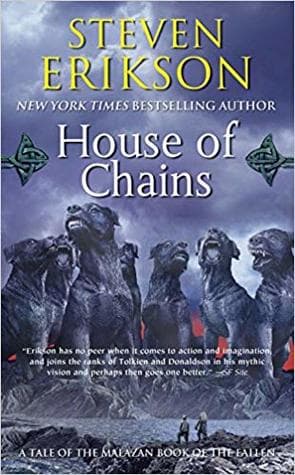
Synopsis
Covers the whole plot, including the ending.
- Difficulty
- Hard
- Pacing
- Variable
- Mood
- Epic, Dark, Philosophical, Brutal, Grand
- Read it if
- You enjoy epic, multi-POV fantasy with morally complex characters, deep world-building, and large-scale military conflicts.
- Skip it if
- You prefer lighthearted fantasy, simple plots, or stories with clear-cut heroes and villains, or you're not prepared for a lengthy and challenging read.
House of Chains Plot Summary
Covers the whole plot, including the ending.
Karsa Orlong's Origins and Enslavement
The story begins in the Teblor lands. Karsa Orlong, a strong warrior, starts his 'coming of age' journey with his friends, Delum Thord and Binadas Sengar. Believing his people are superior, Karsa leads them in raids against lowlander villages in Genabackis, killing many and taking trophies. His pride is immense, fueled by his strength. The trio eventually meets the Malazan 14th Army, led by Squint, who capture Karsa with clever tactics and numbers, despite his power. He is then enslaved, a shock to his view of the world.
The Road to Slavery and the Bridgeburners
Karsa, now a slave, is forced to travel long distances across the continent. He sees the Malazan Empire's brutality and indifference. During his march, he meets different people and learns about the wider world, slowly questioning his simple beliefs. He is present, though not directly involved, during the Chain of Dogs, where the Malazan 7th Army, led by Coltaine, makes its retreat, protecting thousands of refugees. Karsa sees the loyalty and sacrifice of the Bridgeburners and the great suffering, which challenges his ideas of strength and honor. He sees the true cost of war and human resilience.
Tavore's Ascent and the Malazan 14th Army
Empress Laseen names Tavore Paran, a young and new noblewoman, as the new Adjunct. Her first and most important mission is to lead the new Malazan 14th Army to the Holy Desert Raraku to fight the rebellion led by her sister, Sha'ik, who is now the Whirlwind Goddess. The 14th Army is mostly new recruits, many of them conscripts or former criminals, with veteran sergeants and officers from the Bridgeburners and 7th Army. Tavore faces pressure and doubt from her own command, including High Fist Pormqual, who sees her as an untested political appointment. She must quickly turn this group into a fighting force.
Felisin Paran's Ordeal and Sha'ik's Rise
After the events of 'Deadhouse Gates,' Felisin Paran, filled with anger and a desire for revenge against her sister Tavore, is in the Holy Desert Raraku. Through events involving the goddess Poliel and the seer Korbolo Dom, she is chosen to be the Whirlwind Goddess, becoming Sha'ik. This gives her great power and control over the rebel forces. Sha'ik sets up a powerful, but divided, leadership council, including warlords Korbolo Dom and Kamist Reloe, who are driven by their own ambitions, making her control weak despite her divine power.
Karsa's Liberation and Vengeance
Karsa Orlong, after months of enslavement, escapes his captors. He gets back his powerful Teblor swords and begins a path of revenge and self-discovery. He wants to regain his honor and prove his strength, but his experiences have changed him. He is still violent and follows a primal code, but he starts to see the difference between true strength and pointless brutality. He confronts those who wronged him, including the Malazan soldiers who enslaved him, and continues his journey across Genabackis, leaving destruction, but with a growing sense of purpose beyond just conquest.
The Arrival in Raraku and Internal Strife
The Malazan 14th Army, under Tavore's command, marches across the continent and arrives at the Holy Desert Raraku. The harsh conditions and the task ahead weigh on the soldiers. Meanwhile, in Sha'ik's rebel camp, tensions grow between her warlords, Korbolo Dom and Kamist Reloe. Their disagreements and different plans threaten to break the rebellion's unity. Sha'ik struggles to keep control over these ambitious commanders, who see the rebellion as a chance for personal gain.
Apsalar and Cotillion's Mission
Apsalar, the former assassin Empress Laseen used, and Cotillion, the Patron of Assassins, continue their mission. They are to get the souls of the fallen Bridgeburners from the Warren of Chaos, a dangerous task. Their journey brings them into contact with mysterious figures and ancient powers. They subtly affect events, watching the war between the Malazan Empire and the Whirlwind Rebellion. Apsalar, still dealing with her past and Cotillion's influence, becomes more empathetic and wants to protect innocent people, changing from her detached past.
Fiddler and the Bonehunters
Fiddler, one of the last Bridgeburners, is now a sergeant in the new Malazan 14th Army. He, along with veterans like Hedge, Kalam, and Quick Ben, must train and lead new recruits. Fiddler, still affected by the loss of his comrades and the Chain of Dogs, struggles with the responsibility of making these new soldiers into a fighting force. He forms close bonds with his squad, especially with Bottle, a young recruit with magic. His experiences shape his understanding of loyalty, sacrifice, and the Malazan military's spirit.
The First Engagements and Tavore's Resolve
The Malazan 14th Army fights the rebel forces in Raraku in a series of battles. These first fights are brutal, testing the new recruits and Tavore's leadership. Despite many casualties, Tavore shows strong resolve and strategic skill, slowly earning the respect of her officers and soldiers. She makes difficult decisions, sometimes sacrificing parts of her army for larger goals, showing a cold practicality that hides her fragile appearance. Her focus on her mission becomes a key trait.
The Convergence at Y'Ghatan
The novel's climax happens when the Malazan 14th Army, led by Tavore, and the Whirlwind Goddess's forces, led by Sha'ik (Felisin Paran), meet for a large, bloody battle in the city of Y'Ghatan. The battle is chaotic and devastating, with both sides losing many. Karsa Orlong, now free, is drawn into the conflict, fighting on his own terms and becoming more sure of his identity. The various plotlines involving the Malazan veterans, new recruits, and rebel warlords mix in the brutal fighting, leading to a desperate fight for survival in the desert.
Sha'ik's Downfall and the Aftermath
In the battle of Y'Ghatan, Sha'ik is defeated. Tavore, through strategy and her soldiers' sacrifice, breaks the Whirlwind Rebellion. The victory is costly, with much loss and the tragic fight between Tavore and Felisin. Many lives are lost, and the emotional toll on the surviving Malazan soldiers is immense. The novel ends with the Malazan 14th Army, victorious but weakened, facing an uncertain future after the brutal campaign in the Holy Desert Raraku. The true cost of empire and rebellion is clear.
Principal Figures
Karsa Orlong
Protagonist/Anti-hero
A powerful and brutal Teblor warrior seeking to define his own strength and purpose.
Karsa Orlong is a towering, immensely strong Teblor warrior from the northern mountains of Genabackis. Initially driven by a simplistic, arrogant worldview of his own superiority, he embarks on a violent 'coming of age' journey, slaughtering lowlanders without remorse. His experiences as a slave, however, begin to chip away at his hubris, forcing him to question his understanding of strength, honor, and freedom. He is fiercely independent, possessing an almost supernatural resilience and combat prowess, and is driven by a deep-seated desire to forge his own path and prove his worth on his own terms, often through brutal means.
Relationships: Delum Thord (Childhood friend and raiding companion); Binadas Sengar (Childhood friend and raiding companion); Leoman of the Flails (Brief captor and later uneasy ally/adversary)
Tavore Paran
Protagonist
The enigmatic and determined Adjunct leading the Malazan 14th Army against her own sister.
Tavore Paran is the newly appointed Adjunct to Empress Laseen, tasked with quelling the Whirlwind Rebellion led by her sister, Felisin. She is a figure of immense composure and seemingly cold detachment, often concealing her true emotions and intentions. Despite her youth and inexperience in command, she demonstrates an unwavering resolve, strategic brilliance, and a profound, albeit hidden, sense of duty and sacrifice. Her motivations are often ambiguous, but she is driven by a fierce loyalty to the Empire and perhaps a complex, tragic love for her family, even as she is forced to confront them.
Relationships: Felisin Paran (Younger sister, now Sha'ik, the enemy); Ganoes Paran (Brother, High Mage of the Malazan Empire); Pormqual (High Fist under her command, initially skeptical)
Felisin Paran / Sha'ik
Antagonist
Tavore's younger sister, transformed into the vessel of the Whirlwind Goddess and leader of the rebellion.
Felisin Paran begins the novel as a bitter, traumatized young woman, consumed by resentment and a desire for vengeance against her sister, Tavore, for her perceived abandonment. Through a dark ritual in the Holy Desert Raraku, she becomes the mortal vessel for the Whirlwind Goddess, taking on the mantle of Sha'ik. This transformation grants her immense power and authority over the rebel forces, but she struggles to control her ambitious warlords and the divine entity within her. Her journey is one of immense suffering, transformation, and a desperate fight for identity amidst overwhelming forces.
Relationships: Tavore Paran (Older sister, her primary target of vengeance); Korbolo Dom (One of her warlords, manipulative and ambitious); Kamist Reloe (One of her warlords, also ambitious and treacherous)
Fiddler (Strings)
Supporting/Protagonist
A veteran Bridgeburner sapper, now a sergeant in the 14th Army, haunted by past losses.
Fiddler, known as Strings to his comrades, is one of the last surviving Bridgeburners and a highly skilled sapper. He is a pragmatic, weary, but deeply compassionate soldier, profoundly affected by the horrors of the Chain of Dogs and the loss of his friends. In the 14th Army, he takes on the role of a sergeant, guiding and protecting a new generation of recruits, particularly his squad. He carries the immense burden of his past, but his loyalty to his comrades and his innate sense of duty drive him forward. He represents the enduring spirit and resilience of the Malazan common soldier.
Relationships: Hedge (Fellow Bridgeburner sapper, close friend); Kalam (Fellow Bridgeburner, assassin, close friend); Quick Ben (Fellow Bridgeburner, powerful mage, close friend); Bottle (New recruit in his squad, protégé)
Kalam Mekhar
Supporting
A former Claw and Bridgeburner assassin, seeking a new path.
Kalam Mekhar is a formidable assassin, formerly of the Empress's Claw and later a Bridgeburner. He is a man of few words, incredibly dangerous, and possesses a strong moral compass despite his profession. He is driven by a desire to protect those he cares about and to oppose what he perceives as injustice within the Malazan Empire. Throughout the novel, he continues to navigate the complex web of political intrigue and ancient powers, often working in the shadows to achieve his objectives. He is fiercely loyal to his friends and to the ideals he believes in.
Relationships: Fiddler (Fellow Bridgeburner, close friend); Quick Ben (Fellow Bridgeburner, close friend); Apsalar (Former colleague, complex relationship)
Quick Ben
Supporting
A powerful Bridgeburner mage, cunning and resourceful.
Quick Ben is a High Mage of immense power and cunning, one of the last surviving Bridgeburners. He is known for his sharp wit, strategic mind, and his ability to wield multiple warrens simultaneously. Despite his power, he often acts as a mentor and protector to his friends, particularly Fiddler and Kalam. He is deeply knowledgeable about the arcane world and often serves as a guide through the complex magical and spiritual landscape of the Malazan world. Quick Ben is a survivor, always planning several steps ahead, and his loyalties lie firmly with his comrades.
Relationships: Fiddler (Fellow Bridgeburner, close friend); Kalam (Fellow Bridgeburner, close friend); Hedge (Fellow Bridgeburner sapper, close friend)
Apsalar
Supporting
A former assassin grappling with her past and a new sense of purpose.
Apsalar is a former Claw assassin, now seemingly free from the influence of the god Cotillion, yet still bound to him by a complex past. She is a skilled and deadly fighter, but her journey in 'House of Chains' sees her grappling with her identity, her past actions, and a burgeoning sense of empathy and a desire to protect the innocent. She is often quiet and observant, processing the immense changes within her. Her mission with Cotillion is deeply personal, aimed at retrieving the souls of the Bridgeburners, which ties into her own journey of redemption.
Relationships: Cotillion (Her former mentor and partner, god of assassins); Kalam (Former colleague, complex relationship)
Cotillion
Supporting
The Patron of Assassins, a god with a mysterious agenda.
Cotillion is the Patron of Assassins, a powerful and enigmatic god who was once a mortal. He is cunning, manipulative, and possesses vast knowledge of the world and its various powers. His motivations are often shrouded in mystery, but he operates with a long-term plan, subtly influencing events from the shadows. He is deeply connected to Apsalar, having shaped her into an assassin, and their shared mission to retrieve the souls of the Bridgeburners is central to his current objectives. Despite his often-cold exterior, he displays moments of surprising compassion and a deep understanding of human nature.
Relationships: Apsalar (His former protégé, now partner in a shared mission); Shadowthrone (His former partner, now god of Shadow)
Korbolo Dom
Antagonist
A treacherous Malazan general turned warlord in Sha'ik's rebellion.
Korbolo Dom is a former Malazan general, infamous for his cruelty and betrayal during the Chain of Dogs. He is a ruthless, ambitious, and utterly self-serving individual, driven by a thirst for power and a desire to avenge himself against the Malazan Empire. He becomes one of Sha'ik's primary warlords in the Whirlwind Rebellion, but his loyalty is entirely opportunistic. He constantly schemes against other warlords and even Sha'ik herself, seeking to consolidate his own power within the rebel ranks. His presence embodies the corrupting influence of ambition.
Relationships: Sha'ik (Felisin Paran) (His nominal leader, whom he constantly undermines); Kamist Reloe (Rival warlord, constant source of conflict)
Kamist Reloe
Antagonist
Another ambitious warlord in Sha'ik's rebellion, rival to Korbolo Dom.
Kamist Reloe is another powerful warlord within the Whirlwind Rebellion, a rival to Korbolo Dom. Like Dom, he is driven by personal ambition and a desire for power, rather than genuine loyalty to Sha'ik or the cause of the rebellion. He commands a significant portion of the rebel forces and is constantly engaged in a power struggle with Dom, which weakens the overall unity of Sha'ik's army. Reloe is cunning and ruthless, always looking for an advantage, and his presence highlights the fractious nature of the rebellion.
Relationships: Sha'ik (Felisin Paran) (His nominal leader); Korbolo Dom (Rival warlord, constant source of conflict)
Themes & Insights
The Nature of Strength and Power
The novel looks at different kinds of strength: physical, moral, and strategic. Karsa Orlong first thinks strength is just physical power and brutality, but his enslavement and journey make him see the limits of this idea. He sees the moral strength of the Bridgeburners and the strategic power of the Malazans, which makes him rethink his own code. Tavore's strength is her resolve, strategic mind, and ability for great sacrifice, often hidden. The power struggles within Sha'ik's rebellion also show how ambition and treachery can weaken group strength.
“'I am Karsa Orlong. I am Toblakai. I am not a weapon. I am a people.'”
Redemption and Identity
Many characters in 'House of Chains' are trying to find redemption or struggling with who they are. Karsa Orlong's story is about redefining himself beyond his violent youth. Felisin Paran, as Sha'ik, struggles with losing her old self and the goddess's influence, trying to keep some of her identity. Apsalar also seeks redemption from her past as an assassin, looking for a new purpose and a more caring path. Veterans like Fiddler carry their past but find redemption in protecting new recruits.
“'We are not the past. We are not the future. We are the now. And that is enough.'”
The Horrors and Costs of War
'House of Chains' shows the brutal reality and human cost of war. The suffering during the Chain of Dogs, which Karsa sees, reminds readers of conflict's indiscriminate nature. The new Malazan 14th Army, mostly recruits, faces terrible odds and suffers many casualties in the Holy Desert Raraku. The climax at Y'Ghatan is a devastating, bloody event. The novel highlights not just physical harm, but the psychological and emotional scars on soldiers like Fiddler, who are haunted by loss and atrocities.
“'War is not glorious. War is not an adventure. War is a disease. And it will consume you.'”
Duty, Loyalty, and Betrayal
These themes are central to the Malazan world. Tavore shows an almost absolute sense of duty, even when it means fighting her own sister and setting aside personal feelings for the Empire. The loyalty of the Bridgeburners, shown by Fiddler and his squad, contrasts with the betrayal and self-interest among Sha'ik's warlords, Korbolo Dom and Kamist Reloe. These internal conflicts in the rebellion show how a lack of true loyalty and too much betrayal can weaken movements, leading to their downfall.
“'Loyalty is a word, not a weapon.'”
Family and Sacrifice
The tragic relationship between Tavore and Felisin Paran is the novel's emotional heart. Their family bond breaks due to circumstances and politics, forcing them into a devastating conflict. Tavore's actions, though seemingly cold, are driven by a deep, hidden sense of duty and sacrifice for her family and the Empire, even if it means destroying her sister. The novel explores the profound sacrifices people make, not just for a cause, but for the complex and often broken bonds of family, leading to a sad resolution.
“'Sometimes, the greatest love is a silent one. A sacrifice made in the dark.'”
Plot Devices & Literary Techniques
The Whirlwind Goddess
A divine entity possessing Felisin Paran, driving the rebellion.
The Whirlwind Goddess is a powerful, ancient entity that possesses Felisin Paran, transforming her into Sha'ik and making her the figurehead of the rebellion against the Malazan Empire in the Holy Desert Raraku. This device provides a divine justification and immense power for the rebel forces, elevating the conflict beyond mere political uprising. It also serves as a source of internal conflict for Felisin, as she struggles to control or be controlled by the goddess, highlighting themes of possession and loss of identity. The goddess's influence is both a source of strength and a destructive force.
Karsa Orlong's Swords
Two magically potent Teblor swords that symbolize Karsa's power and identity.
Karsa Orlong wields two massive, exceptionally crafted Teblor swords that are not merely weapons but extensions of his identity and power. These swords are imbued with a unique magic, capable of cutting through various enchantments and even the spiritual essence of his foes. When Karsa is enslaved, the loss of his swords symbolizes his loss of freedom and identity. His quest to reclaim them is a pivotal moment in his character arc, representing his reassertion of self and his growing, albeit violent, understanding of his own strength and purpose. They are a constant physical manifestation of his unique nature.
The Malazan 14th Army (Bonehunters)
A new army of raw recruits and veteran remnants, forged in the fires of conflict.
The Malazan 14th Army serves as a crucible for new characters and a continuation of the Malazan military tradition. Composed mostly of raw conscripts and a few hardened veterans from the decimated Bridgeburners and 7th Army, this army represents the Empire's desperate attempt to rebuild and confront a new threat. It highlights themes of mentorship, the forging of camaraderie under duress, and the immense human cost of war. The journey and battles of the 14th Army, nicknamed the 'Bonehunters,' allow for the introduction of new perspectives on the Malazan Empire and the enduring spirit of its soldiers.
The Holy Desert Raraku
A vast, magical desert that serves as the crucible for the rebellion.
The Holy Desert Raraku is not merely a setting but a powerful plot device. It is the heartland of the Whirlwind Rebellion and the place where Felisin Paran becomes Sha'ik. Its harsh, unforgiving environment provides a constant challenge to both the Malazan 14th Army and the rebel forces, shaping their strategies and testing their endurance. The desert is also imbued with ancient magic and spiritual significance, acting as a nexus for various divine and arcane powers, making it a critical battleground for both physical and metaphysical conflicts. It represents both isolation and a mystical power source.
House of Chains Quotes
“First, last, and always, the Empress is what she is. And what she is, is dangerous. Not because she is a tyrant, or even a particularly cruel leader. She is dangerous because she is right. Oh, not always, not in every detail, but in the grand scheme of things, she is terribly, terribly right.”
“Children are innocent and love justice, while most adults are wicked and prefer mercy.”
“The past is a chain, my friend. It holds you. It binds you. And sometimes, you have to break it.”
“We are not our past, nor are we our future. We are only this moment. This breath. This step.”
“And the gods, my friend, are nothing more than a reflection of ourselves. Our greatest hopes, our darkest fears. Our capacity for good, and for evil.”
“There is no justice in the world, not unless we make it. We are the only ones who can bring it forth.”
“Honour is a gift, not a right. It is given by others, and can be taken away.”
“A man learns to live with his mistakes. Or he dies trying to forget them.”
“Compassion is a weapon. Use it wisely.”
“The world is not fair. It never was, and it never will be. But that does not mean we should stop striving for fairness.”
“To forget is to forgive, and to forgive is to be free.”
“Sometimes, the greatest strength lies in knowing when to yield.”
“The path to peace is often paved with conflict, and the price of freedom is eternal vigilance.”
“We walk a narrow road, between what is and what could be. And in that space, we make our choices.”
Quiz
10 questions on the plot and the characters. Each answer comes with a short explanation.
Question 1
What is Karsa Orlong's tribal origin?
- Dal Honese
- Toblakai
- Barghast
- Wickan
Show answer
B. Toblakai Karsa Orlong is a Toblakai warrior from the tribal mountain regions of Northern Genabackis.
Question 2
Who is the Adjunct to the Empress in command of the 12,000 recruits destined for the Holy Desert?
- Lorn
- Felisin Paran
- Tavore Paran
- Sha'ik
Show answer
C. Tavore Paran Tavore Paran is the Adjunct who takes command of the new recruits to confront her sister, Sha'ik, in the Holy Desert.
Question 3
What is the name of Tavore's sister, who leads the rebellion in the Holy Desert?
- Apsalar
- Felisin Paran (Sha'ik)
- Duiker
- Surly
Show answer
B. Felisin Paran (Sha'ik) Tavore's sister, Felisin Paran, becomes the new Sha'ik, the leader of the Whirlwind rebellion.
Question 4
What is the primary motivation for Karsa Orlong's initial journey from his homeland?
- To join the Malazan army
- To seek vengeance for his enslaved kin and prove his strength
- To explore the southern flatlands out of curiosity
- To find a new home for his tribe
Show answer
B. To seek vengeance for his enslaved kin and prove his strength Karsa Orlong sets out to prove his strength and avenge his people who have been raided and enslaved by the flatlanders.
Question 5
What is the name of the Malazan stronghold where Tavore gathers her new recruits?
- Unta
- Aren
- Malaz City
- Otosclan
Show answer
D. Otosclan Tavore enters Otosclan, the last Malazan stronghold, to prepare her new army for the campaign in the Holy Desert.
Question 6
Which ancient entity does Karsa Orlong encounter and eventually swear an oath to, influencing his path significantly?
- The Crippled God
- The Elder God T'riss
- The Jaghut Tyrant
- The Old Man of the Desert (Moby)
Show answer
D. The Old Man of the Desert (Moby) Karsa Orlong encounters and makes an oath to the ancient being known as the Old Man of the Desert, or Moby, who tasks him with a specific purpose.
Question 7
What is the significance of the 'Whirlwind' in the context of the Holy Desert rebellion?
- It is a natural phenomenon unique to the desert
- It is the spiritual and military movement led by Sha'ik against the Malazan Empire
- It refers to a specific type of magic used by the desert sorcerers
- It is the name of a legendary Malazan cavalry unit
Show answer
B. It is the spiritual and military movement led by Sha'ik against the Malazan Empire The Whirlwind is the name given to the massive religious and military rebellion in the Holy Desert, led by Sha'ik, aiming to overthrow Malazan rule.
Question 8
Which of the following characters is NOT one of the 'seer's warlords' who vie for power within Sha'ik's rebellion?
- Korbolo Dom
- Leoman of the Flails
- Bidithal
- Toblakai (Karsa Orlong)
Show answer
C. Bidithal Korbolo Dom, Leoman of the Flails, and Kamist Reloe are prominent warlords under Sha'ik. Bidithal is a sorcerer and advisor, not a warlord in the same sense.
Question 9
What is the ultimate fate of the original Sha'ik (Felisin Paran) in 'House of Chains'?
- She successfully defeats the Malazan army and establishes an independent empire.
- She is killed by her own sister, Tavore, during a confrontation.
- She abandons her leadership and disappears into the desert.
- She is captured by the Malazans and imprisoned.
Show answer
B. She is killed by her own sister, Tavore, during a confrontation. Felisin Paran, as Sha'ik, is ultimately killed by her sister, Tavore, in a pivotal and tragic confrontation near the end of the book.
Question 10
What specific act does Karsa Orlong commit that earns him the moniker 'Teblor who walks the world' and sets him on a different path from his initial tribal raids?
- He leads a successful rebellion against the Malazan Empire.
- He kills a powerful Elder God and claims its power.
- He rejects the traditional Toblakai ways after being captured and learning of wider injustices.
- He constructs a massive monument to his fallen ancestors.
Show answer
C. He rejects the traditional Toblakai ways after being captured and learning of wider injustices. After being captured and exposed to the 'civilized' world, Karsa Orlong gains a new perspective on injustice and rejects his initial, limited understanding of 'strength', leading him to declare himself 'the Teblor who walks the world' to right wrongs.
House of Chains FAQ
What is the primary conflict driving the narrative in 'House of Chains'?
The main conflict revolves around the Malazan Fourteenth Army, led by Adjunct Tavore Paran, attempting to cross the Holy Desert Raraku and confront the Whirlwind Goddess, Sha'ik, who is Tavore's sister. This struggle is set against the backdrop of tribal warfare in Northern Genabackis and the internal power struggles within Sha'ik's rebellion, particularly among her warlords.
Who are Karsa Orlong and what is his role at the beginning of the book?
Karsa Orlong is a Toblakai warrior from the high plains of Genabackis, introduced raiding southern villages with his companions. His early narrative details his capture by Malazan forces, his brutal experiences as a slave, and his subsequent escape, setting him on a path of self-discovery and a quest to 'witness' and challenge the gods.
What is the significance of the Holy Desert Raraku in the story?
Raraku is the sacred desert where the rebellion against the Malazan Empire, led by Sha'ik, has taken root and grown powerful. It is also the location where Felisin Paran, now Sha'ik, underwent her transformation and where the Whirlwind Goddess manifests her power, making it the ultimate destination for Tavore's army.
Who is Tavore Paran and what challenges does she face as the Adjunct?
Tavore Paran is the newly appointed Adjunct to Empress Laseen, tasked with leading the Fourteenth Army, composed largely of raw recruits and veteran officers skeptical of her command. She faces immense pressure to forge this disparate force into an effective fighting unit capable of defeating her own sister, Sha'ik, in the Holy Desert, all while maintaining a stoic and enigmatic demeanor.
What is the relationship between Tavore and Sha'ik (Felisin Paran)?
Tavore and Sha'ik are sisters, with Sha'ik being the former Felisin Paran, who was unjustly imprisoned and suffered greatly, eventually becoming the vessel for the Whirlwind Goddess. Their relationship is one of profound tragedy and conflict, as Tavore is forced to lead an army against her own kin, a sister she believes she failed to protect.
How does Trull Sengar's past actions on the First Shore influence his character arc in this novel?
Trull Sengar's past act of refusing to participate in the T'lan Imass ritual on the First Shore resulted in his banishment and the loss of his family's honour, forcing him to carry a heavy burden of shame and isolation. In 'House of Chains', this past drives his stoicism, his commitment to his oath to Onrack, and his continued quest for redemption, shaping his interactions and his quiet suffering.
What is the true nature of the Whirlwind Goddess and her connection to Sha'ik?
The Whirlwind Goddess is an ancient, powerful entity, possibly a remnant of an Elder God or an ascended being, who has chosen Sha'ik (Felisin Paran) as her mortal vessel. She embodies rebellion and vengeance against the Malazan Empire, manipulating events and empowering Sha'ik's forces, though her ultimate motivations and origins remain shrouded in mystery, hinting at a larger, older conflict.
How do the events of 'House of Chains' connect to the wider Malazan world, specifically the events in 'Deadhouse Gates'?
'House of Chains' directly follows the aftermath of 'Deadhouse Gates', particularly the Chain of Dogs and the rise of Sha'ik's rebellion. It shows the Malazan Empire's response to the Whirlwind, with Tavore's Fourteenth Army being sent to quell it, and explores the repercussions of Coltaine's sacrifice and the suffering endured by Felisin Paran leading to her transformation.
What is the significance of the 'witnessing' motif, especially concerning Karsa Orlong?
Karsa Orlong's journey is fundamentally about 'witnessing' the true nature of power, gods, and civilization. He seeks to understand and judge these forces, believing that his Toblakai heritage grants him a unique perspective. This motif reflects his growing awareness of the world's complexities and his desire to challenge those he deems corrupt or unworthy, ultimately shaping his destiny.
Discuss the psychological impact of Tavore's stoicism on her command and her soldiers.
Tavore's extreme stoicism creates a psychological distance between her and her soldiers, making her an enigma. While it projects an image of unwavering resolve and control, it also breeds suspicion and fear among her troops, who struggle to understand her motivations or connect with her on a personal level. This isolation is a heavy burden she carries, essential for her leadership but detrimental to her personal well-being.
How does Felisin Paran's transformation into Sha'ik reflect psychological trauma and vengeance?
Felisin's transformation into Sha'ik is a profound manifestation of her psychological trauma, born from her unjust imprisonment, abuse, and the perceived abandonment by her family. Her embrace of the Whirlwind Goddess is a desperate act of vengeance and a complete rejection of her past identity, channeling her immense suffering into a powerful, destructive force against the Malazan Empire.
Analyze the psychological journey of Karsa Orlong from a tribal warrior to someone questioning the gods.
Karsa's journey is a psychological awakening, moving from a simplistic, brutal tribal worldview to a complex understanding of power, morality, and the nature of divinity. His experiences with slavery, torture, and witnessing the corruption of civilization force him to re-evaluate his assumptions, leading him to question the authority of gods and mortals alike, forging a unique moral code.
What role does guilt play in the motivations and actions of various characters, particularly Tavore and Cotillion?
Guilt profoundly influences both Tavore and Cotillion. Tavore carries the unspoken guilt of her sister's suffering, which drives her desperate mission to confront Sha'ik, believing it's her responsibility. Cotillion, the Rope, is haunted by the guilt of his past actions and the sacrifices made for the Empress, seeking redemption and a path to protect those he cares about, like Apsalar.
How does 'House of Chains' explore themes of free will versus destiny?
'House of Chains' grapples with free will versus destiny through characters like Karsa Orlong, who actively rejects predestined paths and seeks to forge his own. Conversely, characters like Sha'ik seem to be instruments of a larger power, while Tavore struggles to assert her will against overwhelming forces, suggesting a complex interplay where individuals can either defy or succumb to their fates.
Is Tavore's stoicism a strength or a weakness, and what does it ultimately achieve?
Tavore's stoicism is a complex double-edged sword. It is a strength in that it allows her to maintain control and command respect in dire circumstances, projecting an image of unshakeable resolve. However, it is also a weakness, isolating her from her troops and making her appear cold and unfeeling. Ultimately, it allows her to execute her painful mission, but at immense personal cost, leaving her emotionally scarred.
What is the philosophical significance of Karsa Orlong's declaration: 'I am not a slave to the gods. I am not a slave to men. I am not a slave to my own desires'?
This declaration by Karsa Orlong is central to his philosophy of absolute self-determination and his rejection of all external authority. It signifies his quest for true freedom and his refusal to be bound by any power, whether divine, mortal, or even internal, marking him as a uniquely independent force in the Malazan world who seeks to carve his own path and challenge established orders.
Discuss the moral ambiguity of the Malazan Empire as portrayed in 'House of Chains'.
'House of Chains' continues to paint the Malazan Empire with significant moral ambiguity. While they are often seen as oppressors, particularly in the context of the Holy Desert rebellion, the book also highlights the dedication and humanity of individual Malazan soldiers and officers. The empire's actions, while sometimes brutal, are often framed as necessary evils for stability, leaving readers to debate their ultimate righteousness.
How does the novel use the perspectives of different characters (Karsa, Tavore, Sha'ik) to create a multifaceted view of the conflict?
The novel masterfully uses multiple perspectives to create a rich, multifaceted view of the conflict. Karsa's journey offers an outsider's, often brutal, perspective on civilization and power. Tavore's internal struggles reveal the immense personal cost of command and duty. Sha'ik's narrative illuminates the roots of rebellion and the psychological impact of injustice, allowing readers to understand the motivations and suffering on all sides.
About the author

Steven Erikson is a Canadian author known for his epic fantasy series, "Malazan Book of the Fallen." His notable works include "Deadhouse Gates," "House of Chains," "Midnight Tides," "The Bonehunters," "Toll the Hounds," and "Dust of Dreams." Erikson's writing is characterized by its complex narratives and extensive world-building.
Similar books
- The Way of Kings
Brandon Sanderson
4.6 (305k) average on GoodreadsFantasyFeatures large-scale military campaigns, complex magic systems, and multiple character perspectives.
- A Game of Thrones
George R.R. Martin
4.5 (2M) average on GoodreadsFantasyKnown for its sprawling cast, political intrigue, and grim, realistic approach to war and power.
- The Eye of the World
Robert Jordan
4.2 (392k) average on GoodreadsFantasyCompared to Robert Jordan's The Eye of the World (the first book in The Wheel of Time series), House of Chains is far less conventional in its narrative structure. Jordan's approach is more classic high fantasy, with a clear hero's journey, a more accessible magic system, and a gradual introduction of world elements. Erikson, in contrast, plunges the reader into a pre-existing, complex world with multiple, often morally ambiguous protagonists and a non-linear narrative, requiring a higher degree of reader investment and tolerance for ambiguity from the outset.
- Harry Potter and the Sorcerer's Stone
J.K. Rowling
4.5 (7M) average on GoodreadsFantasyRescued from a miserable life under the stairs, an orphaned boy discovers he's a wizard destined for a magical school, where he uncovers a dangerous secret tied to the dark wizard who murdered his parents.
- The Hunger Games
Suzanne Collins
4.3 (6.4M) average on GoodreadsFantasyIn a future where children fight to the death on live television, Katniss Everdeen volunteers for the arena, turning a death sentence into a fight for survival and a spark of rebellion.
- 1984
George Orwell
4.2 (3.1M) average on GoodreadsPoliticsIn a future where surveillance and thought control are absolute, a man's search for truth clashes with the Party, showing that hope can be a form of rebellion.






Enjoyed the summary?
A summary gives you the shape of the book. The book itself has the detail, the examples and the voice.
Find House of Chains on AmazonAs an Amazon Associate, BookBrief earns from qualifying purchases. How we're funded