
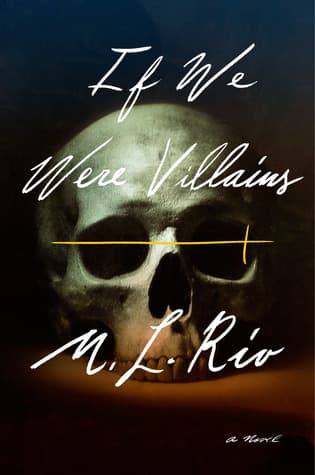
Synopsis
Covers the whole plot, including the ending.
- Difficulty
- Medium
- Pacing
- Moderate
- Mood
- Atmospheric, Suspenseful, Melancholy, Intense
- Read it if
- You love dark academia, Shakespearean drama, and morally ambiguous characters entangled in a web of secrets and murder.
- Skip it if
- You prefer straightforward mysteries with clear-cut heroes and villains, or find theatrical settings and intense character studies unengaging.
If We Were Villains Plot Summary
Covers the whole plot, including the ending.
Release and Reunion
Oliver Marks is released from prison after serving ten years for the murder of Richard Stirling. Waiting for him is Detective Colborne, the man who investigated the original case and secured Oliver's conviction. Colborne, on the verge of retirement, tells Oliver he has never been entirely satisfied with the official story and wants to know the real truth. Oliver, hesitant at first, agrees to recount the events of his final year at Dellecher Classical Conservatory, a prestigious arts college where he and six other students studied Shakespeare, leading to a tragic incident that changed their lives forever.
Dellecher's Elite Seven
Oliver begins his narrative, introducing the insular world of Dellecher Classical Conservatory. He describes the seven fourth-year students in the acting program: himself, the quiet observer; Richard, the charismatic and volatile 'tyrant'; James, the principled 'hero'; Alexander, the flamboyant 'villain'; Meredith, the beautiful 'temptress'; Wren, the delicate 'ingenue'; and Filippa, the pragmatic 'extra'. They live in a secluded building, the Wardrobe, and are bound by intense friendships, rivalries, and a shared passion for Shakespeare, often blurring the lines between their stage roles and their real-life personas.
The Shifting Roles
The group's seemingly stable dynamic begins to unravel during casting for their final play, 'Julius Caesar'. Richard, who typically played the lead 'tyrant' roles, is cast as Brutus, a more conflicted character, while James, the usual 'hero', is cast as Caesar. This unexpected switch, orchestrated by Professor Geller, ignites simmering tensions and resentments, particularly from Richard, who feels his dominance is threatened. The other students are forced to adapt to these new interpretations, and the lines between their stage personas and their personal lives become increasingly blurred, leading to heightened emotional stakes.
Halloween Night and the First Fight
During a Halloween party, fueled by alcohol and underlying resentments, the group's tensions boil over. Richard, increasingly erratic and abusive, provokes James. The confrontation escalates into a brutal fight between them, witnessed by the others. This violent outburst precedes the tragedy that will soon unfold. The incident leaves the group shaken, and the bond between them, once thought unbreakable, shows significant cracks. The others are forced to confront Richard's escalating aggression and its dangerous impact on their tightly knit community.
The Lake and the Discovery
Following the Halloween party, a night of heavy drinking and a particularly vicious fight involving Richard, the group disperses. The next morning, Richard's body is found in the lake near Dellecher. The police are called, and a murder investigation begins. The remaining six students are immediately suspects, and their carefully constructed world is shattered. They must perform their greatest act yet: convincing the authorities, and themselves, that they are innocent, while grappling with the reality of Richard's death and their own complicity.
The Interrogation and the Pact
The police, led by Detective Colborne, begin their interrogations. Each of the six remaining students is questioned separately, and their conflicting accounts raise suspicion. Fearing exposure and desperate to protect their futures, the group convenes and makes a pact: they will all corroborate a fabricated story, claiming they were all together in the Wardrobe when Richard disappeared. This collective lie, born of fear and misguided loyalty, binds them together in a dangerous conspiracy, deepening their individual guilt and complicity in the cover-up.
The Trial and Oliver's Confession
As the investigation continues, the police close in. Despite their shared alibi, the pressure mounts. Ultimately, Oliver, believing he is protecting the others and driven by a desperate need to end the ordeal, confesses to Richard's murder. He provides a detailed, albeit false, account of the events, taking full responsibility. His friends, though distraught, do not contradict his confession, and Oliver is subsequently arrested, tried, and convicted. This act of self-sacrifice marks a turning point, sealing his fate and forever altering the lives of the remaining students.
Life After Dellecher
From prison, Oliver recounts what he knows of his friends' lives after Dellecher. James, burdened by guilt, becomes a reclusive stage actor. Wren and Alexander pursue successful but troubled careers, often performing together. Meredith finds some success but remains haunted. Filippa, the most pragmatic, distances herself from the group, seemingly moving on. The shared trauma and the secret they carry have fractured their once-intense bonds, leaving them isolated and marked by the past. Their lives show the lasting consequences of their actions and the secrets they kept.
Colborne's Doubts and The Real Story
Back in the present, Colborne reveals he always suspected Oliver's confession was incomplete or false. He presses Oliver, explaining that his retirement makes this his last chance for closure. Faced with Colborne's unwavering conviction and the passage of time, Oliver finally breaks. He confesses the true sequence of events leading to Richard's death, revealing that while he was present, the actual perpetrator was not who everyone believed, and the circumstances were far more complex and tragic than his initial confession suggested.
The Truth Revealed
Oliver reveals the truth: during the struggle at the lake, James, in a moment of self-defense and rage, pushed Richard, causing him to hit his head and drown. Oliver, arriving shortly after, witnessed the immediate aftermath. Out of a deep, unspoken love and loyalty for James, Oliver chose to take the blame, fabricating a story that would protect his friend. He orchestrated the scene to appear as if he was the killer, believing it was the only way to save James from a life in prison and to preserve the group's fragile unity, even if it meant sacrificing himself.
The Aftermath and Oliver's Choice
Oliver explains that his decision to confess was an act of profound love and a desperate attempt to save James, whom he considered his closest friend and soulmate. He believed that James, with his inherent goodness, would not survive prison, whereas Oliver felt he could endure it. He meticulously constructed his false confession, ensuring it was convincing. Colborne, though disturbed by the revelation, recognizes the depth of Oliver's sacrifice. Oliver accepts the consequences of his choice, acknowledging the years he lost but finding a strange peace in having protected James, even if it meant his own suffering.
A Final Performance
With the truth finally laid bare to Colborne, Oliver reflects on his ten years in prison and the life he has ahead. He has gained a measure of freedom by telling his story, but the weight of his past and the impact of his sacrifice remain. The novel concludes with Oliver stepping out of the car, having finished his confession, facing an uncertain future. The 'play' is over, but the consequences of his actions and the secrets he kept will undoubtedly continue to shape his life and the lives of those he protected. He is left to navigate a world that has moved on, while he has been suspended in time.
If We Were Villains Characters
Oliver Marks
Protagonist
The quiet, observant actor who takes the fall for a murder he didn't commit.
Oliver is initially depicted as the 'extra' in the Dellecher group, often overlooked and self-effacing. He is deeply observant, intelligent, and possesses a profound love for Shakespeare. His quiet demeanor belies a fierce loyalty and a capacity for immense sacrifice. He is driven by a deep, unspoken affection for James and a desire to protect his friends, even at his own expense. His internal world is rich, and he often narrates events with a theatrical flourish, reflecting his immersion in the craft.
Relationships: James Farrow (Deep, unrequited love and fierce loyalty; best friend); Richard Stirling (Victim; complex relationship of rivalry and fear); Detective Colborne (Interrogator; complex relationship of cat-and-mouse, eventually trust and confessor)
James Farrow
Supporting (catalyst for the murder)
The principled 'hero' of the group, burdened by guilt and a dark secret.
James is initially the group's moral compass, the 'hero' archetype, known for his integrity and quiet strength. He is deeply sensitive and struggles with the darker aspects of human nature, making him a foil to Richard's volatility. His accidental role in Richard's death leaves him profoundly traumatized and guilt-ridden, leading him to a reclusive life. He is driven by a desire for justice and truth, which ultimately clashes with the need to protect his own secret.
Relationships: Oliver Marks (Best friend; unaware of Oliver's love and sacrifice for him); Richard Stirling (Intense rivalry and eventual fatal confrontation); Wren Fairchild (Romantic relationship)
Richard Stirling
Antagonist/Victim
The charismatic but cruel 'tyrant' whose death sets the plot in motion.
Richard is the dominant, charismatic, and deeply manipulative leader of the Dellecher group. He excels at playing villains on stage and embodies many of those traits in real life, using his charm and intelligence to control and torment his friends. He is prone to fits of rage and physical violence, particularly when his authority is challenged. His escalating aggression and cruelty become the catalyst for the tragic events of the story. He represents the destructive power of unchecked ego and a blurred line between art and reality.
Relationships: Meredith Dardenne (On-again, off-again romantic and physically abusive relationship); James Farrow (Intense rivalry); Oliver Marks (Antagonistic; frequent target of his bullying)
Meredith Dardenne
Supporting
The beautiful 'temptress' of the group, entangled with Richard and later James.
Meredith is the beautiful and alluring 'temptress' of the group, often caught in the crossfire of the men's rivalries. She is drawn to the drama and intensity of their world but also suffers greatly from Richard's abuse. She struggles with her own desires and the consequences of her choices, often seeking validation and affection. Her vulnerability and complicated loyalties make her a tragic figure, deeply affected by the group's dynamics and Richard's death.
Relationships: Richard Stirling (Abusive romantic relationship); James Farrow (Brief romantic connection); Wren Fairchild (Close female friendship)
Wren Fairchild
Supporting
The delicate 'ingenue' who often serves as a moral anchor.
Wren is the 'ingenue' of the group, characterized by her delicate beauty, sensitivity, and often childlike innocence. She is deeply empathetic and often tries to mediate conflicts, though she is also susceptible to the group's pressures. She forms a romantic relationship with James, which adds another layer of tension to the group dynamic. Her vulnerability makes her a target for Richard's cruelty, and she is deeply affected by the events at Dellecher.
Relationships: James Farrow (Romantic relationship); Meredith Dardenne (Close female friendship)
Alexander Vass
Supporting
The flamboyant 'villain' on stage and off, known for his wit and theatricality.
Alexander is the flamboyant and theatrical 'villain' of the group, known for his sharp wit, dramatic flair, and sardonic humor. He embraces his roles, both on and off stage, with gusto, often using his persona as a shield. He is fiercely loyal to his friends but also possesses a cynical edge. He is often the one to lighten the mood but also capable of cutting remarks. His theatricality makes it difficult for others to discern his true feelings, adding to the layers of performance within the group.
Relationships: Filippa Marino (Close friendship, often partners in mischief); Richard Stirling (Rivalry and antagonism)
Filippa Marino
Supporting
The pragmatic 'extra' who often observes and documents the group's events.
Filippa is the pragmatic and grounded 'extra' of the group, often serving as an observer and documentarian. She is intelligent, perceptive, and less outwardly emotional than the others. She provides a sense of stability and often captures the group's interactions through photographs and notes, acting as a quiet chronicler. While she participates in the group's pact, she is also the most likely to distance herself from the drama, valuing her own independence and future.
Relationships: Alexander Vass (Close friendship)
Detective Colborne
Supporting
The persistent detective who never fully believes Oliver's original confession.
Detective Colborne is the lead investigator in Richard's murder case. He is shrewd, patient, and possesses a deep intuition that tells him Oliver's confession is not the complete truth. He is driven by a genuine desire for justice and closure, both for the victim and for himself, as he approaches retirement. His persistence over a decade eventually leads Oliver to reveal the full story, making him a crucial catalyst in the narrative.
Relationships: Oliver Marks (Adversarial at first, evolving into a relationship of confessor and confidante)
If We Were Villains Themes
The Blurring of Art and Life
The novel constantly explores how the characters' immersion in Shakespearean roles influences and mirrors their real-life relationships and conflicts. The Dellecher students, particularly Richard, often treat life as a stage, playing archetypal roles like 'tyrant,' 'hero,' or 'temptress.' This theatrical mindset leads to dramatic confrontations and a distorted sense of reality, where the heightened emotions of the stage bleed into their personal interactions, contributing to the tragic events. The casting changes for 'Julius Caesar' directly provoke the fatal shift in their dynamic.
“For us, in our youth, the boundaries between the stage and life were often blurred. We lived for the theatre, and sometimes, we died for it.”
Loyalty and Sacrifice
A central theme is the extreme lengths to which the characters, particularly Oliver, will go to protect those they love. Oliver's confession and ten-year imprisonment are the ultimate acts of loyalty and self-sacrifice, motivated by his deep, unspoken love for James. The collective pact to lie to the police, while flawed, also stems from a misguided sense of group loyalty. This theme explores the moral ambiguities of such sacrifices and their long-term, often devastating, consequences on the individuals involved.
“What is more theatrical than to die for someone else's sins?”
Guilt and Consequences
The novel examines the profound and lasting impact of guilt, both for the act of murder and for the subsequent cover-up. Oliver carries the weight of a crime he did not commit, while James lives with the secret of his accidental involvement. The other characters, complicit in the lie, are also haunted by their past, leading to fractured lives and emotional isolation. The story shows that secrets, even those kept for noble reasons, inevitably take a heavy toll on the human psyche, shaping destinies and preventing true freedom.
“We were so young, so arrogant, we thought we could outrun the consequences. We were wrong.”
Performance and Deception
Given the characters are actors, the theme of performance and deception is pervasive. They are constantly performing, not just on stage, but in their daily lives, presenting carefully crafted personas to each other and to the outside world. The initial pact to lie to the police is their greatest collective performance, a desperate attempt to deceive. Oliver's confession is a meticulously rehearsed act of deception designed to protect James. The novel questions the nature of truth when everyone is an actor, and how difficult it is to discern genuine emotion from practiced performance.
“We were all good at playing parts. The problem was, we'd forgotten how to stop.”
The Nature of Justice
The story challenges conventional notions of justice. Oliver, an innocent man, serves ten years for murder, while the actual perpetrator lives free, albeit burdened by guilt. Detective Colborne's relentless pursuit of the truth, even after Oliver's conviction, highlights the idea that legal justice does not always align with moral truth. The novel suggests that true justice might be found not in retribution, but in the painful process of confession and self-reckoning, allowing for a different kind of closure.
“Justice, I'd learned, was a malleable thing. It bent to fit the circumstances, the evidence, the will of men.”
Plot Devices & Literary Techniques
Frame Narrative
Oliver's present-day confession to Detective Colborne frames the retelling of past events.
The entire story is presented as Oliver Marks recounting the events of his final year at Dellecher to Detective Colborne, ten years after the murder and his subsequent imprisonment. This structure allows for a dual timeline, building suspense as the reader, along with Colborne, pieces together the true sequence of events. It also provides Oliver with the emotional distance and perspective to reflect on his past actions and motivations, revealing the layers of truth gradually.
Dramatic Irony
The audience knows Oliver is in prison for murder, but the details of the crime and its true perpetrator are withheld.
From the outset, the reader knows Oliver has served ten years for Richard's murder, creating immediate tension. However, the specific circumstances, Oliver's true role (or lack thereof), and the identities of all involved are gradually revealed. This dramatic irony fuels the narrative, as the reader anticipates the unfolding truth, constantly questioning Oliver's reliability as a narrator and the validity of his initial confession. It highlights the gap between public perception and private reality.
Shakespearean Allusions and Archetypes
The characters and plot are deeply interwoven with references to Shakespeare's plays and character archetypes.
The novel uses Shakespearean allusions extensively, not just in dialogue and chapter titles, but in the very fabric of the characters' identities and the plot's progression. The seven students consciously embody archetypes like 'hero,' 'villain,' 'tyrant,' 'ingenue,' which profoundly influence their interactions. The casting of 'Julius Caesar' directly precipitates the conflict. This device enriches the themes of performance, fate, and tragedy, drawing parallels between the heightened drama of Shakespeare and the characters' real-life struggles.
Unreliable Narrator
Oliver Marks withholds crucial information and actively deceives in his initial confession.
Oliver Marks functions as an unreliable narrator, particularly concerning his initial confession to Detective Colborne. He presents a version of events that is deliberately incomplete and misleading, designed to protect James. The reader is privy to his internal thoughts and justifications, but the full truth is only revealed in the story's climax. This unreliability forces the reader to actively interpret events and question the narratives presented, adding layers of complexity to the mystery.
If We Were Villains Quotes
“For someone who loved words as much as I did, I was often at a loss to explain how I felt.”
“That's the thing about a tragedy. It's never about the villain.”
“We were a family, in the way that all ensembles are a family: bound by love and rivalry and a terrible, exhilarating intimacy.”
“You can play a role so many times, but it never really becomes you. Not truly. Not the part, only the performance.”
“We were so young. We were so stupid. We were so in love with ourselves.”
“But that’s the trick, isn’t it? To make the audience forget that what they’re seeing isn’t real.”
“We were not actors then, but ourselves. And that was the most terrifying role of all.”
“We were all villains in our own stories. Or at least, we all had the capacity to be.”
“It was a kind of madness, I think, to live so intensely, so entirely for art.”
“How many times could you lose someone before you stopped noticing the empty space?”
“We were always performing, even when there was no audience.”
“The worst part of a lie is not the telling of it, but the living with it.”
“There are nine circles of hell, but the tenth, I think, is reserved for those who know the truth and choose to look away.”
“We were all trying to be something we weren't, and in doing so, we became exactly what we were meant to be.”
Quiz
10 questions on the plot and the characters. Each answer comes with a short explanation.
Question 1
Which Shakespearean role does Oliver Marks primarily play among his group of friends at Dellecher Classical Conservatory?
- The Tyrant
- The Hero
- The Extra
- The Villain
Show answer
C. The Extra Oliver is consistently cast as 'the extra,' a secondary character, both in their plays and within their social dynamic, which fuels some of his internal conflict.
Question 2
Who is the first of the seven friends to die, triggering the central mystery of the novel?
- Alexander
- Richard
- James
- Frederick
Show answer
B. Richard Richard is the first of the group to die, found at the bottom of the lake, which sets off the chain of events and cover-up.
Question 3
What is the name of the elite arts college where the seven friends study Shakespeare?
- Stratford Academy
- Dellecher Classical Conservatory
- Rosewood School of Drama
- Blackfriars College
Show answer
B. Dellecher Classical Conservatory The setting for the story is the isolated and prestigious Dellecher Classical Conservatory, where the students are intensely focused on classical theatre.
Question 4
What significant change in casting precedes the dramatic escalation of conflict and ultimately Richard's death?
- Oliver is finally cast as the lead hero.
- Meredith is replaced by Filippa as the ingenue.
- Richard loses his usual lead roles to James and Alexander.
- Frederick decides to quit acting altogether.
Show answer
C. Richard loses his usual lead roles to James and Alexander. Richard, accustomed to playing the lead hero, is increasingly cast in villainous roles or supplanted by James and Alexander in the hero parts, which deeply wounds his ego and fuels his rage.
Question 5
What is the primary reason Detective Colborne visits Oliver Marks upon his release from prison?
- To offer him a job as a police informant.
- To apologize for wrongly convicting him.
- To finally learn the full truth about what happened a decade ago.
- To inform him that another suspect has been found.
Show answer
C. To finally learn the full truth about what happened a decade ago. Colborne, on the verge of retirement, wants closure and the complete, unvarnished truth from Oliver about the events surrounding Richard's death.
Question 6
Which of the following Shakespearean tragedies is NOT explicitly mentioned or rehearsed by the students at Dellecher?
- Macbeth
- King Lear
- Romeo and Juliet
- Julius Caesar
Show answer
C. Romeo and Juliet While they study many tragedies, 'Romeo and Juliet' is not a primary focus of their advanced classical training, which leans towards more complex tragedies like 'King Lear,' 'Macbeth,' and 'Julius Caesar'.
Question 7
What is the underlying theme that drives much of the characters' actions and motivations throughout the novel?
- The pursuit of wealth and fame.
- The blurred lines between art and life, and the roles people play.
- The struggle for political power.
- The importance of forgiveness and redemption.
Show answer
B. The blurred lines between art and life, and the roles people play. A core theme is how the students' immersion in Shakespearean roles blurs the boundaries with their real lives, leading them to act out dramatic archetypes and make choices as if on a stage.
Question 8
What is the true cause of Richard's death, as revealed by Oliver to Colborne at the end of the book?
- He accidentally drowned while drunk and fighting with Oliver.
- He was pushed into the lake by James during a struggle, and then held down by Oliver.
- He was thrown into the lake by all seven of them in a collective act of violence.
- He was pushed by James into the lake, and then Oliver intervened to ensure his death, believing he was saving James.
Show answer
D. He was pushed by James into the lake, and then Oliver intervened to ensure his death, believing he was saving James. Oliver reveals that James pushed Richard into the lake, but when Richard came up, Oliver held him under to protect James, whom he believed Richard was trying to kill, and thus, Oliver is the true murderer.
Question 9
Which character ultimately commits suicide, unable to cope with the guilt and the weight of their shared secret?
- Alexander
- Meredith
- James
- Frederick
Show answer
C. James James, deeply traumatized by his role in Richard's death and the subsequent cover-up, eventually takes his own life, a secret that Oliver also carries.
Question 10
What is the significance of the quote 'We are all villains in a story, no matter how we try to be heroes' in the context of the novel's resolution?
- It suggests that the police were wrong to convict Oliver, as everyone was equally culpable.
- It reflects Oliver's acceptance of his own culpability and the idea that even heroic intentions can lead to villainous acts.
- It implies that the true villain was Richard all along, and the others were merely defending themselves.
- It is a meta-commentary on Shakespearean tragedy, suggesting that no character is purely good or evil.
Show answer
B. It reflects Oliver's acceptance of his own culpability and the idea that even heroic intentions can lead to villainous acts. The quote encapsulates Oliver's confession and understanding that despite his love for James and his intention to protect him, his actions made him a villain. It highlights the moral ambiguity and the complex nature of guilt and complicity that permeates the entire story.
If We Were Villains FAQ
What is the central mystery Oliver Marks is asked to recount upon his release from prison?
Upon his release, Oliver is asked by Detective Colborne to finally reveal the truth about the death of Richard, one of the seven acting students at Dellecher Conservatory. Oliver has served ten years for this murder, but Colborne suspects there's more to the story than what was presented during the initial investigation and trial.
Who are the seven main acting students at Dellecher Conservatory and what roles do they typically play?
The seven students are Oliver (the 'extra'), Richard (the 'tyrant'/'king'), James (the 'hero'), Alexander (the 'villain'), Meredith (the 'temptress'), Wren (the 'ingenue'), and Filippa (the 'chameleon'/'observer'). These archetypes influence their relationships and interactions both on and off the stage, contributing to the intense drama.
How does Shakespearean drama influence the students' lives and the events leading to Richard's death?
The students are deeply immersed in Shakespeare, and their roles in plays like 'Julius Caesar' and 'King Lear' begin to mirror and even dictate their real-life dynamics. The lines between performance and reality blur as ambition, jealousy, and betrayal, common themes in Shakespeare, manifest within their tight-knit group, escalating tensions and ultimately leading to tragedy.
What is the significance of the casting change mentioned in the synopsis?
The casting change, specifically when Richard loses his leading roles and James and Alexander gain prominence, disrupts the established hierarchy among the students. This shift fuels Richard's resentment and paranoia, leading him to lash out violently and setting the stage for the fatal confrontation that ends his life.
What is the true nature of the relationship between James and Oliver?
James and Oliver share a complex and deeply intertwined relationship, characterized by intense loyalty, unspoken affection, and a shared artistic passion. Their bond is the emotional core of the story, culminating in James's ultimate sacrifice to protect Oliver and their collective secret, solidifying their tragic connection.
What specific Shakespearean play is most directly referenced in the night of Richard's death?
The events surrounding Richard's death most directly echo 'Julius Caesar,' particularly the betrayal and murder of the titular character. Richard's tyrannical behavior and the collective decision to confront him mirror the conspiracy against Caesar, culminating in a violent 'assassination' orchestrated by his peers.
What is the significance of the 'cathedral' location at Dellecher Conservatory?
The 'cathedral' is a secluded and imposing stone structure on the Dellecher campus, used by the students for their most intense and private rehearsals, particularly for tragic scenes. It becomes a symbolic and literal stage for their real-life drama, serving as the location where Richard's body is discovered, solidifying its role as a place of both artistic and tragic consequence.
How does Filippa's character, despite her quiet demeanor, play a crucial role in the unfolding events?
Filippa, often an observer, is the one who ultimately reveals the full truth to Oliver in prison, having pieced together the fragments of memory and witnessed key moments from a distance. Her quiet nature allows her to be overlooked, but her sharp perception and loyalty make her the keeper of the most complete version of events, making her the true 'chameleon' who adapts and endures.
What internal conflict does Oliver struggle with throughout the narrative, particularly regarding his culpability?
Oliver grapples with immense guilt and self-doubt, not only for his role in Richard's death but also for allowing James to take the fall. He constantly questions his own memories, actions, and whether he truly deserves the label of 'murderer,' even after serving his sentence. This internal struggle is central to his character arc.
How does the pressure of performing and living up to their archetypes affect the students' mental states?
The constant pressure to embody their assigned archetypes – hero, villain, temptress – blurs the lines between their stage personas and real identities, leading to intense psychological strain. This performative existence fosters competition, paranoia, and a distorted sense of self, making them susceptible to extreme emotional reactions and impulsive decisions.
What psychological impact does the collective secret have on the surviving students?
The shared secret of Richard's death and James's sacrifice creates a profound and lasting psychological burden on the remaining students. It binds them together in guilt and silence, leading to fractured relationships, trauma, and an inability to fully move on from the tragedy, forever altering their lives and future interactions.
How does Detective Colborne's character serve as a catalyst for Oliver's confession and healing?
Detective Colborne, through his persistent but empathetic questioning, provides Oliver with the opportunity and the safe space to finally articulate the truth he has suppressed for a decade. His belief in Oliver's story and his desire for the real facts allow Oliver to confront his past, leading to a form of catharsis and the beginning of his healing process.
Is James's sacrifice for Oliver purely an act of love, or are there other motivations at play?
While James's deep love and loyalty for Oliver are undeniable motivations, his sacrifice also stems from a profound sense of guilt and responsibility for his own actions leading up to Richard's death. He saw himself as complicit and believed that taking the blame was a way to protect the group and atone for the collective tragedy, embodying the 'hero' he often played.
To what extent are the students truly 'villains' as the title suggests, or are they victims of circumstance?
The novel suggests a nuanced view: while their actions, particularly the conspiracy against Richard, are morally ambiguous and lead to tragedy, they are also young, impressionable artists caught in an intense, isolated environment. They are both perpetrators and victims, their 'villainy' stemming from a volatile mix of ambition, fear, and the blurring of theatrical roles with reality.
What is the ultimate message about truth and justice conveyed by the book's ending?
The ending implies that absolute 'justice' in the legal sense doesn't fully capture the complex human truth. While Oliver served time, the true story of Richard's death, with all its nuances and shared culpability, only emerges years later. The book suggests that personal catharsis and understanding can be more potent than legal retribution, and truth is often multifaceted.
Does the novel romanticize the dark aspects of artistic dedication, or does it serve as a cautionary tale?
The novel walks a fine line, acknowledging the allure and intensity of deep artistic dedication while ultimately serving as a cautionary tale. It vividly portrays how unchecked ambition, blurred boundaries between art and life, and the emotional volatility of young artists can lead to destructive consequences, highlighting the dangers when passion overrides morality and reason.
How does Oliver's narration affect the reader's perception of the events and characters?
Oliver's narration is inherently biased and unreliable, filtered through his guilt, trauma, and the passage of time. This first-person perspective forces the reader to question his memories, motives, and interpretations, mirroring Detective Colborne's challenge to uncover the 'real' story. It emphasizes the subjective nature of truth and memory.
About the author

M.L. Rio is an author known for her fiction, particularly the novel "If We Were Villains," which explores themes of friendship, ambition, and betrayal within a group of Shakespearean actors. Her writing often intertwines literary references with complex character dynamics, appealing to readers interested in both drama and psychological depth.
Similar books
- The Secret History
Donna Tartt
3.9 (2k) average on GoodreadsPoliticsFeatures an insular group of classics students, a murder, and a dark academic setting.
- Ninth House
Leigh Bardugo
4.0 (87k) average on GoodreadsFantasyWhile both share a dark academia atmosphere and focus on intense, sometimes dangerous, relationships within an elite institution, Bardugo's novel incorporates supernatural elements and a broader critique of institutional power structures. Rio's "If We Were Villains" remains grounded in psychological realism and the specific pressures of competitive performance art, without supernatural intrusions.
- Angels & Demons
Dan Brown
3.9 (2.7M) average on GoodreadsThrillerA Harvard symbologist races through Rome's ancient sites, deciphering cryptic clues to unmask the Illuminati and stop a vengeful plot to destroy the Vatican with a stolen antimatter weapon.
- Gone Girl
Gillian Flynn
4.1 (2.3M) average on GoodreadsThrillerA wife's sudden disappearance on her fifth anniversary reveals a web of lies and psychological warfare, exposing the secrets within a seemingly perfect marriage.
- The Girl on the Train
Paula Hawkins
3.9 (2.1M) average on GoodreadsThrillerA woman’s fascination with a seemingly perfect couple she watches from her daily train commute leads her into a dark investigation when she witnesses something that shatters their idyllic image.
- The Da Vinci Code
Dan Brown
3.9 (1.9M) average on GoodreadsThrillerA symbologist and a cryptologist race through European landmarks, deciphering ancient codes and uncovering a conspiracy that could rewrite the foundations of Christianity.





Enjoyed the summary?
A summary gives you the shape of the book. The book itself has the detail, the examples and the voice.
Find If We Were Villains on AmazonAs an Amazon Associate, BookBrief earns from qualifying purchases. How we're funded