
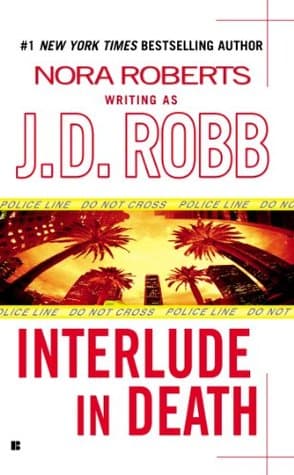
Synopsis
Covers the whole plot, including the ending.
- Difficulty
- Easy
- Pacing
- Fast
- Mood
- Suspenseful, Romantic, Intense, Futuristic
- Read it if
- You enjoy fast-paced futuristic mysteries with a strong romantic subplot and a detective who battles personal demons while solving complex cases.
- Skip it if
- You prefer hard sci-fi over crime thrillers, or dislike protagonists with a dark past.
Interlude in Death Plot Summary
Covers the whole plot, including the ending.
Arrival at the Olympus Resort
Lieutenant Eve Dallas and her husband, Roarke, travel to the Olympus Resort on the planet MagnaSg-7. This luxurious off-world retreat is owned by Roarke, and they are there for the annual Galactic Law Enforcement Conference. Eve is dreading her scheduled seminar, while Roarke encourages her to see it as a partial vacation. Upon arrival, the resort's manager, Galahad, greets them, and they are quickly immersed in the opulence. However, the calm atmosphere breaks when a body is discovered, pulling Eve into a homicide investigation. The victim is Dr. Wilhelm Blatte, a controversial psychologist specializing in criminal minds.
The First Victim and a Troubling Connection
Eve begins her investigation into Dr. Blatte's murder. She immediately recognizes him from her own past. Blatte was a psychologist who had evaluated her as a child after her parents' deaths, and his cold, clinical demeanor had left a lasting negative impression. The crime scene is clean, suggesting a professional killer. A chilling detail emerges: a small, intricate carving of a spider is found near the body. This symbol resonates with Roarke, who recognizes it as the signature of a dangerous criminal from his own past, a man named Jester, who specialized in psychological manipulation and revenge against those he felt wronged him.
Roarke's Past and the Jester
Roarke, visibly disturbed, explains his connection to Jester. Before he met Eve and changed his life, Roarke had a complex network of associates, some of whom Jester had targeted. Jester was a brilliant but twisted individual who believed in a twisted form of justice. He meticulously planned elaborate revenge schemes. He had murdered several people connected to Roarke's past criminal enterprises, framing them for various offenses or making their deaths look like accidents. Roarke confesses that he believed Jester was dead, having been informed of his demise years ago, making his reappearance even more alarming and personal.
The Second Victim and Escalation
As Eve investigates Blatte's life, trying to find a connection to Jester beyond Roarke, another body is discovered. The victim is Julian Cross, a former associate of Roarke's from his criminal days who had also gone legitimate. Like Blatte, Cross is found with the spider symbol nearby, confirming Jester's involvement and his pattern of targeting individuals connected to Roarke's past. The murders are not random; they are carefully orchestrated to inflict maximum psychological torment. Eve realizes that Jester is not just targeting Roarke's past associates, but is trying to draw Roarke and potentially Eve herself into his game.
Eve's Seminar and Public Scrutiny
Despite the escalating murder investigation, Eve must still give her seminar on homicide investigation techniques to the assembled law enforcement professionals. The irony is not lost on her as she stands before her peers, discussing the methods she is currently using to hunt a killer operating within the same resort. The pressure is immense, not only to perform professionally but also to remain composed while knowing Jester is likely observing her. Roarke attends, offering silent support, but the tension in the room is clear, making Eve's presentation a high-stakes performance.
Unraveling Jester's Motives
Eve, with Roarke's knowledge of Jester's personality and past actions, begins to understand the killer's motives. Jester, whose real name is Tobias, holds a deep grudge against Roarke, believing Roarke betrayed him or caused him significant harm in their past. He sees himself as an agent of justice, punishing those he deems worthy of retribution. Eve realizes that Jester's targets are not just Roarke's former associates, but individuals who, in Jester's mind, represent aspects of Roarke's past that Jester wishes to dismantle. They deduce that Jester thrives on psychological warfare and public spectacle.
A Calculated Trap
Jester makes his presence undeniably personal by leaving a direct message for Roarke. It is not a physical threat yet, but a psychological one, delivered in a way that only Roarke would understand, hinting at the depth of Jester's obsession. The message confirms that Jester is not merely seeking revenge on Roarke's past, but is actively trying to destroy Roarke's present and future, specifically by targeting Eve. This revelation energizes both Eve and Roarke, as the stakes become incredibly high. They understand that Jester's ultimate goal is to break Roarke by taking away what he cherishes most, and Eve is now squarely in his sights.
The Confrontation and the Labyrinth
Using their combined skills and knowledge of the resort's layout, Eve and Roarke track Jester to the lower levels, a maze of service corridors and maintenance tunnels that Roarke had designed years ago. Jester, always one step ahead, has booby-trapped the area, turning it into a deadly playground. The pursuit is tense, with Eve relying on her detective instincts and Roarke on his knowledge of the building and Jester's tactics. They navigate through the dark, confined spaces, knowing that Jester is waiting, ready for his final trap. The air is thick with anticipation and danger as they close in.
Jester's Final Stand
Eve finally corners Jester in a hidden chamber. Instead of a direct physical confrontation, Eve engages him in a psychological battle. She dissects his twisted logic, exposing the flaws in his self-proclaimed justice and the pathetic nature of his revenge. She confronts him with the reality of his actions and the emptiness of his pursuit. Her sharp intellect and determination chip away at Jester's carefully constructed façade, revealing the deeply disturbed and insecure man beneath. Roarke, observing from a distance, provides backup, but it is Eve's psychological prowess that ultimately breaks Jester's resolve.
Aftermath and Resolution
With Jester finally apprehended and secured, the immediate danger subsides. Eve and Roarke, though exhausted, feel relief. The conference, though overshadowed by the murders, concludes. They debrief with the local authorities and ensure Jester is properly incarcerated. The experience, while harrowing, strengthens their bond. Eve confronts the lingering shadows of her own past, acknowledging how the case forced her to revisit old wounds. Roarke, too, finds closure regarding his own complicated history with Jester. They leave MagnaSg-7, ready to return to their lives, more connected than ever.
Interlude in Death Characters
Eve Dallas
Protagonist
NYPSD Lieutenant, brilliant homicide detective, and Roarke's wife.
Eve Dallas is a driven and highly intelligent homicide lieutenant with the New York City Police and Security Department. Haunted by a traumatic childhood, she channels her intensity into her work, possessing an almost supernatural ability to read crime scenes and understand killers. She is fiercely independent, often emotionally guarded, but deeply loyal to those she loves. Her vulnerability is often masked by her tough exterior and dry wit. She struggles with social graces and public speaking, preferring the grim reality of crime scenes to the artifice of social events.
Relationships: Roarke (Husband and partner, deeply in love and supportive.); Dr. Wilhelm Blatte (Psychologist who evaluated her as a child; she harbors resentment towards him.)
Roarke
Supporting
Billionaire businessman, former criminal, and Eve's devoted husband.
Roarke is a charismatic and impossibly wealthy Irish businessman with a mysterious and often dark past, having risen from poverty through illicit means before becoming legitimate. He is deeply devoted to Eve, providing unwavering support and using his vast resources and connections to aid her investigations. He possesses a sharp intellect and a keen understanding of human nature, particularly its darker aspects, which often proves invaluable. He is protective of Eve and struggles with the resurfacing of his past, especially when it threatens her.
Relationships: Eve Dallas (Wife and partner, deeply in love and supportive.); Jester (Tobias) (An enemy from his criminal past, now seeking revenge.); Julian Cross (Former associate from his criminal past, now deceased.)
Jester (Tobias)
Antagonist
A calculating and psychologically disturbed killer from Roarke's past.
Jester, whose real name is Tobias, is a highly intelligent but profoundly disturbed individual with a talent for psychological manipulation and elaborate revenge schemes. He believes himself to be an agent of justice, punishing those he deems to have wronged him or others. His methods are meticulous, often involving psychological torture before the kill, and he leaves a distinctive spider symbol at his crime scenes. He harbors a deep, obsessive grudge against Roarke, rooted in a perceived betrayal from their shared criminal past, and delights in playing mind games with his victims and pursuers.
Relationships: Roarke (Target of his revenge, perceived betrayer.); Dr. Wilhelm Blatte (Victim, chosen for his connection to Eve's past.); Julian Cross (Victim, chosen for his connection to Roarke's past.)
Dr. Wilhelm Blatte
Mentioned
The first murder victim, a psychologist with a connection to Eve's childhood.
Dr. Wilhelm Blatte was a renowned but controversial psychologist specializing in criminal minds. He was one of the professionals who evaluated Eve Dallas as a child after her parents' deaths, leaving a lasting negative impression on her due to his detached and clinical approach. His murder at the Olympus Resort sets the entire plot in motion, drawing Eve into the investigation and unknowingly connecting her to Jester's larger scheme against Roarke.
Relationships: Eve Dallas (Evaluated her as a child.); Jester (Tobias) (Murder victim.)
Julian Cross
Mentioned
The second murder victim, a former associate from Roarke's criminal past.
Julian Cross was a former associate of Roarke's from his days in the criminal underworld. Like Roarke, he had since gone legitimate, trying to leave his past behind. His murder at the Olympus Resort confirms Jester's pattern of targeting individuals connected to Roarke's history, intensifying the urgency of Eve's investigation and solidifying the personal vendetta at play. His death further emphasizes the danger Roarke faces from Jester and the lengths the killer will go to exact his revenge.
Relationships: Roarke (Former criminal associate.); Jester (Tobias) (Murder victim.)
Galahad
Supporting
Manager of the Olympus Resort.
Galahad is the meticulous and professional manager of the luxurious Olympus Resort. He is dedicated to maintaining the resort's impeccable standards and ensuring the comfort of its high-profile guests. While initially focused on the smooth running of the conference, he becomes a key point of contact and source of information for Eve during the murder investigation. He provides access to resort records, security footage, and staff, assisting Eve and Roarke in their hunt for Jester.
Relationships: Roarke (His employer.); Eve Dallas (Assists her investigation.)
Interlude in Death Themes
The Persistence of the Past
This theme explores how past actions, traumas, and relationships continue to influence the present. Both Eve and Roarke must confront shadows from their pasts. Eve revisits her childhood trauma through Dr. Blatte's murder, while Roarke faces a dangerous enemy, Jester, from his criminal days. The story emphasizes that while one can move on, the past is never truly erased, and its unresolved issues can resurface with devastating consequences, forcing characters to integrate their histories rather than simply bury them. This is clear in Jester's relentless pursuit, driven by a past perceived injustice from Roarke.
“The past was a living thing, a shadow that stretched and sometimes devoured the present. And sometimes, it came back to kill.”
Revenge and Justice
The novel explores the destructive nature of revenge versus the pursuit of true justice. Jester believes he is enacting a twisted form of justice against Roarke and those connected to him, but his actions are driven by a personal, obsessive vendetta. Eve, as a representative of the law, strives for impartial justice, seeking to apprehend the killer based on evidence and due process, not personal retribution. The contrast shows how personal grievances can warp the concept of justice into a cycle of violence, and how true justice requires stepping outside of such cycles.
“He saw himself as a god, a judge. But all he was, was a killer with a grudge.”
The Nature of Identity
This theme examines how individuals define themselves, especially when faced with a complicated past. Roarke, having transformed from a criminal to a legitimate businessman and devoted husband, is challenged by Jester's reappearance, which tries to drag him back to his former identity. Eve, too, grapples with her identity as a survivor of trauma and a dedicated detective, particularly when confronted by the psychologist from her childhood. The story explores the ongoing process of self-definition and the struggle to integrate one's past experiences into a cohesive and authentic present self, especially when external forces try to redefine you.
“You can run from your past, Roarke, but sometimes it just finds a new way to catch up.”
Love and Partnership as Strength
Despite the dark subject matter, the enduring love and partnership between Eve and Roarke is a central pillar of strength. Their relationship is not just romantic; it is a partnership built on trust, mutual respect, and complementary skills. Roarke's knowledge of Jester's past and the resort's layout, combined with Eve's detective instincts and psychological insights, make them an effective team. Their emotional support for each other, particularly when confronting personal demons, shows how their bond allows them to face and overcome challenges that might destroy them individually. Their love is a sanctuary in the face of chaos and danger.
“With him, she was more than she was alone. And with her, he was everything.”
Plot Devices & Literary Techniques
Red Herring
Misleading clues or suspects to divert attention from the true killer or motive.
Initially, the connection between Dr. Blatte and Eve's past might lead a reader to believe Blatte's death is directly related to Eve, perhaps by someone she investigated. However, this is quickly revealed to be a secondary connection, designed by Jester to psychologically impact Eve and Roarke. The true motive is Jester's revenge against Roarke, with Blatte being a strategic target chosen for his impact on Eve. This misdirection serves to heighten the personal stakes for both protagonists before the real threat is fully understood.
Personal Stakes
The killer's actions directly threaten the protagonist's emotional well-being or loved ones.
Jester's entire modus operandi is built around personal stakes. He doesn't just kill; he targets individuals connected to Roarke's past and, crucially, manipulates the situation to draw Eve into the conflict. By choosing Dr. Blatte, a figure from Eve's own traumatic childhood, Jester ensures that the investigation is deeply personal for her. His ultimate goal to target Eve directly elevates the stakes beyond a typical murder investigation, making it a battle for Roarke's emotional stability and Eve's very life, creating intense tension and emotional investment for the reader.
The Unreliable Narrator (of the past)
Characters' limited or flawed understanding of past events shapes the present conflict.
Roarke's belief that Jester was dead and gone acts as a form of unreliable narration regarding his own past. This flawed understanding of Jester's fate allows the killer to resurface unexpectedly, creating shock and immediate danger. Roarke's past, while he has moved beyond it, is still a source of unresolved threats because he didn't have the full picture. This device highlights how incomplete knowledge of history, especially one's own, can have profound and dangerous implications for the present, forcing Roarke to confront the true extent of his past entanglements.
Symbolism (The Spider)
A recurring image with deeper meaning, representing the killer's nature.
The spider symbol left by Jester at his crime scenes is a powerful and recurring piece of symbolism. It represents Jester's predatory, patient, and manipulative nature – like a spider, he meticulously weaves a web of deceit and traps, ensnaring his victims and drawing in his prey (Roarke and Eve) with careful planning. The spider is also a creature often associated with darkness, fear, and intricate designs, perfectly reflecting Jester's psychological warfare and his desire to control the narrative of his revenge. It acts as his chilling signature, a taunt to his pursuers.
Interlude in Death Quotes
“She was a cop, not a social worker. She dealt with the aftermath, not the before.”
“The dead had their secrets. It was her job to make them tell.”
“He didn't just see her. He saw into her. And that was terrifying.”
“Some men needed to control. Others just needed to own.”
“There was a fine line between justice and vengeance, and sometimes it blurred until it was invisible.”
“He was a dark, dangerous dream she hadn't known she was capable of having.”
“She had a job to do. And she did her job. No matter what.”
“The city never slept, and neither did its darkness.”
“He had a way of looking at her that made her feel like the only woman in the world, and that was a dangerous thing.”
“Every victim had a story. Every killer had a reason. It was just a matter of finding them.”
“Sometimes the ugliest truths were hidden behind the most beautiful lies.”
“He was an inconvenient complication she couldn't seem to shake.”
“The dead don't care about your feelings, Dallas. They just want you to find their killer.”
“She was a survivor, and survivors didn't break. Not easily, anyway.”
Quiz
10 questions on the plot and the characters. Each answer comes with a short explanation.
Question 1
Where is the police conference being held that Lieutenant Eve Dallas is required to attend?
- On Earth, in New York City
- Off-planet, at a resort owned by Roarke
- On a police academy training facility
- In a secure, government-owned complex
Show answer
B. Off-planet, at a resort owned by Roarke Eve Dallas is called off-planet to give a seminar at a police conference held at a resort owned by her husband, Roarke.
Question 2
What is Eve Dallas's initial reaction to the idea of attending the police conference?
- She is excited for the opportunity to network and relax.
- She sees it as a grueling ordeal and not a vacation.
- She is indifferent, viewing it as just another assignment.
- She is apprehensive due to past negative experiences at conferences.
Show answer
B. She sees it as a grueling ordeal and not a vacation. The text states Eve is called off-planet to face a grueling ordeal - giving a seminar at the largest police conference.
Question 3
What event interrupts Eve's 'vacation' and seminar duties?
- A major technical malfunction at the resort.
- A personal emergency requiring her immediate return to Earth.
- A bloody homicide occurs at the resort.
- A sudden, unexpected natural disaster.
Show answer
C. A bloody homicide occurs at the resort. Work intrudes in the form of a bloody homicide, and Eve is off and running.
Question 4
What makes the homicide case particularly complicated for Eve Dallas?
- The victim is a high-ranking political figure.
- The killer is a member of the local police force.
- Eve has a personal history with the victim, and the killer has history with Roarke.
- The crime scene is impossible to secure due to the resort's open layout.
Show answer
C. Eve has a personal history with the victim, and the killer has history with Roarke. The case is complicated by Eve's personal history with the victim - and by the killer's history with Roarke.
Question 5
What is the primary theme Eve Dallas must confront and stop in this story?
- The dangers of unchecked corporate power.
- The cycle of violence and revenge.
- The corruption within the police force.
- The impact of technology on criminal investigation.
Show answer
B. The cycle of violence and revenge. Eve must find a way to stop the cycle of violence and revenge, and shove the past back where it belongs.
Question 6
What role does Roarke play in the setting of the police conference?
- He is a fellow speaker at the conference.
- He is the security head for the entire event.
- He is the owner of the swanky resort where it is being held.
- He is a primary suspect in the initial homicide.
Show answer
C. He is the owner of the swanky resort where it is being held. The resort where the conference is held just happens to be owned by her husband, Roarke.
Question 7
What is the general time period in which the story 'Interlude in Death' takes place?
- Early 21st century
- Late 20th century
- Early spring of 2059
- Mid-22nd century
Show answer
C. Early spring of 2059 The story begins in early spring of 2059.
Question 8
The description implies a conflict between Eve's professional duties and what other aspect of her life?
- Her desire to advance her career rapidly.
- Her personal life and the concept of a 'vacation'.
- Her struggles with technology in a futuristic setting.
- Her loyalty to her colleagues versus her own moral compass.
Show answer
B. Her personal life and the concept of a 'vacation'. Even though Eve can't quite see it that way, it's supposed to be at least partly a vacation, but work intrudes.
Question 9
What is the implied effect of the rising body count on Eve's investigation?
- It makes the killer more careless and easier to catch.
- It provides more clues, simplifying the case.
- It indicates increasing danger and urgency for Eve to solve the case.
- It suggests the killer is trying to frame someone else.
Show answer
C. It indicates increasing danger and urgency for Eve to solve the case. As danger closes in and the body count rises, Eve must find a way to stop the cycle of violence and revenge.
Question 10
What specific action does Eve need to take regarding 'the past' to resolve the conflict?
- She needs to uncover long-lost historical documents.
- She must reconcile with a figure from her own past.
- She has to 'shove the past back where it belongs' to end the cycle of violence.
- She is tasked with rewriting historical records.
Show answer
C. She has to 'shove the past back where it belongs' to end the cycle of violence. Eve must find a way to stop the cycle of violence and revenge, and shove the past back where it belongs.
Interlude in Death FAQ
What is the central premise of 'Interlude in Death'?
Lieutenant Eve Dallas is forced to attend a police conference on a resort planet owned by her husband, Roarke, which is meant to be a partial vacation. However, a murder occurs, pulling her into an investigation complicated by her past connection to the victim and the killer's history with Roarke.
Where does the primary action of the book take place?
The main action unfolds on a luxurious resort planet called Paradise, which is owned by Roarke. This setting is unusual for Eve, as she is typically grounded in New York City, making the off-world location a significant change of pace.
Who is the initial murder victim in 'Interlude in Death' and what is Eve's connection to them?
The initial victim is Bartholomew 'Barty' McDowell, a former cop who was involved in a past case where Eve had to kill his partner, a dirty cop named Ricker. This history creates a complex emotional layer for Eve as she investigates Barty's death.
What role does Roarke play in this particular investigation, beyond being the resort owner?
Roarke becomes deeply involved because the killer, Liam O'Rourke, has a direct, violent history with him from their past in Ireland. This personal vendetta against Roarke drives much of the killer's motive and actions, making Roarke a target and a key source of information.
How does the 'vacation' aspect of the trip evolve for Eve?
The 'vacation' quickly devolves into a full-blown homicide investigation. While Eve initially struggles with the concept of relaxation, the murder of Barty McDowell immediately refocuses her on her duty, turning the resort into a crime scene rather than a getaway.
What is the significance of the killer, Liam O'Rourke, having a connection to Roarke's past?
Liam O'Rourke is a figure from Roarke's violent and criminal past in Ireland, specifically tied to the death of Roarke's father. This connection brings Roarke's own history into the forefront, forcing him to confront unresolved trauma and guilt, and creating a highly personal stakes for the investigation.
How does the setting of Paradise, a luxurious resort, contrast with the dark themes of murder and revenge?
The opulent and tranquil setting of Paradise creates a stark juxtaposition with the brutal murders and dark themes of revenge and violence. This contrast highlights how evil can permeate even the most idyllic environments, making the crimes feel more jarring and intrusive.
Are there any subtle indications of Eve's continuing growth in her personal relationships in this book?
Yes, Eve shows subtle growth in her ability to accept help and comfort from Roarke and Peabody, especially when her past with Barty McDowell resurfaces. Her willingness to lean on them, even slightly, indicates her evolving trust and emotional vulnerability.
How does Eve's past interaction with Barty McDowell's partner, Ricker, affect her psychological state during the investigation?
Eve's past, specifically having to kill Ricker, Barty's dirty partner, brings up old trauma and guilt. She feels a personal responsibility and a sense of unease, questioning if her past actions somehow contributed to Barty's fate, despite his own complicity.
What psychological impact does Liam O'Rourke's personal vendetta have on Roarke?
Liam O'Rourke's vendetta forces Roarke to confront the darkest aspects of his past, including his father's death and his own criminal upbringing. This brings up feelings of guilt, rage, and a primal desire for revenge, threatening to pull him back into old patterns of violence.
How does Eve's professional detachment clash with her personal history in 'Interlude in Death'?
Eve's usual professional detachment is severely tested when her personal history with Barty McDowell, and Roarke's with Liam O'Rourke, directly impact the case. She struggles to maintain objectivity when the lines between investigator and emotionally involved party blur, forcing her to confront her own biases.
In what ways does this book explore the theme of cycles of violence and revenge?
The book deeply explores cycles of violence through Liam O'Rourke's actions, which are driven by a decades-old vendetta against Roarke's family. It highlights how past traumas can perpetuate future violence, and Eve's goal is to break this destructive cycle.
What does the title 'Interlude in Death' signify in the context of the story?
The title 'Interlude in Death' refers to the supposed 'interlude' or break Eve was meant to have from her usual routine, which is ironically interrupted by death. It also subtly suggests that even in moments of peace, death and violence can intrude, or that the events are a brief, intense period surrounded by ongoing struggles.
How does the novel address the concept of justice versus personal revenge?
The novel sharply contrasts the concept of justice, as upheld by Eve and the legal system, with Liam O'Rourke's pursuit of personal revenge against Roarke. It questions whether true justice can ever be achieved through a cycle of violence, ultimately advocating for legal resolution over vigilante retribution.
What message does the resolution of the conflict with Liam O'Rourke convey about confronting one's past?
The resolution conveys that confronting one's past, no matter how painful, is essential for moving forward. Roarke is forced to face his traumatic history with Liam, and while it's agonizing, it ultimately strengthens his bond with Eve and allows him to fully embrace his present identity.
How does the book reinforce the strength of Eve and Roarke's relationship?
The book reinforces their bond by having them navigate a crisis that deeply involves both their pasts. Roarke's vulnerability and Eve's unwavering support, coupled with their combined efforts to solve the case, demonstrate the depth of their trust and commitment to each other.
Are there any moral ambiguities presented regarding Barty McDowell's character?
Yes, Barty McDowell presents moral ambiguities. While he is the victim, his past complicity with a corrupt partner and his subsequent actions suggest he wasn't entirely innocent. This complicates Eve's feelings and makes his murder less clear-cut than a typical 'good guy' victim.
What is the broader commentary on privilege and responsibility, given Roarke's ownership of Paradise?
The novel subtly comments on privilege and responsibility through Roarke's ownership of Paradise. While he provides an idyllic setting, he also bears the responsibility of its safety, and his past actions can still intrude upon even his most carefully constructed domains, highlighting that wealth doesn't insulate one from consequences.
About the author

J.D. Robb is a pseudonym for author Nora Roberts, known for her work in the romance and suspense genres. She is particularly recognized for the "In Death" series, which includes titles such as "Naked in Death," "Glory in Death," "Immortal in Death," "Rapture in Death," "Ceremony in Death," and "Holiday in Death." These novels blend elements of crime fiction with futuristic settings and strong character development.
Similar books
- Naked in Death
J.D. Robb
4.1 (167k) average on GoodreadsThrillerFirst book in the same series, featuring the same characters and blend of genres.
- The Likeness
Tana French
4.0 (126k) average on GoodreadsThrillerFrench's novel focuses on intricate psychological depth, ambiguous morality, and a slower, more introspective pace, contrasting with Robb's faster-paced, more clear-cut good-vs-evil dynamic and established character comfort. While French delves into identity and internal conflict, Robb prioritizes external plot and character relationships.
- Sphere
Michael Crichton
3.8 (167k) average on GoodreadsThrillerCrichton's work blends sci-fi and thriller by making scientific phenomena and the unknown the primary antagonist, exploring their philosophical implications. Robb, in contrast, uses technology as a backdrop for a human-centric mystery, focusing on criminal psychology and human intent in a futuristic setting rather than the science itself as the central conflict.
- Angels & Demons
Dan Brown
3.9 (2.7M) average on GoodreadsThrillerA Harvard symbologist races through Rome's ancient sites, deciphering cryptic clues to unmask the Illuminati and stop a vengeful plot to destroy the Vatican with a stolen antimatter weapon.
- Gone Girl
Gillian Flynn
4.1 (2.3M) average on GoodreadsThrillerA wife's sudden disappearance on her fifth anniversary reveals a web of lies and psychological warfare, exposing the secrets within a seemingly perfect marriage.
- The Girl on the Train
Paula Hawkins
3.9 (2.1M) average on GoodreadsThrillerA woman’s fascination with a seemingly perfect couple she watches from her daily train commute leads her into a dark investigation when she witnesses something that shatters their idyllic image.



Enjoyed the summary?
A summary gives you the shape of the book. The book itself has the detail, the examples and the voice.
Find Interlude in Death on AmazonAs an Amazon Associate, BookBrief earns from qualifying purchases. How we're funded