
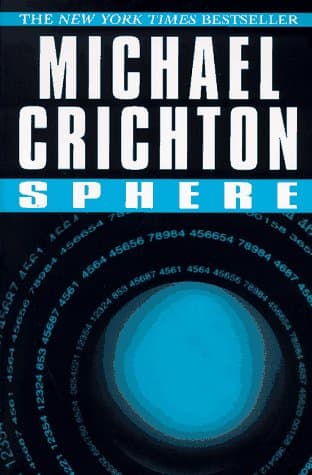
Synopsis
Covers the whole plot, including the ending.
- Difficulty
- Medium
- Pacing
- Fast
- Mood
- Suspenseful, Claustrophobic, Terrifying, Intense
- Read it if
- You enjoy psychological thrillers combined with hard sci-fi, exploring the darker aspects of the human mind under extreme pressure.
- Skip it if
- You prefer a straightforward alien encounter story without deep psychological elements or you dislike claustrophobic, high-stakes scenarios.
Sphere Plot Summary
Covers the whole plot, including the ending.
The Summons and the Enigma
Dr. Norman Johnson, a psychologist, is unexpectedly called by the U.S. Navy for a classified mission. He is flown to a remote location in the South Pacific and briefed by Captain Harold Barnes. Norman learns that a massive, unknown object, possibly an alien spaceship, has been discovered on the ocean floor. The Navy has assembled a team of experts based on a theoretical 'first contact' scenario Norman himself devised years ago. The team includes Dr. Beth Halpern, a biochemist and Norman's former lover; Dr. Harry Adams, a brilliant but socially awkward mathematician; and Dr. Ted Fielding, an astrophysicist. They are transported to a massive underwater habitat, the Habitat, which has been quickly built around the object.
First Contact and the Golden Sphere
The team descends to the Habitat, a sophisticated underwater base. They learn that the 'spaceship' is enormous, about a quarter-mile long, and appears to be made of an unknown, metallic substance. After extensive preparation and a tense journey through a connecting tunnel, they enter the ship. Inside, they find a vast, empty interior, with no discernible technology or life forms. Their exploration eventually leads them to a massive cargo bay, where a perfectly smooth, featureless golden sphere, roughly 15 feet in diameter, is found. The sphere appears to be made of an unknown material and reflects nothing, absorbing all light. It is clearly the focal point of the entire vessel.
The First Deaths and the Logbook
As the team studies the sphere, strange things begin. Ted Fielding discovers a control panel that activates a viewscreen, showing star charts and complex mathematical equations. During a routine dive, Jerry, one of the Habitat's technicians, is killed by a giant squid. This is initially dismissed as an accident, but then another technician, Fletcher, is found dead, seemingly crushed by an unseen force. The team also deciphers the ship's logbook, which reveals a shocking truth: the ship is not alien, but American, and it traveled back in time through a black hole, crashing 300 years in the past. Its original designation was 'CSN Event Horizon'.
Harry's Secret and the Power of the Sphere
The deaths continue, escalating in their bizarre nature. Beth is attacked by a swarm of jellyfish that appear out of nowhere. Harry, increasingly withdrawn and agitated, eventually tells Norman that he has been entering the sphere and interacting with 'it'. He describes 'it' as a sentient entity that communicates through images and ideas, and that it can grant wishes. Norman initially dismisses this as psychological stress, but the mounting evidence and increasingly impossible events force him to reconsider. They realize the sphere is a device that can make thoughts and fears real, and that Harry, having spent the most time inside, is unknowingly causing the phenomena.
Beth's Breakdown and the Monster Attack
Under the immense pressure and psychological strain, Beth begins to unravel. She becomes paranoid and aggressive, eventually attempting to destroy the sphere with explosives. Her actions are stopped, but her mental state deteriorates further. Meanwhile, the manifestations become more direct and terrifying. A massive, multi-tentacled sea serpent, seemingly from Harry's subconscious fears, attacks the Habitat, causing significant damage and threatening to breach the integrity of the base. The remaining crew struggles to defend themselves against these increasingly real and deadly threats.
The Code and the Self-Destruct
As the Habitat is battered by the sea serpent and other manifestations, the remaining team members – Norman, Harry, and Beth – try to understand the sphere's power better. They discover a complex numerical code embedded within the sphere's communications, which they believe is a key to controlling or disabling its abilities. With the Habitat failing and their lives in immediate danger, Captain Barnes, from the surface, orders the Habitat's self-destruct sequence to be initiated, hoping to contain the threat and prevent the sphere's power from reaching the surface. The countdown begins, adding a new layer of urgency.
Harry's Rampage and Norman's Revelation
Driven by his escalating paranoia and the sphere's influence, Harry begins to actively use its power to manifest destructive scenarios, including creating a series of explosions within the Habitat. Norman tries to reason with him, but Harry is beyond reach. During a desperate confrontation, Norman suddenly realizes that he, too, has been inside the sphere, albeit for a much shorter time. He understands that the power isn't exclusive to Harry, but rather a latent ability within anyone who enters the sphere, activated by their deepest thoughts and fears. This revelation shifts the dynamic of their struggle.
The Shared Power and the Escape
With the Habitat on the verge of imploding and the self-destruct countdown nearing zero, Norman understands that he, Beth, and Harry all possess the power to make reality. He tries to explain this to Beth, who is still reeling from her own mental struggles. They realize that their collective unconscious fears and desires are fueling the chaos. They must escape the Habitat before the sphere's influence, and their own uncontrolled thoughts, destroy them. They make a frantic attempt to reach the escape pods, battling against the physical manifestations of their anxieties and Harry's destructive will.
Confrontation and the Agreement
Norman finally confronts Harry, who is now fully consumed by the sphere's power, manifesting a full-scale hurricane within the Habitat. Norman, using his own newfound ability, manages to create a temporary shield to protect himself and Beth. He desperately tries to make Harry understand the shared nature of their power and the danger they all face. In a moment of clarity amidst the chaos, Harry, Norman, and Beth reach a terrifying understanding: the only way to survive and prevent the sphere's destructive potential from reaching the surface is to collectively wish away their memories of the sphere and its powers. They make a pact to forget.
The Ascent and the Amnesia
As the Habitat finally gives way and collapses, Norman, Beth, and Harry manage to reach the escape pods. They ascend rapidly towards the surface. As they breach the water, a profound sense of peace washes over them. The memories of the sphere, its powers, the terrifying manifestations, and their agreement to forget, all begin to fade. They emerge with only vague recollections of a mission and a sense of profound relief, but no conscious memory of the extraordinary abilities they briefly possessed or the pact they made. The sphere's secret, and their own potential, is once again locked away in their subconscious.
Sphere Characters
Dr. Norman Johnson
Protagonist
A psychologist recruited for a first contact mission, grappling with his own fears.
Norman is a middle-aged psychologist whose theoretical paper on first contact scenarios unexpectedly thrusts him into a real-life deep-sea encounter. He is initially portrayed as somewhat cynical and detached, a man who analyzes human behavior but struggles with his own emotions and past relationships. He tries to maintain a logical perspective amidst the chaos, often acting as the voice of reason, but he is ultimately vulnerable to the psychological pressures of the mission and his own subconscious fears. He carries guilt about his past and a desire to prove himself.
Relationships: Dr. Beth Halpern (former lovers, complicated professional relationship); Dr. Harry Adams (colleague, increasingly strained mentor-mentee dynamic); Captain Harold Barnes (military superior, often at odds over mission control)
Dr. Beth Halpern
Supporting
A brilliant biochemist, Norman's former lover, who struggles with mental instability.
Beth is a highly intelligent biochemist, sharp-witted and capable, but also deeply troubled. She has a history of mental health issues, including a suicide attempt, which makes her particularly vulnerable to the psychological pressures of the sphere. Her relationship with Norman is complex, marked by lingering affection and unresolved tension. She is initially pragmatic but quickly succumbs to paranoia and aggression as the events unfold, representing the fragility of the human mind under extreme stress and the sphere's influence.
Relationships: Dr. Norman Johnson (former lovers, complicated professional relationship); Dr. Harry Adams (colleague, initially tolerant but grows wary)
Dr. Harry Adams
Supporting/Antagonist
A brilliant but socially awkward mathematician who becomes powerfully influenced by the sphere.
Harry is a mathematical genius, exceptionally intelligent but socially inept and prone to anxiety. He is fascinated by the sphere and its mathematical properties, making him the first to venture inside. His social isolation and hidden anxieties make him an ideal, and dangerous, conduit for the sphere's power. He initially experiences the sphere as a benign entity but quickly becomes overwhelmed by its influence, manifesting his deepest fears and desires into destructive reality. He embodies the danger of unchecked power and the human subconscious.
Relationships: Dr. Norman Johnson (colleague, initially a student-like dynamic, then adversarial); Dr. Beth Halpern (colleague, strained relationship)
Dr. Ted Fielding
Supporting
An astrophysicist, initially skeptical, who is among the first casualties.
Ted is an astrophysicist, initially enthusiastic and eager to explore the unknown. He is intelligent and contributes significantly to the early understanding of the ship's origins. However, he is also arrogant and somewhat dismissive of Norman's psychological theories. He is one of the first to die from the sphere's manifestations, becoming a stark warning of the danger they face. His death highlights the immediate and unpredictable threat posed by the object, and the vulnerability of even highly rational scientific minds.
Relationships: Dr. Norman Johnson (colleague, initially antagonistic due to differing perspectives); Dr. Beth Halpern (colleague); Dr. Harry Adams (colleague)
Captain Harold Barnes
Supporting
The pragmatic Navy officer in charge of the mission, focused on containment.
Captain Barnes is a career Navy officer, tasked with the logistical and security aspects of the mission. He is pragmatic, authoritative, and primarily concerned with containing the situation and following protocols. He often clashes with Norman and the scientists, viewing their psychological theories with skepticism and prioritizing military objectives. He represents the military's approach to an unknown threat, emphasizing control and containment, even at the cost of scientific exploration. He makes the difficult decision to initiate the Habitat's self-destruct.
Relationships: Dr. Norman Johnson (superior officer, often in conflict); Jerry (subordinate, technician)
Jerry
Supporting
A Habitat technician who is among the first to die.
Jerry is one of the Habitat's technicians, responsible for maintaining the underwater base. He is a practical, no-nonsense individual, focused on his duties. He is among the initial casualties, killed by a giant squid manifestation. His death serves as the first clear sign that something is terribly wrong and that the environment they are in is far more dangerous than initially perceived. His demise marks the transition from scientific wonder to terrifying survival.
Relationships: Captain Harold Barnes (superior officer); Dr. Norman Johnson (crew member)
Fletcher
Mentioned
Another Habitat technician who dies under mysterious circumstances.
Fletcher is another Habitat technician whose death follows Jerry's. He is found crushed by an unseen force, further deepening the mystery and fear among the crew. His death reinforces the idea that the threats are not just environmental accidents but something more sinister and inexplicable. While not a major character, his demise contributes to the escalating sense of dread and the realization that the sphere is directly involved in the fatalities.
Relationships: Captain Harold Barnes (superior officer)
Sphere Themes
The Power of the Subconscious Mind
The novel explores how the human subconscious, particularly fears and desires, can become real when exposed to an external catalyst like the sphere. Harry's initial innocent wishes, and later his escalating paranoia, directly create the monsters and dangers that plague the Habitat. Norman's own hidden anxieties, such as his fear of not being taken seriously or his unresolved feelings for Beth, also subtly influence the environment. The book suggests that our inner world holds immense, often destructive, power if left unchecked. This is evident when Harry, in a fit of rage, manifests a hurricane inside the Habitat.
“What if the sphere was a mirror, reflecting their own minds back at them? What if it wasn't alien at all?”
Fear and Paranoia
Fear is a pervasive theme, driving much of the plot. The isolation of the deep-sea environment, the unknown nature of the sphere, and the escalating deaths quickly erode the team's mental stability. Beth's descent into paranoia and aggression, and Harry's transformation into a destructive force, are direct consequences of their inability to cope with their fears. The novel illustrates how fear, when given an outlet like the sphere, can become a self-fulfilling prophecy, creating the very dangers one dreads. The constant threat of manifestations keeps the characters, and the reader, in a state of high anxiety.
“The greatest danger here wasn't the sphere. It was themselves.”
The Dangers of Unchecked Power
The sphere grants its users god-like power, but without understanding or control, this power becomes catastrophic. Harry, initially intrigued, quickly becomes overwhelmed and corrupted by the ability to make his thoughts real. The consequences are dire: death, destruction, and psychological torment. The book suggests that humanity is ill-equipped to handle such immense power, as our inherent flaws, fears, and aggressions would inevitably lead to misuse and self-destruction. The collective decision to forget their powers highlights the wisdom in relinquishing what they cannot responsibly wield.
“They had glimpsed true power, and it had nearly destroyed them.”
Science vs. The Unknown
The novel pits scientific rationality against an utterly inexplicable phenomenon. The team, composed of highly intelligent scientists, attempts to apply logical frameworks to understand the sphere, but its nature defies all known laws of physics and psychology. Their initial theories—alien contact, time travel—are all eventually superseded by the terrifying reality of its wish-granting power. This theme explores the limits of scientific understanding and the humbling realization that some phenomena may lie beyond our current comprehension, requiring an entirely different approach, or perhaps no approach at all. The scientific method breaks down in the face of the sphere.
“It was beyond science. Beyond understanding. It just… was.”
Plot Devices & Literary Techniques
The Sphere
The central mystery and catalyst for all events, granting wishes and manifesting thoughts.
The golden sphere is the primary plot device, serving as both the MacGuffin and the source of conflict. It is a perfectly smooth, featureless object that appears to be alien, but is later revealed to be an artifact from the future, capable of manifesting the thoughts and fears of anyone who enters it. It drives the plot by introducing the unknown, causing the deaths, driving the characters to madness, and ultimately forcing them to confront their own subconscious. Its true nature as a 'wish-granting' device, albeit a dangerous one, is the core revelation that propels the final act.
The Underwater Habitat
The isolated, claustrophobic setting that amplifies psychological tension.
The Habitat serves as a crucial setting and a plot device to intensify the psychological thriller aspects of the story. Its deep-sea location creates an extreme sense of isolation and claustrophobia, cutting the characters off from the outside world and amplifying their fears. The constant threat of structural integrity failure, combined with the manifestations, makes the Habitat a character in itself, actively contributing to the rising tension and trapping the characters in a deadly environment. Its eventual self-destruction adds a ticking clock to the climax.
The 'First Contact' Scenario
A theoretical framework that ironically leads to a terrifying, internal conflict.
Norman's theoretical 'first contact' scenario, which outlines the ideal team composition for encountering alien life, is the initial justification for assembling the diverse group of scientists. This device serves as an ironic setup, as the 'first contact' they experience is not with an external alien intelligence, but with the terrifying power of their own collective subconscious, mediated by the sphere. It highlights the hubris of humanity in believing they can control or predict such encounters, ultimately leading to a far more dangerous, internal conflict than anticipated.
The Self-Destruct Sequence
A ticking clock that forces the characters into a desperate final decision.
The Habitat's self-destruct sequence is a classic ticking clock device. Initiated by Captain Barnes from the surface, it places an immediate and undeniable deadline on the characters' efforts to understand and escape the sphere's influence. This impending doom forces them to make desperate decisions, accelerates the climax, and ultimately pushes them towards the drastic measure of collectively wishing away their memories of the sphere and its powers, as the only viable escape before total annihilation.
Sphere Quotes
“You think you want to die for a cause. But you really want to live for a cause.”
“The greatest danger in space is the unknown.”
“The mind is its own place, and in itself can make a heaven of hell, a hell of heaven.”
“What is reality? Is it what we see, or what we imagine?”
“Fear is a powerful motivator. It can make you do things you never thought possible.”
“We create our own monsters.”
“You can't solve a problem until you understand it.”
“The human mind is capable of anything, given enough pressure.”
“There's no such thing as a free lunch. Everything has a price.”
“The deepest part of the ocean is the most alien place on Earth.”
“We are what we pretend to be, so we must be careful about what we pretend to be.”
“Power corrupts, and absolute power corrupts absolutely.”
“Sometimes the only way to win is not to play.”
“It's not what you know, it's what you can prove.”
Quiz
10 questions on the plot and the characters. Each answer comes with a short explanation.
Question 1
What is the name of the psychologist who is part of the initial team sent to investigate the sphere?
- Harry Adams
- Ted Fielding
- Norman Johnson
- Jerry Adams
Show answer
A. Harry Adams Norman Johnson is the psychologist and central character who is initially reluctant to join the mission.
Question 2
What is the estimated age of the spaceship when it is first discovered?
- 50 years old
- 100 years old
- 300 years old
- 1000 years old
Show answer
C. 300 years old The book description explicitly states the spaceship appears to be at least three hundred years old, adding to the mystery.
Question 3
What unusual characteristic does the 'sphere' itself possess, making it difficult to study?
- It constantly changes shape.
- It is perfectly reflective, acting as a mirror.
- It emits a high-frequency sound that disorients the crew.
- It is completely transparent.
Show answer
B. It is perfectly reflective, acting as a mirror. The sphere is a perfect mirror, reflecting everything around it, which makes it challenging to perceive directly and adds to its alien nature.
Question 4
Which character is the mathematician on the team and initially believes the sphere is of alien origin?
- Beth Halpern
- Ted Fielding
- Harry Adams
- Arthur Levine
Show answer
B. Ted Fielding Ted Fielding is the brilliant but often arrogant mathematician who quickly jumps to conclusions about the sphere's extraterrestrial nature.
Question 5
What is the primary psychological phenomenon that the sphere exploits in the crew members?
- Telekinesis
- Shared hallucinations
- The manifestation of fears and thoughts
- Induced amnesia
Show answer
C. The manifestation of fears and thoughts The sphere grants its user the ability to make their thoughts and fears manifest in reality, leading to increasingly dangerous situations.
Question 6
What is the initial explanation given by the government for the discovery of the sunken vessel?
- A newly discovered deep-sea volcano.
- A secret Russian submarine.
- A crashed American military plane.
- A large coral formation.
Show answer
D. A large coral formation. To maintain secrecy, the government initially tells the scientists they are investigating a large coral formation, a cover story that quickly unravels.
Question 7
Which specific event initially causes widespread panic and distrust among the crew, leading to a death?
- A massive earthquake damaging the habitat.
- The appearance of giant squid attacking the habitat.
- A communication blackout with the surface.
- The discovery of an unknown alien creature outside the ship.
Show answer
B. The appearance of giant squid attacking the habitat. The manifestation of a giant squid, a fear of Harry's, attacks the habitat and results in the death of Barnes, significantly escalating the tension.
Question 8
What is the ultimate 'origin' of the sphere, as revealed near the end of the book?
- It is a time-traveling device from the future.
- It is a probe sent by an advanced alien civilization.
- It is an American military experiment gone wrong.
- It is a ship from Earth's future, crashed after time travel.
Show answer
D. It is a ship from Earth's future, crashed after time travel. The sphere is revealed to be a spaceship from Earth's future, which traveled back in time, explaining its human origins despite its advanced nature.
Question 9
What does the 'Big Red Button' in the sphere's control room actually do?
- It activates the ship's weapons system.
- It initiates the self-destruct sequence.
- It grants the user the ability to control the sphere's powers.
- It allows the user to forget the sphere's powers.
Show answer
D. It allows the user to forget the sphere's powers. The 'Big Red Button' is a psychological trigger designed to make the user forget the ability to manifest thoughts, a crucial mechanism for survival.
Question 10
Which character is the marine biologist on the team and struggles with the ethical implications of their discovery?
- Harry Adams
- Beth Halpern
- Ted Fielding
- Norman Johnson
Show answer
B. Beth Halpern Beth Halpern is the marine biologist, often the most grounded and ethical voice, who also has a complex personal history with Norman.
Sphere FAQ
What is the initial premise that brings the scientists together?
A team of American scientists, including psychologist Norman Johnson, mathematician Harry Adams, astrophysicist Ted Fielding, and zoologist Beth Halpern, are assembled by the U.S. Navy to investigate a massive, unknown object discovered on the floor of the Pacific Ocean. They are flown to a deep-sea habitat for a secret, urgent mission, initially believing it to be an alien spacecraft.
What is the 'sphere' itself, and what is its most unusual property?
The 'sphere' is a perfectly smooth, metallic, golden orb found within the larger alien spacecraft. Its most unusual property is its ability to make anyone who enters it experience their deepest fears and desires, manifesting them into reality. This power is later revealed to be psychic in nature, amplifying and externalizing the subconscious thoughts of those who interact with it.
Who are the primary members of the scientific team and what are their roles?
The core team consists of Dr. Norman Johnson, a psychologist tasked with designing the 'first contact' protocols; Dr. Harry Adams, a brilliant but socially awkward mathematician; Dr. Beth Halpern, a zoologist with a history with Norman; and Dr. Ted Fielding, an astrophysicist. They are joined by a military contingent, including Captain Barnes, who oversees the operation.
What is the biggest threat the team faces while inside the habitat?
The biggest threat comes from within the team members themselves, as the sphere's influence causes their subconscious fears and anxieties to manifest as physical dangers. This includes giant squid attacks, poisonous jellyfish, and other perceived threats, blurring the line between reality and psychic projection. The escalating paranoia and distrust among the crew also contribute significantly to the danger.
How does the team initially deduce the origin of the spacecraft?
Initially, the team believes the spacecraft to be extraterrestrial. However, upon closer inspection of its 'log' and the discovery of English text, they realize it is a U.S. spacecraft from the future, having traveled back in time after crashing. This revelation significantly shifts their understanding of the mission and the sphere's potential.
What is the significance of the 'black box' data that Harry deciphers?
The 'black box' data, or 'log,' that Harry deciphers reveals that the spacecraft is actually American, from the year 2043, and encountered the sphere in deep space before traveling through a black hole and crashing on Earth centuries ago. This information not only recontextualizes the mission but also hints at the sphere's immense power and unknown origins.
What specific fear does Norman Johnson repeatedly struggle with due to the sphere's influence?
Norman Johnson grapples with his fear of loneliness and abandonment, which manifests as increasingly vivid dreams and hallucinations of being alone in the deep ocean. He also struggles with his guilt over past actions and his perceived failures, which the sphere amplifies, making him question his sanity and judgment.
How does Harry Adams's personality make him particularly vulnerable, yet also powerful, in relation to the sphere?
Harry's repressed anger, social awkwardness, and intellectual arrogance make him particularly vulnerable to the sphere's influence, as his subconscious desires for power and recognition are amplified. However, his strong will and focused intellect also make him incredibly powerful, allowing him to manifest complex and destructive events, such as the giant squid attacks, with unsettling precision.
What is the true nature of the 'gifts' the sphere bestows upon those who enter it?
The 'gifts' are not benevolent powers but rather the raw manifestation of the deepest subconscious thoughts and desires of those who enter the sphere. It acts as an amplifier, turning hidden fears into terrifying realities and unacknowledged wishes into destructive forces, often with unintended and dangerous consequences for the entire team.
How does Beth Halpern's character arc reflect the psychological toll of the sphere?
Beth's character arc shows a descent into paranoia and aggression, particularly after she enters the sphere. Her existing anxieties, including her fear of failure and her complex relationship with Norman, are amplified, leading to erratic behavior, attempts to harm others, and ultimately, a tragic loss of control. Her actions highlight the sphere's insidious psychological impact.
What is the ultimate fate of the sphere and the remaining scientists?
In a desperate attempt to contain its power and prevent global catastrophe, the remaining scientists (Norman, Harry, and Beth, though Beth is incapacitated) decide to use the sphere's own power to make themselves forget their abilities. They collectively wish for the sphere to disappear and their memories of its powers to vanish, effectively neutralizing the threat and erasing their 'gifts' before the Navy arrives.
What is the significance of the red button and its connection to Harry's manifestations?
The red button, initially believed to be a self-destruct mechanism, is later revealed to be a manifestation of Harry's subconscious desire for power and control. He creates it to appear as if he's 'making' things happen, when in reality, his thoughts alone are causing the events. It's a psychological crutch he uses to process and express his newfound abilities.
How does the book explore the ethical implications of unchecked psychic power?
The book vividly explores the dangers of unchecked psychic power by showing how ordinary individuals, when granted such abilities, quickly succumb to their basest fears and desires, leading to chaos and destruction. It suggests that humanity is ill-equipped to handle such power responsibly, highlighting the ethical dilemma of knowledge versus safety.
What is the central debate regarding the sphere's origin and purpose?
The central debate revolves around whether the sphere is an alien artifact, a future human creation, or something else entirely. While the spacecraft is from the future, the sphere itself remains largely unexplained, implying a deeper, possibly cosmic, origin. Its purpose seems to be a passive amplifier rather than an active agent, merely reflecting what it encounters.
Could the sphere be interpreted as a metaphor for the human subconscious?
Yes, the sphere can be strongly interpreted as a metaphor for the human subconscious mind. It externalizes hidden fears, desires, and unresolved conflicts, forcing the characters to confront aspects of themselves they normally repress. The destructive chaos it unleashes mirrors the potential for self-sabotage and internal conflict within the human psyche.
What commentary does the ending offer on humanity's readiness for advanced technology or contact?
The ending, where the survivors choose to forget their powers, offers a pessimistic commentary on humanity's readiness for advanced technology or contact with profound forces. It suggests that humanity, driven by fear and ego, would likely misuse or be overwhelmed by such power, making self-imposed ignorance a safer, albeit tragic, alternative to potential global devastation.
How does Norman's 'journal' at the beginning and end of the book frame the narrative?
Norman's 'journal' entries, presented as a debriefing, frame the narrative by establishing a sense of mystery and foreboding from the outset, hinting at the catastrophic events to come. By returning to it at the end, it underscores the profound psychological impact of the experience and the lasting trauma, even with the memory wipe, suggesting some residual imprint.
What role does Captain Barnes play in the escalating tension and distrust?
Captain Barnes, representing the military presence, initially provides order but also contributes to the escalating tension through his rigid adherence to protocol, his distrust of the scientists, and his increasingly frantic attempts to regain control. His own fears and anxieties, amplified by the sphere's influence, make him a source of conflict and paranoia, ultimately leading to his demise.
About the author

Michael Crichton was an American author and filmmaker known for his contributions to the science fiction genre. His notable works include Jurassic Park, The Andromeda Strain, Timeline, Sphere, Congo, and State of Fear, many of which explore themes of technology and its impact on society. Crichton's writing often blends scientific concepts with thrilling narratives, making him a significant figure in contemporary literature.
Similar books
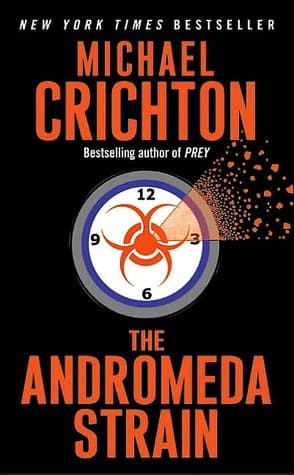
- The Andromeda Strain
Michael Crichton
3.9 (223k) average on GoodreadsThrillerAnother Crichton novel involving a scientific team investigating an unknown, dangerous entity under high-pressure, isolated conditions.
- Jaws
Peter Benchley
4.0 (137k) average on GoodreadsThrillerBoth Sphere and Jaws excel at creating intense suspense from an largely unseen antagonist and depict the breakdown of order under pressure. However, Sphere introduces a significantly more complex, internal, and psychological threat compared to Jaws' biological one, focusing on human fears manifesting rather than an external predator.
- Angels & Demons
Dan Brown
3.9 (2.7M) average on GoodreadsThrillerA Harvard symbologist races through Rome's ancient sites, deciphering cryptic clues to unmask the Illuminati and stop a vengeful plot to destroy the Vatican with a stolen antimatter weapon.
- Gone Girl
Gillian Flynn
4.1 (2.3M) average on GoodreadsThrillerA wife's sudden disappearance on her fifth anniversary reveals a web of lies and psychological warfare, exposing the secrets within a seemingly perfect marriage.
- The Girl on the Train
Paula Hawkins
3.9 (2.1M) average on GoodreadsThrillerA woman’s fascination with a seemingly perfect couple she watches from her daily train commute leads her into a dark investigation when she witnesses something that shatters their idyllic image.
- The Da Vinci Code
Dan Brown
3.9 (1.9M) average on GoodreadsThrillerA symbologist and a cryptologist race through European landmarks, deciphering ancient codes and uncovering a conspiracy that could rewrite the foundations of Christianity.





Enjoyed the summary?
A summary gives you the shape of the book. The book itself has the detail, the examples and the voice.
Find Sphere on AmazonAs an Amazon Associate, BookBrief earns from qualifying purchases. How we're funded