
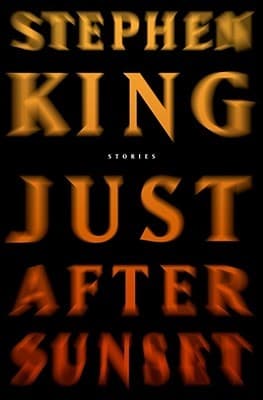
Synopsis
Covers the whole plot, including the ending.
- Difficulty
- Medium
- Pacing
- Variable
- Mood
- Eerie, Suspenseful, Dark, Unsettling, Mystical
- Read it if
- You love Stephen King's short stories and want a collection that explores a wide range of his signature themes, from psychological horror to the supernatural.
- Skip it if
- You prefer full-length novels with continuous narratives or are sensitive to body horror and existential dread.
Just After Sunset Plot Summary
Covers the whole plot, including the ending.
Willa
Dave is on a flight to Pittsburgh when he sees his wife, Willa, across the aisle. This is impossible, as Willa died in a car accident hours before. She and several other passengers seem to be waiting for something, unaware of their deaths. Dave tries to talk to her, but she does not acknowledge him. Eventually, the deceased passengers, including Willa, leave the plane as if it were a normal stop. Dave, bewildered and heartbroken, realizes they are waiting for a connecting flight to the afterlife, and he is still alive, left with his grief.
The Gingerbread Girl
Emily Portman, devastated by the accidental death of her infant daughter, moves to a secluded house on Key Largo, Florida. She runs constantly, pushing her physical limits. One day, while running, she meets a strange, threatening man named Pickering, who has been stalking her. He breaks into her home, and Emily, resourceful and determined, must use her wits and the island's isolation to outsmart and escape her captor. The story becomes a tense chase, with Emily fighting for her life against a relentless predator.
Harvey's Dream
Harvey tells his wife, Janet, about a vivid and unsettling dream. In the dream, their daughter, the family dog, and other familiar things are subtly wrong or missing, and a strange message is written on a calendar. As Harvey describes the dream, Janet becomes more disturbed, not just by the dream's content, but by the eerie feeling that some details are appearing in their waking reality. The story ends with an ambiguous hint that the dream might be prophetic, or that their reality is slowly falling apart.
The Things They Left Behind
Scott Staley, a 9/11 survivor because he overslept, starts finding personal items belonging to his deceased colleagues mysteriously appearing in his apartment. These items—a baseball glove, a sweater, a photograph—are often mundane, but they carry the emotional weight of their former owners. Scott feels he must return these items to the victims' families, a task that becomes a painful journey of grief, guilt, and unexpected connection. He deals with survivor's guilt and the uncanny nature of the objects, which seem to be a form of communication from the dead.
Graduation Afternoon
A privileged, somewhat cynical young man named Archie watches a graduation ceremony from his window. He thinks about his mundane life, his girlfriend, and his future, feeling bored. Suddenly, a massive, catastrophic explosion, implied to be a nuclear attack, shatters the world. The story is a brief, poignant reflection on the abrupt end of ordinary life and the uselessness of future plans in the face of sudden, overwhelming destruction. It captures the shock and disbelief of an apocalyptic event from a very personal, immediate perspective.
N.
Dr. John Goetz receives a new patient, 'N.', who has severe obsessive-compulsive disorder, meticulously arranging stones in a specific pattern to prevent a cosmic horror from entering their world through a 'rift' in a field in Ackerman's Field, Maine. N. believes that elder gods, the 'Cthun,' are held back by these rituals. Dr. Goetz first dismisses it as delusion, but as he looks deeper into N.'s case, and then the cases of N.'s previous psychiatrist and a cousin, he finds disturbing evidence that N.'s 'delusions' might be protecting humanity from an unimaginable evil. The story unfolds through N.'s journal entries and Dr. Goetz's investigation, leading to a chilling revelation about N.'s condition and its global implications.
The Cat from Hell
Hitman Halston is hired by an elderly, wealthy pharmaceutical magnate, Mr. Drogan, to kill a cat. Drogan believes the cat is supernaturally vengeful, sent to punish him for his company's unethical practices, which led to the deaths of thousands of test subjects, including three people who owned the cat. The cat, black and seemingly harmless, proves to be unnervingly resilient and malevolent. Halston, initially skeptical, soon finds himself in a terrifying battle against the feline, which seems to have uncanny strength and a demonic will for revenge. The story ends in a gruesome confrontation.
The New York Times at Special Bargain Rates
Annie receives a phone call from her husband, who died in a car crash two days prior. He calls her at 6:00 AM, as he always did on his way to work. He tells her about events that are yet to happen, specifically mentioning news headlines from the next day's New York Times. Initially terrified, Annie begins to cherish these calls, finding comfort in hearing his voice and the illusion of continued connection. However, the calls are brief and always end abruptly, leaving Annie to deal with the grief of his absence and the unsettling nature of their communication, which offers no real comfort or resolution.
Mute
Monette, a traveling book salesman, picks up a mute hitchhiker. Monette, lonely and desperate to confess, tells the silent man everything, detailing his affair and his plan to murder his wife. The hitchhiker remains impassive, seemingly just listening. However, when Monette is later arrested by the police, he realizes the 'mute' hitchhiker was a Jesuit priest who had taken a vow of silence and was fulfilling his duty to listen to confession, but also his civic duty to report a planned crime. The story explores confession, guilt, and the unexpected consequences of revealing one's darkest secrets.
Ayana
An old man is dying of cancer when a mysterious, blind girl named Ayana visits him. She offers him a miraculous kiss and the touch of her hand, which seems to ease his pain and bring peace. Ayana's visit is brief and enigmatic, and she appears to be a messenger of hope or a divine presence. The story is a tender and spiritual look at faith, miracles, and comfort in the face of death, leaving the reader to wonder about Ayana and her extraordinary gift.
The Very Old Man
Two orderlies in a nursing home meet a new patient, a man so incredibly old that he seems almost inhuman. He is frail, barely responsive, and appears to be constantly decaying, yet he persists. His presence disturbs the staff and other residents. The story looks at the unsettling nature of extreme longevity and its physical and psychological toll, hinting at a being that has outlived its time and clings to existence by the thinnest of threads, an endurance that is both awe-inspiring and horrifying.
Stationary Bike
Richard Sifkitz, a freelance artist, starts an exercise routine on a stationary bike to improve his health. He creates an imaginary landscape for his rides, a road he calls the 'arterial highway,' complete with landmarks and a 'fat-man' monitor. As his health improves, the imaginary world becomes more vivid and real. He starts encountering strange, malevolent figures, the 'life-regulators,' who seem intent on stopping him. Richard realizes his exercise is blurring the lines between reality and imagination, putting him in mortal danger as he races to outpace these terrifying entities.
The Bunker Hill Last Day of School Massacre
This story is presented as a news report or documentary transcript detailing a horrific school shooting that happened on the last day of school. It describes the events, the victims, the shooter's motivations, and the aftermath. The narrative is chillingly realistic, aiming to capture the stark, brutal reality and the devastating impact of such tragedies. It comments on gun violence and the emotional scars left on a community, reflecting on the senselessness and the lingering questions that follow such an event.
Sunday Afternoons
Peter and his wife have a typical Sunday afternoon routine: lunch, reading the paper, and a nap. Peter thinks about his life, his marriage, and a past affair. The story explores the quiet currents of a long-term relationship, the secrets kept, and the comfort of routine. However, a seemingly harmless comment or observation from his wife during their quiet afternoon hints at a deeper, unsettling truth about his past transgression, suggesting that his secrets may not be as hidden as he believes, leaving him with a profound sense of unease.
John Strand
A writer, whose name is not given, struggles with a character he created named John Strand. Strand, a villain in one of his stories, refuses to stay dead or disappear from the writer's imagination. He appears as a persistent, almost tangible presence, haunting the writer and demanding to be written back into existence. The story explores the power of creation, the blurred lines between author and character, and the idea that some fictional creations can take on a life of their own, becoming uncontrollable and even menacing.
Just After Sunset Characters
Emily Portman
Protagonist
A woman seeking solace through running, who finds herself in a fight for survival.
Emily is introduced as a woman shattered by the accidental death of her infant daughter. She is resilient and determined, using physical exertion (running) as a coping mechanism and a way to escape her grief. Despite her emotional vulnerability, she possesses remarkable inner strength, quick thinking, and resourcefulness when faced with a life-threatening situation. Her background hints at a once ordinary life, now irrevocably altered by tragedy.
Relationships: Pickering (antagonist, stalker/would-be killer)
N.
Protagonist/Patient
A man whose severe OCD might be preventing an apocalyptic event.
N. is a highly intelligent but deeply disturbed individual suffering from extreme obsessive-compulsive disorder. He meticulously arranges stones in a specific pattern, believing this ritual is the only thing preventing ancient, cosmic entities from invading Earth. His sanity is constantly questioned, both by himself and by those around him, yet his conviction is unwavering. He represents a fragile barrier against unimaginable horror, burdened by a terrifying secret and a seemingly irrational compulsion.
Relationships: Dr. John Goetz (psychiatrist/investigator); Previous Psychiatrist (deceased) (former therapist, also afflicted by the 'curse')
Dr. John Goetz
Supporting/Investigator
A psychiatrist who uncovers the truth behind his patient's 'delusions'.
Dr. Goetz is initially a skeptical, rational psychiatrist, attempting to understand N.'s OCD through conventional medical frameworks. He is intelligent and thorough in his investigation, initially dismissing N.'s claims as psychosis. However, as he delves deeper, examining N.'s journals and the fates of others connected to Ackerman's Field, he becomes increasingly disturbed and eventually convinced of the horrifying reality N. describes. He becomes a reluctant witness to the cosmic horror.
Relationships: N. (patient/doctor, later, inheritor of N.'s cosmic burden)
Halston
Protagonist
A professional hitman hired to kill a seemingly ordinary cat.
Halston is a ruthless and efficient hitman, accustomed to dealing with human targets. He is pragmatic and initially dismissive of Mr. Drogan's supernatural claims about the cat. He approaches the task with professional detachment, but his composure is gradually eroded by the cat's uncanny resilience and malevolence. He is a man of action, but one who is utterly unprepared for a foe that defies the laws of nature, leading to his ultimate downfall.
Relationships: Mr. Drogan (client/victim of the cat); The Cat (target/supernatural antagonist)
Scott Staley
Protagonist
A 9/11 survivor haunted by the belongings of the deceased.
Scott is a man wracked with survivor's guilt, having missed work on 9/11 due to oversleeping, while his colleagues perished. He is a sensitive and empathetic individual, deeply affected by the tragedy. His life takes an uncanny turn when items belonging to the deceased begin to appear in his apartment. He feels a moral imperative to return these items, a journey that forces him to confront his grief and connect with the families of the victims. He is a conduit for the lingering presence of the dead.
Relationships: Deceased colleagues (former co-workers, now a source of haunting objects)
Richard Sifkitz
Protagonist
An artist whose exercise routine unlocks a terrifying alternate reality.
Richard is a freelance artist, somewhat sedentary, who begins an exercise regimen on a stationary bike to improve his health. He possesses a creative and imaginative mind, which he uses to construct an elaborate mental landscape for his rides. This imagination, however, becomes his undoing as the line between his internal world and external reality blurs. He is determined and resilient, initially embracing the vividness of his 'rides' before realizing the grave danger he has stumbled into.
Willa
Supporting/Deceased
A recently deceased woman seen on a plane by her grieving husband.
Willa is the beloved wife of Dave, who tragically dies in a car accident. In her appearance on the plane, she is serene and seemingly unaware of her own death, or perhaps simply accepting of it. She is part of a group of deceased individuals, waiting for their 'connecting flight' to the afterlife. She represents the peaceful transition of the dead, contrasting sharply with the living's struggle with grief and loss.
Relationships: Dave (husband)
Mr. Drogan
Supporting/Victim
A wealthy pharmaceutical magnate haunted by a vengeful cat.
Mr. Drogan is an elderly and powerful man, responsible for countless deaths due to his company's unethical practices. He is consumed by paranoia and guilt, believing a supernatural cat is enacting revenge upon him for his past misdeeds. He is desperate and terrified, willing to pay any price to be rid of the feline menace, highlighting the karmic retribution for his actions.
Relationships: Halston (hired killer); The Cat (supernatural avenger)
Ayana
Supporting/Mystical
A blind girl with the power to bestow miraculous healing and peace.
Ayana is a mysterious and ethereal blind girl who appears to a dying man. She possesses an otherworldly innocence and the ability to impart profound peace and perhaps even healing through a simple kiss and touch. She is presented as a benevolent, possibly divine, entity, a messenger of hope and comfort in the face of death, leaving a lasting impression of wonder and spiritual solace.
Relationships: Dying man (recipient of her miracle)
Monette
Protagonist
A book salesman who confesses his dark secrets to a mute hitchhiker.
Monette is a lonely, guilt-ridden book salesman, consumed by an affair and a murderous plot against his wife. He is desperate for an audience, for confession, and projects his need onto the silent hitchhiker. He is self-absorbed and morally compromised, believing his secrets are safe with a mute stranger, only to discover the unexpected consequences of his confession. He represents the human need to unburden oneself, regardless of the listener.
Relationships: Mute Hitchhiker (Jesuit priest) (unwitting confessor/informant); Wife (intended victim)
Just After Sunset Themes
The Thin Veil Between Life and Death
Many stories in 'Just After Sunset' explore the thin line between the living and the dead, suggesting that the departed are never truly gone. In 'Willa,' Dave sees his recently deceased wife on a plane, heading towards an afterlife connection. In 'The Things They Left Behind,' objects from 9/11 victims mysteriously appear in Scott Staley's apartment, linking him to the deceased and forcing him to confront their lingering presence. 'The New York Times at Special Bargain Rates' features a widow receiving calls from her dead husband, who provides future news, blurring past, present, and future and denying a clean break from grief. These stories show that death is not always a definitive end, but sometimes a transition with lingering echoes.
“Sometimes the dead just… keep going, don't they? Like a connecting flight you didn't know you had.”
The Fragility of Reality and Sanity
This collection often looks at how easily reality can warp and sanity can unravel, often triggered by trauma or an encounter with the unknown. In 'N.,' a man's obsessive-compulsive disorder is a desperate, sane act to prevent cosmic horrors from entering our world, challenging the usual understanding of madness. 'Stationary Bike' shows Richard Sifkitz's exercise routine leading him into a terrifying alternate reality his mind created, where imaginary 'life-regulators' become very real threats. 'Harvey's Dream' presents a disturbing dream that subtly begins to appear in waking life, eroding the characters' sense of what is real. These stories highlight how fragile our perceived reality is and the thin line between reason and terrifying delusion.
“What if the things we call crazy are just… the things we aren't supposed to see?”
Grief, Loss, and Survivor's Guilt
The deep impact of loss and the complex emotions around grief and guilt are central to several stories. Emily Portman in 'The Gingerbread Girl' is driven into a fight for survival partly as an escape from the unbearable grief of losing her daughter. Scott Staley in 'The Things They Left Behind' deals with immense survivor's guilt after missing 9/11, finding a purpose in returning the items of his deceased colleagues. Dave in 'Willa' experiences the surreal agony of seeing his dead wife, unable to reach her, his grief worsened by the unreality of the situation. These stories explore the many ways people process loss, from escape to acceptance, and the burden of living when others have died.
“The worst part of losing someone isn't the missing, it's the knowing that life goes on, relentlessly, without them.”
The Darkness Within and Without
King often explores both human evil and external, often supernatural, malevolent forces. In 'Mute,' Monette's internal darkness—his affair and murderous intent—is revealed by an unexpected confessor. 'The Cat from Hell' shows external evil directly, presenting a demonic feline seeking revenge for corporate wrongdoing, a clear manifestation of karmic retribution. 'The Bunker Hill Last Day of School Massacre' confronts the chilling reality of human violence and the senseless tragedy it inflicts. 'N.' dives into cosmic horror, a vast, ancient evil threatening to break into our dimension. This theme shows that terror can come from both the depravity of the human heart and forces beyond human understanding.
“There are monsters in the world, some with teeth and claws, and some with just a human face.”
Plot Devices & Literary Techniques
The Unreliable Narrator (and observer)
Characters whose perceptions or sanity are questionable, blurring reality.
This device creates suspense and psychological depth by presenting events through the lens of a character whose mental state, or the very nature of their reality, is ambiguous. In 'N.,' the patient's account of cosmic entities is initially dismissed as delusion, making the reader question if he is insane or truly a protector. Similarly, in 'Harvey's Dream,' the subtle bleed of the dream into reality makes both Harvey and Janet, and by extension the reader, doubt what is real. This device forces the audience to actively interpret events and question the nature of truth within the story.
Supernatural Manifestations of Grief
The physical or psychic appearance of the deceased or their belongings.
King frequently uses supernatural events as a direct consequence or expression of intense grief and loss. In 'Willa,' the protagonist sees his dead wife, a vivid hallucination or genuine encounter that embodies his inability to let go. In 'The Things They Left Behind,' the objects of 9/11 victims appear, acting as a physical manifestation of survivor's guilt and the lingering presence of the dead. These manifestations are not just scary; they are deeply emotional, forcing characters to confront their unresolved feelings and the enduring impact of those they've lost.
The Mundane Turning Macabre
Everyday objects or routines become conduits for horror.
This device takes ordinary, relatable elements of daily life and twists them into sources of terror, making the horror more unsettling because it invades the familiar. In 'Stationary Bike,' a simple exercise routine transforms into a terrifying journey into an alternate dimension. In 'The Cat from Hell,' a common house pet becomes a supernatural engine of vengeance. Even a routine phone call in 'The New York Times at Special Bargain Rates' becomes chilling when it's from a deceased loved one. This technique grounds the fantastical in the everyday, making the supernatural intrusions more impactful and disturbing.
Cosmic Horror
The fear of the unknown, vast, and incomprehensible forces beyond human understanding.
Drawing from Lovecraftian influences, King uses cosmic horror to evoke a sense of insignificance and dread in the face of ancient, alien, and utterly indifferent entities. 'N.' is the prime example, where a patient's OCD is a ritualistic defense against elder gods waiting to break through a rift. This device emphasizes the fragility of human existence and sanity when confronted with powers that operate outside our known laws of physics and morality, suggesting that humanity is merely a speck in a vast, terrifying, and uncaring universe.
Just After Sunset Quotes
“The world's a scary place, but it's also a beautiful place, and you have to take the good with the bad.”
“Sometimes dead is better. But sometimes... sometimes it's not.”
“Memory is a funny thing. Sometimes it's a blessing, sometimes it's a curse.”
“The older you get, the more you realize that the only person who can really save you is yourself.”
“There are things in the dark that are better left undisturbed.”
“It's not the fall that kills you, it's the sudden stop at the end.”
“Love is a choice, not a feeling. And sometimes, it's the hardest choice you'll ever make.”
“The past is never dead. It's not even past.”
“Sometimes the truth is worse than any lie.”
“Fear is a great motivator, but it's a terrible master.”
“There are two kinds of people in this world: those who run, and those who stand.”
“Every life is a story, and every story has an end.”
“The world keeps turning, no matter what you do.”
“Sometimes the nightmares are real, and sometimes the real things are the nightmares.”
Quiz
10 questions on the plot and the characters. Each answer comes with a short explanation.
Question 1
In 'The Gingerbread Girl', where is the main character, Emily, living when the story takes place?
- A secluded cabin in the woods of Maine
- A remote key in Florida
- An isolated farmhouse in rural Kansas
- A deserted island off the coast of California
Show answer
B. A remote key in Florida The description specifically states that 'The Gingerbread Girl' is set on a remote key in Florida, highlighting Emily's isolation.
Question 2
Which story features a character whose exercise routine on a stationary bicycle leads to a terrifying journey?
- 'The Gingerbread Girl'
- The story with the Port-O-San
- The unnamed story about the stationary bicycle
- 'Ayana'
Show answer
C. The unnamed story about the stationary bicycle The book description explicitly mentions an exercise routine on a stationary bicycle leading to a captivating and terrifying journey, without naming the specific story.
Question 3
What unique characteristic does the hitchhiker possess in the story where a book salesman picks him up?
- He is exceptionally talkative, sharing many stories.
- He is blind but has an acute sense of hearing.
- He is mute, but listens altogether too well.
- He has a photographic memory, recalling every detail.
Show answer
C. He is mute, but listens altogether too well. The summary states, 'A book salesman with a grievance might pick up a mute hitchhiker, not knowing the silent man in the passenger seat listens altogether too well.'
Question 4
In the story 'N.', what is the potential consequence of the psychiatric patient's 'irrational thinking'?
- It could cure all mental illness in the world.
- It might create an apocalyptic threat or keep the world from falling victim to it.
- It causes a localized earthquake in Maine.
- It opens a portal to another dimension, allowing friendly entities to enter.
Show answer
B. It might create an apocalyptic threat or keep the world from falling victim to it. The description highlights the dual nature of the patient's thinking in 'N.', stating it 'might create an apocalyptic threat in the Maine countryside...or keep the world from falling victim to it.'
Question 5
Which story features a blind girl who works a miracle with a kiss and the touch of her hand?
- 'The Gingerbread Girl'
- 'Ayana'
- The story with the roadside honky-tonk
- 'N.'
Show answer
B. 'Ayana' The summary explicitly states: 'In “Ayana,” a blind girl works a miracle with a kiss and the touch of her hand.'
Question 6
What common theme is noted about King's work regarding the line between life and death?
- The line is strictly defined and rarely crossed.
- The dead always return as benevolent spirits.
- The line is often blurry, and reality's seams might tear apart.
- Death is always a final and absolute end.
Show answer
C. The line is often blurry, and reality's seams might tear apart. The summary states, 'For King, the line between the living and the dead is often blurry, and the seams that hold our reality intact might tear apart at any moment.'
Question 7
How is the young woman in 'The Gingerbread Girl' described in terms of her vulnerability and resourcefulness?
- As vulnerable and resourceful as a character in a classic horror film.
- As vulnerable and resourceful as Audrey Hepburn’s character in 'Wait Until Dark.'
- As vulnerable and resourceful as a hardened detective in a crime novel.
- As vulnerable and resourceful as a child in a fairy tale.
Show answer
B. As vulnerable and resourceful as Audrey Hepburn’s character in 'Wait Until Dark.' The description directly compares her to 'Audrey Hepburn’s character in 'Wait Until Dark,' indicating a specific type of vulnerability and resourcefulness.
Question 8
What surprising transformation does a Port-O-San undergo in one of the stories?
- It becomes a portal to another dimension.
- It transforms into a luxurious restroom.
- It turns into a slimy birth canal.
- It morphs into a sentient, talking object.
Show answer
C. It turns into a slimy birth canal. The summary notes King's ability to 'turn a Port-O-San into a slimy birth canal,' highlighting his unique imaginative twists.
Question 9
What does the phrase 'Just After Sunset' signify as a time in the context of the book's themes?
- A period of peaceful reflection and rest.
- A time when human life takes on an unnatural cast, and nothing is quite as it appears.
- The beginning of a safe and predictable night.
- A moment of clarity and rational thought.
Show answer
B. A time when human life takes on an unnatural cast, and nothing is quite as it appears. The introduction defines 'Just After Sunset' as 'a time when human life takes on an unnatural cast, when nothing is quite as it appears.'
Question 10
What significant adaptation has the story 'N.' recently undergone?
- It was adapted into a major Hollywood film.
- It was adapted as a graphic digital entertainment.
- It became a popular stage play.
- It was serialized as a podcast.
Show answer
B. It was adapted as a graphic digital entertainment. The description mentions 'N.,' which recently broke new ground when it was adapted as a graphic digital entertainment.
Just After Sunset FAQ
What is the overarching theme or mood explored in 'Just After Sunset'?
'Just After Sunset' primarily explores the unsettling boundary between the mundane and the supernatural, often set during twilight hours where reality blurs. The collection emphasizes how ordinary situations can quickly devolve into terrifying or miraculous events, highlighting the fragility of human perception and the thin veil between worlds.
Which story features a Port-O-San as a central, unsettling element, and what happens there?
In the story 'The Things They Left Behind,' a Port-O-San serves as a horrific, slimy 'birth canal' from which a mysterious, unseen entity emerges. This bizarre event is connected to Scott Staley's inexplicable survival of 9/11 and the subsequent appearance of objects belonging to those who died, leading to unsettling encounters.
Can you describe the premise of 'The Gingerbread Girl' and its protagonist?
'The Gingerbread Girl' follows Emily, a young woman reeling from the loss of her infant daughter, who flees to a remote Florida key to cope. Her exercise routine on a stationary bike becomes a means of escape, but she soon finds herself in a terrifying cat-and-mouse game with a dangerous local, showcasing her vulnerability and unexpected resourcefulness.
What is the core mystery or conflict in the story 'N.'?
'N.' centers on a psychiatric patient, N., who believes that a series of standing stones in a field in Ackerman's Field, Maine, are holding back an ancient, cosmic horror from another dimension. His obsessive-compulsive rituals are, in his mind, the only thing preventing an apocalyptic tear in reality, and he infects his therapist and others with this terrifying belief.
What unusual event occurs in 'Ayana' and who is the central figure?
In 'Ayana,' a blind girl named Ayana possesses a miraculous healing ability. With a kiss and the touch of her hand, she brings about profound healing and comfort, particularly to an elderly man suffering from cancer. The story explores faith, miracles, and the gentle, transformative power of compassion.
How does the mute hitchhiker in 'The New York Times at Special Bargain Rates' influence the protagonist?
The mute hitchhiker in 'The New York Times at Special Bargain Rates' is not just a passenger for the aggrieved book salesman, Richard. He possesses an uncanny ability to listen and seemingly understand Richard's innermost thoughts and desires, subtly guiding him towards a path of retribution and self-discovery, or perhaps, a darker fate.
Are there any subtle connections between the stories, or recurring motifs that link them?
While not explicitly linked, many stories share motifs of twilight, blurred realities, and characters grappling with past trauma or loss. 'N.' features an ancient evil reminiscent of Lovecraft, a theme occasionally touched upon in King's wider works, and the 'thin veil' between life and death is a constant thread, particularly in stories like 'The Things They Left Behind' and 'Ayana'.
What is the significance of the exercise routine on the stationary bicycle in 'The Gingerbread Girl' beyond physical health?
For Emily in 'The Gingerbread Girl,' the stationary bicycle exercise routine initially serves as a coping mechanism for her grief and a way to regain control after her daughter's death. However, it metaphorically becomes her 'escape route' and a source of mental fortitude, physically preparing her for the intense ordeal she faces and symbolizing her determination to survive.
How does the concept of 'unnatural cast' or 'nothing is quite as it appears' manifest psychologically for characters in the collection?
Characters frequently experience psychological disorientation; their perceptions are unreliable, and their sanity is often tested. In 'N.,' the protagonist's grip on reality is entirely dependent on N.'s narrative, while in 'The Gingerbread Girl,' Emily's grief-stricken state makes her vulnerable to perceived threats, which then become horrifyingly real.
Discuss the psychological impact of grief and loss on Emily in 'The Gingerbread Girl.'
Emily's profound grief over her daughter's death drives her isolation and her desperate need for control, manifesting in her obsessive exercise routine. This psychological state, while making her vulnerable, also fuels her raw survival instinct when faced with danger, transforming her from a grieving victim into a resourceful fighter.
How does 'N.' explore the psychology of paranoia and obsessive-compulsive disorder?
'N.' delves deeply into the psychology of paranoia and OCD, portraying N.'s intricate rituals as both a desperate attempt to maintain control and a gateway to a terrifying, shared delusion. The story suggests that these mental states, when intertwined with a perceived external threat, can become contagious, blurring the lines between individual madness and collective reality.
What psychological journey does Scott Staley undergo in 'The Things They Left Behind' after surviving 9/11?
Scott Staley suffers from survivor's guilt and profound confusion as objects belonging to the deceased appear in his apartment. His psychological journey involves grappling with the inexplicable, questioning his sanity, and eventually confronting the emotional burden of these manifestations, which force him to acknowledge the lives lost and his own miraculous, yet cursed, survival.
Is the apocalyptic threat in 'N.' real, or a manifestation of shared delusion, and why is this left ambiguous?
The story 'N.' deliberately leaves the apocalyptic threat ambiguous, making it unclear whether it's a real cosmic entity or a powerful shared delusion. This ambiguity enhances the horror, as the reader, like the characters, is forced to question the nature of reality and the contagious power of belief, making the psychological terror as potent as any physical threat.
How does 'The Things They Left Behind' challenge the reader's understanding of life, death, and memory?
'The Things They Left Behind' profoundly challenges conventional notions of life and death by having objects from the deceased manifest for Scott. This forces readers to consider the lingering presence of the dead, the weight of collective memory, and whether such inexplicable events offer closure or merely deepen the mystery of what lies beyond.
What is the deeper message about human connection and empathy in 'Ayana'?
'Ayana' conveys a powerful message about the transformative power of human connection and empathy. Ayana's simple, selfless acts of kindness and healing highlight how compassion, even from someone vulnerable, can bring profound comfort and miracles, suggesting that true healing extends beyond the physical into the spiritual and emotional realms.
How does the roadside honky-tonk in 'The Cat from Hell' represent a place for 'endless love' in a dark context?
The phrase 'endless love' in the context of 'The Cat from Hell' is ironic and dark. While the synopsis might allude to it, the story itself, which isn't detailed in the provided text, typically involves a hitman hired to kill a cat, suggesting a twisted, relentless pursuit or an enduring, malevolent force rather than romantic love, highlighting a darker, more obsessive 'love' for revenge or control.
What is the significance of the title 'Just After Sunset' for the collection as a whole?
The title 'Just After Sunset' signifies the liminal space between day and night, a time when shadows lengthen, and the familiar becomes unsettling. It perfectly encapsulates the collection's theme of reality blurring, where the ordinary gives way to the extraordinary, and the human mind is most susceptible to fear, wonder, and the unknown.
How does the character of the book salesman with a grievance in 'The New York Times at Special Bargain Rates' evolve?
The book salesman, Richard, begins as a man consumed by grievance and a sense of victimhood. His encounter with the mute hitchhiker, who seems to fulfill his unspoken desires for retribution, leads him down a path of increasing confidence and power, suggesting a transformation from passive resentment to active, albeit morally ambiguous, agency.
About the author

Stephen Edwin King is an American author of horror, supernatural fiction, suspense, crime, science-fiction, and fantasy novels. Described as the "King of Horror", his books have sold more than 350 million copies as of 2006, and many have been adapted into films, television series, miniseries, and comic books. King has published over 65 novels/novellas, including seven under the pen name Richard Bachman, and five non-fiction books. He has also written approximately 200 short stories, most of which have been published in book collections.
Similar books
- Night Shift
Stephen King
4.0 (147k) average on GoodreadsThrillerAnother classic Stephen King short story collection with a mix of horror and supernatural tales.
- 20th Century Ghosts
Joe Hill
4.0 (32k) average on GoodreadsFantasyA modern short story collection with a similar blend of horror, fantasy, and the uncanny, by King's son.
- Tenth of December
George Saunders
4.0 (62k) average on GoodreadsLiterary FictionSaunders' collection, while not strictly horror, shares King's ability to reveal unsettling aspects of human nature and societal pressures. However, Saunders' work is more focused on social realism and dark humor, while King's primary goal is the evocation of fear and wonder through genre conventions.
- Angels & Demons
Dan Brown
3.9 (2.7M) average on GoodreadsThrillerA Harvard symbologist races through Rome's ancient sites, deciphering cryptic clues to unmask the Illuminati and stop a vengeful plot to destroy the Vatican with a stolen antimatter weapon.
- Gone Girl
Gillian Flynn
4.1 (2.3M) average on GoodreadsThrillerA wife's sudden disappearance on her fifth anniversary reveals a web of lies and psychological warfare, exposing the secrets within a seemingly perfect marriage.
- The Girl on the Train
Paula Hawkins
3.9 (2.1M) average on GoodreadsThrillerA woman’s fascination with a seemingly perfect couple she watches from her daily train commute leads her into a dark investigation when she witnesses something that shatters their idyllic image.





Enjoyed the summary?
A summary gives you the shape of the book. The book itself has the detail, the examples and the voice.
Find Just After Sunset on AmazonAs an Amazon Associate, BookBrief earns from qualifying purchases. How we're funded