
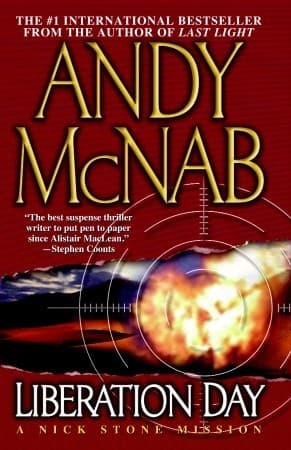
Synopsis
Covers the whole plot, including the ending.
- Difficulty
- Medium
- Pacing
- Fast
- Mood
- Intense, Suspenseful, Gritty, Action-packed
- Read it if
- You enjoy fast-paced, gritty military thrillers with a focus on espionage, close-quarters combat, and a morally ambiguous protagonist.
- Skip it if
- You prefer character-driven narratives over constant action, or are sensitive to explicit violence and morally grey themes.
Liberation Day Plot Summary
Covers the whole plot, including the ending.
The Last Job for Citizenship
Nick Stone, a former SAS operative, lives in the United States and loves Anna, a successful lawyer. He wants American citizenship to build a stable life with her and leave his past behind. The CIA offers him a deal: assassinate a wealthy, money-laundering businessman named Al-Harbi in an unnamed Arab republic. In return, they will speed up his citizenship application. Stone, despite his doubts about the work, agrees, seeing it as his final step toward a normal life. He prepares carefully for the mission, gathering information and planning his escape, unaware of the true complexities and hidden motives behind this seemingly simple task.
Infiltration and Execution
Stone travels to the Arab republic, using his training and experience to bypass security and reach Al-Harbi's heavily guarded compound. He watches the target's routine, finds weak points, and kills Al-Harbi with cold precision. The mission requires him to kill Al-Harbi and retrieve a specific gruesome proof of death—a thumb—to confirm the kill to his handlers. Stone navigates the dangerous environment, completes the objective, and extracts himself from the country, believing he has fulfilled his part of the deal and can now look forward to a peaceful future with Anna.
The Deception Unveiled
Upon his return, Stone expects to finalize his citizenship, but his CIA handler, Henderson, avoids him. Stone's suspicions grow when he finds inconsistencies in the information he was given. He realizes that Al-Harbi was just a pawn, and his assassination was a calculated move to destabilize a larger, more complex network. The real target, and the true reason for his mission, begins to emerge as a shadowy figure connected to al-Qaeda. Stone feels betrayed and manipulated, understanding that his 'last job' was just the start of a deeper and more dangerous entanglement.
Pursuit in the French Underworld
Needing answers and feeling responsible, Stone follows new leads to France. He explores the dark underworld of Paris and other French cities, meeting various contacts, both legal and illegal. He discovers that al-Qaeda operatives are active in the region, using France as a base for their illegal activities. Stone finds himself caught in a secret war, fighting not just individual terrorists but an entire network. The situation intensifies as he realizes the global importance of the information he is uncovering, and the personal danger grows with every step.
Anna's Disappearance
As Stone gets closer to the al-Qaeda network, a devastating personal blow hits him: Anna is kidnapped. This act is clearly direct retaliation and a way to manipulate Stone, showing the reach and ruthlessness of his enemies. Her abduction shatters his hopes for a normal life and plunges him into a desperate race against time. The emotional toll is huge, as he is torn between continuing his pursuit of the terrorists and dropping everything to rescue the woman he loves. This event turns the mission from a professional duty into a deeply personal vendetta.
The Interrogation and the Ultimatum
Stone receives a chilling message from the kidnappers, confirming Anna's capture and giving him an impossible choice. They demand that he stop his operations against them and, possibly, ask him to do something for them, in exchange for Anna's life. The terrorists provide proof of her captivity, leaving Stone in agony. He must face the most lethal dilemma of his life: continue his fight against a global terrorist organization, potentially saving countless lives, or abandon everything to save the one person who means the world to him. The moral and emotional weight of this decision is immense.
A Desperate Alliance
Realizing he cannot save Anna alone, Stone makes difficult choices and forms unexpected alliances. He reaches out to some of his former contacts, including intelligence community members who may have their own agendas, and even some from the criminal underworld. These alliances are full of tension and distrust, as Stone knows he is playing a dangerous game. He must navigate these treacherous relationships, using whatever influence and resources he can to find Anna's location and plan a rescue, all while knowing that any mistake could cost Anna her life or compromise his mission.
The Rescue Attempt
With information from his desperate alliances, Stone locates Anna at a heavily fortified terrorist safe house. He plans a high-stakes rescue operation, using all his tactical skills and combat experience. The attempt faces fierce resistance from the al-Qaeda operatives guarding Anna. Stone engages in brutal close-quarters combat, navigating booby traps and overwhelming odds. The scene is a frantic and bloody struggle for survival, where Stone pushes his physical and mental limits, driven solely by the urgent need to get Anna out alive, regardless of the personal cost.
Aftermath and Revelation
Stone successfully rescues Anna, though both are deeply affected by the ordeal. Afterward, the full extent of the conspiracy and the CIA's manipulation becomes clear. Stone uncovers evidence suggesting the CIA was not just using him to fight al-Qaeda, but that elements within the agency might have been involved in a more complex geopolitical game, possibly even using the terrorist threat for their own ends. The lines between good and evil blur, leaving Stone questioning who he can truly trust and the morality of his own actions within this shadowy world. Anna's safety is most important, but the fight is far from over.
Confronting Henderson
Enraged by the betrayal and the near-fatal consequences for Anna, Stone confronts Henderson, his initial CIA handler. He demands a full explanation of the mission, the lies he was told, and the true reasons for using him as a pawn. The confrontation is tense and volatile, with Stone refusing to accept official jargon or excuses. He seeks not just answers, but some justice for the psychological and physical torment he and Anna endured. Henderson, however, is a master of manipulation and evasion, making it difficult for Stone to get the complete truth, further cementing Stone's distrust in the system.
Loose Ends and Future Threats
Despite rescuing Anna and confronting Henderson, Stone knows that some threats remain. He takes steps to ensure his and Anna's safety, tying up loose ends related to the al-Qaeda network and rogue elements within the intelligence community. He uses his skills to eliminate remaining threats, making it clear that he will protect what is his at all costs. The experience changes him deeply. His desire for a normal life with Anna is now mixed with a deeper understanding of the world's dark side and his own unavoidable role in it. The future remains uncertain, but Stone is ready for whatever comes next.
Principal Figures
Nick Stone
Protagonist
Former SAS operative turned top-secret operative, seeking a normal life.
Nick Stone is a highly skilled and resourceful former SAS commando, possessing exceptional combat, surveillance, and infiltration abilities. He is driven by a deep desire for a stable, peaceful life with his girlfriend, Anna, and is willing to undertake one last dangerous mission for the CIA to achieve American citizenship. Despite his cynical view of the world and his profession, he has a strong moral compass that is often tested by the ambiguous nature of his work. He is fiercely loyal to those he cares about, making Anna's kidnapping a profound personal blow.
Relationships: Anna (Romantic partner, primary motivation for seeking a normal life.); Henderson (CIA handler, manipulative and untrustworthy contact.)
Anna
Supporting
Nick Stone's girlfriend, a lawyer, who becomes a victim of his dangerous life.
Anna is Nick Stone's girlfriend, a successful and intelligent lawyer. She represents the normal, stable life that Stone desperately craves. Her presence grounds him and provides a stark contrast to his violent, shadowy world. Her love for Stone is genuine, but she is largely unaware of the full extent of his dangerous past and present. Her kidnapping serves as the central catalyst for Stone's emotional and moral crisis, forcing him to confront the true costs of his profession and the threats it poses to those he loves.
Relationships: Nick Stone (Romantic partner, deeply in love.)
Henderson
Antagonist/Supporting
Nick Stone's enigmatic and manipulative CIA handler.
Henderson is Nick Stone's primary contact within the CIA, responsible for recruiting him for the initial mission. He is a shadowy figure, calm and composed, with a talent for manipulation and withholding information. Henderson represents the bureaucratic and often morally ambiguous nature of intelligence agencies. His true motives are often hidden, and he prioritizes national security (or what he perceives as such) above individual lives or ethical considerations. He is the embodiment of the system that uses operatives like Stone as pawns in a larger game, making him both an ally and an adversary.
Relationships: Nick Stone (Handler/operative relationship, marked by distrust and manipulation.)
Al-Harbi
Mentioned/Initial Target
A wealthy businessman in an Arab republic, initially targeted for assassination.
Al-Harbi is a wealthy, money-laundering businessman in an unnamed Arab republic, presented by the CIA as the primary target of Stone's first mission. He is portrayed as a key figure in illicit financial networks, making him a seemingly legitimate target for a black operation. However, he is ultimately revealed to be a pawn in a much larger scheme, his assassination designed to trigger a chain of events rather than being an end in itself. His death serves as the opening act of the novel's complex plot, immediately plunging Stone into deeper intrigue.
Al-Qaeda Operatives
Antagonists
The shadowy terrorist organization that becomes Stone's primary adversary.
The al-Qaeda operatives represent the overarching antagonist force in the novel. They are depicted as a ruthless and globally connected terrorist organization, operating in the shadows of the French underworld and beyond. Their actions, particularly the kidnapping of Anna, directly threaten Stone's personal life and force him into a desperate battle. They are driven by their extremist ideology and are willing to employ extreme violence and psychological warfare to achieve their objectives and counter Stone's interference. They are a formidable and ever-present threat.
Relationships: Nick Stone (Mortal enemies, engaged in a deadly covert war.)
French Underworld Contacts
Supporting/Mentioned
Various individuals Stone encounters for intelligence and assistance in France.
These are a network of individuals, both legitimate and illicit, that Nick Stone interacts with during his investigation in France. They provide him with crucial intelligence, resources, and sometimes even direct assistance in navigating the dangerous French underworld. These characters are often morally ambiguous, operating in grey areas, and their loyalty is always conditional. They represent the complex web of information and assistance that a covert operative like Stone must rely on, highlighting the blurred lines between law enforcement, intelligence, and organized crime.
Relationships: Nick Stone (Transactional relationships, exchanging information or favors for mutual benefit.)
Themes & Insights
The Illusion of Control and Betrayal
A main theme is Nick Stone's constant struggle with the illusion of control, especially over his own life and missions. He believes the assassination of Al-Harbi is his 'last job,' a way to achieve a peaceful future with Anna. However, his handlers, particularly Henderson, repeatedly betray him, manipulating him into a deeper conflict against al-Qaeda. This betrayal is not just professional but deeply personal when Anna is kidnapped, showing how little control Stone actually has over the forces at play and how easily his personal hopes can be used by the powerful. The first mission itself is a lie, setting the tone for later deceptions.
“They don't care about you, Nick. You're just a tool, and when they're done, they'll discard you.”
The Cost of a Dangerous Life
The novel clearly shows the devastating personal cost of a life of violence and secret operations. Stone's desire for a normal life with Anna clashes with his dangerous job. Anna's kidnapping is the clearest example of this cost, directly linking his past actions and current mission to the threat against the person he loves most. This forces Stone to face the reality that his choices endanger not only himself but also those closest to him, highlighting how impossible it is to truly separate his two worlds. The psychological toll on both Stone and Anna is immense, even after her rescue.
“You can't just walk away from this life, Nick. It always finds a way to pull you back in.”
Moral Ambiguity and Shifting Loyalties
The story constantly blurs the lines between good and evil, and who truly represents either. The CIA, supposedly a force for good, is shown to be manipulative and self-serving, using Stone as a pawn and hiding important information. Stone himself operates in morally gray areas, committing assassinations for personal gain (citizenship). His alliances are often with unsavory characters from the underworld, further complicating the ethical landscape. This theme makes the reader question traditional ideas of heroism and villainy, revealing a world where everyone acts with their own agenda, and loyalty is not fixed.
“In this game, Nick, everyone has their price. And everyone has their secrets.”
The Global Reach of Terrorism
The novel highlights the widespread and far-reaching nature of global terrorism, specifically al-Qaeda. What starts as a seemingly isolated mission in an Arab republic quickly grows into a secret war across continents, with operatives active in the French underworld. This shows how terrorist networks cross national borders, making them a complex and hard-to-catch enemy. The threat is not just theoretical; it directly affects Stone's life through Anna's kidnapping, emphasizing the personal and immediate danger posed by such groups, even in seemingly safe Western countries. The scale of the threat is a constant pressure on Stone.
“They're everywhere, Nick. Like a virus. You cut off one head, and two more grow.”
Plot Devices & Literary Techniques
The 'One Last Job' Trope
The protagonist takes on a final dangerous mission to escape his past and achieve a desired future.
This classic thriller trope sets up the initial premise of the novel. Nick Stone agrees to assassinate Al-Harbi, believing it to be his 'last job' that will secure his American citizenship and a peaceful life with Anna. This device immediately establishes high stakes and personal motivation. However, the trope is subverted when the 'last job' is revealed to be a deception, serving as a gateway to a much larger and more dangerous conflict, effectively trapping Stone deeper in the very life he tried to escape. This subversion drives the central conflict and Stone's personal anguish.
The MacGuffin (Proof of Death)
A specific, seemingly vital object that drives the initial plot but is ultimately less important than the underlying conflict.
The requirement for Stone to bring back 'gruesome proof' of Al-Harbi's death (a thumb) functions as a MacGuffin. While initially presented as crucial for confirming the assassination and securing Stone's citizenship, its actual significance diminishes as the true nature of the mission is revealed. The proof serves primarily to propel Stone into the initial action and to establish the brutal reality of his world, but the underlying conspiracy and the al-Qaeda threat quickly overshadow its importance, shifting the focus to the larger geopolitical game and Anna's kidnapping.
The False Protagonist/Initial Target
An early target or character who appears to be central but is a diversion from the true antagonist or objective.
Al-Harbi serves as a false protagonist/initial target. Stone is led to believe that assassinating Al-Harbi is the core mission, and that Al-Harbi himself is the primary problem. However, it is later revealed that Al-Harbi was merely a pawn, and his death was a strategic move to destabilize a larger network or to trigger a subsequent chain of events. This device creates a sense of betrayal and manipulation, forcing Stone to re-evaluate his understanding of the mission and uncover the true, more dangerous adversaries (al-Qaeda and rogue intelligence elements) who are the real focus of the story.
The Personal Stake Escalation
The conflict directly threatens the protagonist's loved ones, raising the stakes dramatically.
While Stone initially has personal stakes (citizenship, future with Anna), the conflict escalates dramatically with Anna's kidnapping. This plot device transforms the mission from a professional obligation into a deeply personal vendetta, increasing the emotional intensity and driving Stone's actions with a fierce urgency. Her abduction is not merely a consequence of his dangerous life but a direct manipulation by his enemies, forcing him into an impossible dilemma and highlighting the ultimate cost of his profession. This significantly amplifies the tension and emotional resonance of the narrative.
Liberation Day Quotes
“The wind was a living thing, snatching at your clothes, trying to tear the breath from your lungs. It was a good distraction.”
“Fear was a useful tool if you knew how to wield it. Not to let it wield you.”
“In this game, there were no second chances. Only consequences.”
“He knew the smell of danger. It wasn't always blood; sometimes it was just the absence of noise.”
“Trust was a luxury few could afford, and even fewer could genuinely offer.”
“The best way to hide something was in plain sight, especially when everyone was looking for something else.”
“Every mission had its own heartbeat, its own rhythm. You just had to learn to dance to it.”
“He'd seen enough death to know it wasn't a grand, dramatic affair. Mostly, it was just messy and final.”
“The past was a weapon, and some people were very good at using it.”
“Sometimes the biggest battles were fought not with bullets, but with information.”
“Survival wasn't about being the strongest, it was about being the most adaptable.”
“He lived in the shadows, not because he liked them, but because that's where the work was.”
“The line between hunter and hunted could blur in an instant.”
“Regret was a luxury for those who had time to dwell on it. He didn't.”
Quiz
10 questions on the plot and the characters. Each answer comes with a short explanation.
Question 1
What is Nick Stone's primary motivation for agreeing to do one last job for the CIA?
- To get revenge on an old enemy.
- To gain American citizenship and start a new life.
- To clear his name from a past incident.
- To secure a large sum of money for retirement.
Show answer
B. To gain American citizenship and start a new life. The book description explicitly states that Nick Stone agrees to the mission because he is 'Desperate to gain American citizenship and start a new life with the woman he loves.'
Question 2
What is the initial target of Nick Stone's mission in the Arab republic?
- A high-ranking government official.
- A leader of an al-Qaeda cell.
- A money-laundering local businessman.
- A nuclear scientist.
Show answer
C. A money-laundering local businessman. The synopsis details Stone's initial task: 'He must infiltrate an Arab republic, kill a money-laundering local businessman, and bring back gruesome proof of his death.'
Question 3
Where does Nick Stone find himself caught in a 'dirty war' against al-Qaeda operatives after his initial mission?
- In the deserts of the Arab republic.
- In the shadowy French underworld.
- In a covert CIA facility in the US.
- In the mountains of Afghanistan.
Show answer
B. In the shadowy French underworld. The summary states, 'In the shadowy French underworld, he’s caught in the deep end of a very dirty war against al-Qaeda operatives.'
Question 4
What does Nick Stone initially not care about regarding his mission to kill the businessman?
- The potential risks involved.
- The method of extraction.
- Why he has to kill the businessman.
- The amount of payment he will receive.
Show answer
C. Why he has to kill the businessman. The text mentions, 'He doesn’t know why, and he doesn’t care.' referring to the reason behind the assassination target.
Question 5
What is Nick Stone's professional background before becoming a top-secret operative?
- Former MI6 agent.
- Former SAS commando.
- Former Navy SEAL.
- Former Delta Force operator.
Show answer
B. Former SAS commando. The description introduces Nick Stone as a 'Former SAS commando Andy McNab unleashes a non-stop whirlwind of action and intrigue in his new #1 international bestseller featuring top-secret operative Nick Stone.'
Question 6
What is the nature of the proof Nick Stone is required to bring back after killing the businessman?
- A photograph of the body.
- A confession recorded on audio.
- Gruesome proof of his death.
- Financial documents implicating him.
Show answer
C. Gruesome proof of his death. The synopsis clearly states Stone's task: 'He must infiltrate an Arab republic, kill a money-laundering local businessman, and bring back gruesome proof of his death.'
Question 7
What realization does Nick Stone make 'too late' about his mission?
- He was set up by his own agency.
- The target was innocent.
- The truth about his real mission, which has only just begun.
- He can't go through with the killing.
Show answer
C. The truth about his real mission, which has only just begun. The text reveals, 'Too late, Stone realizes the truth about his real mission — which has only just begun.' indicating a deeper, more complex objective than initially presented.
Question 8
What is the ultimate challenge Nick Stone faces as the twists unfold in the story?
- He must betray his allies to survive.
- He is confronted by the most lethal dilemma a man could face.
- He has to choose between two equally dangerous missions.
- He must escape capture from multiple intelligence agencies.
Show answer
B. He is confronted by the most lethal dilemma a man could face. The final sentence of the synopsis states: 'And as one bloody twist leads to another, Stone soon finds himself on his deadliest assignment yet — and confronted by the most lethal dilemma a man could face.'
Question 9
What characteristic is consistently highlighted about the plot of 'Liberation Day'?
- Its slow-burn psychological tension.
- Its focus on intricate political maneuvering.
- Its non-stop whirlwind of action and intrigue.
- Its detailed character studies.
Show answer
C. Its non-stop whirlwind of action and intrigue. The description uses the phrase 'non-stop whirlwind of action and intrigue' to characterize the book's pacing and content.
Question 10
What is the implication when the synopsis mentions 'one bloody twist leads to another'?
- The story involves a series of unrelated violent events.
- The plot contains continuous, escalating complications and betrayals.
- Nick Stone is repeatedly injured throughout the narrative.
- The story is structured around flashback sequences.
Show answer
B. The plot contains continuous, escalating complications and betrayals. The phrase 'one bloody twist leads to another' suggests a rapidly unfolding and increasingly complex series of events, typical of a thriller, rather than isolated incidents or structural elements.
Liberation Day FAQ
What is Nick Stone's primary motivation for accepting the CIA mission at the beginning of 'Liberation Day'?
Nick Stone's main motivation is to gain American citizenship and begin a new life with the woman he loves. He views this 'one last job' for the CIA as a necessary step to secure his future and settle down, despite not knowing or caring about the true reasons behind the mission.
Who is the initial target Nick Stone is tasked with eliminating in the Arab republic?
Nick Stone's initial target is a local businessman in an Arab republic who is reportedly involved in money-laundering. Stone is instructed to infiltrate the region, kill this individual, and provide gruesome proof of his death to the CIA.
What significant realization does Nick Stone have after completing his initial assignment?
After completing the assassination, Stone realizes that the 'truth' about his real mission is far more complex and sinister than he was led to believe. He discovers that his initial task was merely a prelude, and his true, deadlier assignment has only just begun, pulling him into a deeper web of intrigue.
Where does Nick Stone find himself operating after the initial mission, and against whom is he fighting?
Following the initial mission, Nick Stone is drawn into the shadowy French underworld. Here, he becomes embroiled in a 'very dirty war' against al-Qaeda operatives, indicating a significant shift in the scope and nature of his involvement.
What is the 'most lethal dilemma' Nick Stone faces by the end of the book?
The book culminates with Nick Stone confronting 'the most lethal dilemma a man could face.' This refers to a deeply personal and morally compromising choice, often involving the lives of those he cares about or a decision that will irrevocably alter his future and identity.
How does the initial money-laundering target connect to the larger al-Qaeda plot?
The money-laundering businessman, while seemingly a standalone target, likely served as a financial conduit or information source for al-Qaeda. His elimination was a strategic move to disrupt their funding or to acquire intel that would lead Stone directly to the deeper network in France.
What specific 'gruesome proof' does the CIA demand, and what does it signify about their methods?
The demand for 'gruesome proof' implies the CIA requires undeniable, visually explicit evidence of the target's death, possibly a severed body part or a unique identifier. This signifies their ruthless and cold-blooded operational methods, prioritizing irrefutable confirmation over ethical considerations.
Are there any recurring characters or organizations from previous Nick Stone novels that make an appearance or are alluded to?
While the synopsis doesn't explicitly state it, given Andy McNab's series format, it's highly probable that elements of the CIA handlers, former SAS contacts, or rival intelligence agencies that have featured in previous Nick Stone books make an appearance or are subtly referenced, adding continuity to Stone's world.
What hidden motivations might the CIA have for manipulating Nick Stone into this 'one last job'?
The CIA likely knew Stone's desire for citizenship and used it as leverage, fully aware that the initial mission was a deception. They sought to exploit his unique skillset for a more complex and dangerous operation against al-Qaeda, which they couldn't openly sanction, making Stone a deniable asset.
How does Nick Stone's desire for a 'new life' conflict with his inherent nature as a special operative?
Stone's yearning for a peaceful new life with his loved one directly clashes with his ingrained identity as a highly trained killer. His past experiences and unique skillset constantly pull him back into the world of violence and espionage, making a truly 'normal' existence an elusive dream.
Analyze the psychological impact of Stone's realization that his mission was a deception.
The realization that he was deceived would profoundly impact Stone's trust, potentially leading to feelings of betrayal, anger, and isolation. This manipulation would reinforce his cynical view of intelligence agencies and deepen his internal conflict between duty and personal desires, questioning his own judgment.
How does the 'dirty war' against al-Qaeda operatives affect Nick Stone's moral compass?
Engaging in a 'dirty war' against a ruthless enemy like al-Qaeda forces Stone into morally ambiguous situations where traditional rules of engagement are discarded. This constant exposure to extreme violence and the necessity of making brutal choices would further erode his moral compass, pushing him to justify increasingly extreme actions.
What internal struggles might Nick Stone face when confronted by 'the most lethal dilemma'?
When facing 'the most lethal dilemma,' Stone would likely grapple with intense guilt, fear, and profound existential questions. He would be forced to weigh impossible choices, potentially sacrificing his own principles, loved ones, or even his humanity, leading to immense psychological torment and potential trauma.
Does Nick Stone exhibit signs of PTSD or moral injury from his past and current operations?
Given his background as a former SAS commando and his involvement in continuous high-stress, violent operations, it is highly probable that Nick Stone exhibits signs of PTSD, such as hypervigilance, emotional detachment, and difficulty forming lasting relationships. The 'dirty war' and moral dilemmas would also contribute to significant moral injury.
How does 'Liberation Day' explore themes of personal freedom versus national security?
'Liberation Day' explores this by showing Stone's quest for personal freedom (citizenship, new life) constantly being overridden by demands of national security (CIA missions, fighting al-Qaeda). His personal liberation is contingent upon his continued service, highlighting the individual sacrifice required for perceived greater good.
Is the title 'Liberation Day' ironic, given Nick Stone's predicament?
Yes, the title 'Liberation Day' is highly ironic. Stone seeks liberation from his past and a new life, but each mission, especially the 'one last job,' only ensnares him deeper into conflict, further from true freedom. His 'liberation' is constantly deferred or revealed to be another form of entrapment.
What is the significance of the French underworld setting for the second half of the book?
The French underworld setting provides a stark contrast to the initial Arab republic, symbolizing a shift from overt state-sanctioned violence to a more clandestine, morally ambiguous conflict. It emphasizes the global reach of terrorism and the blurring lines between state intelligence and criminal networks, adding layers of complexity to Stone's fight.
How does the book comment on the ethics of intelligence agencies like the CIA?
The book heavily critiques the ethics of intelligence agencies by depicting the CIA's manipulation of Nick Stone, their use of deception, and demand for 'gruesome proof.' It suggests these agencies operate with a pragmatic ruthlessness, prioritizing objectives over the well-being or informed consent of their operatives.
Could Nick Stone ever truly achieve the 'new life' he desires, or is he fated to remain an operative?
The narrative strongly suggests that Nick Stone is likely fated to remain an operative, or at least perpetually drawn back into that world. His unique skills and the nature of global threats mean 'one last job' is rarely truly the last. His desire for a new life serves as a poignant, unattainable dream, a constant internal struggle.
About the author

Andy McNab is a former SAS soldier turned bestselling author, renowned for his thrilling action novels. His works, including 'Liberation Day,' 'Remote Control,' and 'Traitor,' draw heavily on his real-life experiences in special forces operations. McNab's writing is characterized by its gritty realism and fast-paced plots, making him a prominent figure in the thriller genre.
Similar books
- The Gray Man
Mark Greaney
4.2 (52k) average on GoodreadsFictionFeatures a highly skilled, ex-military operative on the run, involved in high-stakes international espionage.
- I Am Pilgrim
Terry Hayes
4.3 (126k) average on GoodreadsThrillerTerry Hayes' I Am Pilgrim shares the high-stakes, global thriller elements and the focus on a highly trained operative with "Liberation Day." However, Hayes' novel is notable for its intricate, sprawling plot, deeply researched antagonist, and a more literary approach to prose, offering a richer, more complex narrative tapestry. McNab's book is more direct and action-oriented, whereas Hayes allows for more philosophical musings and detailed character backstories, creating a different kind of immersive experience that prioritizes depth over pure velocity, a distinction often highlighted in reviews comparing the two authors' approaches to the genre (e.g., Kirkus Reviews on Hayes' intricate plotting).
- Angels & Demons
Dan Brown
3.9 (2.7M) average on GoodreadsThrillerA Harvard symbologist races through Rome's ancient sites, deciphering cryptic clues to unmask the Illuminati and stop a vengeful plot to destroy the Vatican with a stolen antimatter weapon.
- Gone Girl
Gillian Flynn
4.1 (2.3M) average on GoodreadsThrillerA wife's sudden disappearance on her fifth anniversary reveals a web of lies and psychological warfare, exposing the secrets within a seemingly perfect marriage.
- The Girl on the Train
Paula Hawkins
3.9 (2.1M) average on GoodreadsThrillerA woman’s fascination with a seemingly perfect couple she watches from her daily train commute leads her into a dark investigation when she witnesses something that shatters their idyllic image.
- The Da Vinci Code
Dan Brown
3.9 (1.9M) average on GoodreadsThrillerA symbologist and a cryptologist race through European landmarks, deciphering ancient codes and uncovering a conspiracy that could rewrite the foundations of Christianity.






Enjoyed the summary?
A summary gives you the shape of the book. The book itself has the detail, the examples and the voice.
Find Liberation Day on AmazonAs an Amazon Associate, BookBrief earns from qualifying purchases. How we're funded