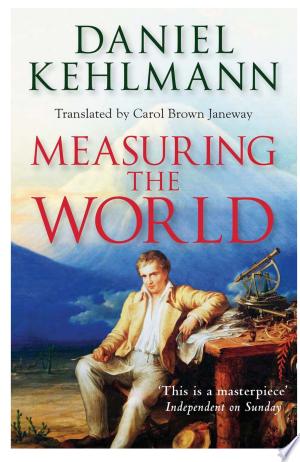
Estimated read time: 6 min read
One Sentence Summary
"Measuring the World" by Daniel Kehlmann is a fictionalized account of the lives and achievements of two German pioneers, mathematician Carl Friedrich Gauss and geographer Alexander von Humboldt, as they strive to quantify and understand the world around them in the early 19th century.
Table of Contents
Introduction
"Measuring the World" is a fascinating historical novel by Daniel Kehlmann. It's a captivating blend of fact and fiction that explores the lives of two brilliant German scientists, Carl Friedrich Gauss and Alexander von Humboldt. The novel intricately weaves their journeys as they strive to understand and measure the world in their unique ways. Kehlmann’s work is significant for its engaging portrayal of scientific exploration during the Enlightenment era, offering readers a window into the minds that shaped modern scientific thought.
Brief Synopsis
Plot Overview
"Measuring the World" follows the parallel lives of Gauss and Humboldt as they embark on their respective quests for knowledge. Gauss, a mathematical prodigy, is portrayed as a recluse who prefers the confines of his study, while Humboldt is a daring explorer, traversing uncharted territories. Their paths converge as they both seek to quantify and understand the world, albeit through different lenses. The novel delves into their personal and professional challenges, triumphs, and the impact of their discoveries on the world.
Setting
The story is set during the late 18th and early 19th centuries, a period marked by rapid scientific and geographical discoveries. The novel transports readers to various locations, from the dense jungles of South America to the academic halls of Germany. This era's spirit of exploration and intellectual curiosity is vividly captured, providing a rich backdrop for the narrative.
Main Characters
- Carl Friedrich Gauss: A genius mathematician known for his groundbreaking work in number theory and astronomy. He is depicted as introverted and socially awkward, yet his intellectual prowess is unmatched.
- Alexander von Humboldt: An adventurous and charismatic naturalist and explorer. He is passionate about understanding the natural world and is driven by his desire to explore unknown territories.
- Wilhelmine Gauss: Gauss's devoted wife, who supports him despite his eccentricities and emotional distance.
- Bonpland: Humboldt's loyal companion and fellow explorer, assisting him in his scientific endeavors.
Plot Summary
Early Life and Inspirations
The novel begins by exploring the early lives of Gauss and Humboldt. Gauss, born into a poor family, quickly demonstrates his mathematical genius. His ability to perform complex calculations in his head earns him recognition and the chance to pursue formal education. In contrast, Humboldt, born into a wealthy family, is encouraged to follow his passions. His fascination with nature and geography propels him to travel and document his findings.
The Journey of Exploration
Humboldt's thirst for adventure leads him to the Americas, where he seeks to measure and understand the natural world. His expeditions take him through the Amazon rainforest and the Andes Mountains. Alongside Bonpland, he faces numerous challenges, including harsh climates and dangerous wildlife. Despite these obstacles, Humboldt meticulously records his observations, contributing significantly to the fields of geography and biology.
Gauss's Mathematical Pursuits
Meanwhile, Gauss's story unfolds in the academic world, where he makes groundbreaking contributions to mathematics and astronomy. His work on prime numbers and the Gaussian distribution cements his reputation as one of the foremost mathematicians of his time. However, Gauss struggles with personal relationships and often isolates himself, finding solace only in his work.
Convergence and Collaboration
As their careers progress, the paths of Gauss and Humboldt eventually intersect. They find themselves at a scientific congress, where their contrasting personalities and methodologies are highlighted. Despite their differences, both share a commitment to scientific inquiry and a desire to measure and understand the world. Their meeting symbolizes the convergence of mathematical precision and empirical exploration.
Legacy and Impact
The novel concludes by reflecting on the enduring legacies of Gauss and Humboldt. Their contributions to science and exploration have a lasting impact, influencing future generations of scientists and explorers. Kehlmann emphasizes the importance of curiosity and perseverance in the pursuit of knowledge, underscoring the novel's central themes.
Themes and Motifs
The Pursuit of Knowledge
A central theme in "Measuring the World" is the relentless pursuit of knowledge. Both Gauss and Humboldt are driven by an insatiable curiosity to understand the world around them. Their quests highlight the importance of scientific inquiry and the quest for truth.
The Intersection of Science and Adventure
The novel explores the intersection of science and adventure, particularly through Humboldt's expeditions. It illustrates how scientific discovery often requires stepping into the unknown and embracing uncertainty.
The Human Condition
Kehlmann delves into the human condition, examining the personal struggles and triumphs of his protagonists. The novel portrays the challenges of balancing personal relationships with professional ambitions, offering insight into the complexities of human nature.
Author's Background
Daniel Kehlmann is a renowned German author known for his literary prowess and ability to blend historical fact with fiction. Born in Munich in 1975, Kehlmann studied philosophy and literature before pursuing a career in writing. His works often explore themes of identity, knowledge, and the human experience. "Measuring the World" is one of his most acclaimed novels, celebrated for its narrative depth and historical accuracy.
Reader's Takeaway
"Measuring the World" offers readers a thought-provoking exploration of the lives of two remarkable scientists. Through Gauss and Humboldt's journeys, readers gain insight into the nature of scientific discovery and the perseverance required to push the boundaries of knowledge. The novel encourages readers to reflect on their curiosity and the role it plays in shaping their understanding of the world.
Conclusion
"Measuring the World" is a masterful blend of historical fiction and biography, offering a rich and immersive reading experience. Kehlmann's portrayal of Gauss and Humboldt's lives provides a unique lens through which to view the scientific and geographical advancements of the Enlightenment era. For readers interested in history, science, and the human spirit, this novel is a compelling invitation to explore the world through the eyes of two of its greatest minds.
Measuring the World FAQ
What is the main theme of 'Measuring the World'?
The main theme of 'Measuring the World' is the exploration of scientific discovery and the lives of two pioneering figures, Carl Friedrich Gauss and Alexander von Humboldt, as they strive to understand and measure the world around them.
Who are the main characters in the book?
The main characters in the book are Carl Friedrich Gauss, a mathematician, and Alexander von Humboldt, a naturalist and explorer.
Is 'Measuring the World' based on true events?
'Measuring the World' is a historical novel that fictionalizes the lives and achievements of real historical figures, Carl Friedrich Gauss and Alexander von Humboldt.
What is the setting of the book?
The book is set in the late 18th and early 19th centuries, primarily in Europe and South America, as it follows the journeys and discoveries of Gauss and Humboldt.
What genre does 'Measuring the World' belong to?
'Measuring the World' is a historical novel that blends elements of biography and fiction.
Who is the author of 'Measuring the World'?
'Measuring the World' is written by Daniel Kehlmann, a German author.
What is the narrative style of the book?
The book employs a third-person narrative style, alternating between the stories of Gauss and Humboldt.
How does the book explore the theme of scientific discovery?
The book explores scientific discovery by chronicling the intellectual pursuits and groundbreaking contributions of Gauss and Humboldt, highlighting their different approaches to understanding the world.
What is the significance of the title 'Measuring the World'?
The title 'Measuring the World' refers to the efforts of Gauss and Humboldt to quantify and understand the natural world through their scientific endeavors and explorations.