
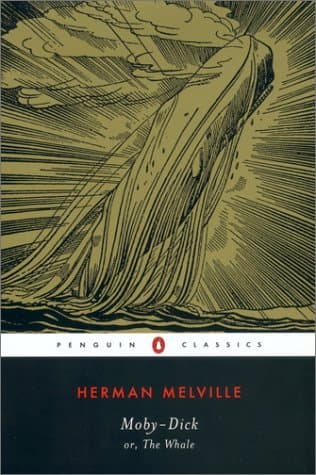
Synopsis
Covers the whole plot, including the ending.
- Difficulty
- Hard
- Pacing
- Variable
- Mood
- Epic, Obsessive, Philosophical, Melancholy, Adventurous, Dark
- Read it if
- You enjoy epic tales of obsession, man versus nature, and profound philosophical inquiry, with rich prose and extensive detail about 19th-century whaling.
- Skip it if
- You prefer fast-paced plots, simple narratives, or find extensive digressions and detailed technical descriptions tedious.
Moby-Dick or, the Whale Plot Summary
Covers the whole plot, including the ending.
Ishmael's Arrival in New Bedford
Ishmael, a schoolmaster, arrives in New Bedford, Massachusetts, seeking escape from his unhappiness by going to sea. He stays at the Spouter-Inn, where he shares a bed with Queequeg, a tattooed harpooner from a cannibalistic tribe. Ishmael is initially wary of Queequeg's appearance and rituals, but he soon overcomes his prejudices, seeing Queequeg's kindness and dignity. They quickly become close friends, deciding to sail together. Their bond, built on mutual respect despite their different backgrounds, prepares them for their journey aboard the whaling ship, the *Pequod*.
Signing Aboard the Pequod
After becoming friends, Ishmael and Queequeg travel to Nantucket, a whaling port. There, they decide to join the *Pequod*, which is preparing for a long voyage. Before boarding, they meet Elijah, a prophet-like figure who warns them about Captain Ahab and the *Pequod*'s doomed fate, hinting at a terrible secret. Despite Elijah's warnings and the unsettling mood around the ship and its captain, Ishmael and Queequeg commit to the voyage, driven by adventure and profit, unaware of Ahab's true obsession.
Ahab's Appearance and Vow
Once the *Pequod* is at sea, Captain Ahab emerges from his cabin. He is a striking figure with an ivory leg, carved from a whale's jawbone. Ahab gathers his crew and reveals his true purpose: not just to hunt whales for oil, but to get revenge on Moby Dick, a white whale that took his leg earlier. He nails a gold coin to the mast, offering it as a reward for the first man to spot the white whale, thus drawing the crew into his personal vendetta.
The First Whale Hunt and Starbuck's Concerns
The *Pequod* finds its first whale, and the crew, led by harpooners Queequeg, Tashtego, and Daggoo, spring into action. The whale hunt is shown in detail, highlighting the dangerous and brutal nature of whaling. The crew successfully captures and processes the whale, showing their skill and the economic goal of their voyage. However, the first mate, Starbuck, a practical and religious man, grows concerned by Ahab's focus on Moby Dick. He tries to reason with Ahab, stressing the financial purpose of their journey over the captain's personal quest, but Ahab ignores him.
Meeting Other Whaling Ships
As the *Pequod* continues through various whaling grounds, it meets other ships, known as 'gamming.' Each meeting allows Captain Ahab to ask about Moby Dick. The captains of these ships share stories and rumors, some confirming Moby Dick's existence and ferocity, others warning of his elusive nature. These meetings build the legend of Moby Dick and emphasize Ahab's unwavering obsession, as he rejects any advice that does not match his vengeful quest, further isolating himself and his crew.
Ahab's Monologues and Isolation
During the voyage, Ahab spends much time alone on deck, speaking to himself and the elements. These speeches show the depth of his obsession, his thoughts on free will versus fate, and his view of Moby Dick as representing an unknowable, evil force. He sees the whale not just as an animal, but as a 'pasteboard mask' hiding some evil. His isolation from the crew, especially Starbuck, deepens as his obsession consumes him, separating him from human connection and the practicalities of whaling.
The Storm and the Compass
The *Pequod* sails into a typhoon, a powerful storm that threatens to capsize the ship. During the storm, lightning renders the ship's compasses useless, causing fear among the crew. In a moment of defiance, Ahab uses a new compass he made to guide the ship, seemingly controlling nature. However, his actions are less about safe navigation and more about showing his power over the natural world, solidifying his image as a man willing to challenge even the heavens for his goal.
Queequeg's Coffin
Queequeg falls ill with a fever. Believing he will die, he asks for a coffin to be built according to his customs. The ship's carpenter builds a watertight coffin, which Queequeg then adorns with his tribal markings. Miraculously, Queequeg recovers, and the coffin, no longer needed, is repurposed by Starbuck as a spare life buoy for the ship. This change from a symbol of death to an instrument of salvation hints at future events and shows the cycle of life and death at sea.
Foreshadowing and Omens
During the latter half of the voyage, many omens and prophecies foretell the *Pequod*'s dark fate. The ship encounters a phantom ship, the *Goney*, which has lost all its crew. Later, a ship called the *Rachel* asks Ahab for help finding its captain's lost son, but Ahab refuses, prioritizing his hunt for Moby Dick. This refusal highlights his moral decline and foreshadows his own loss. The *Pequod* also meets the *Delight*, a ship that just lost five men to Moby Dick, further confirming the white whale's deadly reputation and signaling the coming confrontation.
The Three-Day Chase
After months of searching, Moby Dick is finally sighted by Ahab. What follows is a three-day chase of increasing intensity and destruction. On the first day, Moby Dick damages Ahab's boat and injures him. On the second day, the whale smashes two more boats and kills Ahab's harpooner, Fedallah, who had prophesied Ahab would die only after seeing two hearses. Despite the growing casualties and the whale's power, Ahab's resolve remains unbroken, his obsession driving him and his crew toward their inevitable confrontation.
The Sinking of the Pequod
On the third day of the chase, Moby Dick, seemingly anticipating Ahab's every move, attacks the *Pequod* directly. The whale breaches the ship's hull, causing it to take on water quickly. Ahab, in his final act of defiance, throws his harpoon at Moby Dick. As the line snaps taut, it catches Ahab by the neck, dragging him from the deck into the ocean. The *Pequod* sinks, creating a vortex that pulls down the remaining crew, including Starbuck, Stubb, and Flask. The ship's mast, with Ahab's flag still nailed to it, is the last to disappear.
Ishmael's Survival
As the *Pequod* sinks, Ishmael is thrown clear. He clings to a piece of wreckage. Miraculously, Queequeg's repurposed coffin, now a life buoy, floats to the surface. Ishmael reaches it and holds on, surviving the ship's suction. He drifts alone for a day and a night until he is spotted and rescued by the whaling ship *Rachel*, which, ironically, had been searching for its captain's lost son, whom Ahab had refused to help. Ishmael is the only survivor to tell the story of the *Pequod*'s tragic voyage.
Moby-Dick or, the Whale Characters
Ishmael
Protagonist/Narrator
The philosophical wanderer who recounts the tale of the Pequod's doomed voyage.
Ishmael is the narrator and sole survivor of the *Pequod*'s journey. Initially a melancholic and philosophical young man, he seeks to escape his inner turmoil by going to sea as a common sailor. He is observant, contemplative, and open-minded, allowing him to form an unlikely friendship with Queequeg. He grapples with complex themes of fate, free will, and the nature of good and evil through his experiences and observations of Ahab's obsession and the vastness of the ocean.
Relationships: Queequeg (Deep and genuine friendship, mutual respect); Ahab (Observer of Ahab's madness, initially fascinated, later horrified)
Captain Ahab
Antagonist/Protagonist
The monomaniacal captain of the Pequod, obsessed with vengeance against Moby Dick.
Captain Ahab is the central figure driving the *Pequod*'s tragic voyage. He is a formidable, almost mythical figure, whose leg was taken by Moby Dick. This injury fuels his all-consuming obsession for revenge against the white whale, which he perceives as an embodiment of cosmic evil or an unfeeling, indifferent universe. Ahab is a man of immense will, charisma, and intellectual depth, but his monomania blinds him to all other considerations, including the well-being of his crew and the practical goals of whaling.
Relationships: Starbuck (Antagonistic, Starbuck represents practical reason against Ahab's madness); Moby Dick (Obsessive, vengeful enemy)
Moby Dick
Antagonist
The legendary white whale, the object of Ahab's vengeful obsession.
Moby Dick is not merely an animal but a symbol of the untamed, indifferent, and powerful forces of nature. He is a massive, albino sperm whale, renowned for his intelligence, cunning, and ferocity, particularly for his ability to escape and destroy whaling ships. For Ahab, Moby Dick represents the 'pasteboard mask' behind which all perceived evil or inscrutable malevolence of the universe resides, making him the ultimate target of Ahab's metaphysical rage.
Relationships: Ahab (Mortal enemy, the object of Ahab's monomaniacal vengeance); The Sea (Embodiment of its wild, untameable power)
Starbuck
Supporting
The pragmatic first mate of the Pequod, who values profit and reason over Ahab's obsession.
Starbuck is the first mate of the *Pequod* and a foil to Captain Ahab. A devout Quaker and a seasoned whaler, he is a practical, responsible, and courageous man, deeply concerned with the financial success of the voyage and the safety of the crew. He recognizes the madness in Ahab's quest and attempts, often futilely, to persuade him to abandon his vendetta for the sake of profit and survival. Despite his moral objections, his sense of duty keeps him loyal to Ahab, even as he despairs over their shared fate.
Relationships: Ahab (Subordinate but morally opposed; represents reason against Ahab's madness); Ishmael (Professional acquaintance, but not close)
Queequeg
Supporting
A skilled Polynesian harpooneer and Ishmael's closest friend.
Queequeg is a 'savage' prince from a cannibalistic South Sea island, serving as a harpooneer on the *Pequod*. Despite his exotic appearance and pagan rituals, he is portrayed as noble, kind-hearted, courageous, and deeply spiritual. He quickly forms a profound and unconventional friendship with Ishmael, based on mutual respect and shared humanity. His skills as a harpooneer are unmatched, and his quiet dignity and philosophical outlook often contrast with the more 'civilized' but prejudiced crew members.
Relationships: Ishmael (Deep and genuine friendship, spiritual bond); Ahab (Loyal crew member, but not personally close)
Stubb
Supporting
The jovial and carefree second mate of the Pequod.
Stubb is the second mate of the *Pequod*, a good-humored and easygoing man from Cape Cod. He is fearless in whale hunts and often approaches the dangers of the sea with a lighthearted, almost fatalistic attitude. He enjoys life's simple pleasures, like smoking his pipe, and often uses humor to cope with the harsh realities of whaling. While he is not as morally conflicted as Starbuck, he is also not immune to Ahab's influence, ultimately following his captain's orders without significant protest.
Relationships: Flask (Superior, often humorous interactions); Ahab (Loyal subordinate, less critical than Starbuck)
Flask
Supporting
The short, pugnacious third mate of the Pequod.
Flask is the third mate of the *Pequod*, a short, stout, and aggressive man who views whales solely as 'wheeling oil-kegs.' He is fearless and eager in the chase, often oblivious to the deeper philosophical implications or dangers that concern others. He is driven by a simple desire for action and a sense of duty, making him a reliable but unreflective officer. His limited perspective on the whale and the voyage contrasts sharply with the more complex views of Ahab and Ishmael.
Relationships: Stubb (Subordinate, often takes orders from Stubb); Ahab (Loyal subordinate)
Tashtego
Supporting
A Native American harpooneer from Gay Head.
Tashtego is one of the *Pequod*'s three harpooneers, a proud and skilled Native American from Gay Head on Martha's Vineyard. He is a traditional whaleman, deeply connected to the sea and its creatures. He is known for his agility and bravery during the whale hunts, often working closely with Stubb. His heritage and connection to nature provide a different perspective on the whaling world, contrasting with the diverse backgrounds of the other harpooneers and crew.
Relationships: Stubb (Harpooneer in Stubb's boat, professional relationship); Queequeg (Fellow harpooneer, mutual respect)
Daggoo
Supporting
A giant African harpooneer.
Daggoo is another of the *Pequod*'s harpooneers, a towering, physically imposing African man. His immense strength and imposing presence make him a formidable figure during the whale hunts, where he serves in Flask's boat. Like Tashtego and Queequeg, he represents the diverse, global nature of the whaling industry and the raw, physical power required for the profession. His character, though less developed than Queequeg's, contributes to the exotic and powerful crew assembled by Ahab.
Relationships: Flask (Harpooneer in Flask's boat, professional relationship); Queequeg (Fellow harpooneer, mutual respect)
Fedallah
Supporting
Ahab's mysterious, prophetic Parsi harpooneer.
Fedallah is a mysterious, exotic figure, a Parsi (Persian Zoroastrian) who is the leader of Ahab's secret boat crew. He is often referred to as 'the Parsee' and is depicted as a dark, silent, and almost supernatural presence. He acts as Ahab's personal harpooneer and confidant, offering a series of ominous prophecies regarding Ahab's death. His presence adds an element of the supernatural and fatalism to the narrative, reinforcing the idea of an inescapable doom hanging over Ahab.
Relationships: Ahab (Loyal personal harpooneer and prophetic confidant); Crew (Viewed with suspicion and awe by the general crew)
Elijah
Mentioned
A prophetic figure who warns Ishmael and Queequeg about Ahab.
Elijah is a ragged, prophet-like figure encountered by Ishmael and Queequeg in Nantucket before they board the *Pequod*. He delivers a series of cryptic and ominous warnings about Captain Ahab and the ship's impending doom, hinting at Ahab's madness and the destructive nature of his quest. His prophecies serve as an early foreshadowing of the tragic events to come, establishing an atmosphere of foreboding and supernatural influence.
Relationships: Ishmael (Delivers warnings to Ishmael and Queequeg); Ahab (Has knowledge of Ahab's past and future fate)
Moby-Dick or, the Whale Themes
Obsession and Madness
The novel explores the destructive nature of obsession, mainly through Captain Ahab's single-minded pursuit of Moby Dick. Ahab's desire for revenge consumes him, turning him from a capable captain into a madman willing to sacrifice everything for his goal. This theme is clear in his declaration to the crew, his refusal to help other ships, and his final, fatal lunge at the whale. His madness is shown as both a personal flaw and a force that traps those around him, leading to the *Pequod*'s destruction.
“All my means are sane, my motive and my object mad.”
Man vs. Nature
Moby Dick examines the conflict between humanity's desire to conquer or understand nature and nature's indifference and power. Moby Dick, the white whale, symbolizes the wild, unknowable, and powerful forces of the natural world. Ahab's attempt to control or destroy Moby Dick represents humanity's arrogance in challenging these forces. The ocean itself is a vast, indifferent, and dangerous place, highlighting the fragility of human efforts against its might. The tragic end of the *Pequod* shows the futility of trying to impose human will on the natural order.
“To the last I grapple with thee; from hell's heart I stab at thee; for hate's sake I spit my last breath at thee.”
Good vs. Evil / The Nature of Evil
The novel deals with the elusive nature of evil. Ahab sees Moby Dick as representing an unknowable, evil force, a 'pasteboard mask' hiding some cosmic evil. However, the story also suggests that Ahab's own obsession and vengeful hatred are the true sources of evil, corrupting him and leading to tragic outcomes. Ishmael's thoughts often question whether evil is an external force or a product of human perception and action. The white whale's ambiguity—sometimes a symbol of purity, other times of destruction—makes any simple definition of good or evil complex.
“Is it by its indefiniteness it shadows forth the heartless voids and immensities of the universe, and thus stabs us from behind with the thought of annihilation, when beholding the white depths of the milky way?”
Fate vs. Free Will
A central tension in the novel is the interplay between fate and free will. Ahab often sees himself as an instrument of a predetermined destiny, especially regarding his fight with Moby Dick. The prophecies of Elijah and Fedallah further suggest an inescapable doom. However, Ahab's relentless pursuit also shows his strong will and choice. The question arises whether Ahab is fated to chase Moby Dick, or if his own choices, driven by obsession, lead him to his end. Ishmael often reflects on these themes, questioning how much human actions are truly free or part of a larger design.
“The Fates, they are not to be reasoned with.”
The Diversity of Humanity
Melville shows the wide diversity of humanity through the *Pequod*'s crew, which is a small representation of the world. Sailors from various races, cultures, and nations—including Native Americans (Tashtego), Africans (Daggoo), Polynesians (Queequeg), and Europeans—work together, though under Ahab's command. This diversity highlights both the shared human experience and the unique perspectives from different backgrounds. Ishmael's initial prejudice against Queequeg, and his later overcoming it through friendship, emphasizes the possibility of unity and understanding across cultural divides, contrasting with Ahab's isolating obsession.
“Ahab was an old man, but one whose life had been one long lesson in the art of command.”
Plot Devices & Literary Techniques
Symbolism
Objects, characters, and concepts represent deeper meanings.
Symbolism is pervasive, with Moby Dick himself being the most prominent example, representing nature's indifference, cosmic evil, or the unattainable. Ahab's ivory leg symbolizes his physical and psychological mutilation, his defiance, and his unnatural connection to his enemy. The *Pequod* represents humanity on a doomed quest. The sea symbolizes the vast, mysterious, and dangerous unknown. These symbols enrich the narrative, allowing for multiple layers of interpretation and philosophical inquiry beyond the literal plot.
Foreshadowing
Hints and warnings that suggest future events.
Melville frequently employs foreshadowing to build suspense and a sense of impending doom. Elijah's prophetic warnings about Ahab and the *Pequod*'s fate at the novel's beginning, Queequeg's coffin being repurposed as a life buoy, and Fedallah's specific prophecies about Ahab's death (two hearses, no death by mortal man) all serve to hint at the tragic conclusion. These literary devices create a pervasive atmosphere of inevitability, making the eventual catastrophe both shocking and strangely anticipated.
Allusion
References to other literary, historical, or biblical works.
Allusion is used extensively, particularly biblical allusions, to add depth and moral weight to the narrative. Captain Ahab's name itself is an allusion to the wicked biblical king, hinting at his tyrannical and destructive nature. Ishmael's name also carries biblical weight, suggesting an outcast or wanderer. References to classical mythology, Shakespeare, and other literary works enrich the text, placing the story within a grand tradition of human striving and tragedy, and inviting readers to consider the universal themes at play.
Microcosm
The ship and its crew represent a smaller version of the world.
The *Pequod* serves as a microcosm of the diverse world. Its crew, drawn from various races, nationalities, and backgrounds (Native American, African, Polynesian, European), represents humanity at large. This device allows Melville to explore themes of race, class, and human interaction within a confined, intense setting. The ship's journey becomes a journey of humanity, with Ahab's destructive obsession reflecting broader human failings and the collective fate of those who follow a tyrannical will.
Intercalary Chapters / Digressions
Chapters that interrupt the narrative flow to provide encyclopedic information or philosophical meditations.
Melville frequently inserts chapters that diverge from the main plot to provide detailed information about whaling, cetology, or philosophical reflections. These 'encyclopedic' chapters, such as 'The Whiteness of the Whale' or detailed descriptions of whale anatomy and the process of rendering oil, serve multiple purposes. They ground the fantastical tale in realistic detail, educate the reader, and provide Ishmael (and Melville) opportunities for profound philosophical digressions on the nature of existence, good, and evil, thereby enriching the thematic complexity of the novel.
Moby-Dick or, the Whale Quotes
“Call me Ishmael.”
“Whenever I find myself growing grim about the mouth; whenever it is a damp, drizzly November in my soul; whenever I find myself involuntarily pausing before coffin warehouses, and bringing up the rear of every funeral I meet; and especially whenever my hypos get such an upper hand of me, that it requires a strong moral principle to prevent me from deliberately stepping into the street, and methodically knocking people's hats off—then, I account it high time to get to sea as soon as I can.”
“There are certain queer times and occasions in this strange mixed affair we call life when a man has to shift his own canoe.”
“For as this appalling ocean surrounds the verdant land, so in the soul of man there lies one insular Tahiti, full of peace and joy, but encompassed by all the horrors of the half known life.”
“All men live enveloped in whale-lines. All are liable to ensnarement. But be it ours to disentangle.”
“Ahab stood before them with a crucifixion in his face; in all the nameless regalisms of Ahab's brow.”
“Towards thee I roll, thou all-destroying but unconquering whale; to the last I grapple with thee; from hell's heart I stab at thee; for hate's sake I spit my last breath at thee.”
“The sea is an everlasting cannibal.”
“It is not the white whale that I seek, but the white whale's malice.”
“There is a wisdom that is woe; but there is a woe that is madness.”
“Methinks that in looking at things spiritual, we are too much like oysters observing the sun through the water, and thinking that water the thinnest of air.”
“I am tormented with an everlasting itch for things remote. I love to sail forbidden seas, and land on barbarous coasts.”
“Still, still, old man, you leaden life, still, still, old man, you leaden life! If I have been most moved to thought, it is by the far-off sound of the whale.”
“The truest of all men was the Man of Sorrows, and the truest of all rivers was the River of Death.”
Quiz
10 questions on the plot and the characters. Each answer comes with a short explanation.
Question 1
What is the name of the ship Ahab captains in his pursuit of Moby Dick?
- The Pequod
- The Essex
- The Rachel
- The Jeroboam
Show answer
A. The Pequod The Pequod is the whaling ship from Nantucket that Captain Ahab commands in his obsessive quest for Moby Dick.
Question 2
Which character serves as the narrator of 'Moby-Dick'?
- Captain Ahab
- Starbuck
- Ishmael
- Queequeg
Show answer
C. Ishmael Ishmael is the philosophical and observant narrator who recounts the events of the voyage of the Pequod.
Question 3
What is the primary motivation behind Captain Ahab's relentless pursuit of Moby Dick?
- To gain immense wealth from the whale's oil
- To prove his superior whaling skills to other captains
- Revenge for losing his leg to the white whale
- To capture the rarest whale species for scientific study
Show answer
C. Revenge for losing his leg to the white whale Ahab's pursuit is driven by a deep-seated desire for revenge against Moby Dick, who bit off his leg in a previous encounter.
Question 4
What is the name of the first mate of the Pequod, who frequently questions Ahab's judgment?
- Tashtego
- Flask
- Stubb
- Starbuck
Show answer
D. Starbuck Starbuck is the first mate, a Quaker and a practical man, who repeatedly voices his concerns about Ahab's monomaniacal quest, believing it deviates from their true purpose of whaling for profit.
Question 5
Which of the following literary devices is predominantly used by Melville to describe Moby Dick and Ahab's obsession?
- Foreshadowing
- Symbolism
- Irony
- Alliteration
Show answer
B. Symbolism Moby Dick himself is a powerful symbol, representing nature's indifference, inscrutable evil, or even God, while Ahab's obsession symbolizes humanity's destructive pursuit of vengeance against forces beyond its control.
Question 6
What is the fate of the Pequod and its crew at the climax of the novel?
- They successfully kill Moby Dick and return to Nantucket victorious.
- The ship is destroyed by Moby Dick, and all but one crew member perish.
- Ahab abandons his quest, and the crew mutinies, returning home.
- They encounter a storm and are rescued by another whaling ship.
Show answer
B. The ship is destroyed by Moby Dick, and all but one crew member perish. In the final confrontation, Moby Dick destroys the Pequod, dragging Ahab and most of the crew down with it. Ishmael is the sole survivor.
Question 7
Which character, despite being a 'savage,' exhibits deep loyalty and friendship towards Ishmael, sharing a bed with him at the Spouter-Inn?
- Tashtego
- Daggoo
- Queequeg
- Fedallah
Show answer
C. Queequeg Queequeg, the Polynesian harpooneer, quickly forms an unconventional but profound friendship with Ishmael, symbolizing tolerance and brotherhood.
Question 8
What is the significance of the ship 'The Rachel' in the narrative?
- It is another whaling ship also hunting Moby Dick.
- It is the ship that ultimately rescues Ishmael.
- It is the ship that Ahab originally sailed on when he lost his leg.
- It is a ship that warns Ahab about the dangers of Moby Dick.
Show answer
B. It is the ship that ultimately rescues Ishmael. The Rachel is a ship that encounters the Pequod multiple times, desperately searching for its lost whaling boat and captain's son. Ironically, it is 'The Rachel' that eventually finds and rescues Ishmael after the Pequod's destruction.
Question 9
Beyond a tale of adventure, 'Moby-Dick' is described as Melville's lifelong meditation on what aspect, according to the provided description?
- The history of whaling in the 19th century
- The nature of good versus evil
- America
- The psychological effects of isolation
Show answer
C. America The provided description explicitly states, 'the book can be seen as part of its author's lifelong meditation on America.'
Question 10
What specific detail about Ahab's leg is mentioned repeatedly, emphasizing his connection to the whale?
- It is made of polished mahogany.
- It is carved from whale bone or jaw.
- It is a simple wooden peg leg.
- It is an elaborate prosthetic with metal hinges.
Show answer
B. It is carved from whale bone or jaw. Ahab's prosthetic leg is famously made from whale bone or jaw, a constant, tangible reminder of his encounter with Moby Dick and his connection to the creature.
Moby-Dick or, the Whale FAQ
What is the central premise of 'Moby-Dick'?
'Moby-Dick' centers on Captain Ahab, the monomaniacal captain of the whaling ship Pequod, who is obsessed with hunting and killing Moby Dick, a giant white sperm whale that took his leg on a previous voyage. The story is narrated by Ishmael, a sailor who joins the Pequod's crew, and details their perilous journey across the world's oceans in pursuit of the elusive leviathan.
Who is Ishmael, and what is his role in the narrative?
Ishmael is the narrator of 'Moby-Dick,' a former merchant sailor who decides to go to sea as a whaler to escape melancholy and explore the world. He provides the reader with a philosophical and often detached perspective on the events, offering detailed insights into whaling practices, marine biology, and the complex psychological states of his fellow crew members, particularly Captain Ahab.
What is the significance of the Pequod's diverse crew?
The Pequod's crew is a microcosm of 19th-century global society, featuring harpooneers from different indigenous cultures—Queequeg (Cannibal), Tashtego (Native American), and Daggoo (African)—alongside sailors of various nationalities. This diversity highlights themes of multiculturalism, the global nature of the whaling industry, and the shared human experience under Ahab's tyrannical command, despite their varied backgrounds.
How does Captain Ahab motivate his crew to pursue Moby Dick?
Captain Ahab motivates his crew by appealing to their greed and sense of adventure, offering a gold doubloon to the first man to spot Moby Dick. More profoundly, he instills a shared sense of vengeance and a belief in the whale as a symbol of cosmic evil, effectively transforming a commercial voyage into a personal crusade against the perceived source of his suffering.
What happens to the Pequod and its crew at the end of the novel?
At the climax of the novel, the Pequod finally confronts Moby Dick, leading to a three-day chase that results in the destruction of the ship and the deaths of nearly all its crew, including Captain Ahab. Ahab is dragged to his death by Moby Dick after becoming entangled in his own harpoon line. Ishmael is the sole survivor, clinging to Queequeg's coffin-turned-buoy before being rescued.
What is the symbolic significance of Moby Dick as a white whale?
Moby Dick's whiteness is deeply symbolic, representing not just purity but also the terrifying void, the absence of color that encompasses all colors, and the unknowable, indifferent forces of nature. It challenges human attempts to categorize or understand, embodying a primal, almost supernatural power that defies rational explanation and fuels Ahab's irrational obsession.
How does the character of Queequeg contribute to Ishmael's development?
Queequeg, the Polynesian harpooneer, profoundly influences Ishmael by challenging his preconceived notions about 'savages' and demonstrating genuine friendship, loyalty, and spiritual depth. Their bond, formed through shared experiences and mutual respect, highlights themes of fraternity and the breakdown of societal prejudices, offering Ishmael a sense of belonging and a more open worldview.
Are there any biblical allusions in 'Moby-Dick'?
Yes, 'Moby-Dick' is rich with biblical allusions, most notably in the names of characters like Ishmael (the outcast) and Ahab (the idolatrous king). The story of Jonah and the whale is also frequently referenced, often inverted, as Ahab seeks to conquer rather than submit to the leviathan. These allusions deepen the novel's themes of fate, free will, and man's relationship with the divine.
What is the role of the prophet Elijah in the early chapters?
The prophet Elijah, a mysterious figure encountered by Ishmael and Queequeg before they board the Pequod, serves as an ominous harbinger. He warns them about Captain Ahab's dark nature and the ship's doomed voyage, foreshadowing the tragic events to come. His warnings contribute to the novel's pervasive sense of foreboding and fatalism.
How does Ahab's monomania manifest, and what are its psychological roots?
Ahab's monomania manifests as an all-consuming obsession with Moby Dick, distorting his perception of reality and driving him to sacrifice everything, including his crew, for revenge. Psychologically, it stems from a profound wound—the loss of his leg—which he externalizes onto the whale, believing it to be a malicious agent of cosmic evil rather than a mere animal, thus projecting his internal torment onto the external world.
Discuss the psychological impact of the whaling profession on the crew.
The whaling profession profoundly impacts the crew, exposing them to extreme danger, isolation, and the brutal realities of nature, which can lead to psychological strain. The constant threat of death, the physical demands, and the often-futile pursuit of whales contribute to a sense of fatalism and a hardened, often stoic, demeanor among the sailors, making them susceptible to Ahab's influence.
How does Starbuck's character provide a psychological counterpoint to Ahab?
Starbuck, the pragmatic and God-fearing first mate, serves as a crucial psychological counterpoint to Ahab. While Ahab is driven by irrational vengeance, Starbuck prioritizes the commercial success of the voyage and the safety of the crew, representing reason and moral conscience. His internal conflict between duty to his captain and his own moral compass highlights the struggle between good and evil, and practicality versus obsession.
What is the significance of Ahab's isolation from his crew?
Ahab's isolation, both self-imposed and a consequence of his obsession, signifies his detachment from humanity and conventional morality. He eats alone, rarely interacts with his crew beyond issuing orders, and views them primarily as instruments for his vengeance. This psychological distance underscores his tyrannical leadership and foreshadows the ultimate destruction that results from his singular, unchecked will.
Is Moby Dick truly evil, or is Ahab's perception flawed?
The novel strongly suggests that Moby Dick is not inherently evil, but rather a force of nature, an animal acting on instinct. Ahab's perception is deeply flawed and distorted by his monomania; he projects his own suffering and a desire for cosmic retribution onto the whale. The narrative subtly questions whether evil exists as an external entity or is a construct of human perception and vengeance.
How can 'Moby-Dick' be interpreted as a critique of American expansionism or manifest destiny?
'Moby-Dick' can be interpreted as a critique of American expansionism through Ahab's relentless, destructive pursuit of Moby Dick, symbolizing unchecked ambition and the exploitation of nature. The Pequod, a diverse American vessel, ventures across the globe, mirroring America's growing imperialistic tendencies and its often-violent assertion of dominance over perceived wilderness and other cultures.
What role does fate or free will play in the novel's tragic ending?
The novel explores a complex interplay between fate and free will. While Ahab's monomania and choices clearly drive the Pequod towards its doom (free will), there are numerous omens and prophecies throughout the narrative suggesting an inescapable, predetermined fate. The tragic ending can be seen as the convergence of both, where Ahab's will aligns with an overarching, almost cosmic, destiny.
How does Melville use the sea as a symbolic element in the novel?
Melville uses the sea as a multifaceted symbol: it represents the vast, indifferent, and often terrifying power of nature; a source of life and livelihood; and a psychological canvas reflecting human consciousness and the subconscious. It is both a physical setting for adventure and a metaphorical space for philosophical inquiry into the unknown, the divine, and human insignificance.
What philosophical questions does 'Moby-Dick' raise about humanity's place in the universe?
'Moby-Dick' raises profound philosophical questions about humanity's place in the universe, particularly regarding our relationship with nature, the limits of human knowledge, and the nature of good and evil. It questions whether man can truly conquer or understand the vast, indifferent forces of the cosmos, often suggesting human hubris in attempting to do so, and exploring the meaning of suffering and vengeance.
About the author
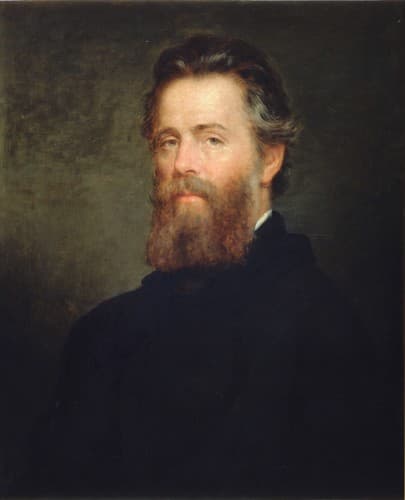
Herman Melville was an American novelist, short story writer, and poet of the American Renaissance period. Among his best-known works are Moby-Dick (1851); Typee (1846), a romanticized account of his experiences in Polynesia; and Billy Budd, Sailor, a posthumously published novella. Although his reputation was not high at the time of his death, the 1919 centennial of his birth was the starting point of a Melville revival, and Moby-Dick grew to be considered one of the great American novels.
Similar books
- Heart of Darkness
Joseph Conrad
3.4 (415k) average on GoodreadsHistorical FictionExplores themes of obsession, descent into madness, and man's struggle against a powerful, unknowable force.
- The Old Man and the Sea
Ernest Hemingway
3.8 (831k) average on GoodreadsLiterary FictionFeatures a lone man's epic struggle against a formidable sea creature, exploring themes of perseverance and nature.
- To Kill a Mockingbird
Harper Lee
4.3 (4.5M) average on GoodreadsHistorical FictionIn the 1930s Jim Crow South, Harper Lee writes about racial injustice, moral growth, and the quiet courage of a lawyer father, Atticus Finch, as seen through his young daughter's eyes.
- The Great Gatsby
F. Scott Fitzgerald
3.9 (3.8M) average on GoodreadsHistorical FictionIn the opulent Roaring Twenties, a mysterious millionaire's lavish parties hide his desperate, tragic pursuit of a lost love, exposing the emptiness within the American Dream.
- Pride and Prejudice
Jane Austen
4.3 (3M) average on GoodreadsHistorical FictionIn a society focused on status and money, Elizabeth Bennet navigates love and pride, challenging Mr. Darcy and social expectations to find true affection.
- Angels & Demons
Dan Brown
3.9 (2.7M) average on GoodreadsThrillerA Harvard symbologist races through Rome's ancient sites, deciphering cryptic clues to unmask the Illuminati and stop a vengeful plot to destroy the Vatican with a stolen antimatter weapon.




Enjoyed the summary?
A summary gives you the shape of the book. The book itself has the detail, the examples and the voice.
Find Moby-Dick or, the Whale on AmazonAs an Amazon Associate, BookBrief earns from qualifying purchases. How we're funded