
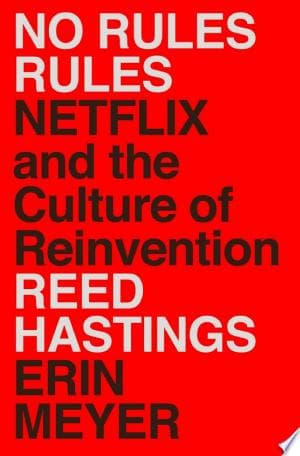
Core Idea
- Difficulty
- Medium
- Read it if
- You are a leader or manager looking to radically rethink traditional HR and management practices, empower your team, and build a high-performance culture based on trust, transparency, and freedom.
- Skip it if
- You prefer a highly structured, process-driven management style and are uncomfortable with extreme transparency or a culture that actively discourages pleasing the boss.
Key Takeaways from No Rules Rules
People Over Process
High talent density enables radical freedom and responsibility.
Netflix values exceptional talent over rigid processes. The idea is that a team of highly effective, self-motivated people will perform better than a larger team with average talent, even with many control systems. This 'talent density' means many traditional corporate rules can be removed, as capable people need less oversight and are driven to perform. This also means 'adequate' performance is not enough; only outstanding contributors stay. This focus on talent helps innovation happen naturally.
“The best managers don't think of themselves as managers, but as talent scouts and developers.”
In the book: Hastings recounts the 'keeper test' where managers are asked if they would fight to keep an employee if they were considering leaving. If the answer isn't a resounding 'yes,' a generous severance package is offered, and the employee is let go. This ruthless focus on top talent was particularly evident during the dot-com bubble burst when Netflix laid off a third of its employees, leading to a more focused and productive remaining team.
Try this: Evaluate your team's talent density regularly. Be willing to make tough decisions to remove adequate performers, even if it feels uncomfortable. Invest heavily in recruiting and retaining top-tier talent, understanding that a smaller, elite team can achieve more than a larger, average one. Focus on providing context and challenging problems rather than micro-managing tasks.
Related ideas: talent-density, keeper-test, high-performance-culture
Radical Candor
Direct, honest feedback is a gift, not an insult.
Netflix promotes extreme transparency and direct feedback, called 'radical candor.' Employees are expected to give and receive feedback directly, immediately, and openly, regardless of their position. The goal is always to help others improve, not to criticize. This requires high psychological safety and trust, where people understand feedback, even if uncomfortable, comes from good intentions. This constant exchange of direct observations speeds up learning, finds problems quickly, and prevents misunderstandings, leading to better decisions and personal growth.
“We believe that honest feedback is a gift. It's how we help each other improve.”
In the book: Netflix encourages the '4A feedback' model: Aim to Assist, Actionable, Appreciate, Accept or Decline. This framework ensures feedback is constructive and respectful. Hastings shares stories of receiving blunt feedback himself, such as being told a presentation was 'boring' or a decision was 'stupid,' and how embracing this feedback, rather than rejecting it, led to better outcomes.
Try this: Implement a culture where direct, constructive feedback is normalized and encouraged. Train employees on how to give and receive feedback effectively, focusing on specific behaviors and impacts rather than personal attacks. As a leader, model this behavior by actively soliciting and openly accepting feedback, demonstrating vulnerability and a commitment to continuous improvement. Create mechanisms for safe, anonymous feedback initially if direct feedback is challenging.
Related ideas: radical-candor, feedback-culture, psychological-safety
Context, Not Control
Empower employees with information, then trust their judgment.
Instead of rigid rules and approval processes, Netflix gives employees extensive context about the company's strategy, goals, and challenges. The belief is that well-informed people, especially talented ones, will make sound decisions that fit the company's best interests. This removes bureaucratic approval layers, speeding up decisions and building ownership. Leaders set clear strategic direction and provide data, then let teams innovate and act independently. This trust-based system values independent judgment over hierarchical command.
“Provide employees with the full context of the business, and they will make excellent decisions without needing to be told what to do.”
In the book: Netflix has no vacation policy or expense policy; employees are simply told to 'act in Netflix's best interest.' This radical trust is underpinned by providing them with deep understanding of company finances, competitive landscape, and strategic priorities. For instance, engineers are given access to detailed financial data and customer metrics, empowering them to prioritize features and projects based on business impact.
Try this: Shift from a 'control' mindset to a 'context' mindset. Share comprehensive company information, including financials, strategic objectives, and key performance indicators, with all employees. Clearly articulate the 'why' behind decisions and goals. Empower teams to make their own operational decisions within defined strategic boundaries, trusting their expertise and judgment. Remove unnecessary approval layers and bureaucratic hurdles.
Related ideas: autonomy, empowerment, distributed-decision-making
Freedom & Responsibility
Unleashing innovation by removing rules and demanding accountability.
Netflix's culture is built on combining extreme freedom with responsibility. Employees have great freedom in how they work, manage their time, and spend company money, seen in the lack of vacation or expense policies. This freedom helps creativity and innovation. However, this freedom comes with high responsibility: employees must act in the company's best interest, own their results, and be accountable for decisions. Not meeting this responsibility, even with good intentions, can lead to separation. This creates an entrepreneurial environment where people want to excel and innovate without bureaucracy.
“The amount of freedom you can give your employees depends on the density of talent you have and how much context you provide.”
In the book: The 'no rules rules' philosophy is best encapsulated by policies like 'take as much vacation as you want' and 'spend company money as if it were your own.' The expectation is that employees, given sufficient context and being top talent, will use this freedom wisely and responsibly. The book details instances where this trust was tested and how Netflix responded by doubling down on context and talent density rather than reinstating rules.
Try this: Identify areas where rules can be replaced with principles and trust. Empower employees with decision-making authority for their domains. Clearly communicate the high expectations for responsibility and accountability that accompany this freedom. Regularly evaluate whether the balance between freedom and responsibility is yielding desired results, adjusting context or talent density as needed rather than resorting to more rules.
Related ideas: autonomy, accountability, entrepreneurial-culture
Pay Top of Market
Attract and retain the best by compensating generously.
Netflix's pay philosophy is to offer top-of-market rates for every role, ensuring employees are among the highest paid in their fields. This is not just about being competitive; it's a strategic choice to attract and keep the best talent. By offering premium pay, Netflix shows it values exceptional performance and reduces reasons for top performers to leave. This supports the 'talent density' idea, helping create a workforce where every person is valuable, making it easier to let go of average performers and making the team more productive and innovative.
“We pay our employees the most we can, not the least we can get away with. It's an investment in talent density.”
In the book: Netflix actively researches what top companies like Google and Facebook pay for similar roles and aims to pay at the very top end of that spectrum. They also regularly adjust salaries based on market fluctuations, often giving significant raises without employees having to ask. The book highlights how this policy, combined with the 'keeper test,' ensures that only the most valuable contributors remain.
Try this: Regularly benchmark salaries against top-tier competitors and adjust compensation to be at the top of the market. View compensation as an investment in talent and productivity, not just a cost. Be transparent with employees about how compensation is determined and what factors influence it. Ensure performance reviews are tied to market value and contribution, not just internal pay bands.
Related ideas: compensation-strategy, talent-retention, market-rate
Don't Seek to Please Your Boss
Focus on company impact, not managerial approval.
In traditional hierarchies, employees often work to please their direct manager, which can lead to 'upward management' and poor decisions for the company. Netflix discourages this by fostering an environment where employees prioritize the company's best interests, even if it means disagreeing with their boss. This requires courage, a good understanding of company goals, and the safety to speak up. By shifting focus from pleasing an individual to serving the collective, Netflix aims for decisions based on merit and impact, not personal politics, leading to better overall results.
“Your job is to do what's best for Netflix, not to please your boss.”
In the book: Hastings describes how employees are encouraged to 'disagree and commit' if they ultimately cannot persuade their boss, but are also expected to voice their differing opinions strongly beforehand. The 'skip-level feedback' system, where employees give feedback on their boss's boss, further reinforces that influence flows in multiple directions, not just top-down. The book includes anecdotes where junior employees successfully challenged senior leaders on product decisions.
Try this: Cultivate a culture where challenging ideas and constructive dissent are valued. As a leader, actively solicit differing opinions and demonstrate that you are open to being wrong. Encourage employees to focus on measurable impact and strategic alignment rather than just fulfilling assigned tasks. Implement feedback mechanisms that allow for multi-directional input, empowering employees to provide upward feedback without fear of retribution.
Related ideas: dissent, upward-feedback, organizational-alignment
Lead with Transparency
Openly share successes, failures, and challenges.
Netflix operates with high internal transparency, sharing sensitive financial data, strategic discussions, and even potential layoff scenarios with many employees. This is a deliberate strategy to give employees the context needed to make informed decisions and act responsibly. By making the company's operations, challenges, and successes clear, Netflix builds trust, creates shared ownership, and ensures everyone works with the same information. This openness also supports the 'no rules rules' by showing that leaders trust employees with critical information, expecting them to use it wisely.
“Transparency is not about sharing everything, but sharing everything that matters.”
In the book: Netflix openly shares its board materials with all employees, a practice almost unheard of in other companies. They also openly discuss competitive threats, internal mistakes, and even the reasons behind difficult decisions, such as letting go of employees. This transparency was crucial during moments of crisis, like the 'Qwikster' debacle, where open communication helped the company navigate a difficult period.
Try this: Identify what 'everything that matters' means for your organization and commit to sharing it widely. This could include financial performance, strategic updates, competitive analysis, and even internal challenges or failures. Create channels for regular, transparent communication (e.g., all-hands meetings, internal newsletters, shared documents). Be prepared for questions and some initial discomfort as employees adjust to this level of openness.
Related ideas: open-communication, trust-building, information-sharing
Rethink Performance Reviews
Focus on continuous feedback and development, not annual rituals.
Netflix mostly avoids traditional annual performance reviews, which are often seen as backward-looking and formal. Instead, the company emphasizes continuous, informal feedback and regular '360-degree' reviews, where employees get input from peers, subordinates, and managers. The goal is to make feedback a regular part of work, integrated into daily interactions. This constant flow of direct input, along with a focus on self-improvement and high performance, helps people grow faster and ensures performance issues are addressed quickly, not left until an annual review.
“The annual performance review is a relic of the past. Continuous, candid feedback is what truly drives improvement.”
In the book: Netflix utilized a '360-degree feedback' process where employees received written feedback from numerous colleagues, which was then discussed openly. This process, while sometimes intense, provided a rich tapestry of perspectives for individual development. The informal, continuous nature of feedback, often delivered in person and in the moment, is also heavily emphasized.
Try this: Move away from rigid annual review cycles. Implement systems for regular, informal feedback and coaching. Encourage peer-to-peer feedback and create a culture where feedback is seen as a normal and valuable part of collaboration. Consider adopting or adapting a 360-degree feedback model that prioritizes actionable insights and open discussion. Train managers to be effective coaches and facilitators of development, not just evaluators.
Related ideas: continuous-feedback, 360-degree-feedback, performance-development
Innovation Over Efficiency
Optimize for creativity and speed, even if it means some redundancy.
Netflix prioritizes innovation and speed over strict efficiency. This means it accepts some redundancy, failed experiments, or even minor chaos if it leads to new ideas and faster execution. Unlike many companies that focus on cost-cutting and streamlined processes, Netflix understands that true innovation often comes from allowing teams to explore, even if some efforts do not succeed. This philosophy connects with its high talent density and context-driven approach, as capable individuals are trusted to make smart bets and learn from failures, creating a more agile and adaptable organization.
“We'd rather be fast and innovative than slow and efficient.”
In the book: The book details instances where Netflix allowed multiple teams to work on similar projects or pursue different approaches to the same problem, accepting the potential for overlap or 'waste' in the short term, in exchange for increasing the odds of a breakthrough. This was particularly evident in their early streaming efforts and content acquisition strategies, where rapid experimentation was key.
Try this: Evaluate where strict efficiency measures might be stifling innovation. Be willing to invest in parallel experimentation or allow for 'good failures' that provide valuable learning. Empower teams to move quickly and make decisions without excessive layers of approval, even if it means occasional missteps. Shift the focus from preventing errors to learning rapidly from them and iterating.
Related ideas: agile-development, experimentation, risk-taking
Culture is Not Static
A company's culture must evolve with its growth and challenges.
Netflix's 'no rules rules' culture is not fixed but changes over time. Hastings notes that as the company grew from a small startup to a global power, and as its business model moved from DVDs to streaming and content creation, its cultural practices also needed to adapt. What worked for 50 employees might not work for 5,000, and what worked in one country might not directly apply to another. This constant review and willingness to question its own cultural ideas are key to long-term relevance and success. It shows that a strong culture means intelligent adaptation while staying true to core values, not just sticking to initial principles.
“Culture isn't something you set once and forget. It's a living, breathing thing that needs constant attention and adaptation.”
In the book: Hastings openly discusses how some aspects of their culture, like extreme candor, had to be adapted for different global cultures, particularly in Japan, where direct feedback can be perceived differently. He also details how the company had to re-evaluate certain aspects of freedom as it scaled, ensuring that the underlying principles remained effective despite increased complexity and size.
Try this: Regularly audit and reflect on your company's culture. Are your existing practices still serving the organization's current size, goals, and global presence? Be open to adapting cultural norms and rules as the company evolves, rather than clinging to outdated practices. Solicit feedback from employees at all levels and across different regions to understand how the culture is experienced and where it might need refinement. View culture as a strategic asset that requires continuous management.
Related ideas: cultural-evolution, organizational-development, adaptive-culture
No Rules Rules Quotes
“Adequate performance gets a generous severance package.”
“Don't seek to please your boss. Seek to serve the company.”
“The best managers don't tell their people what to do. They give them the context to make their own decisions.”
“As companies get bigger, they tend to get slower and less innovative. We fight that.”
“Tell the truth, even if it's uncomfortable.”
“If you give employees more freedom, they will take more ownership.”
“Most companies are like a family. Netflix is like a professional sports team.”
“Don't try to predict the future. Prepare for it.”
“Eliminate rules. Increase freedom. Instill responsibility.”
“The goal is to increase the talent density of the company, not just manage the existing talent.”
“If you hire great people and give them freedom, they will amaze you.”
“We pay top of market. Our goal is to be the highest payer.”
“We don't try to minimize mistakes. We try to maximize innovation.”
“The power of the feedback loop is immense. It's how we learn and grow.”
Quiz
10 questions on the main ideas. Each answer comes with a short explanation.
Question 1
Which core principle does Reed Hastings emphasize as a foundation of Netflix's culture, contrasting with traditional corporate structures?
- Strict adherence to company policies and procedures
- Freedom and Responsibility
- Top-down decision-making and hierarchical approval
- Efficiency above all else
Show answer
B. Freedom and Responsibility The book's premise revolves around Hastings building a culture focused on freedom and responsibility, allowing Netflix to adapt and innovate.
Question 2
According to 'No Rules Rules,' what is Netflix's stance on vacation policies for employees?
- Employees must track all vacation days meticulously and get manager approval.
- There are no vacation policies; employees take time off as needed.
- A fixed number of vacation days are allotted annually, with carryover limits.
- Vacation is discouraged to maintain high productivity.
Show answer
B. There are no vacation policies; employees take time off as needed. The book explicitly states, 'At Netflix, there are no vacation or expense policies,' highlighting the trust placed in employees.
Question 3
What is the Netflix philosophy regarding employee performance that might seem counterintuitive to traditional companies?
- Adequate performance leads to opportunities for improvement plans.
- Hard work is the primary metric for job security and promotion.
- Adequate performance gets a generous severance.
- Performance reviews are optional and peer-based.
Show answer
C. Adequate performance gets a generous severance. The book highlights that 'adequate performance gets a generous severance,' emphasizing the company's focus on hiring and retaining only high performers.
Question 4
Instead of trying to please their boss, what does Netflix encourage employees to do?
- Follow directives without question
- Give candid feedback instead
- Focus solely on individual tasks
- Seek external mentorship
Show answer
B. Give candid feedback instead The book states, 'At Netflix, you don’t try to please your boss, you give candid feedback instead,' promoting a culture of open communication and directness.
Question 5
Which of the following does Netflix prioritize over 'process'?
- Bureaucracy
- People
- Efficiency
- Cost-cutting
Show answer
B. People Hastings set new standards, 'valuing people over process,' which is a key tenet of their cultural philosophy.
Question 6
How does Netflix typically compensate its employees, according to the book?
- Below market average to encourage loyalty
- Based on a fixed salary structure with minimal bonuses
- The company pays top of market
- Primarily through stock options rather than salary
Show answer
C. The company pays top of market The book mentions, 'At Netflix, employees don’t need approval, and the company pays top of market,' reflecting their strategy to attract and retain high-caliber talent.
Question 7
What is the primary reason Netflix's 'unprecedented flexibility' was possible, as described by Hastings?
- Strict adherence to a five-year strategic plan.
- A large budget allocated specifically for rapid pivots.
- The counterintuitive and radical management principles established from the beginning.
- A culture of fear that drove employees to adapt quickly.
Show answer
C. The counterintuitive and radical management principles established from the beginning. The text states this flexibility 'would have been impossible without the counterintuitive and radical management principles that cofounder Reed Hastings established from the very beginning.'
Question 8
When Hastings mentions giving employees 'context, not controls,' what is the underlying intention?
- To provide detailed instructions for every task.
- To empower employees to make informed decisions based on understanding goals.
- To limit employee autonomy by setting strict boundaries.
- To delegate all strategic planning to individual teams.
Show answer
B. To empower employees to make informed decisions based on understanding goals. Giving context over controls means providing employees with the 'why' behind decisions and goals, trusting them to figure out the 'how,' which empowers them to make sound judgments without needing constant supervision or approval.
Question 9
The book was co-authored by Reed Hastings and which other bestselling author and business thinker?
- Adam Grant
- Simon Sinek
- Erin Meyer
- Daniel Kahneman
Show answer
C. Erin Meyer The summary clearly states, 'Here for the first time, Hastings and Erin Meyer, bestselling author of The Culture Map and one of the world’s most influential business thinkers, dive deep into the controversial ideologies.'
Question 10
What is the core argument the book makes about the relationship between innovation and efficiency at Netflix?
- Netflix prioritizes efficiency over innovation to maintain profitability.
- Netflix believes innovation naturally leads to greater efficiency without specific focus.
- Netflix emphasizes innovation over efficiency, accepting that innovation can sometimes be messy.
- Netflix seeks a perfect balance between innovation and efficiency through strict metrics.
Show answer
C. Netflix emphasizes innovation over efficiency, accepting that innovation can sometimes be messy. The book explicitly states Hastings 'emphasizing innovation over efficiency,' which is a key differentiator from many traditional companies that often prioritize efficiency above all else.
No Rules Rules FAQ
What is the core philosophy behind Netflix's culture as described in 'No Rules Rules'?
'No Rules Rules' details Netflix's radical management principles centered on freedom and responsibility. This culture prioritizes people over process, innovation over efficiency, and giving employees context rather than controls, enabling unparalleled adaptability and speed.
Does the 'no rules' approach to vacation and expenses actually work at Netflix?
Yes, the book explains that Netflix operates without formal vacation or expense policies. This trust-based system, combined with a culture of high performance and candid feedback, empowers employees to make responsible decisions while focusing on company success.
What is 'adequate performance gets a generous severance' at Netflix?
This refers to Netflix's 'keeper test,' where managers constantly ask if they would fight to keep an employee. If not, even adequately performing employees are given a generous severance package, ensuring the company maintains a high-talent density.
How is Netflix's management style different from traditional corporate structures?
Netflix's approach, detailed in 'No Rules Rules,' fundamentally differs by rejecting conventional wisdom like strict policies and approvals. Instead, it champions radical transparency, candid feedback, and giving employees significant autonomy, contrasting sharply with hierarchical, process-heavy organizations.
What is 'context, not controls' and how does it apply at Netflix?
'Context, not controls' is a core Netflix principle where leaders provide employees with the strategic information and goals (context) they need to make smart decisions, rather than imposing rigid rules or requiring constant approvals (controls). This empowers employees to act autonomously and innovate.
Does 'No Rules Rules' suggest that hard work is irrelevant at Netflix?
The book clarifies that while hard work is valued, it's not the primary metric for success or retention. Netflix prioritizes impact and results, meaning even diligently working employees might be let go if their performance isn't exceptional enough to contribute significantly to the company's high-talent density.
How does Netflix encourage candid feedback without creating a hostile environment?
Netflix cultivates a culture of radical candor by emphasizing feedback as a gift, not a judgment. The book outlines specific methods like the '4A feedback' model (Aim to Assist, Actionable, Appreciate, Accept or Discard) to ensure feedback is constructive and well-received.
What role does talent density play in Netflix's success?
Talent density is crucial to Netflix's model, as described in 'No Rules Rules.' By consistently hiring and retaining only top performers, the company creates an environment where employees can thrive with less supervision and fewer rules, ultimately driving innovation and speed.
Is the Netflix culture described in 'No Rules Rules' applicable to all types of companies?
While the book showcases Netflix's success, it also acknowledges that aspects of its culture, particularly the extreme emphasis on talent density and radical candor, may require careful adaptation for different industries, company sizes, or existing organizational cultures. It's presented as a philosophy to learn from, not a one-size-fits-all blueprint.
About the author

Reed Hastings is an American entrepreneur and co-founder of Netflix, known for his insights into corporate culture and innovation. In his book "No Rules Rules," he explores the principles that have shaped Netflix's unique work environment and management philosophy. Hastings' contributions to the tech industry and media landscape have garnered significant attention and discussion.
Similar books
- Good to Great: Why Some Companies Make the Leap... and Others Don't
James C. Collins
4.1 (131k) average on GoodreadsBusinessFocuses on what makes companies achieve sustained greatness, with parallels in people-first approaches.
- Steve Jobs
Walter Isaacson
4.1 (957k) average on GoodreadsBusinessSteve Jobs was a visionary who fused creativity and technology to revolutionize six industries and shape our digital world.
- The Tipping Point: How Little Things Can Make a Big Difference
Malcolm Gladwell
4.0 (690k) average on GoodreadsBusinessMalcolm Gladwell explains how small, targeted actions can start widespread changes in trends, behaviors, and ideas.
- Outliers: The Story of Success
Malcolm Gladwell
4.2 (556k) average on GoodreadsBusinessMalcolm Gladwell argues that true success is not just about individual talent, but about the hidden advantages of culture, opportunity, and unique experiences that shape extraordinary lives.
- The 7 Habits of Highly Effective People: Powerful Lessons in Personal Change
Stephen R. Covey
4.1 (524k) average on GoodreadsBusinessThis book presents seven habits that help people live more effective, purposeful lives.
- Blink: The Power of Thinking Without Thinking
Malcolm Gladwell
3.9 (487k) average on GoodreadsBusinessExplore the hidden power of quick judgments and how 'thin-slicing' information helps skilled decision-makers succeed instantly, often without conscious thought.





Enjoyed the summary?
A summary gives you the shape of the book. The book itself has the detail, the examples and the voice.
Find No Rules Rules on AmazonAs an Amazon Associate, BookBrief earns from qualifying purchases. How we're funded