
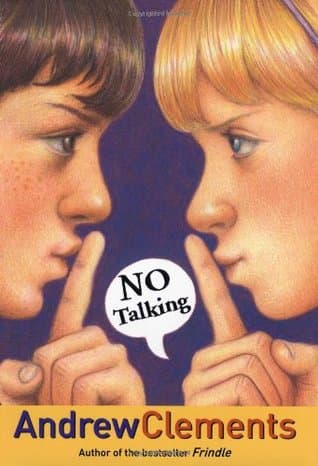
Synopsis
Covers the whole plot, including the ending.
- Difficulty
- Easy
- Pacing
- Moderate
- Mood
- Humorous, Thought-provoking, Lighthearted, Clever
- Read it if
- You enjoy humorous, thought-provoking stories about school life, rivalries, and the unexpected impact of a simple challenge.
- Skip it if
- You prefer complex plots or high fantasy; this is a straightforward, character-driven story set in a realistic elementary school.
No Talking Plot Summary
Covers the whole plot, including the ending.
The Principal's Bullhorn and Dave's Idea
Laketon Elementary School's fifth-grade class, particularly the boys and girls, are known for being loud, often disrupting lunch and class. Principal Hiatt, a strict figure, often uses her red plastic bullhorn to command order, which annoys the students. During a very loud lunch period, Dave Packer, a very talkative fifth-grader, is singled out by Principal Hiatt for his constant chatter. Later, while working on a social studies report about Mahatma Gandhi's silent day of protest, Dave has an idea: what if he tried to go a whole day without talking? He decides to try it, finding it difficult but also strangely empowering. This personal challenge sets the stage for a much larger school event.
The First Silent Lunch and Lynsey's Challenge
The next day, Dave is set on his silent protest. He gets through his morning classes without speaking, communicating only with gestures and written notes. During lunch, the silence is a struggle, but he continues. However, Lynsey Burgess, an equally talkative girl from the fifth grade, is seated nearby, chatting with her friends. Dave, unable to stand her constant talking while he is trying so hard, finally breaks his silence and sarcastically asks if she can ever shut up. Lynsey, offended and quick-witted, responds by challenging Dave and the boys to a 'no talking' contest: which team, boys or girls, can say the fewest words over the next two school days? Both sides quickly accept the challenge, turning Dave's personal experiment into a full fifth-grade war of silence.
The Rules of the Game and Teacher Reactions
The fifth graders quickly set the rules for their 'no talking' contest: each spoken word counts, except for responses in class directly asked by a teacher, or during emergencies. They appoint scorekeepers to count words for each team. The teachers, Mrs. Marlow, Mr. Burton, and Mrs. Rourke, are initially confused by the sudden quietness of their usually noisy students. They notice the students communicating through elaborate hand gestures, notes, and even charades. Some teachers find it amusing, while others, like Mrs. Marlow, worry about the learning impact. The principal, seeing the unusual calm, is both pleased and suspicious, wondering what new prank the fifth graders are planning.
Principal Hiatt's Growing Suspicion
As the silence continues, Principal Hiatt grows more suspicious. She initially enjoys the peace but soon realizes that the quiet is too consistent and too intentional to be natural. She observes the students' intense focus, their secret signals, and their determined expressions. Her instinct tells her that this is not just good behavior, but a coordinated effort, a 'conspiracy of silence' that she cannot control with her bullhorn. The lack of noise, instead of reassuring her, makes her feel like she is losing control of the school, and she begins to investigate the cause of this unusual phenomenon, determined to find out the truth behind the fifth grade's sudden quiet.
The First Day's Progress and Lingering Doubts
The first day of the contest ends with surprisingly low word counts for both teams, though the boys are slightly ahead. The fifth graders celebrate their achievement, feeling a sense of unity and defiance. However, the sustained silence is hard. Students find it difficult to express themselves fully, to ask for help, or to simply chat with friends. Some, like Lynsey, who is naturally very expressive, feel the strain more than others. Despite their commitment, the initial excitement starts to fade for a few, replaced by a growing awareness of the difficulty of true, prolonged silence, especially when they have much they want to say.
The Principal's Intervention and the Reveal
On the second day, Principal Hiatt, unable to tolerate the unnerving silence any longer, calls the entire fifth grade to an assembly. She confronts them directly, asking why they are so quiet. She suspects a trick, a prank, or even a form of rebellion. After a tense silence, a brave student, prompted by Dave and Lynsey, explains the 'no talking' contest. Principal Hiatt is initially angry, feeling her authority undermined. She sees it as a direct challenge to her control and the school's order. The revelation changes the atmosphere, as the students prepare for her punishment, but also feel relief that their secret is out.
Principal Hiatt's Reflection and New Rules
After the initial shock and anger, Principal Hiatt thinks about the situation. She realizes that while the contest was unauthorized, the students had, in fact, been exceptionally well-behaved and focused. She recognizes the genuine effort and self-discipline involved. Instead of shutting it down, she announces that the contest can continue, but with new rules. She declares that she, too, will participate, and will keep a tally of her own words. This unexpected decision surprises the students and teachers alike, showing a different side of the stern principal and turning the contest into a school-wide experiment in self-control and communication.
The Final Hours and Unexpected Outcomes
The final hours of the contest are filled with tension and amusement. Principal Hiatt struggles to keep her own word count low, often using gestures and notes, much like the students. The boys and girls are very close, each team determined to win. As time runs out, the students discover new ways to communicate effectively without speaking, creating a sense of camaraderie and cleverness. When the final tallies are revealed, the boys win by a narrow margin, but the victory feels secondary. The real outcome is the shared experience, the unexpected insights into the power of words, and the surprising connection formed between the students and their principal.
The Aftermath: A New Appreciation for Words
After the contest, the fifth graders are tired but also excited. They have proven a point, not just to each other, but to themselves and their principal. While the silence was hard, it also made them more careful about the words they chose to speak. Principal Hiatt, too, has changed. She uses her bullhorn less often, and when she does speak, her words carry more weight. The students, in turn, are still capable of being loud, but they now understand better when to speak and when to listen. The experience creates a more respectful and thoughtful atmosphere in the fifth grade, showing the strong impact of conscious communication.
No Talking Characters
Dave Packer
Protagonist
The boisterous fifth-grader who initiates the 'no talking' idea.
Dave is a highly talkative and energetic fifth-grader, often found at the center of classroom chatter and noise. He is bright and observant, which leads him to connect Mahatma Gandhi's silent protest to his own school environment. Though initially motivated by a personal challenge, his competitive nature quickly draws him into the boys-versus-girls 'no talking' contest. He is stubborn and determined, pushing himself and his team to adhere to the rules, but also capable of reflection and growth regarding the power of words.
Relationships: Lynsey Burgess (rival in the contest, eventually forming a mutual respect); Principal Hiatt (antagonistic relationship initially, evolving into mutual understanding)
Lynsey Burgess
Protagonist
The equally talkative fifth-grader who turns Dave's idea into a class-wide contest.
Lynsey is bright, articulate, and as talkative as Dave Packer, often engaging in lively conversations with her friends. She is quick-witted and competitive, immediately taking Dave's sarcastic comment during lunch as a challenge and escalating it into a formal contest between the boys and girls. She is a strong leader among the girls, ensuring they stick to the rules and strategize effectively. Despite her love for talking, she embraces the challenge, demonstrating resilience and an unexpected capacity for self-control, ultimately learning alongside Dave about the nuances of communication.
Relationships: Dave Packer (rival in the contest, eventually forming a mutual respect); Principal Hiatt (initially wary, later gaining respect for her)
Principal Hiatt
Antagonist/Supporting
The stern principal who uses a bullhorn to control the school's noise.
Principal Hiatt is a formidable figure at Laketon Elementary, known for her strict demeanor and frequent use of a red plastic bullhorn to maintain order. She values discipline and quiet, seeing noise as a sign of chaos and disrespect. Initially, she views the fifth graders' sudden silence with deep suspicion, convinced they are up to mischief and challenging her authority. However, she is also a reflective and fair leader, eventually coming to understand the students' motivation and even participating in the contest herself, demonstrating a surprising capacity for empathy and adaptability.
Relationships: Dave Packer (disciplinarian to student, evolving into mutual understanding); Lynsey Burgess (disciplinarian to student, evolving into mutual understanding)
Mrs. Marlow
Supporting
One of the fifth-grade teachers, initially perplexed by the silence.
Mrs. Marlow is one of the fifth-grade teachers who observes the 'no talking' contest unfold. She is initially confused and somewhat amused by her students' sudden quietness, but also concerned about its impact on their learning. She tries to understand their motivations and adapts her teaching methods to accommodate their non-verbal communication. She represents the empathetic and observant teacher who is willing to engage with the students' unique experiment, even if it challenges traditional classroom dynamics.
Relationships: Fifth-grade students (teacher-student, fostering understanding)
Mr. Burton
Supporting
Another fifth-grade teacher, more amused by the students' silence.
Mr. Burton is a fifth-grade teacher who finds the 'no talking' contest more amusing than concerning. He appreciates the unexpected quiet in his classroom and enjoys observing the students' creative methods of non-verbal communication. He is less worried about the educational impact than Mrs. Marlow, viewing it as an interesting social experiment. His laid-back approach contrasts with Principal Hiatt's initial alarm, providing a different adult perspective on the children's actions.
Relationships: Fifth-grade students (teacher-student, observing with amusement)
Mrs. Rourke
Supporting
The third fifth-grade teacher, who also experiences the classroom silence.
Mrs. Rourke is the third fifth-grade teacher at Laketon Elementary. Like her colleagues, she is initially surprised by the sudden quietness of her students. Her reactions are a mix of Mrs. Marlow's concern and Mr. Burton's amusement. She tries to maintain a normal learning environment while acknowledging the unusual circumstances, often trying to elicit verbal responses from her students, only to be met with determined silence or elaborate gestures. She is a witness to the profound impact the contest has on the students and the school.
Relationships: Fifth-grade students (teacher-student, navigating new communication norms)
Todd
Supporting
A fifth-grade boy who helps tally words for the boys' team.
Todd is a member of the fifth-grade boys' team and serves as one of the scorekeepers for the 'no talking' contest. He is diligent in his role, carefully tallying every word spoken by his teammates to ensure fairness and accuracy. His participation highlights the students' commitment to the rules and their competitive spirit, as he is invested in the boys' victory.
Relationships: Dave Packer (teammate and fellow contestant)
Kendra
Supporting
A fifth-grade girl who helps tally words for the girls' team.
Kendra is a member of the fifth-grade girls' team and acts as a scorekeeper, meticulously counting the words spoken by her female classmates. Her role emphasizes the girls' dedication to the contest and their strategic efforts to win. She is a reliable and responsible student, taking her duties seriously and contributing to the overall integrity of the challenge.
Relationships: Lynsey Burgess (teammate and fellow contestant)
Mahatma Gandhi
Mentioned
Historical figure whose silent protest inspires Dave Packer.
Though not a character in the traditional sense, Mahatma Gandhi's philosophy and practice of a silent day of protest are central to the book's premise. Dave Packer learns about Gandhi in a social studies report, and this historical example directly inspires his initial personal challenge to remain silent. Gandhi's influence introduces the theme of purposeful silence and its power as a form of communication and protest, setting the intellectual foundation for the entire 'no talking' contest.
No Talking Themes
The Power of Silence and Speech
The main theme explores the impact of both spoken words and deliberate silence. The students' initial loud behavior shows the chaos of unbridled speech, while their 'no talking' contest shows the effect of silence – it helps self-control, forces creative communication, and makes spoken words more meaningful when they are finally used. Principal Hiatt's experience with the bullhorn versus her own silence during the contest further shows how silence can get attention and respect more effectively than constant noise or authoritative commands.
“And the silence had become a thing, almost like another person in the room, a person who was watching them and waiting.”
Identity and Self-Control
The contest makes individual students, especially Dave and Lynsey, face their own habits and develop self-control. Dave, a known talker, finds a new identity in his ability to remain silent. The collective effort of the fifth graders to control their speech defines their class, setting them apart and creating a unique sense of group identity. The struggle to stay silent shows inner strength and discipline, changing how the students see themselves and each other.
“It was amazing how much control he had over his own mouth. He could just not talk if he decided not to.”
Communication and Miscommunication
The book looks at different forms of communication, from loud chatter and sarcastic insults to elaborate gestures, written notes, and the strong message conveyed by collective silence. The initial conflict between Dave and Lynsey comes from miscommunication and irritation. As the contest goes on, students learn to communicate effectively without words, showing the importance of non-verbal cues. The principal's initial misunderstanding of the silence as defiance, and her eventual understanding, shows how intentions behind communication can be easily misunderstood.
“Words were powerful things, and when they were not spoken, they became even more powerful.”
Authority Versus Autonomy
The interaction between Principal Hiatt's authority and the fifth graders' desire for independence is a core theme. Principal Hiatt tries to control the students with her bullhorn, representing traditional top-down authority. The 'no talking' contest, started by the students, is an act of collective independence and self-governance, challenging the principal's control. Her eventual decision to join the contest shows a shift from rigid authority to a more collaborative and understanding leadership, recognizing the students' ability for self-direction and initiative.
“She was losing control of her school. Or at least, she was losing control of the fifth grade.”
Plot Devices & Literary Techniques
The Red Plastic Bullhorn
A symbolic representation of Principal Hiatt's authority and the school's noise problem.
The bullhorn is a recurring symbol throughout the book, representing Principal Hiatt's attempts to enforce order through sheer volume and authority. Its frequent use highlights the prevalent noise issue among the fifth graders. As the story progresses and the students embrace silence, the bullhorn becomes increasingly redundant, symbolizing a shift from external, imposed control to internal, self-imposed discipline. When Principal Hiatt herself struggles to avoid using it during the contest, it underscores her own journey of understanding and adaptation, and the limitations of relying solely on vocal command.
The 'No Talking' Contest
The central conflict and narrative driver.
The contest itself serves as the primary plot device, propelling the narrative forward and creating the central conflict. It shifts Dave's personal experiment into a class-wide competition, generating tension between the boys and girls, and eventually between the students and Principal Hiatt. The rules of the contest and the tallying of words provide concrete stakes and a measurable goal, allowing for clear progression and resolution. It functions as an extended metaphor for the power of self-control and the impact of communication choices.
Mahatma Gandhi's Silent Protest
An inspirational catalyst for Dave's initial idea.
The historical reference to Mahatma Gandhi's silent day of protest acts as a powerful catalyst for Dave Packer's initial decision to try a day without talking. It grounds the seemingly whimsical idea in a historical and philosophical context, giving it a deeper meaning beyond a mere prank. This device introduces the concept of purposeful silence as a form of protest and communication, elevating the children's contest from simple mischief to a thoughtful exploration of language and self-discipline.
The Word Tally
A quantitative measure of the contest's progress and a source of tension.
The word tally, meticulously kept by student scorekeepers, is a crucial plot device that quantifies the progress of the 'no talking' contest. It creates concrete stakes, allowing the boys and girls to track their performance and fostering competitive tension. The act of counting words makes the abstract concept of silence tangible and highlights the conscious effort required by the students. When Principal Hiatt joins, her own word count becomes a point of shared vulnerability and connection with the students.
No Talking Quotes
“No talking. No words at all. That's the rule.”
“Words are like tools. If you use them right, they can build things. If you use them wrong, they can break things.”
“It's not about winning. It's about thinking.”
“Silence is a kind of sound, too.”
“Sometimes the loudest thing in the room is what isn't being said.”
“You don't need words to be a friend.”
“The quiet made the noise inside my head even louder.”
“We were so busy not talking, we started really listening.”
“Three words can change everything. Or no words at all.”
“It's amazing what you notice when you stop talking.”
“The principal thought we were being defiant. We were just being thoughtful.”
“Our words had become like background noise. Now the silence had a voice.”
“We weren't just not talking. We were communicating in a whole new way.”
Quiz
10 questions on the plot and the characters. Each answer comes with a short explanation.
Question 1
What event sparks the boys vs. girls word-count contest in 'No Talking'?
- The principal announces a school-wide quiet challenge
- Dave Packer insults Lynsey Burgess after hearing her talk during his quiet day
- The teachers organize a silent reading competition
- Dave and Lynsey make a bet about who can stay quiet longer
Show answer
B. Dave Packer insults Lynsey Burgess after hearing her talk during his quiet day Dave Packer, inspired by Gandhi, attempts a day of silence but breaks it at lunch when he hears Lynsey Burgess talking. He insults her, calling her a 'blabbermouth,' which leads to their argument and the creation of the boys vs. girls contest.
Question 2
What object does Principal Hiatt frequently use to manage the noisy fifth graders?
- A whistle
- A bell
- A red plastic bullhorn
- A megaphone
Show answer
C. A red plastic bullhorn Principal Hiatt relies on her red plastic bullhorn to get the attention of the loud and disorderly fifth-grade students, using it often before the contest begins.
Question 3
How long does the boys vs. girls word-count contest last?
- One day
- Two days
- A week
- Until the principal stops it
Show answer
B. Two days Dave and Lynsey agree that the contest will last for two whole days, from the start of school on Monday to the end of school on Tuesday, with the team saying the fewest words winning.
Question 4
Why does Dave Packer initially decide to try keeping quiet for a day?
- He loses a bet with his friends
- He is inspired by a school project on Mahatma Gandhi
- He wants to avoid getting in trouble with teachers
- He is trying to impress Lynsey Burgess
Show answer
B. He is inspired by a school project on Mahatma Gandhi Dave reads about Mahatma Gandhi's practice of observing a day of silence each week to promote peace and self-discipline, which inspires him to attempt his own day of silence.
Question 5
How do most teachers initially react to the unusual silence of the fifth graders during the contest?
- They are angry and try to force the students to talk
- They are confused but enjoy the peaceful classroom environment
- They immediately report it to the principal
- They join the contest by not speaking themselves
Show answer
B. They are confused but enjoy the peaceful classroom environment Teachers like Mr. Burton notice the quiet and find it strange, but they appreciate the improved behavior and focus in class, initially seeing it as a positive change.
Question 6
What rule do Dave and Lynsey establish about what counts as a 'word' in their contest?
- Only spoken words in class count
- Three-word answers to teachers are allowed
- Written words count double
- Whispering doesn't count as words
Show answer
B. Three-word answers to teachers are allowed To make the contest feasible during school, they agree that students can use three-word answers when directly questioned by teachers, but any words beyond that count toward their team's total.
Question 7
What does Principal Hiatt do when she feels she is losing control due to the contest?
- She cancels the contest immediately
- She calls an assembly and tries to force the fifth graders to talk
- She punishes Dave and Lynsey with detention
- She ignores it, hoping it will blow over
Show answer
B. She calls an assembly and tries to force the fifth graders to talk Principal Hiatt becomes frustrated with the silence and the disruption it causes, so she calls an assembly where she demands that the fifth graders speak, threatening consequences if they don't.
Question 8
Which theme in 'No Talking' is highlighted by the contrast between words spoken in anger and words spoken in kindness?
- The importance of following school rules
- The power of words and communication
- The benefits of competition in education
- The challenges of growing up
Show answer
B. The power of words and communication The book explores how words can hurt (as with Dave's insult) or heal (as seen in later interactions), emphasizing their impact on relationships and self-expression, a central theme in the story.
Question 9
How does the contest ultimately affect the relationship between the fifth-grade boys and girls?
- It deepens their rivalry and causes lasting conflict
- It has no effect; they return to their usual behavior afterward
- It leads to better understanding and mutual respect
- It forces them to avoid each other completely
Show answer
C. It leads to better understanding and mutual respect Through the shared experience of the contest, the boys and girls learn to communicate more thoughtfully and see each other as individuals rather than rivals, improving their relationships.
Question 10
What practical method do the students use to communicate during the contest without speaking?
- They pass handwritten notes exclusively
- They use sign language they learned in class
- They develop systems of gestures, nods, and written messages
- They rely on teachers to relay messages for them
Show answer
C. They develop systems of gestures, nods, and written messages To adhere to the contest rules, students get creative with non-verbal communication, such as using gestures, facial expressions, and quick written notes to interact and coordinate.
No Talking FAQ
What is 'No Talking' about?
The book follows fifth-graders Dave Packer and Lynsey Burgess who spark a boys-versus-girls contest to see which team can speak the fewest words over two days at Laketon Elementary. Their silent competition disrupts the noisy school environment, challenges teachers and the principal, and ultimately explores how silence can change communication dynamics.
Why should I read 'No Talking'?
It's a humorous yet thought-provoking story that cleverly examines how silence can reveal the true power of words, kindness, and unspoken understanding. Through the children's contest, Andrew Clements explores themes of communication, conflict resolution, and classroom dynamics in an entertaining way that resonates with both kids and adults.
What is the background/setting of 'No Talking'?
The story takes place at Laketon Elementary School, where fifth-grade boys and girls have a longstanding rivalry. The school is characterized by loud, disorderly behavior that prompts Principal Hiatt to frequently use a red plastic bullhorn to maintain control, creating the perfect environment for the silent contest to cause disruption.
What are the most memorable quotes from 'No Talking'?
Key quotes include Dave's initial challenge 'You have the right to remain silent' that sparks the contest, Lynsey's realization that 'Sometimes not talking says more than talking,' and Principal Hiatt's frustrated declaration 'I will not have my school run by fifth graders!' These lines capture the book's central conflicts about communication and control.
What writing style does Andrew Clements use in 'No Talking'?
Clements employs a straightforward, accessible narrative style with humorous dialogue and realistic school scenarios. He uses third-person perspective that alternates between Dave and Lynsey's viewpoints, creating balanced insight into both sides of the gender divide while maintaining a light, engaging tone suitable for young readers.
What minor details add significant meaning to 'No Talking'?
The red plastic bullhorn symbolizes authority and noise control, becoming increasingly irrelevant during the silent contest. Small gestures like Dave passing a note to apologize or Lynsey's three-word limit for essential communication reveal how characters adapt their behavior when words become precious commodities.
What are some subtle foreshadowing moments in 'No Talking'?
Early descriptions of Dave as a 'certified loudmouth' foreshadow his struggle with silence, while mentions of the boys' and girls' mutual dislike hint at the competitive nature of their eventual alliance. Principal Hiatt's dependence on her bullhorn foreshadows her loss of control when traditional disciplinary methods fail.
What unexpected character connections develop in 'No Talking'?
Dave and Lynsey, initially adversaries through their gender-based teams, gradually develop mutual respect and understanding through their shared leadership of the silent contest. Teachers who initially oppose the silence eventually recognize its benefits, creating unexpected alliances between students and faculty against the principal's authoritarian approach.
What are Dave Packer's unspoken motivations in 'No Talking'?
Beyond winning the contest, Dave secretly wants to prove he can exercise self-control despite his loud reputation. His initial insult to Lynsey masks a desire for meaningful interaction, and his leadership of the boys' team reveals an unspoken need for respect from both peers and adults in his chaotic school environment.
What psychological complexities do the characters exhibit?
Lynsey demonstrates conflict between her competitive nature and growing empathy for Dave's perspective. Principal Hiatt shows anxiety about losing control that manifests as rigid authority. The children collectively experience the paradox of feeling both empowered by their silent rebellion and constrained by its rules, revealing how communication shapes identity.
What are the major emotional turning points in 'No Talking'?
Key moments include Dave's public apology to Lynsey that begins breaking down gender barriers, the teachers' realization that silent students are actually more focused learners, and Principal Hiatt's eventual acknowledgment that the contest has created positive change. The climax occurs when both teams voluntarily end their silence, choosing cooperation over competition.
How do relationship dynamics evolve between characters?
The boys' and girls' relationships shift from hostile separation to respectful collaboration as they navigate silent communication together. Student-teacher dynamics improve when teachers discover students can self-regulate. Most significantly, Dave and Lynsey's relationship transforms from competitive animosity to understanding partnership through their shared experience leading the silent challenge.
Which parts of 'No Talking' remain ambiguous or open-ended?
The book doesn't specify whether the silent contest permanently changes Laketon Elementary's noisy culture or if old patterns eventually return. It also leaves ambiguous whether Dave and Lynsey's newfound friendship extends beyond the contest, and whether Principal Hiatt truly changes her authoritarian management style or merely adapts temporarily.
What are controversial scenes or decisions in 'No Talking'?
Some readers debate whether the children's silent rebellion against school authority is justified or disrespectful. Dave's initial insult to Lynsey raises questions about gender-based conflict, while Principal Hiatt's aggressive use of the bullhorn presents ethical questions about disciplinary methods in educational settings.
How does 'No Talking' end and what does it mean?
The story concludes with both teams voluntarily ending their silence after realizing cooperation matters more than competition. Principal Hiatt acknowledges the contest's positive effects on student behavior and focus. The ending suggests that thoughtful communication—whether through words or purposeful silence—can bridge divides and create understanding between conflicting groups.
What deeper themes about communication does 'No Talking' explore?
Beyond the surface competition, the book examines how silence can make people more thoughtful communicators, how unspoken understanding sometimes surpasses words, and how kindness in communication—verbal or nonverbal—holds more power than angry exchanges. It questions whether traditional classroom management methods truly serve educational goals.
How does the silent contest change the students' learning experience?
Teachers discover that silent students actually demonstrate improved focus, complete assignments more efficiently, and engage in more thoughtful written communication. This unintended consequence challenges assumptions about classroom noise levels and reveals how self-imposed discipline can be more effective than external enforcement.
What role does the three-word rule play in the story?
The three-word limit for essential communication forces characters to distill their messages to the most important elements, revealing how verbosity often masks poor communication. This rule becomes a creative constraint that teaches efficiency in expression and highlights how fewer words can sometimes convey more meaning.
About the author

Andrew Clements was a prolific author of children's literature, celebrated for his engaging and relatable stories. His notable works include the beloved "Frindle," "A Week in the Woods," and the "Jake Drake" series, which often explored themes of school, friendship, and growing up. Clements' accessible writing style and keen understanding of young readers earned him widespread critical acclaim and a dedicated fanbase.
Similar books
- Frindle
Andrew Clements
3.8 (104k) average on GoodreadsChildren'sExplores the power of words and student-led challenges within a school setting, with a similar engaging tone.
- The Report Card
Andrew Clements
3.9 (12k) average on GoodreadsChildren'sFeatures a smart, unconventional student protagonist and themes of communication and understanding.
- Wonder
R.J. Palacio
4.4 (733k) average on GoodreadsChildren'sWonder addresses themes of communication, empathy, and social dynamics in a fifth-grade setting, similar to No Talking. Both books use multiple perspectives to build a richer understanding of character interactions. However, Wonder centers on the challenges of a child with facial differences and the broader theme of kindness and acceptance, making communication a tool for overcoming prejudice. No Talking, conversely, makes communication itself the central challenge and experiment, exploring its function and dysfunction in a more direct, experimental way rather than as a consequence of a character's unique situation.
- Harry Potter and the Sorcerer's Stone
J.K. Rowling
4.5 (7M) average on GoodreadsFantasyRescued from a miserable life under the stairs, an orphaned boy discovers he's a wizard destined for a magical school, where he uncovers a dangerous secret tied to the dark wizard who murdered his parents.
- The Hobbit, or There and Back Again
J.R.R. Tolkien
4.3 (2.9M) average on GoodreadsFantasyA comfort-loving hobbit named Bilbo Baggins is whisked away by a mischievous wizard and a band of dwarves on an unexpected journey to reclaim stolen treasure from a fearsome dragon, discovering courage and a magical ring along the way.
- Harry Potter and the Goblet of Fire
J.K. Rowling
4.6 (2.6M) average on GoodreadsFantasyA bewildered Harry Potter, underage and thrust into a deadly Triwizard Tournament, must brave dragons, mermaids, and a resurgent dark magic to survive a year that will forever alter the wizarding world.





Enjoyed the summary?
A summary gives you the shape of the book. The book itself has the detail, the examples and the voice.
Find No Talking on AmazonAs an Amazon Associate, BookBrief earns from qualifying purchases. How we're funded