
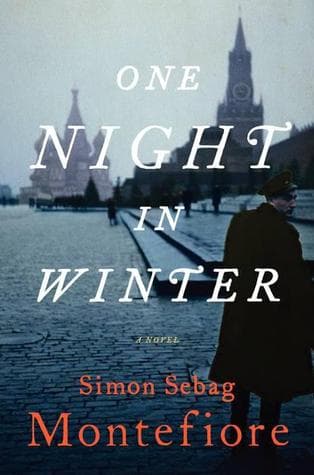
Synopsis
Covers the whole plot, including the ending.
- Difficulty
- Medium
- Pacing
- Moderate
- Mood
- Dark, Suspenseful, Tragic, Atmospheric, Intense
- Read it if
- You enjoy historical thrillers set in totalitarian regimes, intricate mysteries with a focus on character, or tragic romance against a backdrop of political intrigue.
- Skip it if
- You prefer lighthearted reads, dislike stories with extensive political oppression, or are sensitive to detailed depictions of injustice and persecution.
One Night in Winter Plot Summary
Covers the whole plot, including the ending.
The Children's Case Begins
On a snowy night in Moscow, December 1945, just after the war, two teenagers, Boris and Nina, are found dead on a bridge, dressed in 19th-century costumes. Boris is the son of Marshal Tolya Kolokolov, and Nina is the daughter of General Boris Izmailov. Both attend the elite School 110. Their deaths are officially called a double suicide, but the situation is suspicious. Josef Stalin takes a personal interest, ordering Colonel Sergo Mikoyan of the MGB to investigate what he calls 'The Children's Case.' This immediately alarms the privileged families of Moscow's elite, as their children become targets of the state's paranoid scrutiny.
The Arrests and Confessions
Following Stalin's order, Sergo Mikoyan and his MGB agents begin arresting Boris and Nina's friends and classmates. These include Sasha, a charismatic and rebellious intellectual, his girlfriend Anna, and the sensitive Eva and her brother, Leo. The children face brutal interrogations, sleep deprivation, and psychological torture, meant to get confessions of anti-Soviet conspiracy. Under extreme pressure, many confess to made-up crimes, implicating friends and even their own parents. This shows the state's terrifying power to break even the most innocent.
Luba and the Secret Police
Luba Izmailova, Nina's mother, is an MGB officer and a trusted agent of Lavrenty Beria, Stalin's secret police chief. Despite her professional ruthlessness, Luba is devastated by Nina's death. She struggles to balance her grief with her duty to the state. She must investigate the case herself, forcing her to consider that her daughter was involved in something subversive. Her investigation starts to uncover secrets about Nina's life that Luba, in her loyalty to the Party, had ignored. This suggests a darker side to the elite world she lives in.
Anna and Sasha's Forbidden Love
Anna and Sasha are deeply in love, their passionate affair kept secret. This is a dangerous act in a society where personal lives are closely watched. Sasha, a brilliant and cynical poet, often expresses his disillusionment with the Soviet government through his verses, which he shares only with Anna. Their relationship is a symbol of defiance and authenticity amidst widespread fear and hypocrisy. As the Children's Case grows, their love becomes a risk, as any deviation from Party rules can be used against them. Their bond is tested to its limits under the MGB's pressure.
Eva's Artistic Rebellion
Eva, a sensitive and artistic young woman, finds comfort in painting and drawing. She often depicts scenes that subtly criticize the bland Soviet style. She is secretly in love with Sasha, which complicates her friendship with Anna. Eva's artistic expressions and emotional depth make her vulnerable in the oppressive climate. Her brother, Leo, is more pragmatic and less rebellious. He tries to protect her, but Eva's inner world is dangerous in Stalin's Russia, where individual expression is often seen as dissent. Her secret love for Sasha is a constant inner conflict.
The Interrogations Intensify
The MGB's interrogations become more brutal and psychologically manipulative. Children are turned against each other, forced to sign false testimonies accusing their parents of anti-Soviet activities, often under threat to their loved ones. The goal is not truth, but confession and the exposure of perceived enemies. These forced confessions then justify more arrests and purges among adults. This shows how the Children's Case serves as a reason for Stalin and Beria to gain more power and remove rivals.
Uncovering Boris and Nina's Secrets
As the investigation continues, Luba and Sergo discover the complex and tragic truth behind Boris and Nina's deaths. They find that Boris and Nina were not romantically involved. Instead, they were part of a secret group of friends who had intellectual discussions, read forbidden literature, and felt disillusioned with the Soviet system. Their 'suicide' was a desperate act of rebellion, a pact to escape a world they felt trapped by. This challenges the initial idea of a simple love affair and suggests deeper, more widespread unhappiness among elite youth.
The Persecution of Parents
The coerced confessions of the children are used to arrest and interrogate their parents, many of whom are high-ranking Party officials, generals, and intellectuals. Marshal Kolokolov, Boris's father, and General Izmailov, Nina's father, are among those targeted. The case becomes a way for Stalin to remove perceived threats and gain absolute power, similar to the Great Purge of the 1930s. Families are broken apart, and careers are destroyed, showing the terrifying reach of Stalin's paranoia and the MGB's ruthlessness in carrying out his orders.
Luba's Moral Dilemma
Luba, a loyal Party member and MGB officer, finds her faith in the system shaken as she sees the destruction caused by the Children's Case. Her grief over Nina's death conflicts with her professional duties, forcing her to face the moral compromises she has made. She begins to question the very principles she has lived by, experiencing a deep crisis of conscience as she sees innocent people, including her own family, destroyed by the system she helped build. Her loyalty to Beria and Stalin is severely tested.
The Fate of Anna and Sasha
Anna and Sasha, along with Eva, are among the main targets of the MGB. Sasha's rebellious poetry and independent thinking make him especially dangerous to the regime. Their love story, a symbol of individual freedom, is brutally suppressed. They face intense interrogations, and their fate is uncertain. Their strength and defiance against overwhelming state power highlight the human cost of totalitarianism and the tragic results for those who dare to love and think freely, even in private.
The Trials and Sentences
The MGB arranges a series of show trials for the accused children and their parents. The trials are a sham, with predetermined outcomes and forced confessions as the main evidence. Many of the accused are sentenced to long terms in the gulags, internal exile, or execution. The sentences serve as a warning to anyone considering dissent or independent thought. The Children's Case ends with a public display of Stalin's absolute power and the complete subjugation of justice to political goals.
Aftermath and Lingering Shadows
After the Children's Case, many lives are permanently shattered. Survivors, both children and adults, are left with deep psychological scars, their faith in humanity and the state forever broken. The novel explores the long-term effects of such systemic terror, showing how fear and betrayal continue to haunt those who lived through it. The memory of Boris and Nina, and the many others who died or suffered, shows the devastating impact of totalitarianism on individual lives and the collective mind of a nation. The shadows of the case linger for decades.
One Night in Winter Characters
Anna
Protagonist
A passionate and defiant young woman deeply in love with Sasha.
Anna is a vibrant and intelligent teenager, deeply in love with Sasha. She possesses a strong moral compass and a defiant spirit that makes her resist the pressures of the Soviet regime. Her love for Sasha is a source of both strength and vulnerability. She is sensitive but also capable of great resilience, clinging to her humanity and her private world of emotions even under the most brutal interrogations. Her journey highlights the struggle for personal freedom and authenticity in a totalitarian state.
Relationships: Sasha (Deeply in love, intellectual and emotional partners); Eva (Best friend, complicated by Eva's secret love for Sasha)
Sasha
Protagonist
A brilliant, cynical poet whose rebellious nature makes him a target.
Sasha is a charismatic and intellectually precocious young man, a gifted poet who secretly writes verses critical of the Soviet system. He is cynical and disillusioned with the Party's ideology, finding solace and truth in literature and his love for Anna. His intelligence and independent thought make him a dangerous figure in the eyes of the MGB. He embodies the spirit of intellectual resistance, even if it is a private one, and his fate underscores the regime's intolerance for dissent.
Relationships: Anna (Deeply in love, intellectual and emotional partners); Eva (Friend, object of Eva's unrequited love)
Luba Izmailova
Supporting
Nina's mother, a high-ranking MGB officer grappling with personal grief and moral compromise.
Luba is a formidable and ruthless MGB officer, fiercely loyal to the Party and a trusted operative of Beria. She has risen through the ranks by suppressing her emotions and adhering strictly to the Party line. Nina's death shatters her carefully constructed professional facade, forcing her to confront the human cost of the system she serves. Her investigation into the Children's Case becomes a journey of self-discovery and moral reckoning, as she witnesses the destruction of innocent lives, including her own daughter's legacy.
Relationships: Nina Izmailova (Daughter, complicated by Luba's professional distance and Nina's secrets); Lavrenty Beria (Superior, professional allegiance); Sergo Mikoyan (Colleague, initially adversarial, later a reluctant ally)
Sergo Mikoyan
Supporting
A ruthless but perceptive MGB colonel tasked with leading the investigation.
Colonel Sergo Mikoyan is a dedicated and efficient MGB officer, tasked by Stalin to lead the Children's Case. He is initially portrayed as a cold, calculating figure, solely focused on fulfilling his orders and uncovering a conspiracy. However, as the investigation progresses, he displays moments of professional integrity and a subtle understanding of the nuances of human behavior, distinguishing him from some of the more brutal interrogators. He navigates the treacherous political landscape, trying to satisfy Stalin while also discerning the truth, however inconvenient.
Relationships: Josef Stalin (Superior, direct recipient of orders); Lavrenty Beria (Superior, political rival/colleague); Luba Izmailova (Colleague, initially adversarial, later a reluctant ally)
Eva
Supporting
A sensitive and artistic young woman secretly in love with Sasha.
Eva is a quiet, artistic soul, finding refuge in painting and drawing. She is deeply sensitive and observant, often seeing the truth beneath the surface of Soviet propaganda. Her secret love for Sasha is a source of internal conflict and vulnerability. She represents the artistic and emotional spirit that struggles to survive in a repressive environment. Her gentle nature makes her particularly susceptible to the MGB's pressures, yet she also possesses a quiet strength.
Relationships: Sasha (Unrequited love, close friend); Anna (Best friend, complicated by shared love for Sasha); Leo (Brother, protective relationship)
Josef Stalin
Antagonist
The paranoid and ruthless dictator who orchestrates the Children's Case.
Stalin is the ultimate antagonist, a figure of immense power and chilling paranoia. He sees conspiracy everywhere and uses the Children's Case as a pretext to consolidate his power, purge perceived enemies, and instill fear. His decisions drive the entire plot, and his presence, though often offstage, is felt in every interrogation room and every family home. He embodies the terrifying nature of totalitarian rule, where individual lives are mere pawns in his political games.
Relationships: Lavrenty Beria (Loyal, feared subordinate); Sergo Mikoyan (Direct subordinate, instrument of his will)
Lavrenty Beria
Antagonist
Stalin's brutal chief of the MGB, a master of political intrigue.
Beria is Stalin's notoriously cruel and cunning chief of the MGB. He is a master manipulator and a key architect of the purges, always eager to please Stalin and advance his own power. He oversees the brutal interrogations and ensures the Children's Case serves its political purpose. Beria represents the most terrifying aspects of the Soviet secret police, embodying sadism and cold calculation. He is a constant threat to all characters, including his own subordinates like Luba.
Relationships: Josef Stalin (Superior, feared, and served); Luba Izmailova (Subordinate, trusted agent); Sergo Mikoyan (Subordinate, rival)
Boris
Mentioned
The son of Marshal Kolokolov, found dead with Nina.
Boris is one of the two teenagers whose death sparks the entire 'Children's Case.' He is the son of a high-ranking Marshal, representing the privileged youth of Moscow. Initially believed to be Nina's lover, the investigation later reveals a more complex truth about his involvement in an intellectual circle. His death, whether suicide or murder, becomes a symbol of the suppressed discontent among the young elite and the catalyst for Stalin's wider purge.
Relationships: Nina Izmailova (Friend, fellow member of intellectual group, not romantically involved); Marshal Tolya Kolokolov (Father)
Nina Izmailova
Mentioned
Luba's daughter, found dead with Boris.
Nina is the daughter of MGB officer Luba Izmailova, and her death alongside Boris is the inciting incident of the novel. Like Boris, she represents the elite youth. Her character is gradually revealed through the investigation, showing her to be more complex and rebellious than her mother initially believed. Her involvement in a secret intellectual group and her disillusionment with the regime are key discoveries that challenge the official narrative and expose the hypocrisy of Soviet society.
Relationships: Boris (Friend, fellow member of intellectual group, not romantically involved); Luba Izmailova (Mother, complex and distant relationship)
One Night in Winter Themes
The Corrosive Power of Totalitarianism
The novel shows how totalitarianism corrupts every part of society, from personal relationships to the search for truth. The MGB's use of torture, false confessions, and show trials demonstrates how the state values political control over justice and human rights. The Children's Case itself is a fabrication, a tool for Stalin to remove perceived enemies, illustrating how fear maintains power. Even private thoughts and feelings become dangerous, as shown by Sasha's poetry and the children's intellectual discussions, which are seen as subversive. The widespread paranoia and betrayal force individuals to compromise their morality, breaking apart families and destroying trust.
“In this country, the only crime is not to confess.”
Forbidden Love and Resistance
Love, especially forbidden love, is a strong act of resistance against the state's dehumanizing forces. Anna and Sasha's passionate, secret affair represents a desire for authenticity and individual freedom in a society demanding conformity. Their love is a refuge from pervasive fear and hypocrisy, but it also makes them vulnerable. Similarly, Eva's unrequited love for Sasha and her artistic expression are private acts of defiance. The novel suggests that even in the darkest times, human connection and emotional truth can last, though often at a terrible cost. These relationships show the resilience of the human spirit against immense oppression.
“Love was the only thing that belonged to them, the one thing the Party could not touch.”
Loss of Innocence and Betrayal
The 'Children's Case' is a brutal removal of innocence, as teenagers face the harsh realities of Stalinist terror. The children's naive idealism and intellectual curiosity are twisted into evidence of anti-Soviet conspiracy. They are forced to betray friends and even their own parents, leading to deep moral trauma. This theme is central to the tragedy, showing how the regime targets and corrupts the next generation, destroying their trust in adults and institutions. The betrayals, both forced and willing, spread through families and friendships, leaving lasting scars on survivors and showing the moral decay inherent in a police state.
“They were just children, but the state devoured them anyway.”
The Nature of Truth and Lies
The novel explores the blurred lines between truth and lies, especially within the Soviet propaganda machine. The official story of the Children's Case is a fabricated conspiracy, serving political goals rather than finding facts. Confessions are extracted through torture, not genuine guilt. Characters, especially Luba and Sergo, struggle to find the truth amidst layers of deception and fear. This theme shows how totalitarian regimes manipulate information to control populations, creating an environment where objective truth is hard to find and dangerous. The personal truths of love and rebellion contrast sharply with the state's manufactured reality.
“Truth was whatever Comrade Stalin decreed it to be.”
Plot Devices & Literary Techniques
The Children's Case
A fabricated conspiracy used as a pretext for political purges.
The 'Children's Case' serves as the central inciting incident and a powerful symbol of Stalinist terror. It is a politically motivated fabrication, using the deaths of two teenagers as a pretext to launch a wider purge of high-ranking officials and intellectuals. This device allows the author to explore the arbitrary nature of justice in a totalitarian state, where truth is secondary to political expediency. It also provides a framework for examining the corruption of innocence and the devastating impact of state paranoia on individual lives and families.
Forbidden Love
Secret romantic relationships that become acts of defiance and vulnerability.
The forbidden love between Anna and Sasha, and Eva's unrequited love for Sasha, serve as crucial plot devices. These relationships offer moments of human connection and authenticity in an oppressive world, providing emotional depth and high stakes. Their secrecy makes them dangerous, as any deviation from Party orthodoxy can be used against the characters. This device highlights the conflict between individual desire and state control, showing how even the most private emotions can be politicized and punished, making the characters' choices resonate with greater tragic weight.
The MGB Interrogations
Brutal and psychologically manipulative interrogations used to extract false confessions.
The MGB interrogations are a key plot device, driving the narrative forward by revealing character and escalating the stakes. They are not aimed at uncovering truth but at breaking individuals and extracting confessions that fit a predetermined narrative. This device vividly portrays the psychological and physical torment inflicted by the state, demonstrating the insidious methods of totalitarian control. The interrogations force characters to make impossible choices, leading to betrayals, false accusations, and the destruction of lives, emphasizing the regime's power to corrupt and destroy.
Stalin's Personal Interest
The dictator's direct involvement in the case, driving its ruthlessness.
Stalin's personal interest in the Children's Case is a crucial plot device that establishes the gravity and ruthlessness of the investigation. His direct orders ensure that the MGB pursues the case with maximum brutality and without regard for justice. This device underscores the absolute power of the dictator and his pervasive paranoia, making him the ultimate antagonist. It also explains why high-ranking officials are targeted, transforming a seemingly isolated incident into a widespread political purge that affects the entire Moscow elite.
One Night in Winter Quotes
“The greatest prison people live in is the fear of what other people think.”
“Love is not a decision, it's a feeling. If we could decide who we loved, it would be much simpler, but much less true.”
“In the Soviet Union, everyone was equal, but some were more equal than others.”
“A secret is only a secret if it is kept from everyone, including yourself.”
“History is written by the victors, but the truth is often whispered by the defeated.”
“Hope is a dangerous thing in these times, but without it, we are truly lost.”
“To be truly free, you must first be free of fear.”
“The past is never dead. It's not even past.”
“Betrayal is the currency of survival in this city.”
“Even in the darkest night, there are always stars, if you know where to look.”
“Truth is a luxury few can afford, and fewer still dare to speak.”
“The human heart, even in the coldest winter, still yearns for warmth.”
“Sometimes, doing nothing is the most dangerous thing of all.”
“Every revolution devours its own children.”
Quiz
10 questions on the plot and the characters. Each answer comes with a short explanation.
Question 1
What is the initial event that sparks the 'Children's Case' investigation in Moscow?
- A bomb explosion in Red Square
- The discovery of two teenagers, dressed in nineteenth-century costumes, dead on a bridge
- A public protest by students against the government
- The disappearance of a high-ranking official's child
Show answer
B. The discovery of two teenagers, dressed in nineteenth-century costumes, dead on a bridge The novel begins with the discovery of two dead teenagers, dressed unusually, which immediately raises suspicions and triggers the 'Children's Case' investigation on Stalin's orders.
Question 2
Who instructs the ruthless investigation into the 'Children's Case'?
- Lavrentiy Beria
- Nikita Khrushchev
- Joseph Stalin
- Vyacheslav Molotov
Show answer
C. Joseph Stalin The synopsis explicitly states that 'On Stalin's instructions, a ruthless investigation begins into what becomes known as the Children's Case.'
Question 3
What is the primary consequence for families across the city as the 'Children's Case' investigation progresses?
- They are given new housing allocations
- Their children are sent to re-education camps
- Families are ripped apart, and secrets come spilling out
- They are forced to relocate to rural areas
Show answer
C. Families are ripped apart, and secrets come spilling out The synopsis highlights that 'As families are ripped apart, all kinds of secrets come spilling out' as a direct result of the investigation and forced testimonies.
Question 4
What historical period does 'One Night in Winter' primarily take place in?
- During the Russian Revolution of 1917
- Immediately after World War II in Stalin's Moscow
- The Cold War era of the 1960s
- The pre-World War II purges of the 1930s
Show answer
B. Immediately after World War II in Stalin's Moscow The book is set 'in Stalin's Moscow during the bleak days after World War II,' specifically as Moscow celebrates victory over the Nazis.
Question 5
The two initial victims of the 'Children's Case' are described as attending what kind of institution?
- A military academy
- The most elite school in Moscow
- A vocational training college
- A school for the children of ordinary workers
Show answer
B. The most elite school in Moscow The synopsis states that the dead teenagers 'attend the most elite school in Moscow,' highlighting their privileged background.
Question 6
What central theme, beyond the mystery and thriller aspects, does the novel explore that exacts a 'terrible price'?
- The pursuit of scientific discovery
- The consequences of forbidden love
- The struggle for economic equality
- The importance of artistic freedom
Show answer
B. The consequences of forbidden love The synopsis explicitly mentions that the novel explores 'the consequences of forbidden love' and that 'matters of the heart exact a terrible price' for the illicit lovers.
Question 7
The novel is described as being 'by turns' which of the following genres?
- A gothic horror, a family drama, and a historical romance
- A darkly sophisticated political thriller, a rich historical saga, and a deeply human love story
- A spy novel, a coming-of-age story, and a philosophical treatise
- A courtroom drama, a psychological thriller, and a war memoir
Show answer
B. A darkly sophisticated political thriller, a rich historical saga, and a deeply human love story The final sentence of the synopsis clearly states, 'By turns a darkly sophisticated political thriller, a rich historical saga, and a deeply human love story, Montefiore's masterful novel powerfully portrays the terror and drama of Stalin's Russia.'
Question 8
What is the significance of the teenagers' attire at the time of their death?
- It indicates they were part of a secret society.
- It was a common fashion trend among Moscow youth.
- It was unusual, traditional nineteenth-century costumes, adding to the mystery and suspicion.
- It signified their participation in a theatrical performance.
Show answer
C. It was unusual, traditional nineteenth-century costumes, adding to the mystery and suspicion. The detail that they were 'dressed in traditional nineteenth-century costumes' is specifically mentioned, suggesting it was an unusual detail that would raise questions about the circumstances of their death, making it a key element of the initial mystery.
Question 9
The investigation into the 'Children's Case' is described as forcing youth across the city to do what?
- Join the Komsomol (Communist Youth League)
- Enroll in military service
- Testify against their friends and their parents
- Participate in public parades and demonstrations
Show answer
C. Testify against their friends and their parents The synopsis explicitly states: 'Youth across the city are arrested and forced to testify against their friends and their parents,' which is a brutal and central aspect of the 'witch-hunt' described.
Question 10
Beyond the immediate tragedy, what two broader possibilities are initially considered regarding the teenagers' deaths?
- A foreign espionage plot or a natural disaster.
- An accident or a murder, potentially a conspiracy against Stalin or one of his own intrigues.
- A lovers' quarrel or a random act of violence.
- A revolutionary act or a cultural protest.
Show answer
B. An accident or a murder, potentially a conspiracy against Stalin or one of his own intrigues. The synopsis poses the questions directly: 'Was it an accident, or murder? Is it a conspiracy against Stalin, or one of his own terrifying intrigues?' These are the initial broad considerations for the cause of death.
One Night in Winter FAQ
What is the central mystery that kicks off the plot in 'One Night in Winter'?
The novel begins with the shocking discovery of two teenagers, Boris and Anna, dressed in nineteenth-century costumes, found dead on a Moscow bridge. The central mystery revolves around whether their deaths were an accident, a double suicide, a murder, or part of a larger conspiracy against Stalin, prompting a ruthless investigation.
Who are the two main teenage characters whose deaths initiate the 'Children's Case'?
The two main teenage characters are Boris, the son of a high-ranking Soviet official, and Anna, the daughter of another prominent figure. Their deaths are pivotal, leading to the 'Children's Case' and the subsequent arrests and interrogations of their classmates and families.
What is the historical setting and political climate in which the story unfolds?
The story is set in Moscow during the bleak days after World War II, specifically in 1947. It portrays the oppressive and paranoid political climate of Stalin's Russia, where fear, betrayal, and state-sanctioned terror are pervasive, even amidst celebrations of victory.
What is the 'Children's Case' and how does it impact the characters?
The 'Children's Case' is the ruthless investigation initiated by Stalin himself into the deaths of Boris and Anna. It leads to the widespread arrest and interrogation of Moscow's elite youth, forcing them to testify against friends and parents, tearing families apart and exposing hidden secrets.
Who are the two pairs of illicit lovers at the heart of the witch-hunt?
The novel focuses on two pairs of illicit lovers: the teenagers Boris and Anna, whose forbidden relationship is central to the initial mystery, and their teacher, the idealistic and beautiful Natalya, and her lover, the older, powerful investigator, Colonel Kirov, whose affair is also jeopardized.
What is the significance of the nineteenth-century costumes Boris and Anna are wearing?
The nineteenth-century costumes worn by Boris and Anna symbolize their escape into a romanticized past, a world of forbidden literature and freedom, contrasting sharply with the grim reality of Stalinist Russia. Their shared love for Pushkin and their reenactment of a duel highlight their yearning for a different life.
How does the character of Colonel Kirov evolve throughout the investigation?
Colonel Kirov initially appears as a ruthless investigator, dedicated to Stalin's will, but his involvement in the Children's Case and his deepening relationship with Natalya force him to confront his conscience. He grapples with the moral compromises required by the regime, eventually questioning the very system he serves.
What role do literary references, particularly Pushkin, play in the narrative?
Pushkin's poetry and themes, especially those of tragic love and duels, are central to Boris and Anna's story, influencing their actions and motivations. These literary allusions provide a romantic counterpoint to the harsh political reality and offer clues to the teenagers' final moments, suggesting a planned, romanticized death.
How does the novel explore the concept of 'truth' in a totalitarian regime?
The novel demonstrates how 'truth' is a malleable construct under Stalin's regime, often fabricated or distorted to serve political ends. Investigations are not about finding objective facts but about extracting confessions and identifying enemies, making personal integrity and genuine truth-seeking dangerous endeavors.
What psychological impact does the constant surveillance and fear have on the adult characters like Natalya and Kirov?
The constant surveillance and pervasive fear in Stalin's Moscow force Natalya and Kirov to live double lives, suppressing their true feelings and desires. This leads to deep psychological stress, paranoia, and a profound sense of isolation, as trust is a dangerous commodity even within intimate relationships.
How does the novel portray the innocence and corruption of youth in Stalin's Russia?
The novel starkly contrasts the inherent innocence and idealistic romanticism of teenagers like Boris and Anna with the brutal corruption they face under interrogation. Their youthful dreams and forbidden loves are cruelly exploited and twisted by the adult world, leading to their tragic downfall and the betrayal of their peers.
What psychological motivations drive Stalin's personal involvement in the 'Children's Case'?
Stalin's personal involvement in the 'Children's Case' is driven by his deep-seated paranoia and his need to maintain absolute control by demonstrating his power over even the most elite families. It serves as a tool to instill fear, consolidate authority, and eliminate any perceived dissent or independent thought, even among the youth.
Is the ending of the novel ultimately hopeful or tragic for the surviving characters?
The ending of the novel is largely tragic, as the pervasive terror of Stalin's regime leaves deep scars on all surviving characters. While some manage to endure, their lives are irrevocably altered by loss, betrayal, and the psychological burden of their experiences, leaving little room for genuine hope or resolution.
To what extent is the 'forbidden love' aspect a critique of the Soviet system?
The 'forbidden love' in the novel, both between Boris and Anna and Natalya and Kirov, serves as a powerful critique of the Soviet system. It highlights how personal freedom, individual desires, and genuine human connection were suppressed and deemed dangerous, demonstrating the regime's intrusion into the most intimate aspects of life.
How does Montefiore balance historical accuracy with fictional narrative in the book?
Montefiore, a historian, meticulously grounds the fictional narrative in historical accuracy by depicting the authentic atmosphere, political mechanisms, and daily life of Stalin's Moscow. While the specific characters and the 'Children's Case' are fictionalized, they are inspired by real events and the documented terror of the period, making the story feel deeply authentic.
What is the broader message about totalitarianism that the novel conveys?
The novel conveys a powerful message about the destructive nature of totalitarianism, illustrating how it systematically dismantles trust, corrupts justice, and ultimately dehumanizes its citizens. It shows how fear becomes an instrument of control, crushing individual spirit and turning people against each other for survival.
Could Boris and Anna have survived if they had made different choices?
Given the pervasive surveillance and the unforgiving nature of Stalin's regime, it is highly unlikely Boris and Anna could have survived even with different choices. Their forbidden love and intellectual curiosity, coupled with their parents' high status, made them targets in a system that sought to control every aspect of life, making their tragic end almost inevitable.
About the author

Simon Sebag Montefiore is a British author known for his historical fiction and narrative non-fiction. His notable work, "One Night in Winter," explores themes of love and betrayal against the backdrop of post-war Russia. Montefiore has also written extensively on history, particularly regarding the Russian Empire and the Soviet Union.
Similar books
- The Master And Margarita
Mikhail Bulgakov
4.3 (243k) average on GoodreadsFantasyCaptures the atmosphere and absurdity of Soviet Moscow, albeit with a fantastical element, exploring themes of truth and power.
- Doctor Zhivago
Boris Pasternak
4.0 (82k) average on GoodreadsHistorical FictionAn epic Russian romance and historical saga set against a backdrop of revolution and war, exploring love and survival.
- Angels & Demons
Dan Brown
3.9 (2.7M) average on GoodreadsThrillerA Harvard symbologist races through Rome's ancient sites, deciphering cryptic clues to unmask the Illuminati and stop a vengeful plot to destroy the Vatican with a stolen antimatter weapon.
- Gone Girl
Gillian Flynn
4.1 (2.3M) average on GoodreadsThrillerA wife's sudden disappearance on her fifth anniversary reveals a web of lies and psychological warfare, exposing the secrets within a seemingly perfect marriage.
- The Girl on the Train
Paula Hawkins
3.9 (2.1M) average on GoodreadsThrillerA woman’s fascination with a seemingly perfect couple she watches from her daily train commute leads her into a dark investigation when she witnesses something that shatters their idyllic image.
- The Da Vinci Code
Dan Brown
3.9 (1.9M) average on GoodreadsThrillerA symbologist and a cryptologist race through European landmarks, deciphering ancient codes and uncovering a conspiracy that could rewrite the foundations of Christianity.




Enjoyed the summary?
A summary gives you the shape of the book. The book itself has the detail, the examples and the voice.
Find One Night in Winter on AmazonAs an Amazon Associate, BookBrief earns from qualifying purchases. How we're funded