
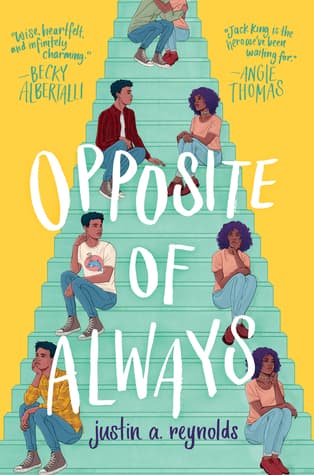
Synopsis
Covers the whole plot, including the ending.
- Difficulty
- Easy
- Pacing
- Moderate
- Mood
- Heartwarming, Bittersweet, Reflective, Humorous
- Read it if
- You enjoy YA romance with a speculative twist, 'Groundhog Day' style time loops, and stories about making difficult choices and finding meaning in everyday moments.
- Skip it if
- You prefer hard science fiction over fantasy elements, or if you dislike repetitive narratives and emotionally challenging decisions.
Opposite of Always Plot Summary
Covers the whole plot, including the ending.
A Chance Encounter and Instant Connection
Jack, a charming high school senior, goes to a party at his best friend Franny's house. He meets Kate, a witty girl with a blue streak in her hair. They talk all night, bonding over Froot Loops and classic movies. They feel a strong connection. Jack is immediately interested, and despite his usual avoidance of commitment, he likes Kate. They exchange numbers, and a quick romance starts, supported by Jack's friends, Franny and Jillian. Their relationship grows fast, full of laughter and deep talks. Jack thinks he has found something special.
Tragedy Strikes and the Loop Begins
Jack and Kate's relationship grows over months. But their happiness ends when Kate suddenly collapses and dies from an undiagnosed heart condition. Jack is devastated. Overwhelmed by grief, he finds himself at a party, feeling lost. As he leaves, he trips and hits his head. He wakes up at the exact moment he first met Kate at Franny's party. Kate is alive and healthy, unaware of their past or her coming death. Jack is confused, thinking he is dreaming, but he slowly understands he has gone back in time.
Jack's First Attempt to Save Kate
Knowing Kate's future, Jack tries to save her. In this new timeline, he talks to Kate differently at the party, trying to guide their conversation toward her health. He urges her to see a doctor, making up reasons for his worry, which makes Kate cautious. Their relationship does not grow naturally, and Kate is put off by his intensity. He eventually convinces her to get checked, but doctors find nothing. Despite his efforts, Kate's heart condition is not found, and she dies again, just like before. Jack is sad, realizing that just knowing is not enough.
The Second Loop and the Cost of Change
Jack goes back to the beginning again. This time, he is more direct, telling Kate about the time loop and her coming death, hoping she will believe him. Kate thinks he is crazy and avoids him. Feeling desperate, Jack tries to force her to see a specialist he found, which pushes her away more. He also tries to protect Kate by keeping her isolated, disrupting his own life and friendships. In this timeline, his focus on Kate causes him to ignore Franny, who gets into a serious car accident, breaking her leg and possibly ruining a scholarship. This bad result makes Jack realize that saving Kate might hurt others he cares about.
A Life Without Kate and a New Friendship
With what he learned from past loops, Jack tries a new plan: he avoids meeting Kate. He stays away from the party where they first met, hoping to break the cycle. But he still meets Kate, in a different way. This time, he tries to keep their talks short, focusing on his friendships with Franny and Jillian. This decision lets him spend more time with Jillian. He discovers new parts of their friendship. Jack realizes how much he values her friendship, understanding that his past focus on Kate made him miss other important connections.
Jillian's Revelation and a New Threat
As Jack goes through this new timeline, trying to save Kate and protect his friends, Jillian acts strangely. She seems to know things she should not, mentioning events that have not happened in this loop. Jillian then tells him her secret: she also experiences time loops. She explains she has been looping for a while, first trying to save her brother, then getting caught in Jack's loops as he tries to save Kate. This changes Jack's situation, as he realizes he is not alone. Jillian's actions and wishes might also affect the results. He learns the loops are about making the 'right' choice, not just *a* choice.
The True Nature of the Loops and a Difficult Choice
Jillian explains more about the time loops. She says they are not about simply changing events, but about making a 'right' choice that lets the timeline become stable. She explains that each loop is a chance to learn and grow, and trying to force a specific outcome without understanding the problems can cause bad results for others. She tells him that continuing to loop creates problems and that eventually, one must make a clear choice. Jack realizes he might not be able to save everyone. He must choose between saving Kate, which could put his friends in danger, or letting Kate go to protect Franny and Jillian, who he also cares about.
The Proposal and a Final Confrontation
To save Kate, Jack decides to propose to her, thinking a strong commitment might prevent her death or give her a reason to fight. He plans a romantic setting and asks her. Kate is surprised, feeling their intense relationship is moving too fast. She rejects him, leading to a painful talk where Jack, frustrated and unable to tell her about the loops, expresses his worries. This shows that controlling fate through big actions is impossible and highlights the emotional toll the loops are taking on Jack and his relationships.
Acceptance and a Different Path
After many loops and thinking about his choices, Jack understands he cannot force fate. He accepts that Kate's death, though sad, is part of her story, and trying to change it only causes more pain for everyone. He decides to stop trying to save Kate and instead focuses on living in the present and valuing the people around him. He understands the loops were not just about Kate, but about his own growth and learning to value life and relationships beyond romance. This acceptance is a big change for him.
The Last Loop and a Bittersweet Goodbye
In his last loop, Jack approaches his relationship with Kate differently. He does not try to save her or change her fate. Instead, he focuses on loving her completely for the time they have. He enjoys every moment, making good memories, and letting their relationship develop naturally. He makes sure he is present for his friends, Franny and Jillian, and strengthens his bonds with them. When Kate's death comes, it is still sad, but Jack faces it with a new sense of peace. He grieves, but he also keeps the love and memories, understanding that some things are beyond his control. The value of life is in how it is lived, not how long it lasts.
Opposite of Always Characters
Jack
Protagonist
A high school senior caught in a time loop, trying to save the girl he loves.
Jack is a charming, witty, and initially somewhat indecisive high school senior. He is deeply loyal to his best friends, Franny and Jillian, and prides himself on his ability to observe and analyze. His life takes a dramatic turn when he meets Kate and falls deeply in love, only to be thrust into a time-looping phenomenon after her death. Jack's primary motivation throughout the book is to save Kate, leading him to experiment with various strategies, often with unintended consequences. He struggles with the moral dilemmas of altering timelines and the personal sacrifices required. His journey forces him to confront his own selfishness and learn the true meaning of love, friendship, and acceptance.
Relationships: Kate (Romantic interest, the catalyst for his time loops); Franny (Lifelong best friend, like a sister); Jillian (Lifelong best friend, shares the time-looping experience with him); Mr. & Mrs. Jordan (Loving and supportive parents)
Kate
Love Interest / Catalyst
Jack's enigmatic and vibrant love interest whose death triggers the time loops.
Kate is a captivating and intelligent girl with a distinctive blue streak in her hair. She is witty, adventurous, and possesses a unique perspective on life, drawing Jack in from their first meeting. Kate suffers from a congenital heart condition that ultimately leads to her death, which Jack repeatedly tries to prevent. In various loops, her personality shifts based on Jack's approach – from being charmed and falling in love, to being confused, wary, or even annoyed by his strange behavior. She represents the unpredictable nature of life and the painful reality of loss, forcing Jack to confront his limitations and the meaning of true love.
Relationships: Jack (Romantic interest); Franny (Friend (in timelines where she meets her)); Jillian (Friend (in timelines where she meets her))
Jillian
Supporting / Fellow Looper
Jack's best friend who reveals she also experiences time loops.
Jillian is one of Jack's two best friends, a kind, artistic, and perceptive girl. She is the more pragmatic and grounded of the trio, often offering sensible advice. Later in the story, Jillian reveals that she also experiences time loops, having been stuck in her own cycle trying to save her brother. Her understanding of the loops, their rules, and the ethical dilemmas involved becomes crucial for Jack. She acts as a confidante, a guide, and a moral compass, helping Jack navigate the complexities of his situation. Her own struggles with the loops mirror Jack's, forging a deeper bond between them and providing a unique perspective on the narrative's central conflict.
Relationships: Jack (Lifelong best friend, fellow time-looper); Franny (Lifelong best friend); Chris (Deceased brother, the original reason for her loops)
Franny
Supporting
Jack's other best friend, a boisterous and loyal personality.
Franny is Jack's other best friend, known for her outgoing personality, sharp wit, and unwavering loyalty. She is often the life of the party and a source of humor and support for Jack. In various loops, Franny's well-being becomes a critical factor for Jack, especially when his attempts to save Kate inadvertently put Franny in danger, such as her car accident. She represents the collateral damage of Jack's obsessive pursuit of Kate, forcing him to consider the broader impact of his actions on those he loves. Her friendship with Jack is a bedrock of his life, reminding him of the importance of maintaining balance and valuing all his relationships.
Relationships: Jack (Lifelong best friend); Jillian (Lifelong best friend); Kate (Friend (in timelines where she meets her))
Mr. Jordan
Supporting
Jack's supportive and wise father.
Mr. Jordan is Jack's father, a kind and understanding man who offers Jack guidance and wisdom throughout his struggles. He often provides Jack with profound insights, sometimes through seemingly mundane conversations, which resonate deeply with Jack's time-looping predicament. He encourages Jack to live in the present and embrace life's uncertainties. His calm demeanor and consistent love offer Jack a stable anchor amidst the chaos of his looping reality. He represents parental wisdom and the importance of acceptance and moving forward, even in the face of grief.
Relationships: Jack (Son); Mrs. Jordan (Wife)
Mrs. Jordan
Supporting
Jack's loving and encouraging mother.
Mrs. Jordan is Jack's mother, a warm and nurturing figure who provides emotional support and comfort. She is often seen engaging in lighthearted banter with Jack and offers a loving home environment. Her presence reinforces the theme of family support and the importance of having a strong foundation. While not as overtly philosophical as Mr. Jordan, her unwavering love and practical care contribute significantly to Jack's well-being and his ability to cope with his extraordinary circumstances.
Relationships: Jack (Son); Mr. Jordan (Husband)
Chris
Mentioned
Jillian's deceased brother, the original reason for her own time loops.
Chris is Jillian's older brother who died tragically, an event that originally triggered Jillian's own time-looping abilities. Although he never appears directly in the story, his death and Jillian's attempts to save him provide crucial context for understanding the nature of the loops and the profound impact of loss on those who experience them. His story serves as a parallel to Kate's, highlighting that Jack is not alone in his grief and his desire to change the past, and that others have faced similar impossible choices.
Relationships: Jillian (Sister)
Brad
Supporting
Kate's friend from her original timeline.
Brad is a friend of Kate's from the original timeline, and he occasionally appears in different loops. He represents the established relationships and social circles Kate has outside of Jack. In some loops, Jack views him as a potential rival or an obstacle to his plans to get close to Kate, especially when Jack is trying to isolate Kate for her own 'protection.' Brad serves as a minor character who helps to flesh out Kate's world and to demonstrate the ripple effects of Jack's attempts to alter the timeline.
Relationships: Kate (Friend)
Opposite of Always Themes
Acceptance vs. Control
The main theme is Jack's struggle to accept Kate's death versus his desire to change her fate through time travel. Jack first thinks he can beat destiny, but each loop shows him that forcing outcomes is useless and dangerous. He learns that peace comes from accepting what cannot change and valuing the moments he has. This is clear in his last loop where he lets go of saving Kate and focuses on loving her fully, and in Jillian's explanation about making the 'right' choice.
“Sometimes the best way to save someone is to let them go.”
The Nature of Love and Loss
The book explores different kinds of love—romantic, platonic, and family—and the impact of loss. Jack's love for Kate drives his actions, but the loops also show the strength of his friendships with Franny and Jillian. The story shows that love is about presence, understanding, and valuing time with loved ones. Loss, while painful, is part of life that shapes people and relationships, leading to growth and a deeper appreciation for life's short beauty.
“Love isn’t about forever. It’s about right now. It’s about holding on to what you have, even if you know it’s going to slip away.”
Consequences of Choice
Every loop Jack experiences shows the big and often unexpected results of his choices. His attempts to save Kate often lead to bad things for others, especially Franny, who gets hurt in one timeline. This theme shows how lives are connected and the ethical weight of changing events. It makes Jack consider not just his own desires, but the well-being of everyone around him. He learns that saving one person might cost too much for others. Jillian's presence as another looper also supports this, as she also dealt with the results of her choices.
“You can’t just change things willy-nilly, Jack. Every action has a ripple.”
Living in the Present
Throughout his journey, Jack is pulled between the past (what happened) and the future (what he wants to happen), often not fully living in the present. The loops teach him that true happiness and meaning come from embracing the 'now.' His parents, especially his father, often give advice about enjoying moments. By the last loop, Jack chooses to live fully in the present with Kate, making memories without trying to change her fate, finding peace in acceptance.
“Don’t worry so much about what’s next, Jack. Just live what’s now.”
Plot Devices & Literary Techniques
Time Loop
The central narrative device, repeatedly sending Jack back to the same starting point.
The time loop is the core plot device of the novel. Jack is repeatedly sent back to the moment he first meets Kate after her death. This device allows the author to explore various 'what if' scenarios and the consequences of different choices. It forces Jack to confront his desires, learn from his mistakes, and evolve as a character. The loops also create narrative tension, as Jack tries to break the cycle, and later, understand its purpose. The device is further complicated by Jillian's revelation that she also experiences loops, adding a layer of shared experience and understanding to the phenomenon.
Unreliable Narrator (initial loops)
Jack's initial confusion and disbelief about the time loops.
In the initial stages of the time loops, Jack questions his own sanity, believing he might be dreaming, hallucinating, or even experiencing a mental breakdown. This creates a sense of an unreliable narrator, as the reader experiences his disorientation and uncertainty alongside him. This device helps build suspense and empathy for Jack's predicament before the reality of the loops is firmly established, both for him and the reader. It highlights the psychological toll of his extraordinary situation and makes his eventual acceptance of the loops more impactful.
Froot Loops Cereal
A recurring symbol of connection, comfort, and the bittersweet nature of memory.
Froot Loops cereal serves as a recurring symbol throughout the novel. It's the first shared quirky detail that bonds Jack and Kate during their initial meeting, representing their instant connection and the simple joys of their relationship. Later, it becomes a bittersweet reminder of Kate and the life Jack keeps losing. In the loops, Jack sometimes uses it as a way to reconnect with Kate or to test if she remembers their shared past. It symbolizes the comfort of routine, the sweetness of shared moments, and the painful nostalgia for what has been lost or might never be again, representing both a beginning and an ending.
The Blue Streak in Kate's Hair
A visual identifier and symbol of Kate's unique spirit and individuality.
The distinctive blue streak in Kate's hair is a prominent visual motif throughout the book. It serves as an immediate identifier for Kate in each new loop, grounding Jack's disorientation with a recognizable detail. Beyond its practical use, it symbolizes Kate's unique, vibrant, and slightly unconventional personality. It makes her stand out, much like her character stands out in Jack's life. The unchanging nature of the blue streak, even as other circumstances shift, subtly hints at core aspects of Kate that remain constant, despite Jack's attempts to change her fate.
Opposite of Always Quotes
“Time is a thief, but it's also a gift. It gives you chances to do things over, to get them right.”
“Love isn't about finding the perfect person. It's about seeing an imperfect person perfectly.”
“Sometimes the hardest person to save is yourself.”
“We're all just stories in the end. Make yours a good one.”
“The opposite of always is never. But maybe it's also now.”
“Grief is love with nowhere to go.”
“You don't get to choose who you love. It just happens, like gravity.”
“Every choice is a ripple. You never know how far it'll reach.”
“Being brave doesn't mean you're not scared. It means you're scared but you do it anyway.”
“Home isn't a place. It's a person.”
“The past is a ghost. It can haunt you, but it can't hurt you unless you let it.”
“We're all a little broken. That's how the light gets in.”
“Time doesn't heal all wounds. But it gives you space to learn how to live with them.”
“Sometimes the right thing and the hard thing are the same thing.”
“Love is worth the risk. Even when it ends, it was worth it.”
Quiz
10 questions on the plot and the characters. Each answer comes with a short explanation.
Question 1
What do Jack and Kate bond over when they first meet at a party?
- Their favorite books and movies
- Froot Loops and their favorite flicks
- Their mutual dislike of parties
- Their shared interest in science fiction
Show answer
B. Froot Loops and their favorite flicks In the book, Jack and Kate's initial connection is built on their love for Froot Loops and favorite movies, which they discuss until sunrise at the party.
Question 2
What event triggers Jack's first time travel back to the beginning of his relationship with Kate?
- Jack's own near-death experience
- A major argument with Kate
- Kate's death
- A car accident involving his friends
Show answer
C. Kate's death Jack is sent back in time to the moment he first meets Kate after she dies, setting up the central premise of the novel where he tries to prevent her death.
Question 3
Who are Jack's two best friends that Kate meets and wins over?
- Jillian and Franny
- Mike and Sarah
- Chris and Emma
- Alex and Taylor
Show answer
A. Jillian and Franny Jillian and Franny are Jack's close friends, and Kate quickly impresses them, strengthening her integration into Jack's life.
Question 4
What does Jack initially struggle to believe when he first travels back in time?
- That Kate is actually alive again
- That he is losing his mind
- That his friends remember the previous timeline
- That time travel is scientifically possible
Show answer
B. That he is losing his mind Upon returning to the past, Jack questions his sanity because the experience is so surreal and unbelievable, even as he sees Kate healthy and happy again.
Question 5
What major lesson does Jack learn as he repeatedly tries to save Kate?
- That time travel is easy to control
- That his actions have unintended consequences
- That he can change everything without effort
- That Kate's death is inevitable no matter what
Show answer
B. That his actions have unintended consequences Jack discovers that altering events to save Kate leads to dangerous outcomes for others, highlighting the theme of consequences in the novel.
Question 6
Which of the following best describes a central theme of 'Opposite of Always'?
- The importance of scientific discovery
- The choices we make and their impact on loved ones
- The inevitability of fate and destiny
- The superiority of logic over emotion
Show answer
B. The choices we make and their impact on loved ones The book explores how Jack's decisions in trying to save Kate affect not just her but also his friends and himself, emphasizing the weight of choices.
Question 7
What happens when Jack's attempts to save Kate result in a deadly consequence for someone else?
- He gives up on time travel entirely
- He must decide what he's willing to do to save the people he loves
- Kate becomes angry and leaves him
- He realizes he can't change anything at all
Show answer
B. He must decide what he's willing to do to save the people he loves This pivotal moment forces Jack to confront moral dilemmas and prioritize whom he tries to protect, driving the novel's emotional conflict.
Question 8
How does the novel blend genres according to its description?
- It combines horror and comedy elements
- It mixes fantasy, science fiction, young adult, and romance
- It focuses solely on historical fiction
- It is primarily a mystery thriller
Show answer
B. It mixes fantasy, science fiction, young adult, and romance 'Opposite of Always' is categorized as fantasy and science fiction due to its time travel, young adult for its coming-of-age themes, and romance for the central love story.
Question 9
What does the title 'Opposite of Always' metaphorically refer to in the context of the story?
- The idea that nothing lasts forever, contrasting with 'always'
- A scientific principle about time reversal
- The opposite direction Jack travels in time
- A phrase Kate uses to describe their relationship
Show answer
A. The idea that nothing lasts forever, contrasting with 'always' The title reflects the novel's exploration of impermanence and change, as Jack grapples with loss and the fleeting nature of moments, opposite to the concept of 'always'.
Question 10
In what way does Jack's journey challenge the typical time travel narrative?
- By showing that changing the past is always beneficial
- By focusing on the emotional and relational costs rather than just the mechanics
- By having Jack travel to the future instead of the past
- By making time travel a widely known phenomenon
Show answer
B. By focusing on the emotional and relational costs rather than just the mechanics Unlike many time travel stories that emphasize scientific details, this book delves into how Jack's attempts affect his relationships and mental state, adding depth to the genre.
Opposite of Always FAQ
What is 'Opposite of Always' about?
The novel follows high school senior Jack, who falls in love with Kate at a party, only for her to die from a genetic blood disorder. Jack is then sent back in time to their first meeting, giving him repeated chances to prevent her death while navigating the unintended consequences of his actions on his best friends Jillian and Franny.
Why should I read 'Opposite of Always'?
This book offers a fresh take on time-travel romance with witty dialogue, authentic teenage relationships, and profound themes about grief, sacrifice, and the ethics of altering fate. It balances humor and heartbreak while exploring how small choices ripple through lives.
What is the background/setting of 'Opposite of Always'?
Set in a contemporary American suburb, the story unfolds across multiple time loops starting at a high school party where Jack and Kate meet. Key locations include Jack's home, school, and the hospital where Kate receives treatment for sickle cell disease.
What are the most memorable quotes?
Notable quotes include: 'The opposite of always is never,' reflecting the novel's themes of loss and time; and 'You don't get to choose who you love,' highlighting Jack's unwavering devotion to Kate despite the loops' emotional toll.
What writing style does the author use?
Justin A. Reynolds employs a conversational, first-person narrative from Jack's perspective, blending humor with raw emotion. The prose is accessible yet poignant, using pop-culture references and realistic teen dialogue to ground the fantastical time-travel elements.
What minor details add significant meaning?
Kate's love for Froot Loops symbolizes her childlike joy and becomes a recurring motif that Jack associates with her vitality. The 'opposite of always' phrase, initially a casual remark, gains weight as Jack grapples with mortality and time's limitations.
What are some subtle foreshadowing moments?
Early mentions of Kate's fatigue and hospital visits hint at her illness before it's fully revealed. Jack's initial sense of 'too-perfect' moments with Kate foreshadows the loops' artificiality and the costs of trying to control destiny.
What unexpected character connections exist?
Jillian and Franny's friendship is tested as Jack's loops inadvertently strain their bond, revealing hidden tensions. Kate's illness connects to broader themes of healthcare disparities, subtly tying her personal struggle to societal issues.
What are unspoken character motivations?
Jack's obsession with saving Kate stems not just from love but from guilt over his perceived failure to protect her. Jillian's loyalty masks her own unspoken fears of abandonment, while Franny's humor often deflects his anxiety about change.
What psychological complexities do characters exhibit?
Jack experiences trauma-like symptoms from reliving loss, blurring reality and memory. Kate maintains optimism despite her illness, showcasing resilience, while Jillian and Franny grapple with confusion and resentment as Jack's behavior becomes erratic across loops.
What are the major emotional turning points?
Key moments include Kate's first death, which shatters Jack's world; the loop where Franny dies instead, forcing Jack to confront unintended consequences; and the final realization that some outcomes are immutable, leading to acceptance.
How do relationship dynamics evolve?
Jack and Kate's romance deepens with each loop as Jack learns more about her, but it becomes strained by his secretive attempts to change fate. Jillian and Franny's friendship fractures under the stress of Jack's actions, only to rebuild through shared understanding.
Which parts remain ambiguous or open-ended?
The origin of the time loops is never explained, leaving it as a metaphorical device. The ending implies Jack finds peace, but it's unclear if he fully moves on or retains memories of the loops, inviting interpretation about healing and memory.
What are controversial scenes or decisions?
Jack's choice to prioritize saving Kate over others sparks debate about selfishness versus love. His manipulation of events in the loops, such as interfering with Franny's life, raises ethical questions about playing god with time.
'Opposite of Always' ending explained: how it ends & what it means
In the finale, Jack accepts that he cannot save Kate without harming others, leading to a loop where he cherishes their time without interference. The ending suggests that love means embracing moments as they are, not controlling them, symbolizing growth through loss.
Similar books
- Before I Fall
Lauren Oliver
3.9 (295k) average on GoodreadsFantasyFeatures a character reliving the same day, trying to change their fate and understand life's meaning.
- The Sun Is Also a Star
Nicola Yoon
4.1 (184k) average on GoodreadsYoung AdultA poignant YA romance that unfolds over a single day with a sense of destiny and choice.
- The Time Traveler's Wife
Audrey Niffenegger
4.0 (1.6M) average on GoodreadsFantasyWhile both involve time travel and romance, Reynolds's book is more emotionally grounded and less focused on the scientific or philosophical complexities of time displacement. Opposite of Always prioritizes the human element and emotional journey within a YA framework, whereas Niffenegger's work delves deeper into the involuntary and often chaotic nature of temporal shifts and their broader implications, as discussed by critics like Sarah Lyall in her review for The New York Times (2003).
- Harry Potter and the Sorcerer's Stone
J.K. Rowling
4.5 (7M) average on GoodreadsFantasyRescued from a miserable life under the stairs, an orphaned boy discovers he's a wizard destined for a magical school, where he uncovers a dangerous secret tied to the dark wizard who murdered his parents.
- The Hunger Games
Suzanne Collins
4.3 (6.4M) average on GoodreadsFantasyIn a future where children fight to the death on live television, Katniss Everdeen volunteers for the arena, turning a death sentence into a fight for survival and a spark of rebellion.
- 1984
George Orwell
4.2 (3.1M) average on GoodreadsPoliticsIn a future where surveillance and thought control are absolute, a man's search for truth clashes with the Party, showing that hope can be a form of rebellion.



Enjoyed the summary?
A summary gives you the shape of the book. The book itself has the detail, the examples and the voice.
Find Opposite of Always on AmazonAs an Amazon Associate, BookBrief earns from qualifying purchases. How we're funded