
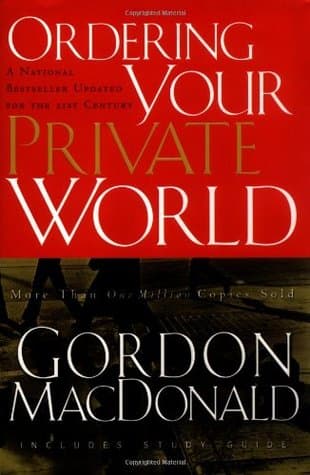
Core Idea
- Difficulty
- Medium
- Read it if
- You are a leader, professional, or individual feeling overwhelmed, fragmented, or in danger of burnout, and believe your external busyness is compromising your internal well-being and long-term effectiveness. You want practical, spiritually-grounded advice on personal discipline and prioritizing what truly matters.
- Skip it if
- You are looking for a quick-fix productivity hack book, prefer secular self-help, or are not open to spiritual principles guiding personal development and leadership.
Key Takeaways from Ordering Your Private World
The Private World Precedes Public Effectiveness
True leadership and spiritual vitality stem from a well-ordered inner life, not just outward activity.
MacDonald argues that modern Western culture, especially in religious and leadership circles, wrongly sees busyness and public visibility as signs of spirituality and effectiveness. This leads to too much focus on external programs, meetings, and duties, often at the cost of one's inner, private world. He states that real and lasting impact in public life comes directly from a disciplined, thoughtful, and spiritually nourished inner life. Without this basic order in the private world, people, even with good intentions, risk burnout, hypocrisy, and ultimately, being ineffective. The book corrects this view, urging readers to prioritize internal success before seeking external influence.
“One of the great battlegrounds of the new century is within the private world of the individual.”
In the book: MacDonald frequently references the societal pressure on leaders to appear constantly active and engaged, contrasting it with the biblical examples of leaders like Jesus who regularly withdrew for solitude and prayer to replenish their inner resources.
Try this: Regularly schedule 'white space' in your calendar for solitude, reflection, and spiritual disciplines. This isn't just downtime; it's proactive investment in your core being. Start with 15-30 minutes daily, building up to longer periods weekly or monthly.
Related ideas: inner-life, spiritual-discipline, leadership-sustainability
Mastering the Calendar and the Clock
Intentional time management is crucial for protecting the private world from the demands of the public.
MacDonald points out that while we are good at organizing our public and professional lives with various tools, we often fail to apply the same care to our private, spiritual lives. He stresses that time is limited and cannot be replaced, and how we use it shows our true priorities. Good management of the calendar and the clock is not about fitting more into a busy schedule, but about setting clear limits and making time for personal growth, spiritual practices, and relationships. This active approach stops the constant demands of the public world from taking over the space needed for inner growth.
“We have schedule planners, computerized calendars, and self-stick notes to help us organize our business and social lives everyday. But what about organizing the other side of our lives—the spiritual side?”
In the book: MacDonald's own experience as a busy pastor and leader, where he learned through trial and error the necessity of rigid calendar blocking and saying 'no' to good opportunities to protect essential private time.
Try this: Block out non-negotiable time in your calendar for spiritual practices (prayer, meditation, scripture reading) and personal reflection. Treat these appointments with the same seriousness as professional meetings, refusing to let other demands infringe upon them.
Related ideas: time-management, boundaries, prioritization
The Tyranny of the Urgent
Distinguish between urgent tasks and truly important priorities to avoid constant reactivity.
MacDonald criticizes the cultural habit of equating busyness with importance, which makes people constantly respond to urgent, but often unimportant, demands. This 'tyranny of the urgent' stops people from investing in activities that are truly important for long-term growth and well-being, especially those related to their private world. He suggests a shift from reacting to planning ahead, emphasizing that important tasks (like spiritual practices, deep work, and meaningful relationships) rarely feel urgent but are essential for lasting effectiveness and inner peace. Learning to recognize and prioritize these important but non-urgent items is a sign of a well-ordered private world.
“The values of our Western culture incline us to believe that the busy, publicly active person in ministry is also the most spiritual.”
In the book: MacDonald uses the example of leaders who are constantly putting out fires and responding to emails, leaving no time for strategic planning, personal development, or deep spiritual engagement, leading to burnout.
Try this: Before starting your day, identify your top 1-3 'important but not urgent' tasks for your private world. Dedicate your freshest energy to these first, before diving into the reactive demands of the day. Use a priority matrix to help categorize tasks.
Related ideas: priority-management, urgent-vs-important, proactive-living
Cultivating a World of Thought
Disciplined thinking and intentional input are essential for shaping the inner landscape.
MacDonald argues that the private world is not just about quiet time, but about the quality and direction of one's thoughts. He stresses that just as we protect our physical space, we must actively manage our mental space. This includes what we take in (what we read, listen to, and see) and how we process it (reflection, meditation, prayer). If left unchecked, our thoughts can cause anxiety, negativity, and distraction, hindering spiritual growth. In contrast, a disciplined thought life, focused on truth and purpose, becomes a source of wisdom, peace, and strength, directly affecting public effectiveness.
“The quality of our private world is determined by the quality of our thought life.”
In the book: MacDonald often refers to the influence of media and pervasive cultural narratives on our thinking, advocating for intentional engagement with scripture and enriching literature to counteract these influences.
Try this: Implement a 'thought audit' for a week: pay attention to recurring negative or unproductive thoughts. Then, intentionally replace them with scripture, positive affirmations, or focused problem-solving. Dedicate time daily to reading edifying books or listening to insightful podcasts.
Related ideas: mindfulness, cognitive-discipline, spiritual-formation
The Power of Rest and Recreation
True rest is not idleness but a restorative practice that renews the soul and body.
MacDonald strongly challenges the modern praise of constant activity by stating the necessary role of rest and recreation in keeping a healthy private world. He distinguishes between simply stopping work and true, refreshing rest—activities that truly renew the mind, body, and spirit. This includes the biblical idea of Sabbath, which is not just a day off, but a deliberate practice of stopping work and enjoying God. Neglecting rest leads to burnout, less creativity, and a reduced ability to serve well. Prioritizing rest is not a luxury; it is a necessary strategy for lasting impact and a strong inner life.
“Our massive responsibilities at home, work, and church have resulted in a lot of good people on the verge of collapse.”
In the book: MacDonald frequently cites the epidemic of burnout among highly dedicated individuals in leadership and ministry, attributing it to the failure to embrace consistent, intentional rest and Sabbath practices.
Try this: Establish a weekly Sabbath practice: designate one 24-hour period to cease from regular work, refrain from digital distractions, and engage in activities that genuinely refresh you—reading for pleasure, spending time in nature, connecting with loved ones, or spiritual reflection.
Related ideas: sabbath, burnout-prevention, self-care
Confronting the Inner Imposter
Authenticity in the private world is crucial for integrity in the public sphere.
MacDonald addresses the common problem of living a double life—an impressive public image hiding an unexamined or messy private world. This gap, driven by a desire for approval or fear of exposure, creates an 'inner imposter' that erodes integrity and causes anxiety. He argues that true spiritual health and leadership effectiveness require a consistent connection between one's inner beliefs and outer actions. Facing this inner imposter involves honest self-assessment, confession, and a commitment to aligning private values with public behavior. This difficult but necessary process builds real authenticity and lasting influence.
“Tempted to give imbalanced attention to the public world at the expense of the private, we become involved in more programs, more meetings.”
In the book: MacDonald often refers to the tragic downfalls of public figures and leaders whose private lives were inconsistent with their public image, underscoring the destructive power of hypocrisy.
Try this: Regularly engage in self-reflection through journaling or with a trusted mentor/spiritual director. Ask yourself: 'Are my private thoughts and actions consistent with my public declarations and values?' Identify one area where there's a disconnect and take a small, actionable step towards alignment.
Related ideas: authenticity, integrity, self-reflection
The Importance of Key Relationships
Nurturing deep, trust-based relationships is fundamental to a healthy private world.
While focusing on the 'private' world, MacDonald does not suggest isolation. Instead, he highlights the vital role of a few deeply trusted relationships in supporting one's inner life. These are not casual acquaintances but confidantes who offer accountability, encouragement, and honest feedback without judgment. In a culture that often values many connections over deep ones, MacDonald reminds us that real spiritual and emotional health requires openness within a safe, committed group. These relationships act as a crucial support system, helping individuals handle challenges, process thoughts, and maintain perspective, preventing the private world from becoming lonely or unchecked.
“No person is an island, especially in the spiritual journey.”
In the book: MacDonald often shares anecdotes about his own mentors and trusted friends who provided crucial support and challenged him to grow, illustrating the practical benefits of such relationships.
Try this: Identify 1-2 individuals with whom you can be completely transparent about your inner struggles and triumphs. Proactively schedule regular, intentional time to connect with them for mutual encouragement and accountability. If you don't have such a person, actively seek one out.
Related ideas: accountability, mentorship, community
Learning to Say 'No'
Protecting the private world often requires setting firm boundaries and declining good opportunities.
MacDonald argues that one of the hardest, yet most important, skills for ordering one's private world is the ability to say 'no.' In a world full of good causes and endless demands, the temptation to take on too much is huge, especially for those driven to serve or achieve. However, every 'yes' to an external demand is potentially a 'no' to an internal priority. Learning to decline opportunities, even good ones, is not selfish but a wise way to manage oneself. It is about recognizing one's limits and protecting the time and energy needed to maintain a strong inner life, ensuring that one's capacity is not constantly drained.
“Tempted to give imbalanced attention to the public world at the expense of the private, we become involved in more programs, more meetings.”
In the book: MacDonald recounts instances where he himself had to make difficult decisions to step back from certain commitments or decline invitations, even when they seemed beneficial, to preserve his personal and spiritual well-being.
Try this: Practice the 'hell yes or no' rule: if an opportunity doesn't immediately elicit an enthusiastic 'hell yes', then it's a 'no'. Before committing to anything new, check your calendar and your energy levels, and consider its impact on your private world priorities.
Related ideas: boundaries, self-stewardship, decluttering
The Habit of Reflection
Regular introspection and journaling are vital tools for understanding and shaping the inner self.
MacDonald supports the practice of reflection as a foundation of an ordered private world. This is not just passive thinking, but active, intentional looking inward—examining motives, evaluating decisions, processing emotions, and finding spiritual insights. Tools like journaling are very useful for this process, providing a written record of one's inner journey and allowing for deeper self-awareness. Without regular reflection, people risk living reactively, repeating patterns, and failing to learn from experiences. Through this deliberate pause and analysis, one gains clarity, wisdom, and the ability to adjust course, ensuring alignment with one's deepest values and purpose.
“The unexamined life is not worth living.”
In the book: MacDonald's emphasis on understanding one's own motivations and the impact of one's actions suggests a strong underlying belief in the power of consistent self-assessment and reflection.
Try this: Commit to a daily journaling practice for 10-15 minutes. Use prompts like: 'What was my greatest challenge today and how did I respond?', 'What brought me joy?', 'Where did I see God working?', or 'What do I need to let go of?'
Related ideas: journaling, introspection, self-awareness
Living from the Inside Out
Cultivating inner victory is the prerequisite for all meaningful public effectiveness.
The main message of MacDonald's work is a change in perspective: true, lasting impact and spiritual effectiveness do not come from external effort or public praise, but from a deeply nurtured and successful inner life. He challenges the common cultural idea that prioritizes outer activity, arguing that lasting public influence is simply a result of a well-ordered private world. This 'inside out' approach means that spiritual practices, personal reflection, healthy boundaries, and real relationships are not extras but essential foundations. Without this inner success—control over one's thoughts, time, and desires—external efforts become unsustainable, empty, or even harmful.
“Gordon MacDonald equips a new generation to live life from the inside out, cultivating the inner victory necessary for public effectiveness.”
In the book: The entire premise of the book, contrasting the 'public world' and 'private world' and advocating for the latter as the source of strength, serves as evidence for this core takeaway.
Try this: Regularly review your priorities to ensure they align with an 'inside-out' philosophy. Before taking on new commitments, ask: 'How will this impact my private world, and is my private world robust enough to sustain this?' Prioritize your spiritual and mental well-being as the primary fuel for all other endeavors.
Related ideas: holistic-living, spiritual-maturity, purpose-driven
Ordering Your Private World Quotes
“The private world of the man or woman of God is that which is not open to the public; it is the inner sanctuary of personal thought, feeling, and decision.”
“We are all in danger of living a life that is too public, too much on the surface, too little aware of the deep currents that shape us.”
“When we fail to order our private world, we eventually find that we have little to give to our public world.”
“The greatest enemy of the ordered private world is hurry.”
“Discipline is not an enemy of spontaneity. It is the framework within which spontaneity can flourish.”
“A person who is not able to retreat to a private place and be alone with God for significant periods of time will eventually be drained and ineffective.”
“The ordering of our private world begins with the ordering of our thought-life.”
“We cannot give away what we do not possess. If we want to give love, joy, peace, and patience, we must first possess them in our private world.”
“Many of us are living in a constant state of reaction, rather than living from a place of intentionality.”
“The wise person is one who understands the value of silence and uses it to replenish the soul.”
“Leadership that is authentic and sustainable flows from a well-ordered private world.”
“The quality of our spiritual life is determined by the quality of our time alone with God.”
“Don't let the urgent crowd out the important.”
“The person who is constantly giving without regularly receiving will eventually run dry.”
Quiz
10 questions on the main ideas. Each answer comes with a short explanation.
Question 1
According to Gordon MacDonald, what is identified as one of the 'great battlegrounds of the new century'?
- The geopolitical landscape between nations
- The private world of the individual
- The struggle for economic dominance
- The public square of social discourse
Show answer
B. The private world of the individual The book explicitly states, 'One of the great battlegrounds of the new century is within the private world of the individual,' highlighting the internal struggle for order.
Question 2
What common cultural belief does MacDonald challenge regarding spirituality and public activity?
- That spiritual growth is best achieved through solitude.
- That the most spiritual people are typically quiet and reserved.
- That the busy, publicly active person in ministry is also the most spiritual.
- That spirituality is irrelevant to public service.
Show answer
C. That the busy, publicly active person in ministry is also the most spiritual. The text states, 'The values of our Western culture incline us to believe that the busy, publicly active person in ministry is also the most spiritual,' which MacDonald aims to correct.
Question 3
What is the primary consequence of giving imbalanced attention to the public world at the expense of the private, as described by MacDonald?
- Reduced participation in community events.
- A decrease in professional opportunities.
- Good people on the verge of collapse due to massive responsibilities.
- An increase in leisure time.
Show answer
C. Good people on the verge of collapse due to massive responsibilities. MacDonald warns that 'Our massive responsibilities at home, work, and church have resulted in a lot of good people on the verge of collapse,' due to this imbalance.
Question 4
What is the core aim of 'Ordering Your Private World' for its readers?
- To increase public visibility and influence.
- To develop advanced time management skills for external tasks.
- To live life from the inside out, cultivating inner victory for public effectiveness.
- To reduce all public responsibilities to focus solely on personal well-being.
Show answer
C. To live life from the inside out, cultivating inner victory for public effectiveness. The book's description states MacDonald 'equips a new generation to live life from the inside out, cultivating the inner victory necessary for public effectiveness,' emphasizing internal ordering as foundational.
Question 5
MacDonald suggests that modern tools like schedule planners and computerized calendars are effective for what aspect of life, but insufficient for another?
- They organize intellectual pursuits but not emotional ones.
- They organize business and social lives but not the spiritual side.
- They organize family life but not professional life.
- They organize public speaking engagements but not private thoughts.
Show answer
B. They organize business and social lives but not the spiritual side. The introduction highlights that these tools 'help us organize our business and social lives everyday. But what about organizing the other side of our lives—the spiritual side?'
Question 6
What specific temptation does MacDonald identify that leads individuals to become involved in 'more programs, more meetings'?
- The desire for financial gain.
- The pressure from peers to conform.
- Tempted to give imbalanced attention to the public world at the expense of the private.
- A genuine interest in every available opportunity.
Show answer
C. Tempted to give imbalanced attention to the public world at the expense of the private. The text explicitly states, 'Tempted to give imbalanced attention to the public world at the expense of the private, we become involved in more programs, more meetings.'
Question 7
The book's updated edition is described as 'timely.' What does this suggest about the relevance of its message in the 'new century'?
- The challenges of an unordered private world are diminishing.
- The need for inner ordering has become more pressing and critical.
- It implies that the original message was outdated and no longer applicable.
- It means the book is only relevant for a short period.
Show answer
B. The need for inner ordering has become more pressing and critical. Calling it 'timely' in the context of 'one of the great battlegrounds of the new century' implies its message is highly relevant and perhaps even more necessary now than before, addressing ongoing or intensifying struggles.
Question 8
MacDonald's work addresses the 'spiritual side' of life. What does this imply about the nature of the 'private world' he is concerned with ordering?
- It primarily focuses on financial planning and investment strategies.
- It extends beyond mere logistical organization to include one's inner character, beliefs, and relationship with God.
- It is exclusively about managing personal hobbies and leisure activities.
- It deals only with intellectual pursuits and academic achievements.
Show answer
B. It extends beyond mere logistical organization to include one's inner character, beliefs, and relationship with God. By explicitly asking 'what about organizing the other side of our lives—the spiritual side?' and emphasizing 'inner victory,' MacDonald indicates his focus is on the profound internal aspects of a person, including their faith and character, not just superficial organization.
Question 9
What is the implied relationship between 'inner victory' and 'public effectiveness' in MacDonald's framework?
- They are independent concepts with no direct correlation.
- Public effectiveness is a prerequisite for achieving inner victory.
- Inner victory is a necessary foundation or prerequisite for genuine and sustainable public effectiveness.
- They are opposing forces, where one diminishes the other.
Show answer
C. Inner victory is a necessary foundation or prerequisite for genuine and sustainable public effectiveness. The text states MacDonald equips readers 'cultivating the inner victory necessary for public effectiveness.' This establishes a causal and foundational relationship: inner order is essential for true and lasting outer impact.
Question 10
Considering the context, what does MacDonald mean by 'ordering' one's private world, beyond simply scheduling appointments?
- Delegating all personal tasks to others.
- Imposing structure and discipline on one's internal life, including thoughts, priorities, and spiritual habits, to achieve harmony and purpose.
- Eliminating all spontaneity and creativity from one's life.
- Focusing exclusively on physical health and fitness.
Show answer
B. Imposing structure and discipline on one's internal life, including thoughts, priorities, and spiritual habits, to achieve harmony and purpose. Given the contrast with 'schedule planners' and the emphasis on the 'spiritual side' and 'inner victory,' 'ordering' extends far beyond mere external scheduling. It implies bringing intentional structure, discipline, and alignment to one's internal landscape—mind, spirit, and values—to prevent collapse and enable effective living.
Ordering Your Private World FAQ
What is the main premise of 'Ordering Your Private World'?
The book argues that true public effectiveness and spiritual health stem from cultivating a well-ordered private, inner world. It challenges the modern tendency to prioritize external busyness over internal spiritual development, which can lead to burnout and an imbalanced life.
Does 'Ordering Your Private World' offer practical steps for spiritual growth?
Yes, Gordon MacDonald provides actionable insights and strategies for developing disciplines in areas like time management, spiritual reflection, and prioritizing one's inner life. The book aims to equip readers with tools to live 'from the inside out' rather than being driven solely by external demands.
What does Gordon MacDonald mean by 'private world'?
The 'private world' refers to the inner life of an individual—their thoughts, beliefs, values, spiritual disciplines, and the unseen aspects of their character. It's the realm that often gets neglected in favor of public activity and external responsibilities.
How is 'Ordering Your Private World' different from typical self-help or time management books?
While it touches on aspects of self-help and time management, this book uniquely emphasizes the spiritual dimension as the foundation for true effectiveness. Unlike books that focus solely on external productivity, MacDonald's work prioritizes cultivating an inner life to sustain public effectiveness, particularly for those in leadership or ministry.
Who is the target audience for 'Ordering Your Private World'?
The book is primarily aimed at leaders, individuals in ministry, and anyone feeling overwhelmed by public responsibilities at the expense of their spiritual and personal well-being. It's for those seeking a more integrated and sustainable approach to life.
Does the book suggest withdrawing from public life?
No, the book does not advocate for withdrawing from public life. Instead, it argues that a well-ordered private world is essential for sustaining and enhancing public effectiveness. It's about finding balance and ensuring that one's external activities are fueled by a healthy internal state.
What is the danger of an 'imbalanced attention to the public world'?
The danger is that individuals, especially those in demanding roles, can become overly focused on external achievements and activities, neglecting their spiritual and personal foundations. This often leads to burnout, moral compromise, and a feeling of being on the 'verge of collapse,' despite outward success.
What is the significance of the book being a 'timely update' of a classic?
The update indicates that the core principles remain relevant, but the new edition likely addresses contemporary challenges and cultural pressures that impact individuals' private worlds today. It ensures the timeless wisdom is accessible and applicable to a new generation facing modern complexities.
Does 'Ordering Your Private World' help with avoiding burnout?
Yes, a central theme of the book is providing strategies to prevent burnout by cultivating a strong inner life that can sustain external demands. By prioritizing spiritual and personal well-being, readers can build resilience and avoid the exhaustion that comes from an imbalanced focus on public activity.
Similar books
- The 7 Habits of Highly Effective People: Powerful Lessons in Personal Change
Stephen R. Covey
4.1 (524k) average on GoodreadsBusinessBoth emphasize character-based ethics and prioritizing principles over urgent tasks for long-term effectiveness.
- Steve Jobs
Walter Isaacson
4.1 (957k) average on GoodreadsBusinessSteve Jobs was a visionary who fused creativity and technology to revolutionize six industries and shape our digital world.
- The Tipping Point: How Little Things Can Make a Big Difference
Malcolm Gladwell
4.0 (690k) average on GoodreadsBusinessMalcolm Gladwell explains how small, targeted actions can start widespread changes in trends, behaviors, and ideas.
- Outliers: The Story of Success
Malcolm Gladwell
4.2 (556k) average on GoodreadsBusinessMalcolm Gladwell argues that true success is not just about individual talent, but about the hidden advantages of culture, opportunity, and unique experiences that shape extraordinary lives.
- Blink: The Power of Thinking Without Thinking
Malcolm Gladwell
3.9 (487k) average on GoodreadsBusinessExplore the hidden power of quick judgments and how 'thin-slicing' information helps skilled decision-makers succeed instantly, often without conscious thought.
- Who Moved My Cheese?
Spencer Johnson
3.8 (367k) average on GoodreadsBusinessFour tiny maze-dwellers scramble to adapt when their beloved cheese supply vanishes, revealing a timeless parable about embracing change rather than fearing its inevitable relocation.




Enjoyed the summary?
A summary gives you the shape of the book. The book itself has the detail, the examples and the voice.
Find Ordering Your Private World on AmazonAs an Amazon Associate, BookBrief earns from qualifying purchases. How we're funded