
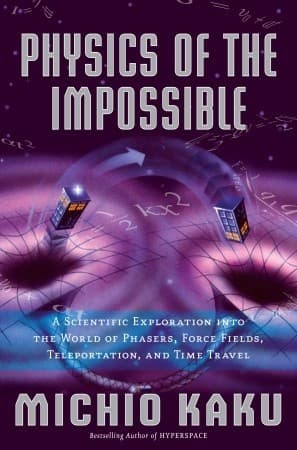
Core Idea
- Difficulty
- Medium
- Read it if
- You are fascinated by the intersection of science fiction and real-world physics, enjoy speculative science based on current theories, or want to understand the scientific limitations and possibilities of futuristic technologies.
- Skip it if
- You prefer practical, near-future technological discussions over theoretical physics and speculative science, or are looking for a deep dive into any single specific scientific topic rather than a broad survey.
Key Takeaways from Physics of the Impossible
The Impossibility Spectrum
Not all 'impossible' things are equally impossible; Kaku categorizes them by their potential for future realization.
Kaku introduces a tiered system for 'impossible' technologies: Class I (impossible today, but possible within a century or two), Class II (impossible today, but possible in millennia), and Class III (impossible today, and possibly never possible). This system shifts the discussion from a simple 'possible/impossible' to a nuanced understanding of scientific limits. It recognizes that our current understanding of physics is not complete and that technology often redefines what is feasible. This classification helps readers appreciate science's changing nature and the potential for discoveries that could make today's impossibilities tomorrow's realities, while also showing the truly difficult barriers that still exist.
“One hundred years ago, scientists would have said that lasers, televisions, and the atomic bomb were beyond the realm of physical possibility. In Physics of the Impossible, the renowned physicist Michio Kaku explores to what extent the technologies and devices of science fiction that are deemed equally impossible today might well become commonplace in the future.”
In the book: Kaku's entire book is structured around this classification, applying it to diverse concepts like force fields (Class I), faster-than-light travel (Class II), and perpetual motion machines (Class III).
Try this: When encountering a new 'impossible' concept, apply Kaku's framework. Instead of dismissing it outright, consider which class it might fall into based on current scientific understanding. This encourages a more open-minded and scientifically informed approach to future technologies.
Related ideas: class-i-impossibilities, class-ii-impossibilities, class-iii-impossibilities, scientific-frontiers
Invisibility: Bending Light, Not Disappearing
True invisibility relies on manipulating light waves, not on the object itself vanishing.
Kaku explains that to achieve invisibility, the goal is not to make an object vanish, but to make light waves flow around it as if it were not there. This involves metamaterials, which are artificial materials with properties not found in nature, able to control electromagnetic waves in new ways. By creating a 'cloak' that guides light around an object and then puts it back together on the other side, the object becomes optically undetectable. This is not just theory; Kaku points to early successful experiments with microwaves, showing the basic principles are sound. The challenge is to apply these principles to visible light and create cloaks for larger, non-flat objects, but the basic physics is very strong.
“How the science of optics and electromagnetism may one day enable us to bend light around an object, like a stream flowing around a boulder, making the object invisible to observers 'downstream'”
In the book: Kaku discusses the work of scientists like John Pendry and David Smith, who have pioneered the concept of metamaterials and demonstrated 'invisibility cloaks' that work at microwave frequencies in laboratory settings.
Try this: Understand that 'invisibility' in a scientific context is about optical manipulation, not magic. When evaluating claims of invisibility, look for explanations involving light bending and metamaterials, rather than simple 'disappearance.' This helps distinguish science from pseudoscience.
Related ideas: metamaterials, electromagnetism, optics, light-bending
Teleportation: Quantum Leaps vs. Star Trek
While quantum teleportation is real, Star Trek-style materialization is far more complex and likely impossible for macroscopic objects.
Kaku distinguishes between two different ideas of teleportation. Quantum teleportation, where a particle's quantum state is instantly moved to another, is a proven scientific event. It is about information, not matter. However, the 'Star Trek' idea of taking apart a human in one place and reassembling them elsewhere is a Class II or III impossibility. The vast amount of information needed to perfectly encode and send every atom and quantum state of a human is astronomically large, far beyond any possible data storage or transmission capacity. Also, the ethical and existential questions of 'copying' rather than 'moving' a person raise deep philosophical issues.
“The teleportation of quantum information has already been demonstrated in laboratories, but the teleportation of macroscopic objects, like humans, faces formidable challenges.”
In the book: Kaku references actual experiments in quantum teleportation involving photons and atoms, which have successfully transferred quantum states over distances. He then contrasts this with the informational hurdles of macroscopic teleportation, estimating the data required for a single human body.
Try this: When you hear about 'teleportation,' always clarify if it's quantum information transfer (possible) or macroscopic object transfer (highly unlikely/impossible). This distinction prevents conflating cutting-edge physics with science fiction fantasy.
Related ideas: quantum-teleportation, quantum-entanglement, information-theory, macroscopic-teleportation
Time Travel: Possible, But Impractical
The laws of physics don't forbid time travel, but the energy requirements make it a civilization-level endeavor.
Kaku shows that time travel, especially into the future, is not strictly forbidden by Einstein's theory of relativity. Moving near the speed of light or experiencing strong gravity can cause time dilation, effectively sending a person into the future compared to those who stayed behind. Traveling to the past, however, is much harder, possibly requiring exotic matter, 'wormholes,' or cosmic strings, which demand huge amounts of energy. The 'grandfather paradox' also presents a logical problem, though Kaku discusses solutions like parallel universes. The point is that while physics allows for theoretical possibilities, the engineering problems are so vast they would require a Type III civilization to even consider.
“Why a time machine is apparently consistent with the known laws of quantum physics, although it would take an unbelievably advanced civilization to actually build one.”
In the book: Kaku cites Einstein's theories of special and general relativity, explaining time dilation. He also discusses theoretical concepts like 'wormholes' (Einstein-Rosen bridges) and Tipler cylinders as potential mechanisms for time travel to the past, emphasizing their extreme energy demands.
Try this: Approach time travel discussions with a physics-informed perspective. Recognize that 'time travel to the future' via time dilation is a real, albeit extreme, consequence of relativity, while 'time travel to the past' involves highly speculative and energy-intensive theoretical constructs.
Related ideas: time-dilation, general-relativity, wormholes, grandfather-paradox, type-iii-civilization
Psychic Powers: Technology, Not Mysticism
What we call telepathy or psychokinesis might one day be achieved through advanced technology, not supernatural abilities.
Kaku argues that concepts like telepathy and psychokinesis, often seen as pseudoscience, could become real through technology. He sees 'telepathy' as advanced brain-computer interfaces, where thoughts become digital signals and are sent, or even 'brain-nets' connecting multiple minds. 'Psychokinesis' could appear as advanced robots controlled by thought, or even nanotechnology moving objects from a distance through thought-commanded fields. The key is that these would not be 'powers' in a mystical sense, but extensions of human ability made possible by advanced, integrated technologies that link directly with our brains and the physical world.
“How telepathy and psychokinesis, once considered pseudoscience, may one day be possible using advances in MRI, computers, superconductivity, and nanotechnology.”
In the book: Kaku points to current research in brain-computer interfaces (BCIs), where paralyzed individuals can control robotic limbs or cursors with their thoughts, and functional MRI (fMRI) which can detect brain activity associated with specific thoughts or intentions.
Try this: When encountering 'psychic' phenomena, look for potential technological explanations. Instead of dismissing them as impossible, consider how advanced BCIs, robotics, or nanotechnology might mimic such abilities in the distant future. This helps bridge the gap between science fiction and future science.
Related ideas: brain-computer-interfaces, nanotechnology, fMRI, telepathy, psychokinesis
Space Travel: The Ultimate Engineering Challenge
Interstellar travel is a monumental task, requiring propulsion systems far beyond current capabilities.
Reaching even nearby stars within a human lifetime is a huge engineering challenge. Kaku details the limits of chemical rockets and then looks at more advanced, theoretical propulsion systems. These include nuclear pulse propulsion (Orion project), ramjets that collect hydrogen from interstellar space, laser sails pushed by powerful ground-based lasers, and antimatter engines offering the highest theoretical energy density. Each concept has its own set of difficult challenges, from the sheer energy needs to the safe handling of exotic fuels. Kaku stresses that overcoming these challenges will define the abilities of a truly spacefaring civilization, pushing the limits of materials science, energy generation, and automation.
“How ramjet rockets, laser sails, antimatter engines, and nanorockets may one day take us to the nearby stars.”
In the book: Kaku details various propulsion concepts, including the Bussard ramjet, Project Orion, and the potential of antimatter for propulsion, discussing their theoretical efficiencies and practical difficulties.
Try this: When considering future space travel, move beyond traditional rockets. Understand that achieving interstellar distances requires revolutionary propulsion methods. This highlights the immense scientific and engineering innovation needed to become a truly multi-planetary species.
Related ideas: interstellar-travel, antimatter-propulsion, laser-sails, nuclear-pulse-propulsion, bussard-ramjet
Force Fields: Energy and Plasma
Future force fields will likely be created by manipulating plasma or using powerful electromagnetic fields, not an invisible 'wall.'
Kaku clarifies the sci-fi idea of a 'force field' by basing it in known physics. He suggests that such defensive barriers could come from superheated plasma, a state where electrons are removed from atoms. A strong magnetic field could hold and shape this plasma, creating an energy barrier able to deflect incoming objects or radiation. Another possibility involves quickly changing electromagnetic fields creating a repulsive force. While creating a truly impenetrable, large-scale force field is a huge engineering task, the basic ideas of plasma containment and electromagnetic repulsion are well-known. This places force fields in the Class I or II category, depending on their desired strength and size.
“The science of plasma physics suggests that force fields, once confined to science fiction, might one day be within our grasp.”
In the book: Kaku references fusion research, where strong magnetic fields are used to contain superheated plasma, and also discusses the potential of 'plasmaspheres' or 'magnetic bottles' as defensive shields.
Try this: When imagining a 'force field,' think about the underlying physics: plasma, magnetic fields, and energy manipulation. This helps separate plausible future technologies from purely fantastical concepts, focusing on the scientific principles that might make them possible.
Related ideas: plasma-physics, magnetic-fields, electromagnetic-repulsion, fusion-energy, defensive-shields
Robots and AI: From Tools to Companions
The evolution of AI will transform robots from simple machines into intelligent, even sentient, entities.
Kaku explores the future of robotics and artificial intelligence, predicting a time when AI goes beyond just computing to achieve true consciousness. He discusses the three laws of robotics, then examines what self-aware machines capable of learning, expressing emotions, and even setting their own goals would mean. This evolution will change robots from simple tools to complex companions, workers, and even potential rivals. The challenges are not just in programming intelligence, but in understanding and replicating consciousness, and in setting ethical rules for living together. Kaku warns that the 'singularity' – the point where AI surpasses human intelligence – is a critical moment humanity must handle carefully.
“The development of true artificial intelligence, capable of learning and independent thought, will profoundly reshape our future.”
In the book: Kaku discusses current advancements in deep learning and neural networks, as well as the historical progression of robotics from industrial arms to more sophisticated humanoid forms. He also touches upon the philosophical debate around consciousness and AI.
Try this: Consider the ethical implications of AI development beyond just functionality. Think about how societies will integrate truly intelligent machines and the necessary safeguards or societal shifts required as AI capabilities grow.
Related ideas: artificial-intelligence, robotics, consciousness, singularity, ethics-of-ai
Parallel Universes: A Multiverse of Possibilities
Many 'impossible' paradoxes in our universe might be resolved by the existence of multiple realities.
Kaku explores the complex idea of parallel universes, suggesting they are not just theoretical curiosities but a possible result of quantum mechanics and cosmic inflation. He explains how the 'many-worlds interpretation' of quantum physics implies that every quantum event causes the universe to split into multiple realities, each showing a different outcome. This multiverse theory offers interesting solutions to paradoxes like the grandfather paradox in time travel, where changing the past in one universe simply creates a new, different timeline in another. While currently untestable, the mathematical elegance and explanatory power of the multiverse make it a compelling, though speculative, area of physics.
“The existence of parallel universes is not just a staple of science fiction, but a serious consideration in modern physics, potentially resolving paradoxes like time travel.”
In the book: Kaku discusses the many-worlds interpretation of quantum mechanics, cosmic inflation theory, and String Theory (M-theory) as theoretical frameworks that suggest the existence of a multiverse.
Try this: When faced with seemingly irresolvable paradoxes in physics or sci-fi, consider if a multiverse theory could offer a potential, albeit speculative, resolution. This broadens your understanding of the frontiers of theoretical physics.
Related ideas: multiverse, quantum-mechanics, many-worlds-interpretation, cosmic-inflation, string-theory
The Limits of Physics: Class III Impossibilities
Some concepts truly defy the known laws of physics and may remain forever impossible.
Kaku does not just discuss possibilities; he also sets limits. Class III impossibilities are those that break the known laws of physics so deeply that they will likely stay impossible forever, unless our understanding of the universe completely changes. Examples include perpetual motion machines (breaking thermodynamics), precognition (breaking causality), and truly instant travel faster than light (breaking relativity). He emphasizes that while science constantly changes, these ideas challenge fundamental, well-tested principles. This classification is important for telling the difference between visionary science and pure fantasy, giving a realistic view of what truly lies beyond even future scientific achievement.
“There are some technologies that, based on our current understanding, appear to violate the fundamental laws of physics, placing them in Class III of impossibility.”
In the book: Kaku uses the example of perpetual motion machines, explaining how they violate the first and second laws of thermodynamics. He also discusses the impossibility of faster-than-light travel for information or matter as a Class III impossibility due to Einstein's theory of relativity.
Try this: Develop a critical eye for 'impossible' claims. If a concept violates established laws like the conservation of energy or the speed of light, it's likely a Class III impossibility. This helps you identify pseudoscience and focus on genuinely plausible future technologies.
Related ideas: perpetual-motion, laws-of-thermodynamics, causality, faster-than-light, scientific-limits
Physics of the Impossible Quotes
“Yesterday's science fiction is today's science fact.”
“The only way to discover the limits of the possible is to go beyond them into the impossible.”
“If we want to build a starship, we will need to master physics on a cosmic scale.”
“The laws of physics, as we know them, do not forbid time travel; they merely make it extraordinarily difficult.”
“Perhaps the most important discovery of all is yet to be made.”
“One day, we may be able to manipulate space-time itself, bending it to our will.”
“The universe is far stranger than we can imagine.”
“The true sign of intelligence is not knowledge but imagination.”
“To build a true force field, one would have to create a bubble of altered space-time.”
“The human brain is the most complex object in the known universe.”
“The greatest breakthroughs often come from asking 'what if'.”
“Teleportation, in its purest form, involves disassembling and reassembling matter at the quantum level.”
“While some impossibilities are merely a matter of engineering, others challenge the very laws of physics.”
“The future of humanity lies in our ability to master the universe, not just inhabit a small corner of it.”
Quiz
10 questions on the main ideas. Each answer comes with a short explanation.
Question 1
According to Michio Kaku's classification in 'Physics of the Impossible,' which class of impossibility refers to technologies that are impossible today but do not violate known laws of physics, and may be possible in a century or two?
- Class I Impossibilities
- Class II Impossibilities
- Class III Impossibilities
- Class 0 Impossibilities
Show answer
A. Class I Impossibilities Kaku categorizes impossibilities into three classes. Class I refers to technologies that are currently impossible but do not violate known laws of physics and could be realized in a century or two. Examples include force fields and invisibility.
Question 2
Kaku discusses the possibility of invisibility cloaks by referencing how the science of optics and electromagnetism might enable us to manipulate what?
- Gravity waves
- Sound waves
- Light around an object
- Magnetic fields
Show answer
C. Light around an object The book explains how 'the science of optics and electromagnetism may one day enable us to bend light around an object, like a stream flowing around a boulder, making the object invisible.'
Question 3
Which of the following propulsion systems does Kaku mention as a potential means for interstellar travel?
- Steam engines
- Internal combustion engines
- Ramjet rockets, laser sails, and antimatter engines
- Chemical rockets only
Show answer
C. Ramjet rockets, laser sails, and antimatter engines Kaku specifically lists 'ramjet rockets, laser sails, antimatter engines, and nanorockets' as potential technologies for future interstellar travel.
Question 4
According to Kaku, what historical examples does he provide to illustrate that technologies once considered 'impossible' became commonplace?
- The wheel, the printing press, and the telescope
- Lasers, televisions, and the atomic bomb
- Steam power, electricity, and the telephone
- The internet, smartphones, and artificial intelligence
Show answer
B. Lasers, televisions, and the atomic bomb The book states, 'One hundred years ago, scientists would have said that lasers, televisions, and the atomic bomb were beyond the realm of physical possibility.'
Question 5
Kaku suggests that telepathy and psychokinesis, once considered pseudoscience, might become possible due to advancements in which fields?
- Astrology and alchemy
- Genetics and robotics
- MRI, computers, superconductivity, and nanotechnology
- Geology and meteorology
Show answer
C. MRI, computers, superconductivity, and nanotechnology The text highlights that 'telepathy and psychokinesis, once considered pseudoscience, may one day be possible using advances in MRI, computers, superconductivity, and nanotechnology.'
Question 6
What is Kaku's primary method for exploring the fundamentals and limits of physics in 'Physics of the Impossible'?
- Conducting new laboratory experiments
- Analyzing ancient philosophical texts
- Using the world of science fiction as a starting point
- Focusing solely on current military technology
Show answer
C. Using the world of science fiction as a starting point The description states, 'Kaku uses the world of science fiction to explore the fundamentals—and the limits—of the laws of physics as we know them today.'
Question 7
When discussing time travel, Kaku notes that a time machine is apparently consistent with which known laws, despite requiring an unbelievably advanced civilization to build?
- Newton's Laws of Motion
- The Laws of Thermodynamics
- The known laws of quantum physics
- Classical electromagnetic theory
Show answer
C. The known laws of quantum physics Kaku asserts 'Why a time machine is apparently consistent with the known laws of quantum physics, although it would take an unbelievably advanced civilization to actually build one.'
Question 8
Class III Impossibilities, according to Kaku's framework, are defined as technologies that:
- Are currently impossible but will be achieved within the next decade.
- Violate known laws of physics and may be impossible to achieve for millennia or ever.
- Are already commonplace but were once thought impossible.
- Are theoretically possible but lack the necessary materials.
Show answer
B. Violate known laws of physics and may be impossible to achieve for millennia or ever. Kaku ranks impossible technologies into categories, with Class III representing those that 'perhaps never' might be achieved, implying they violate known laws of physics or require a fundamental shift in our understanding.
Question 9
When discussing invisibility, Kaku draws an analogy to a 'stream flowing around a boulder.' What is the 'stream' in this analogy meant to represent in the context of invisibility?
- Gravitational forces
- Electromagnetic waves, specifically light
- Subatomic particles
- Quantum fluctuations
Show answer
B. Electromagnetic waves, specifically light The text explicitly states: 'How the science of optics and electromagnetism may one day enable us to bend light around an object, like a stream flowing around a boulder, making the object invisible to observers “downstream”.' The stream represents light.
Question 10
What is the overarching purpose of Kaku's discussion of each impossible technology in the book?
- To prove that all science fiction will eventually become reality.
- To explain the science behind it and explore the limits of physics.
- To discourage further research into these 'impossible' areas.
- To provide a historical account of science fiction literature.
Show answer
B. To explain the science behind it and explore the limits of physics. The description clearly states: 'Kaku uses his discussion of each technology as a jumping-off point to explain the science behind it.' The broader context of the book is to explore the fundamentals and limits of physics.
Physics of the Impossible FAQ
What impossible technologies does Michio Kaku explore in his book?
Michio Kaku explores a wide range of science fiction technologies, including death rays, force fields, invisibility cloaks, teleportation, telekinesis, and time travel, examining their potential for future realization based on current scientific understanding.
Does invisibility work according to the laws of physics?
Yes, Kaku discusses how the science of optics and electromagnetism could potentially enable us to bend light around an object, effectively making it invisible to observers, similar to how water flows around a rock.
What is Michio Kaku's classification system for impossible technologies?
Kaku classifies impossible technologies into three categories: Class I (achievable within a century), Class II (achievable within millennia), and Class III (perhaps never achievable with current understanding of physics). This system helps frame when these concepts might transition from fiction to reality.
How different is 'Physics of the Impossible' from other popular science books about the future?
'Physics of the Impossible' distinguishes itself by systematically using the framework of known physics to assess the feasibility of specific, iconic science fiction concepts, rather than just broadly discussing future trends. Kaku uses each technology as a detailed jumping-off point to explain complex scientific principles.
Can humans really achieve interstellar travel?
Kaku explores various propulsion concepts like ramjet rockets, laser sails, antimatter engines, and nanorockets, suggesting that while incredibly challenging, such technologies might one day enable humanity to travel to nearby stars.
What is the scientific basis for telepathy and psychokinesis?
While once considered pseudoscience, Kaku suggests that advances in MRI, computers, superconductivity, and nanotechnology could potentially lay the groundwork for understanding and perhaps even developing forms of telepathy and psychokinesis.
Does time travel violate the laws of physics?
Kaku explains that while building a time machine would require an unbelievably advanced civilization, the concept of time travel is surprisingly consistent with the known laws of quantum physics, making it a theoretically plausible, though practically distant, possibility.
What makes some 'impossible' technologies possible in the future?
Many technologies once considered impossible, like lasers or television, became reality through a deeper understanding of physics and technological advancements. Kaku argues that similar breakthroughs could make today's impossible technologies commonplace decades or millennia from now.
About the author

Michio Kaku is a theoretical physicist and futurist known for his work in popularizing science. He is the author of "Physics of the Impossible," where he explores concepts of science fiction through the lens of modern physics. Kaku's writings often bridge complex scientific ideas with accessible explanations for a general audience.
Similar books
- Astrophysics for People in a Hurry
Neil deGrasse Tyson
4.1 (113k) average on GoodreadsHistoryOffers concise explanations of complex cosmic phenomena, making advanced science digestible for a broad readership.
- The Story of Art
E.H. Gombrich
3.9 (311k) average on GoodreadsReferenceExplore thousands of years of human creativity, from ancient cave art to modern masterpieces, with Gombrich's classic account, updated with new insights into art's changing story.
- The New Drawing on the Right Side of the Brain
Betty Edwards
3.9 (297k) average on GoodreadsPsychologyLearn to draw by using the often-ignored visual side of your brain, changing how you see the world.
- Go Ask Alice
Anonymous
3.7 (293k) average on GoodreadsReferenceA teenage girl's diary chronicles her swift decline into 1970s drug culture, from an innocent game to addiction, ending in her tragic death.
- Their Eyes Were Watching God
Zora Neale Hurston
3.9 (266k) average on GoodreadsReferenceIn early 20th-century Florida, Janie Crawford searches for identity, love, and independence, defying social norms to find her voice.
- On Writing: A Memoir of the Craft
Stephen King
4.3 (222k) average on GoodreadsBiography





Enjoyed the summary?
A summary gives you the shape of the book. The book itself has the detail, the examples and the voice.
Find Physics of the Impossible on AmazonAs an Amazon Associate, BookBrief earns from qualifying purchases. How we're funded