
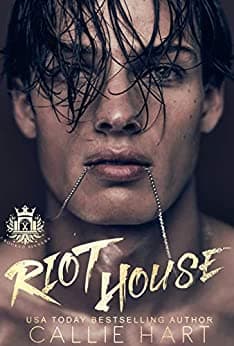
Synopsis
Covers the whole plot, including the ending.
- Difficulty
- Medium
- Pacing
- Fast
- Mood
- Dark, Suspenseful, Vengeful, Intense, Obsessive
- Read it if
- You enjoy dark academia thrillers with a strong, vengeful female protagonist, enemies-to-lovers romance, and a mystery that unravels alongside psychological torment and high-stakes drama.
- Skip it if
- You are sensitive to themes of abuse, bullying, and dark subject matter, or prefer romance without significant power imbalances and morally grey characters.
Riot House Plot Summary
Covers the whole plot, including the ending.
A New Life at Wolf Hall Academy
Elodie Stillwater, a scholarship student from a troubled past, arrives at the isolated Wolf Hall Academy in the Scottish Highlands. She immediately faces the oppressive atmosphere and the ruling 'Riot House' boys: Wren Jacobi, the leader; his volatile cousin, Crew; and the quiet, observant Silas. Elodie’s goal is to find information about her mother's mysterious death, which she suspects is connected to the academy and her estranged, abusive father, Senator Stillwater. The boys, especially Wren, see her as an outsider and a target, making it clear she is not welcome in their exclusive world. Elodie, however, is not easily intimidated and secretly plans to uncover the truth and seek justice.
The Initiation and Wren's Obsession
The 'Riot House' boys subject Elodie to a series of humiliating and dangerous pranks, escalating their bullying. Wren Jacobi, initially wanting to break her, finds himself increasingly intrigued and frustrated by Elodie’s resilience. Their interactions mix antagonism, power struggles, and an undeniable, if twisted, attraction. Elodie, while outwardly appearing to suffer, secretly gathers information, observing the boys' dynamics and the academy's hidden rules. She learns about the 'Trials,' a brutal tradition among the elite students, and suspects they might be linked to the secrets she seeks. Her resolve to expose them hardens with each attack.
Uncovering the Past: Clues and Connections
Elodie starts to find hidden clues about her mother, Catherine, who was once a student at Wolf Hall. She uncovers old yearbooks, letters, and whispered rumors suggesting Catherine had a secret life at the academy and was connected to powerful figures, including Wren's father and her own father, Senator Stillwater. As Elodie investigates, she realizes her mother's death was not a suicide as she was led to believe, but likely a murder, covered up by those in power. She starts to suspect that the 'Riot House' boys, or at least their families, are directly involved in the conspiracy, complicating her already tense relationship with Wren.
Silas's Warning and Crew's Volatility
Silas, the quietest of the 'Riot House' boys, occasionally offers Elodie cryptic warnings and subtle assistance, hinting at deeper secrets and dangers within the academy. He seems to have information the others don't, or at least views the situation with more clarity. Meanwhile, Crew Jacobi's aggressive nature makes him a constant threat, often escalating the bullying beyond Wren's control. Elodie realizes that Crew's instability is a weakness she might exploit, but also a significant danger. Her investigation becomes more dangerous as she navigates the shifting alliances and animosities among the boys, trying to stay one step ahead.
The Developing Connection with Wren
Despite their adversarial relationship, a complex, undeniable attraction develops between Elodie and Wren. Their interactions are charged with tension, anger, and a reluctant respect. Wren, initially wanting to dominate, finds himself drawn to Elodie's strength and defiance. Elodie, in turn, sees glimpses of vulnerability and a hidden past in Wren, making her question her initial assessment of him. This connection complicates her mission, as she struggles to reconcile her feelings with the knowledge that Wren's family might be involved in her mother's death. Their dynamic becomes a dangerous dance of manipulation and desire.
The 'Trials' and the Truth
Elodie learns that the 'Trials' are a brutal, secret ritual where students are subjected to extreme challenges, often resulting in severe injury or death, to prove their worth and maintain the power structure. She discovers that her mother, Catherine, was involved in these 'Trials' and was murdered to cover up a scandal involving Senator Stillwater and other powerful figures connected to the academy. The 'Trials' were used to control and silence those who threatened the elite. Elodie realizes her mother was attempting to expose the corruption and was silenced, making her own mission even more urgent and dangerous.
The Revelation of Treachery
Elodie discovers that Senator Stillwater, her father, was not only involved in the cover-up but was directly responsible for her mother's death, using his power and influence to orchestrate it. She also learns that Wren's father, Mr. Jacobi, was complicit in the conspiracy, protecting his own family's reputation and power. The revelation shatters Elodie's world, confirming her deepest fears and solidifying her resolve for revenge. She realizes the corruption reaches the highest echelons of society, and the academy is merely a small example of this widespread evil. The 'Riot House' boys, while pawns, also benefit from this system.
Wren's Choice and the Confrontation
As Elodie closes in on the truth, Wren is forced to confront his family's dark legacy and his father's complicity. He struggles with his loyalty to his family and his growing feelings for Elodie, realizing the depth of the injustice. A climactic confrontation ensues, involving Elodie, Wren, Crew, Silas, and the powerful adults involved. Elodie uses the evidence she's collected to expose the truth, leveraging the boys' internal conflicts and Wren's moral dilemma. The tension culminates in a violent showdown, where the true allegiances of each character are revealed under immense pressure.
Justice and Aftermath
After the confrontation, the truth about Catherine Stillwater's murder and the academy's corrupt practices is exposed. Senator Stillwater and other implicated figures face investigation and public scrutiny, though the full extent of their downfall is left somewhat open-ended. Wren, having chosen to help Elodie, faces the consequences of his actions within his own family and the elite circles. The 'Riot House' is forever changed, its power structure fractured. Elodie, having achieved justice for her mother, grapples with the emotional toll of her journey and the complex, unresolved relationship she now shares with Wren. The academy, though shaken, continues to exist, but its secrets are no longer entirely safe.
Riot House Characters
Elodie Stillwater
Protagonist
A resilient scholarship student seeking justice for her mother's death.
Elodie arrives at Wolf Hall Academy with a hidden agenda: to uncover the truth about her mother, Catherine Stillwater's, mysterious death and expose her abusive father, Senator Stillwater. She is intelligent, observant, and possesses an inner strength that belies her quiet exterior. Despite being a scholarship student and an outsider, she refuses to be broken by the 'Riot House' boys' bullying. Her determination and courage drive the narrative as she navigates the dangerous world of elite privilege and corruption, often using her wit and resourcefulness to gather clues and manipulate situations to her advantage. She is driven by grief, a thirst for justice, and a desire to protect herself.
Relationships: Wren Jacobi (complex, adversarial, evolving into a reluctant attraction and partnership); Crew Jacobi (antagonistic, target of his aggression); Silas (cautious alliance, source of cryptic information); Senator Stillwater (Father) (abusive, estranged, ultimately her mother's murderer); Catherine Stillwater (Mother) (deceased, the catalyst for Elodie's mission)
Wren Jacobi
Antagonist/Love Interest
The charismatic, cruel leader of the 'Riot House' boys, haunted by his own family's secrets.
Wren is the undisputed leader of the 'Riot House,' a powerful and intimidating figure who initially views Elodie as a new plaything to torment. He is intelligent, manipulative, and deeply entrenched in the academy's elite culture. Beneath his cruel exterior, however, lies a complex individual burdened by his family's expectations and secrets, particularly his father's involvement in the academy's darker dealings. His initial desire to break Elodie gradually morphs into a grudging respect and a powerful, forbidden attraction, forcing him to confront his own moral compass and the truth about his family's legacy. He is a master of psychological games.
Relationships: Elodie Stillwater (complex, adversarial, evolving into a reluctant attraction and partnership); Crew Jacobi (cousin, often manages his volatile behavior); Silas (friend, part of the 'Riot House' inner circle); Mr. Jacobi (Father) (powerful, complicit in the academy's corruption, source of Wren's pressure)
Crew Jacobi
Supporting/Antagonist
Wren's volatile cousin, prone to aggressive outbursts and extreme bullying.
Crew is the most unpredictable and aggressive of the 'Riot House' boys. He is Wren's cousin and often acts as his enforcer, but his own temper and impulsiveness frequently lead to dangerous situations. Crew's bullying of Elodie is more visceral and less calculated than Wren's, driven by a raw, unbridled hostility. He is fiercely loyal to Wren and the 'Riot House' code, but his instability makes him a wild card. He embodies the unchecked privilege and moral decay of the academy's elite, often escalating the violence and intimidation tactics. His actions frequently put Elodie in direct physical danger.
Relationships: Wren Jacobi (cousin, follows his lead but often acts impulsively); Elodie Stillwater (intensely antagonistic, often physically threatening)
Silas
Supporting
The quiet, observant member of the 'Riot House,' who offers cryptic insights and subtle aid.
Silas is the third member of the 'Riot House' inner circle, often overlooked due to his quiet demeanor. Unlike Wren and Crew, he is more observant and less overtly cruel. He seems to possess a deeper understanding of the academy's secrets and the true nature of its power dynamics. Silas occasionally provides Elodie with subtle warnings or clues, hinting at a moral conflict within him. He is a reluctant participant in the 'Riot House' games, and his actions suggest a hidden conscience, making him a potential, albeit cautious, ally for Elodie. His quiet nature allows him to see things others miss.
Relationships: Wren Jacobi (friend, part of the 'Riot House' inner circle); Crew Jacobi (friend, part of the 'Riot House' inner circle); Elodie Stillwater (cautious ally, source of cryptic information)
Senator Stillwater
Antagonist
Elodie's abusive father and a powerful, corrupt politician.
Senator Stillwater is Elodie's estranged and abusive father, a high-ranking politician with immense power and influence. He is the primary antagonist, revealed to be directly responsible for the murder of Elodie's mother, Catherine, and the subsequent cover-up. He embodies the corruption and moral bankruptcy that Elodie seeks to expose. His character represents the overarching societal evil that permeates the elite world of Wolf Hall, using his position to manipulate events and silence anyone who threatens his carefully constructed image. He is ruthless, devoid of empathy, and driven solely by self-preservation and power.
Relationships: Elodie Stillwater (abusive father, antagonist); Catherine Stillwater (Wife) (murderer of his wife)
Catherine Stillwater
Mentioned
Elodie's deceased mother, whose mysterious past at Wolf Hall drives the plot.
Catherine Stillwater is Elodie's mother, whose suspicious death prior to the start of the book is the central mystery. She was once a student at Wolf Hall Academy, and her past actions and connections within the school are gradually uncovered by Elodie. Catherine was attempting to expose the corruption and dark secrets of the academy and its powerful benefactors, including her husband, Senator Stillwater. Her memory and the injustice of her death fuel Elodie's determination, making her the ultimate catalyst for the entire plot. She represents the tragic consequences of defying the powerful elite.
Relationships: Elodie Stillwater (Daughter) (mother, her death is the driving force for Elodie); Senator Stillwater (Husband) (victim of his machinations)
Mr. Jacobi
Supporting/Antagonist
Wren's father, a powerful and complicit figure connected to the academy's secrets.
Mr. Jacobi is Wren's influential father and a key figure in the powerful families connected to Wolf Hall Academy. He is deeply entangled in the cover-up surrounding Catherine Stillwater's death and the academy's corrupt practices. He represents the older generation of the elite who maintain their power through secrecy and manipulation. He exerts significant pressure on Wren, expecting him to uphold the family's reputation and traditions, even if it means participating in morally questionable acts. His character highlights the generational cycle of corruption that Elodie seeks to break.
Relationships: Wren Jacobi (Son) (demanding father, complicit in his son's actions); Senator Stillwater (accomplice in the cover-up)
Riot House Themes
Abuse of Power and Privilege
This theme is central to 'Riot House,' appearing in the unchecked authority of the wealthy students and their families. The 'Riot House' boys, particularly Wren and Crew, use their social standing and financial influence to terrorize Elodie with impunity, knowing they are protected by their parents' connections and the academy's complicity. The revelation that Senator Stillwater and Mr. Jacobi covered up Catherine's murder shows how the elite use their power to commit crimes and escape justice. The academy itself is a symbol of this privilege, operating outside conventional rules.
“They might be richer than gods, but they’re morally bankrupt.”
Justice and Revenge
Elodie Stillwater's entire mission at Wolf Hall Academy is driven by her quest for justice for her mother's murder and revenge against those who wronged her family. She is not just seeking answers but actively planning to dismantle the lives of her father and others involved in the cover-up. This theme explores the moral complexities of seeking retribution, as Elodie often uses manipulative or dangerous tactics to achieve her goals. Her journey shows the human desire to right wrongs, even against overwhelming odds, and the personal cost of such a pursuit.
“There’s a wolf stalking the forests that surround my new school. Little does he know…There are far scarier predators lurking out there in the dark.”
Survival and Resilience
Elodie's character embodies the theme of survival and resilience. Despite enduring relentless bullying, psychological torment, and the emotional weight of her past trauma, she refuses to break. She adapts to the hostile environment of Wolf Hall, learning to fight back, manipulate, and endure. Her resilience is not just about physical survival but also maintaining her sense of self and purpose in a world designed to crush her. This theme highlights the strength of the human spirit in the face of adversity and the determination to overcome even the most powerful oppressors.
“He knows nothing of my troubled past, though. Nothing of my mother’s suspicious death, or the horrific treatment I’ve had to endure at the hands of my psychotic father. And he has no idea of the lengths that I, unassuming little Elodie Stillwater, will go to in order to break the savage beast who dreams of breaking me first.”
Forbidden Attraction and Toxic Relationships
The tumultuous relationship between Elodie and Wren exemplifies the theme of forbidden attraction and toxic relationships. Despite Wren's initial cruelty and his family's involvement in her mother's death, an intense attraction develops between them. This dynamic explores the complex interplay of power, hatred, and desire, where the lines between tormentor and tormented blur. Their connection is toxic due to the circumstances, yet it adds psychological complexity to the narrative, forcing both characters to confront their loyalties and desires amidst betrayal and danger.
“He might be my enemy, but he was also the most beautiful thing I’d ever seen. And I was falling for him, even as he tried to destroy me.”
Plot Devices & Literary Techniques
The 'Riot House'
A symbolic location and a group of characters representing unchecked power.
The 'Riot House' serves as both a physical location (a dormitory or section of the academy) and a symbolic entity representing the unchecked power, privilege, and moral corruption of the elite students. It is the seat of power for Wren, Crew, and Silas, and the source of much of the torment Elodie endures. As a plot device, it creates a formidable antagonist group and establishes the oppressive atmosphere of the academy. It also acts as a microcosm of the larger societal corruption that Elodie is fighting against, making her struggle against the boys a symbolic battle against the system itself.
The 'Trials'
A secret, brutal ritual that reveals the academy's dark underbelly.
The 'Trials' are a crucial plot device, functioning as a hidden tradition within Wolf Hall Academy that exposes the extreme lengths to which the elite will go to maintain their power and control. These brutal rituals, often involving violence and potentially death, serve to test and initiate students, but also to silence dissent. The discovery of Catherine Stillwater's involvement and ultimate murder during or because of these 'Trials' provides the central mystery and propels Elodie's quest for justice. It highlights the inherent danger of the academy and the moral depravity of its powerful patrons, serving as a dark mirror to the supposed prestige.
The Isolated Setting (Wolf Hall Academy)
A remote, elite academy that fosters secrecy and lawlessness.
The remote and isolated setting of Wolf Hall Academy in the Scottish Highlands is a significant plot device. Its seclusion allows the elite students and their families to operate with minimal external oversight, fostering a culture of secrecy, privilege, and lawlessness. This isolation intensifies the psychological tension and creates a sense of entrapment for Elodie, making escape difficult and amplifying the power of the 'Riot House' boys. The wild, untamed nature of the surrounding landscape also mirrors the untamed and dangerous nature of the academy's inhabitants and their dark secrets.
Hidden Clues and Secrets
Objects and information that gradually reveal the central mystery.
Throughout the narrative, Elodie uncovers various hidden clues and secrets – old yearbooks, letters, whispered rumors, and fragmented memories – that gradually piece together the truth about her mother's death and the academy's corruption. This device drives the mystery aspect of the plot, engaging the reader in Elodie's investigation. Each discovery deepens the conspiracy and raises the stakes, moving the plot forward and revealing more about the characters' pasts and motivations. It emphasizes Elodie's intelligence and resourcefulness as she meticulously gathers the evidence needed to expose the powerful.
Riot House Quotes
“Sometimes, the only way to find yourself is to get completely lost first.”
“The past is a monster, and it's always lurking, just waiting for you to turn your back.”
“Love isn't supposed to hurt this much. But then again, neither is living.”
“In a world of shadows, sometimes the darkest places hold the brightest truths.”
“We're all just broken pieces, trying to fit ourselves back together in a world that keeps trying to shatter us.”
“Fear is a powerful motivator, but hope? Hope can move mountains.”
“Sometimes, the most dangerous people are the ones who smile the sweetest.”
“There's a fine line between love and obsession, and we're dancing right on it.”
“The truth is a weapon, and sometimes, it's better left buried.”
“You can't outrun your demons, but you can learn to fight them.”
“Home isn't a place; it's the people you're willing to fight for.”
“Every secret has a price, and some prices are paid in blood.”
“Even in the darkest night, there's always a flicker of light, if you just know where to look.”
Quiz
10 questions on the plot and the characters. Each answer comes with a short explanation.
Question 1
What is the name of the exclusive international academy Elodie Stillwater is forced to attend?
- Blackwood Manor
- Wolf Hall Academy
- Riot House Preparatory
- Stillwater Elite
Show answer
B. Wolf Hall Academy Elodie is sent to Wolf Hall Academy, an exclusive and morally bankrupt institution, where she encounters the 'boys who run' the school.
Question 2
Who is the specific boy at Wolf Hall Academy who initially views Elodie as an 'easy mark'?
- Jax Teller
- Wren Jacobi
- Cole Thornton
- Silas Black
Show answer
B. Wren Jacobi The synopsis explicitly states, 'When Wren Jacobi sets eyes on Wolf Hall Academy’s newest inductee, all he sees is an easy mark.'
Question 3
What significant past event is mentioned as contributing to Elodie's troubled background?
- Her family losing all their wealth
- Her mother's suspicious death
- A previous expulsion from another school
- Being abandoned by her father
Show answer
B. Her mother's suspicious death Elodie's 'troubled past' is directly linked to 'my mother’s suspicious death' and the 'horrific treatment I’ve had to endure at the hands of my psychotic father.'
Question 4
What is Elodie's primary goal concerning Wren Jacobi and the other boys at the academy?
- To escape the academy without drawing attention
- To expose their illicit activities to the authorities
- To gain their acceptance and join their ranks
- To 'break the savage beast who dreams of breaking me first'
Show answer
D. To 'break the savage beast who dreams of breaking me first' Elodie's resolve is clear: she intends to 'break the savage beast who dreams of breaking me first,' indicating a direct confrontation and reversal of power.
Question 5
The description states the boys are 'richer than gods.' What negative characteristic immediately follows this statement?
- They are academically brilliant.
- They are morally bankrupt.
- They are exceptionally handsome.
- They are highly competitive.
Show answer
B. They are morally bankrupt. The very next phrase after 'richer than gods' is 'but they’re morally bankrupt,' setting the tone for their character.
Question 6
How does Elodie perceive herself in contrast to the initial perception Wren has of her?
- She sees herself as a powerful heiress, while he sees her as an equal.
- She sees herself as a 'scarier predator,' while he sees her as a 'reserved little girl.'
- She sees herself as a victim, while he sees her as a challenge.
- She sees herself as a rebel, while he sees her as obedient.
Show answer
B. She sees herself as a 'scarier predator,' while he sees her as a 'reserved little girl.' Wren sees her as 'A reserved little girl with a target painted on her back,' but Elodie reveals, 'Little does he know…There are far scarier predators lurking out there in the dark,' implying her own dangerous nature.
Question 7
The phrase 'There’s a wolf stalking the forests that surround my new school' is a metaphor for whom?
- Elodie's psychotic father
- Wren Jacobi, who is described as a 'savage beast'
- A literal wild animal near the academy
- An unknown antagonist lurking in the shadows
Show answer
B. Wren Jacobi, who is described as a 'savage beast' The metaphor of the 'wolf' directly precedes Elodie's statement about 'breaking the savage beast who dreams of breaking me first,' heavily implying Wren Jacobi as the metaphorical wolf.
Question 8
What is the underlying motivation for Elodie's fierce determination to confront Wren and the other boys?
- She wants to prove her intellectual superiority.
- She seeks revenge for her mother's death by targeting anyone associated with wealth.
- Her past trauma and experience with her father have hardened her, making her unwilling to be a victim again.
- She secretly desires to be accepted into their exclusive group and believes this is the way.
Show answer
C. Her past trauma and experience with her father have hardened her, making her unwilling to be a victim again. Elodie's resolve stems from her 'troubled past,' her 'mother’s suspicious death,' and 'the horrific treatment I’ve had to endure at the hands of my psychotic father,' indicating a deep-seated refusal to be dominated again.
Question 9
The synopsis describes the boys as 'morally bankrupt.' How does this characteristic manifest in their treatment of Elodie?
- They ignore her completely, showing no interest in her presence.
- They attempt to befriend her but are secretly manipulative.
- They view her as an 'unwelcome interloper' and 'inconvenience,' actively trying to make her life 'a living hell.'
- They challenge her to academic competitions to assert their dominance.
Show answer
C. They view her as an 'unwelcome interloper' and 'inconvenience,' actively trying to make her life 'a living hell.' Their moral bankruptcy is demonstrated by their immediate hostility and determination to torment Elodie: 'As far as the boys... are concerned, I’m an unwelcome interloper, an inconvenience, and they’re determined to make my life a living hell.'
Question 10
What literary device is primarily used in the closing line: 'Little does he know…There are far scarier predators lurking out there in the dark'?
- Simile
- Dramatic Irony
- Alliteration
- Hyperbole
Show answer
B. Dramatic Irony This is an example of dramatic irony because the reader is aware of Elodie's true nature and intentions ('scarier predators'), while Wren (the 'wolf') is oblivious to the danger she poses, expecting her to be an 'easy mark.'
Riot House FAQ
What is Riot House about?
Riot House follows Elodie Stillwater, a new student at the elite Wolf Hall Academy, who is targeted by the school's powerful and cruel 'Riot House' boys, led by Wren Jacobi. Elodie, however, is not a typical victim; she has a dark past involving her mother's suspicious death and an abusive father, and she arrives at Wolf Hall with a hidden agenda of revenge and a fierce determination to break Wren and his friends.
Why should I read Riot House?
You should read Riot House for its compelling blend of dark romance, psychological thriller, and mystery. It offers a gripping narrative of a protagonist seeking revenge against a group of privileged bullies, featuring intricate power dynamics, unexpected plot twists, and a morally gray cast of characters that will keep you guessing about their true intentions and allegiances.
What is the background/setting of Riot House?
The story is set primarily at Wolf Hall Academy, an exclusive and isolated international boarding school nestled in a forest. This elite environment is run by a group of wealthy, morally corrupt male students known as 'Riot House,' who exert significant control and influence, creating a dangerous and oppressive atmosphere for new students like Elodie Stillwater.
What writing style does the author use?
Callie Hart employs a direct, intense, and often gritty writing style in Riot House. The narrative is typically told from Elodie's first-person perspective, providing deep insight into her vengeful thoughts and strategic planning. The prose is characterized by its suspenseful tone, sharp dialogue, and vivid descriptions of the opulent yet sinister academy setting.
What minor details add significant meaning?
The recurring motif of the 'wolf' in the forest surrounding Wolf Hall Academy is a significant detail, symbolizing not only Wren Jacobi's predatory nature but also foreshadowing Elodie's own hidden ferocity. The subtle mentions of Elodie's mother's 'suspicious death' early on are crucial, establishing the deep-seated motive behind Elodie's actions and her arrival at Wolf Hall.
What are some subtle foreshadowing moments?
Elodie's internal monologues often contain subtle hints of her darker capabilities and meticulous planning, such as when she observes the boys' weaknesses or considers strategic moves, far beyond what a typical 'reserved little girl' would. The initial interactions where Wren underestimates Elodie's resilience subtly foreshadow her eventual success in challenging and potentially breaking him.
What unexpected character connections exist?
Beyond the obvious rivalry, an unexpected connection develops between Elodie and Wren, evolving from pure animosity into a complex, dark attraction. There are also hints of hidden alliances or past relationships among the Riot House boys themselves, suggesting a deeper network of secrets that Elodie gradually uncovers as she infiltrates their world.
What are unspoken character motivations?
Beneath Wren Jacobi's arrogant and cruel exterior lies an unspoken motivation likely rooted in a desire for control and perhaps a hidden vulnerability or trauma. Elodie's own unspoken motivation extends beyond simple revenge; she also seeks a sense of justice or closure for her mother's death, driving her relentless pursuit of those she believes are responsible.
What psychological complexities do characters exhibit?
Elodie Stillwater exhibits complex psychological traits, including a high degree of manipulation, resilience, and a detached analytical mind, all products of her traumatic past. Wren Jacobi, despite his outward sadism, shows moments of internal conflict and a surprising fascination with Elodie, hinting at deeper psychological scars and a desire for someone who can challenge him.
What are the major emotional turning points?
A major emotional turning point occurs when Elodie, despite her resolve, finds herself unexpectedly drawn to Wren, complicating her clear-cut mission of revenge. Another significant point is when she uncovers new information about her mother's death, shifting her focus from generalized retribution to a more specific target, intensifying her emotional drive.
How do relationship dynamics evolve?
The core relationship dynamic between Elodie and Wren evolves from pure predator-prey to a twisted, volatile dance of power and attraction, where lines blur between hatred and desire. Elodie's interactions with other Riot House members also shift, as she strategically forms uneasy alliances and manipulates their internal rivalries to further her own agenda.
Which parts remain ambiguous or open-ended?
The full extent of the conspiracy surrounding Elodie's mother's death and the ultimate fate of some minor characters often remain ambiguous at the end of the book, leaving readers to speculate on the long-term consequences of Elodie's actions. The true depth of Wren's feelings for Elodie, beyond possessiveness, also remains somewhat open-ended.
What are controversial scenes or decisions?
The morally ambiguous decisions made by Elodie, particularly her willingness to inflict psychological torment and manipulate others, can be controversial, challenging readers' perceptions of a 'heroine.' Certain scenes depicting the extreme bullying and violence perpetuated by the Riot House boys, and Elodie's often brutal retaliation, also spark debate due to their dark nature.
Riot House ending explained: how it ends & what it means
The ending of Riot House typically sees Elodie achieving a significant part of her revenge, either by exposing secrets, dismantling the Riot House's power structure, or directly confronting her abusers. It often concludes with a cliffhanger, leaving Elodie's ultimate victory and the future of her complex relationship with Wren unresolved, implying that her fight and quest for justice are far from over and setting up future installments.
About the author

Callie Hart is a fiction author known for her gritty and emotionally charged storytelling. Her notable works include the popular novels 'Collateral' and 'Riot House,' which delve into complex characters and intense relationships. Hart's writing often explores themes of trauma, resilience, and the darker aspects of human nature.
Similar books
- The Cruel Prince
Holly Black
4.1 (216k) average on GoodreadsFantasyFeatures a strong female protagonist navigating a dangerous, elite world with a complex enemies-to-lovers dynamic.
- Pretty Little Liars
Sara Shepard
3.9 (184k) average on GoodreadsThrillerInvolves a group of teens uncovering dark secrets and a murder mystery within an exclusive social circle.
- One of Us Is Lying
Karen M. McManus
4.0 (216k) average on GoodreadsThrillerCompared to 'One of Us Is Lying,' 'Riot House' struggles with character development and the organic unfolding of its mystery. McManus's novel excels in crafting distinct, multi-layered protagonists whose individual struggles and secrets contribute significantly to the overall tension and mystery. The slow reveal of truths in 'One of Us Is Lying' feels more earned and less reliant on external, convenient plot devices than in 'Riot House.' While both are YA thrillers with mystery elements, McManus prioritizes the internal lives of her characters and the psychological impact of the events, creating a more resonant and believable narrative.
- Angels & Demons
Dan Brown
3.9 (2.7M) average on GoodreadsThrillerA Harvard symbologist races through Rome's ancient sites, deciphering cryptic clues to unmask the Illuminati and stop a vengeful plot to destroy the Vatican with a stolen antimatter weapon.
- Gone Girl
Gillian Flynn
4.1 (2.3M) average on GoodreadsThrillerA wife's sudden disappearance on her fifth anniversary reveals a web of lies and psychological warfare, exposing the secrets within a seemingly perfect marriage.
- The Girl on the Train
Paula Hawkins
3.9 (2.1M) average on GoodreadsThrillerA woman’s fascination with a seemingly perfect couple she watches from her daily train commute leads her into a dark investigation when she witnesses something that shatters their idyllic image.



Enjoyed the summary?
A summary gives you the shape of the book. The book itself has the detail, the examples and the voice.
Find Riot House on AmazonAs an Amazon Associate, BookBrief earns from qualifying purchases. How we're funded