
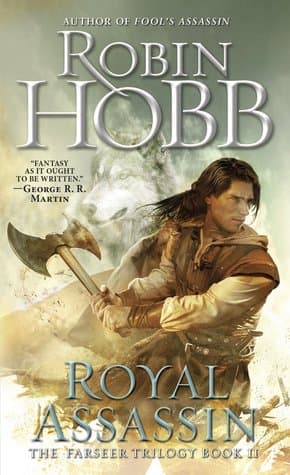
Synopsis
Covers the whole plot, including the ending.
- Difficulty
- Medium
- Pacing
- Moderate
- Mood
- Dark, Melancholy, Suspenseful, Introspective
- Read it if
- You enjoy complex, character-driven fantasy with deep emotional stakes and political intrigue, where the protagonist faces constant internal and external struggles.
- Skip it if
- You prefer fast-paced action-heavy fantasy or stories with a clear, morally unambiguous hero.
Royal Assassin Plot Summary
Covers the whole plot, including the ending.
A Crippled Assassin's Retreat and Reluctant Return
After his mission to the Mountain Kingdom, FitzChivalry Farseer has severe, crippling injuries and deep bitterness. He retreats to the remote cabin of his former mentor, Burrich, in the mountains, trying to escape his life as a royal assassin and the pain it caused. He tries to live a simple life, tending to animals and dealing with his physical and emotional scars. However, urgent messages from Buckkeep, particularly from Chade and King Shrewd, repeatedly disturb his peace, asking him to return. The increasing threat of the Red-Ship Raiders and the king's declining health create urgency. Despite his initial resistance and desire to abandon his oath, his deep affection for Molly and his loyalty to the Farseer crown eventually make him return to Buckkeep Castle, leaving his newfound, fragile calm behind.
Buckkeep's Decay and the Skill's Strain
Upon his return to Buckkeep, Fitz finds the castle in disrepair, reflecting the kingdom's declining fortunes. King Shrewd is visibly aging and increasingly frail, his health steadily worsening under the mysterious, debilitating influence of the Skill. Prince Verity is busy fortifying the coastal defenses against the Red-Ship Raiders using the Skill, leaving daily governance to the increasingly ambitious and manipulative Prince Regal. Fitz sees the court's growing divisions and the subtle power plays orchestrated by Regal, who openly dislikes Fitz and tries to lessen his influence. The atmosphere is tense, filled with suspicion and fear, as the Red-Ship threat is large and the Farseer line appears to be crumbling, leaving Fitz feeling isolated and vulnerable amidst familiar yet changed surroundings.
The Red-Ship Menace and the Forged
The Red-Ship Raiders continue their brutal attacks on the Six Duchies' coastline, burning villages and abducting inhabitants. Fitz learns the truth behind the raiders' most insidious weapon: the 'Forging.' Victims of Forging are returned to the Duchies, stripped of their memories, loyalty, and basic humanity, becoming soulless husks that wander aimlessly, committing petty theft and violence. These 'Forged' individuals are a constant, chilling reminder of the raiders' cruelty and a psychological weapon, spreading fear and distrust among the people. Their presence creates a sense of vulnerability and despair, as people realize that even surviving a raid does not guarantee escape from a fate worse than death. Fitz sees firsthand the devastating impact of the Forged on the morale of the populace and the integrity of the kingdom.
Verity's Desperate Quest and Regal's Ascent
Convinced that the only way to truly defeat the Red-Ship Raiders is to find the mythical Elderlings and awaken their ancient magic, Prince Verity decides to leave Buckkeep and embark on a dangerous quest into the Mountain Kingdom. This decision, though born of desperation and courage, leaves a dangerous power vacuum. With King Shrewd increasingly unable to act due to the Skill, Prince Regal uses the opportunity to gain power. Regal actively undermines Verity's authority, spreads rumors of his madness, and begins to openly take control of the Six Duchies, becoming the de facto ruler. His actions are driven by a ruthless ambition to secure the throne for himself, even if it means sacrificing the kingdom's stability and the lives of those loyal to Verity.
Fitz's Divided Loyalties and Molly's Peril
Fitz is torn between his deep loyalty to Prince Verity, who has departed on his quest, and his love for Molly. He continues to serve the Farseer line, often acting as King Shrewd's eyes and ears, and trying to protect the kingdom in Verity's absence. However, his personal life becomes more intertwined with the court's dangers. Molly, now pregnant with Fitz's child, becomes a vulnerable target. Her connection with Fitz, along with Regal's growing tyranny, puts her in direct danger. Fitz tries to protect her and their unborn child, but the demands of his duties and Regal's watchful eye make this an almost impossible task. The constant threat to Molly adds immense emotional weight to Fitz's already burdened shoulders, forcing him to make difficult choices between his duty and his heart.
The Skill-Drain and King Shrewd's Decline
King Shrewd's health declines quickly, made worse by Prince Regal's deliberate and cruel manipulation of the Skill. Regal uses the Skill to drain Shrewd's life force, weakening his mind and body to secure his own claim to the throne. Fitz discovers that he has a unique connection to Shrewd through the Skill, becoming a vital anchor that inadvertently prolongs the king's life, though at great personal cost. Fitz experiences the king's pain and confusion, finding himself unable to fully escape the king's dying thoughts and emotions. This involuntary connection, while important for Shrewd's survival, also makes Fitz a target for Regal's plans, as Regal seeks to break this link to hasten Shrewd's death and solidify his own power. Fitz is forced into a painful closeness with the king's slow death.
Regal's Treachery and Molly's Escape
Prince Regal's treachery becomes more obvious and dangerous. He frames Fitz for various crimes, including the alleged poisoning of King Shrewd, and arranges attacks on Fitz's allies. Realizing the extreme danger Molly and their unborn child are in, Fitz, with the help of Burrich and Kettricken, arranges for Molly's escape from Buckkeep. She is sent away to a remote, safe location, cutting off Fitz's direct contact with her but ensuring her survival from Regal's wrath. This separation is a painful necessity, leaving Fitz isolated and heartbroken, but resolved to protect his family. Regal's actions push Fitz to the brink, strengthening his resolve to resist the tyrannical prince and protect what little remains of the Farseer legacy.
The Skill-Cot and Fitz's Agony
Regal's plans end in Fitz's capture and imprisonment. He is placed on the dreaded Skill-cot, a device designed to amplify and drain the Skill, used as a tool of torture and interrogation by Regal's White Prophets. Fitz endures horrific physical and mental torment, as his Skill is relentlessly siphoned away, leaving him in excruciating pain and bordering on madness. During this ordeal, he experiences visions and fragmented memories, connecting him to the dying King Shrewd and the distant Verity. The Skill-cot is a tool of both physical destruction and psychological manipulation, designed to break Fitz and get information, particularly about Verity's whereabouts. Fitz's resilience is tested to its absolute limit as he fights to maintain his sanity and protect the secrets he holds.
Verity's Return and the Dragon's Awakening
During Fitz's torture on the Skill-cot, Verity's Skill-presence briefly appears at Buckkeep. Though not physically present for long, his powerful Skill-message confirms that he is alive and making progress in his quest to find the Elderlings. More importantly, he reveals that the way to defeat the Red-Ship Raiders is to awaken a dragon, a concept that seems mythical and impossible to most. This revelation, communicated through the Skill, invigorates Fitz and his remaining allies, offering a glimmer of hope amidst the despair. Verity's brief, powerful return is an important plot point, refocusing the efforts of those loyal to the Farseer throne and providing a clear, though daunting, objective for the kingdom's salvation. It also further highlights the effectiveness and danger of the Skill.
Fitz's Escape and Faking His Death
Recognizing that Fitz is near death and that his continued existence in Buckkeep is a threat to Regal, Chade and Burrich conspire to stage Fitz's death. They manage to free him from the Skill-cot, though he is barely alive and severely disfigured. Through stealth, manipulation, and the use of a specially prepared body (likely the corpse of another Skill-drained victim), they convince Regal and his court that FitzChivalry Farseer has died from his injuries. Fitz is then smuggled out of Buckkeep, disguised and hidden, his true identity concealed. This 'death' allows Fitz to escape Regal's immediate grasp and gives him a chance to heal and regroup, though as a ghost in his own kingdom, free from the direct threats of the court but forever changed.
The White Prophet's Prophecy and Fitz's New Path
Following his escape, Fitz is taken to a hidden location where he slowly begins to recover. It is revealed that Fitz is a White Prophet, a rare individual whose life is a living prophecy, a tool of fate. His 'death' at Buckkeep is not an end but an important moment in his prophetic journey, setting him on a new, undefined path. This revelation, delivered by the mysterious figures who aid in his recovery, places a heavy burden on Fitz, as he deals with the idea that his life is not his own but dictated by a larger, unseen force. He is now a man without a name, without a clear purpose beyond the vague whispers of prophecy, forced to abandon his past identity and embrace a future he cannot comprehend, yet is deeply bound to. He is left with a profound sense of loss and overwhelming uncertainty about his next steps.
Royal Assassin Characters
FitzChivalry Farseer
Protagonist
Royal bastard, assassin, and reluctant hero burdened by duty and love.
FitzChivalry is the illegitimate son of Prince Chivalry, trained as a royal assassin and skilled in both the Skill and the Wit. In 'Royal Assassin,' he is deeply scarred, both physically and emotionally, from his previous mission. He yearns for a simple life with Molly, but his innate loyalty to the Farseer throne and his personal bonds continually draw him back into court intrigue. He is often conflicted, struggling with his identity, his duties, and the sacrifices he is forced to make. His compassion and sense of justice are strong, but he is also prone to self-pity and anger, making him a complex and relatable character. He is deeply connected to King Shrewd and Prince Verity through the Skill, and to Nighteyes through the Wit.
Relationships: King Shrewd (Liege lord and grandfather figure, connected by Skill); Prince Verity (Loyal half-uncle, mentor, and Skill-partner); Prince Regal (Bitter enemy and half-uncle, constantly seeking his downfall); Molly Chandler (Deeply beloved partner, pregnant with his child); Burrich (Surrogate father, mentor, and loyal friend); Chade Fallstar (Mentor in assassination, half-uncle, and co-conspirator); Nighteyes (Wit-bonded wolf, loyal companion, and closest confidant)
King Shrewd
Supporting
The aging, ailing king of the Six Duchies, weakened by the Skill and Regal's manipulations.
King Shrewd is the reigning monarch of the Six Duchies, a wise but increasingly frail ruler. In 'Royal Assassin,' his health rapidly declines due to a combination of old age, the strain of Skill-casting to protect his kingdom, and the insidious Skill-drain orchestrated by Prince Regal. He is often confined to his chambers, his mind clouded and his body weak, yet he retains moments of lucidity and a deep concern for his kingdom. He relies heavily on Fitz and Verity, and his slow, agonizing death is a central tragedy of the novel, symbolizing the decay of the Farseer line and the kingdom itself.
Relationships: FitzChivalry Farseer (Grandfather, liege, and Skill-anchor); Prince Verity (Loyal son and heir); Prince Regal (Ambitious son and betrayer)
Prince Verity
Supporting
The dedicated heir, consumed by his quest to save the Six Duchies from the Red-Ship Raiders.
Prince Verity is the eldest legitimate son of King Shrewd and the rightful heir to the Farseer throne. He is a man of immense dedication and courage, prioritizing the safety of his kingdom above all else. In 'Royal Assassin,' he becomes obsessed with finding the mythical Elderlings, believing they hold the key to defeating the Red-Ship Raiders. He spends countless hours Skill-fortifying the coastline, draining his own life force, before embarking on his desperate quest to the Mountain Kingdom. Verity is a powerful Skill-user, albeit an untrained one, and his absence leaves a significant void in Buckkeep, allowing Regal to seize power. He represents the selfless duty of the Farseer line.
Relationships: FitzChivalry Farseer (Loyal half-nephew, Skill-partner, and confidant); King Shrewd (Father and liege); Kettricken (Devoted wife)
Prince Regal
Antagonist
The ambitious and cruel younger prince, who schemes to usurp the throne.
Prince Regal is King Shrewd's youngest legitimate son and the primary antagonist of 'Royal Assassin.' He is characterized by his vanity, cruelty, and boundless ambition. With Verity absent and Shrewd ailing, Regal systematically consolidates power, using manipulation, propaganda, and even the Skill to undermine his family and seize control. He despises Fitz and sees him as a constant threat to his aspirations. Regal is a master of court intrigue, surrounded by sycophants, and his actions drive much of the conflict, leading to Fitz's torture and 'death.' He embodies the corrupting influence of unchecked power and selfishness.
Relationships: FitzChivalry Farseer (Bitter enemy, half-nephew, and target of his schemes); King Shrewd (Father, whom he actively undermines and drains); Prince Verity (Older brother, whom he seeks to discredit and replace)
Molly Chandler
Supporting
Fitz's beloved, a candlemaker who becomes entangled in court politics.
Molly is a pragmatic and strong-willed candlemaker from Buckkeep Town, and Fitz's secret love interest. She represents the possibility of a normal, peaceful life for Fitz, a stark contrast to his duties as an assassin. In 'Royal Assassin,' her relationship with Fitz deepens, and she becomes pregnant with his child. This pregnancy, however, makes her a vulnerable target for Prince Regal's machinations, forcing Fitz to make difficult choices to protect her. Molly is resilient and independent, but her safety ultimately depends on Fitz's sacrifices. Her forced departure from Buckkeep is a major emotional blow to Fitz, symbolizing his loss of a normal future.
Relationships: FitzChivalry Farseer (Beloved partner and father of her child); Burrich (Friend and protector, who helps facilitate her escape)
Burrich
Supporting
Former Stablemaster, Fitz's surrogate father, and fiercely loyal protector.
Burrich is the former Stablemaster of Buckkeep and Fitz's guardian and surrogate father. He is a stern, practical, and deeply loyal man, with a strong moral compass. He disapproves of Fitz's Wit-bond with Nighteyes but cares deeply for Fitz's well-being. In 'Royal Assassin,' he provides Fitz with refuge after his crippling mission and later becomes instrumental in protecting Molly and orchestrating Fitz's escape and 'death.' Burrich often acts as Fitz's conscience and a voice of reason, though he is not afraid to take decisive, even brutal, action when necessary. His unwavering loyalty to the Farseer line and to Fitz personally is a constant source of support.
Relationships: FitzChivalry Farseer (Surrogate father, mentor, and fiercely loyal friend); Molly Chandler (Protector and friend); Chade Fallstar (Reluctant ally in protecting Fitz)
Chade Fallstar
Supporting
The King's Assassin, Fitz's mentor, and master of intrigue.
Chade is King Shrewd's personal assassin, a master of poisons, disguises, and political manipulation. He is Fitz's half-uncle and mentor in the art of assassination. In 'Royal Assassin,' Chade is a key player in the court's covert operations, always working behind the scenes to protect the Farseer line. He is pragmatic and ruthless when necessary, but also deeply committed to the kingdom's survival. He plays a crucial role in trying to mitigate Regal's influence and later, in orchestrating Fitz's escape and faked death, demonstrating his deep, albeit often hidden, affection for Fitz. Chade represents the darker, more practical side of Farseer loyalty.
Relationships: FitzChivalry Farseer (Mentor, half-uncle, and co-conspirator); King Shrewd (Liege and long-time companion); Burrich (Reluctant ally)
Nighteyes
Supporting
Fitz's Wit-bonded wolf, his loyal companion and emotional anchor.
Nighteyes is a wild wolf with whom Fitz shares a deep, telepathic Wit-bond. He is Fitz's most trusted companion and emotional anchor, providing comfort and a unique perspective on the human world. In 'Royal Assassin,' Nighteyes' presence is a constant source of strength and companionship for Fitz, especially during his darkest moments. Their bond allows for shared senses and thoughts, making them an inseparable pair. Nighteyes' loyalty is absolute, and he often acts on Fitz's behalf, providing protection and intelligence. He represents the primal, instinctual side of Fitz and a connection to nature that contrasts sharply with the artificiality of court life.
Relationships: FitzChivalry Farseer (Wit-bonded companion, best friend, and protector)
Kettricken
Supporting
Mountain Princess and Verity's wife, who adapts to Buckkeep's intrigues.
Kettricken is the strong-willed and honorable princess from the Mountain Kingdom, married to Prince Verity. She initially struggles to adapt to the customs and intrigues of Buckkeep but quickly proves her resilience and intelligence. In 'Royal Assassin,' she becomes a steadfast ally to Fitz, trusting him implicitly and aiding him in protecting Molly and resisting Regal. Her unwavering loyalty to Verity and her growing understanding of the Six Duchies' plight make her a significant figure. She embodies strength, dignity, and a sense of justice that stands in stark contrast to Regal's corruption.
Relationships: Prince Verity (Devoted wife); FitzChivalry Farseer (Trusted ally and friend)
The Forged
Mentioned
Victims of the Red-Ship Raiders, stripped of humanity and loyalty.
The Forged are the most insidious weapon of the Red-Ship Raiders. They are victims who have been subjected to a horrifying process that strips them of their memories, empathy, and sense of self, leaving them as mindless, wandering husks. They retain just enough instinct to steal and cause petty mischief, sowing fear and distrust in the coastal towns. Their existence is a constant, chilling reminder of the raiders' cruelty and a psychological weapon, as people realize that even surviving a raid can lead to a fate worse than death. They represent the ultimate dehumanization and destruction of identity.
Royal Assassin Themes
Duty vs. Personal Desire
Fitz's entire journey in 'Royal Assassin' is a constant battle between his duty to the Farseer crown, his commitment to King Shrewd and Verity, and his personal desire for a normal life with Molly. He repeatedly tries to escape his obligations, retreating to the mountains or wanting domesticity, but circumstances and his own inherent loyalty always pull him back into the dangerous world of court intrigue and assassination. This conflict is clear when he reluctantly returns to Buckkeep despite his injuries, and when he must choose to send Molly away for her safety, sacrificing his own happiness for the greater good and her survival.
“I was a king's man, and no matter how much I might wish to be only Fitz, a man who loved Molly and wished to live quietly, I could not deny the blood that had been given me, nor the oath I had sworn.”
The Corrupting Nature of Power
Prince Regal embodies this theme. His ambition for the throne leads him to increasingly cruel and manipulative acts. He drains King Shrewd's life force through the Skill, frames Fitz for crimes, and persecutes anyone loyal to Verity or who stands in his way. Regal's unchecked desire for power corrupts him completely, making him a tyrannical figure willing to sacrifice his kingdom's well-being and his family's lives for his own gain. His actions show how power, when sought for selfish ends, can destroy morality and cause great suffering for others.
“Power, Fitz, is a drug. The more you have, the more you want. And the more you have, the more you are willing to do to keep it.”
Loss of Identity and Trauma
Fitz's journey is deeply marked by trauma and a loss of identity. His crippling injuries at the beginning of the book leave him physically and emotionally broken, making him question his purpose. The constant demands of his assassin's role and the Skill's intrusive nature erode his sense of self. This theme ends in his torture on the Skill-cot, which strips him of his sanity and ultimately leads to his staged death, forcing him to abandon his name and past identity entirely. The 'Forged' also represent a horrifying example of this theme, as they are literally stripped of their humanity and memories, becoming empty shells.
“I was no longer FitzChivalry Farseer, royal bastard and assassin. I was a ghost, a nameless thing, born of pain and deceit.”
The Burden of Prophecy and Fate
While hinted at in the first book, 'Royal Assassin' explicitly introduces Fitz as a 'White Prophet,' a living tool of fate whose life is a prophecy. This revelation, delivered after his 'death,' places a heavy burden on Fitz, suggesting that his choices are not entirely his own and that his suffering serves a larger, predetermined purpose. This theme explores the tension between free will and destiny, as Fitz deals with the idea that his entire life, including his pain and sacrifices, is part of a grander design. It sets the stage for his future role as an important figure in the fate of the Six Duchies.
“Your life is not your own, FitzChivalry. It is a story, and you are its teller, whether you wish to be or no. Every choice you make, every path you walk, is part of the weaving.”
The Power and Peril of Connection
The novel explores various forms of connection: the Wit-bond, the Skill-bond, and emotional human relationships. Fitz's Wit-bond with Nighteyes provides companionship and strength but is also feared and outlawed by society. His Skill-bond with King Shrewd and Verity is vital for communication and protection but also exposes him to their pain and vulnerabilities, making him a target. His love for Molly brings joy but also puts her in great danger. These connections are sources of both great power and great peril, showing how deeply intertwined lives can be and the sacrifices they demand.
“To love is to be vulnerable. To care is to be hurt. But to be alone… that is the deepest wound of all.”
Plot Devices & Literary Techniques
The Skill-Cot
A device used to torture and drain Skill-users.
The Skill-cot is a horrifying instrument of torture introduced by Prince Regal and his White Prophets. It amplifies and drains the Skill from its victim, causing immense physical and mental agony. Fitz's prolonged torture on the Skill-cot serves as a pivotal plot point, pushing him to the brink of death, extracting information, and ultimately leading to his disfigurement and staged demise. It is a symbol of Regal's cruelty and the destructive potential of the Skill when wielded for malevolent purposes. Its use highlights the vulnerability of Skill-users and the brutal tactics employed by Regal to consolidate his power and eliminate opposition.
The Forged
A psychological weapon used by the Red-Ship Raiders.
The Forged are victims of the Red-Ship Raiders who have been stripped of their identity, memories, and humanity, leaving them as empty, amoral husks. They are a horrifying plot device that not only demonstrates the extreme cruelty of the Raiders but also acts as a profound psychological weapon against the Six Duchies. Their presence spreads fear, distrust, and hopelessness, undermining morale and destabilizing society from within. The Forged symbolize the ultimate loss of self and are a constant, chilling reminder of the existential threat facing the kingdom, making the fight against the Raiders about more than just physical defense.
The Skill-Drain
A deliberate use of the Skill to weaken and kill.
The Skill-drain is a malicious application of the Skill, primarily employed by Prince Regal against King Shrewd. By subtly or overtly siphoning off the king's life force through the Skill, Regal hastens Shrewd's decline, weakening his mind and body to clear his path to the throne. Fitz inadvertently becomes an anchor for Shrewd, prolonging his life but also experiencing the king's pain. This device highlights the insidious nature of Regal's ambition and the darker capabilities of the Skill, turning a powerful tool of connection into a weapon of slow, agonizing murder. It underscores the danger of untrained or malevolent Skill-use.
Verity's Elderling Quest
A desperate journey to find ancient, mythical allies.
Prince Verity's departure on a desperate quest to find the mythical Elderlings is a crucial plot device that drives much of the narrative. His absence leaves a power vacuum at Buckkeep, allowing Prince Regal to seize control and creating a sense of urgency and despair. The quest itself provides a distant, almost mythical hope for the kingdom's salvation, a goal that seems impossible but necessary. It shifts the focus from purely defensive measures to a proactive, magical solution, setting up future conflicts and revelations. The ambiguity of the Elderlings' existence adds to the desperation and faith required for Verity's journey.
The Wit-Bond
A telepathic and empathic link between human and animal.
The Wit-bond, particularly between Fitz and Nighteyes, is a fundamental plot device that provides Fitz with companionship, enhanced senses, and a unique perspective. It allows for direct communication and shared experiences, making Nighteyes an invaluable ally and confidant. However, the Wit is also feared and outlawed in the Six Duchies, making Fitz's bond a dangerous secret. It represents a connection to nature and instinct that contrasts with the more cerebral Skill. The Wit-bond offers Fitz emotional grounding and practical assistance, but also puts him at risk of being discovered and persecuted for practicing the 'beast magic.'
Royal Assassin Quotes
“I had always thought that the best way to tell a story was to begin at the beginning, and end at the end. But I was learning that there were other ways to tell stories, and that sometimes the most effective way was to begin in the middle, or even at the end, and then circle back around to the beginning.”
“The world is not a safe place, Fitz. It is full of dangers, and not all of them have teeth and claws. Some of them wear fine clothes and speak with honeyed words.”
“A man who cannot control his own mind is a slave to the minds of others.”
“There are times when the only thing a man can do is to hold on, and wait. And pray that what he holds on to is strong enough to hold him.”
“To be truly alone, one must be alone in one's own mind.”
“Sometimes the hardest thing to do is to simply exist, to breathe, to keep moving forward when every fiber of your being screams for you to stop.”
“Loyalty is a weapon, Fitz. A sharp one. But it can cut both ways.”
“It is not the strength of the body that matters, but the strength of the will.”
“The hardest part of any journey is the first step. And sometimes, the last.”
“Love is not a thing to be earned. It is a thing to be given. Freely, and without expectation.”
“There is a difference, Fitz, between knowing a thing and understanding a thing.”
“Sometimes the best defense is to be underestimated.”
“The weight of a crown is not measured in gold, but in the lives it touches.”
“To serve is to sacrifice. To rule is to serve.”
Quiz
10 questions on the plot and the characters. Each answer comes with a short explanation.
Question 1
What is the primary reason Fitz initially attempts to abandon his oath to King Shrewd at the beginning of 'Royal Assassin'?
- He is tired of the political intrigue at Buckkeep.
- He feels betrayed by Verity's departure for the Mountains.
- He is physically and mentally broken from his previous mission.
- He wants to pursue a life with Molly away from the court.
Show answer
C. He is physically and mentally broken from his previous mission. Fitz begins 'Royal Assassin' severely crippled and traumatized after his mission in the previous book, leading him to seek refuge and abandon his duties in the mountains, feeling he can no longer serve.
Question 2
Which character frequently uses the Skill to communicate with Fitz, often providing guidance or warnings, throughout the book?
- King Shrewd
- Chade Fallstar
- Verity Farseer
- The Fool
Show answer
C. Verity Farseer Prince Verity, despite being away on his quest to awaken the Elderlings, frequently uses the Skill to communicate with Fitz, often relying on Fitz to act as his eyes and ears at Buckkeep and relaying vital information or commands.
Question 3
What specific affliction do the Red-Ship Raiders inflict upon their victims, leaving them 'demented'?
- A magical plague that causes physical decay.
- They 'Forgo' the victims, stealing their memories and wills.
- They use a poison that induces madness and hallucinations.
- They burn out their eyes, causing sensory deprivation and insanity.
Show answer
B. They 'Forgo' the victims, stealing their memories and wills. The Red-Ship Raiders use a horrific form of Skill magic called Forging, which steals the victims' identities, memories, and wills, leaving them as empty, often violent, shells, referred to as 'Forgo'.
Question 4
Which character is widely suspected of poisoning King Shrewd throughout the book?
- Regal Farseer
- Lady Patience
- Lord Bright
- Molly Chandler
Show answer
A. Regal Farseer Prince Regal is the primary suspect in poisoning King Shrewd, as he stands to gain the most from his father's incapacitation and eventual death, allowing him to seize power and influence at court.
Question 5
What significant personal sacrifice does Fitz make towards the end of the book to protect those he loves and serve the kingdom?
- He publicly denounces King Shrewd to expose Regal's treachery.
- He fakes his own death to escape Regal's control and continue his fight from the shadows.
- He permanently severs his bond with Nighteyes to avoid detection.
- He agrees to marry a noblewoman he doesn't love for political alliance.
Show answer
B. He fakes his own death to escape Regal's control and continue his fight from the shadows. To protect Molly and others from Regal's wrath and to continue his work against the prince, Fitz undergoes a ritual that leaves him appearing dead, allowing him to escape Buckkeep and operate covertly.
Question 6
Which character forms a deep and fundamental bond with Fitz through the Wit, becoming his constant companion and confidant?
- Molly Chandler
- Nighteyes, the wolf
- Burrich
- Patience
Show answer
B. Nighteyes, the wolf Nighteyes, the wolf, becomes Fitz's Wit-partner, sharing thoughts, senses, and emotions. This bond is central to Fitz's character development and survival throughout the book.
Question 7
What is the primary motivation behind Prince Regal's actions and schemes throughout 'Royal Assassin'?
- To secure a lasting peace treaty with the Mountain Kingdom.
- To usurp the throne and gain absolute power for himself.
- To assist Verity in his quest to awaken the Elderlings.
- To eliminate the Red-Ship Raiders from the coast.
Show answer
B. To usurp the throne and gain absolute power for himself. Regal's every move, from undermining Verity to poisoning King Shrewd and persecuting Fitz, is driven by his overwhelming ambition to become king and rule the Six Duchies.
Question 8
How does Fitz attempt to protect Molly and her child from Regal's persecution after his own 'death'?
- He sends them to the Mountain Kingdom under Verity's protection.
- He arranges for Burrich to take them away and care for them, giving Molly a new identity.
- He hides them within the secret passages of Buckkeep Castle.
- He uses the Skill to erase their memories of him, making them safe from association.
Show answer
B. He arranges for Burrich to take them away and care for them, giving Molly a new identity. After his 'death', Fitz entrusts Molly and their unborn child to Burrich, who takes them away from Buckkeep to a new life and identity, ensuring their safety from Regal's continued malice.
Question 9
What is the significant political event that occurs during the course of 'Royal Assassin' which further destabilizes the Six Duchies?
- The signing of a peace treaty with the Outislanders.
- King Shrewd abdicates the throne to Verity.
- The capital of the Six Duchies is moved from Buckkeep to Tradeford.
- A new alliance is formed with the Chalced States.
Show answer
C. The capital of the Six Duchies is moved from Buckkeep to Tradeford. As the Red-Ship Raiders continue their attacks and Buckkeep seems increasingly vulnerable, Regal manipulates events to have the capital moved to Tradeford, a move that weakens the coastal duchies and strengthens his own power base.
Question 10
The theme of 'sacrifice' is central to the book. What is the 'ultimate sacrifice' hinted at in the book's description regarding Fitz's role?
- Giving up his love for Molly to become a full-time assassin.
- Dying and being reborn through the Skill, losing his previous identity.
- Abandoning his royal heritage to live as a commoner.
- Forfeiting his Wit-bond with Nighteyes for the kingdom's safety.
Show answer
B. Dying and being reborn through the Skill, losing his previous identity. Fitz's 'ultimate sacrifice' refers to his 'death' and subsequent rebirth through the Skill, a process that fundamentally changes him and allows him to escape Regal's grasp, but at the cost of his former life and identity.
Royal Assassin FAQ
What is 'Royal Assassin' about?
'Royal Assassin' is the second book in Robin Hobb's Farseer Trilogy, continuing the story of FitzChivalry Farseer. After barely surviving his mission to the Mountain Kingdom, Fitz returns to Buckkeep crippled and bitter, only to be drawn back into the perilous court intrigues and the escalating war against the Red-Ship Raiders, who are leaving Wit-scrambled victims in their wake. He must navigate treacherous political waters while protecting the ailing King Shrewd and Prince Verity.
Why should I read 'Royal Assassin'?
You should read 'Royal Assassin' for its deep character development, intricate political intrigue, and the emotional weight of Fitz's journey. It masterfully explores themes of duty, sacrifice, and the burden of unwanted power, solidifying Fitz's complex relationships with characters like Verity, Chade, and Molly, and pushing him to his absolute limits both physically and mentally. The book significantly raises the stakes from the first installment.
What is the background/setting of 'Royal Assassin'?
The story is primarily set in Buckkeep Castle, the capital of the Six Duchies, a coastal kingdom constantly under siege by the Red-Ship Raiders from the Outislands. The kingdom is in a state of crisis, with its people suffering from the Raiders' attacks and their mind-destroying 'Forgetting.' Internally, the court is rife with political machinations, particularly from Prince Regal, as King Shrewd's health deteriorates.
What are the most memorable quotes?
Memorable quotes include 'A man who is king must be a king every day,' emphasizing the relentless burden of leadership. Another is, 'The world is not a safe place, Fitz. But you are safer in it with a friend than without one,' highlighting the importance of connection amidst danger. And 'Duty is a concept created by the powerful to make the weak work for them,' reflecting Fitz's growing cynicism.
What writing style does the author use?
Robin Hobb employs a first-person narrative through FitzChivalry's perspective, offering deep introspection and emotional honesty. Her style is richly descriptive, evocative, and often melancholic, focusing heavily on character psychology and the internal struggles of her protagonist. She uses a detailed, immersive approach that builds a strong connection between the reader and Fitz's experiences.
What minor details add significant meaning?
The subtle but persistent use of the Skill-bond between Fitz and Verity, even when Fitz resists it, underscores their inherent connection and Verity's reliance on Fitz. Additionally, the constant physical pain Fitz endures from his previous mission serves as a continuous reminder of his sacrifices and the lasting consequences of his loyalty, shaping his bitterness and his decisions.
What are some subtle foreshadowing moments?
The growing despair and detachment Fitz feels as he uses the Wit, despite his efforts to suppress it, subtly foreshadows his eventual deeper embrace of his animalistic nature and the consequences of neglecting his human ties. Regal's increasing influence over King Shrewd and his subtle undermining of Verity's authority also foreshadow his more overt treachery later in the book and trilogy.
What unexpected character connections exist?
One unexpected connection is Fitz's growing, albeit complicated, bond with the Fool, who becomes a confidante and a source of cryptic wisdom, revealing a deeper understanding of Fitz's fate. Another is the unexpected, brief, but poignant connection Fitz makes with the starving wolf, Nighteyes, which evolves into a profound and life-altering Wit-bond, becoming a central relationship in his life.
What are unspoken character motivations?
Prince Regal's unspoken motivation is a deep-seated jealousy and desire for power, stemming from his belief that he is the rightful heir and his resentment of Verity and Fitz. Chade's unspoken motivation is a profound loyalty to the Farseer line and a willingness to make ruthless decisions to protect the kingdom, even if it means sacrificing Fitz's well-being.
What psychological complexities do characters exhibit?
Fitz exhibits immense psychological complexity, grappling with his identity as both a royal bastard and the King's Man, his forbidden Wit-bond, and his duty versus personal desires. King Shrewd, in his decline, shows the psychological toll of kingship and the vulnerability of a once-powerful mind under duress, leading to paranoia and wavering judgment.
What are the major emotional turning points?
A major emotional turning point is Fitz's decision to return to Buckkeep despite his vow, driven by his love for Molly and his sense of duty to Verity, marking his acceptance of his fate. Another is his forced separation from Molly when she leaves Buckkeep, which devastates him and solidifies his commitment to his path as the King's Man, free of personal attachments.
How do relationship dynamics evolve?
Fitz's relationship with Verity deepens from one of servant and prince to a profound, almost brotherly bond, solidified by their shared Skill-bond and common enemy. His romantic relationship with Molly is tested and ultimately shattered by his duties and the dangers of court, forcing him to choose between a normal life and his role as assassin. His bond with Nighteyes evolves into a powerful, symbiotic connection that redefines his understanding of self.
Which parts remain ambiguous or open-ended?
The precise nature and limits of the Forgetting, inflicted by the Red-Ship Raiders, remain somewhat ambiguous, leaving readers to wonder about its true magical source and potential cures. The long-term effects of Fitz's constant use of the Skill and the Wit on his own sanity and humanity are also left open-ended, hinting at future transformations.
What are controversial scenes or decisions?
One controversial decision is Fitz's repeated, often self-destructive, choice to prioritize his duty to the Farseer crown over his personal happiness, particularly his relationship with Molly. Another is the Council's decision to allow King Shrewd to continue ruling despite his obvious mental decline, which many readers find irresponsible and a catalyst for further tragedy.
'Royal Assassin' ending explained: how it ends & what it means
'Royal Assassin' ends with Fitz faking his own death by drinking poison to escape Regal's torture and the political machinations at Buckkeep. He is buried in a shallow grave, but secretly revived by Burrich and Chade, using the Wit and Skill. This ending signifies Fitz's complete rejection of his former life and identity, marking a profound sacrifice for the kingdom, and setting him on a new, more solitary path, embracing his animalistic nature with Nighteyes.
About the author

Robin Hobb is an American author known for her contributions to the fantasy genre. She is best known for her series featuring the character FitzChivalry Farseer, including the novels "Royal Assassin" and "Assassin's Quest." Hobb's works often explore themes of identity, loyalty, and the complexities of human relationships.
Similar books
- A Game of Thrones
George R.R. Martin
4.5 (2M) average on GoodreadsFantasyFeatures intricate political maneuvering, morally grey characters, and a sense of impending doom.
- The Name of the Wind
Patrick Rothfuss
4.5 (716k) average on GoodreadsFantasyFocuses on a gifted but troubled protagonist's journey and struggles, with a strong emphasis on internal monologue.
- The Way of Kings
Brandon Sanderson
4.6 (305k) average on GoodreadsFantasyEpic fantasy with a large cast, significant world-building, and characters struggling with trauma and duty.
- A Clash of Kings
George R.R. Martin
4.4 (788k) average on GoodreadsFantasyRoyal Assassin focuses on a single, deeply introspective protagonist, exploring psychological depth and emotional trauma. A Clash of Kings offers a broader, multi-perspective narrative with a strong emphasis on large-scale political machinations, war, and a vast ensemble cast, prioritizing epic scope over intense singular character interiority.
- The Great Hunt
Robert Jordan
4.2 (228k) average on GoodreadsFantasyRoyal Assassin delves into the personal and psychological burdens of its protagonist within a more confined, character-driven narrative. The Great Hunt is part of a sprawling epic fantasy series, focusing on a grand quest, an ensemble cast, and extensive world-building, with less emphasis on the intense internal psychological struggles that define Hobb's work.
- Harry Potter and the Sorcerer's Stone
J.K. Rowling
4.5 (7M) average on GoodreadsFantasyRescued from a miserable life under the stairs, an orphaned boy discovers he's a wizard destined for a magical school, where he uncovers a dangerous secret tied to the dark wizard who murdered his parents.




Enjoyed the summary?
A summary gives you the shape of the book. The book itself has the detail, the examples and the voice.
Find Royal Assassin on AmazonAs an Amazon Associate, BookBrief earns from qualifying purchases. How we're funded