
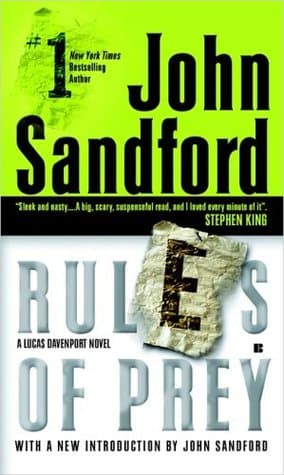
Synopsis
Covers the whole plot, including the ending.
- Difficulty
- Medium
- Pacing
- Fast
- Mood
- Suspenseful, Dark, Gritty, Intense
- Read it if
- You love intense, psychologically driven thrillers with a brilliant detective pitted against an equally brilliant serial killer, featuring cat-and-mouse games and dark themes.
- Skip it if
- You prefer cozy mysteries, less violent content, or stories with a more straightforward, less morally ambiguous protagonist.
Rules of Prey Plot Summary
Covers the whole plot, including the ending.
The First Victim and the Taunting Note
The book starts with the murder of wealthy Minneapolis businessman William Compton. His throat is cut, and a note is found pinned to his chest: 'Rules of Prey.' The note is a poem, suggesting a game between the killer and police. Lieutenant Lucas Davenport, a decorated but controversial homicide detective, is called to the scene. Davenport, known for his methods and intelligence, sees the killer's taunt and the careful nature of the crime, setting up a long investigation. The lack of motive and the theatrical presentation suggest a killer who enjoys the act and outsmarting law enforcement.
The Second Victim and the Killer's Pseudonym
Soon, Dr. Evan Cooper, a respected surgeon, is murdered similarly. This time, the killer leaves a more detailed message, still referencing the 'Rules of Prey' but also including a drawing of a dog. The media calls the killer 'Maddog.' Lucas Davenport and his team, including detectives Del Capslock and Lily Rothenberg, cannot find a connection between the victims beyond their prominence and wealth. Davenport starts to understand that the killer is not just a murderer; he plans his crimes and enjoys the psychological warfare with police. The 'Maddog' name shows the killer's predatory nature and enjoyment of the hunt.
Davenport's Investigation and Personal Life
As the Maddog investigation continues, Lucas Davenport's personal life is complicated. He has a casual relationship with Sarah Jensen, a psychiatrist, and still has feelings for his ex-wife, Jenny. His main focus is the case, and he spends hours reviewing evidence and profiles, trying to understand the killer. He visits Sarah for insights into a serial killer's mind, using their talks to refine his understanding of Maddog's reasons and methods. His approach often puts him at odds with his superiors, especially Chief Mike Francisco, but his history of solving difficult cases gives him some freedom.
The Third Victim and the Growing Frustration
The Maddog strikes again, murdering Judge Robert DeSpain. Each murder is carefully done, leaving little evidence and increasing public fear and police frustration. The 'Rules of Prey' notes continue, each one more complex and mocking. Davenport and his team work constantly, but leads are few, and media scrutiny is intense. The lack of a clear motive or connection, other than the victims' high social standing, puzzles the investigators. Davenport realizes the killer is not just targeting the wealthy, but specific individuals who fit an unknown pattern in his game.
Davenport's Breakthrough: The 'Rules' Deciphered
By studying the killer's notes and victim profiles, Lucas Davenport starts to understand the Maddog's 'Rules of Prey.' He realizes the killer is not choosing random wealthy victims; he targets individuals who, in his view, represent societal flaws. The notes are not just taunts but clues, describing the killer's moral code. Davenport understands that the Maddog sees himself as a judge and executioner, punishing those he thinks are corrupt or deserve death. This allows Davenport to start predicting the killer's next moves and narrow the victim pool, giving the investigation direction.
Introducing Louis Vullion, the Maddog
The story sometimes shifts, showing the killer's identity to the reader as Louis Vullion, a brilliant, charismatic, and disturbed individual. Vullion is a successful software entrepreneur who carefully plans each murder, enjoying the challenge and thrill. We see his thoughts, his justifications for his actions, and his enjoyment of the game with Davenport. Vullion's background shows childhood trauma and a sense of superiority, fueling his desire to 'cleanse' society and prove his intelligence by outsmarting police. He sees Davenport as a worthy opponent.
The Trap and the Near Miss
Based on his understanding of Maddog's 'rules' and victim type, Davenport sets a trap, using a high-profile, seemingly vulnerable person as bait. Police watch the potential victim's home, hoping to catch Maddog. However, Vullion, always alert, senses the increased police presence and avoids the trap. He does not abandon his plan but adapts, choosing a different, equally high-profile target, showing his flexibility and ability to anticipate police actions. This near-miss increases the rivalry between Davenport and Vullion, confirming for Davenport that he is dealing with a very intelligent adversary.
The Connection to Vullion's Past
After much research, Davenport finds a subtle connection between the victims: they were all involved in a past legal case that resulted in a miscarriage of justice, specifically concerning the death of Vullion's sister years before. This reveals the motive, showing Vullion's murders as revenge against a system and individuals he feels wronged him and his family. The 'Rules of Prey' are Vullion's personal justice, and the victims are those he holds responsible for his past trauma.
The Final Confrontation Begins
With Vullion's identity known, Lucas Davenport and his team start a manhunt. They track Vullion to his high-tech home, but he escapes, starting a chase. Vullion, knowing Davenport is after him, enjoys the direct confrontation, seeing it as the ultimate test of his intelligence. The pursuit becomes personal for Davenport, as he feels the pressure to stop Vullion before he can kill again. The game moves from abstract clues to a direct, physical hunt across the city.
The Psychological Duel and the Climax
The chase ends in a psychological battle, with Vullion continuing to taunt Davenport, even making direct contact. Vullion tries to set one final trap for Davenport, intending to frame or kill him. Davenport, however, anticipates Vullion's moves, using his knowledge of the killer's ego and love of games against him. The climax sees Davenport cornering Vullion in a remote place. After a final, intense confrontation where Vullion tries to manipulate Davenport, the detective kills the Maddog in a violent struggle, ending his terror.
Rules of Prey Characters
Lucas Davenport
Protagonist
Brilliant but unconventional Minneapolis homicide detective
Lucas Davenport is the lead homicide detective for the Minneapolis Police Department. He is highly intelligent, often arrogant, and possesses a keen understanding of criminal psychology, which allows him to get inside the minds of killers. Davenport is known for his unconventional methods, willingness to bend rules, and his personal wealth, which sometimes puts him at odds with his superiors and colleagues. Despite his flaws, he is dedicated to justice and fiercely determined to solve his cases. He drives expensive cars, wears designer clothes, and has a complex personal life, often juggling multiple relationships. His primary motivation is the intellectual challenge and the desire to stop evil.
Relationships: Louis Vullion (Arch-nemesis, intellectual adversary); Sarah Jensen (Casual romantic partner, professional consultant); Jenny (Ex-wife, lingering romantic interest); Del Capslock (Detective partner, colleague); Lily Rothenberg (Detective partner, colleague)
Louis Vullion (Maddog)
Antagonist
Brilliant, psychopathic serial killer obsessed with a 'game' of justice
Louis Vullion is the highly intelligent and deeply disturbed serial killer, dubbed 'Maddog' by the media. He is a successful software entrepreneur with a charming facade, masking a profound psychopathy. Vullion kills for pleasure, seeing himself as a moral arbiter punishing those he deems corrupt or responsible for past injustices, particularly related to his sister's death. He meticulously plans his crimes, leaving cryptic notes and enjoying the intellectual cat-and-mouse game with the police, especially Lucas Davenport. His motive is a warped sense of revenge and a desire to prove his intellectual superiority.
Relationships: Lucas Davenport (Obsessive rival, 'prey' in his game); William Compton (Victim); Dr. Evan Cooper (Victim); Judge Robert DeSpain (Victim)
Sarah Jensen
Supporting
Psychiatrist and Lucas Davenport's on-again, off-again girlfriend
Sarah Jensen is a psychiatrist who is romantically involved with Lucas Davenport. She provides him with psychological insights into the minds of serial killers, helping him to understand Maddog's motivations and methods. Sarah is intelligent, compassionate, and often serves as a sounding board for Lucas's theories, offering a more academic perspective on the criminal mind. Her relationship with Lucas is complicated by his dangerous profession and his lingering connection to his ex-wife, but she cares deeply for him and provides a source of emotional connection amidst the darkness of his work.
Relationships: Lucas Davenport (Romantic partner, professional confidante)
Del Capslock
Supporting
Dedicated and loyal detective on Davenport's team
Del Capslock is one of Lucas Davenport's trusted detectives. He is hardworking, reliable, and provides a steady, methodical presence in the investigative team. While not as flashy or unconventional as Davenport, Del is a competent investigator who diligently follows leads and supports Lucas's often unorthodox strategies. He represents the more traditional, diligent aspect of police work, providing a contrast to Davenport's intuitive leaps. Del's loyalty to Davenport is unwavering, and he is a crucial part of the team's success in solving complex cases.
Relationships: Lucas Davenport (Colleague, subordinate); Lily Rothenberg (Colleague)
Lily Rothenberg
Supporting
Sharp and capable detective on Davenport's team
Lily Rothenberg is another key detective working under Lucas Davenport. She is intelligent, observant, and brings a strong analytical mind to the team. Lily is adept at sifting through data and identifying patterns, complementing Davenport's more intuitive approach. She is a dedicated officer who can hold her own in the male-dominated world of homicide investigation. Her contributions are vital in piecing together the evidence and understanding the killer's methodology, making her an indispensable member of Davenport's unit.
Relationships: Lucas Davenport (Colleague, subordinate); Del Capslock (Colleague)
Chief Mike Francisco
Supporting
Davenport's superior, often at odds with his methods
Chief Mike Francisco is Lucas Davenport's direct superior in the police department. He is a career police officer, more concerned with departmental protocols, public perception, and political pressures than Davenport. Francisco often finds Davenport's unconventional methods, wealthy lifestyle, and independent streak frustrating and difficult to manage. Despite their frequent clashes, Francisco recognizes Davenport's unique talent for solving seemingly impossible cases and often grants him the necessary leeway, even if grudgingly. He represents the bureaucratic hurdles and political realities Davenport must navigate.
Relationships: Lucas Davenport (Superior, often adversarial)
Jenny
Supporting
Lucas Davenport's ex-wife, with whom he maintains a complex relationship
Jenny is Lucas Davenport's ex-wife. Despite their divorce, they maintain a complicated relationship, often seeing each other socially and sharing a history that still binds them. Jenny represents a more stable, grounded aspect of Lucas's past life, and his lingering feelings for her add another layer to his personal complexities. Her presence in the story highlights Davenport's struggle to balance his dangerous, all-consuming career with the desire for a conventional personal life.
Relationships: Lucas Davenport (Ex-wife, lingering romantic connection)
William Compton
Mentioned
The first victim of the 'Maddog' killer
William Compton is the wealthy Minneapolis businessman who becomes the Maddog's first victim. His brutal murder, marked by the 'Rules of Prey' note, sets the entire plot in motion. While only appearing briefly at the beginning, his death is pivotal as it introduces the killer's methodology and the challenge facing Lucas Davenport.
Relationships: Louis Vullion (Victim)
Rules of Prey Themes
The Nature of Evil and Psychopathy
The book explores the mind of a psychopathic killer, Louis Vullion (Maddog). It looks at his lack of empathy, his justifications for murder, and his enjoyment of the act. Vullion sees himself as a judge and executioner, operating under his own 'rules of prey,' which he believes are morally superior. The theme is shown through Vullion's careful planning, his taunting notes, and his thoughts, revealing an intelligent person driven by superiority and a desire for revenge, not typical motives.
“He didn't kill for money, or for passion, or for hate. He killed because it was fun.”
Justice vs. Vengeance
A main theme is the unclear line between justice and personal revenge. Louis Vullion believes he is giving justice by punishing people he holds responsible for past wrongs, especially his sister's death. His 'Rules of Prey' are his personal code of 'justice.' In contrast, Lucas Davenport represents the legal system's pursuit of justice, bound by laws and evidence. The book makes the reader consider how personal trauma can turn justice into a violent, self-serving quest for revenge, and the need to uphold a structured legal system, even if it is not perfect.
“He wasn't a criminal. He was a judge. And he was very, very good at his job.”
The Intellectual Game of Cat and Mouse
The book's core is the intellectual battle between Lucas Davenport and Louis Vullion. Both characters are intelligent, and the killer designs his crimes as a 'game' to challenge police. The 'Rules of Prey' notes are not just taunts but clues, part of Vullion's performance. Davenport must use his intelligence, intuition, and understanding of human psychology to figure out the killer's patterns and predict his moves. This theme shows the strategic and psychological parts of criminal investigation, where the battle of wits is as important as evidence.
“It was a game, pure and simple. And he was the referee, the scorekeeper, and the only player who really mattered.”
The Personal Cost of Law Enforcement
The book explores the effect of high-stakes criminal investigations on detectives' personal lives, especially Lucas Davenport. His dedication to solving the Maddog case consumes him, affecting his relationships with Sarah Jensen and Jenny. The constant exposure to crimes and the psychological burden of hunting a serial killer lead to emotional isolation and blurred personal and professional lines. This theme shows the sacrifices made by those who fight crime, often at the expense of their own well-being.
“He knew he was good at this, but sometimes, he wondered if it was worth the price.”
Plot Devices & Literary Techniques
The 'Rules of Prey' Notes
Cryptic messages left by the killer, serving as taunts and clues.
The 'Rules of Prey' notes are a central plot device. They are poems or cryptic messages left at each crime scene by Louis Vullion, pinned to his victims. These notes serve multiple functions: they are a direct taunt to the police, a signature for the killer, and, most importantly, they contain subtle clues about Vullion's twisted moral code and his motivations. Lucas Davenport's ability to decipher these 'rules' is crucial to understanding the killer's pattern and eventually identifying him, transforming them from mere taunts into vital investigative tools.
Shifting Perspectives
Alternating between Davenport's investigation and Vullion's planning.
The narrative employs shifting perspectives, primarily focusing on Lucas Davenport's investigation but occasionally interspersing chapters or scenes from Louis Vullion's point of view. This device allows the reader to understand the killer's meticulous planning, his psychological state, and his warped justifications, creating a sense of dramatic irony and heightening the tension. By revealing the killer's identity early to the reader, the story becomes less about 'who' and more about 'how' Davenport will catch him, emphasizing the intellectual game between them.
The 'Maddog' Persona
The media-assigned nickname for the killer, influencing public perception and the killer's ego.
The 'Maddog' persona is a plot device that arises from the killer's actions and media coverage. The name, inspired by a drawing left at a crime scene, quickly becomes synonymous with the killer. This persona influences public fear, puts pressure on the police, and feeds Louis Vullion's ego, as he revels in the notoriety. The 'Maddog' identity also shapes Davenport's understanding of the killer as a predatory, untamed force, guiding his psychological profiling and investigative approach, and solidifying the image of a relentless, animalistic hunter.
The Unconventional Protagonist
Lucas Davenport's wealth and disregard for protocol as a narrative driver.
Lucas Davenport's character itself acts as a plot device. His personal wealth, expensive tastes, and willingness to bend or break rules set him apart from typical police detectives. This allows him freedoms that other officers wouldn't have, such as pursuing leads without immediate budgetary constraints or ignoring bureaucratic red tape. His unconventional nature often creates friction with superiors but also enables him to think outside the box, mirroring the killer's own unique intelligence, making him a fitting adversary for the Maddog and driving the narrative through his unorthodox choices.
Rules of Prey Quotes
“The first thing you learn is that you always gotta have a plan. The second thing you learn is that the plan never works.”
“Never kill anyone you know. It leads to the police.”
“If you're going to kill someone, make sure it's someone who deserves it.”
“Cops are like mushrooms. Keep them in the dark and feed them shit.”
“The world is full of monsters with friendly faces.”
“Never leave physical evidence. That's the first rule.”
“Sometimes you have to break the rules to catch the bad guys.”
“Fear is a weapon. Use it.”
“The best way to hide is in plain sight.”
“You can't outthink a madman, but you can outlast him.”
“Every killer has a pattern. Find it, and you find him.”
“In this business, luck is just another word for being prepared.”
“The dead don't care about justice. Only the living do.”
“Rules are for people who don't know how to break them properly.”
Quiz
10 questions on the plot and the characters. Each answer comes with a short explanation.
Question 1
What is the nickname given to the serial killer in 'Rules of Prey'?
- The Shadow
- The maddog
- The Phantom
- The Ripper
Show answer
B. The maddog The serial killer is referred to as 'the maddog' throughout the book, a nickname reflecting his unpredictable and violent nature while maintaining an air of mystery about his identity.
Question 2
What is Lieutenant Lucas Davenport's profession outside of being a police officer?
- He is a novelist
- He is a video game designer
- He is a lawyer
- He is a psychologist
Show answer
B. He is a video game designer Davenport designs and sells computer games, which provides him with additional income and reflects his strategic, analytical mind that he applies to police work.
Question 3
Where does the maddog primarily carry out his murders?
- Chicago
- The Twin Cities (Minneapolis-St. Paul)
- New York City
- Los Angeles
Show answer
B. The Twin Cities (Minneapolis-St. Paul) The maddog's killing spree terrorizes the Twin Cities area of Minnesota, specifically Minneapolis and St. Paul, which is the central setting of the novel.
Question 4
What is one of the maddog's 'rules' that he follows during his murders?
- Never kill on a weekend
- Never kill anyone you know
- Always use a gun
- Leave a calling card at each scene
Show answer
B. Never kill anyone you know The maddog adheres to self-imposed rules to avoid detection, including 'Never kill anyone you know,' which helps him maintain anonymity and complicate the investigation.
Question 5
How does Davenport initially identify a potential suspect in the maddog case?
- Through fingerprint analysis
- By profiling the killer's psychological patterns
- Via a tip from an informant
- Using surveillance footage
Show answer
B. By profiling the killer's psychological patterns Davenport uses psychological profiling and behavioral analysis to narrow down suspects, showcasing his innovative approach to detective work in contrast to traditional methods.
Question 6
What motivates the maddog to commit his murders?
- Financial gain
- Revenge for past wrongs
- The pleasure and intellectual challenge
- Political ideology
Show answer
C. The pleasure and intellectual challenge The maddog kills for pleasure and enjoys the intellectual game of outsmarting the police, viewing each murder as a point of pride rather than being driven by external motives like money or revenge.
Question 7
Which character becomes a target of the maddog after he breaks one of his own rules?
- Lucas Davenport's wife
- A police informant
- A woman he knows personally
- A fellow police officer
Show answer
C. A woman he knows personally The maddog targets a woman he knows personally, breaking his rule 'Never kill anyone you know,' which increases the risk and intensity of the investigation as it brings the case closer to home.
Question 8
What aspect of Davenport's character makes him particularly effective against the maddog?
- His physical strength and combat skills
- His wealth and social connections
- His brilliance and strategic thinking
- His use of advanced technology
Show answer
C. His brilliance and strategic thinking Davenport's intelligence and strategic mind, honed through his police work and game design, allow him to match the maddog's cunning, making him a worthy adversary in their cat-and-mouse game.
Question 9
How does the maddog view the police investigation into his crimes?
- As a nuisance to be avoided
- As a personal challenge and game
- As a threat that terrifies him
- As an opportunity for fame
Show answer
B. As a personal challenge and game The maddog sees the investigation as an intellectual game, taking pride in outsmarting the police and viewing Davenport's involvement as elevating the challenge, which aligns with his psychotic enjoyment of the murders.
Question 10
What key detail helps Davenport eventually close in on the maddog's identity?
- A witness who saw the killer's face
- Analysis of the killer's handwriting
- Patterns in the victims' backgrounds
- A confession from an accomplice
Show answer
C. Patterns in the victims' backgrounds Davenport identifies connections and patterns among the victims' backgrounds, such as their professions or locations, which gradually leads him to suspect the maddog's identity through deductive reasoning and profiling.
Rules of Prey FAQ
What is 'Rules of Prey' about?
'Rules of Prey' follows the cat-and-mouse game between the 'maddog' murderer, an intelligent but insane killer who terrorizes the Twin Cities with elaborate, rule-based murders, and Lieutenant Lucas Davenport, a brilliant and dedicated cop who uses his unconventional methods to hunt him down. The maddog kills for pleasure and pride, while Davenport must outsmart him to stop the escalating violence.
Why should I read 'Rules of Prey'?
You should read 'Rules of Prey' for its gripping psychological thriller elements, featuring a chillingly intelligent antagonist and a compelling protagonist in Lucas Davenport. John Sandford masterfully builds tension through the maddog's twisted rules and Davenport's relentless pursuit, making it a standout in the mystery genre with sharp dialogue and fast-paced plotting.
What is the background/setting of 'Rules of Prey'?
The story is set in the Twin Cities of Minneapolis and St. Paul, Minnesota, during the late 1980s. This urban setting provides a gritty backdrop for the maddog's murders and Davenport's investigation, with key locations including crime scenes, police departments, and the maddog's own apartment where he plans his kills.
What are the most memorable quotes?
Memorable quotes include the maddog's chilling rule: 'Never kill anyone you know,' which underscores his calculated insanity, and Davenport's pragmatic line: 'I don't care if he's crazy, I just want to stop him,' highlighting his focused determination. These lines encapsulate the central conflict between methodical evil and relentless justice.
What writing style does the author use?
John Sandford uses a fast-paced, gritty writing style with sharp, realistic dialogue and tight plotting. He alternates between the perspectives of the maddog and Davenport, building suspense through detailed procedural elements and psychological insights, creating a tense and immersive thriller experience.
What minor details add significant meaning?
Minor details like the maddog's meticulous note-taking on his victims and his collection of newspaper clippings about the murders add depth to his obsessive nature. Similarly, Davenport's habit of playing computer games to unwind subtly contrasts his high-stakes job, humanizing him and showing his strategic mind at work.
What are some subtle foreshadowing moments?
Early scenes where the maddog discusses his 'rules' and his pride in outsmarting police foreshadow his eventual overconfidence leading to mistakes. Davenport's initial frustration with bureaucratic red tape hints at his later decision to take more aggressive, unconventional actions to catch the killer.
What unexpected character connections exist?
An unexpected connection arises when it's revealed that the maddog's lawyer, Louis Vullion, unknowingly interacts with Davenport during the investigation, creating a tense subplot. Additionally, Davenport's romantic involvement with a journalist covering the case adds personal stakes and complicates his professional duties.
What are unspoken character motivations?
The maddog's unspoken motivation is a deep-seated need for recognition and superiority, driving him to create elaborate murders as a twisted form of art. Davenport is motivated not just by duty but by a personal vendetta against killers who evade justice, rooted in his past experiences and moral code.
What psychological complexities do characters exhibit?
The maddog exhibits a complex blend of high intelligence and psychotic detachment, allowing him to plan murders coldly while reveling in the chaos he causes. Davenport shows psychological depth through his struggle with violence and ethics, balancing his aggressive tactics with a underlying desire to protect the innocent.
What are the major emotional turning points?
A major emotional turning point occurs when the maddog kills a victim known to Davenport, intensifying his personal investment in the case. Another is Davenport's confrontation with the maddog's lawyer, which forces him to grapple with legal and moral boundaries, heightening the emotional stakes of the hunt.
How do relationship dynamics evolve?
Davenport's relationship with his police colleagues evolves from initial skepticism to mutual respect as they witness his effectiveness. His dynamic with the maddog shifts from distant hunter-prey to a deeply personal rivalry, culminating in a tense final confrontation that tests both characters' limits.
Which parts remain ambiguous or open-ended?
The maddog's full backstory and the origins of his insanity remain somewhat ambiguous, leaving readers to ponder what drove him to murder. Additionally, the ethical implications of Davenport's methods are left open-ended, inviting debate on whether his ends justify his means in pursuing justice.
What are controversial scenes or decisions?
Controversial scenes include Davenport's use of aggressive, borderline illegal tactics to trap the maddog, such as manipulating evidence. The maddog's cold-blooded murders, described in graphic detail, also spark debate about the portrayal of violence in thrillers and its impact on readers.
'Rules of Prey' ending explained: how it ends & what it means
The ending sees Davenport finally cornering and capturing the maddog after a tense showdown, relying on his wits and persistence. This conclusion reinforces the theme that intelligence and determination can overcome even the most cunning evil, but it also leaves lingering questions about the cost of justice and the nature of obsession.
About the author

John Sandford is an American author known for his work in the thriller genre. He is best recognized for his "Prey" series, which includes notable titles such as "Rules of Prey," "Winter Prey," "Buried Prey," and "Eyes of Prey." Sandford's writing often features complex characters and intricate plots, contributing to his reputation in contemporary fiction.
Similar books
- The Silence of the Lambs
Thomas Harris
4.2 (464k) average on GoodreadsThrillerFeatures a brilliant FBI agent pursuing a cunning serial killer, with strong psychological elements.
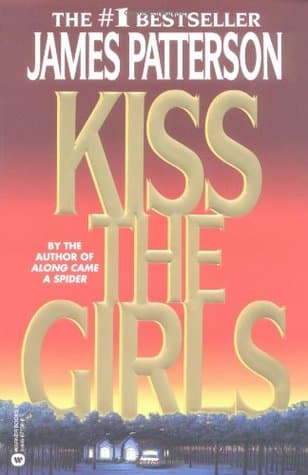
- Kiss the Girls
James Patterson
4.0 (313k) average on GoodreadsThrillerInvolves a detective pursuing a highly intelligent and elusive serial killer with a complex modus operandi.
- The Black Echo
Michael Connelly
4.1 (155k) average on GoodreadsThrillerUnlike Connelly's Harry Bosch, who is a more traditional, rule-bound detective operating within the system, Lucas Davenport is a maverick who frequently bends or breaks rules to achieve justice, offering a more visceral and less constrained pursuit of the killer.
- Angels & Demons
Dan Brown
3.9 (2.7M) average on GoodreadsThrillerA Harvard symbologist races through Rome's ancient sites, deciphering cryptic clues to unmask the Illuminati and stop a vengeful plot to destroy the Vatican with a stolen antimatter weapon.
- Gone Girl
Gillian Flynn
4.1 (2.3M) average on GoodreadsThrillerA wife's sudden disappearance on her fifth anniversary reveals a web of lies and psychological warfare, exposing the secrets within a seemingly perfect marriage.
- The Girl on the Train
Paula Hawkins
3.9 (2.1M) average on GoodreadsThrillerA woman’s fascination with a seemingly perfect couple she watches from her daily train commute leads her into a dark investigation when she witnesses something that shatters their idyllic image.





Enjoyed the summary?
A summary gives you the shape of the book. The book itself has the detail, the examples and the voice.
Find Rules of Prey on AmazonAs an Amazon Associate, BookBrief earns from qualifying purchases. How we're funded