
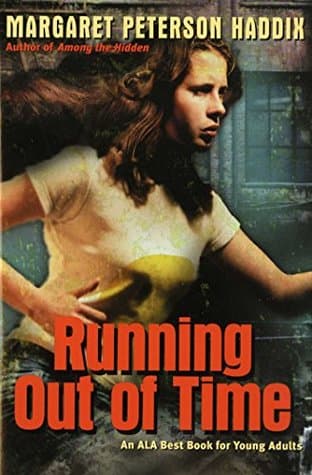
Synopsis
Covers the whole plot, including the ending.
- Difficulty
- Easy
- Pacing
- Fast
- Mood
- Suspenseful, Mysterious, Adventurous, Intense
- Read it if
- You enjoy fast-paced mysteries with a unique blend of historical and science fiction elements, featuring a brave young protagonist.
- Skip it if
- You prefer realistic historical fiction without speculative elements or find medical experimentation themes too disturbing.
Running Out of Time Plot Summary
Covers the whole plot, including the ending.
The Sickness in Clifton
Jessie Keyser, a thirteen-year-old living in the village of Clifton, Indiana, which appears to be in the 1840s, sees fear and illness spread among the children. Her younger sister, Katie, becomes very sick with diphtheria, a disease that has already killed several other children. Jessie's mother, Sarah, in desperation, tells Jessie that Clifton is not truly in the past; it is a carefully built historical preserve. She explains that the 'disease' is a modern illness that the village's doctors cannot cure because they are trained in 19th-century medicine. Sarah sends Jessie on a dangerous mission: to escape Clifton and find a cure in the outside world, which Sarah calls the 'present day,' before more children die.
Escape from Clifton
With specific instructions from her mother, Jessie goes to the 'pump house,' a hidden exit from Clifton. She finds a secret passage leading to a modern road. Overwhelmed by the sight of cars, paved roads, and an unfamiliar landscape, Jessie struggles to understand her surroundings. She remembers her mother's warning to be careful of everyone and to find a specific person: a man named Frank Lyle, her mother's brother. Jessie's first encounter with the outside world is confusing and scary, as she tries to navigate a world unlike anything she has known.
A Dangerous Discovery
Jessie eventually gets a ride with a kind truck driver heading towards Indianapolis. During her trip, she hears a news report about a controversial and secret historical preservation project called 'Clifton.' The report mentions a genetic experiment and a rich, powerful man named Mr. Neeley, who funds the project. Jessie realizes with horror that Clifton is not just a historical village, but a controlled environment where children, including herself, are part of a medical experiment, unknowingly living in a made-up past. This discovery increases her urgency and fear.
The Search for Frank Lyle
Following her mother's instructions, Jessie finds Frank Lyle's house. Frank at first doubts Jessie's story, thinking she is a runaway or confused. However, Jessie's detailed knowledge of Clifton and her family convinces him. Frank reveals he is a journalist who has tried to expose Mr. Neeley's unethical 'Clifton Project' for years, but has not found enough solid evidence. He explains that Mr. Neeley's project involves raising children in an isolated, disease-free place to study their immunity, then exposing them to diseases to test new cures. This confirms Jessie's worst fears about Clifton's true purpose.
The Plan to Expose Neeley
Frank Lyle, understanding the seriousness of the situation and the immediate danger to the children, agrees to help Jessie. They plan to expose Mr. Neeley and his unethical experiments. Jessie must return to Clifton with modern medicine for the diphtheria and gather clear proof of the project's existence and its human rights violations. Frank will contact his journalistic sources and prepare to make the story public once Jessie provides the necessary evidence. The stakes are very high, as the lives of all the Clifton children, and possibly Jessie's own, depend on their success.
Return to Clifton
Equipped with modern antibiotics and a hidden camera, Jessie makes the dangerous trip back to Clifton. She successfully re-enters the village, barely avoiding detection by the guards, called 'patrollers.' The village is in a state of growing panic, with more children getting sick. Jessie gives the medicine to Katie and other sick children, hoping it will work. Her main goal now is to gather photographic evidence of the modern equipment and facilities hidden within Clifton, proving to the outside world that it is not a real 1840s village but a complex scientific experiment.
Confrontation and Capture
While trying to photograph the hidden surveillance cameras and other modern items within Clifton, Jessie is discovered by Mr. Neeley's security. She is caught and brought before Mr. Neeley. Neeley, a cold and calculating man, explains his twisted reasoning for the Clifton Project, believing he is helping humanity by finding cures. He tries to manipulate Jessie, saying her parents willingly joined the project, agreeing to raise their children in Clifton for certain benefits. Jessie, however, remains firm, understanding the great cruelty of his actions.
The Broadcast and the Rescue
As Jessie is questioned, Frank Lyle, having received a signal or confirmation from Jessie (implied by their plan), releases his story. He broadcasts the truth about the Clifton Project, presenting the evidence he has gathered and Jessie's testimony. The news causes a huge public outcry and media frenzy. Authorities are forced to act, sending a team to Clifton. A tense standoff occurs between Mr. Neeley's private security and the arriving government officials, ending with the forced entry into the village and the rescue of the children.
The Aftermath and the Future
The children of Clifton, including Katie, are safely removed from the village and receive proper medical care. Mr. Neeley is arrested, and his unethical project is stopped. Jessie, her family, and the other Clifton residents now face the hard task of adjusting to the modern world, a world they had only just begun to understand. The book ends with Jessie thinking about the changes in her life, the loss of her innocent view of the world, and the challenges ahead for her and the other children as they join a society very different from the one they grew up in.
Family Reunions and New Beginnings
After the rescue, Jessie reunites with her parents, Sarah and Thomas Keyser. The reunion is mixed, as Jessie deals with the knowledge that her parents knowingly participated in the Clifton Project. Her mother explains their reasons, driven by a wish for a 'better,' simpler life and a belief that the project was harmless for their children. While Jessie understands their view, she also feels betrayed. The family begins the long, difficult process of healing and adapting to a world that is both freeing and overwhelming, facing the future together but with a changed understanding of trust and truth.
Running Out of Time Characters
Jessie Keyser
Protagonist
A brave and resourceful thirteen-year-old girl from Clifton.
Jessie is a curious and observant girl, initially believing she lives in the 1840s. She is fiercely loyal to her family, especially her younger sister, Katie. When tasked with saving her village, she displays remarkable courage, adaptability, and intelligence. Despite her sheltered upbringing, she quickly grasps the gravity of her situation and the complexities of the outside world. Her journey forces her to confront harsh truths about her parents and the nature of her reality.
Relationships: Sarah Keyser (Mother, reveals the truth and sends Jessie on her mission.); Thomas Keyser (Father, also a resident of Clifton, initially unaware of Jessie's mission.); Katie Keyser (Younger sister, falls ill with diphtheria, motivating Jessie's quest.); Frank Lyle (Maternal uncle, journalist, helps Jessie expose Clifton.)
Sarah Keyser
Supporting
Jessie's mother, who reveals Clifton's secret and initiates Jessie's mission.
Sarah is a conflicted character, deeply loving towards her children but also complicit in the Clifton Project. She initially appears to be a typical 19th-century mother, but her desperation to save Katie forces her to reveal the truth about Clifton. She is resourceful and brave in her own right, carefully planning Jessie's escape and providing crucial information. Her motivations are complex, rooted in a desire for a safe, simpler life for her family, even if it meant sacrificing truth.
Relationships: Jessie Keyser (Daughter, entrusts her with a life-saving mission.); Thomas Keyser (Husband, fellow resident of Clifton.); Frank Lyle (Brother, whom she directs Jessie to find.)
Frank Lyle
Supporting
Jessie's uncle, a journalist who helps expose the Clifton Project.
Frank is a cynical but principled journalist who has been trying to uncover the truth about the Clifton Project for years. He is initially skeptical of Jessie but quickly becomes her most crucial ally in the outside world. He is intelligent, well-connected, and determined to expose injustice. His journalistic integrity and love for his sister's family drive him to take significant risks, ultimately leading to the project's downfall. He acts as Jessie's guide and protector in the confusing modern world.
Relationships: Jessie Keyser (Niece, his primary source and partner in exposing Clifton.); Sarah Keyser (Sister, whose warning leads Jessie to him.)
Mr. Neeley
Antagonist
The wealthy and ruthless mastermind behind the Clifton Project.
Mr. Neeley is the enigmatic and powerful benefactor of the Clifton Project. He is a cold, calculating, and arrogant individual who believes his unethical experiments are for the greater good of humanity. He sees the children of Clifton as test subjects rather than human beings, demonstrating a profound lack of empathy. His motives are driven by a desire for scientific advancement and legacy, coupled with a belief that he is above moral constraints. He represents the dangers of unchecked scientific ambition and corporate power.
Relationships: Jessie Keyser (His unwitting test subject and the agent of his downfall.)
Katie Keyser
Supporting
Jessie's younger sister, whose illness sparks the central conflict.
Katie is Jessie's innocent younger sister, who falls gravely ill with diphtheria. Her deteriorating condition provides the immediate impetus for Jessie's dangerous mission. As a child, she embodies the vulnerability of all the children in Clifton, who are unknowingly living under the threat of Mr. Neeley's experiments. Her recovery is a symbol of Jessie's success and the triumph over the project's unethical practices.
Relationships: Jessie Keyser (Sister, who risks everything to save her.)
Thomas Keyser
Supporting
Jessie's father, a resident of Clifton.
Thomas Keyser is Jessie's father, a seemingly ordinary man within the confines of Clifton. Like Sarah, he is a participant in the project, though he appears to have a less active role in understanding its full implications than his wife. His primary concern is his family's well-being, and he struggles to reconcile the 'truth' of Clifton with the reality Jessie brings back. He represents the segment of the adult population in Clifton who bought into the illusion for a perceived better life.
Relationships: Jessie Keyser (Daughter.); Sarah Keyser (Wife.); Katie Keyser (Daughter.)
The Patrollers
Mentioned
Security guards of Clifton, maintaining the illusion and preventing escape.
The Patrollers are the security personnel employed by Mr. Neeley, tasked with maintaining the illusion of the 1840s village and preventing any resident from leaving or discovering the truth. They are a constant, menacing presence for Jessie, representing the oppressive control of the Clifton Project. Their role is to enforce Neeley's rules and ensure the 'experiment' remains undisturbed. They are faceless enforcers of the antagonist's will.
The Truck Driver
Supporting
A kind stranger who gives Jessie a ride outside Clifton.
The truck driver is the first person Jessie encounters in the modern world who shows her kindness and offers assistance without ulterior motives. He is a symbol of the unexpected humanity and help Jessie finds outside the controlled environment of Clifton. His casual conversation and the radio news he plays are crucial in Jessie's understanding of the outside world and the true nature of the Clifton Project.
Relationships: Jessie Keyser (Helps her travel towards Indianapolis.)
Running Out of Time Themes
The Nature of Reality and Deception
The story focuses on Jessie learning that her entire life in Clifton has been a carefully created lie. This theme explores how easily reality can be controlled and how people see truth based on their surroundings. Jessie's journey outside Clifton breaks her understanding, making her question everything she was taught. The village itself is a huge deception, kept for scientific reasons, showing the moral problems of making up reality for others.
“What if everything I'd ever known was a lie? What if everything I'd ever believed was wrong?”
Ethical Implications of Science and Progress
The novel examines the ethical limits of scientific experimentation, especially with human subjects. Mr. Neeley's Clifton Project, which raises children in isolation only to expose them to disease, is a chilling example of science pursued without moral guidance. The story asks if the chance of a cure justifies exploiting and deceiving innocent lives, making readers consider the responsibility that comes with scientific power. It shows the conflict between seeking knowledge and protecting human dignity.
“We were doing something wonderful for mankind. You simply cannot understand the grandness of my vision.”
Courage and Agency in the Face of Adversity
Jessie's change from a sheltered village girl to a brave and determined protagonist shows the theme of courage. She faces great fear, confusion, and danger, both inside and outside Clifton, yet she continues for her sister and the other children. Her journey shows the power of individual action, proving that even a young person can challenge powerful systems and bring about important change when driven by belief and a sense of justice.
“I was just a kid. What could I do? But then I remembered Katie, and I knew: I had to do something.”
The Clash Between Past and Present
The sharp difference between Clifton's 1840s appearance and the modern world outside is a main theme. Jessie's confusing experiences with cars, electricity, and current society highlight the fast pace of technological and social change. This theme explores the challenges of adapting, the appeal of a simpler past, and the certainty of progress. It also points out how artificial it is to try and keep a past that no longer exists, especially when it costs human freedom and truth.
“It was like stepping into a different century, only it wasn't a different century; it was the same one, just... different.”
Family Bonds and Betrayal
The strength of family bonds drives the story, as Jessie's love for Katie fuels her mission. However, the theme also explores the difficulties of family relationships when trust is broken. Jessie deals with her parents' betrayal, as they knowingly placed her and her siblings in the Clifton Project. This highlights the tough balance between parental love, the desire for a 'better' life, and the moral compromises made, forcing Jessie to change her understanding of her family.
“How could my own parents have done this to us? How could they have lied?”
Plot Devices & Literary Techniques
The Hidden Exit (Pump House)
A secret passage connecting the fabricated past to the present.
The pump house serves as the physical portal between Clifton's 1840s illusion and the modern world. It is a crucial plot device that allows Jessie to transition between realities, symbolizing the breaking of the illusion. Its existence is a carefully guarded secret, known only to a few, and its discovery by Jessie marks the true beginning of her journey into the unknown. It literally opens the door for the protagonist to confront the truth.
The Diphtheria Epidemic
The catalyst for Jessie's mission and the revelation of Clifton's true nature.
The outbreak of diphtheria among the children of Clifton is the central inciting incident. It creates immediate urgency and forces Sarah Keyser to reveal the truth about the village and send Jessie on her mission. Without this life-threatening crisis, the children of Clifton might have remained indefinitely unaware of their true circumstances. It highlights the vulnerability of the children and the moral imperative to act, driving the entire plot forward.
The Radio News Report
A crucial source of exposition and revelation for Jessie about the Clifton Project.
While riding with the truck driver, Jessie overhears a news report on the radio that provides vital information about the 'Clifton Project,' Mr. Neeley, and the controversial genetic experiments. This device is a concise way to deliver critical backstory and context directly to the protagonist, confirming her suspicions and deepening her understanding of the conspiracy. It allows the narrative to quickly inform both Jessie and the reader about the sinister reality behind Clifton.
The Hidden Camera
A tool for gathering irrefutable evidence of Clifton's modern nature.
Frank Lyle provides Jessie with a miniature modern camera to take back into Clifton. This device is essential for generating the concrete evidence needed to expose Mr. Neeley's project to the public. It transforms Jessie from a messenger into an active investigator, giving her the means to prove that Clifton is not a genuine historical village but a modern, technologically advanced experiment. The photos are the 'smoking gun' that Frank needs for his exposé.
Running Out of Time Quotes
“Sometimes you have to break the rules to do what's right.”
“The past is not always what it seems.”
“How can something so perfect be so wrong?”
“Fear can make you do things you never thought you would.”
“Even in the simplest lives, there are secrets.”
“Time is a river, and we are all just floating along.”
“Sometimes the greatest dangers are the ones you can't see.”
“The world outside is vast and strange, but it's also real.”
“Ignorance is not bliss when lives are at stake.”
“A mother's love knows no bounds, even across time.”
“The hardest choices are the ones where there's no clear right answer.”
“We are all connected, whether we know it or not.”
“Hope is a powerful thing, even when everything seems lost.”
Quiz
10 questions on the plot and the characters. Each answer comes with a short explanation.
Question 1
What deadly disease breaks out in the village of Clifton, prompting Jessie's mission?
- Smallpox
- Cholera
- Diphtheria
- Typhoid Fever
Show answer
C. Diphtheria The central conflict of the story is initiated by a diphtheria outbreak in Clifton, which causes many children to fall ill and die.
Question 2
What is the true nature of Clifton, Indiana, that Jessie discovers?
- It is a hidden Amish community.
- It is a historical reenactment village for tourists.
- It is a secret scientific experiment preserving a 19th-century lifestyle.
- It is a forgotten settlement isolated by a natural disaster.
Show answer
C. It is a secret scientific experiment preserving a 19th-century lifestyle. Jessie learns that Clifton is not an authentic 19th-century village, but rather a carefully controlled scientific experiment called a 'historical preserve'.
Question 3
What is the primary reason Jessie's mother sends her, specifically, on the mission?
- Jessie is the fastest runner in the village.
- Jessie is the only child who hasn't contracted diphtheria yet.
- Jessie is actually from the outside world and knows how to navigate it.
- Jessie is the most rebellious and therefore most likely to succeed.
Show answer
C. Jessie is actually from the outside world and knows how to navigate it. Jessie's mother reveals that Jessie was adopted from the outside world and is therefore genetically equipped to survive its diseases and knows how to function in modern society.
Question 4
What specific item does Jessie's mother give her as proof of her identity and mission to the outside world?
- A hand-drawn map of the area.
- A modern-day credit card and driver's license.
- A note written in English and a modern-day dollar bill.
- A locket with a picture of her biological parents.
Show answer
C. A note written in English and a modern-day dollar bill. Jessie's mother provides her with a note explaining her situation and a modern dollar bill to prove she is from the outside and needs help, as these items would be recognizable to people in the current era.
Question 5
What is the name of the man who initially helps Jessie outside of Clifton and explains some of the truth?
- Mr. Neeley
- Mr. Isaac Neeley
- Mr. Johnson
- Mr. Smith
Show answer
B. Mr. Isaac Neeley Mr. Neeley is the man working at the observation post who first encounters Jessie and reluctantly begins to reveal the truth about Clifton.
Question 6
What is the main ethical dilemma explored in the novel regarding the existence of Clifton?
- The ethics of historical preservation versus modernization.
- The ethics of deceiving and isolating people for scientific study.
- The ethics of allowing children to experience hardship for character building.
- The ethics of using outdated medical treatments.
Show answer
B. The ethics of deceiving and isolating people for scientific study. The core ethical conflict revolves around whether it is morally justifiable to keep an entire community, including children, in ignorance and isolation for the sake of a scientific experiment, especially when their lives are at risk.
Question 7
How does Jessie's understanding of 'time' change throughout her journey?
- She realizes that time moves slower in the outside world.
- She learns that the concept of time is relative and subjective.
- She discovers that Clifton is stuck in the past, while the outside world has advanced significantly.
- She understands that time is a linear progression that cannot be altered.
Show answer
C. She discovers that Clifton is stuck in the past, while the outside world has advanced significantly. Jessie's journey reveals that the '1840's' time she grew up in is an artificial construct, and the real world has progressed to a much later, technologically advanced era.
Question 8
What is the ultimate goal of the people who created Clifton, as explained to Jessie?
- To study the effects of prolonged isolation on human behavior.
- To preserve a 'pure' genetic line free from modern diseases.
- To create a self-sustaining community for future generations after a global catastrophe.
- To understand if people in a simpler time were happier or more resilient.
Show answer
D. To understand if people in a simpler time were happier or more resilient. The experiment's stated purpose was to study whether people in a simpler, less technologically advanced society would be happier or more resilient, as a social science experiment.
Question 9
What is the greatest risk Jessie faces when she finally reaches the outside world, beyond the danger of being caught?
- Being unable to communicate with modern people.
- Contracting modern diseases to which she has no immunity.
- Getting lost in the unfamiliar urban landscape.
- Being mistaken for a runaway and sent back.
Show answer
B. Contracting modern diseases to which she has no immunity. A major danger for Jessie and other Clifton residents in the outside world is their lack of immunity to common modern diseases, making them highly vulnerable.
Question 10
What is the significance of the 'red flag' system used by the outside observers of Clifton?
- It signals a severe weather warning to the villagers.
- It indicates a critical situation within Clifton that requires immediate intervention.
- It's a historical marker for significant events in Clifton's simulated past.
- It alerts the villagers to the presence of outsiders.
Show answer
B. It indicates a critical situation within Clifton that requires immediate intervention. The 'red flag' is a system for the outside observers to determine when the experiment has gone too far and intervention is necessary, such as during the diphtheria outbreak.
Running Out of Time FAQ
What is the core premise of 'Running Out of Time'?
The story follows 13-year-old Jessie Keyser, who lives in the seemingly 1840s village of Clifton, Indiana. When a diphtheria epidemic threatens the children, her mother reveals that Clifton is actually a recreated 1840s village and sends Jessie on a perilous mission to the 'outside' world of the late 20th century to find modern medicine.
Who is Jessie's mother and what is her role in the Clifton experiment?
Jessie's mother, Sarah Keyser, is revealed to be a modern-day scientist, Dr. Sarah Miller, who volunteered to live in Clifton under the guise of an 1840s woman. She is one of the project's lead researchers, deeply invested in the experiment but ultimately prioritizing her children's lives over the scientific integrity of the project.
What is the true nature of Clifton village and its inhabitants?
Clifton is a meticulously recreated 1840s village, a secret scientific experiment called the 'Historical Preservation Project.' Most adult inhabitants are modern scientists or volunteers, while the children, including Jessie, are unaware of their true time period, believing they live in the past.
What is the primary conflict Jessie faces once she leaves Clifton?
After escaping Clifton, Jessie must navigate the bewildering and dangerous modern world of 1996, trying to find Dr. Neely and expose the unethical experiment. She faces disbelief, suspicion, and active pursuit by project security while trying to understand technology like cars and phones.
How does Jessie's understanding of her identity change throughout the book?
Jessie's identity shifts dramatically from a simple 1840s frontier girl to a child caught between two eras. She grapples with the revelation that her entire life has been a lie, questioning who she truly is and where she belongs, ultimately embracing her unique position as a bridge between the past and present.
What specific clues in Clifton hint at its true nature before the big reveal?
Subtle hints include the children's unusual lack of knowledge about outside events, the strict rules about not leaving the village, and the adults' sometimes anachronistic behaviors or knowledge. For instance, the 'medicine' given to children often seemed ineffective, and the village felt oddly isolated.
Who is Isaac Neely and what is his connection to Clifton?
Isaac Neely is the original visionary and lead scientist behind the Clifton project. He is portrayed as increasingly reclusive and obsessed with maintaining the experiment's secrecy, even at the cost of the children's lives, making him the primary antagonist once Jessie leaves Clifton.
How does Jessie's perception of her parents change after learning the truth?
Jessie's initial shock and betrayal lead to a deep distrust of her mother, Sarah, for lying to her. However, she also sees her mother's desperate love and sacrifice, eventually understanding the complex motivations behind her parents' involvement and their efforts to protect her.
What role does the 'guard' play in Jessie's escape and journey?
The guard, Frank, is initially an enforcer of the project's rules, but he becomes a reluctant helper for Jessie. He provides crucial information about the outside world, helps her escape, and later, out of a sense of guilt and responsibility, assists her in finding Dr. Neely and exposing the project.
What is the ethical dilemma at the heart of the Clifton project?
The core dilemma is whether the pursuit of scientific knowledge and historical preservation justifies deceiving and endangering children. The project prioritizes observation and control over the well-being and autonomy of its youngest subjects, sparking a debate about human rights in research.
How does Jessie's 'old-fashioned' upbringing benefit her in the modern world?
Despite her initial bewilderment, Jessie's 1840s upbringing instills resilience, resourcefulness, and a strong sense of purpose. She is less distracted by modern conveniences and more focused on her mission, using her common sense and physical endurance to navigate obstacles that might overwhelm a modern child.
What happens to the children of Clifton at the end of the book?
After Jessie exposes the project, the children of Clifton are removed from the village and begin a long process of adaptation to the modern world. They receive medical care for the diphtheria and psychological support to understand their true identities and the society they now inhabit.
What is the significance of the 'red ribbon' in the story?
The red ribbon is a symbolic item that Jessie's mother gives her, meant to be a signal to an outside contact. It represents hope, a secret connection, and the mother's desperate attempt to provide her daughter with a means of survival and communication with the outside world.
How does the book explore themes of truth versus deception?
The book deeply explores truth versus deception through the entire premise of Clifton. Jessie's entire life is a deception, and her journey forces her to confront the lies told by those she trusted. It questions when deception is justified, even with good intentions, and the consequences of withholding truth.
Could Clifton have continued indefinitely without the diphtheria outbreak?
It's debatable, but highly unlikely. The diphtheria outbreak simply accelerated the inevitable crisis. The children were growing older and becoming more inquisitive, and the inherent ethical and logistical challenges of maintaining such a large-scale deception would likely have led to its exposure or collapse eventually.
What is the significance of the book's title, 'Running Out of Time'?
The title has multiple layers of meaning. Literally, Jessie is running against time to get medicine for the diphtheria-stricken children. Metaphorically, the Clifton experiment itself is running out of time as the children mature, and the ethical clock on the project is ticking down.
How does Jessie adapt to modern technology, specifically cars?
Jessie's first encounters with cars are terrifying and confusing; she initially mistakes them for monstrous, self-propelled carriages. Her adaptation is gradual, driven by necessity, as she learns to understand their purpose and how to interact with them, eventually using them as a means to achieve her mission.
What psychological impact does the revelation of Clifton's true nature have on the children?
The revelation causes immense psychological distress, including confusion, betrayal, and an identity crisis, as their entire reality is shattered. They must reconcile their 'past' lives with a completely alien present, requiring extensive therapy and support to integrate their experiences.
What message does the book convey about scientific ethics?
The book strongly advocates for ethical boundaries in scientific research, particularly when human subjects, especially children, are involved. It suggests that the pursuit of knowledge should never override the fundamental rights, well-being, and informed consent of individuals.
About the author

Margaret Peterson Haddix is an American author known for her works of children's and young adult fiction. Some of her notable books include "Among the Hidden," "Just Ella," "Among the Impostors," "Among the Betrayed," "Running Out of Time," and "Among the Brave." Her stories often explore themes of identity, freedom, and the consequences of societal rules.
Similar books
- The Giver
Lois Lowry
4.1 (1.8M) average on GoodreadsFantasyExplores a seemingly utopian society with dark secrets and a young protagonist who uncovers the truth.
- A Wrinkle in Time
Madeleine L'Engle
4.0 (1.1M) average on GoodreadsFantasyFeatures a young protagonist on a dangerous mission, encountering unfamiliar worlds and fighting against powerful, hidden forces.
- Among the Hidden
Margaret Peterson Haddix
4.0 (112k) average on GoodreadsFantasyAnother Haddix book where a young character lives in a restrictive society and must venture into a forbidden outside world.
- Harry Potter and the Sorcerer's Stone
J.K. Rowling
4.5 (7M) average on GoodreadsFantasyRescued from a miserable life under the stairs, an orphaned boy discovers he's a wizard destined for a magical school, where he uncovers a dangerous secret tied to the dark wizard who murdered his parents.
- The Hobbit, or There and Back Again
J.R.R. Tolkien
4.3 (2.9M) average on GoodreadsFantasyA comfort-loving hobbit named Bilbo Baggins is whisked away by a mischievous wizard and a band of dwarves on an unexpected journey to reclaim stolen treasure from a fearsome dragon, discovering courage and a magical ring along the way.
- Harry Potter and the Goblet of Fire
J.K. Rowling
4.6 (2.6M) average on GoodreadsFantasyA bewildered Harry Potter, underage and thrust into a deadly Triwizard Tournament, must brave dragons, mermaids, and a resurgent dark magic to survive a year that will forever alter the wizarding world.





Enjoyed the summary?
A summary gives you the shape of the book. The book itself has the detail, the examples and the voice.
Find Running Out of Time on AmazonAs an Amazon Associate, BookBrief earns from qualifying purchases. How we're funded