
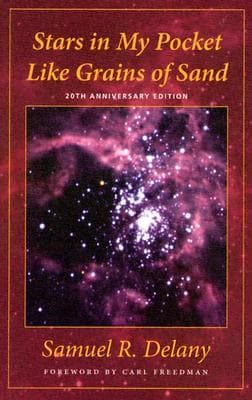
Synopsis
Covers the whole plot, including the ending.
- Difficulty
- Hard
- Pacing
- Variable
- Mood
- Philosophical, Erotic, Complex, Thought-Provoking, Immersive
- Read it if
- You want a challenging, deeply philosophical sci-fi novel that explores sexuality, information, and power in a unique, non-traditional way.
- Skip it if
- You prefer linear plots, easy-to-digest world-building, or don't enjoy explicit and complex explorations of gender and sexuality.
Stars in My Pocket Like Grains of Sand Plot Summary
Covers the whole plot, including the ending.
The Arrival of Korga
Marq Dyeth, a 'ratiocinator' of the Sygn network and a member of a powerful Velm family, attends a cultural event on his home planet. He meets Korga, a young, illiterate laborer from Ryvellon, an agrarian world recently destroyed by a 'cultural fugue' – a societal collapse. Despite their cultural differences, Marq feels an overwhelming erotic attraction to Korga. This attraction is mutual and mathematically perfect, a 'general information' event. This encounter starts a series of events that will intertwine their fates and have galactic implications.
The General Information Event
The intense, mathematically quantified erotic compatibility between Marq and Korga is a 'general information' event, broadcast across the galactic network known as Sygn. This unprecedented compatibility – 'point nine-nine-nine and several nines percent more' – causes widespread fascination and alarm. Such a perfect match between individuals from different social classes and planetary systems has enormous implications, threatening established social orders and power structures, especially those of the 'Family' entities that control much of galactic commerce and politics. Marq, a member of one such Family, finds himself at the center of this unexpected situation.
The Velm-Sygn Connection
Marq Dyeth's home world, Velm, is a center of advanced technology and social protocols, dominated by the Sygn network. Sygn allows instant communication and information exchange across star systems. While connecting worlds, the Sygn network also helps the powerful 'Families' maintain their influence and control. Marq, as a ratiocinator, is deeply involved in this system. The revelation of his perfect match with Korga, an outsider from a destroyed world, disrupts Velm's order and the Sygn network. This challenges established hierarchies and information control in the galaxy. The Families begin to react to this perceived threat.
Korga's Past and Ryvellon's Fall
Korga's world, Ryvellon, was an agrarian society, kept isolated and technologically underdeveloped by galactic powers. Its destruction by a 'cultural fugue' – a societal collapse caused by an inability to integrate new information – is a significant plot point. Korga is the only known survivor, having been off-world at the time. His illiteracy and lack of exposure to advanced technology highlight the vast cultural gap between him and Marq. The circumstances of Ryvellon's destruction and Korga's survival are not fully explained but suggest larger political maneuvers and deliberate manipulation of planetary development by the Families, adding mystery and a potential conspiracy.
The Threat of the Families
The galactic 'Families' are large, interconnected corporate and political entities that control interstellar trade, information, and planetary development. They operate through complex networks and rivalries. The 'general information' event of Marq and Korga's perfect erotic match is seen as a major threat to their established order. Such an unprecedented connection, especially one involving a powerful family member and an 'unclassified' individual from a destroyed world, could destabilize their power structures and challenge their control over information and social norms. Marq becomes a target, and Korga's safety is immediately compromised as the Families react to this disruptive event.
Marq's Flight and Pursuit
Marq realizes the danger their connection poses, especially to Korga, and decides to flee Velm. He understands that the Families will try to control or eliminate Korga, and possibly him, to prevent the disruption their bond represents. This flight begins a journey across various worlds, each with its own culture and social structure. Marq is pursued by Family agents, who are determined to capture or neutralize Korga. During this pursuit, Marq learns more about galactic politics, the Families' reach, and the deeper implications of the 'general information' event, while trying to ensure Korga's survival.
The Search for Answers
As Marq travels, he investigates the 'general information' event, trying to understand why his and Korga's erotic compatibility has such profound galactic repercussions. He consults experts, historians, and 'ratiocinators' across different worlds, gathering knowledge about societal collapse, information flow, and how power is used in the galaxy. This quest for understanding is vital for their survival. He learns about the Sygn network, the deliberate suppression of certain technologies and information, and the potential for a new social organization that their bond might bring.
Encounters with 'Unclassifieds'
During their flight, Marq and Korga meet individuals and communities outside the dominant 'Family' and Sygn network structures. These 'unclassifieds' represent alternative ways of life, social organizations, and technological adaptations. Some are survivors of other 'cultural fugues,' others are communities that have chosen to stay out of the galactic mainstream. These encounters broaden Marq's perspective, challenging his Velm-centric worldview and offering glimpses of futures not dictated by the Families. Korga also begins to learn about the vastness of the galaxy and complexities beyond his simple agrarian past, slowly adapting to new realities.
The Nature of Erotic Attraction
A central theme is the deep nature of erotic attraction. Marq and Korga's bond is more than physical desire; it is a mathematically quantifiable phenomenon with societal and political effects. The novel suggests that such a perfect match is not just personal but an information event that can destabilize entire systems. It explores how societies understand, categorize, and control sexuality, and what happens when an attraction defies all established norms. The inexplicable pull between Marq and Korga becomes a symbol of disruptive potential, challenging the foundations of galactic society.
The Climax and Confrontation
The narrative builds towards a confrontation with the powerful forces trying to control or eliminate Marq and Korga. The Families, seeing their bond as an existential threat, intensify their pursuit. Marq, having a deeper understanding of galactic politics and information, prepares for a decisive stand. The climax involves political maneuvering, technological skill, and personal conviction. The fate of Korga, and potentially the future of galactic society, hangs in the balance as Marq tries to protect their unique connection and reveal its true, transformative potential, rather than let it be suppressed or used as a weapon.
The Aftermath and New Beginnings
After the confrontation, the immediate threats to Marq and Korga are neutralized, though with significant costs and changes to the galactic landscape. While their perfect erotic match remains a 'general information' event, its disruptive power has been acknowledged, if not fully understood or accepted, by wider galactic society. Marq and Korga's relationship, strengthened by adversity, deepens. The novel ends with them on a new path, their bond having changed their lives and potentially starting a subtle but profound shift in the galaxy's understanding of connection, information, and power. Their future, while uncertain, involves continued exploration and defiance of convention.
Stars in My Pocket Like Grains of Sand Characters
Marq Dyeth
Protagonist
A privileged, intellectual ratiocinator from Velm, thrust into a galactic crisis.
Marq is a highly intelligent and sensitive individual, born into one of Velm's influential 'Families.' As a 'ratiocinator,' he is deeply involved in the Sygn network, analyzing and processing complex information. He is accustomed to a life of intellectual pursuit and social privilege. His encounter with Korga shatters his preconceived notions about the universe and himself, forcing him to confront the limitations of his own understanding and the rigid structures of his society. He is driven by a deep sense of protectiveness for Korga and a desire to understand the profound implications of their bond.
Relationships: Korga (Perfect erotic object, partner, protégé); The Dyeth Family (His powerful, but ultimately restrictive, familial network)
Korga
Protagonist
An illiterate survivor from a destroyed world, whose unique connection to Marq ignites a galactic crisis.
Korga is a young, unassuming laborer from the agrarian world of Ryvellon, which was destroyed by a 'cultural fugue.' He is initially depicted as illiterate, naive, and culturally unsophisticated compared to Marq. Despite his humble origins, he possesses an innate resilience and a capacity for deep connection. His survival from Ryvellon and his 'perfect' erotic match with Marq make him a figure of immense political and social significance, though he struggles to comprehend the vast implications. He is driven by a desire for safety and a growing bond with Marq, slowly adapting to the complex galactic society.
Relationships: Marq Dyeth (Perfect erotic object, partner, protector); Ryvellon (His destroyed home world, a source of trauma and mystery)
The Families
Antagonist (collective)
Powerful, interconnected corporate and political entities that control much of galactic society.
The 'Families' are not a single entity but a network of rivalrous, yet collectively dominant, power structures that dictate interstellar trade, information flow, and planetary development. They operate through complex social protocols, economic leverage, and control over the Sygn network. They represent the established order, resistant to any force that threatens their control. Their primary motivation is the maintenance of their power and the prevention of any disruptive 'general information' events that could destabilize their carefully constructed hierarchies. They view Marq and Korga's connection as a profound threat.
Relationships: Marq Dyeth (Family member (Marq is part of one), but also a threat to their collective order); Korga (An 'unclassified' individual to be controlled or eliminated)
The Sygn Network
Supporting/Setting
The ubiquitous galactic information and communication network, controlled by the Families.
The Sygn network is a pervasive, instantaneous communication and information system that connects all major worlds in the galaxy. It is the lifeblood of galactic commerce, politics, and social interaction. While seemingly a neutral conduit for information, it is heavily influenced and controlled by the Families, who use it to maintain their power and disseminate approved narratives. The 'general information' event of Marq and Korga's bond is broadcast across Sygn, highlighting its power and its susceptibility to being disrupted by unprecedented data. It is both a tool and a potential vulnerability for the established order.
Relationships: Marq Dyeth (User and analyst (ratiocinator)); The Families (Controllers and beneficiaries)
The Diplomatic Corps
Supporting
A bureaucratic body navigating interstellar relations, often constrained by Family influence.
The Diplomatic Corps represents a more formal, bureaucratic aspect of galactic governance, distinct from the direct power of the Families, though often intertwined with it. They attempt to maintain order and mediate disputes between worlds and Families. Marq, as a ratiocinator with diplomatic ties, often interacts with members of this corps. Their role is to interpret and manage the fallout from events like Ryvellon's destruction and the 'general information' event, often finding themselves caught between the demands of the Families and the need for galactic stability. They represent a more traditional, if often ineffectual, form of governance.
Relationships: Marq Dyeth (Colleague/acquaintance (Marq has ties to diplomatic functions)); The Families (Subordinate to their influence)
The 'Unclassifieds'
Supporting (collective)
Individuals and communities existing outside the dominant galactic power structures.
The 'Unclassifieds' are a diverse group of people and societies that do not fit into the established categories or control mechanisms of the Families and the Sygn network. They may be survivors of other 'cultural fugues,' communities that have deliberately chosen isolation, or individuals who reject the prevailing social norms. They represent alternative ways of life, different technological adaptations, and often possess unique perspectives on galactic history and power. Marq and Korga encounter several such groups during their flight, and these encounters are crucial for Marq's evolving understanding of the galaxy.
Relationships: Marq Dyeth (Sources of information and alternative perspectives); Korga (Fellow outsiders, offering a sense of community)
Ryvellon (as a concept)
Mentioned/Setting
Korga's destroyed agrarian home world, a symbol of deliberate underdevelopment and 'cultural fugue.'
Ryvellon is not a character but functions as a significant conceptual presence. It was an agrarian world, deliberately kept technologically underdeveloped by the Families, existing as a kind of 'reserve' or controlled territory. Its destruction by a 'cultural fugue' – a societal collapse due to an inability to integrate new information – is a crucial backstory for Korga and a stark warning about the dangers of information control and cultural isolation. It represents the consequences of deliberate manipulation and the fragility of societies when faced with overwhelming change, foreshadowing potential fates for other worlds.
Relationships: Korga (His origin and trauma); The Families (Their object of control and eventual destruction)
Stars in My Pocket Like Grains of Sand Themes
The Nature and Control of Information
The novel explores how information is spread, controlled, and its power to shape societies. The Sygn network is a central example, showing how powerful entities (the Families) manipulate information to maintain control. Marq and Korga's 'general information' event, an uncontrollable broadcast of their erotic compatibility, shows how disruptive free, unfiltered information can be to established orders. Ryvellon's destruction by a 'cultural fugue' – an inability to integrate new information – warns about the dangers of information suppression. The novel suggests that the free flow of information, even personal data, has galactic political consequences.
“What are the repercussions, once it has been made public, that two individuals have been found to be each other's perfect erotic object out to 'point nine-nine-nine and several nines percent more'?”
Erotic Attraction and Its Societal Impact
A core idea is that sexual attractiveness is not just a personal experience but a quantifiable, societal force. Marq and Korga's 'perfect match' is a 'general information' event, capable of destabilizing galactic politics and challenging social hierarchies. The novel explores how societies categorize, control, or are upended by such powerful connections. It suggests that deep erotic bonds, when recognized and broadcast, can override class, planet, and cultural divides, forcing a re-evaluation of what makes a meaningful connection and how that connection affects collective identity and power structures.
“It was not a question of love, or even of desire, but of a knowledge so complete it was a terror.”
Globalization, Cultural Fugue, and Societal Collapse
The concept of 'cultural fugue' is a critical theme, representing societal collapse due to an inability to integrate new information or adapt to rapid change. Ryvellon's destruction is a primary example. This theme explores the fragility of isolated or rigidly controlled societies when faced with the vast, interconnected galaxy. It raises questions about deliberate underdevelopment, the ethics of information control, and the dangers of cultural stagnation in a dynamic universe. The contrast between Velm's advanced, interconnected society and Ryvellon's simple, isolated one highlights the range of vulnerabilities.
“A cultural fugue... It's what happens when a society simply stops being able to process new information. It just... breaks.”
Identity and Otherness
The novel explores the construction of identity, both personal and societal, and the concept of 'otherness.' Marq, from a privileged, advanced world, deals with his identity when he meets Korga, an illiterate survivor from a destroyed, agrarian planet. Korga, an 'unclassified' individual, represents the ultimate 'other' within the galactic system, challenging the Families' rigid classifications. Their bond forces both characters, and the reader, to question how identity is formed by social structures, technology, and personal connections, and how these boundaries can be crossed or violently enforced. Encounters with other 'unclassified' societies further broaden this exploration.
“He was 'unclassified,' which meant, in the parlance of the Families, that he was nothing.”
Power Structures and Resistance
Galactic society is dominated by powerful 'Families' who control information, trade, and planetary development. The novel details how these power structures operate through manipulation, economic leverage, and control of the Sygn network. Marq and Korga's 'general information' event becomes an unwitting act of resistance, as their bond directly challenges the Families' ability to categorize and control. Their flight and search for understanding represent individual resistance against an overwhelming, institutionalized power. The novel suggests that even personal connections can become radical acts against systemic control.
“The Families held the stars in their pocket, like grains of sand.”
Plot Devices & Literary Techniques
The General Information Event
A mathematically perfect erotic match that becomes a galaxy-wide information broadcast.
This is the central plot device. The 'general information event' refers to the statistically improbable, near-perfect erotic compatibility between Marq and Korga, quantified to 'point nine-nine-nine and several nines percent more.' This isn't just a personal connection; it's an event that is immediately broadcast across the Sygn network, making it public knowledge throughout the galaxy. It serves as the catalyst for the entire plot, driving the Families' fear and pursuit, and forcing Marq and Korga into their journey. It highlights the novel's themes of information control, the societal impact of sexuality, and the fragility of established power structures when confronted with unprecedented data.
Cultural Fugue
A societal collapse caused by the inability to integrate new information or adapt to change.
The 'cultural fugue' is a conceptual plot device that explains the destruction of Korga's home world, Ryvellon. It describes a society's inability to process or integrate overwhelming new information, leading to its collapse. This device serves multiple functions: it provides Korga's backstory and his status as a sole survivor, establishes the stakes of information control, and acts as a warning for other worlds. It also highlights the contrast between technologically advanced, information-rich societies like Velm and more isolated, vulnerable ones, underscoring the novel's themes of globalization and the dangers of cultural stagnation.
The Sygn Network
The ubiquitous interstellar communication and information network.
While also a setting element, the Sygn network functions as a crucial plot device. It is the medium through which the 'general information event' of Marq and Korga's bond is instantly broadcast across the galaxy, making their private connection a public, political crisis. It represents the ultimate tool for both connection and control. The Families use Sygn to maintain their power and disseminate information, but its very pervasiveness also makes it vulnerable to unpredictable, disruptive information like the perfect erotic match. It is the mechanism that both enables galactic society and also threatens to unravel it.
The 'Unclassified' Status
A designation for individuals or societies outside the dominant galactic classification system.
The 'unclassified' status, particularly applied to Korga, is a plot device that immediately establishes his 'otherness' and vulnerability within the galactic system. It signifies a lack of categorization, lineage, or recognized place within the Families' hierarchical order. This status makes Korga both a threat (because he cannot be easily controlled or understood) and a target. It also allows the narrative to introduce various 'unclassified' societies that represent alternative forms of social organization and resistance, broadening the scope of the galactic political landscape and offering Marq new perspectives beyond his Velm-centric worldview.
Stars in My Pocket Like Grains of Sand Quotes
“There are always more things than you can say.”
“The price of freedom is eternal vigilance, and the price of knowledge is eternal doubt.”
“We are all of us, in some sense, fictions.”
“Memory is a kind of fiction, too, but one we try to make as real as possible.”
“The universe is not obliged to make sense to you.”
“Love is not a state, it's a process. It's an active verb.”
“What is real? What is not real? The question itself is often a trap.”
“To be truly free, one must be willing to lose everything.”
“Every act of communication is an act of translation.”
“The future is not something we enter. The future is something we create.”
“There is no such thing as a simple story, only stories we choose to simplify.”
“Desire is the engine of the universe.”
“We live in the present, but the present is constantly being remade by our past and future.”
“The greatest freedom is the freedom to define oneself.”
Quiz
10 questions on the plot and the characters. Each answer comes with a short explanation.
Question 1
What is the primary reason the protagonist, Korga, is considered a unique and significant figure at the beginning of the novel?
- He possesses advanced technological knowledge unknown to other worlds.
- He is the sole survivor of a world destroyed by 'cultural fugue'.
- He is a highly decorated interstellar diplomat.
- He has discovered a new form of faster-than-light travel.
Show answer
B. He is the sole survivor of a world destroyed by 'cultural fugue'. Korga's unique status stems from being the only survivor of Velm, a world annihilated by cultural fugue, making him a subject of great interest and study.
Question 2
What term does the novel use to describe two individuals who are each other's 'perfect erotic object'?
- Synaptic Twins
- Anchor-mates
- Perfect Erotic Objects
- Soul-bonded
Show answer
C. Perfect Erotic Objects The novel explicitly refers to the concept as two individuals being each other's 'perfect erotic object out to point nine-nine-nine and several nines percent more'.
Question 3
What is the name of the organization that seeks to control and regulate information and alliances across the galaxy, which is often at odds with the Web?
- The Alliance of Worlds
- The Family
- The Galactic Federation
- The Interstellar Congress
Show answer
B. The Family The Family is the powerful, controlling organization that represents a more traditional, hierarchical structure of power and information, often opposing the decentralized nature of the Web.
Question 4
What is 'cultural fugue' as depicted in the novel, and what is its consequence for a world?
- A sudden, widespread amnesia that erases historical records.
- A state of societal collapse resulting from an inability to process or integrate new information, leading to destruction.
- A rapid technological advancement that leaves traditional cultures behind.
- A deliberate act of cultural purification by an invading alien species.
Show answer
B. A state of societal collapse resulting from an inability to process or integrate new information, leading to destruction. Cultural fugue is presented as a catastrophic societal breakdown where a civilization becomes overwhelmed and unable to cope with the sheer volume and complexity of its own information and cultural output, leading to self-destruction.
Question 5
What is the significance of the 'Web' in the interstellar political landscape of the novel?
- It is a centralized government body that dictates laws for all planets.
- It is a network of interconnected worlds that share information, resources, and culture, often operating outside traditional governmental structures.
- It is a military alliance formed to combat the Family's influence.
- It is a clandestine organization dedicated to uncovering ancient alien technologies.
Show answer
B. It is a network of interconnected worlds that share information, resources, and culture, often operating outside traditional governmental structures. The Web represents a decentralized, fluid network of interconnected worlds, cultures, and information, contrasting sharply with the hierarchical control sought by the Family. Its existence is a major driver of the novel's political tensions.
Question 6
What is the primary thematic concern explored through the revelation of Korga and the protagonist as 'perfect erotic objects'?
- The inevitable triumph of true love over political machinations.
- The unpredictable and transformative power of information, particularly regarding sexuality and personal identity, within a globalized context.
- The scientific quest to quantify and replicate human emotion.
- The dangers of interstellar travel and cultural exchange.
Show answer
B. The unpredictable and transformative power of information, particularly regarding sexuality and personal identity, within a globalized context. The core of the novel, as stated in the premise, revolves around the repercussions of this information becoming public, exploring how it affects individuals, societies, and the very nature of information itself in a complex, interconnected universe.
Question 7
What is the name of the protagonist, the 'you' character in the novel's description, who is discovered to be Korga's perfect erotic object?
- Marq Dyckman
- Kiri
- Rat Korga
- The narrator's name is never explicitly stated, often referred to as 'you' or Prince.
Show answer
D. The narrator's name is never explicitly stated, often referred to as 'you' or Prince. The protagonist is often addressed as 'you' or referred to by a title like Prince, but a specific personal name for the narrator is deliberately withheld, making the reader's identification with the character more direct.
Question 8
How does the novel portray the concept of 'gender' and 'sexuality' in its interstellar societies?
- As largely conforming to traditional binary understandings across all worlds.
- As fluid, diverse, and culturally constructed, with many worlds having unique expressions beyond human binaries.
- As irrelevant due to advanced genetic engineering eliminating biological differences.
- As a source of constant interstellar conflict due to differing moral codes.
Show answer
B. As fluid, diverse, and culturally constructed, with many worlds having unique expressions beyond human binaries. The novel is celebrated for its exploration of diverse gender and sexual identities across its many worlds, presenting them as highly fluid and culturally specific, challenging conventional norms.
Question 9
What role does the character Marq Dyckman play in the unfolding political drama?
- He is a leader of the Family, seeking to suppress the Web.
- He is a prominent figure within the Web, often acting as a guide and informant for the protagonist.
- He is a neutral observer, documenting the events for historical archives.
- He is the chief scientist responsible for identifying perfect erotic objects.
Show answer
B. He is a prominent figure within the Web, often acting as a guide and informant for the protagonist. Marq Dyckman is a key figure associated with the Web, providing crucial information, context, and guidance to the protagonist as they navigate the complex political landscape and the implications of their relationship with Korga.
Question 10
The novel's structure often involves shifts in narrative perspective and includes extensive footnotes. What is the primary artistic purpose of these stylistic choices?
- To confuse the reader and obscure the main plot points.
- To mimic the fragmented and complex nature of information in a globalized, interconnected universe, and to provide layers of cultural context and alternative viewpoints.
- To allow for multiple authors to contribute to the narrative simultaneously.
- To deliberately slow down the pacing of the story for dramatic effect.
Show answer
B. To mimic the fragmented and complex nature of information in a globalized, interconnected universe, and to provide layers of cultural context and alternative viewpoints. Delany's use of shifting perspectives and extensive footnotes is a deliberate meta-narrative technique, immersing the reader in the very 'information' that is central to the novel's themes, reflecting the complexity and multi-faceted nature of knowledge and culture in the Web.
Stars in My Pocket Like Grains of Sand FAQ
What is the core premise of 'Stars in My Pocket Like Grains of Sand'?
The novel explores the profound societal and personal repercussions when two individuals, Marq Dyce and the unnamed reader-character, are identified as perfect erotic objects for each other. This 'erotic object' status is a precise, scientifically verifiable match, igniting political and cultural upheaval across their respective worlds and beyond.
Who is Marq Dyce and what is their background?
Marq Dyce is a 'geosynchronous' worker, essentially an illiterate laborer, and the sole survivor of the planet Velm, which was destroyed by 'cultural fugue.' Their past is marked by trauma and a lack of formal education, making their sudden elevation to a figure of interstellar interest even more disruptive.
What is the significance of the 'cultural fugue' that destroyed Velm?
Cultural fugue is depicted as a catastrophic societal collapse resulting from an inability to process or integrate new information and cultural shifts. Velm's destruction serves as a stark warning about the fragility of civilizations in the face of overwhelming change, a theme central to the novel's exploration of information flow.
How does the novel address the concept of 'gender' and 'sexuality'?
The book presents a fluid and diverse understanding of gender and sexuality, with multiple gender identities (e.g., 'he,' 'she,' 'they,' 'e,' 've') and sexual orientations being commonplace and accepted. The central 'erotic object' relationship transcends conventional labels, focusing on an almost scientific compatibility.
What role does the 'Family' play in the interstellar politics?
The Family is a powerful, ancient, and highly influential interstellar political and economic entity that dictates much of galactic society. They are a hierarchical, almost aristocratic group, and their machinations significantly impact the lives of Marq Dyce and the reader-character, particularly in their efforts to control information.
What is the 'sygn' and why is it important?
The sygn is a complex, almost telepathic communication system used by the Family and other advanced societies, allowing for rapid and nuanced information exchange. Its existence highlights the novel's focus on different modes of communication and the power dynamics associated with controlling access to them.
How does the 'free-flow' of information contrast with the Family's control?
The 'free-flow' represents a utopian ideal of unrestricted information access and sharing, vital for societal health, as opposed to the Family's rigid, often manipulative control over knowledge. The conflict between these two philosophies is a major political struggle within the narrative.
What is the significance of the reader-character being unnamed and referred to as 'you'?
This narrative choice directly implicates the reader in the story, making them a participant in the profound erotic and political entanglement with Marq Dyce. It blurs the lines between fiction and reality, emphasizing the personal impact of the novel's themes.
Are there any hidden connections between the 'cultural fugue' and the Family's actions?
While not explicitly stated as a direct cause, the Family's highly centralized control and information manipulation could be seen as a contributing factor to the conditions that lead to cultural fugue. Their efforts to suppress certain information might prevent societies from adapting, echoing Velm's fate.
How does Marq Dyce's illiteracy impact their psychological journey?
Marq's illiteracy initially places them at a disadvantage in a highly information-driven society, but it also highlights their raw, unmediated experience of the world. Psychologically, it makes them both vulnerable and uniquely resilient, forcing them to navigate complex situations through intuition and direct interaction rather than codified knowledge.
What psychological effects does being a 'perfect erotic object' have on the individuals?
The designation creates immense psychological pressure, as their personal lives become public spectacle and political leverage. It forces them to confront deep questions about identity, agency, and the nature of attraction, often leading to feelings of being objectified or manipulated by external forces.
How does the novel explore the psychology of power and control within the Family?
The Family's members exhibit a psychology shaped by inherited power, privilege, and a deep-seated belief in their right to dictate galactic affairs. They often display a detached, strategic mindset, viewing individuals as pawns in larger political games, which can lead to ruthless and manipulative behavior.
What is the psychological impact of globalization and multiculturalism on the characters?
Characters constantly grapple with navigating diverse cultures, communication styles, and societal norms, leading to both enrichment and profound disorientation. The psychological challenge lies in integrating vast amounts of new information and adapting personal identities within an ever-expanding, interconnected universe.
Is the 'perfect erotic object' status a blessing or a curse for Marq Dyce?
It is arguably both. While it elevates Marq from an obscure laborer to a figure of interstellar importance, it also strips them of privacy and agency, making them a focal point for political machinations and personal scrutiny. The 'blessing' of perfect compatibility comes with the 'curse' of immense pressure.
How does the novel critique or celebrate technology?
The novel presents a nuanced view, showcasing technology's potential for advanced communication and societal organization (like the sygn), but also its capacity for surveillance, control, and even destruction (like the 'cultural fugue' or weapons technology). It's a tool whose impact depends entirely on its application.
What is Delany's ultimate message about the 'inexplicability of sexual attractiveness'?
Delany suggests that while there can be a scientific, almost mathematical, basis for 'perfect' erotic matching, true attraction remains deeply personal, complex, and often beyond rational explanation. The novel probes the tension between objective compatibility and subjective desire, implying that the 'inexplicability' persists even with advanced knowledge.
Does the novel offer hope for overcoming societal divisions or does it present a pessimistic view?
The novel offers a complex, somewhat ambiguous perspective. While it vividly portrays deep-seated societal divisions and the destructive potential of information control, the very existence of the 'free-flow' ideal and the persistent human drive for connection suggest a glimmer of hope for overcoming these challenges, even if the path is arduous.
How does the ending of the novel resolve the central conflicts, or does it leave them open-ended?
The ending of 'Stars in My Pocket Like Grains of Sand' is largely open-ended, leaving many central conflicts unresolved. It emphasizes the ongoing nature of political struggles, personal journeys, and the quest for understanding in a vast, complex universe, rather than providing neat resolutions. The journey itself is the point.
About the author
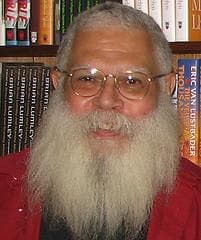
Samuel R. Delany is an American author known for his contributions to science fiction. His notable works include "Dhalgren," a complex narrative exploring themes of identity and society, and "Stars in My Pocket Like Grains of Sand," which delves into issues of sexuality and culture. Delany's writing is recognized for its innovative style and depth.
Similar books
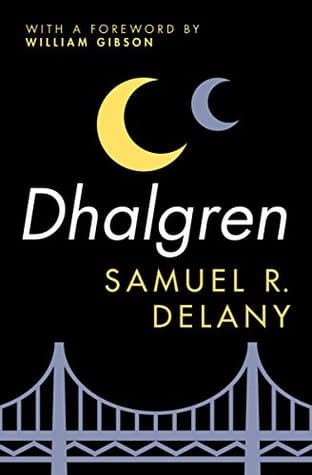
- Dhalgren
Samuel R. Delany
3.8 (9k) average on GoodreadsFantasyShares Delany's experimental style, complex themes, and unique narrative voice.
- The Left Hand Of Darkness
Ursula K. Le Guin
4.1 (120k) average on GoodreadsFantasyExplores gender, society, and alien cultures through a deeply immersive and thoughtful lens.
- Dune
Frank Herbert
4.2 (766k) average on GoodreadsFantasyFeatures intricate galactic politics, vast world-building, and a blend of philosophical and action elements.
- Harry Potter and the Sorcerer's Stone
J.K. Rowling
4.5 (7M) average on GoodreadsFantasyRescued from a miserable life under the stairs, an orphaned boy discovers he's a wizard destined for a magical school, where he uncovers a dangerous secret tied to the dark wizard who murdered his parents.
- The Hunger Games
Suzanne Collins
4.3 (6.4M) average on GoodreadsFantasyIn a future where children fight to the death on live television, Katniss Everdeen volunteers for the arena, turning a death sentence into a fight for survival and a spark of rebellion.
- 1984
George Orwell
4.2 (3.1M) average on GoodreadsPoliticsIn a future where surveillance and thought control are absolute, a man's search for truth clashes with the Party, showing that hope can be a form of rebellion.





Enjoyed the summary?
A summary gives you the shape of the book. The book itself has the detail, the examples and the voice.
Find Stars in My Pocket Like Grains of Sand on AmazonAs an Amazon Associate, BookBrief earns from qualifying purchases. How we're funded