
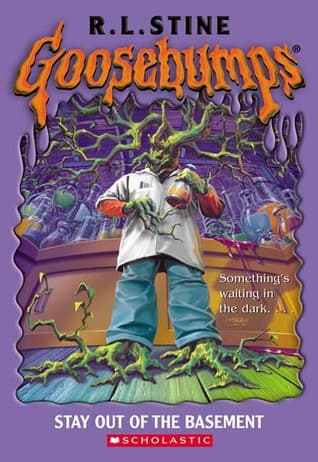
Synopsis
Covers the whole plot, including the ending.
- Difficulty
- Easy
- Pacing
- Fast
- Mood
- Suspenseful, Eerie, Campy, Fun
- Read it if
- You enjoy classic Goosebumps stories with a blend of horror, mystery, and a touch of the absurd.
- Skip it if
- You prefer realistic thrillers or complex character-driven narratives.
Stay Out of the Basement Plot Summary
Covers the whole plot, including the ending.
A Father's Return and a Basement Warning
Margaret and Casey Brewer's father, Dr. Brewer, returns home from his job as a botanist after being fired, claiming he had a 'nervous breakdown.' He has a bandaged hand and a strange green cut on his forehead. He immediately takes over the basement, declaring it his new laboratory and strictly forbidding Margaret and Casey from entering. Their mother, Mrs. Brewer, seems unusually calm, attributing it to their father's recovery. The children are uneasy, noticing his increasingly odd behavior and the peculiar sounds from the basement.
Peculiar Plants and a Father's Transformation
Driven by curiosity and growing concern, Margaret and Casey sneak into the basement while their father is supposedly asleep. They discover a room filled with bizarre, pulsating plants that seem almost alive. Their father's appearance begins to change; his skin takes on a greenish tint, he develops a strange odor, and his voice becomes hoarse. He spends all his time in the basement, emerging only for meals, which he barely touches. The children try to talk to their mother about their worries, but she dismisses their concerns, insisting their father is simply recovering.
The First Plant-Dad
One afternoon, Margaret and Casey hear a strange noise from the basement. When they investigate, they find their father in distress, struggling with a large, vine-like plant. To their horror, they discover a grotesque, plant-like duplicate of their father, a 'plant-dad,' lying on the floor. This creature is clearly not human, but an imitation. Dr. Brewer quickly disposes of it, but the incident confirms the children's worst fears: his experiments are dangerous, and he is involved in something unnatural. They are now convinced their father is not himself.
A Mother's Denial and a Daughter's Discovery
Margaret and Casey try to confront their mother again, explaining what they saw, but she remains in denial, accusing them of having overactive imaginations. Margaret, however, remains determined to uncover the truth. She finds an old photograph of her father with a colleague, Dr. Martinez, known for his controversial plant experiments. This discovery, coupled with her father's increasingly erratic and cold behavior, makes Margaret realize that the 'plant-dad' they saw was not an isolated incident, and the danger is far greater than they imagined. She suspects her father might be one of these plant creations.
The Plant's True Nature Revealed
The children secretly observe their father's work in the basement. They witness him nurturing the plants, which appear to be growing human-like features. They also find his old research notes, detailing his work with sentient plant clones. It becomes clear that the plants are not just imitations but living, parasitic duplicates, capable of replacing humans. The most shocking realization dawns on them: the 'father' who returned home, the one with the green skin and strange habits, is not their real father but one of these plant-clones, a replacement.
The Real Dr. Brewer's Fate
Determined to find their real father, Margaret and Casey venture deeper into the basement. In a hidden section, they discover their true father, Dr. Brewer, frail and weak, bound by thick vines. He is barely alive, held captive by his plant-clone. He explains that the plant-clone took his place after creating him, and has been trying to perfect the cloning process. The real Dr. Brewer warns them that the plant-clone is dangerous and will stop at nothing to continue its experiments, and that he himself is slowly being drained of life.
Confrontation and Escape
As Margaret and Casey try to free their real father, the plant-clone 'father' appears, its green skin now more pronounced and its eyes glowing menacingly. It reveals its sinister nature, admitting its plan to replace the entire family. A struggle ensues, with the plant-clone attempting to capture the children. With their real father's guidance and their own quick thinking, Margaret and Casey manage to sever the vines holding their father and escape the basement, leaving the enraged plant-clone behind. They realize they must find a way to destroy the plant-clone and its creations.
The Mother's Revelation
Having escaped the basement with their weakened real father, Margaret and Casey try to explain everything to their mother. However, their mother displays no shock or concern, and her eyes have a peculiar glassy look. To their horror, they realize that she too has been replaced by a plant-clone. The 'mother' plant-clone reveals herself, stating that the replacement process is complete. The children are now faced with the terrifying reality that both their parents have been usurped by these plant duplicates, and they are completely alone against them.
A Desperate Plan
With both their parents replaced, Margaret and Casey, along with their ailing real father, realize they are in grave danger. Their real father, though weak, remembers a crucial detail from his research: the plant-clones are highly sensitive to direct sunlight, which can be fatal. They formulate a desperate plan to lure the plant-clones outside and expose them to the sun. This is their only hope of destroying the duplicates and saving themselves, as well as preventing the spread of these parasitic plants.
The Final Battle
Margaret and Casey put their plan into action. They create a distraction, luring the plant-clone 'father' and 'mother' out of the house, ostensibly to discuss a 'problem' with the garden. The plant-clones, driven by their desire to maintain their human facade and control, follow them outside. As the plant-clones step into the direct sunlight, they begin to shrivel, burn, and disintegrate into piles of green slime, their plant nature unable to withstand the sun's rays. The children watch in relief and horror as their terrifying ordeal comes to an end.
A New Beginning, A Lingering Doubt
With the plant-clones destroyed, Margaret and Casey bring their real father, still weak but recovering, back into the house. They are relieved to have their true family back, though shaken by the traumatic events. As they begin to heal and rebuild their lives, a final, chilling detail emerges. The real Dr. Brewer comments on how much better he feels, and then, with a strange, knowing smile, mentions how much he loves gardening now. The children exchange a look of unease, a lingering doubt: could a part of the plant still remain, or worse, could this 'real' father be another clone, or simply influenced by the plant's nature?
Principal Figures
Margaret Brewer
Protagonist
The elder sister, observant and determined to uncover the truth.
Margaret is the older of the two Brewer children, portrayed as intelligent, observant, and highly skeptical. She is the first to notice the strange changes in her father and the bizarre goings-on in the basement. Driven by a deep love for her real father and a strong sense of self-preservation, she is determined to uncover the truth behind his transformation and the unsettling plant experiments. She often takes the lead in investigating and formulating plans, demonstrating courage and resourcefulness.
Relationships: Casey Brewer (Sister, confidante, and partner in investigation); Dr. Brewer (real) (Daughter, motivated to save him); Dr. Brewer (plant-clone) (Antagonist, fears and fights against him); Mrs. Brewer (real) (Daughter, seeks her comfort and understanding); Mrs. Brewer (plant-clone) (Antagonist, fears and fights against her)
Casey Brewer
Protagonist
The younger brother, initially more hesitant but equally brave.
Casey is Margaret's younger brother, initially more prone to fear and less assertive than Margaret, but equally observant. He often follows Margaret's lead in their investigations but contributes his own insights and courage when needed. Despite his initial apprehension, he shows remarkable bravery and loyalty to his sister and real father. He is essential in helping Margaret carry out their plans to expose and destroy the plant-clones, providing support and often acting as a sounding board for Margaret's ideas.
Relationships: Margaret Brewer (Brother, relies on her leadership and courage); Dr. Brewer (real) (Son, motivated to save him); Dr. Brewer (plant-clone) (Antagonist, fears and fights against him); Mrs. Brewer (real) (Son, seeks her comfort and understanding); Mrs. Brewer (plant-clone) (Antagonist, fears and fights against her)
Dr. Brewer (Plant-Clone)
Antagonist
The initial plant duplicate of the children's father, attempting to replace him and his family.
This is the primary antagonist, a sentient plant-clone that has replaced the real Dr. Brewer. Initially, it mimics human behavior convincingly enough to fool Mrs. Brewer, but its plant-like tendencies (greenish skin, strange smell, obsession with the basement) become increasingly apparent to Margaret and Casey. Its motivation is to perfect the cloning process and replace the entire Brewer family. It is cold, manipulative, and ruthless, showing no genuine emotion or parental affection, only a desire to maintain its existence and continue its work.
Relationships: Margaret Brewer (Antagonist, attempts to replace and control her); Casey Brewer (Antagonist, attempts to replace and control him); Dr. Brewer (real) (Captor and usurper, holds him prisoner); Mrs. Brewer (plant-clone) (Partner in crime, both plant-clones)
Dr. Brewer (Real)
Supporting
The children's actual father, a botanist who became a victim of his own experiments.
The real Dr. Brewer is a brilliant botanist whose fascination with plant genetics led him down a dangerous path. He inadvertently created the sentient plant-clones that eventually replaced him and held him captive in his own basement. When discovered by his children, he is weak and frail, but still retains his intellect and love for his children. He provides crucial information about the plant-clones' weaknesses, aiding Margaret and Casey in their fight. His initial ambition and subsequent suffering highlight the dangers of unchecked scientific curiosity.
Relationships: Margaret Brewer (Father, relies on her to save him); Casey Brewer (Father, relies on him to save him); Dr. Brewer (plant-clone) (Victim and rival, captured by his creation)
Mrs. Brewer (Plant-Clone)
Antagonist
The plant duplicate of the children's mother, revealed late in the story.
This plant-clone replaces the real Mrs. Brewer, initially appearing as the calm and dismissive mother who believes her 'husband' is simply recovering. Her denial of the children's concerns is a key part of the deception. Her true nature is revealed later in the story, showing her to be another cold, emotionless plant duplicate, fully complicit in the plant-clones' plan to replace the entire family. She acts as a secondary antagonist, reinforcing the chilling reality of the children's isolation.
Relationships: Margaret Brewer (Antagonist, attempts to control her); Casey Brewer (Antagonist, attempts to control him); Dr. Brewer (plant-clone) (Partner in crime, both plant-clones)
Mrs. Brewer (Real)
Mentioned
The children's true mother, who is replaced by a plant-clone.
The real Mrs. Brewer is only briefly mentioned and implied to have been replaced by a plant-clone before the story's main events. Her absence and replacement underscore the sinister efficiency of the plant-clones and the isolation of Margaret and Casey. She represents what was lost to the children before they even fully understood the danger.
Relationships: Margaret Brewer (Mother, her loss is a driving force); Casey Brewer (Mother, her loss is a driving force)
Dr. Martinez
Mentioned
Dr. Brewer's former colleague, known for controversial plant research.
Dr. Martinez is mentioned as a former colleague of Dr. Brewer, known for his controversial and ethically dubious plant experiments. He serves as a background figure, providing context for Dr. Brewer's own dangerous research and hinting at the scientific origins of the plant-clones. His work likely influenced or inspired Dr. Brewer's own experiments, leading to the creation of the sentient plants.
Relationships: Dr. Brewer (real) (Colleague, shared scientific interests)
Themes & Insights
The Dangers of Unchecked Scientific Ambition
The novel explores how Dr. Brewer's pursuit of scientific discovery, specifically in plant genetics, leads to catastrophic consequences for himself and his family. His ambition blinds him to the ethical implications and potential dangers of creating sentient plant life capable of mimicry and replacement. The basement, initially a symbol of his work, becomes a prison and a source of horror, demonstrating that pushing the boundaries of nature without caution can lead to self-destruction and the endangerment of loved ones. This is evident when Margaret and Casey discover the real Dr. Brewer, a victim of his own creation.
“''Stay out of the basement,' their father had warned them. 'It's dangerous down there.' He was right. More dangerous than they could have imagined.”
Identity and Impersonation
A central theme is the concept of identity being stolen and impersonated. The plant-clones perfectly mimic human appearance and behavior, creating unease and forcing the children to question who their parents truly are. The 'father' who returns home is not their real father, and later, the 'mother' is also revealed to be a duplicate. This theme highlights the terror of losing loved ones not through death, but through replacement by an identical, soulless imitation. The children's struggle to discern the real from the fake is a key driver of the plot.
“He looks like Dad. He sounds like Dad. But he's not Dad.”
Childhood Vigilance vs. Adult Denial
The story contrasts the children's awareness and fear with the adults' denial. Margaret and Casey immediately sense something is wrong with their father, noticing subtle changes and the strange atmosphere in the house. In contrast, their 'mother' dismisses their concerns, attributing their father's bizarre behavior to a 'nervous breakdown.' This dynamic shows how children are often more perceptive to underlying truths when adults are unwilling or unable to confront uncomfortable realities. The adults' denial initially isolates the children, forcing them to investigate and act alone.
“You two have such overactive imaginations,' their mother said, forcing a smile. 'Your father is just recovering.”
The Fragility of Family and Trust
The story revolves around the shattering of the Brewer family unit and the erosion of trust. The sudden and unexplained changes in Dr. Brewer, followed by the revelation of his plant-clone replacement, dismantle the children's sense of security and trust in their parents. The ultimate discovery that their mother has also been replaced further isolates Margaret and Casey, forcing them to question the very foundation of their family. This theme explores the psychological impact of betrayal and the desperate fight to reclaim what was lost, highlighting how quickly family bonds can be threatened by external, sinister forces.
“They were alone. Both their parents were gone. Replaced by them.”
Plot Devices & Literary Techniques
The Forbidden Basement
A classic horror trope creating suspense and mystery.
The basement serves as the primary setting for the horror and mystery in the story. Dr. Brewer's strict prohibition against entering it immediately establishes a sense of forbidden knowledge and danger. This device effectively builds suspense, as the children's natural curiosity drives them to defy the warning, leading to their terrifying discoveries. It symbolizes the hidden truths and the dark secrets that lie beneath the surface of their seemingly normal family life.
Body Horror / Impersonation
The unsettling physical transformation and replacement of human characters.
This device manifests through the gradual, unsettling physical changes in the plant-clone Dr. Brewer (greenish skin, strange smell) and the reveal of the grotesque plant-duplicates. The idea of a loved one being replaced by an identical but fundamentally alien entity is a core element of the horror. It plays on fears of losing identity and the uncanny valley, where something looks human but is subtly, terrifyingly off, creating a deep sense of revulsion and distrust.
The Unreliable Adult
Adult figures who either mislead or are unaware of the danger.
The 'mother' character, initially, and the plant-clone 'father' demonstrate this device. The 'mother' constantly dismisses the children's valid concerns, making them question their own sanity and isolating them. The plant-clone 'father' is actively deceptive, maintaining a facade of being human while pursuing his sinister agenda. This device amplifies the children's vulnerability and forces them to rely solely on each other, heightening the tension and urgency of their situation.
Deus ex Machina (Weakness of the Clones)
A convenient, previously unknown weakness that resolves the conflict.
The discovery that the plant-clones are fatally vulnerable to direct sunlight serves as a convenient resolution to an otherwise seemingly insurmountable threat. While foreshadowed by Dr. Brewer's botanical research, its precise effectiveness and the ease with which it can be exploited by children to defeat powerful, intelligent clones, functions as a 'deus ex machina.' It provides a clear, albeit sudden, solution to the main conflict, allowing the protagonists to achieve victory.
Stay Out of the Basement Quotes
“The basement was more than just a room; it was a hungry mouth, waiting to swallow them whole.”
“Don't go in the basement. Whatever you do, *never* go in the basement.”
“The plants weren't just growing; they were *watching*.”
“A plant doesn't just... eat things. Does it?”
“The air down there felt thick, alive, like it was breathing.”
“They looked exactly like their parents, but something was terribly, horribly wrong.”
“It wasn't a bad dream. It was real. And it was waiting for them.”
“The vines twisted and writhed, not like plants, but like hungry snakes.”
“Our parents wouldn't do that. Our *real* parents wouldn't.”
“The basement wasn't just a place where things grew; it was a place where things *changed*.”
“Sometimes, the things you love the most can be the most dangerous.”
“They were trapped. Not in the basement, but in their own home.”
“The green slime pulsed, almost as if it had a heartbeat.”
“You can't trust anyone, not even your own reflection, when the basement has had its way.”
Quiz
10 questions on the plot and the characters. Each answer comes with a short explanation.
Question 1
What is the name of the doctor who conducts experiments in the basement?
- Dr. Frankenstein
- Dr. Brewer
- Dr. Green
- Dr. Thorn
Show answer
B. Dr. Brewer The father character conducting the experiments is named Dr. Brewer.
Question 2
What kind of experiments is Dr. Brewer conducting in his basement?
- Animal cloning
- Chemical reactions
- Plant-testing
- Robotics
Show answer
C. Plant-testing The story explicitly states Dr. Brewer is doing 'plant-testing' in his basement.
Question 3
Who are Dr. Brewer's children?
- Sarah and Tim
- Margaret and Casey
- Emily and Josh
- Alice and Peter
Show answer
B. Margaret and Casey The children who are worried about their father are named Margaret and Casey Brewer.
Question 4
What is the primary physical change the children notice in their father?
- He starts growing scales.
- He develops plant-like tendencies and becomes 'weedy-and seedy'.
- He begins to glow in the dark.
- He loses the ability to speak.
Show answer
B. He develops plant-like tendencies and becomes 'weedy-and seedy'. The description states he 'is developing plant like tendencies' and 'is becoming distinctly weedy-and seedy'.
Question 5
What is the main setting for Dr. Brewer's mysterious experiments?
- The attic
- A secret laboratory in the garden
- The basement of his home
- A remote cabin in the woods
Show answer
C. The basement of his home The title of the book 'Stay Out of the Basement' and the description clearly indicate the basement as the setting for the experiments.
Question 6
What phrase does Dr. Brewer use to describe his experiments to his children?
- Groundbreaking and dangerous
- Harmless
- Top secret
- For the good of humanity
Show answer
B. Harmless Dr. Brewer assures his children his experiments are 'Harmless, he says.'
Question 7
What is the underlying fear or concern that drives the plot?
- Fear of a house fire due to experiments.
- Concern that Dr. Brewer's experiments are transforming him into something non-human.
- Worry about Dr. Brewer losing his job.
- Anxiety about strange noises coming from the basement.
Show answer
B. Concern that Dr. Brewer's experiments are transforming him into something non-human. The children's worry stems from their father 'developing plant like tendencies' and becoming 'distinctly weedy-and seedy', suggesting a transformation.
Question 8
The tagline asks if Dad has 'more than just a green thumb'. What literary device is primarily used here?
- Simile
- Metaphor
- Pun/Idiom with a twist
- Hyperbole
Show answer
C. Pun/Idiom with a twist 'Green thumb' is an idiom for being good with plants. The twist suggests he is literally becoming part plant, playing on the idiom.
Question 9
What is the primary conflict presented in the story's premise?
- Man vs. Nature, as Dr. Brewer tries to control plant life.
- Children vs. Parents, as Margaret and Casey disobey their father's rules.
- Internal conflict within Dr. Brewer about his experiments.
- The mysterious and potentially dangerous transformation of Dr. Brewer due to his own experiments.
Show answer
D. The mysterious and potentially dangerous transformation of Dr. Brewer due to his own experiments. The core conflict revolves around Dr. Brewer's transformation and the children's fear about what is happening to him, implying a struggle against the effects of his own science.
Question 10
What specific detail about the plants makes the children worried, beyond just seeing them?
- The plants are making strange noises.
- They 'meet' some of the plants, implying an unsettling interaction or sentience.
- The plants are emitting a foul odor.
- The plants are dying despite Dr. Brewer's efforts.
Show answer
B. They 'meet' some of the plants, implying an unsettling interaction or sentience. The text states, 'Especially when they...meet...some of the plants he is growing down there,' implying a personal and potentially alarming encounter, not just observation.
Stay Out of the Basement FAQ
What is the central premise of 'Stay Out of the Basement'?
The story revolves around Margaret and Casey Brewer, who become increasingly concerned about their botanist father, Dr. Brewer, and his peculiar plant experiments in their basement. Their father begins to exhibit unsettling plant-like physical and behavioral changes, leading them to suspect his 'harmless' research is far more sinister than he lets on.
Who are the main protagonists of the story?
The main protagonists are the siblings Margaret and Casey Brewer. They are the ones who observe their father's strange transformation and venture into the basement to uncover the truth behind his experiments, often finding themselves in dangerous situations.
What specific physical changes do Margaret and Casey observe in Dr. Brewer?
Dr. Brewer's skin becomes green and rough, he develops roots on his feet, and his hair turns into leaves. He also starts to smell like fertilizer and speaks in a slow, drawn-out manner, indicating a profound physiological shift towards a plant-like state.
What is the primary setting for the terrifying events in the book?
The primary setting is the basement of the Brewer family home, which Dr. Brewer has converted into a laboratory for his plant experiments. This dark, humid, and overgrown space becomes the source of all the horror and mystery, housing the monstrous plants and the transformed Dr. Brewer.
What is the ultimate fate of the 'original' Dr. Brewer?
It is revealed that the Dr. Brewer the children have been interacting with for much of the story is actually a plant clone, or 'plant-man,' created by the real Dr. Brewer. The genuine Dr. Brewer is found tied up and held captive by his own creations in the basement, having been replaced by the clone.
How do the 'plant-men' communicate or interact with the children?
The plant-men, particularly the one impersonating Dr. Brewer, communicate verbally, albeit with an increasingly slow and monotone delivery. They try to trick the children into staying in the basement and even attempt to 'plant' them, showing a malicious intent despite their botanical nature.
What role do the monstrous plants in the basement play in the plot?
The monstrous plants are not just background elements; they are active antagonists. They are the result of Dr. Brewer's dangerous experiments, capable of movement, communication, and even attempting to capture and transform Margaret and Casey, serving as guardians for the plant-men.
Is there any symbolism in Dr. Brewer's transformation into a plant-like being?
Dr. Brewer's transformation can symbolize the dangers of unchecked scientific ambition and the blurring of lines between humanity and nature. His obsession with his work ultimately consumes him, literally turning him into the very subject of his research, highlighting a loss of control.
How do Margaret and Casey's differing personalities contribute to their survival?
Margaret, often more cautious and observant, pieces together clues, while Casey, more impulsive, sometimes acts as the catalyst for discoveries or escapes. Their combined strengths—Margaret's analytical thinking and Casey's willingness to act—are crucial for navigating the dangers of the basement and outsmarting the plant-men.
What psychological impact might the discovery of their 'father' being a plant clone have on the children?
The revelation that their father was replaced by a plant clone could lead to profound trust issues and trauma, making them question reality and the identities of those around them. It's a deeply unsettling betrayal of parental trust, even if perpetrated by a non-human entity.
How does the book explore themes of identity and authenticity?
The book heavily explores identity through the plant-man impersonating Dr. Brewer, raising questions about what truly constitutes a person and whether appearance defines identity. The children struggle with recognizing their father, forcing them to look beyond the surface to discern the truth of who he is.
Could Dr. Brewer be considered a villain, or merely a victim of his own experiments?
This is debatable. While the real Dr. Brewer is a victim, his initial recklessness and ambition in creating the plant-men set the stage for the horror. The plant-man who replaces him certainly acts as a villain, but the original Dr. Brewer's culpability lies in his dangerous scientific pursuits.
What is the significance of the title 'Stay Out of the Basement'?
The title serves as both a literal warning and a metaphorical one. Literally, it's where the danger lurks. Metaphorically, it represents the forbidden, the unknown, and the consequences of ignoring boundaries, as the children's curiosity ultimately forces them to enter the dangerous space.
Does the ending offer a complete resolution, or does it leave room for lingering dread?
While the immediate threat is resolved with the rescue of the real Dr. Brewer and the defeat of the plant-men, the ending often leaves a lingering sense of unease. The traumatic events and the sheer strangeness of what occurred suggest that the children's lives, and potentially Dr. Brewer's research, will never be quite the same, hinting at lasting psychological scars.
How does the book utilize the 'thriller' and 'science fiction' elements for its target audience?
It uses thriller elements through suspenseful pacing, jump scares, and the constant threat to the children, while science fiction provides the fantastical premise of human-plant hybrids and genetic experimentation. These elements are presented in an accessible way for young adults, focusing on immediate dangers rather than complex scientific theories.
About the author

R.L. Stine is an American author best known for his work in children's horror fiction. His notable books include "Welcome to Dead House," "Night of the Living Dummy," "The Haunted Mask," "Stay Out of the Basement," "The Scarecrow Walks at Midnight," and "The Curse of Camp Cold Lake," which have captivated young readers with their thrilling and spooky narratives.
Similar books
- The Blob that Ate Everyone
R.L. Stine
3.5 (6k) average on GoodreadsAnother Goosebumps book with a monster consuming people and a similar tone.
- The Witches
Roald Dahl
4.2 (314k) average on GoodreadsFantasyWhile both Stay Out of the Basement and The Witches are children's thrillers involving monstrous transformations and hidden dangers, Dahl's work offers significantly more nuanced character development and a darker, more sophisticated sense of peril. Dahl's Grand High Witch is a genuinely terrifying and intelligent antagonist, whereas Stine's plant-dad, while creepy, lacks the same strategic malevolence. The Witches also delves deeper into themes of courage and resilience in the face of overwhelming evil, whereas Stay Out of the Basement prioritizes immediate scares over profound character journeys.
- Coraline
Neil Gaiman
4.0 (23k) average on GoodreadsFantasyGaiman's Coraline shares Stine's theme of a child discovering a monstrous 'other' within their home and family structure. However, Coraline is vastly superior in its psychological depth, world-building, and thematic complexity. Gaiman crafts a truly disturbing atmosphere and explores themes of neglect, identity, and the allure of false perfection with far greater sophistication. The 'Other Mother' in Coraline is a chilling representation of manipulative evil, a stark contrast to the more straightforward, almost accidental horror of Stine's plant-father. While both aim to scare, Gaiman achieves a level of existential dread that Stine's Goosebumps series, by design, does not.
- Angels & Demons
Dan Brown
3.9 (2.7M) average on GoodreadsThrillerA Harvard symbologist races through Rome's ancient sites, deciphering cryptic clues to unmask the Illuminati and stop a vengeful plot to destroy the Vatican with a stolen antimatter weapon.
- Gone Girl
Gillian Flynn
4.1 (2.3M) average on GoodreadsThrillerA wife's sudden disappearance on her fifth anniversary reveals a web of lies and psychological warfare, exposing the secrets within a seemingly perfect marriage.
- The Girl on the Train
Paula Hawkins
3.9 (2.1M) average on GoodreadsThrillerA woman’s fascination with a seemingly perfect couple she watches from her daily train commute leads her into a dark investigation when she witnesses something that shatters their idyllic image.






Enjoyed the summary?
A summary gives you the shape of the book. The book itself has the detail, the examples and the voice.
Find Stay Out of the Basement on AmazonAs an Amazon Associate, BookBrief earns from qualifying purchases. How we're funded