
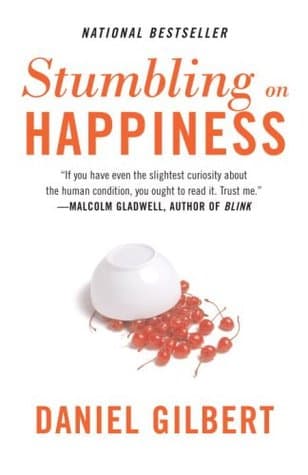
Core Idea
- Difficulty
- Medium
- Read it if
- You are interested in the psychological science behind why humans are so bad at predicting their future happiness and want a humorous, research-backed explanation.
- Skip it if
- You are looking for a prescriptive self-help guide with actionable steps to achieve happiness, rather than a deep dive into the cognitive errors that prevent us from accurately forecasting it.
Key Takeaways from Stumbling on Happiness
The Simulation Gap
Our imagination is a poor predictor of future happiness.
People can imagine future experiences, but this mental simulation is often wrong. We frequently forget how our present emotional state, knowledge, and situation will differ from our future selves. This 'simulation gap' causes us to misjudge how we will feel when future events happen. We tend to fill in missing information with what we know now, projecting our current desires and feelings onto a future self who may have different priorities. This bias means our imagined futures are often more vivid but less accurate than we believe, leading to poor decisions based on expected happiness that never arrives.
“The greatest achievement of the human brain is its ability to imagine objects and episodes that do not exist in the realm of reality.”
In the book: Gilbert discusses how people consistently overestimate the impact of major life events (like winning the lottery or becoming paralyzed) on their long-term happiness, a phenomenon known as the 'impact bias.' They fail to predict their own psychological immune system's ability to adapt.
Try this: When making significant life decisions, actively consider how your perspective and values might shift over time. Don't rely solely on your immediate emotional projection; instead, seek out 'surrogates' – people who have experienced similar futures – to gain more accurate insights into future satisfaction.
Related ideas: affective-forecasting, impact-bias, psychological-immune-system
Presentism's Trap
Our current state of mind distorts our predictions about the future.
Presentism is the common tendency to project our current feelings, knowledge, and circumstances onto our future selves, which leads to wrong predictions about future happiness. When hungry, we imagine we will always want food; when in love, we cannot imagine falling out of it. This is not a conscious choice but an automatic mental default. Our brains struggle to remove our present 'self' from the equation when imagining the future, resulting in a 'hot-cold empathy gap.' We cannot accurately predict how we will act or feel when in a different emotional or physical state, leading to bad choices about future experiences.
“When we try to imagine the future, we don't just use our imagination – we use our memory, too.”
In the book: Studies show that people in a 'hot' state (e.g., sexually aroused, angry, hungry) make different decisions and predictions than those in a 'cold' state, often failing to anticipate how their 'cold' future self would feel or act. For instance, someone full of food might struggle to empathize with their hungry future self's desire for a large meal.
Try this: Before making decisions that impact your future happiness, try to simulate the future self's state as accurately as possible. If you're deciding on a diet, don't do it on a full stomach. If planning a vacation, consider what your future, tired self will appreciate, not just your current excited self. Seek diverse perspectives, especially from those who have been in the future state you're predicting.
Related ideas: presentism, hot-cold-empathy-gap, cognitive-bias
The Myopia of Memory
Our memories are reconstructive, not reproductive, affecting future predictions.
We often use past experiences to predict future happiness, but our memories are often unreliable. They are not perfect recordings but rather reconstructions, influenced by our current emotions, beliefs, and even information learned after the event. We tend to remember the best and worst parts of experiences and forget the ordinary middle, leading to a skewed view of how enjoyable or painful past events truly were. This 'myopia of memory' means that even when we try to learn from the past, we are often using a biased, edited version of it, leading to repeated errors in predicting future satisfaction.
“Memory is not a photocopy machine. It's more like a Wikipedia page—you can go in there and change it, but so can other people.”
In the book: Gilbert cites the 'peak-end rule,' where people's evaluation of an experience is heavily influenced by its most intense moment (peak) and how it ended, rather than the total duration or average intensity. This explains why a slightly longer, less painful colonoscopy might be preferred over a shorter, more painful one if the end is less uncomfortable.
Try this: When evaluating past experiences to inform future decisions, be skeptical of your emotional recall. Instead of just remembering how you 'felt,' try to recall specific details, and consider journaling experiences as they happen to create a more accurate record. Don't let a strong ending or a single intense moment overshadow the overall reality of an experience.
Related ideas: peak-end-rule, reconstructive-memory, memory-bias
Filling-In Fallacy
Our brains invent details to make incomplete simulations feel real.
When we imagine a future event, our brains do not just retrieve existing information; they actively 'fill in' missing details, often based on our current beliefs and desires, to create a consistent story. This 'filling-in fallacy' means our mental simulations are rarely complete or accurate. Instead of admitting the gaps in our knowledge about a future experience, our brains invent plausible (but often wrong) information, making the simulation feel complete and convincing. This makes us overconfident in our predictions, even when they rely on significant omissions and inventions, leading to unexpected disappointments.
“The brain does not just remember the past, it also 'premembers' the future.”
In the book: Gilbert explains how our perceptual systems 'fill in' blind spots or missing visual information to create a seamless perception of reality. Similarly, our brains fill in the gaps when imagining the future, often omitting negative details or inventing positive ones to create a more desirable, but less accurate, forecast. He likens it to how we don't notice the gaps in a visual scene.
Try this: When imagining a future event, consciously identify what you *don't* know. Ask specific questions about the details you might be filling in automatically. Challenge your assumptions and consider alternative, less ideal scenarios that your brain might be conveniently omitting. Don't let a smooth mental narrative blind you to potential pitfalls.
Related ideas: filling-in, cognitive-bias, imagination-bias
The Problem of Distinction
We prioritize minor distinctions over major similarities.
People tend to focus on the unique differences between two options, even when the shared aspects are more important for overall happiness. This 'problem of distinction' causes us to overemphasize small differences when comparing future possibilities, such as choosing between two similar job offers based on a minor perk, rather than their core responsibilities or work-life balance. We fail to see that many parts of our lives will stay the same regardless of our choice, leading us to believe that a seemingly different option will lead to a dramatically different emotional outcome, which rarely happens.
“When we are asked to imagine two futures, we tend to focus on the features that distinguish them, rather than on the features they share.”
In the book: Gilbert uses the example of dining companions who insist on ordering different meals, even if they both want the same thing, to avoid appearing unoriginal. This highlights our tendency to seek distinction, even at the cost of personal preference. Another example is choosing between two colleges that are fundamentally similar, based on a minor difference in campus culture.
Try this: When comparing future options, force yourself to list all the shared characteristics first. Then, critically evaluate whether the distinguishing features are truly significant enough to warrant a different prediction of happiness. Focus on the core aspects that drive satisfaction, not just superficial differences.
Related ideas: distinction-bias, comparative-thinking, cognitive-bias
The Illusion of Control
We overestimate our ability to control future outcomes and happiness.
We have an inherent, often irrational, belief that we control future events and our happiness more than we actually do. This 'illusion of control' makes us feel more secure and motivated, but it also causes us to take too much responsibility for outcomes largely influenced by chance or external factors. When things go wrong, we blame ourselves too much, and when things go right, we attribute it solely to our own efforts, reinforcing the illusion. This overestimation of control can lead to anxiety, disappointment, and a failure to appreciate the role of luck or adapt to unforeseen circumstances.
“The human mind is a master of illusion, and one of its most compelling tricks is the illusion of control.”
In the book: Gilbert discusses studies where people believe they can influence random events, like rolling dice, or feel more confident in a lottery ticket they picked themselves versus one assigned randomly. This demonstrates our tendency to attribute causality to our actions even when none exists.
Try this: Recognize that while effort is important, many factors are beyond your control. Focus on influencing what you can, but also cultivate resilience and acceptance for what you cannot. Practice letting go of the need for perfect control and embrace a more probabilistic view of outcomes, reducing self-blame and increasing adaptability.
Related ideas: illusion-of-control, locus-of-control, attribution-bias
Habituation's Hammer
We quickly adapt to new circumstances, diminishing long-term happiness.
People are remarkably good at adjusting to new situations, both good and bad. This 'habituation' or 'hedonic adaptation' means that the initial excitement of a new car, a promotion, or even a new relationship quickly fades as we get used to it. While this psychological immune system protects us from long-term suffering, it also means that the things we predict will make us lastingly happy often provide only a temporary boost. Our predictions for happiness fail to account for this quick return to a baseline level of contentment, leading us to constantly seek the 'next big thing' in a futile search for lasting joy.
“One of the most powerful determinants of our emotional experience is adaptation.”
In the book: Gilbert refers to studies showing that lottery winners and paraplegics, after an initial period of intense joy or despair, tend to return to their baseline levels of happiness within a relatively short time. This demonstrates the powerful effect of hedonic adaptation.
Try this: Instead of constantly pursuing major life changes for happiness, focus on variety, novelty, and savoring small pleasures. Break up routines, introduce new experiences, and actively practice gratitude to counteract habituation. Invest in experiences rather than material goods, as experiences are less prone to adaptation.
Related ideas: hedonic-adaptation, habituation, psychological-immune-system
The Power of Surrogation
Using others' experiences is a superior prediction method.
Given the flaws in our personal simulations of the future, a more reliable way to predict happiness is 'surrogation'—observing and learning from others who have already experienced the future event we are considering. While we often believe our experiences are unique, human emotional responses are surprisingly consistent across individuals. By asking someone who has actually lived through a situation how they felt, we avoid our own biases and get a more accurate picture of potential satisfaction or dissatisfaction. This method is often overlooked because we believe in our own uniqueness and want to be self-reliant.
“The best way to predict our future feelings is not to imagine how we'd feel, but to see how someone else feels.”
In the book: Gilbert argues that despite our belief in our individuality, human beings are remarkably similar in their fundamental emotional responses to common life events. He suggests that if you want to know how happy a new car will make you, ask someone who just bought that car, rather than trying to imagine it yourself.
Try this: Before making significant decisions, actively seek out 'surrogates' – people who have already experienced the outcomes you are considering. Ask them specific questions about their emotional experience, not just factual details. Be open to their insights, even if they contradict your own imagined future.
Related ideas: surrogation, social-learning, prediction-accuracy
Rationalization's Resilience
Our 'psychological immune system' helps us cope with disappointment.
People have a remarkable 'psychological immune system' that helps us explain away negative experiences, find good in bad situations, and adjust to hardship. This system works best when we are truly 'stuck' in a situation, making us more likely to find positive aspects in irreversible choices (e.g., a bad job or a fixed relationship). However, we often do not anticipate the power of this system, leading us to overestimate the long-term impact of negative events. Conversely, we underestimate its ability to lessen the disappointment of a 'bad' choice, causing us to worry over decisions more than necessary, fearing a misery that our brains will likely soften.
“We are all prone to a set of errors that make us believe that things will be better or worse than they turn out to be.”
In the book: Gilbert discusses how people find ways to be happy even after major tragedies or disappointments. For example, people who are denied something they wanted often rationalize why they didn't want it anyway, or find unexpected benefits in their current situation. This system is particularly strong when choices are irreversible.
Try this: Don't fear making 'wrong' choices as much as you think you should. Trust that your psychological immune system will help you adapt and find contentment, especially with irreversible decisions. This doesn't mean being reckless, but it suggests that agonizing over every minor choice might be a waste of emotional energy. Focus on making good choices, but be prepared to make the best of whatever outcome ensues.
Related ideas: psychological-immune-system, rationalization, cognitive-dissonance
The Uniqueness Fallacy
We believe our experiences are more unique than they truly are.
A main reason we struggle to predict our future happiness is our deep belief in our own uniqueness. We tend to think that our specific situation, personality, and history make us an exception to general human psychological patterns. This 'uniqueness fallacy' causes us to dismiss the experiences of others (surrogates) as irrelevant to our own situation, preferring to rely on our flawed imagination. While individual differences certainly exist, the basic mechanisms of human emotion and adaptation are quite universal. Overestimating our own distinctiveness prevents us from using valuable information from others, thus continuing our errors in predicting future feelings.
“We are unique in our own eyes, and this uniqueness makes us suspect that our emotional reactions will be unique as well.”
In the book: Gilbert points out that while we are indeed unique individuals, our basic emotional hardware and psychological immune system operate in very similar ways across humanity. He challenges the notion that 'my experience will be different' when it comes to fundamental human responses like adaptation to change or coping with loss.
Try this: Actively challenge your assumption that your situation is 'different.' While specific details vary, the underlying emotional and adaptive processes are often shared. Embrace the wisdom of crowds and the experiences of others, recognizing that human commonalities are more profound than our individual differences when it comes to predicting happiness. Don't let ego prevent you from learning from others.
Related ideas: uniqueness-bias, self-enhancement-bias, affective-forecasting
Stumbling on Happiness Quotes
“The greatest discovery of the last few thousand years is that we don't know what will make us happy.”
“We are the only animal that thinks about the future.”
“The human being is an 'experiencing self' and a 'remembering self.' The remembering self is the one that tells the story.”
“The greatest shortcoming of the human imagination is its inability to imagine its own shortcomings.”
“We often judge the pleasure of an experience by its ending, not by its sum total.”
“Impact bias is the tendency to overestimate the intensity and duration of our future emotional reactions to future events.”
“We treat our future selves as though they were strangers.”
“The brain is a wonderfully efficient organ. It starts working the moment you get up in the morning and does not stop until you get into the office.”
“People are more likely to endorse an idea if it is easy to process.”
“Our brains are not designed to tell us the truth about how we will feel; they are designed to get us to reproduce.”
“The surest way to work up a appetite for a thing is to see some one else supremely enjoying it.”
“Happiness is a word people use to denote a certain kind of feeling.”
“The best way to predict your future feelings is to see how others are feeling who are having the experience you are contemplating.”
“We confuse wants with likes.”
Quiz
10 questions on the main ideas. Each answer comes with a short explanation.
Question 1
According to Gilbert, what is the primary reason humans struggle to accurately predict their future happiness?
- They are inherently pessimistic about future events.
- Their imagination tends to fill in details that aren't present, often leading to misinterpretations.
- They lack sufficient data about past experiences to make informed predictions.
- Societal pressures compel them to pursue goals that don't align with true happiness.
Show answer
B. Their imagination tends to fill in details that aren't present, often leading to misinterpretations. Gilbert argues that our imagination, while powerful, often 'prefills' details or omits crucial information, leading us to create inaccurate simulations of future experiences and thus mispredict our emotional responses.
Question 2
Which of the following cognitive biases does Gilbert extensively discuss as a reason for misforecasting happiness, particularly regarding how we adapt to circumstances?
- Confirmation bias
- Hindsight bias
- Impact bias
- Anchoring bias
Show answer
C. Impact bias Gilbert frequently refers to the 'impact bias,' which is our tendency to overestimate the intensity and duration of our future emotional reactions to events.
Question 3
Gilbert uses the example of why lovers might forgive infidelity more readily than dirty dishes to illustrate what point about our emotional responses?
- Major transgressions are inherently easier to rationalize than minor annoyances.
- Our psychological immune system works more effectively on significant, threatening events.
- The perceived intentionality behind an action dictates the severity of the emotional impact.
- People are more forgiving when they have a deep emotional attachment.
Show answer
B. Our psychological immune system works more effectively on significant, threatening events. Gilbert explains that our 'psychological immune system' is more likely to be triggered and work to rationalize or mitigate the emotional impact of major, unavoidable threats (like infidelity) than minor, everyday annoyances (like dirty dishes).
Question 4
What does Gilbert suggest is the reason sighted people might pay more to avoid going blind than blind people would pay to regain their sight?
- Sighted people overestimate the negative impact of blindness due to a lack of experience.
- Blind people have developed alternative sensory compensations that reduce the value of sight.
- The cost of treatment for blindness is prohibitively high, making the decision economic rather than emotional.
- Sighted people are more prone to fear-based decision-making.
Show answer
A. Sighted people overestimate the negative impact of blindness due to a lack of experience. This example highlights our 'impact bias' and 'focalism.' Sighted people focus intensely on the negative aspects of losing sight, overestimating its long-term impact, while blind individuals have adapted and integrated their condition into their lives, often with less overall unhappiness than imagined.
Question 5
Gilbert introduces the concept of 'prospection.' What is prospection?
- The act of reflecting on past events to understand current emotions.
- The uniquely human ability to think about and imagine the future.
- The psychological process of comparing one's current state to others' states.
- The tendency to seek out positive experiences over negative ones.
Show answer
B. The uniquely human ability to think about and imagine the future. Prospection is defined as the act of looking forward or considering the future, a central theme of the book regarding our ability to imagine and predict future happiness.
Question 6
Why do dining companions often insist on ordering different meals, even if they might prefer the same dish, according to Gilbert?
- To avoid perceived social awkwardness or appearing unoriginal.
- To maximize the variety of tastes available at the table for everyone.
- They genuinely have different preferences that align at that moment.
- It's a subconscious effort to assert individuality.
Show answer
A. To avoid perceived social awkwardness or appearing unoriginal. Gilbert discusses this as an example of 'social influence' and how we sometimes make choices based on what we think others expect or to avoid seeming 'boring' or unadventurous, even if it detracts from our own satisfaction.
Question 7
Gilbert notes that one of the main problems with our imagination is its tendency to 'fill in and leave out.' What does this mean in the context of predicting future happiness?
- Our imagination adds details that weren't originally present and ignores details that are crucial to the actual experience.
- We often fantasize about perfect scenarios while neglecting any potential downsides.
- The imagination only focuses on the most salient features of an event, overlooking the mundane.
- It creates a complete, detailed simulation but then filters out emotionally unpleasant parts.
Show answer
A. Our imagination adds details that weren't originally present and ignores details that are crucial to the actual experience. Gilbert explains that our imagination is a poor predictor because it fabricates details that aren't there and, more importantly, omits crucial information about how an experience will actually feel or unfold, leading to flawed simulations.
Question 8
What is 'focalism' (or the 'focalism illusion') as described by Gilbert?
- The tendency to focus too much on past failures.
- The tendency to overestimate how much we will think about an event in the future and underestimate the impact of other events.
- The ability to concentrate intently on a single task without distraction.
- The bias towards remembering positive events more clearly than negative ones.
Show answer
B. The tendency to overestimate how much we will think about an event in the future and underestimate the impact of other events. Focalism is the phenomenon where, when imagining a future event, we tend to focus exclusively on that event and neglect to consider the myriad other things that will also be happening in our lives at that time, leading to an overestimation of its emotional impact.
Question 9
Gilbert asserts that 'we are the only animal that thinks about the future.' What specific cognitive ability does he link to this unique human trait?
- Episodic memory, which allows us to recall specific past events.
- Symbolic language, enabling complex communication.
- The ability to simulate future experiences in our minds (prospection).
- Tool-making and problem-solving skills.
Show answer
C. The ability to simulate future experiences in our minds (prospection). Gilbert argues that the uniquely human ability to 'stumble on happiness' (or unhappiness) stems from our capacity for prospection – creating mental simulations of future events and their emotional consequences.
Question 10
When discussing the 'reality first' principle, Gilbert explains that our brains tend to treat imagined future events as if they are already happening. How does this contribute to our mispredictions?
- It causes us to experience real emotional reactions to non-existent events, exhausting our emotional reserves.
- Our brains automatically process the imagined event with the same biases and shortcuts used for real-time perception, leading to an 'edited' version of reality.
- It makes us overly optimistic because the brain seeks to avoid negative emotional simulations.
- It leads to 'pre-regret,' where we feel remorse for future actions before they occur.
Show answer
B. Our brains automatically process the imagined event with the same biases and shortcuts used for real-time perception, leading to an 'edited' version of reality. Gilbert explains that our brains operate under a 'reality first' principle, processing imagined events in a similar way to real perceptions. This means that the brain 'fills in' missing details and 'edits' the simulation based on past experiences and biases, leading to an inaccurate or incomplete representation of the actual future.
Stumbling on Happiness FAQ
What is 'Stumbling on Happiness' about?
Daniel Gilbert's 'Stumbling on Happiness' explores why humans are so bad at predicting what will make them happy in the future. It delves into the psychological and cognitive biases that lead us to misimagine our tomorrows and misestimate our future satisfactions, drawing on research from psychology, neuroscience, and behavioral economics.
Does 'Stumbling on Happiness' offer practical advice for becoming happier?
While the book explains the mechanisms behind our faulty predictions of happiness, it is not a prescriptive self-help guide. Instead, it aims to educate readers on the illusions of foresight, helping them understand why their predictions often go awry rather than providing direct steps to achieve happiness.
What is 'affective forecasting' as discussed in the book?
Affective forecasting is the term used to describe our ability, or inability, to predict our future emotional states. Gilbert argues that humans are surprisingly poor at this, often overestimating the intensity and duration of both positive and negative future emotions, which leads to flawed decision-making.
How is 'Stumbling on Happiness' different from other self-help books on happiness?
Unlike many self-help books that offer strategies for achieving happiness, Gilbert's book focuses on the science of why we mispredict happiness. It's more of an explanatory work, dissecting the cognitive processes involved in foresight and imagination, rather than a prescriptive guide.
Why do people often order different meals when dining together, even if they want the same thing?
The book suggests this behavior stems from a desire to appear unique and avoid conformity, even if it means sacrificing personal preference. It's an example of how social considerations can override our true desires, leading to less optimal outcomes for individual satisfaction.
What is the 'impact bias' and how does it relate to happiness?
Impact bias refers to our tendency to overestimate the intensity and duration of future emotional reactions. Gilbert explains how this bias leads us to believe both good and bad events will affect us more profoundly and for longer than they actually do, causing us to make decisions based on exaggerated expectations.
Does 'Stumbling on Happiness' suggest that we can't control our own happiness?
The book doesn't argue against the possibility of controlling happiness but rather highlights the significant challenges and inherent biases in our attempts to predict what will make us happy. It suggests that our future selves are often different from our current selves, making accurate predictions difficult.
Why do sighted people pay more to avoid blindness than blind people pay to regain sight?
This paradox illustrates how we adapt to circumstances. Sighted individuals imagine the devastating impact of losing sight, while blind individuals have adapted to their condition, and their current happiness is not as diminished as a sighted person might predict. This highlights our poor ability to forecast adaptation.
How does memory influence our predictions of future happiness?
Our memories are often flawed and biased, leading us to misremember past experiences in ways that reinforce our current beliefs or desires. Gilbert explains that these distorted memories then feed into our predictions for the future, further skewing our ability to accurately forecast happiness.
About the author

Daniel Todd Gilbert is a renowned social psychologist and professor at Harvard University. He is best known for his critically acclaimed book, "Stumbling on Happiness," which explores the psychology of happiness and human prediction. Gilbert's research and writing delve into the fascinating ways people misunderstand their own emotions and future well-being.
Similar books
- Predictably Irrational: The Hidden Forces That Shape Our Decisions
Dan Ariely
4.1 (101k) average on GoodreadsBusinessInvestigates the systematic ways in which humans deviate from rational behavior, often in predictable patterns, echoing Gilbert's examination of our predictable errors in happiness forecasting.
- Steve Jobs
Walter Isaacson
4.1 (957k) average on GoodreadsBusinessSteve Jobs was a visionary who fused creativity and technology to revolutionize six industries and shape our digital world.
- Freakonomics: A Rogue Economist Explores the Hidden Side of Everything
Steven D. Levitt
4.0 (709k) average on GoodreadsBusinessThis book uses economic principles to reveal the surprising incentives behind everything from drug dealing and real estate to cheating teachers and the decline of crime.
- The Tipping Point: How Little Things Can Make a Big Difference
Malcolm Gladwell
4.0 (690k) average on GoodreadsBusinessMalcolm Gladwell explains how small, targeted actions can start widespread changes in trends, behaviors, and ideas.
- Outliers: The Story of Success
Malcolm Gladwell
4.2 (556k) average on GoodreadsBusinessMalcolm Gladwell argues that true success is not just about individual talent, but about the hidden advantages of culture, opportunity, and unique experiences that shape extraordinary lives.
- The Subtle Art of Not Giving a F*ck: A Counterintuitive Approach to Living a Good Life
Mark Manson
3.9 (530k) average on GoodreadsBusinessEmbrace your flaws and stomach life's lemons, because true happiness isn't about relentless positivity, but about choosing what truly matters to give a f*ck about.






Enjoyed the summary?
A summary gives you the shape of the book. The book itself has the detail, the examples and the voice.
Find Stumbling on Happiness on AmazonAs an Amazon Associate, BookBrief earns from qualifying purchases. How we're funded