
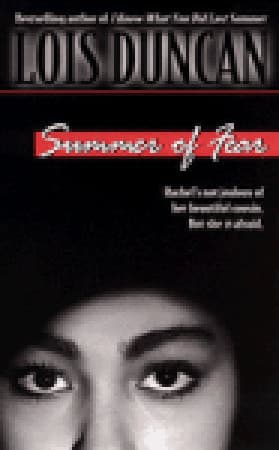
Synopsis
Covers the whole plot, including the ending.
- Difficulty
- Easy
- Pacing
- Moderate
- Mood
- Suspenseful, Eerie, Mysterious, Unsettling
- Read it if
- You enjoy classic YA thrillers with a supernatural twist and a strong sense of impending doom.
- Skip it if
- You prefer contemporary YA with complex character development over plot-driven suspense.
Summer of Fear Plot Summary
Covers the whole plot, including the ending.
A Sudden Arrival
Rachel's summer plans are suddenly changed when her Aunt Cora calls with tragic news: Rachel's Uncle David and Aunt Martha have died in a car accident. Their orphaned daughter, Julia, Rachel's cousin whom she's never met, is coming to live with them in their large, old house in Albuquerque, New Mexico. Rachel's parents, Mr. and Mrs. Bryant, agree to take Julia in. Rachel is uneasy, having heard stories of Julia's mother, Martha, being beautiful but eccentric with an interest in the occult. The family prepares for Julia's arrival, converting the guest room into her new space, and Rachel feels a mix of pity and unease about the change to her family.
Julia's Enchantment
Upon Julia's arrival, Rachel notices her cousin's beauty and quiet manner. Julia quickly wins over Rachel's parents, who are taken by her grace and sweet nature. Even Rachel's younger brother, Peter, finds Julia charming. Rachel's best friend, Allison, and her boyfriend, Mike, are also immediately smitten. Julia's presence transforms the household, and Rachel feels increasingly ignored as everyone dotes on Julia. Rachel, however, experiences an unsettling feeling whenever Julia is near, a prickling sensation and unease she cannot explain, despite Julia's pleasant demeanor.
Whispers of the Past
As summer continues, strange incidents begin to happen around the house. Rachel's cat, Midnight, disappears, and her dog, Skipper, becomes agitated whenever Julia is around. Rachel also notices Julia's aversion to mirrors and her habit of wearing a silver locket constantly. Driven by growing suspicion, Rachel investigates her Aunt Martha's old belongings, which Julia brought with her. Hidden among Martha's things, Rachel discovers books on witchcraft, a book of shadows, and strange herbs, confirming her earlier suspicions about Martha's occult practices and deepening her unease about Julia.
A Divided Loyalty
Julia's charm extends to Rachel's social circle, especially her boyfriend, Mike. Mike, initially polite, becomes increasingly drawn to Julia, spending more time with her and defending her against Rachel's subtle criticisms. Rachel feels jealous and increasingly isolated as Allison also seems to prefer Julia's company. Rachel tries to tell Mike about her fears regarding Julia and the strange occurrences, but he dismisses her concerns as jealousy. This rift between Rachel and Mike grows, leaving Rachel feeling alone in her conviction that something is wrong with Julia.
The Accident at the Canyon
During a family outing to a canyon, Rachel finds herself near a dangerous cliff. She feels a sudden, strong urge to step closer to the edge, as if an unseen force is compelling her. At the same moment, she senses Julia's presence behind her, an intense feeling of malice coming from her cousin. Rachel struggles against the urge, barely pulling herself back from the edge. The incident leaves her shaken and convinced that Julia was involved, trying to harm her, though she has no proof.
The Burning Photo
Rachel's suspicions grow after the canyon incident. She continues to search for clues, finding an old photograph among her aunt and uncle's belongings. The photograph shows a young girl, identical to Julia, but dated years before Julia's supposed age. As Rachel holds the photo, a corner of it spontaneously burns, leaving a small hole through the image of the girl. This event, combined with the old date, confirms Rachel's belief that Julia is not who she claims to be and possesses dangerous, supernatural abilities.
Julia's True Form
One evening, Rachel creeps downstairs, unable to sleep, and sees Julia performing a ritual in the living room. Julia chants in a language Rachel doesn't understand, surrounded by flickering candles and odd symbols. As Rachel watches, horrified, Julia's face seems to shift, taking on a grotesque, animalistic appearance for a moment. Rachel retreats, terrified but now certain that Julia practices black magic and is more sinister than anyone could imagine. This observation confirms Rachel's belief in Julia's true, malevolent nature.
The Confrontation
Armed with her evidence — the dated photograph, the missing cat, the strange incidents, and her observations — Rachel tries to tell her parents and Mike about Julia's true identity and her witchcraft. She explains her theory that Julia is not her cousin but an imposter, possibly a witch who has taken on Julia's form. However, her family, under Julia's spell, dismisses her claims as hysteria, jealousy, and an overactive imagination. They cannot see the evil Rachel perceives, further isolating her and making her desperate to prove the truth.
The Spell's Grip
Rachel's frustration grows as she realizes that her family and friends are not simply charmed by Julia, but are under a powerful spell, a 'glamour' that prevents them from seeing her true, malevolent nature. She understands that Julia's beauty and gentle demeanor are a facade, a magical illusion meant to deceive. This realization explains why no one believes her and why they are so protective of Julia. Rachel feels an urgent need to break the spell before Julia can cause harm.
The Silver Locket
Remembering Julia's constant wearing of the silver locket and her aversion to mirrors, Rachel connects these details. She theorizes that the locket is a crucial part of Julia's power, perhaps a focus for her glamour or a protective charm. She recalls stories of witches using objects to channel their magic. Rachel realizes that if she can remove or destroy the locket, she might be able to break Julia's spell and reveal her true identity to her family. This becomes her plan.
The Climactic Showdown
During a tense confrontation, Rachel finally snatches the silver locket from Julia's neck. As soon as the locket is removed, Julia's beautiful facade shatters. Her features twist, her skin shrivels, and her hair turns coarse and gray. The family sees a horrifying transformation as Julia reverts to her true, ancient, and grotesque form — a withered, old witch. The glamour breaks, and Rachel's family and friends step back in horror, finally seeing the evil they had been blind to. Julia, exposed and weakened, screams in fury and pain.
The Witch's Demise
With her true form revealed and her power diminished by the loss of the locket, Julia tries to escape. Rachel, with the help of her now-believing family, manages to trap the witch. In a struggle, the ancient witch is defeated. The details of her demise are somewhat unclear, but the implication is that her evil is banished, and she is no longer a threat. The family is traumatized but relieved, finally understanding the danger they had been in and grateful for Rachel's belief and courage.
The Aftermath
After Julia's defeat, the family begins the process of healing and understanding what happened. Rachel's parents are remorseful for not believing her, and Mike apologizes for his skepticism and for being swayed by Julia. Rachel's relationships with her family and friends are restored, stronger than before, built on trust and shared trauma. The summer, once filled with fear and isolation, ends with a renewed sense of connection and a deeper appreciation for Rachel's intuition and strength.
A Lingering Shadow
Even though the witch is gone, Rachel carries the memories of the summer. She is no longer the same innocent girl she was before Julia arrived. The experience has given her a deep understanding of the hidden darkness that can exist beneath beautiful surfaces and the importance of trusting one's instincts. She thinks about the nature of evil and the vulnerability of those who are easily swayed. While peace returns to the household, Rachel knows that the summer's events will always be a part of her, shaping her view of the world.
Summer of Fear Characters
Rachel Bryant
Protagonist
An observant and intuitive teenager who senses evil where others see only beauty.
Rachel is a thoughtful and somewhat reserved teenager living a typical life in Albuquerque. She is close to her family and her boyfriend, Mike. She possesses a keen sense of intuition and a strong moral compass. When Julia arrives, Rachel is the only one who perceives the underlying malice, even when everyone else is charmed. She struggles with self-doubt and isolation as her warnings are dismissed, but her conviction in her perceptions ultimately drives her to uncover the truth. She is brave and determined, even when facing supernatural threats alone.
Relationships: Julia (Cousin (later revealed to be an imposter witch); antagonistic); Mike (Boyfriend; their relationship is strained by Julia's influence but ultimately strengthened); Mr. & Mrs. Bryant (Parents; initially dismissive of her fears, but later supportive); Allison (Best friend; temporarily swayed by Julia but remains loyal)
Julia
Antagonist
Rachel's beautiful and seemingly sweet cousin, who is secretly an ancient, malevolent witch.
Julia is introduced as a beautiful, quiet, and graceful girl who has recently been orphaned. She quickly charms everyone around her with her delicate demeanor and seemingly innocent nature. However, this is a carefully constructed facade, a 'glamour' used to conceal her true identity as an ancient witch. She is manipulative, power-hungry, and utterly devoid of empathy, using her magic to enchant and control those around her. Her true form is withered and grotesque, reflecting her inner evil. She seeks to drain life and spread malevolence.
Relationships: Rachel (Cousin (in disguise); primary target and opponent); Mike (Target of her glamour and manipulation); Mr. & Mrs. Bryant (Victims of her glamour and deception)
Mike
Supporting
Rachel's boyfriend, who falls under Julia's spell.
Mike is Rachel's caring and generally supportive boyfriend. He is initially a typical, well-meaning teenager. However, like most others, he is quickly captivated by Julia's beauty and charm, falling under her subtle influence. He becomes defensive of Julia and dismissive of Rachel's growing fears, causing a significant strain on his relationship with Rachel. He represents the vulnerability of even good-hearted people to manipulative charm and magic, but ultimately his loyalty to Rachel wins out once the truth is revealed.
Relationships: Rachel (Girlfriend; their relationship is tested but ultimately strengthened); Julia (Object of fascination due to glamour; manipulated by her)
Mr. Bryant
Supporting
Rachel's father, who is kind but easily swayed by Julia's charm.
Mr. Bryant is Rachel's loving and protective father. He is a practical and rational man, initially welcoming Julia into their home with open arms and compassion. He, like his wife, quickly falls under Julia's glamour, becoming charmed by her quiet grace and perceived innocence. He dismisses Rachel's concerns as jealousy or imagination, highlighting how deeply Julia's spell affects even strong-willed adults. His character represents the well-meaning but unsuspecting adult who fails to perceive hidden evil.
Relationships: Rachel (Daughter; initially disbelieving of her, later apologetic); Julia (Niece (in disguise); enchanted by her); Mrs. Bryant (Wife)
Mrs. Bryant
Supporting
Rachel's mother, who is nurturing but also falls prey to Julia's spell.
Mrs. Bryant is Rachel's caring and nurturing mother. She is eager to provide a loving home for her orphaned niece, Julia, and is quickly captivated by Julia's seemingly sweet and delicate nature. She defends Julia against Rachel's accusations, believing Rachel is simply jealous or struggling to adjust. Her maternal instincts are misdirected by Julia's glamour, making her unknowingly complicit in the witch's deception. She represents the warmth and hospitality that can be exploited by malevolent forces.
Relationships: Rachel (Daughter; initially disbelieving of her, later apologetic); Julia (Niece (in disguise); enchanted by her); Mr. Bryant (Husband)
Allison
Supporting
Rachel's best friend, who is also charmed by Julia.
Allison is Rachel's loyal best friend. She is initially supportive of Rachel but, like Mike and the Bryant parents, quickly falls under Julia's captivating spell. She finds Julia beautiful and charming, and her loyalty to Rachel is temporarily strained as she finds herself drawn to Julia's company. Allison's experience highlights how pervasive Julia's glamour is, affecting even those closest to Rachel. She eventually comes to her senses, reaffirming her friendship with Rachel.
Relationships: Rachel (Best friend; their friendship is tested but endures); Julia (Acquaintance; charmed by her)
Peter Bryant
Supporting
Rachel's younger brother, who also finds Julia charming.
Peter is Rachel's younger brother. He is a typical child, easily impressed and entertained. He, too, is charmed by Julia's quiet demeanor and seemingly innocent nature, seeing her as a pleasant addition to the household. His lack of suspicion further emphasizes the effectiveness of Julia's glamour, as even a child's natural wariness is overcome. He serves as another example of how deeply Julia's spell affects everyone in the family.
Relationships: Rachel (Sister); Julia (Cousin (in disguise); charmed by her)
Aunt Martha
Mentioned
Julia's deceased mother, whose occult practices hint at the truth.
Aunt Martha is Julia's deceased mother and Rachel's Aunt. She is only mentioned in the story, having died in a car accident with her husband. Rachel's family recalls her as a beautiful but somewhat eccentric woman with an interest in the occult. Her old belongings, particularly the books on witchcraft and the book of shadows discovered by Rachel, provide crucial clues about Julia's true nature and the lineage of magic. She serves as a thematic link to the supernatural elements of the story.
Relationships: Julia (Mother (of the original Julia, whom the witch impersonates)); Mr. & Mrs. Bryant (Sister-in-law/Sister)
Summer of Fear Themes
The Deceptiveness of Appearance
This theme is central to the novel. Julia's beauty and sweet demeanor hide a malevolent, ancient witch. Everyone, except Rachel, is fooled by this 'glamour,' showing how easily people are swayed by superficial charm and fail to see hidden evil. Rachel's struggle to convince her family and friends shows the power of this deception, as they cannot reconcile Julia's angelic looks with Rachel's accusations of witchcraft. The climax, where Julia's true, grotesque form is revealed, shatters this illusion, proving that evil often hides behind a beautiful facade.
“Beauty is a mask, and evil often wears the fairest face.”
The Power of Intuition vs. Rationality
Rachel's intuition drives the story. From Julia's arrival, Rachel feels an unexplained dread, a 'prickling sensation.' In contrast, her family and friends rely on rational observation, seeing only a grieving, beautiful girl. This conflict between Rachel's gut feeling and everyone else's logical dismissal of her concerns is a key element. The story champions intuition, showing that sometimes, an unexplained feeling can be a more accurate guide to truth than what is superficially presented, especially with the supernatural. Rachel's trust in her instincts ultimately saves her family.
“There are some things you just know, deep down, even if you can't explain them.”
Isolation and Disbelief
Rachel's journey is marked by isolation as she is the only one who sees Julia's true nature. Her family and friends, charmed by Julia's glamour, dismiss her warnings, accusing her of jealousy or overreacting. This disbelief creates loneliness and desperation for Rachel, alienating her from those she loves. The theme explores the psychological cost of being the only one who knows the truth when everyone else is under a spell, showing the struggle to maintain one's sanity and conviction when facing widespread skepticism. Her isolation emphasizes the challenge of fighting a hidden evil alone.
“It was like screaming underwater; no one could hear her, and she was drowning.”
The Supernatural in the Everyday
The novel blends the mundane with the magical, introducing a terrifying supernatural threat into an ordinary suburban summer. The Bryant family's typical life is invaded by ancient witchcraft, shown through unsettling events like disappearing pets, accidents, and the pervasive 'glamour' Julia casts. This theme suggests that evil and magic can exist just beneath the surface of everyday reality, disrupting the familiar. It transforms a normal summer into a battleground against dark forces, showing how easily the supernatural can corrupt the ordinary world.
“The magic was not in some faraway land, but here, in their very home, disguised as a sweet, fragile girl.”
Plot Devices & Literary Techniques
The Glamour
A magical illusion that makes Julia appear beautiful and innocent.
The glamour is a powerful magical spell cast by Julia, which causes everyone around her (except Rachel) to perceive her as an exceptionally beautiful, sweet, and innocent young girl. This illusion is crucial to the plot, as it explains why Rachel's family and friends are so easily fooled and why they dismiss Rachel's increasingly frantic warnings. The glamour not only affects perception but also seems to influence emotions, making people feel protective and fond of Julia, thus isolating Rachel. Its breaking is the pivotal moment of the climax, revealing Julia's true, monstrous form.
The Silver Locket
A magical artifact that channels and sustains Julia's power.
The silver locket is a significant magical artifact that Julia wears constantly. It is later revealed to be a focal point for her magical abilities, particularly her glamour. Its importance is hinted at by Julia's extreme reluctance to remove it and her aversion to mirrors, which might reflect her true image without the locket's influence. Rachel's discovery of its significance and her eventual act of snatching it from Julia's neck directly leads to the breaking of the glamour and the witch's exposure, making it the key to defeating the antagonist.
The Dated Photograph
An anachronistic photograph that provides concrete proof of Julia's deception.
The dated photograph is a crucial piece of evidence Rachel uncovers. It depicts a young girl identical to Julia, but the date on the photo is years before Julia's supposed birth year. This anachronism provides the first tangible, non-intuitive proof that Julia is an imposter and not who she claims to be. The spontaneous combustion of a corner of the photo further hints at Julia's supernatural nature and the danger she poses, serving as a catalyst for Rachel's urgent realization of the full extent of the threat.
The Disappearing Pets
Symbolic and unsettling events that foreshadow Julia's malevolence.
The mysterious disappearance of Rachel's beloved cat, Midnight, and her dog Skipper's sudden agitation around Julia, serve as early, unsettling indicators of Julia's malevolent presence. Animals are often depicted as having a heightened sensitivity to evil or the supernatural, making their reactions a subtle warning system. These incidents are not directly magical but create an atmosphere of dread and suspicion, providing Rachel with early, non-verbal cues that something is terribly wrong with Julia, even before more overt magical occurrences begin.
Summer of Fear Quotes
“There was nothing to be done. It was too late now to change anything. Her mother and father were dead. And she and her brother were alone.”
“It was as though the very air in the house had changed, grown heavier, colder, since Julia had come.”
“She felt a prickle of unease. It was not like Julia to be so quiet, so withdrawn. Something was wrong.”
“The feeling of being watched intensified. It was not an illusion. Someone was there.”
“Her reflection stared back at her, but it wasn't quite right. The eyes were too dark, the smile a little too wide.”
“The wind howled like a banshee, rattling the windows, trying to get in.”
“She knew, with a certainty that chilled her to the bone, that this was not her cousin Julia.”
“The old house seemed to breathe around them, holding its secrets close.”
“It was a game, a cruel, twisted game, and she was the unwitting pawn.”
“Some things, once started, could not be stopped. They had a life of their own.”
“The scent of jasmine, heavy and sweet, suddenly filled the air, out of place, out of season.”
“She had to fight. For herself, for her brother, for the life that was being stolen from them.”
“The line between reality and nightmare blurred, making it impossible to tell which was which.”
“Evil had a way of twisting everything, making the familiar strange, the safe dangerous.”
“There were shadows even in the brightest light, if you knew where to look.”
Quiz
10 questions on the plot and the characters. Each answer comes with a short explanation.
Question 1
What is the primary reason Rachel is the only one who senses the evil surrounding Julia?
- Rachel has a natural distrust of new people.
- Rachel is a witch herself and recognizes Julia's power.
- Rachel is jealous of Julia's beauty and popularity.
- Rachel has a history of mental instability and paranoia.
Show answer
B. Rachel is a witch herself and recognizes Julia's power. Rachel is revealed to be a witch, inheriting her powers from her mother's side of the family, which allows her to sense and eventually combat Julia's witchcraft.
Question 2
Where does Julia claim to have lived before coming to stay with Rachel's family?
- A small town in Oklahoma
- A remote farm in Kentucky
- An isolated cabin in the mountains of Virginia
- A bustling city in North Carolina
Show answer
C. An isolated cabin in the mountains of Virginia Julia states that she came from an isolated cabin in the mountains of Virginia, where her mother practiced her craft.
Question 3
What significant item of Rachel's does Julia 'borrow' and seemingly ruin, causing Rachel distress?
- Her favorite record album
- Her prized riding horse
- A handmade quilt from her grandmother
- Her antique silver locket
Show answer
B. Her prized riding horse Julia 'borrows' Rachel's horse, Gypsy, and rides it to exhaustion, causing it to become ill and eventually die, a clear act of malice.
Question 4
What happens to Rachel's mother that further isolates Rachel and makes her feel unheard about Julia?
- She leaves for an extended vacation.
- She becomes ill and is bedridden.
- She gets a new job that consumes all her time.
- She has a major argument with Rachel and stops speaking to her.
Show answer
B. She becomes ill and is bedridden. Julia uses her powers to make Rachel's mother ill, rendering her unable to help Rachel or believe her claims about Julia's true nature.
Question 5
What is Julia's ultimate goal in staying with Rachel's family?
- To find a new family to live with permanently.
- To steal Rachel's boyfriend and social standing.
- To harness Rachel's latent magical powers for herself.
- To escape a troubled past in her previous home.
Show answer
C. To harness Rachel's latent magical powers for herself. Julia reveals that she sought out Rachel's family specifically to tap into Rachel's inherent witchcraft and absorb her powers, as Julia's own powers were waning.
Question 6
What object does Rachel's grandmother send her that turns out to be a protective charm against Julia's influence?
- A silver locket
- A small wooden doll
- A dried herbal sachet
- A crystal pendant
Show answer
C. A dried herbal sachet Rachel's grandmother, who also has magical abilities, sends her a sachet of dried herbs that helps protect Rachel from Julia's spells and influence.
Question 7
How does Rachel eventually discover the truth about Julia's magical abilities and her own heritage?
- She reads about it in an old family diary.
- Her grandmother visits and explains everything.
- Julia openly confesses her plans to Rachel.
- She finds a hidden book on witchcraft in the attic.
Show answer
B. Her grandmother visits and explains everything. Rachel's grandmother arrives and reveals the family's history of witchcraft, explaining both Julia's nature and Rachel's own latent powers.
Question 8
What is the key difference in the nature of Rachel's magic compared to Julia's?
- Rachel's magic is stronger, while Julia's is weaker.
- Rachel's magic is innate and natural, while Julia's is learned and malevolent.
- Rachel's magic requires tools, while Julia's is purely mental.
- Rachel's magic is tied to nature, while Julia's is tied to urban environments.
Show answer
B. Rachel's magic is innate and natural, while Julia's is learned and malevolent. Rachel's magic is described as a natural, inherited gift, often associated with healing and intuition, while Julia's is a darker, manipulative power used for personal gain and harm.
Question 9
How does Rachel ultimately defeat Julia?
- She exposes Julia's true nature to her family and friends.
- She uses a powerful counter-spell taught by her grandmother.
- She physically fights Julia and overcomes her.
- Julia simply leaves after her plans are thwarted.
Show answer
B. She uses a powerful counter-spell taught by her grandmother. With her grandmother's guidance, Rachel learns to use her own burgeoning powers to create a counter-spell that effectively defeats Julia, causing her to vanish.
Question 10
What is the thematic significance of Julia's disappearance at the end of the book?
- It signifies that evil can never truly be vanquished, only temporarily suppressed.
- It represents Rachel's coming-of-age and acceptance of her own power and identity.
- It suggests that sometimes problems resolve themselves without direct intervention.
- It implies that Julia will return in a sequel to seek revenge.
Show answer
B. It represents Rachel's coming-of-age and acceptance of her own power and identity. Julia's defeat and disappearance mark Rachel's successful navigation of a significant challenge, symbolizing her growth, self-discovery, and the acceptance of her unique heritage and abilities.
Summer of Fear FAQ
What is the central premise of 'Summer of Fear'?
The book centers on Rachel, whose life is upended by the arrival of her mysterious cousin Julia after Julia's parents die in a car crash. Rachel quickly senses a sinister presence about Julia, who subtly manipulates those around her, including Rachel's family and boyfriend, while Rachel alone seems aware of the danger.
How does Julia's arrival impact Rachel's family dynamics?
Julia's presence quickly isolates Rachel from her family. Her parents are charmed by Julia's seemingly sweet and vulnerable demeanor, often siding with her over Rachel and dismissing Rachel's concerns as jealousy. This creates a rift, making Rachel feel increasingly alone and misunderstood within her own home.
What role does Rachel's boyfriend, Mike, play in the narrative?
Mike initially serves as Rachel's confidant and anchor, but he too falls under Julia's spell, becoming increasingly infatuated with her. His betrayal and shift in allegiance deepen Rachel's isolation and heighten her sense of urgency to expose Julia, as even her closest ally seems lost to Julia's influence.
What is the climax of the story?
The climax occurs when Rachel realizes Julia is a witch and attempts to expose her. This leads to a terrifying confrontation where Julia uses her powers against Rachel, culminating in a perilous situation often involving a fire or direct magical attack, where Rachel must fight for her life and reveal Julia's true nature to others.
What is the ultimate fate of Julia?
Julia's ultimate fate is left somewhat ambiguous but implies her defeat or removal from Rachel's life, often through exposure or a magical confrontation. While she may not be definitively killed, her power over the family is broken, and she is no longer a threat to Rachel, leaving a lasting impression of her malevolence.
Why is Rachel the only one to sense the evil that surrounds Julia?
Rachel's unique sensitivity to Julia's malevolence is often attributed to her own latent intuitive abilities or simply her strong connection to her own life and home, making her resistant to Julia's charm. She might possess a natural protective instinct or an inherent awareness that others lack, allowing her to see beyond Julia's facade.
Are there any subtle clues about Julia's true nature early in the book?
Yes, subtle clues include Julia's unusually quick recovery from the 'trauma' of her parents' death, her unnatural ability to instantly charm everyone, and unsettling incidents like objects moving or strange occurrences that only Rachel notices or experiences. Her almost too-perfect demeanor and lack of genuine grief are also telling.
What is the significance of the necklace Rachel receives?
The necklace, often a locket or charm, serves as a significant plot device. It might be a family heirloom that Julia tries to steal, symbolizing Rachel's heritage and connection to her past, or it could possess protective qualities that subtly ward off Julia's influence, highlighting Rachel's inherent strength.
Is there any indication of Julia's magical background or how she acquired her powers?
The book implies Julia inherited her powers through a family lineage, often hinting at her mother or an ancestral connection to witchcraft. Details are usually vague, focusing more on the 'what' of her abilities rather than the 'how,' suggesting a natural, inherent gift passed down through generations.
How does Rachel's psychological state evolve throughout the story?
Rachel begins as a typical teenager, but Julia's gaslighting and manipulation progressively erode her self-confidence and mental stability. She experiences paranoia, fear, and self-doubt, feeling isolated and questioning her own sanity, which intensifies her desperation to expose Julia.
What psychological tactics does Julia employ to manipulate others?
Julia uses a combination of feigned vulnerability, charm, and subtle gaslighting. She plays the victim, drawing sympathy from adults, while simultaneously undermining Rachel's credibility by subtly twisting her words or fabricating situations, making Rachel appear jealous or unstable.
How does the theme of trust and betrayal impact Rachel's psychological journey?
The betrayal by her family and boyfriend deeply wounds Rachel, leading to profound feelings of isolation and distrust. This forces her to rely solely on herself, strengthening her resolve but also highlighting the psychological toll of having no one believe her, pushing her to the brink of despair.
What is the psychological impact of being gaslighted on a young protagonist like Rachel?
Being gaslighted by Julia causes Rachel to doubt her perceptions, memories, and sanity, leading to severe anxiety and distress. This constant psychological assault makes her question her own reality, eroding her self-worth and ability to trust her instincts, a common outcome for victims of such manipulation.
Is 'Summer of Fear' meant to be a cautionary tale about appearances?
Yes, the novel strongly functions as a cautionary tale, emphasizing that appearances can be deceiving. Julia's beautiful and innocent facade hides a malevolent nature, warning readers not to judge solely by surface impressions and to trust their instincts, even when others are charmed.
How does the supernatural element enhance the themes of the book?
The supernatural element of witchcraft elevates the themes of hidden evil and the struggle against unseen forces. It provides a tangible, yet insidious, threat that justifies Rachel's seemingly irrational fears, highlighting the difficulty of combating a foe that operates beyond conventional understanding or proof.
Can Julia's actions be interpreted as symbolic of common teenage anxieties?
Julia can be interpreted as a symbol of common teenage anxieties such as jealousy, competition for affection, loss of identity, and the fear of being replaced or misunderstood by one's peers and family. Her insidious nature amplifies these fears into a tangible, horrifying threat.
Does the ending offer a complete resolution, or is there lingering ambiguity?
While the immediate threat of Julia is resolved, the ending often leaves a lingering sense of unease or ambiguity. Rachel's experiences leave a lasting psychological impact, and the potential for evil to resurface or the difficulty of fully erasing such a traumatic event suggests that some scars remain, even if the danger is gone.
What message does the book convey about believing one's own instincts?
The book strongly conveys the message to trust one's instincts, even when others dismiss them. Rachel's unwavering belief in her own perceptions, despite everyone else's doubt, ultimately leads her to uncover the truth about Julia, emphasizing the importance of self-trust and intuition.
How does the title 'Summer of Fear' reflect the overall tone and plot?
The title perfectly encapsulates the narrative, as the summer, typically a time of carefree joy, becomes a period of intense psychological terror and suspense for Rachel. It highlights the contrast between the expected idyllic season and the actual horrifying events orchestrated by Julia.
About the author

Lois Duncan was an American author known for her young adult fiction, particularly in the suspense and thriller genres. Her notable works include "I Know What You Did Last Summer," "Stranger with My Face," "Summer of Fear," "Gallows Hill," and "They Never Came Home," which often explore themes of fear and the supernatural. Duncan's writing has garnered a significant following among readers of teen fiction.
Similar books
- Stranger with My Face
Lois Duncan
3.9 (9k) average on GoodreadsThrillerAnother Lois Duncan YA thriller involving identity theft and the supernatural.
- The Haunting of Hill House
Shirley Jackson
3.8 (162k) average on GoodreadsThrillerFeatures an unsettling atmosphere and a protagonist who feels isolated in their perception of evil.
- Rosemary's Baby
Ira Levin
4.0 (112k) average on GoodreadsThrillerA classic tale of a woman realizing a sinister plot within her own home, with everyone else oblivious.
- A Great and Terrible Beauty
Libba Bray
3.8 (208k) average on GoodreadsFantasyUnlike Summer of Fear's more grounded, insidious approach to magic, Bray's novel fully immerses its protagonist in a fantastical, complex magical world within a historical setting. While both feature young women discovering supernatural abilities, Bray's focus is on the discovery and mastery of magic by the protagonist, whereas Duncan's is on the protagonist's struggle against an external, malevolent magical force. Bray offers a richer, more detailed magical system, while Duncan prioritizes psychological suspense over intricate world-building.
- Angels & Demons
Dan Brown
3.9 (2.7M) average on GoodreadsThrillerA Harvard symbologist races through Rome's ancient sites, deciphering cryptic clues to unmask the Illuminati and stop a vengeful plot to destroy the Vatican with a stolen antimatter weapon.
- Gone Girl
Gillian Flynn
4.1 (2.3M) average on GoodreadsThrillerA wife's sudden disappearance on her fifth anniversary reveals a web of lies and psychological warfare, exposing the secrets within a seemingly perfect marriage.




Enjoyed the summary?
A summary gives you the shape of the book. The book itself has the detail, the examples and the voice.
Find Summer of Fear on AmazonAs an Amazon Associate, BookBrief earns from qualifying purchases. How we're funded