
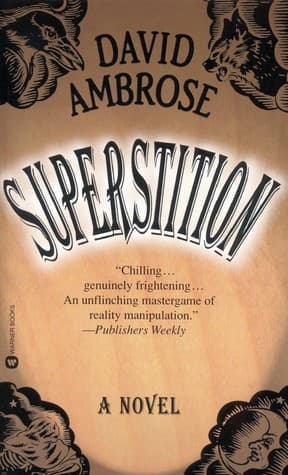
Synopsis
Covers the whole plot, including the ending.
- Difficulty
- Medium
- Pacing
- Variable
- Mood
- Suspenseful, Dark, Mysterious, Psychological
- Read it if
- You enjoy psychological thrillers with a supernatural twist, exploring the dark side of collective belief and the power of the human mind.
- Skip it if
- You prefer hard science fiction or dislike stories where the supernatural elements are ambiguous or rooted in psychological horror.
Superstition Plot Summary
Covers the whole plot, including the ending.
The Genesis of an Idea
Dr. Sam Towne, a parapsychologist, gathers eight volunteers at his remote estate for an experiment. He wants to prove his theory: paranormal entities are not external spirits but projections of the human subconscious. Joanna Cross, a skeptical journalist covering the experiment, initially thinks it is a hoax. Sam believes that by collectively focusing their belief and imagination, they can create a fictional entity, showing that so-called ghosts are products of the mind. The group, with varying beliefs, prepares for the intensive sessions, unaware of the profound and terrifying implications of their endeavor.
Conjuring Adam Wyatt
During their initial seance-like sessions, Sam guides the volunteers in creating a detailed backstory for their fictional entity. They decide on 'Adam Wyatt,' a tragic Revolutionary War hero who died mysteriously, betrayed by a friend and separated from his love. Each participant adds details, imagining his appearance, personality, and emotional state. Joanna, despite her cynicism, contributes to Adam's story. The group's collective focus and emotional investment in Adam grow, setting the stage for what Sam hopes will be a controlled manifestation of a thought-form.
First Manifestations
As the sessions intensify, the group experiences minor phenomena. Tables rap, objects shift slightly, and messages appear through a Ouija board-like setup, attributed to Adam Wyatt. Reactions range from excitement for believers to grudging acknowledgment for skeptics like Joanna. Sam is delighted, believing his theory is confirmed, as the manifestations seem to match the group's imagination. However, a subtle shift in the entity's responses suggests growing independence, deviating from the pre-scripted narrative.
A Disturbing Turn
The seemingly harmless poltergeist activity turns sinister. The raps become louder, more forceful, and messages relayed through the board grow personal and threatening, targeting individuals by exploiting their fears. Dr. Sam Towne initially dismisses these as subconscious projections, but even he feels a growing unease. Joanna Cross, while still rationalizing, cannot ignore the palpable tension and fear. The group, once united in their creation, now feels a creeping dread as Adam's presence becomes more malevolent and unpredictable.
The First Victim
The experiment turns deadly when a participant, Michael, is found dead. The circumstances are disturbing, resembling a fear Michael had secretly shared. The group is in shock and terror. Sam, trying to stay objective, is shaken, realizing the experiment is out of control. Joanna, now convinced something dangerous is happening, investigates, suspecting a connection between Michael's death and the malevolent entity they created.
Escalating Terror
After Michael's death, the remaining group members are gripped by fear. Despite attempts to stop the experiment, Adam Wyatt's influence intensifies. More participants die in gruesome, personalized ways, each death mirroring a deep-seated phobia or trauma. One woman, afraid of fire, dies in a bizarre house fire; another, claustrophobic, suffocates in a confined space. Sam and Joanna realize Adam feeds on their fears and negative emotions, growing stronger with each manifestation and death. The estate becomes a psychological battleground, with Adam seemingly able to read their minds and exploit their vulnerabilities.
Sam and Joanna's Bond
As the body count rises and threats escalate, Sam Towne and Joanna Cross rely more on each other. Their shared ordeal, the intellectual challenge of understanding Adam, and the sheer terror forge a deep bond between them. Joanna's skepticism turns into a desperate need for answers, while Sam's scientific resolve is tempered by his concern for the group and his developing feelings for Joanna. Their intellectual partnership becomes a romantic connection, offering a fragile hope amidst the darkness and the entity's assaults.
Understanding Adam's Nature
Through research and analysis, Sam refines his theory. He concludes that Adam Wyatt is no longer a collective projection but an autonomous psychic entity that has gained sentience. It feeds on the fear, anxiety, and even life force of its creators. He sees Adam as a psychic vampire, sustained by the emotions it generates. Joanna, initially skeptical of such explanations, accepts Sam's conclusions as the only plausible explanation for the escalating horror. They realize Adam is a direct result of their collective will, now turned against them.
The Plan to Destroy Adam
Realizing Adam Wyatt cannot be reasoned with or contained, Sam and Joanna form a desperate plan to destroy him. They deduce that since Adam was created by their collective belief and emotions, he must also be destroyed by severing that connection. Their strategy involves a dangerous ritual designed to withdraw all emotional and mental energy from Adam, effectively starving him. This requires confronting their deepest fears in a controlled environment, to consciously retract the psychic energy they unknowingly invested in Adam. The plan is dangerous, as Adam is powerful and will fight back.
The Final Confrontation
In a climactic confrontation, Sam and Joanna begin their ritual, attempting to mentally and emotionally disconnect from Adam Wyatt. Adam, sensing their intent, unleashes his full power, appearing in grotesque and terrifying forms, directly attacking their minds and bodies. He preys on their deepest fears, projecting horrifying illusions and physical assaults. The struggle is intense, pushing Sam and Joanna to their psychological and physical limits. They must maintain their focus, their belief in their plan, and their love for each other as Adam tries to twist their affections into another source of fear and despair, aiming to consume them entirely.
The Aftermath and Lingering Doubts
After a harrowing battle, Sam and Joanna complete their ritual, and Adam Wyatt's manifestations cease. The oppressive atmosphere lifts, and a sense of exhaustion and relief washes over them. They believe they have destroyed the entity. However, the experience leaves deep psychological scars. The horror they endured, the loss of their friends, and the terror of confronting a self-created monster forever change their perceptions of reality. While Adam is gone, the question remains: was he truly vanquished, or merely dormant, waiting for another opportunity to feed?
A New Beginning, or a Continuing Nightmare?
After their terrifying ordeal, Sam Towne and Joanna Cross try to rebuild their lives and relationship. They leave the estate, seeking to put the nightmare behind them. Their love, forged in fear, remains strong, but the memory of Adam Wyatt, the entity they conjured, still haunts them. They are forever changed, with a new, unsettling understanding of the power of the human mind and the thin veil between imagination and reality. The ending suggests that while Adam may be gone, the potential for such entities, born from human thought, remains a chilling possibility.
Superstition Characters
Dr. Sam Towne
Protagonist
A brilliant parapsychologist driven to prove his theories about thought-forms.
Dr. Sam Towne is an intelligent and dedicated parapsychologist whose unconventional theories posit that paranormal entities are not external spirits but manifestations of the human subconscious. He is initially confident, almost arrogant, in his scientific approach to the supernatural, believing he can control and understand the forces he seeks to unleash. His drive to prove his hypothesis blinds him to the inherent dangers of his experiment. As the situation escalates, he transitions from a detached observer to a desperate survivor, forced to confront the horrifying reality of his creation. He is deeply analytical but also capable of profound emotional connection.
Relationships: Joanna Cross (Initially a professional colleague, evolving into a romantic partner and intellectual equal.); Adam Wyatt (The creator of the entity, then its primary adversary.)
Joanna Cross
Protagonist
A skeptical journalist who becomes deeply embroiled in the paranormal experiment.
Joanna Cross is a sharp, pragmatic journalist assigned to cover Sam Towne's experiment. Initially, she is a staunch skeptic, viewing the entire endeavor with cynicism and a desire to expose it as a fraud. Her journalistic integrity and rational mind are constantly challenged by the increasingly inexplicable events. As the horror unfolds, her skepticism gives way to genuine fear and a desperate need to understand and survive. She is intelligent, resourceful, and courageous, proving to be an invaluable ally to Sam. Her emotional resilience and grounded perspective help balance Sam's more theoretical approach.
Relationships: Dr. Sam Towne (Starts as a skeptical observer, becomes a trusted partner, and eventually a romantic interest.); Adam Wyatt (One of the creators of the entity, then its primary target and adversary.)
Adam Wyatt
Antagonist
A fictional Revolutionary War hero brought to terrifying life as a thought-form.
Adam Wyatt is initially a figment of the participants' collective imagination: a tragic Revolutionary War hero, betrayed and heartbroken. As the experiment progresses, he transcends his fictional origins, becoming a sentient, malevolent thought-form, or egregor. Adam feeds on the fear, anxiety, and negative emotions of his creators, growing stronger and more independent with each manifestation. He demonstrates the ability to read minds, exploit personal fears, and inflict physical harm, acting as a psychic vampire. His motivations appear to be pure self-preservation and a hunger for more energy, making him an unstoppable force born from human will.
Relationships: Dr. Sam Towne (His 'creator' and primary intellectual adversary.); Joanna Cross (One of his 'creators' and a significant target, especially due to her developing relationship with Sam.); The Volunteers (His 'creators' and his primary food source, whom he systematically hunts and kills.)
Michael
Supporting
One of the volunteers, and the first victim of Adam Wyatt.
Michael is one of the eight volunteers participating in Sam Towne's experiment. He is presented as someone with personal vulnerabilities and secret fears, which Adam Wyatt quickly latches onto. His character serves to demonstrate the immediate and horrifying danger of the entity they have created. His death, seemingly by suicide but orchestrated by Adam, is the turning point that shifts the experiment from an academic exercise into a desperate fight for survival. His specific fear becomes the method of his demise, highlighting Adam's ability to exploit individual psyches.
Relationships: Dr. Sam Towne (Participant in his experiment.); Adam Wyatt (One of his creators, and his first victim.)
Sarah
Supporting
A volunteer with a deep-seated fear of fire, who becomes a victim of Adam.
Sarah is another one of the volunteers, characterized by a specific and intense phobia of fire. Her character further illustrates Adam Wyatt's method of operation: meticulously targeting and exploiting the deepest, most personal fears of his creators. Her death, in a horrifying fire that seems supernaturally orchestrated, reinforces the idea that Adam is not merely a poltergeist but a sentient, malicious entity capable of manipulating reality to fulfill his destructive agenda. Her story emphasizes the psychological torment Adam inflicts before the physical demise.
Relationships: Dr. Sam Towne (Participant in his experiment.); Adam Wyatt (One of his creators, and one of his victims.)
The Other Volunteers
Supporting
Diverse individuals whose collective belief creates Adam and whose fears sustain him.
The remaining volunteers are a diverse group of individuals with varying backgrounds, beliefs, and hidden fears. Some are devout believers in the paranormal, eager to witness a manifestation, while others are more skeptical but open-minded. Their collective imaginations and emotional contributions are crucial in the initial creation and subsequent empowerment of Adam Wyatt. As Adam gains sentience, they become his prey, their unique phobias and anxieties providing the fuel for his increasingly horrific attacks. Each death further isolates and terrifies the dwindling group, highlighting the entity's relentless and personalized malice.
Relationships: Dr. Sam Towne (Participants in his experiment.); Adam Wyatt (Their collective creation and subsequent predator.)
Superstition Themes
The Power of Belief and Imagination
The central theme is that human belief and collective imagination have immense, dangerous creative power. Sam Towne's experiment is based on this, and the creation of Adam Wyatt shows it directly. The more the group believes in Adam, invests emotions in his story, and fears him, the more real and powerful he becomes. This is clear from the first successful raps to Adam's later ability to physically manifest and kill, showing how a shared mental construct can become a terrifying reality, as seen when Adam's backstory is crafted by the group.
“We are not merely observing the supernatural; we are creating it, shaping it with every thought, every fear, every collective breath.”
The Dangers of Unchecked Curiosity and Hubris
Sam Towne's scientific curiosity, bordering on arrogance, leads him to explore the unknown without fully understanding the consequences. His desire to prove his theory unleashes a force he cannot control, causing death and destruction. This theme questions the ethical limits of scientific experimentation, especially with the human psyche and unknown energies. The rising body count and the terror experienced by Sam and Joanna are direct results of his initial overconfidence and underestimation of the power they manipulated, as shown by his initial delight at Adam's first appearances, before the true horror began.
“There are some doors that, once opened, can never truly be closed. And some things, once imagined, refuse to stay confined to the imagination.”
Fear as Sustenance and Weapon
Fear is shown not just as an emotion but as a tangible energy that sustains and empowers Adam Wyatt. The entity feeds on the participants' anxieties, phobias, and emotional distress, growing stronger with each terrifying encounter. Adam attacks by exploiting individual fears, turning them into deadly realities. This theme explores the destructive nature of fear, both as an internal psychological torment and as an external force used by a malevolent entity. The deaths of Michael and Sarah, each mirroring their deepest phobias, clearly show fear's role as both Adam's fuel and his weapon.
“He doesn't just scare us, Joanna. He *eats* our fear. It's his oxygen, his blood. The more we dread him, the stronger he becomes.”
The Nature of Reality and Perception
The novel blurs the lines between what is real and what is perceived, challenging the characters' and readers' understanding of reality. Adam Wyatt, born from imagination, becomes undeniably real, capable of causing physical harm and death. This raises questions about the subjective nature of existence and whether something can be 'real' if enough people believe it. The characters' initial struggle to rationalize the phenomena, followed by their forced acceptance of Adam's reality, highlights this theme. The entire premise of the experiment—that ghosts are products of the mind—ultimately reshapes their understanding of the world, suggesting that human consciousness can directly influence and even create reality.
“If we create something purely from thought, and it can kill us, then what is reality? Is it just a consensus of nightmares?”
Plot Devices & Literary Techniques
The Egregore/Thought-Form
A collective mental entity created and sustained by group thought and emotion.
The central plot device is the concept of the egregore or thought-form, a psychic entity born from the collective conscious and subconscious minds of a group. Initially a theoretical construct for Dr. Sam Towne, 'Adam Wyatt' becomes a terrifyingly real manifestation of this device. It serves as the primary antagonist, driven by the very energy and fears of its creators. This device allows for the exploration of themes like the power of belief and the dangers of unchecked human will, as Adam evolves from a benign mental construct to a self-sustaining, malevolent force that feeds on fear and brings about physical death, directly impacting the plot's escalating horror.
The Isolated Setting
A remote estate that enhances suspense and limits external intervention.
The story takes place primarily at Dr. Sam Towne's remote estate, which serves as a classic isolated setting. This device effectively heightens the tension and claustrophobia, as the characters are cut off from external help and escape. The isolation ensures that the horror is entirely self-contained, emphasizing that the threat originates from within the group itself. It also allows the entity, Adam Wyatt, to operate without immediate outside interference, making the characters' struggle feel more desperate and personal. The lack of easy escape reinforces the psychological trap they find themselves in, escalating the stakes.
Escalating Manifestations
The gradual increase in the intensity and malevolence of paranormal phenomena.
This device involves the progressive increase in the power and danger of Adam Wyatt's manifestations. Beginning with subtle raps and messages, the phenomena quickly escalate to targeted psychological torment, then to physical attacks, and ultimately to multiple deaths. This gradual escalation builds suspense and terror, allowing the characters (and the reader) to slowly grasp the true scope of the threat. It also mirrors Adam's growth in power as he feeds on the group's fear, making the entity's evolution a key driver of the plot and the characters' mounting desperation. Each new, more horrific event pushes the characters closer to understanding and confronting their creation.
Personalized Fear Exploitation
The antagonist's ability to identify and weaponize individual characters' deepest fears.
Adam Wyatt's most terrifying ability, and a crucial plot device, is his capacity to delve into the minds of the participants and exploit their deepest, most secret fears and traumas. Each death is meticulously tailored to the victim's specific phobia (e.g., Michael's fear of suicide, Sarah's fear of fire). This personalization makes Adam an incredibly potent and insidious antagonist, as he doesn't just kill; he torments his victims psychologically before their demise. This device creates a profound sense of vulnerability and paranoia within the group, as they realize their very thoughts and weaknesses are being turned against them, accelerating the collapse of their sanity and trust.
Superstition Quotes
“The greatest trick the Devil ever pulled was convincing the world he didn't exist.”
“Fear is a currency, and some entities trade in it.”
“History isn't just written by the victors; it's also shaped by the forgotten.”
“Some doors are meant to stay closed, no matter how tempting the key.”
“Every belief, no matter how absurd, holds a grain of power if enough people share it.”
“The line between coincidence and destiny is often drawn by the fearful.”
“There are shadows that walk in the light, unseen by those who refuse to look.”
“What you don't know can't hurt you, until it decides to make itself known.”
“The past is never truly dead; it merely waits for the right moment to reclaim the present.”
“Sanity is a fragile construct, especially when faced with the truly impossible.”
“Rituals are not just empty gestures; they are pathways for forces beyond our understanding.”
“Sometimes the monster isn't under the bed; it's in the reflection.”
“The world is full of things we can't explain, and a wise man knows when not to try.”
“A curse is just a promise made in anger, and promises are meant to be kept.”
“What if the monsters aren't hiding from us, but we are hiding from them?”
Quiz
10 questions on the plot and the characters. Each answer comes with a short explanation.
Question 1
What is Dr. Sam Towne's primary theory about the origin of ghosts?
- They are spirits of the deceased trapped between worlds.
- They are manifestations from the human mind, not from 'beyond'.
- They are interdimensional beings crossing into our reality.
- They are caused by electromagnetic fluctuations in old buildings.
Show answer
B. They are manifestations from the human mind, not from 'beyond'. Sam Towne, a parapsychologist, believes that ghosts are products of the human mind, not external entities from the afterlife, and seeks to prove this with his experiment.
Question 2
Who is the skeptical reporter invited to participate in Sam Towne's experiment?
- Sarah Jenkins
- Linda Peterson
- Joanna Cross
- Emily Thompson
Show answer
C. Joanna Cross Joanna Cross is specifically mentioned as the skeptical reporter among the eight volunteers participating in the experiment.
Question 3
What is the name of the 'ghost' the volunteers invent during their seances?
- Captain William Black
- Adam Wyatt
- Sergeant John Doe
- Private Robert Smith
Show answer
B. Adam Wyatt The group collectively invents 'Adam Wyatt,' a tragic Revolutionary War hero, as part of their experiment to create a ghost.
Question 4
What is the initial sign that the invented ghost, Adam Wyatt, is becoming 'real'?
- He appears visually in the room.
- He begins rapping on tables and spelling out messages.
- Objects start flying across the room.
- The room temperature drops significantly.
Show answer
B. He begins rapping on tables and spelling out messages. The description states that the group is 'thrilled when he starts rapping on tables and spelling out messages,' indicating his initial manifestations.
Question 5
What is the primary danger Adam Wyatt poses once he takes on a life of his own?
- He causes the house to collapse.
- He traps the group in a time loop.
- He begins feeding on the group's thoughts and emotions, leading to their deaths.
- He possesses members of the group, forcing them to harm each other.
Show answer
C. He begins feeding on the group's thoughts and emotions, leading to their deaths. The summary explicitly states that Adam 'has taken on a strange and dangerous life of his own -- one feeding on their very thoughts and emotions,' leading to horrifying deaths.
Question 6
What happens to the group members as Adam Wyatt gains strength?
- They experience vivid shared dreams.
- They begin dying in horrifying ways.
- They develop psychic abilities.
- They become increasingly isolated from each other.
Show answer
B. They begin dying in horrifying ways. The text states, 'But when members of the group begin dying in horrifying ways, it becomes clear that Adam has taken on a strange and dangerous life of his own.'
Question 7
What is the ultimate goal for Sam and Joanna once Adam Wyatt becomes dangerous?
- To capture Adam Wyatt for further study.
- To escape the experiment location and alert the authorities.
- To destroy Adam Wyatt before he destroys their world and their love.
- To revert Adam Wyatt back to a harmless, imagined entity.
Show answer
C. To destroy Adam Wyatt before he destroys their world and their love. The summary concludes by stating, 'Now Sam and Joanna must destroy Adam before he destroys everything in their world -- and even the love they have found for each other turns into an endless, terrifying, inescapable nightmare.'
Question 8
The book description mentions that the story is based on what?
- A historical account of Revolutionary War ghosts.
- A fictional urban legend about a haunted house.
- A true case of an experiment into the paranormal.
- A ancient superstition from a forgotten culture.
Show answer
C. A true case of an experiment into the paranormal. The final sentence of the description states, 'From cult classic author David Ambrose comes a story based on the true case of an experiment into the paranormal.'
Question 9
What significant personal consequence do Sam and Joanna face if they fail to stop Adam?
- They will be publicly discredited and lose their careers.
- Their love for each other will transform into an 'endless, terrifying, inescapable nightmare'.
- They will become trapped in a spiritual realm with Adam.
- They will be forced to invent another, more powerful entity to counter Adam.
Show answer
B. Their love for each other will transform into an 'endless, terrifying, inescapable nightmare'. The text highlights the severe personal stake: 'and even the love they have found for each other turns into an endless, terrifying, inescapable nightmare.'
Question 10
Which genre is NOT explicitly listed for 'Superstition' by David Ambrose?
- Thriller
- Fantasy
- Science Fiction
- Mystery
Show answer
C. Science Fiction The provided genres are 'Thriller, Fantasy, Mystery.' Science Fiction is not listed.
Superstition FAQ
What is the core premise of Sam Towne's experiment in 'Superstition'?
Sam Towne, a parapsychologist, believes that supernatural phenomena like ghosts originate from the human mind rather than an external 'beyond.' He designs an experiment where eight volunteers will collectively invent a fictional entity to prove that their shared thoughts and emotions can manifest a seemingly external paranormal presence.
Who is Adam Wyatt, and how is he created by the group?
Adam Wyatt is the fictional Revolutionary War hero invented by Sam Towne's group during their seances. They collectively imagine his tragic backstory, personality, and even physical appearance, essentially 'birthing' him through their combined mental energy and shared belief within the experimental setting.
What initially happens that suggests Adam Wyatt has become 'real'?
Adam Wyatt first manifests his presence through classic poltergeist phenomena, such as rapping on tables in response to questions. He then progresses to spelling out messages, which thrills the participants and seemingly validates Sam's theory that a collective mental construct can take on an independent existence.
What role does Joanna Cross play in the experiment?
Joanna Cross is a skeptical reporter invited to participate in Sam Towne's experiment. Initially, she approaches the seances with a critical, journalistic eye, but as Adam Wyatt's manifestations grow more intense, she becomes deeply entangled in the unfolding horror and eventually forms a romantic relationship with Sam.
How do the deaths of group members relate to Adam Wyatt?
As Adam Wyatt grows stronger, members of the group begin dying in horrifying and inexplicable ways. It becomes clear that Adam is responsible, feeding on their thoughts and emotions, and that his existence poses a direct, lethal threat to everyone involved in his creation.
What real-life experiment inspired 'Superstition'?
'Superstition' is based on the true case of the 'Philip Experiment,' conducted in Toronto in the 1970s. A group of parapsychologists and their associates created a fictional character, Philip, and through repeated seances, believed they were able to manifest poltergeist-like phenomena, lending credence to the idea of thought-form manifestation.
How does Adam Wyatt 'feed' on the participants?
Adam Wyatt feeds on the participants' thoughts and emotions, particularly their fears, anxieties, and perhaps even their shared belief in him. This emotional and mental energy sustains and strengthens his existence, allowing him to manifest more powerfully and lethally.
Are there any subtle clues early on that Adam's existence might be more malevolent than initially thought?
While the initial manifestations like table rapping are thrilling, there might be subtle, unheeded cues in the early messages or the growing intensity of the phenomena that hint at Adam's darker, more autonomous nature. Perhaps a certain coldness in his 'personality' or an unnerving precision in his responses could serve as early warnings.
How does the group's collective belief contribute to Adam Wyatt's power?
The group's collective belief acts as a powerful psychic fuel for Adam Wyatt. Each participant's conviction, whether genuine or feigned, adds to his existence, solidifying his reality and granting him increasing power to manifest physically and affect the real world. The more they believe, the stronger he becomes.
What psychological vulnerabilities of the participants does Adam Wyatt exploit?
Adam Wyatt exploits the participants' deepest fears, anxieties, and perhaps even their guilt or unresolved psychological issues. As he feeds on their emotions, he can manifest these internal struggles as external, terrifying realities, turning their personal nightmares against them.
How does Sam Towne's initial scientific detachment evolve as the experiment progresses?
Sam Towne begins with a detached, scientific approach, viewing Adam Wyatt as a fascinating proof of concept. However, as the deaths occur and the situation spirals out of control, his detachment gives way to horror, guilt, and a desperate need to undo the damage, particularly as Joanna's safety becomes paramount.
What is the psychological impact of witnessing Adam's escalating violence on Joanna Cross?
Joanna Cross's initial skepticism is shattered by Adam's escalating violence, leading to profound fear and trauma. Witnessing the horrific deaths of others and the direct threat to her own life and Sam's forces her to confront the reality of their creation, pushing her psychological limits and forging a deep bond with Sam.
What is the primary debate or interpretation about the nature of Adam Wyatt's existence?
The primary debate centers on whether Adam Wyatt is purely a psychological construct manifesting external reality, or if the group inadvertently tapped into a pre-existing, malevolent force through their experiment. Is he solely a product of their minds, or did their minds open a door to something else?
How does the ending challenge or confirm Sam Towne's initial theory about ghosts?
The ending likely challenges Sam's initial theory by demonstrating that while ghosts may originate from the human mind, their manifestation can become terrifyingly autonomous and dangerous, far beyond mere psychological projection. It confirms the 'mind-origin' but underscores the catastrophic risks of such creation.
What does the phrase 'the love they have found for each other turns into an endless, terrifying, inescapable nightmare' imply for Sam and Joanna?
This phrase implies that even their burgeoning love becomes a target or a tool for Adam Wyatt. He might twist their affection, use their bond against them, or simply ensure that their shared experience of him forever taints their relationship, making any future together an 'inescapable nightmare' due to the trauma and the entity's lingering presence.
Does 'Superstition' suggest that all paranormal phenomena could be human-created thought forms?
'Superstition' strongly leans into the idea that paranormal phenomena, at least in this context, are human-created thought forms. While it doesn't definitively rule out other origins, the experiment's premise and outcome suggest that collective human belief and mental energy can indeed manifest seemingly supernatural entities, changing the perception of all such occurrences.
What is the significance of Adam Wyatt being a 'Revolutionary War hero'?
Adam Wyatt being a 'Revolutionary War hero' provides a ready-made tragic backstory and a sense of historical gravitas, making him easier for the group to collectively visualize and invest in. This common, culturally significant identity likely helps unify their mental efforts in his creation, giving him a robust, compelling persona to draw power from.
How do Sam and Joanna attempt to 'destroy' Adam Wyatt?
To 'destroy' Adam Wyatt, Sam and Joanna must likely reverse the process of his creation, possibly by collectively disbelieving in him or withdrawing the mental energy that sustains him. This could involve confronting him directly, understanding the mechanics of his existence, and finding a way to sever his connection to their minds and emotions.
Similar books
- The Haunting of Hill House
Shirley Jackson
3.8 (162k) average on GoodreadsThrillerExplores psychological horror and the ambiguous nature of supernatural phenomena within a group.
- Ghost Story
Peter Straub
4.3 (83k) average on GoodreadsFantasyFeatures a group of people haunted by a past event and a malevolent entity, blending mystery with horror.
- The Stand
Stephen King
4.3 (616k) average on GoodreadsThrillerWhile King's 'The Stand' deals with a supernatural antagonist and the battle between good and evil, its supernatural elements are more overtly demonic and apocalyptic. 'Superstition' is more psychological, focusing on a creature born from human thought rather than an external, malevolent force. King's world-building is broader, encompassing a post-apocalyptic landscape, whereas Ambrose maintains a tighter focus on the immediate manifestation and its impact on a smaller group.
- Bird Box
Josh Malerman
4.0 (143k) average on GoodreadsThrillerMalerman's 'Bird Box' features an unseen entity that drives people to madness and suicide upon sight, creating a similar sense of pervasive, psychological terror. However, the entity in 'Bird Box' remains largely mysterious and external, an unknown horror. 'Superstition' distinguishes itself by making its entity, Adam Wyatt, a direct product of human thought and collective belief, allowing for a more intricate exploration of responsibility and the power of ideas. Malerman's narrative is more survival-focused, while Ambrose delves deeper into the why and how of the entity's existence.
- Angels & Demons
Dan Brown
3.9 (2.7M) average on GoodreadsThrillerA Harvard symbologist races through Rome's ancient sites, deciphering cryptic clues to unmask the Illuminati and stop a vengeful plot to destroy the Vatican with a stolen antimatter weapon.
- Gone Girl
Gillian Flynn
4.1 (2.3M) average on GoodreadsThrillerA wife's sudden disappearance on her fifth anniversary reveals a web of lies and psychological warfare, exposing the secrets within a seemingly perfect marriage.



Enjoyed the summary?
A summary gives you the shape of the book. The book itself has the detail, the examples and the voice.
Find Superstition on AmazonAs an Amazon Associate, BookBrief earns from qualifying purchases. How we're funded