
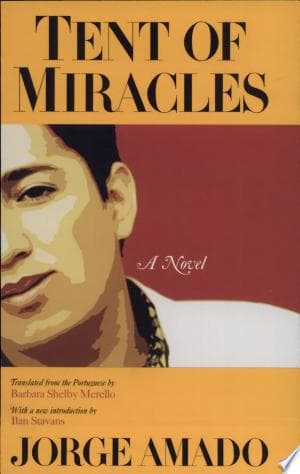
Synopsis
Covers the whole plot, including the ending.
- Difficulty
- Medium
- Pacing
- Variable
- Mood
- Vibrant, Reflective, Cultural, Historical, Melancholy
- Read it if
- You enjoy rich, character-driven narratives set in vibrant cultural backdrops, exploring themes of race, class, and intellectual freedom.
- Skip it if
- You prefer fast-paced plots with clear, linear progression and minimal digressions.
Tent of Miracles Plot Summary
Covers the whole plot, including the ending.
The Arrival of the American Scholar
The novel begins with the arrival of James Levenson, an American anthropologist, in Salvador, Bahia. He comes to research the life and work of Pedro Archanjo, a largely forgotten local poet, philosopher, and self-taught ethnographer. Levenson is interested in Archanjo's studies of Afro-Brazilian culture and his fight against racial prejudice. His arrival sparks new interest in Archanjo among local intellectuals, journalists, and some of Archanjo's old friends, many of whom begin to share their memories of the man. Levenson's presence prompts a collective look back at Archanjo's life and legacy, which unfolds through various stories and recollections.
Pedro's Humble Beginnings and Early Education
Pedro Archanjo was born poor in Salvador's Pelourinho district, a mulatto orphan who learned to read and write through his own efforts and the help of strangers. He never went to formal school, but his curiosity led him to read books from various places, including the Benevolent Society library and discarded volumes from the wealthy. His early life involved a deep immersion in the Afro-Brazilian culture of his neighborhood, including candomblé rituals, capoeira, and street festivals. These experiences, with his reading, formed his unique view on race, class, and culture, shaping him into the unconventional intellectual he would become.
The Printer's Apprentice and Budding Intellectual
As a young man, Pedro Archanjo finds work at a printing press, a job that helps his intellectual growth. Surrounded by type and paper, he learns printing and gains access to many texts. This environment allows him to improve his writing and begin to express his observations and theories about Bahia's culture. He starts to publish small, self-financed pamphlets and broadsides, often using false names, where he supports the poor and marginalized, and celebrates Afro-Brazilian traditions. These early writings show his growing social awareness and his commitment to challenging the racial hierarchies of his time.
The Tent of Miracles and Public Discourse
Pedro Archanjo establishes his 'Tent of Miracles,' a small shack in the Pelourinho that becomes a center for intellectual and cultural exchange. It serves as a meeting place for artists, poets, mystics, and ordinary people, where ideas are debated, stories are shared, and Afro-Brazilian culture is celebrated. Pedro, with his knowledge and personality, becomes a central figure, guiding discussions and inspiring others. The Tent of Miracles is not just a physical space; it symbolizes his philosophy of open dialogue and his belief in the wisdom of common people, offering an alternative to the rigid academic institutions of the day.
Love and Loss: The Story of Rosa
Pedro Archanjo experiences a lasting love with Rosa, a mulatto woman who shares his passion for life and culture. Their relationship is shown as a source of joy and mutual respect, a testament to love in a society often marked by prejudice. However, their happiness is cut short when Rosa falls ill and dies, leaving Pedro heartbroken. This loss affects Pedro deeply, but he channels his grief into his work, dedicating himself to understanding and preserving the cultural heritage he and Rosa cherished. Her memory becomes a driving force behind his continued efforts for justice and celebration of life.
Clashes with Authority and Academia
Pedro Archanjo's ideas and his critique of racial inequality often put him in conflict with the authorities and academic elite of Salvador. His embrace of Afro-Brazilian religions, his challenge to Eurocentric history, and his support for the marginalized are seen as radical. He is often dismissed as uneducated or a troublemaker. Despite the scorn and attempts to silence him, Pedro continues his work, using his writings and his 'Tent of Miracles' to spread his ideas and empower the community. These conflicts highlight the prejudices he fought against throughout his life.
The Publication of 'The Mulatto from Bahia'
Pedro Archanjo's main work, 'The Mulatto from Bahia,' is eventually published, though with difficulty and limited reach. In this book, he documents the cultural contributions of Afro-Brazilians and argues for their central role in shaping Brazilian identity. He challenges the idea of racial purity and celebrates the richness of miscegenation, presenting a vision of Brazil that embraces its diverse heritage. Though initially met with indifference or hostility from the mainstream, the book slowly gains readers, becoming a testament to his intellectual foresight and his commitment to social justice.
Pedro's Later Years and Obscurity
In his later years, Pedro Archanjo, despite his contributions, fades into obscurity. His radical ideas and lack of formal academic credentials prevent him from gaining widespread recognition during his lifetime. He continues to live a humble life in the Pelourinho, surrounded by his books and memories, but his work remains largely unacknowledged by the academic and literary establishment. This period shows the irony of a visionary whose insights were ahead of his time, rediscovered only much later. His obscurity highlights the systemic biases he battled against, even in his own intellectual legacy.
The Posthumous Reappraisal
James Levenson's arrival in Salvador helps bring Pedro Archanjo's life and work back into public view. Levenson's research, combined with the memories of those who knew Pedro, revives his forgotten contributions. Journalists publish articles, intellectuals revisit his writings, and a new generation begins to appreciate his spirit. This renewed interest turns Pedro from a forgotten local eccentric into a significant cultural figure, showing how history can be reshaped and how the value of an individual's work can be recognized over time and across cultures, finally giving Pedro the recognition he deserved.
The Festival for Pedro Archanjo
The novel ends with a festival in Salvador, celebrating Pedro Archanjo's life and legacy. This event, reflecting the city's spirit, brings together people from all walks of life—academics, artists, street vendors, and citizens—to honor the mulatto intellectual. Speeches are given, music plays, and the streets of Pelourinho fill with dancing and joyous remembrance. The festival symbolizes the triumph of Pedro's ideas and the power of his message of cultural pride and racial equality. It shows that despite his struggles, Pedro Archanjo's vision resonated with his people, securing his place as a hero of Bahia.
Principal Figures
Pedro Archanjo
Protagonist
A self-taught mulatto intellectual, poet, and ethnographer.
Pedro Archanjo is the central figure, a mulatto man born into poverty in Salvador, Bahia. Despite lacking formal education, he possesses an insatiable curiosity and a profound intellect. He is a self-taught scholar, deeply immersed in Afro-Brazilian culture, and dedicates his life to documenting its richness and fighting against racial prejudice. He is charismatic, philosophical, and deeply committed to justice, often challenging the societal norms and academic establishments of his time. His driving force is to celebrate the mulatto identity and the diverse heritage of Brazil.
Relationships: Rosa (Deeply loving and committed partner); Professor James Levenson (The posthumous researcher and advocate for his legacy)
Professor James Levenson
Supporting
An American anthropologist who researches Pedro Archanjo's life.
James Levenson is a respected American anthropologist who travels to Salvador, Bahia, specifically to research Pedro Archanjo. He is intelligent, methodical, and genuinely fascinated by Archanjo's unique contributions to ethnography and social thought. Levenson acts as the primary catalyst for the rediscovery of Archanjo's work, providing an external, academic validation that helps to elevate Archanjo's status. His presence allows the narrative to unfold through various recollections and perspectives, piecing together the protagonist's life from different angles. He is driven by academic curiosity and a desire to uncover forgotten truths.
Relationships: Pedro Archanjo (Subject of his research, posthumous mentor)
Rosa
Supporting
Pedro Archanjo's beloved partner and a source of inspiration.
Rosa is Pedro Archanjo's great love and life partner. She is a beautiful mulatto woman who shares Pedro's spirit and appreciation for their culture. Her presence in Pedro's life brings him immense joy and stability, and her understanding and support are crucial to his work. Her tragic death leaves a profound impact on Pedro, serving as both a source of grief and a renewed impetus for his dedication to his cultural and social causes. She embodies the vibrant beauty and resilience of the Afro-Brazilian community that Pedro champions.
Relationships: Pedro Archanjo (Deeply loving and committed partner)
Guma
Supporting
A fisherman and one of Pedro's friends and admirers.
Guma is a strong, honest fisherman and a friend and admirer of Pedro Archanjo. He represents the common people of Bahia, those who live close to the sea and maintain a deep connection to their traditions. Guma often provides a grounded, practical perspective on life in Salvador and is a testament to the diverse range of individuals who were touched by Pedro's intellect and charisma. His recollections contribute to the rich tapestry of memories that paint a comprehensive picture of Pedro Archanjo, highlighting Pedro's ability to connect with all segments of society.
Relationships: Pedro Archanjo (Friend and admirer)
Lídio Corró
Supporting
A capoeira master and candomblé practitioner, a friend of Pedro.
Lídio Corró is a master of capoeira and a respected practitioner of Candomblé, representing the spiritual and martial traditions of Afro-Brazilian culture. He is a close friend and confidante of Pedro Archanjo, often sharing insights into the deeper meanings of their shared heritage. Lídio's character highlights the profound cultural roots that nourished Pedro's work and thought. His stories and memories of Pedro emphasize the protagonist's deep immersion in and respect for these traditions, providing valuable context for Levenson's research and the reader's understanding.
Relationships: Pedro Archanjo (Close friend and cultural comrade)
Mestre Pastinha
Mentioned
A legendary capoeira master, admired by Pedro Archanjo.
Mestre Pastinha, though not a direct character in the narrative, is frequently mentioned as a legendary figure in the world of capoeira. He is deeply admired by Pedro Archanjo and serves as an embodiment of the rich, often undervalued, Afro-Brazilian cultural heritage that Pedro seeks to celebrate and preserve. References to Pastinha underscore Pedro's connection to and respect for the traditional arts and the wisdom of his community, further establishing his credibility as an ethnographer of his own people.
Relationships: Pedro Archanjo (Figure of admiration and inspiration)
Dona Augusta
Supporting
A wise and elderly woman who shares memories of Pedro.
Dona Augusta is an elderly, wise woman from the Pelourinho who knew Pedro Archanjo throughout his life. She offers a more personal and intimate perspective on Pedro, recalling anecdotes and details that reveal his character beyond his intellectual pursuits. Her memories are invaluable to Professor Levenson's research, providing a link to Pedro's early life and his connections within the community. She represents the collective memory of the neighborhood and the enduring impact Pedro had on the lives of ordinary people.
Relationships: Pedro Archanjo (Long-time acquaintance and admirer)
The Academics/Intellectual Elite
Antagonist/Supporting
The established, often prejudiced, academic and cultural figures of Salvador.
This collective group represents the conservative and often racially biased intellectual establishment of Salvador. They initially dismiss Pedro Archanjo as an uneducated charlatan, mocking his lack of formal credentials and his unconventional ideas. They embody the systemic prejudice and resistance to change that Pedro fought against. Their initial disdain highlights the uphill battle Pedro faced. Later, some are forced to grudgingly acknowledge his contributions, especially after Levenson's intervention, showcasing a shift in perception.
Relationships: Pedro Archanjo (Opponents and critics of his work and ideology)
Themes & Insights
Racial Identity and Miscegenation
The novel explores racial identity in Brazil, especially the mulatto. Pedro Archanjo promotes miscegenation not as a weakness, but as the strength of Brazilian culture. He fights against racist ideas that devalued Black and mixed-race people, arguing instead for the beauty and richness from the blending of African, Indigenous, and European influences. His work, 'The Mulatto from Bahia,' celebrates this, stating that the mulatto is the true heart of Brazilian identity, challenging the European-centric stories of his time. This theme is central to Pedro's life's work and his constant struggle.
“What is Bahia? A miracle of miscegenation, a tent of miracles, where races mix and souls intertwine.”
The Power of Oral Tradition and Popular Culture
Amado shows the value of oral traditions, folklore, and popular culture as valid forms of knowledge and expression, often surpassing formal academic discourse. Pedro Archanjo, a self-taught ethnographer, gets his insights directly from the streets, capoeira, candomblé, and the daily lives of Pelourinho's people. His 'Tent of Miracles' is a place for this exchange. The novel itself uses memories and anecdotes from various characters, showing how collective memory and storytelling preserve history and identity, contrasting with the often sterile views of academia.
“The wisdom of the people, that's where the truth lies, not in dusty books or pompous speeches.”
The Role of the Intellectual in Society
The novel shows the intellectual's role, especially in an unequal society. Pedro Archanjo is an 'organic intellectual'—one whose knowledge comes from and serves his community, not confined to academia. He uses his intellect to challenge oppression, celebrate marginalized cultures, and empower his people. His struggle against the academic elite, who dismiss him due to his lack of formal credentials, highlights the tension between institutional knowledge and community wisdom. Levenson's arrival validates Pedro's intellectual contributions, forcing the establishment to reconsider its narrow definitions of scholarship and acknowledge the impact of a self-made scholar.
“An intellectual is not just someone who reads books, but someone who reads the world and speaks for those who cannot.”
Memory and History
The structure of 'Tent of Miracles' uses memory and history. Professor Levenson's effort to reconstruct Pedro Archanjo's life relies on the subjective, often contradictory, memories of those who knew him. This fragmented story technique emphasizes that history is not a single truth but a complex whole woven from individual experiences and perspectives. The novel explores how collective memory can both preserve and distort, and how the past is constantly reinterpreted in the present. It suggests that a true understanding of history requires embracing its multifaceted nature, including the voices of the marginalized often left out of official records.
“History is not written in stone, but in the hearts and memories of men and women.”
Plot Devices & Literary Techniques
Framing Device (The American Scholar)
Professor Levenson's research provides the narrative structure.
The arrival of Professor James Levenson in Salvador serves as the primary framing device for the entire novel. His academic quest to research Pedro Archanjo's life acts as the narrative's central spine. Through Levenson's interviews, discoveries, and interactions, the story of Pedro Archanjo is gradually pieced together from various perspectives. This device allows Amado to present a fragmented, multi-voiced account of Pedro's life, reflecting the subjective nature of memory and history. It also provides an external, 'objective' lens through which the local community's memories are brought to light and validated, ultimately sparking a posthumous re-evaluation of Pedro's legacy.
Multiple Perspectives/Recollections
Pedro's life is revealed through the memories of many characters.
Rather than a linear narrative, Pedro Archanjo's life is unveiled through a mosaic of recollections, anecdotes, and opinions from a diverse cast of characters who knew him: friends, lovers, rivals, academics, and ordinary citizens. Each perspective adds a layer to his complex character, sometimes contradicting, sometimes complementing, the others. This device emphasizes the multifaceted nature of truth and identity, especially for a figure as enigmatic and influential as Pedro. It allows the reader to experience Pedro not as a singular, authorial voice, but as a living legend shaped by the collective memory of his community, showcasing the richness of oral tradition.
The Tent of Miracles (Metaphor/Setting)
A physical space that symbolizes Pedro's philosophy of cultural exchange.
The 'Tent of Miracles' is both a literal setting—Pedro Archanjo's humble dwelling and meeting place—and a powerful metaphor. As a physical space, it is a vibrant hub for intellectual discourse, cultural celebration, and community gathering, contrasting with the formal, often prejudiced, institutions of Salvador. Metaphorically, it represents Pedro's philosophy of embracing the 'miracle' of miscegenation and the richness of Afro-Brazilian culture. It symbolizes open dialogue, the blending of ideas, and the inherent wisdom found within the common people, embodying the novel's central themes of identity, culture, and resistance against prejudice. It is a space where all are welcome and all knowledge is valued.
Irony
The contrast between Pedro's obscurity in life and his posthumous fame.
A significant use of irony lies in the stark contrast between Pedro Archanjo's life of relative obscurity and struggle against academic dismissal, and his eventual posthumous recognition as a cultural hero. During his lifetime, his groundbreaking work was largely ignored or ridiculed by the establishment due to his lack of formal education and his radical ideas. It is only through the intervention of an outside academic, Professor Levenson, that his true genius is acknowledged and celebrated. This irony highlights the societal prejudices that prevented his recognition earlier and underscores the novel's critique of rigid academic structures versus genuine intellectual contribution and popular wisdom.
Tent of Miracles Quotes
“The greatest miracle is the simple fact of living.”
“There are no ugly women, only women badly loved.”
“A man without a story is a man without a soul.”
“The people's wisdom is a river that never dries up.”
“Every man has a bit of a saint and a bit of a scoundrel in him.”
“To be truly free, one must first be free in one's mind.”
“The past is not dead; it is not even past.”
“Poetry is the bread of the soul, and music its wine.”
“The truth is like a cat; it always finds its way home.”
“No one owns the wind, no one owns the sea, no one owns the people's heart.”
“The world is a tent of miracles, if only you know how to look.”
“Even the smallest gesture of kindness can change a life.”
“Books are silent companions that speak volumes to those who listen.”
“What is life but a series of goodbyes and hellos?”
Quiz
10 questions on the plot and the characters. Each answer comes with a short explanation.
Question 1
What is the primary profession of Pedro Archanjo, who is posthumously celebrated in 'Tent of Miracles'?
- Fisherman
- Professor of Anthropology
- Printer and self-taught intellectual
- Musician and composer
Show answer
C. Printer and self-taught intellectual Pedro Archanjo worked as a printer and dedicated his life to self-study, writing, and documenting Afro-Bahian culture.
Question 2
Which city serves as the main setting for 'Tent of Miracles' and is central to Pedro Archanjo's life and work?
- Rio de Janeiro
- Salvador, Bahia
- São Paulo
- Recife
Show answer
B. Salvador, Bahia The entire narrative revolves around Salvador, Bahia, and its rich Afro-Brazilian culture, which Pedro Archanjo passionately defended.
Question 3
What event triggers the renewed interest in Pedro Archanjo's life and work at the beginning of the novel?
- The discovery of a lost manuscript
- A visit from a famous foreign scholar
- A political revolution in Bahia
- The opening of a new cultural center
Show answer
B. A visit from a famous foreign scholar The arrival of American Nobel laureate James D. Levenson to research Archanjo's life sparks the retrospective narrative.
Question 4
What does the 'Tent of Miracles' (Tenda dos Milagres) symbolize in the novel?
- A traditional Candomblé temple
- A literal tent where miracles are performed
- Pedro Archanjo's printing shop and intellectual hub
- A government-sponsored cultural exhibition
Show answer
C. Pedro Archanjo's printing shop and intellectual hub The 'Tent of Miracles' is the name of Pedro Archanjo's small printing shop, which became a vibrant center for intellectual discussion, popular art, and the dissemination of Afro-Bahian culture.
Question 5
Which character serves as the primary narrator, collecting stories and memories about Pedro Archanjo?
- James D. Levenson
- Lídio Corró
- Professor Nilo Argolo
- Rosa dos Ventos
Show answer
B. Lídio Corró Lídio Corró, a poet and former apprentice of Archanjo, is the main figure who gathers the diverse accounts and memories of Pedro's life, piecing together his story.
Question 6
What central theme does Pedro Archanjo's life and work in the novel most strongly champion?
- The importance of economic development
- The preservation and valorization of Afro-Brazilian culture and identity
- The pursuit of academic recognition
- The superiority of European intellectual traditions
Show answer
B. The preservation and valorization of Afro-Brazilian culture and identity Pedro Archanjo dedicates his life to combating prejudice and celebrating the rich traditions, religions, and heritage of Afro-Brazilians, often against the prevailing academic and social norms.
Question 7
How does the novel portray the academic and intellectual establishment's view of Pedro Archanjo during his lifetime?
- They largely ignored him but eventually recognized his contributions.
- They embraced his work and provided him with funding.
- They mostly dismissed and ridiculed him as an amateur or charlatan.
- They saw him as a rival and actively tried to suppress his publications.
Show answer
C. They mostly dismissed and ridiculed him as an amateur or charlatan. During his lifetime, Pedro Archanjo faced significant scorn and dismissal from the established academy, who viewed his work on popular culture and Afro-Bahian traditions as unscientific and beneath their notice.
Question 8
Which specific Afro-Brazilian religious practice is frequently referenced and defended by Pedro Archanjo in his writings and life?
- Umbanda
- Spiritism
- Candomblé
- Macumba
Show answer
C. Candomblé Pedro Archanjo is a staunch defender and documenter of Candomblé, highlighting its spiritual depth and cultural significance against prevailing prejudices.
Question 9
What literary device does Amado employ throughout the novel to weave together the story of Pedro Archanjo?
- Strict chronological narration
- First-person monologue from Archanjo's perspective
- A mosaic of shifting perspectives, anecdotes, and journalistic reports
- An omniscient narrator with direct access to all characters' thoughts
Show answer
C. A mosaic of shifting perspectives, anecdotes, and journalistic reports The novel uses a non-linear, multi-voiced approach, gathering fragments of memory, interviews, newspaper clippings, and academic critiques to construct Archanjo's multifaceted legacy.
Question 10
Despite his intellectual contributions, what was Pedro Archanjo's social standing and economic status for most of his life?
- He achieved moderate wealth and social influence.
- He lived a life of relative poverty and was often marginalized.
- He was supported by a wealthy patron throughout his career.
- He gained significant political power through his writings.
Show answer
B. He lived a life of relative poverty and was often marginalized. Pedro Archanjo, despite his profound intellectual contributions, remained a common man, living in relative poverty and facing social marginalization due to his race and unconventional pursuits.
Tent of Miracles FAQ
What is the central premise of 'Tent of Miracles'?
'Tent of Miracles' revolves around the rediscovery of Pedro Archanjo, a largely forgotten mulatto intellectual, poet, and popular leader from Bahia, Brazil. His life's work, which challenged racial prejudice and advocated for Afro-Brazilian culture, is brought back into the spotlight by French ethnographer Pierre Verger and local journalist Fausto Pena decades after Archanjo's death.
Who is Pedro Archanjo and what was his significance in Bahia?
Pedro Archanjo is the protagonist, a self-taught mulatto man from the poor districts of Salvador, Bahia. He was a prolific writer, philosopher, and social activist who dedicated his life to documenting and celebrating Afro-Brazilian culture, fighting against racial discrimination, and advocating for the rights of the marginalized. His 'Tent of Miracles' was a printing press and cultural hub.
How does the narrative structure of the book contribute to its themes?
The book employs a non-linear narrative, frequently shifting between the contemporary efforts of Fausto Pena and Pierre Verger to reconstruct Archanjo's life and direct flashbacks to Archanjo's experiences in the early 20th century. This structure allows Amado to contrast the historical struggles with modern perceptions, highlighting how Archanjo's ideas resonate across time and are subject to different interpretations.
What role does Fausto Pena play in uncovering Archanjo's legacy?
Fausto Pena is a young, ambitious journalist tasked with writing an article about Pedro Archanjo. Initially dismissive, Pena becomes increasingly fascinated and dedicated to understanding Archanjo's life and philosophy. He acts as a proxy for the reader, piecing together fragments of history and challenging the official, often prejudiced, narratives about Archanjo.
Who is Pierre Verger and what is his connection to Archanjo?
Pierre Verger is a fictionalized version of the real-life French ethnographer and photographer who extensively documented Afro-Brazilian culture. In the novel, Verger is instrumental in sparking renewed interest in Archanjo, having known him personally and recognizing the profound importance of his work long before others did. His presence lends an outsider's perspective and validation to Archanjo's local significance.
How does the 'Tent of Miracles' itself function as a symbol in the novel?
The 'Tent of Miracles' is both a literal place – Archanjo's small printing shop and cultural center – and a powerful symbol. It represents a sanctuary for free thought, a bastion of popular culture, and a workshop where ideas of racial equality and cultural pride were forged and disseminated. It symbolizes the resilience and creativity of the marginalized in the face of oppression.
What is the significance of the various characters who recall Archanjo, such as Professor Nilo Argolo and Dr. Zé Alma?
The diverse recollections from characters like Professor Nilo Argolo, who represents the academic elite, and Dr. Zé Alma, a fellow intellectual and friend, highlight the multifaceted nature of Archanjo's impact. Their contrasting views—from admiration to condescension—underscore the societal divisions and differing interpretations of Archanjo's work, revealing how his legacy was perceived by various segments of Bahian society.
How do the 'miracles' in the title relate to Archanjo's life and work?
The 'miracles' are not supernatural events but rather the extraordinary achievements and profound impact of Archanjo, a man from humble origins, who managed to challenge entrenched prejudices and preserve a rich cultural heritage. His ability to inspire, educate, and unify people despite systemic racism and poverty is presented as a 'miracle' in itself, a testament to human spirit and intellectual perseverance.
What subtle critique of academic institutions does the novel offer through its depiction of Archanjo's legacy?
The novel subtly critiques academic institutions by showing how Archanjo's profound insights were largely ignored or dismissed by the formal academy during his lifetime due to his race and lack of conventional education. Only decades later, with the validation of an esteemed foreign ethnographer like Verger, do local academics begin to acknowledge his brilliance, exposing their inherent biases and Eurocentric perspectives.
How does Archanjo's upbringing influence his worldview and activism?
Archanjo's upbringing in the poor, vibrant, and largely Afro-Brazilian neighborhoods of Salvador deeply shapes his worldview. He experiences firsthand the injustices of racism and class discrimination, fueling his passion for social justice and his dedication to celebrating the rich cultural traditions often denigrated by the dominant society. His lived experience grounds his philosophical and political stances.
What psychological impact does societal prejudice have on characters like Archanjo?
Societal prejudice, while a driving force for Archanjo's activism, also inflicts deep psychological wounds. He faces constant dismissal, mockery, and outright hostility from the white elite, which could lead to frustration and isolation. However, Archanjo channels this adversity into resilience and a stronger commitment to his community and cultural identity, refusing to be silenced or defined by others' biases.
How does the character of Fausto Pena evolve psychologically throughout his investigation?
Fausto Pena undergoes a significant psychological transformation. Initially cynical and focused on superficial success, his immersion in Archanjo's life forces him to confront his own preconceptions about race, class, and intellectualism. He develops a deeper sense of empathy and a profound respect for Archanjo, moving from a detached observer to a passionate advocate for Archanjo's legacy, indicating a growth in his moral and intellectual understanding.
In what ways does Archanjo embody resilience in the face of adversity?
Archanjo embodies resilience through his unwavering commitment to his ideals despite constant social ostracism, financial hardship, and intellectual dismissal. He persistently writes, prints, and advocates for his beliefs, never succumbing to despair or compromising his vision. His ability to maintain his dignity and continue his fight against deeply entrenched racism showcases remarkable psychological fortitude and an unbreakable spirit.
What is the novel's primary message about cultural memory and historical revisionism?
The novel's primary message is that cultural memory is often manipulated and historical narratives are frequently revised to suit the dominant power structures. It argues for the importance of reclaiming and preserving the true stories of marginalized figures like Archanjo, ensuring that their contributions are not erased or distorted by official histories, thus fighting against historical amnesia and injustice.
How does Amado challenge traditional notions of 'intellectualism' and 'scholarship' through Archanjo?
Amado profoundly challenges traditional notions by presenting Archanjo as a self-taught intellectual whose wisdom and contributions surpass those of many formally educated academics. Archanjo's 'scholarship' is rooted in lived experience, popular culture, and a deep understanding of his community, arguing that true intellectualism stems from insight and empathy, not just institutional credentials or Eurocentric perspectives.
Is 'Tent of Miracles' an optimistic or pessimistic view of social change?
'Tent of Miracles' offers a cautiously optimistic view of social change. While it vividly portrays the enduring nature of prejudice and the difficulty of achieving recognition for marginalized voices, the very act of Archanjo's rediscovery decades later suggests that truth and justice can eventually prevail. The novel implies that while change is slow, the seeds planted by figures like Archanjo will eventually bear fruit.
What is the significance of the novel's blend of realism, folklore, and magical realism?
The blend of realism, folklore, and subtle magical realism is crucial to the novel's unique voice. Realism grounds the story in the social struggles of Bahia, while folklore and the occasional hints of the mystical (like Archanjo's almost legendary status) elevate Archanjo's story beyond mere biography, imbuing it with the rich spiritual and cultural essence of Afro-Brazilian traditions. This blend reflects Amado's style and the cultural fabric of Bahia.
How does the novel address the concept of legacy and its posthumous impact?
The novel deeply explores the concept of legacy, demonstrating that a person's true impact might not be fully appreciated during their lifetime but can resonate powerfully long after their death. Archanjo's posthumous recognition highlights how the value of one's contributions can be re-evaluated and celebrated by future generations, suggesting that genuine influence transcends immediate acclaim and societal prejudice.
About the author
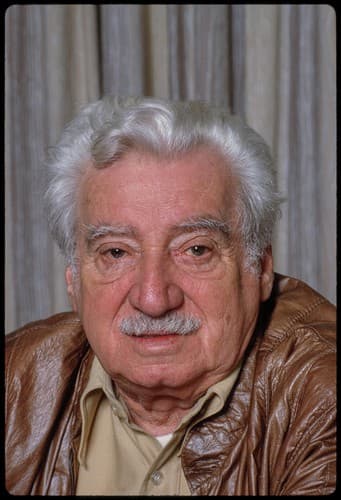
Jorge Leal Amado de Faria was a Brazilian writer of the modernist school. He remains the best known of modern Brazilian writers, with his work having been translated into some 49 languages and popularized in film, including Dona Flor and Her Two Husbands in 1976. His work reflects the image of a Mestiço Brazil and is marked by religious syncretism. He depicted a cheerful and optimistic country that was beset, at the same time, with deep social and economic differences.
Similar books
- The House of the Spirits
Isabel Allende
4.2 (190k) average on GoodreadsFantasyFeatures sprawling family sagas, magical realism elements, and a deep sense of place and history.
- One Hundred Years of Solitude
Gabriel García Márquez
4.1 (753k) average on GoodreadsLiterary FictionOffers a multi-generational narrative, rich cultural tapestry, and a blend of realism with mythical elements.
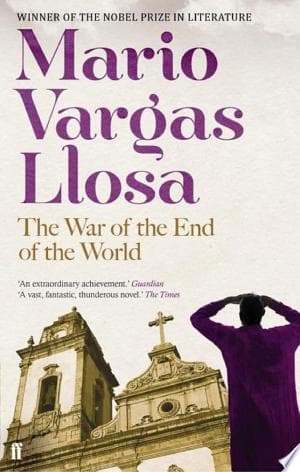
- The War of the End of the World
Mario Vargas Llosa
4.2 (9k) average on GoodreadsHistorical FictionBoth Tent of Miracles and Mario Vargas Llosa's The War of the End of the World (1981) are epic historical novels set in Latin America that deal with clashes between popular movements and established authority, religious fervor, and the construction of historical narratives. However, Vargas Llosa's novel, set in the sertão of Brazil during the Canudos War, focuses on a much larger-scale, violent conflict and the ideological fanaticism that drives it, employing a more fragmented, modernist narrative style. Amado's Tent of Miracles, while addressing social conflict, is more intimate in scope, focusing on cultural and intellectual struggles in an urban setting and employing a more accessible, folkloric narrative voice. While both question official histories, Vargas Llosa's critique is often more overtly political and cynical about human nature, whereas Amado maintains a more celebratory tone regarding cultural resilience.
- Nineteen Eighty-Four
George Orwell
4.2 (5.5M) average on GoodreadsFictionWinston Smith dreams of truth and rebellion in a world where Big Brother watches all, but he confronts the terrifying power of a regime that controls not just actions, but thoughts.
- The Frozen River
Ariel Lawhon
4.4 (600k) average on GoodreadsFictionIn 1789 Maine, a heroic midwife's diary helps her expose a murder and get justice in a town that wants to silence her.
- A Man Called Ove
Fredrik Backman
4.4 (569k) average on GoodreadsFictionA stubborn widower, who lives by strict rules, finds his quiet world changed by a lively new family next door, making him face his past and find happiness in human connection.





Enjoyed the summary?
A summary gives you the shape of the book. The book itself has the detail, the examples and the voice.
Find Tent of Miracles on AmazonAs an Amazon Associate, BookBrief earns from qualifying purchases. How we're funded