
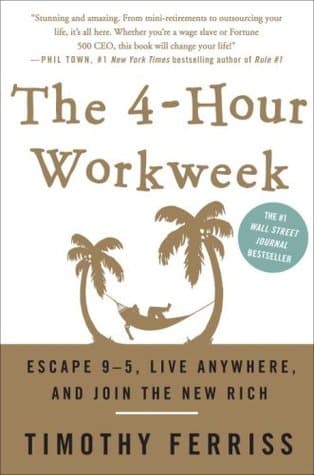
Core Idea
- Difficulty
- Medium
- Read it if
- You're tired of the traditional 9-to-5, dream of location independence, want to start an online business with minimal effort, or are looking for practical strategies to outsource tasks and create automated income.
- Skip it if
- You prefer a stable corporate career, are looking for deep academic research on productivity, or are unwilling to challenge conventional work ethics and embrace unconventional lifestyle design.
Key Takeaways from The 4-Hour Workweek
The New Rich vs. The Deferred Life Plan
Redefining wealth as time and mobility, not just money.
Ferriss introduces the 'New Rich' as an alternative to the traditional 'deferred-life plan,' where people work hard for decades for retirement. The New Rich focus on 'lifestyle design,' aiming to maximize experiences and personal freedom now, not later. This is not about being a millionaire, but about having the flexibility to do what you want, when you want, from anywhere. It is a big change from the common idea that hard work means putting off enjoyment. Instead, it suggests a life rich in time, mobility, and personal satisfaction, achieved through smart work and automation.
“The New Rich (NR) are those who abandon the deferred-life plan and instead create luxury lifestyles in the here and now by mastering the new currencies: time and mobility.”
In the book: Ferriss's own lifestyle, traveling the world, racing motorcycles, and dancing tango, exemplifies the New Rich. He contrasts this with the typical corporate drone who waits until 65 to live.
Try this: Challenge the assumption that you must work 40+ years before enjoying life. Identify how you can integrate 'mini-retirements' and location independence into your current career or business, even if it's in small steps.
Related ideas: new-rich, deferred-life-plan, lifestyle-design, time-mobility
D.E.A.L.: The Four-Step Blueprint
Deconstruct, Eliminate, Automate, Liberate your way to freedom.
Ferriss summarizes his method with the acronym: D.E.A.L. This system offers a clear path to the New Rich lifestyle. 'Definition' means clarifying your goals and fears, and setting clear targets. 'Elimination' focuses on cutting out unnecessary tasks, using the 80/20 rule and selective ignorance. 'Automation' involves building systems and outsourcing tasks to create passive income and free up your time. Lastly, 'Liberation' means gaining true mobility and leaving the traditional office, allowing you to live and work from anywhere. Each step builds on the last, providing a practical framework for change.
“The 4-Hour Workweek is not about being lazy. It is about the intelligent application of the DEAL formula: Definition, Elimination, Automation, and Liberation.”
In the book: The entire book is structured around these four pillars, with dedicated sections and actionable advice for each. For example, the 'Elimination' section details the low-information diet and the 80/20 principle.
Try this: Apply the DEAL framework to your current work. First, define what a 'dream day' looks like. Then, identify tasks to eliminate. Next, brainstorm what can be automated or outsourced. Finally, consider how you can achieve location independence.
Related ideas: deal-formula, definition, elimination, automation, liberation
The 80/20 Rule & Selective Ignorance
Focus on high-impact activities and filter out distractions.
One of Ferriss's most effective ideas is applying the Pareto Principle (80/20 rule) to productivity: 80% of your results come from 20% of your efforts. He tells readers to find and focus only on these high-impact activities, removing the rest. Along with this is 'selective ignorance,' which means purposely ignoring information not essential to your immediate, high-impact goals. This includes avoiding news, most emails, and unnecessary meetings. The goal is to avoid 'information overload' and the 'busy trap,' freeing up mental space and time for truly productive work, rather than just being active.
“Slow down and remember this: Most things make no difference. Being busy is a form of laziness – lazy thinking and indiscriminate action.”
In the book: Ferriss recounts his own experience drastically reducing email checking and news consumption, leading to increased productivity and reduced stress. He cites Vilfredo Pareto's original observation about 80% of land in Italy being owned by 20% of the population.
Try this: Audit your daily tasks for one week. Identify the 20% of tasks that yield 80% of your results. Then, create a 'not-to-do' list and implement a 'low-information diet' by limiting news, social media, and email checks to specific, short blocks.
Related ideas: pareto-principle, 80-20-rule, selective-ignorance, low-information-diet, busy-trap
Outsourcing Your Life with VAs
Leverage virtual assistants for mundane and time-consuming tasks.
Ferriss supports the use of virtual assistants (VAs) as a key part of the 'Automation' stage. He suggests outsourcing not just business tasks, but also personal errands and administrative duties (e.g., scheduling, paying bills, research). The main point is to start small, with clear, repeatable instructions, and to use VAs from countries with lower labor costs, making it very affordable. This frees up a lot of personal time, letting the person focus on high-value, enjoyable activities. It effectively buys back hours of their life for a small cost.
“Never automate something that can be eliminated, and never delegate something that can be automated or streamlined. Otherwise, you're just automating and delegating a mess.”
In the book: Ferriss details his own experiments with VAs, having them manage everything from travel bookings to sending gifts to family members, often for as little as $5 per hour from places like India.
Try this: Identify one or two recurring personal or professional tasks that take up significant time but don't require your unique skills (e.g., scheduling, online research). Document the process, then hire a VA for a trial period to handle these tasks.
Related ideas: virtual-assistant, outsourcing, delegation, automation, time-management
Creating Automated 'Muses'
Develop passive income streams that run without constant supervision.
A 'muse' is Ferriss's term for an automated income system, usually a small, niche business that makes money with little ongoing effort. He outlines a process for creating these: finding a niche market, quickly testing if a product will sell (often with presales or simple websites), and then automating the sales and delivery. The ideal muse is a digital product or a highly specialized physical product with low overhead and high profit margins. This idea is central to gaining financial freedom and taking 'mini-retirements,' because it separates income from hours worked.
“The goal is to create a muse: an automated vehicle for generating income that can run on autopilot.”
In the book: Ferriss describes creating several muses, including selling a supplement online and a digital course, demonstrating how to identify a profitable niche and automate the sales funnel.
Try this: Brainstorm niche interests or problems you understand well. Research potential 'micro-products' (e.g., an e-book, a specialized online course, a unique physical product) that could solve these problems. Use online tools to test demand before investing heavily in creation.
Related ideas: muse, passive-income, niche-business, automation, product-testing
Mini-Retirements & Lifestyle Design
Integrate frequent breaks and travel throughout your life, not just at the end.
The idea of 'mini-retirements' directly counters the deferred-life plan. Instead of saving all travel and leisure for old age, Ferriss suggests taking longer breaks (1-6 months) throughout your working life. These are not just vacations; they are chances to experience new cultures, learn new skills, or follow passions without the pressure of returning to daily work. This approach recognizes that life is unpredictable. Spreading rich experiences throughout your life is a more satisfying and secure strategy than relying on a distant, uncertain future.
“Why wait until 65 to retire when you can have mini-retirements every few years? The goal is to distribute recovery and adventure throughout life.”
In the book: Ferriss himself takes frequent mini-retirements, using them to learn tango in Argentina, race motorcycles in Europe, and ski in the Andes, showcasing how these experiences are integrated into his productive life.
Try this: Start planning your first mini-retirement. Even if it's just a month, research destinations, costs, and how you could make your work remote or automate it during that period. Discuss the possibility with your employer if applicable, focusing on performance-based arrangements.
Related ideas: mini-retirement, lifestyle-design, travel, work-life-balance, deferred-life-plan
Relative vs. Absolute Income
Measure wealth by purchasing power and freedom, not just raw numbers.
Ferriss makes an important difference between absolute income (the total money earned) and relative income (income compared to time worked and local cost of living). Earning $100,000 in New York City while working 80 hours a week is less 'rich' than earning $50,000 while working 10 hours a week from a low-cost country like Thailand. The latter provides much more time and mobility, which are the real measures of the New Rich. This way of thinking encourages people to optimize for lifestyle benefits rather than just higher salaries. It challenges the belief that more money always means more freedom.
“The New Rich realize that absolute income means little. It is relative income that matters, which is measured by time (hourly wage) and location independence.”
In the book: Ferriss contrasts a high-earning Wall Street banker working 80+ hours with someone earning less but living in a low-cost country, working fewer hours, and enjoying greater freedom.
Try this: Calculate your effective hourly wage by dividing your total income by actual hours worked. Then, research the cost of living in places you'd like to live. Compare your current 'relative income' with what it could be if you optimized for time and location.
Related ideas: relative-income, absolute-income, purchasing-power, hourly-wage, location-independence
Training Your Boss & Remote Work
Negotiate flexible work arrangements based on performance, not presence.
For employees, Ferriss offers a step-by-step guide to working remotely. This involves proving your value through better productivity, then suggesting a trial period of remote work. The focus is on performance, not hours spent in the office. This strategy emphasizes building trust and showing that working remotely actually improves output. It is about 'training your boss' to value results over being physically present. If successful, this can lead to full location independence, even without quitting your job, embodying the 'blue-chip escape artist' concept.
“The goal is to demonstrate that your output is not dependent on your physical presence in the office.”
In the book: Ferriss outlines a detailed email script and a phased approach for proposing remote work to a boss, starting with a short trial period and emphasizing measurable results.
Try this: Identify a project where you can significantly over-deliver. Once completed, propose a short, trial period of working remotely (e.g., one day a week), clearly outlining how you'll maintain or improve productivity and communication.
Related ideas: remote-work, performance-over-presence, negotiation, location-independence, blue-chip-escape-artist
Filling the Void & Meaningful Life
Discover purpose beyond work once financial freedom is achieved.
A key, often overlooked part of the New Rich lifestyle is what to do after gaining freedom from the 9-to-5. Ferriss warns against the 'void' that can appear when work is removed. He stresses that true fulfillment comes from pursuing passions, learning, and contributing. He tells readers to think deeply about their purpose and what truly excites them beyond money. This involves self-improvement, creative activities, or charity work, ensuring that the liberated life is not just free from work, but rich in meaning and personal growth. It is a proactive approach to prevent losing interest and maintain long-term satisfaction.
“If you have all the time and money in the world, what do you do? Most people don't know, and that's a problem.”
In the book: Ferriss shares anecdotes of people who achieve financial freedom only to feel lost or bored, leading them back to traditional work. He suggests creating a 'dreamline' to articulate what you would do with unlimited time and money.
Try this: Create a 'dreamline' with 3-5 things you would do if time and money were no object. For each, identify one small, actionable step you can take *this week* to move towards it, demonstrating that these dreams don't have to wait for full liberation.
Related ideas: filling-the-void, purpose, meaningful-life, personal-growth, hedonistic-adaptation
The 4-Hour Workweek Quotes
“Slow down and remember this: Most of what we say and do is not essential. If you can eliminate it, you'll have more time and more tranquility. Ask yourself at every moment, 'Is this necessary?'”
“The New Rich (NR) are those who abandon the deferred-life plan and create luxury lifestyles in the present using the currencies of the new rich: time and mobility.”
“To 5x your output, you don't need to work 5x longer. You need to work 5x smarter.”
“Doing less is not laziness. Doing less is the path of the productive.”
“For all of the most important things, the timing is always wrong. Waiting for a good time to quit your job? The stars will never align and the traffic lights of life will never all be green at the same time.”
“What you do is infinitely more important than how you do it.”
“The fishing is best where the fewest go.”
“Focus on being productive instead of busy.”
“Develop the habit of asking yourself 'If I only did one thing today, what would be the biggest impact?'”
“Lack of time is a lack of priorities.”
“The goal is to create a business that serves your life, not a life that serves your business.”
“Most people are fast to stop working and slow to start. I am fast to start and slow to stop.”
“People are fond of saying, 'If you want something done right, do it yourself.' This is a recipe for mediocrity. The person who says this is often the most overworked and least effective person in the room.”
“The fact that you are not where you want to be should be enough motivation.”
Quiz
10 questions on the main ideas. Each answer comes with a short explanation.
Question 1
According to Tim Ferriss, what is the primary distinction between the 'New Rich' and the 'Deferred-Life Plan' adherents?
- The New Rich prioritize wealth accumulation, while the Deferred-Life Plan prioritizes leisure.
- The New Rich master time and mobility to create luxury lifestyles now, while the Deferred-Life Plan postpones it.
- The New Rich are typically entrepreneurs, while the Deferred-Life Plan adherents are employees.
- The New Rich focus on increasing absolute income, while the Deferred-Life Plan focuses on relative income.
Show answer
B. The New Rich master time and mobility to create luxury lifestyles now, while the Deferred-Life Plan postpones it. The core concept of the New Rich in 'The 4-Hour Workweek' is to abandon the traditional 'deferred-life plan' of working hard now to enjoy later, and instead leverage time and mobility to experience luxury lifestyles in the present.
Question 2
Ferriss advocates for outsourcing life to overseas virtual assistants. What is the approximate hourly rate he mentions for these services?
- $15 per hour
- $10 per hour
- $5 per hour
- $20 per hour
Show answer
C. $5 per hour The book explicitly states, 'How to outsource your life to overseas virtual assistants for $5 per hour and do whatever you want?' This low cost is a key enabler for the New Rich.
Question 3
Which of the following principles, attributed to a 'forgotten Italian economist,' does Ferriss suggest for eliminating 50% of work in 48 hours?
- Pareto Principle (80/20 rule)
- Law of Diminishing Returns
- Say's Law of Markets
- Ricardian Equivalence
Show answer
A. Pareto Principle (80/20 rule) Ferriss heavily promotes the Pareto Principle (80/20 rule), often attributed to Vilfredo Pareto, an Italian economist, as a way to identify and focus on the 20% of efforts that yield 80% of results, thereby eliminating unproductive work.
Question 4
What does Ferriss refer to as 'muses' in the context of creating automated cash-flow?
- Creative ideas for new businesses that require constant personal involvement.
- Automated systems or businesses that generate income with minimal ongoing effort.
- Inspirational figures who motivate one to pursue entrepreneurial ventures.
- Side projects that are personally fulfilling but not necessarily profitable.
Show answer
B. Automated systems or businesses that generate income with minimal ongoing effort. Muses are defined in the book as automated cash-flow systems or businesses designed to generate income with minimal intervention, allowing the individual to pursue other interests.
Question 5
What is the crucial difference Ferriss highlights between absolute and relative income?
- Absolute income is net profit, while relative income is gross revenue.
- Absolute income is the total amount earned, while relative income considers income per unit of time spent working.
- Absolute income is taxable, while relative income is tax-exempt.
- Absolute income is for employees, while relative income is for entrepreneurs.
Show answer
B. Absolute income is the total amount earned, while relative income considers income per unit of time spent working. Ferriss argues that relative income (e.g., how much you earn per hour or per effort) is far more important than absolute income for the New Rich, as it directly relates to time and mobility.
Question 6
How does Ferriss suggest cultivating 'selective ignorance' and creating time?
- By avoiding all forms of news and media consumption entirely.
- By delegating all information intake to virtual assistants.
- By adopting a 'low-information diet' and filtering out non-essential data.
- By only consuming information from academic journals and highly curated sources.
Show answer
C. By adopting a 'low-information diet' and filtering out non-essential data. A key strategy for time management in the book is the 'low-information diet,' which involves consciously filtering out irrelevant or non-actionable information to reduce distraction and cognitive load.
Question 7
Ferriss introduces the concept of 'mini-retirements.' What is their primary purpose?
- To accumulate enough wealth to stop working permanently.
- To take frequent, extended breaks throughout one's career instead of deferring all leisure to old age.
- To experiment with different career paths before settling on one.
- To save money by living frugally in exotic locations.
Show answer
B. To take frequent, extended breaks throughout one's career instead of deferring all leisure to old age. Mini-retirements are short work bursts followed by frequent, extended periods of leisure and travel, designed to spread out the 'retirement' experience throughout one's life rather than saving it all for the end.
Question 8
When training your boss, Ferriss emphasizes valuing performance over presence. What is the ultimate goal if this training fails?
- To demand a significant salary increase.
- To find a new department within the same company.
- To kill your job (or company) if it's beyond repair and move on.
- To outsource your job duties to a virtual assistant without your boss's knowledge.
Show answer
C. To kill your job (or company) if it's beyond repair and move on. Ferriss's advice is clear: if efforts to transition to a performance-based, remote work model with your current employer fail, the next step is to 'kill your job (or company) if it's beyond repair,' implying a strategic exit to pursue other opportunities.
Question 9
Ferriss mentions blue-chip escape artists. What is a key characteristic of how they travel the world?
- They quit their jobs to travel for extended periods.
- They travel the world without quitting their jobs, often through remote work or strategic mini-retirements.
- They primarily use company-sponsored business trips for personal leisure.
- They fund their travels through passive income generated from extensive real estate portfolios.
Show answer
B. They travel the world without quitting their jobs, often through remote work or strategic mini-retirements. The book highlights how 'blue-chip escape artists travel the world without quitting their jobs,' embodying the New Rich ideal of combining work and travel through leveraging mobility and remote work strategies.
Question 10
After removing work and the office, Ferriss addresses the potential 'void.' What does he suggest is important to do?
- Immediately start a new, more demanding business venture.
- Focus solely on hedonistic pursuits and endless leisure.
- Cultivate a meaningful life by filling the void with purpose and personal growth activities.
- Re-enter the traditional workforce with a higher-paying job.
Show answer
C. Cultivate a meaningful life by filling the void with purpose and personal growth activities. Ferriss dedicates a significant portion of the book to discussing the importance of filling the void left by traditional work with meaningful activities, personal growth, and purpose, rather than just aimless leisure.
The 4-Hour Workweek FAQ
What is 'The 4-Hour Workweek' about?
The 4-Hour Workweek is a guide to escaping the traditional 9-to-5 grind by leveraging automation, outsourcing, and strategic lifestyle design. It teaches readers how to create a luxury lifestyle by focusing on time and mobility, rather than just accumulating wealth for a deferred retirement.
Does the 4-hour workweek concept actually work?
While achieving an exact 4-hour workweek might be an aspirational goal, the book's principles of efficiency, delegation, and creating automated income streams are widely applicable and have helped many individuals significantly reduce their working hours and improve their quality of life. Its effectiveness lies in adopting its core strategies rather than focusing solely on the literal number.
What is a 'mini-retirement' as described in the book?
A mini-retirement is a concept of taking frequent, extended breaks throughout your career to travel, learn new skills, or pursue passions, rather than waiting for one long retirement at the end of your life. It allows individuals to experience the benefits of retirement in their youth and prime.
How is 'The 4-Hour Workweek' different from traditional productivity books?
Unlike traditional productivity books that often focus on working harder or more efficiently within existing structures, 'The 4-Hour Workweek' advocates for fundamentally restructuring work and life. It emphasizes delegation, automation, and eliminating unnecessary tasks to create freedom and mobility, rather than just optimizing a busy schedule.
What are 'muses' and how do they help create automated income?
Muses are automated cash-flow businesses, typically involving low-maintenance products or services that generate income with minimal ongoing effort. The book teaches how to identify, test, and launch these ventures to provide a consistent revenue stream, freeing up time for other pursuits.
Can these principles be applied if I'm an employee and not an entrepreneur?
Yes, many principles, such as cultivating selective ignorance, eliminating unnecessary tasks, and negotiating remote work or performance-based metrics, are designed for employees. The book provides strategies to train your boss to value performance over presence and even to initiate a 'kill your job' strategy if necessary.
What is the difference between absolute and relative income?
Absolute income is the total amount of money you earn, while relative income considers your earnings in relation to the time spent working. The book argues that focusing on relative income (e.g., earning $50,000 working 10 hours a week vs. $100,000 working 80 hours a week) is key to achieving the New Rich lifestyle.
How does outsourcing to virtual assistants work?
The book details how to delegate personal and professional tasks to overseas virtual assistants for a low hourly rate (e.g., $5/hour). This strategy allows individuals to free up significant time by offloading administrative, research, and other routine duties.
Is 'The 4-Hour Workweek' still relevant today, given its age?
Despite being published over a decade ago, the core principles of 'The 4-Hour Workweek'—such as leveraging technology, outsourcing, creating passive income, and prioritizing lifestyle over traditional career paths—remain highly relevant. Many of its strategies are even more feasible now with advancements in remote work tools and the gig economy.
About the author
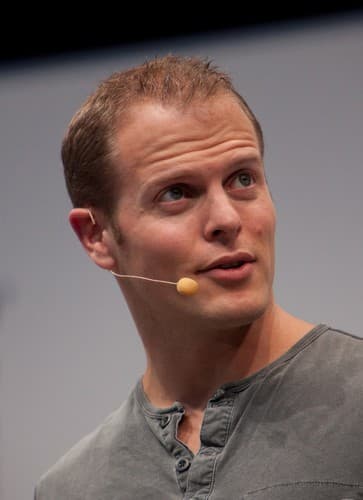
Timothy Ferriss is an American author and entrepreneur known for his work in the self-help and productivity genres. His notable book, The 4-Hour Workweek, explores strategies for maximizing efficiency and achieving a lifestyle of freedom. Ferriss is recognized for popularizing concepts related to lifestyle design and personal optimization.
Similar books
- Steve Jobs
Walter Isaacson
4.1 (957k) average on GoodreadsBusinessSteve Jobs was a visionary who fused creativity and technology to revolutionize six industries and shape our digital world.
- Freakonomics: A Rogue Economist Explores the Hidden Side of Everything
Steven D. Levitt
4.0 (709k) average on GoodreadsBusinessThis book uses economic principles to reveal the surprising incentives behind everything from drug dealing and real estate to cheating teachers and the decline of crime.
- The Tipping Point: How Little Things Can Make a Big Difference
Malcolm Gladwell
4.0 (690k) average on GoodreadsBusinessMalcolm Gladwell explains how small, targeted actions can start widespread changes in trends, behaviors, and ideas.
- Outliers: The Story of Success
Malcolm Gladwell
4.2 (556k) average on GoodreadsBusinessMalcolm Gladwell argues that true success is not just about individual talent, but about the hidden advantages of culture, opportunity, and unique experiences that shape extraordinary lives.
- The Subtle Art of Not Giving a F*ck: A Counterintuitive Approach to Living a Good Life
Mark Manson
3.9 (530k) average on GoodreadsBusinessEmbrace your flaws and stomach life's lemons, because true happiness isn't about relentless positivity, but about choosing what truly matters to give a f*ck about.
- The 7 Habits of Highly Effective People: Powerful Lessons in Personal Change
Stephen R. Covey
4.1 (524k) average on GoodreadsBusinessThis book presents seven habits that help people live more effective, purposeful lives.






Enjoyed the summary?
A summary gives you the shape of the book. The book itself has the detail, the examples and the voice.
Find The 4-Hour Workweek on AmazonAs an Amazon Associate, BookBrief earns from qualifying purchases. How we're funded