
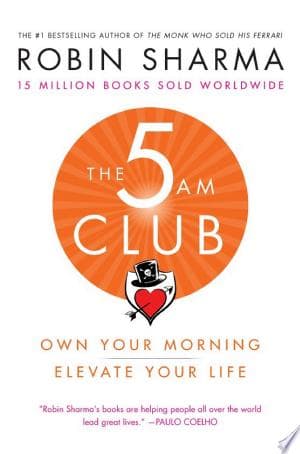
Core Idea
- Difficulty
- Easy
- Read it if
- You are looking for a structured daily routine to boost productivity, improve focus, and develop a more disciplined approach to personal and professional growth.
- Skip it if
- You are already an early riser with an established, effective morning routine or prefer a less prescriptive approach to self-improvement.
Key Takeaways from The 5AM Club
The 5 AM Club: Your Secret Weapon
Embrace the early morning to unlock peak productivity and serenity.
The main idea of 'The 5 AM Club' is that the first hour of your day, from 5 AM to 6 AM, is a productive time that can greatly improve your work, personal health, and happiness. By waking before others and before digital distractions start, you create a private time for self-improvement and focused work. This early start is not just about having more hours; it is about making those hours better, using a unique time of clear thinking and quiet. Sharma says this habit is not just for 'morning people.' It is a skill you can learn, and once learned, it gives you an advantage in a busy, distracting world.
“Own your mornings, elevate your life.”
In the book: Sharma introduces the concept through a narrative featuring a billionaire mentor who shares the morning routines of highly successful individuals and historical figures, implying that early rising is a common thread among high achievers. While specific scientific studies aren't detailed in the provided summary, the emphasis is on 'neuroscience-based practice' to make early rising easier.
Try this: Commit to waking up at 5 AM every day for at least 66 days to solidify the habit. Prepare your environment the night before by laying out clothes, packing your bag, and setting an alarm away from your bed to force you to get up. Resist the urge to check your phone immediately upon waking.
Related ideas: morning-routine, productivity-hacks
The 20/20/20 Formula
Structure your first hour for maximum impact across mind, body, and soul.
The 20/20/20 Formula is the main part of the 5 AM Club's morning routine. It splits the 'victory hour' (5 AM to 6 AM) into three 20-minute blocks. The first 20 minutes (5:00-5:20 AM) are for 'Move,' focusing on strong exercise to sweat, lower stress, and increase energy. The next 20 minutes (5:20-5:40 AM) are for 'Reflect,' which includes journaling, meditation, planning, or reviewing goals to help with clear thinking and appreciation. The last 20 minutes (5:40-6:00 AM) are for 'Grow,' for learning by reading, listening to podcasts, or watching educational videos. This structured start helps the whole person, addressing physical energy, mental strength, and intellectual growth before the day's demands begin.
“The first sixty minutes are the golden hour of the world-builders.”
In the book: The summary mentions 'a step-by-step method to protect the quietest hours of daybreak so you have time for exercise, self-renewal and personal growth,' which directly aligns with the 20/20/20 structure. The narrative of the eccentric tycoon mentoring the two strangers would likely introduce and demonstrate this formula.
Try this: Implement the 20/20/20 rule: Start with 20 minutes of high-intensity exercise (e.g., burpees, running), followed by 20 minutes of silent reflection (journaling, meditation, goal review), and conclude with 20 minutes of learning (reading a non-fiction book, listening to an educational podcast).
Related ideas: morning-ritual, personal-development, mindfulness
Bulletproofing Your Serenity
Defend your focus and inner peace against digital distractions.
In a time of constant connection and too much information, Sharma stresses the need to protect your calm by setting limits on digital distractions. This means more than just avoiding your phone in the morning; it means having an 'insider-only' mindset where you guard your 'gifts, talents, and dreams' from small distractions. The main idea is that constant notifications and social media take away focus, lessen creativity, and stop deep work. By purposely disconnecting during important times, especially the morning, you get back mental space, allowing for better concentration, new ideas, and a deep sense of calm needed for high performance and overall health.
“Digital distraction is the assassin of your creative potential.”
In the book: The summary explicitly states, '“Insider-only” tactics to defend your gifts, talents and dreams against digital distraction and trivial diversions so you enjoy fortune, influence and a magnificent impact on the world.' This highlights the strategic importance of managing digital input.
Try this: Implement a 'Digital Sunset' by turning off all screens (phone, TV, computer) at least 90 minutes before bed. Keep your phone out of your bedroom or on airplane mode overnight. Designate specific times during the day to check emails and social media, rather than being constantly responsive.
Related ideas: digital-detox, focus-techniques, mental-clarity
The Habit Installation Protocol
Master the science of habit formation for lasting change.
Sharma discusses how habits form, explaining that creating a new routine like the 5 AM Club needs understanding and dedication. The 'Habit Installation Protocol' helps people through the three stages of habit formation: breaking old habits, installing new ones, and integrating them. The first stage is about consciously stopping old, unhelpful patterns. The second involves doing the new desired behavior consistently until it becomes automatic. The third stage is about making the new habit so deep that it feels natural. This protocol shows that consistency, patience, and a clear reason for the change are important for getting past initial resistance and making the 5 AM routine a lasting part of your life.
“All change is hard at first, messy in the middle, and gorgeous at the end.”
In the book: The summary references 'A neuroscience-based practice proven to help make it easy to rise while most people are sleeping.' This points to the structured approach Sharma takes to habit formation, moving beyond mere willpower to a more scientific understanding of behavioral change.
Try this: Commit to a 66-day challenge for any new habit you want to install. During the 'destruction' phase (days 1-22), focus on breaking old patterns. In the 'installation' phase (days 23-44), reinforce the new behavior daily. In the 'integration' phase (days 45-66), refine and solidify the habit until it feels automatic.
Related ideas: habit-formation, behavioral-science, self-mastery
The Four Focuses of History Makers
Direct your energy towards areas that yield exponential results.
Sharma names 'The Four Focuses of History Makers' as a key plan for achieving great results and having a big impact. These focuses are: 1) Capitalization IQ (using your natural talents and strengths), 2) Freedom From Distraction (protecting your attention and time), 3) Practice Blockage (consistent, focused practice to master skills), and 4) Day Stacking (consistently doing your best routine, day after day). This plan shows that success is not just about hard work, but about smart, focused work on things that truly matter. By using these four focuses, people can move past average and unlock their ability for 'astonishing achievements,' as the book says.
“To be great, you must focus on what few do.”
In the book: The summary alludes to 'How great geniuses, business titans and the world’s wisest people start their mornings to produce astonishing achievements,' implying a set of principles or 'focuses' that these high achievers utilize. The narrative of the eccentric tycoon would undoubtedly reveal these principles.
Try this: Regularly audit your activities against these four focuses. Are you spending enough time honing your unique talents (Capitalization IQ)? Are you effectively minimizing distractions (Freedom From Distraction)? Are you dedicating consistent time to deliberate practice (Practice Blockage)? Are you consistently executing your ideal daily routine (Day Stacking)? Adjust your schedule and priorities accordingly.
Related ideas: strategic-focus, high-performance, personal-excellence
The Twin Cycles of Elite Performance
Balance intense effort with deep rest for sustainable peak output.
Sharma introduces 'The Twin Cycles of Elite Performance,' which says that lasting high performance is not about endless work. It is about smartly switching between times of intense, focused effort and equally intense, planned rest and recovery. This idea goes against the 'always-on' way of thinking common today. The first cycle involves pushing your limits, doing deep work, and using your 'victory hour' for maximum output. The second, equally important cycle, is for renewal—sleep, meditation, nature walks, creative activities, and time with loved ones. Ignoring the recovery cycle leads to burnout, less creativity, and poor health. True skill, Sharma says, is in respecting and optimizing both cycles.
“Rest and recovery are not luxuries; they are fundamental for world-class output.”
In the book: While not explicitly stated in the summary, the idea of 'bulletproof their serenity' and 'activate their best health' strongly implies a focus on well-being that goes beyond mere productivity. The narrative framework of the book would likely illustrate how even the most successful individuals prioritize rest.
Try this: Schedule specific blocks for deep work and equally important blocks for deliberate recovery. Ensure you get 7-9 hours of quality sleep nightly. Incorporate 'micro-recovery' breaks throughout your day, such as short walks or mindfulness exercises. Plan for regular longer recovery periods, like 'digital sabbaths' or vacations.
Related ideas: work-life-balance, recovery-strategies, sustainable-performance
The Power of the 'Victory Hour'
Leverage the quiet dawn for unparalleled personal growth.
The 'Victory Hour' is Sharma's name for the 5 AM to 6 AM block. He calls it the most powerful and life-changing time of the day. This hour is special because it is mostly free from outside demands, digital noise, and the mental clutter that builds up during the day. It offers a quiet place for self-reflection, physical activity, and learning—the three parts of the 20/20/20 formula. By regularly taking charge of this hour, people can actively shape their day, instead of just reacting to it. This active approach creates a sense of control, reduces stress, and gives a big head start, allowing for deeper focus and creativity before the world wakes up.
“The quietest hours of daybreak are where empires are built and souls are restored.”
In the book: The summary highlights 'A step-by-step method to protect the quietest hours of daybreak so you have time for exercise, self-renewal and personal growth,' directly reinforcing the concept and value of the 'Victory Hour.'
Try this: Treat your 5 AM to 6 AM window as a non-negotiable appointment with yourself. Protect it fiercely from any interruptions, including family members if possible. Use this time exclusively for your 20/20/20 routine, ensuring no external tasks or digital distractions creep in.
Related ideas: morning-mastery, self-care, time-management
The Importance of Environment and Association
Curate your surroundings and relationships for optimal growth.
Sharma says that lasting change and high performance do not just depend on personal willpower. They are also greatly affected by one's surroundings and the people one spends time with. This means purposely creating a physical space that supports your goals—whether it is an inspiring workspace or a tidy home—and being around 'A-players' who encourage, challenge, and inspire you. He also warns against 'energy vampires' and harmful environments that take away your motivation and stop your progress. The book's story, with its mentor-mentee relationship, shows the strong effect of positive connections and an environment that helps growth. Your outer world directly affects your inner world and your ability to stay disciplined.
“Your environment is stronger than your willpower.”
In the book: The story format, where two struggling strangers meet an 'eccentric tycoon who becomes their secret mentor,' inherently underscores the transformative power of associating with inspiring individuals and being exposed to a new, empowering environment or philosophy.
Try this: Actively audit your physical environment, decluttering and organizing spaces that impact your productivity. Evaluate your closest relationships: are they supportive of your goals? Seek out mentors, join communities, or engage with individuals who embody the values and aspirations you hold. Minimize contact with those who consistently bring you down.
Related ideas: positive-environment, mentorship, social-influence
The Mastery Mindset: Continuous Learning and Growth
Embrace a lifelong commitment to self-improvement and skill development.
A repeated idea in 'The 5 AM Club' is the need to have a 'mastery mindset.' This means always seeking to learn, grow personally, and improve skills. This is directly addressed in the 'Grow' part of the 20/20/20 formula, where specific time is set aside for intellectual development. Sharma says that truly successful people never settle for their current skill level; they are always curious, always trying to learn more, improve their craft, and grow as individuals. This dedication to lifelong learning lets them 'produce astonishing achievements' and keep 'influence' in their fields, always adapting and creating new things instead of staying still.
“Commit to becoming a student of life, and life will reward you with mastery.”
In the book: The summary mentions discovering 'how great geniuses, business titans and the world’s wisest people start their mornings to produce astonishing achievements,' implying that their routines include dedicated time for intellectual and personal growth, aligning with a mastery mindset.
Try this: Dedicate at least 20 minutes daily (as part of the 5 AM routine) to reading non-fiction books, listening to educational content, or taking online courses relevant to your personal and professional development. Identify areas where you want to achieve mastery and create a structured learning plan for them.
Related ideas: growth-mindset, lifelong-learning, skill-development
The Philosophy of Contribution and Impact
Success is amplified when anchored in service to others.
Beyond personal productivity and success, 'The 5 AM Club' suggests that true fulfillment and lasting impact come from helping something larger than oneself. While the book focuses a lot on individual achievement, Sharma implies that the main goal of developing skill and influence is to be able to serve others better and make a 'magnificent impact on the world.' This is not just about getting rich or winning awards. It is about using one's improved abilities to solve problems, help communities, and leave a good legacy. The journey of the two struggling strangers, guided by a kind mentor, likely ends with them not only changing their own lives but also contributing meaningfully to society.
“The purpose of life is a life of purpose.”
In the book: The summary explicitly states that the tactics shared will help you 'enjoy fortune, influence and a magnificent impact on the world,' linking personal success directly to a broader sense of contribution and positive global effect.
Try this: Regularly reflect on how your personal goals and achievements can be aligned with serving a greater purpose. Seek opportunities to mentor others, volunteer, or contribute to causes you believe in. Consider how your work or business can create value and positive change for your community or the world.
Related ideas: purpose-driven-life, social-impact, legacy-building
The 5AM Club Quotes
“Own your morning. Elevate your life.”
“All change is hard at first, messy in the middle and gorgeous at the end.”
“Victims have big TVs. Leaders have big libraries.”
“The secret to genius is not genetics but daily habits.”
“The great heroes of humanity were not born great. They became great through daily, disciplined acts of courage and commitment.”
“An addiction to distraction is the death of your creative production.”
“The way you start your day pretty much determines how productively, peacefully and powerfully you’ll live it.”
“To have the results only 5% of the population has, you must be willing to do what only 5% of the population is willing to do.”
“Your comfort zone is a beautiful place, but nothing ever grows there.”
“Elite producers understand that the best way to leverage their gifts is to protect their focus.”
“The more you sweat in practice, the less you bleed in battle.”
“The greatest fortunes are built by people who have developed the ability to manage their time, energy, attention and mental focus.”
“Life’s too short to play small with your talents.”
Quiz
10 questions on the main ideas. Each answer comes with a short explanation.
Question 1
According to 'The 5 AM Club', what is the core concept introduced by Robin Sharma over twenty years ago?
- The 20/20/20 Rule for daily planning
- The revolutionary morning routine for maximizing productivity and well-being
- The 'Titan's Toolkit' for business success
- The 'Digital Detox' strategy for focus
Show answer
B. The revolutionary morning routine for maximizing productivity and well-being The core concept introduced by Robin Sharma, as stated in the book's description, is the revolutionary morning routine of 'The 5 AM Club' designed to maximize productivity, activate best health, and bulletproof serenity.
Question 2
What is the primary narrative structure used in 'The 5 AM Club' to convey its teachings?
- A series of academic essays and case studies
- A direct, instructional manual with exercises
- An enchanting story about two struggling strangers who meet an eccentric tycoon
- A collection of interviews with successful early risers
Show answer
C. An enchanting story about two struggling strangers who meet an eccentric tycoon The book employs an 'enchanting—and often amusing—story about two struggling strangers who meet an eccentric tycoon who becomes their secret mentor' to deliver its lessons.
Question 3
Which of the following is NOT explicitly mentioned as a benefit of adopting the early-rising habit taught in 'The 5 AM Club'?
- Upgrading happiness and helpfulness
- Activating best health and bulletproofing serenity
- Achieving epic results and feelings of aliveness
- Guaranteed financial freedom and early retirement
Show answer
D. Guaranteed financial freedom and early retirement While the book aims to help readers achieve success and influence, it does not explicitly guarantee financial freedom and early retirement. It focuses on productivity, health, happiness, and personal growth.
Question 4
The book promises to teach a 'neuroscience-based practice' to make early rising easier. What is the main outcome of this practice?
- To increase physical strength and endurance immediately upon waking
- To help make it easy to rise while most people are sleeping, giving precious time for self-reflection and creativity
- To eliminate the need for sleep entirely through advanced mental conditioning
- To develop photographic memory for daily tasks
Show answer
B. To help make it easy to rise while most people are sleeping, giving precious time for self-reflection and creativity The neuroscience-based practice is described as helping 'make it easy to rise while most people are sleeping, giving you precious time for yourself to think, express your creativity and begin the day peacefully instead of being rushed.'
Question 5
What is one of the 'insider-only' tactics mentioned in the book for defending against digital distraction?
- Completely avoiding all technology for a full 24 hours each week
- Deleting all social media accounts permanently
- Tactics to defend your gifts, talents and dreams against digital distraction and trivial diversions
- Hiring a personal assistant to manage all digital communications
Show answer
C. Tactics to defend your gifts, talents and dreams against digital distraction and trivial diversions The book explicitly mentions '“Insider-only” tactics to defend your gifts, talents and dreams against digital distraction and trivial diversions so you enjoy fortune, influence and a magnificent impact on the world.'
Question 6
How long did Robin Sharma rigorously handcraft 'The 5 AM Club' book?
- Six months
- One year
- Four years
- Ten years
Show answer
C. Four years The book description states it was 'handcrafted by the author over a rigorous four-year period.'
Question 7
The book is described as 'part manifesto for mastery, part playbook for genius-grade productivity and part companion for a life lived beautifully'. What does this multifaceted description imply about its content?
- It is solely focused on theoretical concepts without practical application.
- It offers a comprehensive approach covering mindset, actionable strategies, and holistic well-being.
- It is a collection of unrelated self-help tips from various authors.
- It primarily targets artists and creative professionals.
Show answer
B. It offers a comprehensive approach covering mindset, actionable strategies, and holistic well-being. This description highlights the book's comprehensive nature, combining inspirational philosophy (manifesto), practical guidance (playbook), and support for a fulfilling life (companion).
Question 8
What kind of formula is promised to help readers wake up early feeling inspired and focused?
- A complex, multi-stage meditation sequence requiring years of practice.
- A little-known formula that can be used instantly.
- A prescription-based supplement regimen.
- A highly personalized formula developed through one-on-one coaching.
Show answer
B. A little-known formula that can be used instantly. The book promises 'A little-known formula you can use instantly to wake up early feeling inspired, focused and flooded with a fiery drive to get the most out of each day.'
Question 9
The book emphasizes protecting the 'quietest hours of daybreak'. For what specific activities is this time meant to be used?
- Checking emails, planning social events, and watching morning news.
- Exercise, self-renewal, and personal growth.
- Preparing elaborate breakfasts and commuting to work.
- Engaging in lengthy phone calls and digital networking.
Show answer
B. Exercise, self-renewal, and personal growth. The book provides 'A step-by-step method to protect the quietest hours of daybreak so you have time for exercise, self-renewal and personal growth.'
Question 10
What is the overarching promise of 'The 5 AM Club' regarding its impact on a reader's life?
- It will provide temporary motivation for a few weeks.
- It will offer a modest improvement in daily routines.
- It is a work that will transform your life. Forever.
- It will primarily enhance sleep quality without affecting other areas.
Show answer
C. It is a work that will transform your life. Forever. The concluding sentence of the description makes a very strong claim: 'The 5am Club is a work that will transform your life. Forever.'
The 5AM Club FAQ
What is the core concept of The 5AM Club?
The 5AM Club is based on a revolutionary morning routine that encourages waking up at 5 AM to maximize productivity, improve health, and achieve greater serenity. It's a method for personal mastery and achieving epic results by leveraging the quiet hours of daybreak.
Does waking up at 5 AM actually work for everyone?
The book suggests that the early-rising habit can significantly benefit anyone committed to the routine, drawing on practices of great geniuses and business titans. It provides neuroscience-based methods to make early rising easier and sustainable, aiming to transform daily performance and well-being.
What is the '20/20/20 Formula' in The 5AM Club?
The '20/20/20 Formula' is a key part of the morning routine, dividing the first hour (5 AM to 6 AM) into three 20-minute blocks dedicated to movement (exercise), reflection (journaling/meditation), and growth (learning/planning). This structure is designed for holistic self-renewal and personal growth.
How does The 5AM Club help with digital distraction?
The book provides 'insider-only' tactics to defend against digital distraction and trivial diversions, emphasizing the protection of your morning hours. This allows for focused time on personal growth, creativity, and strategic thinking before the day's demands and digital noise begin.
Is The 5AM Club just about productivity, or does it cover other aspects of life?
While productivity is a major theme, The 5AM Club is also a manifesto for mastery, a playbook for genius-grade productivity, and a companion for a life lived beautifully. It aims to upgrade happiness, helpfulness, and feelings of aliveness, touching on leadership, health, and personal growth.
What kind of results can one expect from joining The 5AM Club?
Followers of The 5AM Club can expect to achieve astonishing achievements, upgrade their happiness, helpfulness, and feelings of aliveness. The routine is designed to help maximize productivity, activate best health, and bulletproof serenity in a complex world, leading to fortune, influence, and impact.
How is The 5AM Club different from other self-help or productivity books?
The 5AM Club distinguishes itself through its specific focus on an early-rising habit, presented through an enchanting story with an eccentric mentor. It offers a detailed, neuroscience-based method and a structured formula (like the 20/20/20 rule) to optimize the first hour of the day, going beyond general advice.
What is the 'Victory Hour' as described in the book?
The 'Victory Hour' refers to the 5 AM to 6 AM period, which The 5AM Club advocates for dedicating to personal growth and self-mastery. By winning the first hour of the day, individuals set themselves up for a victorious and productive remainder of the day, free from distractions.
Does The 5AM Club provide specific steps for implementing the morning routine?
Yes, the book offers a step-by-step method to protect the quietest hours of daybreak, ensuring time for exercise, self-renewal, and personal growth. It includes a little-known formula to wake up early feeling inspired and provides a clear framework for the morning routine.
About the author

Robin Sharma is a Canadian writer and motivational speaker known for his work in personal development and leadership. He is the author of "The 5AM Club," which encourages readers to adopt early rising as a means to enhance productivity and well-being. Sharma's books primarily focus on self-improvement and achieving success in various aspects of life.
Similar books
- Atomic Habits: An Easy & Proven Way to Build Good Habits & Break Bad Ones
James Clear
4.3 (126k) average on GoodreadsBusinessFocuses on building small, consistent habits for significant long-term improvement.
- Deep Work
Cal Newport
4.2 (192k) average on GoodreadsProductivityEmphasizes the importance of focused, uninterrupted work periods to achieve high-quality output.
- The Power of Habit: Why We Do What We Do in Life and Business
Charles Duhigg
4.1 (343k) average on GoodreadsBusinessCharles Duhigg's 'The Power of Habit' provides a deep dive into the science behind habit formation, exploring the neurological loop of cue-routine-reward through compelling case studies and scientific explanations. Duhigg's strength lies in explaining why habits work the way they do, offering a profound understanding that empowers readers to identify and change their own habits. Sharma's 'The 5AM Club' offers a what-to-do guide with a specific routine. While Sharma provides the motivation, Duhigg provides the foundational scientific knowledge and analytical tools for understanding habit change across various contexts, from individuals to organizations. Sharma's book is more of a self-help manual, while Duhigg's is a journalistic exploration of a core psychological phenomenon.
- The 7 Habits of Highly Effective People: Powerful Lessons in Personal Change
Stephen R. Covey
4.1 (524k) average on GoodreadsBusinessThis book presents seven habits that help people live more effective, purposeful lives.
- The Lean Startup: How Today's Entrepreneurs Use Continuous Innovation to Create Radically Successful Businesses
Eric Ries
4.1 (235k) average on GoodreadsBusinessLearn how to manage startups through rapid experimentation, validated learning, and constant adjustment, building sustainable businesses instead of untested plans.
- The 4-Hour Workweek
Timothy Ferriss
3.9 (181k) average on GoodreadsBusinessLearn how to leave the traditional work-life by creating automated income, outsourcing tasks, and taking 'mini-retirements' to live a life of freedom and adventure, all while working only four hours a week.



Enjoyed the summary?
A summary gives you the shape of the book. The book itself has the detail, the examples and the voice.
Find The 5AM Club on AmazonAs an Amazon Associate, BookBrief earns from qualifying purchases. How we're funded