
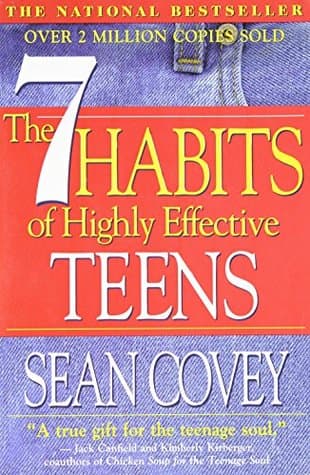
Core Idea
- Difficulty
- Easy
- Read it if
- You are a teenager (or a parent of one) looking for practical, actionable advice on self-improvement, goal setting, managing relationships, and building a strong character during formative years.
- Skip it if
- You are an adult already familiar with Stephen Covey's 'The 7 Habits of Highly Effective People' and are not seeking a simplified, teen-focused adaptation, or you prefer a less structured, more narrative approach to self-help.
Key Takeaways from The 7 Habits Of Highly Effective Teens
Be Proactive
Take responsibility for your choices and actions, rather than blaming others or circumstances.
Proactivity is the first habit. It means you control your life. You can choose how you respond to situations, instead of being a victim. Reactive people let outside factors, like bad weather or someone else's mood, control their feelings and actions. Proactive teens, though, know they can choose their attitude and response, even in tough situations. This habit changes your focus from what you can't control to what you can. It helps you make positive changes and avoid feeling like a victim. It's about taking action and making things happen, instead of waiting for things to happen to you.
“I am a product of my choices, not my circumstances.”
In the book: Covey often uses the metaphor of 'response-ability,' highlighting that we have the 'ability to respond' to any situation. He provides examples of teens who chose to study harder after failing a test rather than blaming the teacher, or those who chose to forgive a friend rather than hold a grudge.
Try this: Identify one area where you tend to be reactive (e.g., getting angry when a sibling annoys you). Next time, pause and consciously choose a different, more positive response, like walking away or calmly expressing your feelings.
Related ideas: personal-responsibility, locus-of-control, self-empowerment
Begin With the End in Mind
Define your values and goals to guide your decisions and actions.
This habit tells teens to imagine their future and find what truly matters to them. It means creating a personal mission statement—a plan for your life based on your deepest values and goals. Without a clear vision, teens can easily get sidetracked by peer pressure, passing trends, or others' expectations. By defining your 'end in mind,' you create a personal guide that helps you make choices that match your long-term goals and principles. This applies to choosing friends, school paths, or how you spend your free time. This habit gives you clarity and purpose, stopping you from just drifting.
“If you don't decide what your life is about, someone else will decide for you.”
In the book: Covey suggests creating a 'personal mission statement' or visualizing your funeral and what you'd want people to say about you. He shares stories of teens who set clear goals, like getting into a specific college or excelling in a sport, and then made daily choices to support those goals.
Try this: Write down a personal mission statement that reflects your core values and what you want to achieve in life. Keep it visible and refer to it when making important decisions.
Related ideas: goal-setting, personal-mission-statement, values-clarification
Put First Things First
Prioritize your tasks and manage your time effectively based on what truly matters.
This habit is about managing your time well and having self-discipline. It makes sure you spend your time on activities that match your 'end in mind' (Habit 2). Covey shows the Time Management Matrix, which puts tasks into four groups: Urgent/Important, Not Urgent/Important, Urgent/Not Important, and Not Urgent/Not Important. Effective teens focus on Quadrant 2 activities (Not Urgent/Important). These include planning, building relationships, and self-care. These activities prevent problems and lead to long-term success. It's about not giving in to distractions and immediate rewards, and instead, purposely spending time on what helps you reach your goals.
“The key is not to prioritize what's on your schedule, but to schedule your priorities.”
In the book: The Time Management Matrix is a core tool presented, with examples of teens who struggled when focusing on Quadrant 1 (crises) and Quadrant 3 (interruptions), versus those who thrived by dedicating time to Quadrant 2 activities like studying for tests in advance or spending quality time with family.
Try this: Use the Time Management Matrix for a week. Plan your daily schedule by identifying your Quadrant 2 activities first, then fitting in Quadrant 1 tasks, and minimizing Quadrant 3 and 4 distractions.
Related ideas: time-management, prioritization, self-discipline, procrastination
Think Win-Win
Seek mutually beneficial solutions in all your interactions and relationships.
This habit questions the competitive 'win-lose' idea often common among teens, where one person's success means another's failure. Instead, it promotes an abundance mindset, believing there are enough opportunities and successes for everyone. Thinking Win-Win means approaching conflicts and talks with the goal of finding solutions that work for everyone. It's about cooperation instead of competition, which builds stronger relationships based on mutual respect and understanding. This approach needs understanding, good communication, and a belief in working together. It leads to more positive and lasting results in friendships, family, and group projects.
“Life is an all-you-can-eat buffet, not a pie. There's plenty for everyone.”
In the book: Covey contrasts Win-Win with Win-Lose (competitive), Lose-Win (doormat), Lose-Lose (revenge), and Win-Only (selfish) scenarios. He shares stories of friends who successfully resolved disagreements over shared belongings or group project roles by finding solutions where everyone felt heard and valued.
Try this: In your next disagreement with a friend or family member, actively listen to their perspective and propose a solution that addresses both your needs and theirs, ensuring both parties feel they've 'won' something.
Related ideas: collaboration, conflict-resolution, empathy, interpersonal-skills
Seek First to Understand, Then to Be Understood
Listen empathetically before attempting to explain your own perspective.
This habit is key to good communication and building strong relationships. Most people listen to respond, not to understand. They hear what others say through their own experiences and assumptions. To seek first to understand means to listen with empathy. This involves putting yourself in the other person's shoes, trying to see things from their view, and truly hearing their feelings and worries without judging or interrupting. Only after the other person feels truly heard and understood can good communication and problem-solving begin. This habit builds trust and helps your own message be heard more openly.
“The deepest need of the human heart is to be understood.”
In the book: Covey likens poor listening to trying to fix someone's eyes without understanding their vision problem first. He provides examples of teens who successfully navigated difficult conversations with parents or teachers by first validating their perspective before expressing their own needs.
Try this: Before responding in your next conversation, especially a sensitive one, focus solely on listening to understand the other person's feelings and message. Try to paraphrase what they said to confirm your understanding before sharing your own thoughts.
Related ideas: empathetic-listening, active-listening, communication-skills, perspective-taking
Synergize
Work together to create something greater than any individual could achieve alone.
Synergy means valuing differences and combining strengths to get great results. It's the idea that when people work together with respect, and welcome different views, they can create solutions and outcomes that wouldn't be possible alone. This habit tells teens to appreciate different perspectives. It shows that different opinions can make discussions better and lead to new ideas. Synergy means going beyond just compromising (where everyone gives up something) to a 'third alternative'—a solution that is better than any original idea. It is necessary for group projects, team sports, and even family life. It turns possible conflict into strong teamwork.
“The whole is greater than the sum of its parts.”
In the book: Covey often uses the metaphor of '1 + 1 = 3 or more' to explain synergy. He shares stories of diverse groups of teens successfully completing complex school projects or organizing community events by leveraging each member's unique talents and overcoming initial disagreements.
Try this: In your next group project, actively encourage team members to share their unique ideas, even if they differ from yours. Look for ways to combine these ideas to create an innovative solution that no single person would have thought of alone.
Related ideas: teamwork, collaboration, diversity, innovation, problem-solving
Sharpen the Saw
Continuously renew yourself physically, mentally, emotionally, and spiritually.
This habit is about self-care and always getting better. It makes sure your personal 'tool' (you!) stays ready and effective. It says you need to balance and regularly refresh four main parts of your life: physical (exercise, healthy eating, sleep), mental (learning, reading, writing), emotional (building relationships, laughing, helping others), and spiritual (meditation, being in nature, connecting with values). Ignoring any of these can cause burnout, stress, and make it harder to use the other habits. Sharpening the Saw is not selfish; it is necessary for long-term effectiveness, strength, and overall well-being. It lets you keep going and enjoy life more.
“If you don't take care of yourself, you won't be able to take care of anything else.”
In the book: Covey uses the analogy of a woodcutter who keeps chopping with a dull saw, becoming exhausted and ineffective, versus one who takes time to sharpen the saw, increasing their efficiency. He provides examples of teens who prioritize sleep, exercise, reading, and healthy social connections to manage stress and excel.
Try this: Schedule dedicated time each week for activities that renew you in each of the four dimensions (physical, mental, emotional, spiritual). For example, a morning run (physical), reading a book (mental), calling a friend (emotional), and journaling (spiritual).
Related ideas: self-care, well-being, resilience, personal-renewal, stress-management
The Private Victory Precedes the Public Victory
Mastering yourself is the foundation for successful relationships and external achievements.
This main idea says that the first three habits (Be Proactive, Begin With the End in Mind, Put First Things First) are about self-mastery, building character, and taking personal responsibility. Covey calls this the 'Private Victory.' Only when a teen has this inner strength and self-discipline can they truly succeed in the 'Public Victory' habits (Think Win-Win, Seek First to Understand, Synergize), which involve interacting well with others. A strong sense of self-worth and control over one's own life is the basis for healthy relationships, success in groups, and positive influence. Trying to achieve public victories without a private victory often leads to depending on others and results that don't last.
“You can't have a public victory without a private victory.”
In the book: Covey repeatedly stresses that you can't be a good friend or team member if you're not first a good 'you.' He illustrates this with examples of teens who tried to be popular or successful in groups but lacked self-confidence or struggled with personal habits, ultimately failing in their public endeavors.
Try this: Before attempting to resolve a conflict with a friend or lead a group, take time to reflect on your own values, goals, and priorities. Ensure your own 'saw is sharpened' and you're coming from a place of personal strength and clarity.
Related ideas: self-mastery, character-development, interdependence, personal-growth
Paradigms and Principles
Understand that your perception shapes your reality, and timeless principles govern success.
Covey talks about 'paradigms' as how we see the world—our perceptions, assumptions, and beliefs. These paradigms are like mental maps. They affect how we understand events and interact with others. If our map is wrong, we'll get lost. He argues that our paradigms often need to change for us to see new possibilities and solve problems well. Underneath these paradigms are universal 'principles'—timeless, clear truths like fairness, honesty, and human dignity. Success and happiness come from living our lives according to these unchanging principles, not just following trends or peer pressure. Understanding this difference helps teens question their own assumptions and build their lives on a strong foundation.
“How you see the problem is the problem.”
In the book: Covey uses the classic optical illusion examples (e.g., the old woman/young woman drawing) to demonstrate how two people can look at the same thing and see something different. He also highlights historical figures and events that demonstrated adherence to principles leading to long-term success.
Try this: When facing a challenge or misunderstanding, pause and consider your current 'paradigm' or viewpoint. Try to consciously shift your perspective and consider alternative ways of seeing the situation, or reflect on which universal principle applies to guide your response.
Related ideas: perception, mindset, values, ethics, worldview
The 7 Habits Of Highly Effective Teens Quotes
“Be proactive. Take responsibility for your life.”
“Begin with the end in mind. Know where you want to go so you know where you are now.”
“Put first things first. Prioritize and do the most important things first.”
“Think win-win. See life as a cooperative arena, not a competitive one.”
“Seek first to understand, then to be understood.”
“Synergize. The whole is greater than the sum of its parts.”
“Sharpen the saw. Renew yourself regularly.”
“You are the driver of your life, not the passenger.”
“The key is not to prioritize what's on your schedule, but to schedule your priorities.”
“Listen with your eyes, heart, and ears.”
“Celebrate differences. It's the variety that adds spice to life.”
“Balance feels better than burnout.”
“You can't control everything that happens to you, but you can control how you react to it.”
“The more you trust, the less you need to control.”
Quiz
10 questions on the main ideas. Each answer comes with a short explanation.
Question 1
According to Sean Covey, what is the foundational habit that all other habits build upon in 'The 7 Habits of Highly Effective Teens'?
- Be Proactive
- Begin with the End in Mind
- Synergize
- Sharpen the Saw
Show answer
A. Be Proactive Habit 1: Be Proactive is described as the foundation because it emphasizes taking responsibility for your life and choices rather than blaming circumstances or others. This mindset shift is essential before implementing the other habits.
Question 2
Which of the 7 Habits focuses on creating win-win situations in relationships, as described in the book?
- Think Win-Win
- Seek First to Understand, Then to Be Understood
- Put First Things First
- Synergize
Show answer
A. Think Win-Win Habit 4: Think Win-Win is about fostering mutual benefit in interactions, whether with friends, family, or peers. It encourages teens to move away from competitive or selfish mindsets toward cooperation.
Question 3
What practical tool does Sean Covey introduce in Habit 3: Put First Things First to help teens prioritize tasks?
- The Time Matrix
- The Goal Ladder
- The Friendship Circle
- The Proactive Planner
Show answer
A. The Time Matrix The Time Matrix categorizes tasks into four quadrants based on urgency and importance, helping teens focus on what matters most (Quadrant II: important but not urgent) rather than getting stuck in crises or trivial activities.
Question 4
In the book, which habit emphasizes the importance of listening empathetically before expressing your own viewpoint?
- Habit 5: Seek First to Understand, Then to Be Understood
- Habit 2: Begin with the End in Mind
- Habit 6: Synergize
- Habit 7: Sharpen the Saw
Show answer
A. Habit 5: Seek First to Understand, Then to Be Understood Habit 5 teaches that effective communication starts with genuine listening to understand others' perspectives. This builds trust and reduces conflicts, which is crucial for teen relationships.
Question 5
According to Covey, what does 'Sharpen the Saw' (Habit 7) specifically refer to in the context of teen life?
- Renewing yourself in four key areas: body, brain, heart, and soul
- Learning new skills for future careers
- Cutting out negative influences from your life
- Practicing the first six habits daily
Show answer
A. Renewing yourself in four key areas: body, brain, heart, and soul Habit 7 is about self-renewal to maintain effectiveness. Covey breaks it into physical (body), mental (brain), social/emotional (heart), and spiritual (soul) dimensions, encouraging balanced growth.
Question 6
Which of the following is a key principle of Habit 2: Begin with the End in Mind, as applied to teens in the book?
- Creating a Personal Mission Statement
- Setting daily to-do lists
- Apologizing quickly after mistakes
- Joining multiple extracurricular activities
Show answer
A. Creating a Personal Mission Statement Habit 2 involves defining your values and long-term goals. Covey recommends writing a Personal Mission Statement to clarify what matters most, guiding decisions and actions toward a meaningful life.
Question 7
In the context of peer pressure, which habit helps teens stay true to their values and make independent choices?
- Habit 1: Be Proactive
- Habit 3: Put First Things First
- Habit 6: Synergize
- Habit 7: Sharpen the Saw
Show answer
A. Habit 1: Be Proactive Being proactive means recognizing you have the freedom to choose your response to external pressures. By focusing on your circle of influence (what you can control) rather than circle of concern, teens can resist negative peer influence.
Question 8
What does Covey describe as the outcome of Habit 6: Synergize when applied to group projects or team activities?
- Achieving results that are greater than the sum of individual efforts
- Ensuring everyone follows the same plan without conflict
- Dividing tasks equally among all members
- Focusing solely on the fastest way to complete the project
Show answer
A. Achieving results that are greater than the sum of individual efforts Synergy is about creative cooperation where diverse perspectives lead to innovative solutions. Covey uses examples like sports teams or study groups to show how teamwork can produce outcomes unattainable alone.
Question 9
According to the book, how does the 'Emotional Bank Account' metaphor relate to building friendships?
- It represents the trust level in a relationship, built by deposits (kind acts) and damaged by withdrawals (broken promises)
- It's a savings plan for money to spend on friends during outings
- It tracks how many friends you have on social media accounts
- It measures the amount of time invested in maintaining friendships
Show answer
A. It represents the trust level in a relationship, built by deposits (kind acts) and damaged by withdrawals (broken promises) Covey introduces the Emotional Bank Account as a key concept for relationships. Deposits include being kind, loyal, or apologizing, while withdrawals involve gossip, breaking promises, or disrespect. A high balance fosters strong friendships.
Question 10
In the book's framework, which habit sequence represents the 'Private Victory' (self-mastery) before moving to 'Public Victory' (relationships)?
- Habits 1-3
- Habits 4-6
- Habits 5-7
- Habits 2-4
Show answer
A. Habits 1-3 Covey structures the habits into Private Victory (Habits 1-3: Be Proactive, Begin with the End in Mind, Put First Things First) for personal effectiveness, followed by Public Victory (Habits 4-6: Think Win-Win, Seek First to Understand, Synergize) for interpersonal effectiveness, with Habit 7 as renewal for both.
The 7 Habits Of Highly Effective Teens FAQ
What is The 7 Habits of Highly Effective Teens about?
The 7 Habits of Highly Effective Teens adapts Stephen Covey's principles for teenagers, offering a step-by-step guide to help them improve self-image, build friendships, resist peer pressure, achieve goals, and navigate relationships with parents. It's presented in an entertaining style with cartoons, quotes, and real-life stories to engage young readers.
Does The 7 Habits of Highly Effective Teens work for improving self-esteem?
Yes, the book focuses on building self-image through habits like being proactive and seeking win-win solutions, which help teens develop confidence and resilience. Many readers report positive changes in self-esteem by applying these principles to daily challenges.
How is The 7 Habits of Highly Effective Teens different from the adult version?
While based on the same core principles as Stephen Covey's The 7 Habits of Highly Effective People, this version is tailored for teens with relatable examples, cartoons, and stories about peer pressure, school, and family. It uses a more engaging, accessible style to address teenage-specific issues.
What is the 'win-win' habit in the book?
The 'win-win' habit teaches teens to seek mutually beneficial solutions in conflicts, such as with friends or parents, rather than competing or compromising. It emphasizes cooperation and empathy to build healthier relationships and achieve shared goals.
Does The 7 Habits of Highly Effective Teens help with peer pressure?
Yes, the book provides strategies like being proactive and prioritizing important goals to help teens resist negative peer pressure. It encourages them to make decisions based on their values rather than external influences.
How different is it from other self-help books for teens?
Unlike many self-help books that focus on quick fixes, this book offers a structured, principle-based approach with seven habits that build on each other. Its use of cartoons, real stories, and interactive elements makes it more engaging and practical for teenage readers.
What is 'begin with the end in mind' in the context of teens?
This habit encourages teens to set clear goals and visualize their desired outcomes, such as academic success or personal growth, to guide daily actions. It helps them stay focused and make decisions that align with their long-term aspirations.
Is The 7 Habits of Highly Effective Teens suitable for parents too?
Yes, the book is recommended for parents, grandparents, and adults who influence teens, as it provides insights into teenage challenges and offers tools to support young people in developing effective habits and improving family dynamics.
What is the 'synergize' habit and how do teens apply it?
The 'synergize' habit teaches teens to collaborate creatively with others, combining strengths to achieve better results than working alone. They can apply it in group projects, team sports, or resolving conflicts by valuing diverse perspectives.
Does the book include practical exercises for teens?
Yes, the book includes step-by-step guides, interactive ideas, and real-life scenarios that encourage teens to practice the habits daily. Exercises focus on goal-setting, communication skills, and self-reflection to reinforce learning.
Similar books
- The 7 Habits of Highly Effective People: Powerful Lessons in Personal Change
Stephen R. Covey
4.1 (524k) average on GoodreadsBusinessThe foundational adult version from which this teen adaptation is derived, sharing the same core principles.
- Steve Jobs
Walter Isaacson
4.1 (957k) average on GoodreadsBusinessSteve Jobs was a visionary who fused creativity and technology to revolutionize six industries and shape our digital world.
- Freakonomics: A Rogue Economist Explores the Hidden Side of Everything
Steven D. Levitt
4.0 (709k) average on GoodreadsBusinessThis book uses economic principles to reveal the surprising incentives behind everything from drug dealing and real estate to cheating teachers and the decline of crime.
- The Tipping Point: How Little Things Can Make a Big Difference
Malcolm Gladwell
4.0 (690k) average on GoodreadsBusinessMalcolm Gladwell explains how small, targeted actions can start widespread changes in trends, behaviors, and ideas.
- Outliers: The Story of Success
Malcolm Gladwell
4.2 (556k) average on GoodreadsBusinessMalcolm Gladwell argues that true success is not just about individual talent, but about the hidden advantages of culture, opportunity, and unique experiences that shape extraordinary lives.
- The Subtle Art of Not Giving a F*ck: A Counterintuitive Approach to Living a Good Life
Mark Manson
3.9 (530k) average on GoodreadsBusinessEmbrace your flaws and stomach life's lemons, because true happiness isn't about relentless positivity, but about choosing what truly matters to give a f*ck about.






Enjoyed the summary?
A summary gives you the shape of the book. The book itself has the detail, the examples and the voice.
Find The 7 Habits Of Highly Effective Teens on AmazonAs an Amazon Associate, BookBrief earns from qualifying purchases. How we're funded