
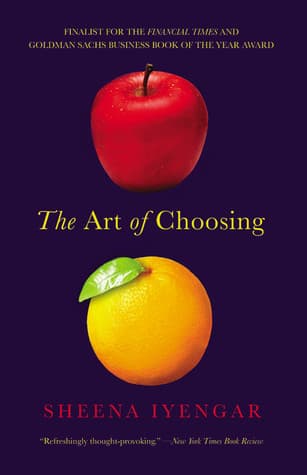
Core Idea
- Difficulty
- Medium
- Read it if
- You are fascinated by the psychology behind decision-making, want to understand why having too many options can be paralyzing, or seek to make better choices in your personal and professional life.
- Skip it if
- You prefer prescriptive, step-by-step guides for making decisions, or are not interested in the academic and scientific underpinnings of choice.
Key Takeaways from The Art of Choosing
The Paradox of Choice
More options don't always lead to better decisions or greater satisfaction.
Iyengar's 'jam study' shows that many options might seem appealing at first, but they often lead to decision paralysis, anxiety, and less satisfaction with the choice made. Too many choices increase our mental load, making it harder to weigh each option. This can result in delaying the decision or making a choice we are less confident in, leading to regret. The freedom of abundant choice can become a burden, which highlights the need for curation and limits in decision-making.
“The more choices people have, the more they prefer to put off making a decision, or to make no decision at all.”
In the book: The 'jam study' where consumers were presented with either 6 or 24 varieties of jam. While the larger display attracted more initial interest, the smaller display led to significantly more purchases (30% vs. 3%).
Try this: When facing a major decision, intentionally limit your options to a manageable few (e.g., 3-5). For presenting choices to others, curate the selection to avoid overwhelming them, focusing on quality over quantity.
Related ideas: decision-paralysis, choice-overload, cognitive-load
Cultural Lens of Choice
Our perception and value of choice are deeply shaped by cultural context.
Iyengar argues that the desire for individual choice is not an inborn, universal human trait. Instead, she shows how different cultures define and value choice differently. Western cultures often emphasize individual freedom to choose, while Eastern cultures might prioritize group harmony, duty, or choices made by trusted authorities for the common good. This cultural conditioning affects how we make decisions, our expectations of choice, and our reactions when those expectations are not met. Understanding these differences is important for good cross-cultural communication and avoiding assumptions about decision-making.
“The American ideal of choice as an inherent good is not universal; other cultures prioritize different values.”
In the book: Studies comparing choice behavior in individualistic (e.g., American) versus collectivistic (e.g., Japanese) cultures. For example, American children performed better on tasks when they chose their own anagrams, while Asian-American children performed better when their mothers or teachers chose for them.
Try this: When working in diverse teams or interacting with people from different backgrounds, recognize that their approach to choice might differ. Instead of imposing your own choice framework, seek to understand their cultural values around decision-making.
Related ideas: cultural-relativism, individualism-collectivism, cross-cultural-psychology
The Illusion of Control
We often overestimate our control over outcomes, especially when we've made the choice.
Humans need to feel in control, and making a choice often provides this feeling, even when outside factors heavily influence the outcome. This 'illusion of control' can have both good and bad results. On one hand, it can empower us and increase engagement. On the other, it can lead to overconfidence, a failure to prepare for unexpected events, and too much self-blame when things go wrong. Recognizing the limits of our control, especially in complex systems, is important for realistic planning and building resilience against uncertainties.
“When we make a choice, we tend to feel a greater sense of control, even if that control is largely an illusion.”
In the book: The study where lottery players who chose their own numbers felt they had a greater chance of winning than those who were given random numbers, despite the odds being identical.
Try this: Before making a significant choice, list the factors truly within your control versus those that are external. This helps manage expectations and reduces post-decision regret if outcomes aren't perfect.
Related ideas: cognitive-bias, locus-of-control, self-efficacy
Defaults as Powerful Nudges
The default option significantly influences choices, often without conscious awareness.
Defaults are choices automatically selected unless someone actively changes them. Iyengar shows that these pre-selected options greatly impact outcomes, from organ donation rates to retirement savings. People tend to stick with the default due to inertia, the belief that the default is the recommended option, or simply to avoid the effort of making an active choice. Understanding the power of defaults allows for ethical 'choice architecture,' where defaults can guide individuals toward good outcomes while still allowing them to opt out.
“Defaults are not just choices; they are powerful tools for shaping behavior, often without people realizing they are being influenced.”
In the book: Comparison of organ donation rates in European countries. Countries with 'opt-out' systems (default is donor) have significantly higher donation rates (90-99%) than 'opt-in' systems (default is non-donor, 4-28%).
Try this: When designing systems or presenting choices, consider the default option carefully. For personal decisions, be aware of pre-set defaults and actively evaluate if they align with your best interests, rather than passively accepting them.
Related ideas: nudge-theory, choice-architecture, behavioral-economics
The Cost of Making Choices
Decision-making itself consumes valuable mental resources.
Beyond the 'paradox of choice,' Iyengar highlights the mental effort involved in making decisions. Each choice, whether small or big, requires mental energy, attention, and often emotional processing. This 'decision fatigue' can reduce our mental resources, leading to poorer choices later in the day, more impulsivity, or avoiding decisions altogether. Recognizing this cost shows the importance of automating routine decisions, creating habits, and saving mental resources for truly important choices. It's not just about what we choose, but the act of choosing itself.
“Every choice, no matter how small, exacts a mental toll.”
In the book: Studies showing that judges are more likely to grant parole earlier in the day and after meal breaks, suggesting decision fatigue influences their rulings later in the day.
Try this: Automate routine decisions (e.g., 'uniform' wardrobe, pre-planned meals) to free up mental energy for more critical choices. Schedule important decisions for when you are well-rested and have peak cognitive capacity.
Related ideas: decision-fatigue, ego-depletion, cognitive-load
Internal vs. External Locus of Choice
We can choose to focus on what we can control, even when external options are limited.
Iyengar moves from external choice structures to the internal aspect of choice. While we often focus on the number of options given to us, a powerful part of choice lies in our internal response to situations, especially those beyond our direct control. This echoes Stoic philosophy: we may not choose our circumstances, but we always choose our attitude and interpretation. This internal choice is especially empowering when external options are few, such as during adversity or extreme limits. It emphasizes resilience and the ability to act even when freedom of action is limited.
“Even when external choices are constrained, we always retain the internal choice of how we respond.”
In the book: Examples from individuals in highly constrained environments (e.g., concentration camps, chronic illness) who find meaning and agency through their internal choices and attitudes.
Try this: When feeling overwhelmed by a situation you can't change, shift your focus from 'What can I do?' to 'How can I choose to perceive and respond to this?' Practice reframing challenges as opportunities for growth or learning.
Related ideas: stoicism, resilience, agency
The Feedback Loop of Choice
Our choices shape our identity, and our identity influences our future choices.
Choices are not isolated events; they connect and form a continuous feedback loop that defines who we are and who we become. Each decision strengthens certain values, beliefs, and behaviors, solidifying our self-concept. Conversely, our existing identity guides us toward choices that match our perceived self. Understanding this dynamic allows us to be more intentional about our choices, recognizing that they are not just transactions but are fundamental to personal growth and self-authorship. It's a reminder that we are always choosing our future selves.
“Every choice we make, no matter how small, is a brushstroke on the canvas of our identity.”
In the book: The idea that 'identity-based' choices (e.g., 'I am a healthy person, so I will choose the salad') are often stronger motivators than outcome-based choices (e.g., 'I will choose the salad to lose weight').
Try this: Before making a significant choice, ask yourself: 'Does this choice align with the person I want to be?' Actively choose behaviors that reinforce your desired identity, creating a positive feedback loop.
Related ideas: self-identity, personal-growth, self-authorship
Learning to Choose Well
Effective choice-making is a skill that can be developed through deliberate practice.
Iyengar concludes that while choices are complex and influenced by many factors, the ability to choose effectively is a learnable skill, not a fixed trait. This involves understanding our biases, recognizing the influence of context, and using strategies to manage choice overload and decision fatigue. It requires moving from impulsive reactions to more thoughtful and intentional decision-making. By practicing mindful choice, seeking different perspectives, and learning from past outcomes, individuals can greatly improve their ability to navigate options and make choices that lead to greater satisfaction and better results.
“Choosing well is not an innate talent but a cultivated art, requiring awareness, strategy, and reflection.”
In the book: The entire book serves as evidence, synthesizing research from psychology, economics, and neuroscience to provide a framework for better decision-making.
Try this: Regularly reflect on past choices: What went well? What could have been better? Why? Experiment with different decision-making frameworks (e.g., pros/cons, decision matrix) and observe their impact.
Related ideas: decision-making-skills, critical-thinking, meta-cognition
The Power of Framing
How options are presented dramatically alters our choices.
Iyengar examines the psychological phenomenon of framing, showing how the language, context, and presentation of choices can greatly bias our decisions. Whether options are presented as gains or losses, or highlighted in a certain order, these subtle cues can sway our preferences without us knowing. This insight is important for both consumers and creators of choices: consumers need to be aware of how information is presented to them, and creators have a responsibility to frame choices clearly and ethically, recognizing the powerful influence they have over others' decisions.
“The way a choice is framed can be more influential than the actual content of the options themselves.”
In the book: Studies showing that people are more likely to choose a medical treatment with a '90% survival rate' than one with a '10% mortality rate,' even though the outcomes are identical.
Try this: When evaluating options, try to reframe them in different ways (e.g., positive vs. negative, short-term vs. long-term impact) to uncover potential biases. When presenting choices, be mindful of how your framing might influence the recipient.
Related ideas: framing-effect, cognitive-bias, persuasion
The Social Dimension of Choice
Our choices are often influenced by the choices and expectations of others.
Beyond cultural influences, Iyengar highlights the more immediate social context of choice. We are often influenced by what our peers do, what society expects of us, or what we see as the 'right' choice within our social circle. This can appear as conformity, where we choose something to fit in, or as a desire to stand out. Understanding this social dimension is vital because it shows that choices are rarely purely individual. Our social environment is a strong, often subconscious, force that guides our preferences and actions, emphasizing the interconnectedness of human decision-making.
“We are not isolated choosers; our decisions are inherently social, shaped by the people around us and the groups we belong to.”
In the book: Experiments on conformity, such as the Asch conformity experiments, where individuals often conformed to incorrect group judgments even when their own perception was different.
Try this: Before making a significant choice, consider if you are being unduly influenced by social pressure. Seek out diverse opinions, and if necessary, consciously detach from groupthink to make a choice that truly reflects your values.
Related ideas: social-influence, conformity, groupthink
The Art of Choosing Quotes
“The more choices you have, the more likely you are to make a choice that is not in your best interest.”
“The greatest gift you can give yourself is the freedom to choose.”
“Choice is not just about what we want, but also about who we are.”
“When we have too many choices, we tend to choose nothing at all.”
“The right choice isn't always the one that makes us happiest in the moment, but the one that serves our long-term goals.”
“Our choices are often more influenced by our emotions than by our logic.”
“To choose well, we must first understand what truly matters to us.”
“The act of choosing can be a source of both anxiety and empowerment.”
“Sometimes, the best choice is to delegate the choice to someone else.”
“We are often happier with fewer, more meaningful choices.”
“The ability to choose is a fundamental human need.”
“Our choices don't just affect us; they ripple outward to impact others.”
“Learning to choose is learning to live.”
Quiz
10 questions on the main ideas. Each answer comes with a short explanation.
Question 1
According to Iyengar, what is a common Western cultural assumption about choice that is not universally shared?
- Choice is primarily about group harmony.
- The more choices, the better.
- Choice is often an illusion.
- Choice leads to greater anxiety.
Show answer
B. The more choices, the better. Iyengar discusses how Western cultures often equate more choice with greater freedom and happiness, a view not always held in collectivist cultures where choice might be seen in relation to group welfare or as a burden.
Question 2
What did Iyengar's famous jam study demonstrate regarding the number of choices presented to consumers?
- More choices always lead to higher sales.
- A moderate number of choices leads to the highest satisfaction.
- Fewer choices often lead to more purchases.
- The type of jam matters more than the number of choices.
Show answer
C. Fewer choices often lead to more purchases. The jam study showed that while a large selection (24 jams) attracted more initial interest, a smaller selection (6 jams) resulted in significantly higher purchase rates, illustrating the 'paradox of choice'.
Question 3
Which of the following is NOT presented by Iyengar as a factor influencing how we perceive and make choices?
- Our cultural background.
- The number of available options.
- Our astrological sign.
- Our perceived control over the outcome.
Show answer
C. Our astrological sign. Iyengar extensively covers the impact of culture, the number of options, and perceived control on choice, but astrology is not discussed as a scientific factor.
Question 4
Iyengar discusses 'choice overload' or the 'paradox of choice'. What is a key consequence of experiencing too many options?
- Increased satisfaction with the chosen option.
- Faster decision-making.
- Decision paralysis and lower satisfaction.
- A greater sense of personal freedom.
Show answer
C. Decision paralysis and lower satisfaction. The book explains that while more options might seem appealing, an excessive number can lead to difficulty making a choice (paralysis) and, even after choosing, a reduced sense of satisfaction due to regret or the feeling of missing out on other options.
Question 5
When discussing the role of 'pre-selection' or 'curation' in choice, what does Iyengar suggest is its benefit?
- It eliminates the need for personal choice entirely.
- It simplifies the decision process by reducing the choice set.
- It ensures that the 'best' option is always chosen.
- It makes choices feel more authentic and personal.
Show answer
B. It simplifies the decision process by reducing the choice set. Iyengar argues that pre-selection, or having options curated by an expert or trusted source, can alleviate choice overload by presenting a manageable and often higher-quality set of alternatives, making the decision process easier and more effective.
Question 6
What concept does Iyengar introduce when discussing how our choices are often shaped by the choices of others, even when we believe we are acting independently?
- The illusion of control.
- The choice architecture.
- The tyranny of choice.
- The freedom of choice.
Show answer
B. The choice architecture. Choice architecture refers to the way choices are presented, which can subtly nudge individuals toward certain decisions. It's about designing the context in which people make decisions, often influencing them without their full awareness.
Question 7
In the context of 'secondary choice,' what does Iyengar suggest is a key benefit, particularly in situations where primary choice is limited or absent?
- It always leads to a better outcome than primary choice.
- It allows individuals to exert influence over how a decision is enacted or experienced, even if they didn't make the initial decision.
- It refers to making a choice for someone else.
- It is a less effective form of choice that should be avoided.
Show answer
B. It allows individuals to exert influence over how a decision is enacted or experienced, even if they didn't make the initial decision. Secondary choice involves choosing how to react or adapt to a situation, or how a pre-determined choice is implemented. Iyengar highlights its importance in maintaining a sense of agency and control even when primary choice is restricted, such as choosing how to cope with a medical diagnosis.
Question 8
Iyengar argues that for choices to be truly meaningful and satisfying, what crucial element must be present beyond merely having options?
- A guarantee of the best possible outcome.
- A clear, rational decision-making process.
- A sense of personal connection and perceived control over the choice and its consequences.
- External validation from peers or experts.
Show answer
C. A sense of personal connection and perceived control over the choice and its consequences. Iyengar emphasizes that the subjective experience of choice is critical. It's not just about the number of options, but about feeling personally engaged, understanding the implications, and believing that one's choice genuinely matters and reflects one's desires.
Question 9
When advising on how to make better choices, Iyengar suggests focusing on 'satisficing' rather than 'maximizing'. What does 'satisficing' entail?
- Always choosing the option that yields the absolute best result.
- Choosing an option that is 'good enough' to meet one's criteria, without exhausting all possibilities.
- Delegating choices to someone else to avoid personal responsibility.
- Making choices based purely on emotional impulses.
Show answer
B. Choosing an option that is 'good enough' to meet one's criteria, without exhausting all possibilities. Satisficing, a term coined by Herbert Simon, is about choosing an option that satisfies a minimum set of criteria, rather than striving to find the 'perfect' option (maximizing). Iyengar suggests this approach can lead to greater satisfaction and less regret, especially with complex choices.
Question 10
Iyengar discusses the neurological basis of choice, highlighting the role of the prefrontal cortex. What is the primary function of this brain region in the context of decision-making?
- Processing basic sensory information.
- Regulating involuntary bodily functions.
- Evaluating options, weighing risks and rewards, and planning for the future.
- Storing long-term memories.
Show answer
C. Evaluating options, weighing risks and rewards, and planning for the future. The prefrontal cortex is crucial for executive functions, including complex cognitive behavior, decision-making, planning, and moderating social behavior. It plays a key role in evaluating the potential consequences of different choices.
The Art of Choosing FAQ
What is the main premise of 'The Art of Choosing'?
'The Art of Choosing' explores the complexities of human decision-making, examining how and why we make choices, from the trivial to the life-altering. Author Sheena Iyengar delves into the cultural, psychological, and biological factors that influence our selections and their far-reaching consequences.
Is the desire for choice universal, or is it culturally influenced?
Sheena Iyengar's research suggests that while the desire for choice might seem innate, its expression and perceived value are significantly shaped by culture. Different societies have varying approaches to individual autonomy and the number of options considered optimal.
Does having more choices always lead to better outcomes or greater satisfaction?
Not necessarily. The book discusses the phenomenon of 'choice overload,' where an excessive number of options can lead to anxiety, decision paralysis, and even regret, rather than increased satisfaction or optimal outcomes.
What is 'choice overload' and how does it impact decision-making?
Choice overload refers to the cognitive impairment and decreased satisfaction that can result from being presented with too many options. It can lead to procrastination, poor decisions, and a feeling of being overwhelmed, rather than empowered.
How can 'The Art of Choosing' help me make better personal and professional decisions?
By understanding the underlying mechanisms and biases that influence choice, readers can develop strategies to navigate complex decisions more effectively. The book provides insights into structuring choices, recognizing cultural influences, and avoiding common pitfalls to improve decision-making in various aspects of life.
How does 'The Art of Choosing' differ from other self-help books on decision-making?
'The Art of Choosing' stands out by integrating rigorous scientific research from economics, psychology, and neuroscience with philosophical insights and real-world examples. It offers a comprehensive, evidence-based exploration of choice rather than just prescriptive advice, emphasizing the cultural and contextual nuances of decision-making.
Does the book suggest there are 'right' or 'wrong' ways to choose?
Rather than dictating right or wrong choices, the book aims to illuminate the processes and factors that lead to different outcomes. It encourages readers to understand their own choice architecture and the implications of their decisions, fostering more conscious and deliberate selection.
What role does technology play in our choices, according to the book?
The book touches on how technological advancements have both expanded our choices and introduced new complexities. Digital platforms and interconnected commerce present unprecedented options, but also create new challenges in managing information and making informed decisions.
Does 'The Art of Choosing' offer practical exercises or frameworks for improving choice skills?
While not a workbook, the book provides a deep understanding of the principles behind effective choice, which readers can apply to their own lives. It encourages critical thinking about choice architecture, the value of options, and the impact of cultural context, allowing readers to develop their own practical approaches.
About the author

Sheena Iyengar is a scholar and author known for her work in the field of decision-making and choice. Her book, The Art of Choosing, explores the complexities of how people make choices and the factors that influence them. Iyengar's research has contributed significantly to the understanding of choice in various contexts, including psychology and economics.
Similar books
- Steve Jobs
Walter Isaacson
4.1 (957k) average on GoodreadsBusinessSteve Jobs was a visionary who fused creativity and technology to revolutionize six industries and shape our digital world.
- Freakonomics: A Rogue Economist Explores the Hidden Side of Everything
Steven D. Levitt
4.0 (709k) average on GoodreadsBusinessThis book uses economic principles to reveal the surprising incentives behind everything from drug dealing and real estate to cheating teachers and the decline of crime.
- The Tipping Point: How Little Things Can Make a Big Difference
Malcolm Gladwell
4.0 (690k) average on GoodreadsBusinessMalcolm Gladwell explains how small, targeted actions can start widespread changes in trends, behaviors, and ideas.
- Outliers: The Story of Success
Malcolm Gladwell
4.2 (556k) average on GoodreadsBusinessMalcolm Gladwell argues that true success is not just about individual talent, but about the hidden advantages of culture, opportunity, and unique experiences that shape extraordinary lives.
- The Subtle Art of Not Giving a F*ck: A Counterintuitive Approach to Living a Good Life
Mark Manson
3.9 (530k) average on GoodreadsBusinessEmbrace your flaws and stomach life's lemons, because true happiness isn't about relentless positivity, but about choosing what truly matters to give a f*ck about.
- The 7 Habits of Highly Effective People: Powerful Lessons in Personal Change
Stephen R. Covey
4.1 (524k) average on GoodreadsBusinessThis book presents seven habits that help people live more effective, purposeful lives.






Enjoyed the summary?
A summary gives you the shape of the book. The book itself has the detail, the examples and the voice.
Find The Art of Choosing on AmazonAs an Amazon Associate, BookBrief earns from qualifying purchases. How we're funded