
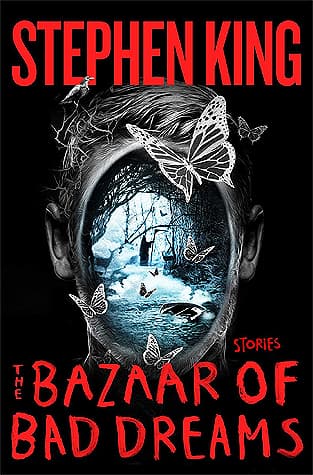
Synopsis
Covers the whole plot, including the ending.
- Difficulty
- Medium
- Pacing
- Variable
- Mood
- Eerie, Suspenseful, Thought-provoking, Dark, Atmospheric
- Read it if
- You enjoy Stephen King's short fiction and want a collection with a variety of themes, including supernatural horror, moral dilemmas, and psychological suspense, along with author commentary.
- Skip it if
- You prefer full-length novels with a single continuous plot or are sensitive to dark, often disturbing, and sometimes grim themes.
The Bazaar of Bad Dreams Plot Summary
Covers the whole plot, including the ending.
Mile 81
At a quiet highway rest stop in rural Maine, a mud-splattered, seemingly empty 1980s Ford Country Squire station wagon appears. Ten-year-old Pete Simmons, looking for a place to drink a forbidden beer, finds the car. He approaches it, curious, and finds it locked with no driver. Soon, other travelers arrive, drawn to the strange vehicle. The car, however, is not empty; it has a malicious, almost predatory mind. It begins to absorb anyone who touches it or gets too close, leaving only their clothes and belongings. Pete sees this horror and tries to warn others, but the car's magnetic pull and the victims' disbelief make his efforts useless as more people disappear into the car.
Premium Harmony
Ray and Mary are a long-married couple with unspoken resentments. They are on a mundane shopping trip to a Walmart in rural Maine, arguing about small things like cigarettes and lottery tickets. While Ray is inside the store, Mary, who has a heart condition, waits in the car with their dachshund, Bizzy. When Ray returns, he finds Mary dead in the passenger seat from a heart attack. Ray struggles with grief, regret, and a strange sense of freedom. He thinks about their life together, the small cruelties they shared, and the sudden finality of death. He decides to continue their shopping trip as planned, even with his deceased wife in the car.
Batman and Robin Have an Altercation
Sanderson 'Sandy' Dean regularly takes his elderly father, who has advanced Alzheimer's disease, to eat at a local fast-food restaurant. Their routine is a source of quiet comfort amid his father's declining mental state. During one outing, a confrontation occurs between Sandy and a group of young men who mock his father. Sandy, usually mild-mannered, surprises himself by fiercely defending his father. The fight triggers a vivid, painful memory from Sandy's childhood: an incident where his father brutally beat a man who had attacked Sandy's mother. This memory reveals the complex, often violent nature of his father's love and protection, making Sandy confront his own suppressed anger and his changing relationship with his aging parent.
The Dune
Judge Harvey Beecher, an elderly, respected man, shares a strange and terrifying secret he has kept since childhood. As a boy, he found a deserted island in a Florida bayou, reachable only by canoe. On this island, a specific dune would show names written in the sand by an unseen force. Each name that appeared on the dune belonged to someone who would soon die in a bizarre, often gruesome accident. Harvey recounts visiting the dune, reading the names, and later hearing of their deaths, always in the order they appeared. He describes the chilling predictions and the moral problem of knowing but being unable to help. As he nears the end of his life, he revisits the island one last time, expecting to see his own name, but finds a different, equally unsettling revelation.
Bad Little Kid
George Hallas, a successful lawyer, describes his torment from a 'bad little kid' — a supernatural, ever-present boy who appears only to George. This child, always in old-fashioned clothes, does not physically harm George directly but causes the deaths of everyone George loves or cares about. From his grandmother to his wife and even his dog, the child's appearance precedes a tragic accident or illness for each. George, driven to desperation, commits a crime to escape the curse, believing that if he is imprisoned, the child will have no one left to target. The story shows George's increasing paranoia and the psychological toll of being singled out for such a cruel, inexplicable fate.
A Death
In a bleak, snow-covered town in 1889, Sheriff Barclay investigates the brutal murder of a young girl. The main suspect is Todd, a simple-minded, poor local known for his strange habits. Despite little concrete evidence and Todd's gentle nature, circumstantial clues and the town's prejudice quickly point to him. Barclay, under pressure from the community and his own biases, builds a case against Todd, leading to his conviction and hanging. The story examines justice, prejudice, and the legal system's flaws, making the reader question Todd's guilt and the sheriff's role in his death. The narrative is a somber look at how easily an innocent person can be condemned by a community's fear and a flawed investigation.
Obits
Michael Anderson, a struggling online journalist, discovers he has a terrifying supernatural ability. While writing obituaries for a gossip website, he realizes that anyone whose obituary he writes immediately dies in a bizarre and often ironic way. He first dismisses it as coincidence, but after several undeniable instances, including the death of his former editor who wronged him, he accepts his power. Michael begins to use this ability to 'punish' those he deems deserving, from internet trolls to public figures he dislikes. However, the power starts to corrupt him; he becomes increasingly isolated and paranoid, realizing the immense responsibility and moral burden of his deadly gift. His vengeful actions spiral out of control, leading to a chilling end.
Morality
Chad and Nora Callahan are a young, financially struggling couple. Chad is a writer, and Nora is a hospice nurse. Nora's wealthy, terminally ill patient, Mr. George Deters, offers her $200,000 if she will commit a specific sin: scream obscenities at him, curse God, and denounce morality itself, essentially 'damning herself.' Desperate for money, Nora agrees, despite Chad's initial doubts. The act is brief, but its psychological effects are deep. The money brings temporary relief but also introduces deep-seated guilt, suspicion, and resentment into their marriage. They both become more paranoid and morally compromised, leading to the gradual breakdown of their relationship and their individual integrity as the 'sin' slowly poisons their lives.
Afterlife
William Andrews, a man who dies of colon cancer, awakens in a strange, sterile office building, a kind of purgatorial afterlife. He meets a 'Case Worker' who tells him he will live his life over again, exactly as it was, with no memories of his previous existence or the afterlife. However, he will face the same choices and make the same mistakes, trapped in an endless cycle. The Case Worker explains that this is a common fate, a form of cosmic bureaucratic recycling. William struggles with the futility and injustice of this eternal loop, trying to break the cycle or understand its purpose, but he is ultimately returned to the moment of his birth, destined to repeat his existence.
Ur
College English instructor Wesley Smith, recently divorced, buys a mysterious, old-fashioned pink Kindle from a pawn shop. He soon discovers this device is no ordinary e-reader; it can access books, newspapers, and even entire literary works from alternate universes, specifically those where certain historical events or cultural shifts happened differently. More deeply, it allows him to read 'Ur' versions of reality, where events like the Kennedy assassination or the survival of certain authors took different paths. Wesley becomes obsessed, exploring these parallel worlds and trying to use the device to warn people in his own reality about disasters in other timelines, especially focusing on his ex-girlfriend's fate. However, his interference attracts the attention of mysterious, powerful entities who guard the multiverse.
Mister Yummy
Ollie Franklin, an octogenarian gay man in a nursing home, reflects on his long life, his past loves, and the indignities of aging. He recounts his early experiences accepting his sexuality, the societal prejudices he faced, and the lasting love he shared with his partner, David. The story is a poignant look at memory, regret, and the search for dignity in old age. Ollie often sees a younger, handsome orderly he calls 'Mister Yummy,' a fleeting symbol of youth and physical attraction that contrasts sharply with his current physical decline. As his health worsens, Ollie faces the fear of oblivion and the desire to leave a meaningful legacy, finding comfort in his memories and the enduring power of love.
Blockade Billy
Former baseball commissioner George Grantham recounts the astonishing and disturbing story of William 'Blockade Billy' Blakely, a catcher with a legendary but very brief career in the late 1950s. Billy was an almost superhuman player on the field, with incredible defensive skills and an uncanny ability to block the plate, but he also had a dark secret. The story unfolds as Grantham reveals that Billy was a psychopathic killer who murdered people and used their blood as a ritualistic good luck charm before games. His career ended abruptly when his crimes were discovered. The narrative looks at the hidden side of sports, the lengths people go for success, and the horrifying truth behind a seemingly mythical figure.
That Bus Is Another World
Katherine, a man caught in traffic, sees a disturbing scene through a passing bus window: a man holding a bloody knife, seemingly having just committed a murder, with a woman dead on the seat beside him. The bus quickly drives away, leaving Katherine shaken and unsure if what he saw was real. He grapples with the moral question of whether to report it, the unreliability of perception, and the idea that countless hidden dramas happen around us constantly. The brief, shocking glimpse makes him confront life's fragility and the dark, unseen realities that exist just beyond his immediate perception, making him question his reality and the world's indifference.
DRONES
In a near-future setting, a married couple, Roger and Marsha, are enjoying a peaceful retreat at a remote cabin in the woods. Their calm is broken when weaponized drones attack them. These are not ordinary drones; they seem to be sentient, operating with malicious intelligence, apparently hunting the couple. The story unfolds as a tense game of cat and mouse, with Roger and Marsha desperately trying to escape and fight off the relentless aerial attackers. The narrative explores fears of technology, surveillance, and machines turning against humanity. The couple's struggle for survival highlights their reliance on their wits and their strained relationship as they face an implacable, technologically advanced enemy in an isolated environment.
Summer Thunder
In a post-apocalyptic world destroyed by nuclear war, two men, Joe and Tim, are among the last known survivors. They live in a makeshift shelter, scavenging for supplies and trying to maintain some humanity in a desolate landscape. The story reflects on the end of the world, detailing their daily struggles, their fading hopes, and their conversations about what little remains. They eventually find a dog, a brief symbol of life and companionship, but even that hope is fleeting. As their supplies run out and radiation sickness takes its toll, they face humanity's inevitable, lonely end. The narrative is a poignant meditation on survival, despair, and the ultimate futility of clinging to life in a destroyed world.
The Bazaar of Bad Dreams Characters
Pete Simmons
Protagonist (Mile 81)
A ten-year-old boy who discovers a predatory car.
Pete is a curious and somewhat rebellious ten-year-old, seeking refuge from his older brother at a highway rest stop. He's initially drawn to the mysterious Ford Country Squire but quickly becomes the sole witness to its horrific nature. Despite his youth, he displays courage and a desperate sense of responsibility in trying to warn others, though his efforts are tragically futile. He represents childhood innocence confronted by incomprehensible evil.
Relationships: The Ford Country Squire (Victim/Witness to its predatory nature)
Ray
Protagonist (Premium Harmony)
A husband grappling with the sudden death of his estranged wife.
Ray is a middle-aged man whose marriage to Mary has become a landscape of quiet resentment and routine. He's somewhat detached and self-absorbed, often focusing on his own desires like cigarettes. His internal monologue reveals a man burdened by unspoken frustrations and a profound sense of inertia. Mary's sudden death forces him into a state of shocked reflection, where he grapples with grief, regret, and a strange, almost unsettling sense of freedom and the mundane continuation of life.
Relationships: Mary (Long-married, estranged wife); Bizzy (Beloved family dog)
Sanderson 'Sandy' Dean
Protagonist (Batman and Robin Have an Altercation)
A mild-mannered man caring for his Alzheimer's-stricken father.
Sandy is a devoted son, patiently caring for his father afflicted with Alzheimer's. He appears gentle and somewhat passive, but beneath the surface lies a deep well of suppressed emotion and trauma from his past. The story reveals his internal struggle with his father's decline and the resurfacing of a violent childhood memory that shaped his understanding of his father's protective, yet dangerous, nature. He represents the burden and complexities of filial love.
Relationships: Sandy's Father (Son/Father relationship, caregiver)
Judge Harvey Beecher
Protagonist (The Dune)
An elderly judge who possesses a lifelong, chilling secret.
Judge Harvey Beecher is a respected, elderly figure who carries the burden of a terrifying supernatural secret from his youth. He is a man of logic and law, yet he has witnessed inexplicable phenomena. His character embodies the conflict between reason and the supernatural, and the moral weight of knowing future tragedies without the power to prevent them. He is reflective and haunted by his past, sharing his story as a form of confession and resignation.
George Hallas
Protagonist (Bad Little Kid)
A lawyer tormented by a malevolent, death-bringing child.
George is a successful lawyer whose life is systematically destroyed by a supernatural entity. He is initially rational and attempts to find logical explanations, but he is gradually driven to paranoia and madness by the relentless, inexplicable deaths of everyone he loves. His character arc is one of escalating despair and a desperate, ultimately futile, struggle against an unseen, unstoppable evil. He represents the psychological breakdown under extreme, personalized torment.
Relationships: The Bad Little Kid (Victim/Tormented by a supernatural entity)
Sheriff Barclay
Protagonist/Antagonist (A Death)
A 19th-century sheriff investigating a murder, prone to prejudice.
Sheriff Barclay is a lawman in a harsh 19th-century setting, tasked with solving a brutal murder. He is a product of his time, susceptible to community pressure and his own biases. While he attempts to conduct an investigation, his judgment is clouded by prejudice against the simple-minded suspect, Todd. He represents the flawed nature of justice and the ease with which an innocent person can be condemned when fear and preconceived notions take hold.
Relationships: Todd (Investigator/Suspect, leading to Todd's conviction)
Michael Anderson
Protagonist/Antagonist (Obits)
An online journalist who gains the power to kill people by writing their obituaries.
Michael is a disgruntled, somewhat bitter online journalist who feels undervalued. He's initially a victim of circumstance, but upon discovering his power, he quickly succumbs to its corrupting influence. He transforms into a vengeful, almost god-like figure, using his ability to mete out his own brand of justice and retribution. His character explores the dark side of power and the moral decay that can accompany it, as he becomes increasingly isolated and paranoid.
Nora Callahan
Protagonist (Morality)
A hospice nurse who makes a moral compromise for money.
Nora is a compassionate hospice nurse, but she is also financially desperate. She struggles with her conscience when offered a large sum of money to commit a morally repugnant act. Her character embodies the conflict between financial necessity and personal ethics. The aftermath of her decision reveals her vulnerability to guilt, paranoia, and the slow erosion of her moral compass, demonstrating how a single 'sin' can unravel an entire life.
Relationships: Chad Callahan (Husband/Wife, their marriage deteriorates); Mr. George Deters (Patient/Benefactor, who offers the immoral deal)
William Andrews
Protagonist (Afterlife)
A man who dies and is forced to relive his life repeatedly.
William is an ordinary man who dies from colon cancer and finds himself in a bureaucratic, existential afterlife. He's initially bewildered and then increasingly frustrated by the revelation that he is trapped in an endless cycle of reliving his life, making the same choices and mistakes. He represents humanity's struggle with free will, fate, and the search for meaning in a seemingly predetermined existence. His character is defined by his desperate, futile attempts to understand and break free from his post-mortem predicament.
Relationships: Case Worker (Guide/Administrator of the afterlife process)
Wesley Smith
Protagonist (Ur)
A college professor who discovers a Kindle capable of accessing alternate realities.
Wesley is a recently divorced English instructor, somewhat adrift in his life. He is intelligent and curious, but also susceptible to obsession. His discovery of the mysterious pink Kindle ignites a profound intellectual and emotional journey, as he grapples with the implications of parallel universes. He represents the human desire to alter fate and the dangers of meddling with forces beyond comprehension. His initial fascination turns into a desperate attempt to use the device for personal reasons, attracting unwanted attention.
Relationships: Ellen (Ex-girlfriend, whom he tries to help using the Kindle)
Ollie Franklin
Protagonist (Mister Yummy)
An elderly gay man reflecting on his life in a nursing home.
Ollie is an octogenarian gay man, witty and reflective, residing in a nursing home. He is a repository of memories, both joyful and painful, regarding his sexuality, his long-term partner David, and the societal challenges he faced. His character embodies resilience, dignity in aging, and the poignant struggle against physical decline and the fear of being forgotten. He finds comfort in his past and a fleeting connection to youth through 'Mister Yummy.'
Relationships: David (Deceased long-term partner); Mister Yummy (An orderly, a symbol of youth and attraction)
William 'Blockade Billy' Blakely
Protagonist/Antagonist (Blockade Billy)
A legendary, psychopathic baseball catcher.
Blockade Billy is a mythical figure in baseball, known for his incredible, almost supernatural, talent as a catcher. He is portrayed as a quiet, somewhat odd man off the field, but a force of nature on it. Beneath this veneer, however, lies a chilling secret: he is a cold-blooded psychopath who uses ritualistic murder to fuel his performance. His character explores the dark side of ambition and the hidden horrors that can lurk behind public personas, blurring the line between genius and madness.
Relationships: George Grantham (Former commissioner, who recounts Billy's story)
The Bazaar of Bad Dreams Themes
The Corrupting Nature of Power
Several stories explore how extraordinary abilities or opportunities can lead to moral decline. In 'Obits,' Michael Anderson's power to kill by writing obituaries quickly changes him from a disgruntled journalist to a vengeful, isolated, and paranoid person, using his gift for personal revenge. Similarly, in 'Morality,' Nora and Chad's decision to accept money for a morally compromising act slowly erodes their integrity and their marriage, showing how a single 'sin' can poison every part of their lives, leading to suspicion and resentment. The initial excitement of power or financial gain gives way to deep psychological and ethical consequences.
“Power corrupts, and absolute power corrupts absolutely.”
The Unseen Horrors of Everyday Life
Many stories look at how terror can hide beneath the surface of everyday life. 'Mile 81' presents a seemingly abandoned car at a rest stop as a predatory, sentient being, turning a common travel convenience into a death trap. In 'That Bus Is Another World,' a quick glimpse through a bus window reveals a possible murder, forcing the protagonist to confront the hidden, dark dramas constantly happening around him. These stories suggest that the most terrifying things are not always monstrous creatures, but rather the unexpected, inexplicable evils that can invade ordinary settings and shatter the illusion of safety, leaving characters to question their perceptions and the stability of their world.
“The world is full of obvious things which nobody by any chance ever observes.”
The Weight of the Past and Regret
The collection often explores how past decisions, traumas, and secrets continue to affect characters. 'Afterlife' literally traps William Andrews in an endless cycle of reliving his life, doomed to repeat his mistakes, emphasizing that past choices are inescapable. In 'Batman and Robin Have an Altercation,' Sandy's present actions are tied to a violent childhood memory, making him confront the complex, often dark legacy of his father's protective love. Judge Beecher in 'The Dune' carries the burden of a prophetic secret from his youth throughout his life, showing the lasting psychological impact of knowing future tragedies. These stories suggest that the past is never truly gone, constantly shaping identity and destiny.
“The past is like a good story, you don't want to change a word.”
The Fragility of Life and the Inevitability of Death
Death is a common theme, often appearing suddenly and brutally, forcing characters to face their own mortality or the loss of loved ones. 'Premium Harmony' depicts Mary's sudden, ordinary death, leaving Ray to deal with the abrupt finality and the quiet cruelties of their marriage. 'Summer Thunder' offers a stark, bleak portrayal of humanity's last two survivors facing their inevitable end after a nuclear apocalypse, highlighting how fragile existence is. Even in 'Bad Little Kid,' the protagonist's loved ones are systematically taken by an unseen force, emphasizing death's arbitrary and inescapable nature. These stories serve as reminders of life's precariousness.
“The world moves on, and we move with it, or we're left behind. It's a choice, but it's not much of one.”
The Nature of Justice and Prejudice
Several narratives examine the complexities and flaws in human justice systems and the destructive power of prejudice. In 'A Death,' Sheriff Barclay, influenced by community pressure and his own biases, condemns a simple-minded man named Todd for a murder without conclusive evidence. This shows how easily an innocent person can become a victim of a flawed legal process and societal fear. This story comments on the dangers of prejudgment and the lasting impact of injustice, suggesting that 'justice' can often reflect communal anxieties rather than objective truth. The narrative questions the very basis of fair judgment.
“There's justice and then there's justice, and sometimes they ain't the same thing at all.”
Plot Devices & Literary Techniques
The Unreliable Narrator
A narrator whose credibility is compromised, leaving the reader to question the truth.
This device is prominent in stories like 'Bad Little Kid' and 'That Bus Is Another World.' In 'Bad Little Kid,' George Hallas's escalating paranoia and mental breakdown make the reader question if the 'bad little kid' is a real supernatural entity or a manifestation of his own guilt and madness. Similarly, in 'That Bus Is Another World,' the protagonist's brief, shocking glimpse of a potential murder on a passing bus leaves him, and the reader, uncertain whether it was a real event, a hallucination, or a dream. This technique immerses the reader in the character's subjective experience, blurring the lines between reality and delusion and heightening the psychological tension.
Supernatural Empowerment/Curse
Characters gain an inexplicable, often dangerous, ability or are afflicted by a supernatural torment.
This device drives the central conflicts in stories such as 'Obits,' 'The Dune,' and 'Bad Little Kid.' In 'Obits,' Michael Anderson gains the power to kill people by writing their obituaries, which initially feels like empowerment but quickly becomes a corrupting curse. Judge Beecher in 'The Dune' is cursed with the ability to see the names of those destined to die. George Hallas in 'Bad Little Kid' is tormented by a malevolent, unseen child who systematically destroys his life. These powers or curses are often inexplicable and beyond the characters' control, forcing them to grapple with immense moral dilemmas and the terrifying consequences of their new reality, often leading to their downfall or despair.
The Mundane Made Macabre
Ordinary objects, places, or situations become sources of horror and dread.
King masterfully employs this device to instill fear in the familiar. In 'Mile 81,' a seemingly abandoned station wagon at a highway rest stop transforms into a predatory, sentient entity, turning a common travel convenience into a death trap. 'Premium Harmony' takes the mundane act of a shopping trip to Walmart and infuses it with the sudden, brutal reality of death and marital decay. The 'pink Kindle' in 'Ur' takes an everyday electronic device and imbues it with the power to access alternate realities, shifting from a simple gadget to a gateway for dangerous cosmic forces. This device makes the reader question the safety and normalcy of their own surroundings, finding horror in the everyday.
Cosmic Indifference/Bureaucracy of the Afterlife
The universe or afterlife is portrayed as uncaring, bureaucratic, or absurdly indifferent to human suffering.
This device is most prominently featured in 'Afterlife,' where William Andrews finds himself in a sterile, office-like purgatory. The 'Case Worker' he encounters is not a divine or benevolent figure but a detached bureaucrat, explaining his fate to endlessly relive his life due to a cosmic recycling system. The universe is presented not as a realm of divine judgment or ultimate purpose, but as an indifferent, even absurd, administrative machine. This cold, mechanistic view of existence amplifies the existential dread, stripping characters of agency and meaning, and highlighting the insignificance of individual lives in the grand scheme of things, making their suffering feel all the more futile.
Foreshadowing through Childhood Trauma/Memories
Past traumatic events or childhood experiences are revealed to have profound, often dark, implications for present circumstances.
This device is effectively used in 'Batman and Robin Have an Altercation' and 'The Dune.' In 'Batman and Robin,' Sandy's present-day defense of his father triggers a vivid, violent childhood memory that reshapes his understanding of his father's protective, yet dangerous, nature, and foreshadows his own capacity for violence. In 'The Dune,' Judge Beecher's lifelong secret about the prophetic island originates from a childhood discovery, and these early experiences profoundly shape his worldview and lead to a climactic return to the source of his trauma in old age. These past events are not just memories but active forces that continue to influence and often dictate the characters' present realities and future destinies.
The Bazaar of Bad Dreams Quotes
“The mind can be a cruel and unusual place, even for its owner.”
“Sometimes the things that may or may not be true are the things a man most needs to believe.”
“Life is a wheel. The only difference is, sometimes it's a wheel you're tied to, and sometimes you're spinning it yourself.”
“The world is a much more interesting place if you assume things aren't what they seem.”
“We're all just trying to get through the day, aren't we? Some of us with more success than others.”
“Memory is a funny thing. Sometimes you can't remember what you had for breakfast, but you can remember every detail of a day fifty years ago.”
“The past is never dead. It's not even past.”
“Fear is a great motivator. Unfortunately, it's not always a good one.”
“There are no monsters, only people who are afraid.”
“Sometimes the truth is the most unbelievable thing of all.”
“Every life is a story. And every story has its share of shadows.”
“The best way to deal with a bad dream is to wake up. But what if you can't?”
“You never really know a person until you've walked a mile in their shoes... or seen them in a crisis.”
“Books are a uniquely portable magic.”
Quiz
10 questions on the plot and the characters. Each answer comes with a short explanation.
Question 1
In the story 'Afterlife,' what recurring event does the protagonist, who died of colon cancer, experience?
- He is continuously reborn into different historical periods.
- He keeps reliving the same life, repeating his mistakes.
- He finds himself in various purgatorial waiting rooms.
- He encounters other souls who have also died of colon cancer.
Show answer
B. He keeps reliving the same life, repeating his mistakes. The story 'Afterlife' features a man who died of colon cancer and is trapped in a cycle of reliving his life and repeating his mistakes.
Question 2
What is the supernatural ability of the columnist in the story 'Obits'?
- He can predict future lottery numbers.
- He can bring dead people back to life by writing their eulogies.
- He kills people by writing their obituaries.
- He can communicate with the deceased through his articles.
Show answer
C. He kills people by writing their obituaries. In 'Obits,' the columnist discovers he has the dark power to cause people's deaths simply by writing their obituaries.
Question 3
What is the primary theme explored in the story 'Morality'?
- The triumph of love over adversity.
- How a marriage and two lives can fall apart after a 'devil's pact.'
- The importance of financial stability in a relationship.
- The struggle for artistic recognition.
Show answer
B. How a marriage and two lives can fall apart after a 'devil's pact.' 'Morality' examines the deterioration of a marriage and the lives of the couple after they make a seemingly beneficial, but ultimately destructive, 'devil's pact.'
Question 4
In 'The Dune,' what does the young boy discover on a deserted island that predicts future deaths?
- Ancient hieroglyphs carved into rocks.
- A mysterious ledger containing names.
- Names written in the sand.
- A series of strange symbols drawn with seaweed.
Show answer
C. Names written in the sand. The story 'The Dune' features an old judge recalling his boyhood discovery on a deserted island, where he found names written in the sand that belonged to people who subsequently died in freak accidents.
Question 5
According to the collection's description, what kind of comments does Stephen King include with each story?
- Critical reviews from other authors.
- Autobiographical comments on when, why, and how he wrote (or rewrote) each story.
- Detailed literary analyses of the story's themes.
- Instructions for aspiring writers.
Show answer
B. Autobiographical comments on when, why, and how he wrote (or rewrote) each story. The book description explicitly states that King introduces each story with 'revelatory autobiographical comments on when, why, and how he came to write (or rewrite) each story.'
Question 6
What connects several of the stories in 'The Bazaar of Bad Dreams' beyond supernatural elements?
- They all take place in the same fictional town.
- They feature characters at the end of life, revisiting their crimes and misdemeanors.
- They are all set during major historical events.
- They all involve sentient animals.
Show answer
B. They feature characters at the end of life, revisiting their crimes and misdemeanors. The collection description highlights a common thread: 'Several stories feature characters at the end of life, revisiting their crimes and misdemeanors.'
Question 7
What does Stephen King metaphorically warn readers about his stories in the collection's introduction?
- They are fragile and easily broken.
- They are sweet but ultimately unsatisfying.
- The best of them have teeth.
- They require careful academic study.
Show answer
C. The best of them have teeth. King concludes his personal message to the constant reader with a warning: 'Feel free to examine them, but please be careful. The best of them have teeth.'
Question 8
Which of the following is NOT listed as a common theme or connection between stories in the collection's description?
- Morality.
- The afterlife.
- The dangers of technology.
- Guilt.
Show answer
C. The dangers of technology. The description explicitly mentions themes of 'morality, the afterlife, guilt, what we would do differently if we could see into the future or correct the mistakes of the past.' The dangers of technology are not listed.
Question 9
The collection includes stories that have never been published in a book before. How long ago was King's first collection, 'Nightshift,' published?
- Fifteen years ago.
- Twenty-five years ago.
- Thirty-five years ago.
- Forty-five years ago.
Show answer
C. Thirty-five years ago. The description states: 'Since his first collection, Nightshift, published thirty-five years ago, Stephen King has dazzled readers with his genius as a writer of short fiction.'
Question 10
What specific phrase does King use to tell his 'constant reader' that the stories were made especially for them?
- 'These tales are my gift to you.'
- 'I made them especially for you.'
- 'Your loyal devotion inspired these works.'
- 'For my truest fans, a special collection.'
Show answer
B. 'I made them especially for you.' King directly addresses his readers, stating: 'I made them especially for you,' says King. 'Feel free to examine them, but please be careful. The best of them have teeth.'
The Bazaar of Bad Dreams FAQ
What is the overarching theme connecting many of the stories in 'The Bazaar of Bad Dreams'?
Many stories explore themes of morality, the afterlife, guilt, and the desire to alter past mistakes or foresee the future. Characters frequently grapple with the consequences of their choices, often at pivotal or end-of-life moments, highlighting the weight of human decisions.
In 'Afterlife,' what is the protagonist's recurring dilemma after dying of colon cancer?
The protagonist in 'Afterlife' finds himself trapped in a cyclical existence, repeatedly reliving his life. Despite knowing the outcome of his past mistakes, he is unable to alter them, experiencing the same regrets and failures over and over, trapped in a purgatorial loop.
How do supernatural powers manifest in the story 'Obits'?
In 'Obits,' the protagonist, a columnist, discovers he possesses a terrifying supernatural ability: anyone whose obituary he writes in a specific, almost ritualistic way, dies shortly thereafter. This power gives him ultimate control over life and death, leading to moral complications.
What is the unique ability of the old judge in 'The Dune'?
As a boy, the old judge in 'The Dune' discovered he could canoe to a specific deserted island where names would appear written in the sand. These names were those of people who would subsequently die in freak accidents, revealing a chilling precognitive or causative power.
What is the central conflict in the story 'Morality'?
'Morality' centers on a struggling couple, Nora and Chad, whose lives unravel after Nora accepts a substantial sum of money from her employer to commit a morally reprehensible act. What initially seems like a solution to their financial woes becomes a corrosive force that destroys their marriage and individual psyches.
Are there any direct character or plot crossovers between the stories in the collection?
While the collection is primarily standalone stories, King often weaves subtle thematic echoes and recurring motifs, like the struggle with guilt or the nature of reality. There aren't direct character crossovers, but the shared exploration of human darkness and supernatural influence creates a cohesive atmosphere.
What role do the author's introductions play in understanding the stories?
Stephen King's autobiographical introductions to each story offer invaluable insight into his creative process, revealing when, why, and how he conceived or rewrote them. These commentaries provide context, motivation, and often a deeper layer of meaning, almost acting as a meta-narrative for the collection.
How does King often use the 'end of life' stage for his characters in this collection?
King frequently places characters at the precipice of death or in the afterlife to force them to confront their past 'crimes and misdemeanors.' This narrative choice allows for profound introspection, regret, and a stark examination of the legacy they leave behind, as seen in stories like 'Afterlife' and others.
In 'Morality,' how does the 'devil's pact' affect Nora and Chad's psychological states?
Nora's act of immorality, coupled with Chad's complicity and later, his own descent, deeply traumatizes them both. Their relationship erodes under the weight of guilt, suspicion, and moral decay, leading to paranoia, resentment, and a complete breakdown of trust and affection, demonstrating the psychological cost of their choice.
What psychological impact does the power in 'Obits' have on the columnist?
The columnist in 'Obits' experiences a profound psychological transformation, moving from initial disbelief and fear to a dangerous sense of omnipotence and control. This power corrupts him, blurring the lines between justice and personal vengeance, and isolating him in his terrible secret, leading to a distorted view of morality.
How does the cyclical nature of 'Afterlife' contribute to the protagonist's psychological torment?
The protagonist's inability to break free from his repeated mistakes in 'Afterlife' creates an agonizing psychological torment. Despite foreknowledge, his inability to change his past choices traps him in an eternal loop of regret and powerlessness, highlighting the futility of wishing for a different past without true change.
How does 'The Dune' explore the psychological burden of foreknowledge?
The old judge in 'The Dune' lives with the heavy psychological burden of knowing who will die next, without the ability to intervene. This foreknowledge isolates him and forces him to confront the arbitrary nature of fate, leading to a life marked by quiet dread and a profound sense of helplessness.
Do the stories collectively suggest a specific philosophical stance on free will versus fate?
The stories present a nuanced view, often leaning towards the power of fate or predestination, as seen in 'Afterlife' and 'The Dune.' However, they also explore the profound moral choices characters make within those constraints, suggesting that while the outcome might be fixed, the journey and the moral compromises made along the way are still significant, leaving room for debate on the ultimate balance.
What is King's likely intention in including the autobiographical notes for each story?
King likely intends to deepen the reader's connection to his creative process and the stories themselves, demystifying the act of writing while simultaneously enhancing the appreciation for the craft. These notes serve as a direct conversation with his 'constant reader,' adding a personal, intimate layer to the collection.
How can the collection's title, 'The Bazaar of Bad Dreams,' be interpreted?
The title can be interpreted as a marketplace for disturbing or unsettling narratives, where King, as the proprietor, offers readers a selection of dark fantasies and psychological horrors. Each story represents a 'bad dream' or nightmare scenario, curated for examination, reflecting the collection's themes of dread, guilt, and the darker aspects of human nature.
Is there a recurring motif of regret or the desire for a second chance throughout the collection?
Yes, regret and the yearning for a second chance are strong recurring motifs. Characters in stories like 'Afterlife' are literally trapped in a loop of past mistakes, while others, like those in 'Morality,' confront the irreversible consequences of their choices, underscoring the universal human desire to undo the past.
What does King mean by stating 'The best of them have teeth' in reference to the stories?
When King says 'The best of them have teeth,' he implies that his most effective stories are sharp, dangerous, and capable of leaving a lasting, unsettling impression. They are not merely entertaining but possess a keen psychological edge, a moral bite, or a terrifying revelation that can genuinely disturb and provoke thought in the reader.
About the author

Stephen Edwin King is an American author of horror, supernatural fiction, suspense, crime, science-fiction, and fantasy novels. Described as the "King of Horror", his books have sold more than 350 million copies as of 2006, and many have been adapted into films, television series, miniseries, and comic books. King has published over 65 novels/novellas, including seven under the pen name Richard Bachman, and five non-fiction books. He has also written approximately 200 short stories, most of which have been published in book collections.
Similar books
- Night Shift
Stephen King
4.0 (147k) average on GoodreadsThrillerAnother classic collection of King's short stories, showcasing his early mastery of the form and diverse horror themes.
- Tenth of December
George Saunders
4.0 (62k) average on GoodreadsLiterary FictionA collection of short stories that explore the human condition with dark humor and profound insight, though less focused on horror.
- 20th Century Ghosts
Joe Hill
4.0 (32k) average on GoodreadsFantasyHill's collection, while operating in a similar genre space, often presents more tightly constructed narratives with sharper, more consistent thematic focus. Hill's stories frequently feel more polished and impactful as standalone pieces, whereas some of King's in Bazaar can feel like lighter explorations.
- Angels & Demons
Dan Brown
3.9 (2.7M) average on GoodreadsThrillerA Harvard symbologist races through Rome's ancient sites, deciphering cryptic clues to unmask the Illuminati and stop a vengeful plot to destroy the Vatican with a stolen antimatter weapon.
- Gone Girl
Gillian Flynn
4.1 (2.3M) average on GoodreadsThrillerA wife's sudden disappearance on her fifth anniversary reveals a web of lies and psychological warfare, exposing the secrets within a seemingly perfect marriage.
- The Girl on the Train
Paula Hawkins
3.9 (2.1M) average on GoodreadsThrillerA woman’s fascination with a seemingly perfect couple she watches from her daily train commute leads her into a dark investigation when she witnesses something that shatters their idyllic image.



Enjoyed the summary?
A summary gives you the shape of the book. The book itself has the detail, the examples and the voice.
Find The Bazaar of Bad Dreams on AmazonAs an Amazon Associate, BookBrief earns from qualifying purchases. How we're funded