
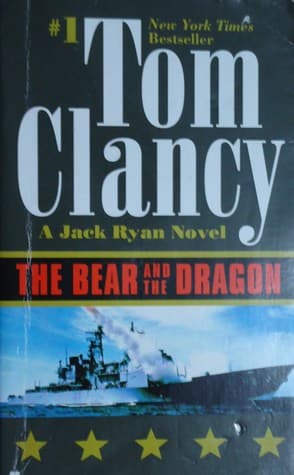
Synopsis
Covers the whole plot, including the ending.
- Difficulty
- Hard
- Pacing
- Variable
- Mood
- Suspenseful, Geopolitical, Action-packed, Detailed
- Read it if
- You enjoy geopolitical thrillers with intricate military details, espionage, and a large cast of characters, focusing on a fictionalized near-future conflict between major world powers.
- Skip it if
- You prefer character-driven stories over plot-heavy narratives, or find extensive military and political procedural details tedious.
The Bear and the Dragon Plot Summary
Covers the whole plot, including the ending.
Assassination Attempt in Moscow
The novel opens with an assassination attempt in Moscow on Sergey Golovko, the chairman of Russia's Foreign Intelligence Service (SVR), using a rocket-propelled grenade. Golovko survives with injuries, immediately alarming Moscow and Washington. President Jack Ryan, recently elected, learns of the attack and its potential impact on global stability, given Russia's unstable political situation. Ryan sends his black ops specialist, John Clark, and his protégé, Domingo 'Ding' Chavez, to Russia to quietly investigate the attack and find the perpetrators and their motives, suspecting it might be more than just internal Russian conflict.
Chinese Economic Troubles and Expansionist Plans
At the same time, China faces a severe economic crisis. Decades of rapid, unsustainable growth have led to widespread unemployment, social unrest, and a looming financial collapse. The Chinese Politburo, led by Chairman Zhang Han San, desperately seeks a solution to maintain power and prevent internal rebellion. Zhang and his hardline group propose a bold plan: a full-scale invasion and annexation of Siberia, rich in natural resources, especially oil and gas. They believe this will solve their economic problems and secure China's future as a global superpower, despite the immense risks of provoking Russia and the international community.
Clark and Ding's Investigation in Russia
John Clark and Ding Chavez arrive in Moscow and begin their covert investigation. They navigate the complex and often dangerous world of Russian intelligence and organized crime. Through contacts and careful detective work, they discover that the assassination attempt on Golovko was not an internal Russian affair, but was planned by Chinese intelligence agents working with parts of the Russian mafia. This discovery points to a much larger, more sinister plot than initially suspected, suggesting China is actively destabilizing Russia for its own strategic gains, though the full extent of their plan remains hidden.
The Siberian Incursion Begins
Under the guise of a large military exercise, China launches a quick and brutal invasion of Siberia. Millions of People's Liberation Army (PLA) troops cross the sparsely defended border, overwhelming Russian garrisons and seizing critical infrastructure. The scale and speed of the invasion surprise Russia and the world. The Chinese leadership, believing the West will be too busy with its own problems and too cautious to confront a nuclear-armed China, moves quickly to secure its gains, presenting the world with a done deal. The invasion significantly increases international tensions.
Ryan's Diplomatic Response and Military Buildup
Upon learning of the Chinese invasion, President Ryan calls an emergency meeting of his national security team. Recognizing the huge threat to global stability and the violation of international law, Ryan immediately condemns China's actions and begins to gather international support for Russia. He orders a rapid deployment of US forces, including naval and air assets, to the Pacific region and Europe to deter further Chinese aggression and to signal a willingness to intervene. Ryan also starts diplomatic efforts to unite NATO and other allies against China, while offering strategic and logistical aid to Russia.
Russian Resistance and US Aid
Despite being initially overwhelmed, Russian forces, under General Bondarenko, begin to organize strong resistance against the Chinese invaders. Siberia's vastness and harsh winter conditions pose significant challenges for the PLA. The US, through Clark and Ding's team on the ground and various intelligence assets, provides critical intelligence, supplies, and strategic advice to the Russians. US special operations forces, including Clark and Ding, engage in covert actions to disrupt Chinese logistics and command, while US airpower, operating from bases in Alaska, begins to provide reconnaissance and limited air support.
The Pope's Intervention and International Pressure
In a bold and unprecedented move, Pope John Paul II travels to China, despite the ongoing conflict and the Chinese government's strong opposition to religious freedom. His visit is a powerful moral statement against the invasion and the human rights abuses committed by the PLA. The Pope's presence draws immense international media attention, putting more pressure on the Chinese leadership. While his direct influence on the military conflict is limited, his moral authority and global appeal increase international condemnation of China's actions, making it harder for the Politburo to control its narrative and global perception of the war.
The Battle for Siberia Intensifies
The war in Siberia intensifies, becoming a brutal, large-scale conflict. The PLA, despite having more soldiers, faces strong resistance from the Russians, who are fighting on their home soil with US intelligence and special forces support. Major battles erupt across the vast Siberian landscape, marked by heavy casualties and the devastating use of modern weapons. The Chinese leadership, increasingly frustrated by the lack of a decisive victory and growing domestic unrest, considers even more desperate measures, raising fears of potential nuclear escalation as the conflict threatens to spin out of control.
Internal Chinese Dissension and Coup Attempt
As the war continues and casualties mount, dissent grows within the Chinese Politburo and military leadership. The economic benefits promised by Chairman Zhang have not appeared, and international isolation is crippling China. A group led by senior military and political figures, unhappy with Zhang's reckless actions, stages a coup attempt. The coup is led by General Tan Deshi, a pragmatic general who believes Zhang's actions are leading China to ruin. The internal power struggle in Beijing creates more chaos and uncertainty, significantly affecting the command and control of PLA forces in Siberia.
The Resolution and Aftermath
The coup against Chairman Zhang Han San succeeds, though with significant internal conflict and bloodshed in Beijing. General Tan Deshi takes control, immediately ordering a ceasefire and the withdrawal of all Chinese forces from Siberia. The war ends, but at a huge cost in lives and resources for all sides. The international community breathes a sigh of relief. President Ryan works with the new Chinese leadership to reduce tensions and begin the long process of rebuilding international relations, though the scars of the conflict, especially for Russia and China, will likely last for generations.
The Bear and the Dragon Characters
Jack Ryan
Protagonist
President of the United States, facing unprecedented global challenges.
Jack Ryan is the newly elected President of the United States. A former history professor, intelligence analyst, and Vice President, Ryan is known for his integrity, intellect, and pragmatic approach to foreign policy. He is a family man who reluctantly embraces the immense responsibilities of the presidency. Throughout the crisis, Ryan demonstrates calm leadership, strategic thinking, and a firm commitment to international law and human rights, balancing diplomatic efforts with the necessary show of military strength.
Relationships: Cathy Ryan (Wife, provides personal support); John Clark (Trusted black ops operative, relies on for covert action); Scott Adler (Secretary of State, key diplomatic advisor)
John Clark
Supporting
Veteran black ops specialist, leading covert operations in Russia and Siberia.
John Clark, born John Kelly, is a seasoned CIA black operations officer. Ruthless, highly skilled, and fiercely loyal to Jack Ryan, Clark is an expert in covert intelligence gathering, infiltration, and combat. He operates in the shadows, often undertaking the most dangerous missions. His experience and resourcefulness are crucial in uncovering Chinese involvement in the Moscow assassination attempt and in providing direct support to Russian resistance fighters in Siberia, often working outside conventional military channels.
Relationships: Jack Ryan (Trusted subordinate, executes Ryan's sensitive directives); Domingo Chavez (Protégé and partner in the field); Sergey Golovko (Counterpart in Russian intelligence, uneasy alliance)
Domingo 'Ding' Chavez
Supporting
Elite special forces operative, working alongside John Clark.
Domingo Chavez is a highly skilled former US Army Ranger and CIA operative, now working directly with John Clark. He is proficient in languages, close-quarters combat, and reconnaissance. Ding often acts as Clark's eyes and ears on the ground, providing tactical expertise and executing critical missions. His calm demeanor under pressure and his ability to quickly assess and adapt to dangerous situations make him an indispensable asset in the covert operations in Russia and Siberia, often leading small teams behind enemy lines.
Relationships: John Clark (Mentor and field partner); Patsy Clark (Wife (John Clark's daughter))
Sergey Golovko
Supporting
Chairman of Russia's Foreign Intelligence Service (SVR), target of an assassination attempt.
Sergey Golovko is the shrewd and experienced chairman of the SVR, Russia's equivalent of the CIA. A professional intelligence officer, Golovko is a pragmatic patriot who recognizes the need for cooperation with the West, particularly the United States, in times of crisis. He survives an assassination attempt early in the novel, which sets off the main plot. Despite his injuries, he plays a crucial role in coordinating Russian intelligence efforts and fostering an uneasy but necessary alliance with the US against the Chinese threat.
Relationships: Jack Ryan (Strategic ally, shares intelligence and objectives); John Clark (Uneasy but necessary field-level cooperation)
Zhang Han San
Antagonist
Hardline Chairman of the Chinese Politburo, orchestrating the Siberian invasion.
Zhang Han San is the ambitious and ruthless Chairman of the Chinese Politburo. Driven by a desire to secure China's future and his own political power, he is the architect of the plan to invade Siberia. Zhang believes that China's economic woes can only be solved through expansion and the acquisition of natural resources, regardless of the human cost or international consequences. He represents the hardline, authoritarian faction within the Chinese Communist Party, and his hubris ultimately leads to his downfall.
Relationships: General Tan Deshi (Military subordinate who eventually leads a coup against him)
General Tan Deshi
Supporting
Pragmatic Chinese general who leads a coup against Chairman Zhang.
General Tan Deshi is a high-ranking officer in the People's Liberation Army and a member of the Chinese Politburo. Initially complicit in the invasion plans, Tan becomes increasingly disillusioned with Chairman Zhang's reckless leadership as the war in Siberia falters and China faces international isolation and internal unrest. He is a pragmatist who prioritizes the long-term stability and well-being of China over ideological dogma. Tan eventually leads the coup that unseats Zhang, bringing an end to the conflict.
Relationships: Zhang Han San (Subordinate who eventually overthrows him); Other Politburo Members (Allies in the coup)
Father Pat West
Supporting
American Jesuit priest serving as the Pope's personal secretary.
Father Pat West is the personal secretary to Pope John Paul II. A dedicated and intelligent priest, he is deeply involved in the Pope's diplomatic and humanitarian efforts. He accompanies the Pope on his unprecedented and dangerous trip to China, serving as a trusted advisor and confidant. West is instrumental in facilitating communications and ensuring the Pope's safety during this high-stakes mission, providing a moral counterpoint to the geopolitical machinations of the secular leaders.
Relationships: Pope John Paul II (Confidant and personal secretary)
Pope John Paul II
Supporting
Head of the Catholic Church, who makes a daring visit to China.
The Pope, identified as John Paul II, is a figure of immense moral authority and global influence. Despite his advanced age and declining health, he undertakes a perilous journey to China in the midst of the Siberian invasion. His visit is a powerful act of moral witness, aimed at promoting peace, human rights, and religious freedom, and implicitly condemning China's aggression. His presence significantly amplifies international pressure on the Chinese government, demonstrating the power of spiritual leadership in secular conflicts.
Relationships: Father Pat West (Personal secretary and trusted aide)
The Bear and the Dragon Themes
The Perils of Unchecked Ambition and Authoritarianism
The novel clearly shows how the unchecked ambition of an authoritarian regime, particularly Chairman Zhang Han San's China, can lead to terrible outcomes. Zhang's desire to keep power and solve economic problems through military expansion shows the dangers of prioritizing nationalistic goals over human lives and international law. The story shows the internal dissent and eventual collapse that such ambition can cause, as seen in the coup against Zhang when his plans fail and bring China to the edge of ruin. This theme is central to the conflict, demonstrating that even powerful nations face consequences for their pride.
“History has many lessons, but the most frequently ignored is that one cannot indefinitely suppress the will of a people.”
The Interconnectedness of Global Politics and Economics
The plot is driven by the complex links between geopolitical events and economic realities. China's economic crisis directly causes its decision to invade Siberia, showing how domestic issues can lead to international conflict. President Ryan's administration constantly deals with the economic effects of the war, understanding that a global conflict would have devastating financial consequences beyond the immediate battlefields. The interconnectedness also extends to intelligence, as the assassination attempt in Moscow is revealed to be part of a larger Chinese strategy, demonstrating that seemingly isolated events are often linked in a complex global web.
“A nation's economy is not a thing apart from its foreign policy. Indeed, it often drives it.”
The Power of Moral Authority and Diplomacy
While military force is central to the thriller genre, the novel also highlights the important role of moral authority and diplomacy in solving international crises. President Ryan consistently seeks diplomatic solutions and builds international agreement against China, rather than immediately going to war. Most notably, Pope John Paul II's brave visit to China, despite the dangers, serves as a powerful moral statement that mobilizes international opinion and puts immense pressure on the Chinese leadership. This shows that non-military interventions, driven by ethical considerations, can significantly influence the outcome of large-scale conflicts, offering an an alternative to pure power politics.
“Sometimes, the strongest weapons are not made of steel, but of conviction.”
The Role of Covert Operations and Intelligence
The story relies heavily on effective intelligence gathering and covert operations. John Clark and Ding Chavez's investigation into the Moscow assassination attempt is important for uncovering China's true intentions, giving the US vital early warnings. Throughout the Siberian conflict, their special operations provide critical support to Russian forces, disrupting Chinese logistics and command structures behind enemy lines. This theme shows how intelligence and discreet actions, often unseen by the public, can significantly influence the course of major international events and provide options beyond conventional warfare.
“Information is not just power, Mr. President. It is survival.”
Plot Devices & Literary Techniques
The MacGuffin (Siberian Resources)
The valuable natural resources of Siberia act as the primary catalyst for the Chinese invasion.
The vast, untapped natural resources of Siberia, particularly oil and gas, serve as the primary MacGuffin in 'The Bear and the Dragon.' These resources are the driving force behind China's audacious invasion plan. While the specific details of these resources are less important than their existence, they provide the compelling motivation for Chairman Zhang Han San's desperate gamble. The MacGuffin effectively sets the entire plot in motion, creating the central conflict and justifying the extreme measures taken by the Chinese government to secure them, thus propelling the narrative forward.
Ticking Clock
The rapid advance of the Chinese invasion and the looming threat of nuclear escalation create constant urgency.
A pervasive ticking clock device is employed throughout the novel, creating intense suspense. From the initial swiftness of the Chinese invasion of Siberia, which presents the world with a fait accompli, to the escalating casualties and the dwindling time for diplomatic solutions, the narrative maintains a sense of urgency. The most critical ticking clock is the increasing likelihood of China or Russia resorting to tactical nuclear weapons as the conventional war grinds on. This constant pressure on Jack Ryan and other leaders to act quickly and decisively keeps the stakes incredibly high and the reader engaged.
The Unreliable Ally
Russia, while an ally against China, remains a complex and sometimes unpredictable partner for the US.
Russia functions as an unreliable ally throughout the conflict. While the US and Russia share a common enemy in China's aggression, their historical animosity and differing geopolitical interests create friction. Jack Ryan must constantly manage this delicate alliance, providing aid and intelligence without fully trusting Russia's long-term intentions or internal stability. This device adds layers of complexity to the international dynamics, as the US cannot fully commit to a partnership without considering potential betrayals or shifts in Russian policy once the immediate threat is contained, complicating the strategic decisions Ryan faces.
Deus ex Machina (Pope's Intervention)
The Pope's unexpected trip to China provides a critical moral and political turning point.
The Pope's decision to travel to China, an unprecedented and highly risky move, functions somewhat as a Deus ex Machina. While not directly resolving the military conflict, his presence significantly alters the political landscape and international pressure on the Chinese government. His moral authority and global media attention make it impossible for China to ignore the ethical implications of its actions, contributing to the internal dissent that ultimately leads to the coup. This intervention, while plausible within the narrative's established world, provides a sudden and powerful shift in the non-military aspect of the conflict's resolution.
The Bear and the Dragon Quotes
“The problem with socialism is that you eventually run out of other people's money.”
“The greatest enemy of a good plan is the dream of a perfect plan.”
“Democracy is two wolves and a lamb voting on what to have for lunch. Liberty is a well-armed lamb contesting the vote.”
“The trick to being a good leader is not to be perfect, but to be able to admit your mistakes.”
“Power is never given; it is taken.”
“Sometimes the only way to make things right is to do something wrong.”
“Fear is a great motivator, but a terrible master.”
“The most dangerous weapon is the one you don't know your enemy has.”
“Diplomacy is the art of letting someone else have your way.”
“History is not a burden but a lesson.”
“Every nation has its own internal logic, and it's rarely the same as yours.”
“The truth is a highly overrated commodity in politics.”
“The greatest strength of a free society is its ability to correct its own mistakes.”
“Never underestimate the predictability of stupidity.”
Quiz
10 questions on the plot and the characters. Each answer comes with a short explanation.
Question 1
What significant event occurs in Moscow at the beginning of the novel that prompts President Ryan's concern?
- A major economic summit collapses due to internal disputes.
- The chairman of the SVR (former KGB) is targeted with a rocket-propelled grenade.
- A high-ranking Russian general defects to the United States.
- A massive protest erupts in Red Square, threatening government stability.
Show answer
B. The chairman of the SVR (former KGB) is targeted with a rocket-propelled grenade. The assassination attempt on the chairman of the SVR with a rocket-propelled grenade in Moscow is the initial major incident that draws President Ryan's attention.
Question 2
Who is dispatched by President Ryan to investigate the events unfolding in Russia?
- Secretary of State, Scott Adler
- National Security Advisor, Robert Jackson
- Black ops specialist, John Clark
- CIA Director, Mary Pat Foley
Show answer
C. Black ops specialist, John Clark President Ryan dispatches his most trusted eyes and ears, including black ops specialist John Clark, to uncover the truth in Russia.
Question 3
What is one of the domestic challenges Jack Ryan faces as President, as mentioned in the synopsis?
- A severe energy crisis across the United States.
- Widespread labor strikes demanding higher wages.
- Significant political opposition to his healthcare reforms.
- Domestic pitfalls await him at every turn.
Show answer
D. Domestic pitfalls await him at every turn. The synopsis states that 'domestic pitfalls await him at every turn,' indicating general internal challenges for President Ryan.
Question 4
Beyond the Russian incident, what other international crisis is mentioned that President Ryan is dealing with?
- A coup d'état in Venezuela.
- A revolution in Liberia.
- Tensions escalating in the Balkans.
- A new nuclear proliferation crisis in North Korea.
Show answer
B. A revolution in Liberia. The synopsis explicitly mentions 'there's a revolution in Liberia' as another international issue President Ryan is confronting.
Question 5
What is the primary concern regarding the Asian economy mentioned in the book's premise?
- It is experiencing unprecedented growth, causing global inflation.
- It is going down the tubes, indicating a significant downturn.
- It is being manipulated by a single powerful corporation.
- It is becoming overly reliant on Western markets.
Show answer
B. It is going down the tubes, indicating a significant downturn. The synopsis states that 'the Asian economy is going down the tubes,' highlighting a major economic crisis in the region.
Question 6
What entity is described as moving ahead with a 'plan of truly audacious proportions' that could drastically change the world?
- A powerful global terrorist organization.
- Forces in China.
- A rogue faction within the Russian military.
- An international consortium of corrupt billionaires.
Show answer
B. Forces in China. The synopsis reveals that 'forces in China are moving ahead with a plan of truly audacious proportions,' which is the central conflict of the story.
Question 7
What is the role of Jack Ryan in the novel?
- He is the newly appointed Director of the CIA.
- He is a covert intelligence operative embedded in Russia.
- He is the newly elected President of the United States.
- He is a retired analyst called back into service.
Show answer
C. He is the newly elected President of the United States. The synopsis clearly states, 'Newly elected in his own right, Jack Ryan has found that being President has gotten no easier.'
Question 8
What historical organization is the SVR identified as the 'former' version of?
- The GRU
- The Stasi
- The KGB
- The NKVD
Show answer
C. The KGB The synopsis explicitly states, 'the chairman of the SVR--the former KGB'.
Question 9
What characteristic is highlighted as a hallmark of Tom Clancy's novels, alongside intricate plotting and suspense?
- Deep philosophical discussions.
- Exceptional realism and authenticity.
- Extensive romantic subplots.
- Humorous satire of political figures.
Show answer
B. Exceptional realism and authenticity. The description praises Clancy for 'Blending the exceptional realism and authenticity that are his hallmarks with intricate plotting, razor-sharp suspense...'
Question 10
What is the ultimate consequence if the 'audacious plan' by forces in China fails?
- A minor diplomatic incident with the United States.
- The world as we know it will be slightly inconvenienced.
- The consequences will be unspeakable.
- A temporary economic recession for Asian countries.
Show answer
C. The consequences will be unspeakable. The synopsis dramatically states, 'If they fail...the consequences will be unspeakable,' emphasizing the high stakes.
The Bear and the Dragon FAQ
What is the central conflict that President Jack Ryan faces at the beginning of 'The Bear and the Dragon'?
President Jack Ryan is immediately confronted with a potential assassination attempt on the chairman of the SVR in Moscow, Anatoliy Golovko, using a rocket-propelled grenade. This incident destabilizes Russia and forces Ryan to consider the identities and motives of the assassins, ranging from political enemies to disaffected former KGB, while simultaneously dealing with domestic issues and a revolution in Liberia.
Who are the primary antagonists driving the overarching plot against the United States and Russia?
The primary antagonists are the hardline faction within the Chinese Politburo, specifically men like Fang Gan and Zhang Han San, who orchestrate a plan to invade Siberia for its natural resources. Their ambition to expand China's territory and influence, coupled with a severe economic downturn, fuels their aggressive strategy.
How does the economic situation in China contribute to the conflict described in the book?
China's severe economic downturn and dwindling natural resources, particularly oil, are the primary motivators for the Politburo's decision to invade Siberia. The leadership believes that acquiring Russia's vast natural wealth is the only way to prevent widespread civil unrest and maintain their power, directly leading to the large-scale military conflict.
What is the role of John Clark and Ding Chavez in the early stages of the investigation into the Moscow assassination attempt?
John Clark and Ding Chavez are dispatched by President Ryan to Moscow to investigate the assassination attempt on Anatoliy Golovko. They work with Russian intelligence to uncover the truth, initially focusing on internal Russian factions, but eventually identifying a deeper, more international conspiracy involving Chinese agents.
How does the book explore the concept of information warfare and intelligence gathering?
The book extensively showcases information warfare through the meticulous gathering and analysis of intelligence by the CIA and SVR. Characters like Mary Patricia Foley and Ed Foley utilize signals intelligence, human intelligence, and satellite imagery to piece together China's intentions, highlighting the critical role of accurate and timely information in preventing and responding to global crises.
What is the significance of the character of Father Gerry in the overall narrative?
Father Gerry, an American priest working in China, plays a crucial role as an unwitting, yet brave, source of critical intelligence. His observations of unusual military movements and his subsequent communications, though initially dismissed, eventually provide key corroborating evidence that alerts the West to China's impending invasion of Siberia.
How does the novel subtly foreshadow the Chinese invasion of Siberia before it is explicitly revealed?
The novel subtly foreshadows the invasion through several details: discussions about China's dwindling resources and economic problems, intelligence reports of unusual Chinese military exercises near the Russian border, and the seemingly unrelated assassination attempt in Moscow designed to destabilize Russia, all pointing to a larger strategic play.
What is the true purpose behind the assassination attempt on Anatoliy Golovko, the chairman of the SVR?
The assassination attempt on Anatoliy Golovko was orchestrated by Chinese intelligence to create instability and distrust within Russia, specifically targeting the SVR's leadership. The goal was to distract and weaken Russia's internal security apparatus, making it less capable of responding effectively when China launched its invasion of Siberia.
How does Tom Clancy integrate technological advancements and their implications into the plot?
Clancy integrates technological advancements through detailed descriptions of military hardware, intelligence gathering tools, and communication systems. The use of advanced satellite reconnaissance, secure communication channels, and modern weaponry, such as guided missiles and stealth aircraft, is central to both the conflict and the West's ability to counter the Chinese threat.
Analyze Jack Ryan's leadership style under extreme pressure in 'The Bear and the Dragon'.
Jack Ryan demonstrates a decisive yet deliberative leadership style, prioritizing intelligence analysis and diplomatic solutions while preparing for military intervention. He relies heavily on his trusted advisors, maintains a calm demeanor even in crisis, and exhibits a strong moral compass, always seeking to minimize casualties and avoid escalation if possible, but willing to act forcefully when necessary.
How does the novel explore the psychological toll of high-stakes decision-making on characters like President Ryan?
The novel portrays the immense psychological toll on President Ryan through his internal monologues and interactions, showcasing the weight of making decisions that could lead to global war. He grapples with the moral implications of military action, the responsibility for countless lives, and the constant pressure to interpret ambiguous intelligence correctly, often sacrificing sleep and personal comfort.
Discuss the psychological motivations of the Chinese hardliners, such as Fang Gan, for initiating such a risky invasion.
The Chinese hardliners are driven by a combination of nationalistic pride, fear of internal collapse due to economic hardship, and a deep-seated belief in China's historical right to regional dominance. Their motivations are rooted in a desperate attempt to maintain political power and prevent a perceived national humiliation, even at the cost of massive human suffering and global conflict.
What psychological impact does the civilian reporting of the Chinese invasion have on the global perception of the conflict?
The civilian reporting, particularly from Father Gerry, has a profound psychological impact by humanizing the conflict and providing irrefutable, eyewitness accounts that bypass official state censorship. This unfiltered information shocks the international community, galvanizes public opinion against China, and pressures governments to take decisive action, exposing the brutality of the invasion.
How does the book portray the ethical dilemmas faced by intelligence operatives like John Clark and Ding Chavez?
John Clark and Ding Chavez frequently face ethical dilemmas concerning the use of force, deception, and operating outside traditional legal frameworks to achieve strategic objectives. They must balance their orders with their own moral compass, making difficult decisions in morally ambiguous situations where the greater good often requires morally questionable actions, highlighting the 'dirty' nature of their work.
To what extent does 'The Bear and the Dragon' reflect or deviate from real-world geopolitical tensions of its time?
'The Bear and the Dragon' reflects late 20th/early 21st-century geopolitical tensions by focusing on rising Chinese power, Russian instability, and the enduring threat of global conflict over resources. While the specific invasion scenario is fictional, it taps into real anxieties about economic competition, authoritarian expansionism, and the potential for a new Cold War-like confrontation.
Is the ultimate resolution of the conflict in the book realistic, given the scale of the war?
The ultimate resolution, involving a combination of military defeat for China and internal political upheaval, is debatable in its realism. While the concept of internal dissent and military overextension is plausible, the swiftness of China's collapse and the relatively clean political transition might be seen as overly optimistic for a conflict of such immense scale and potential for protracted resistance.
How does the novel's depiction of a united US-Russian front against China challenge traditional Cold War narratives?
The novel's depiction of a united US-Russian front against China fundamentally challenges traditional Cold War narratives by portraying former adversaries as allies against a new, common threat. This alliance signifies a shift in global power dynamics and suggests that geopolitical alignments are fluid, capable of adapting to emerging threats rather than being fixed by historical animosities.
What is the enduring message or warning that Tom Clancy might be conveying through 'The Bear and the Dragon'?
Tom Clancy's enduring message seems to be a warning about the dangers of unchecked authoritarian ambition, resource scarcity leading to conflict, and the critical importance of robust intelligence and international cooperation. He emphasizes that even in a post-Cold War world, new threats can emerge rapidly, requiring vigilance, strong leadership, and a willingness to defend democratic values.
How does the book's title, 'The Bear and the Dragon,' symbolize the core conflict and alliances?
The title 'The Bear and the Dragon' symbolizes the core conflict by representing Russia (the Bear) and China (the Dragon). Initially, it hints at potential conflict between these two powers, but ultimately, it highlights their historical rivalry and the unexpected alliance that forms when Russia is attacked by China, forcing the 'Bear' to defend its territory against the 'Dragon's' aggression, with the US acting as a crucial third party.
About the author

Tom Clancy was an American author known for his military and espionage-themed novels. His notable works include The Hunt for Red October, Patriot Games, Clear and Present Danger, Red Storm Rising, Rainbow Six, and Executive Orders, which often feature intricate plots and detailed technical descriptions. Clancy's writing has significantly influenced the genre of techno-thrillers.
Similar books
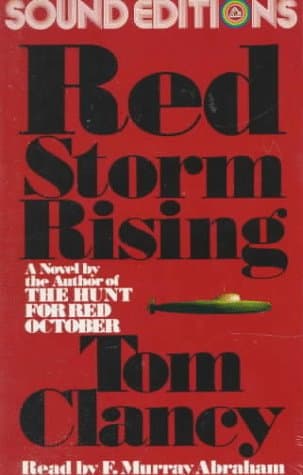
- Red Storm Rising
Tom Clancy
4.2 (70k) average on GoodreadsThrillerAnother large-scale military thriller depicting a conventional war between superpowers, rich in technical detail.
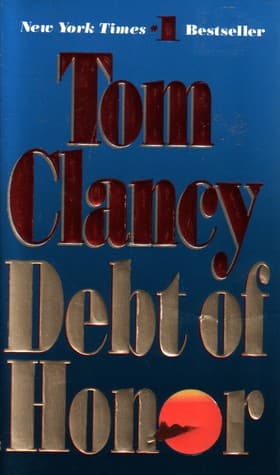
- Debt of Honor
Tom Clancy
4.0 (45k) average on GoodreadsThrillerFeatures Jack Ryan as President dealing with international crises and military conflicts, with a focus on geopolitical tensions.
- Angels & Demons
Dan Brown
3.9 (2.7M) average on GoodreadsThrillerA Harvard symbologist races through Rome's ancient sites, deciphering cryptic clues to unmask the Illuminati and stop a vengeful plot to destroy the Vatican with a stolen antimatter weapon.
- Gone Girl
Gillian Flynn
4.1 (2.3M) average on GoodreadsThrillerA wife's sudden disappearance on her fifth anniversary reveals a web of lies and psychological warfare, exposing the secrets within a seemingly perfect marriage.
- The Girl on the Train
Paula Hawkins
3.9 (2.1M) average on GoodreadsThrillerA woman’s fascination with a seemingly perfect couple she watches from her daily train commute leads her into a dark investigation when she witnesses something that shatters their idyllic image.
- The Da Vinci Code
Dan Brown
3.9 (1.9M) average on GoodreadsThrillerA symbologist and a cryptologist race through European landmarks, deciphering ancient codes and uncovering a conspiracy that could rewrite the foundations of Christianity.




Enjoyed the summary?
A summary gives you the shape of the book. The book itself has the detail, the examples and the voice.
Find The Bear and the Dragon on AmazonAs an Amazon Associate, BookBrief earns from qualifying purchases. How we're funded