
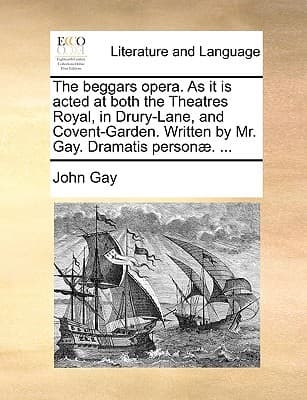
Synopsis
Covers the whole plot, including the ending.
- Difficulty
- Medium
- Pacing
- Fast
- Mood
- Satirical, Witty, Cynical, Amusing
- Read it if
- You enjoy satirical comedies, plays with music (ballad opera), or a critical look at 18th-century English society and politics.
- Skip it if
- You prefer straightforward dramas, complex character development over social commentary, or are averse to dark humor.
The Beggars Opera Plot Summary
Covers the whole plot, including the ending.
Peachum's Operations and Polly's Secret
The opera begins in Peachum's house. He is listing his gang's earnings from crimes. He worries about the risks of their job, especially that his associates might become informers. He is a cynical man, focused more on profit and survival than on morals. His wife, Mrs. Peachum, joins him, and they talk about their daughter, Polly. Mrs. Peachum worries Polly is too naive and might fall for a man, naming Captain Macheath. Peachum is horrified at the idea of Polly marrying a man who could be hanged, losing his valuable asset. Unknown to them, Polly has already secretly married Macheath, a fact she tells the audience aside.
Parental Outrage and Macheath's Arrival
Polly, after telling the audience about her marriage, confronts her parents. They are furious when they hear the truth. Peachum and Mrs. Peachum see the marriage as a financial disaster, as Macheath's money would be tied up and possibly lost. They immediately plan to have Macheath arrested and executed. They believe that if he is hanged, Polly, as his widow, would inherit his estate, which they could then control. Their cold planning shows their mercenary nature. Macheath, unaware of their plots, arrives to visit Polly, expressing his love for her and hopes for their future, not knowing the danger from his new in-laws.
Polly's Dilemma and Macheath's Escape
Polly, torn between her love for Macheath and her parents, warns Macheath of the plot against him. She urges him to run, which he reluctantly does, promising to return for her. Soon after, Macheath finds himself in a tavern with women of ill repute, including Lucy Lockit, daughter of the Newgate Prison jailer, and other women from his past. Despite his recent marriage, Macheath flirts and sings to these women. Unknown to him, this gathering is a trap set by Peachum and Lockit. The women, jealous and wanting a reward, help capture him, leading to his arrest and imprisonment in Newgate.
Lucy's Jealousy and Macheath's Imprisonment
Macheath is brought to Newgate Prison, run by the corrupt jailer, Lockit. There, he meets Lucy Lockit, who is enraged to find he married Polly Peachum. Lucy believes Macheath promised to marry her and sees Polly as a rival. She expresses her fury and feeling of betrayal, showing the complex state of Macheath's love life. Macheath, always charming, tries to calm Lucy, denying his marriage to Polly and trying to win her back. He is good at manipulating women, but his lies only make his situation worse, as Lucy's jealousy becomes a threat to his freedom and life.
Polly and Lucy's Confrontation
Polly Peachum, heartbroken by Macheath's imprisonment, visits him in Newgate. Her arrival causes a furious fight with Lucy Lockit, who is still with Macheath. The two women argue bitterly, each claiming Macheath's love. Macheath, caught between them, tries to soothe both, showing his dishonest nature. He denies his marriage to Polly in front of Lucy, then, when Lucy is gone, tells Polly he loves her. This scene shows Macheath's lack of loyalty and his ability to change his affections to fit his immediate needs, further trapping him in his romantic web.
Macheath's Escape and Recapture
Despite her initial anger, Lucy Lockit, still having feelings for Macheath and perhaps swayed by his charm, helps him escape from Newgate Prison. She gives him the means to unlock his chains and flee, much to her father, Lockit's, annoyance. Lockit cares more about the financial loss of the escape. Macheath enjoys a short period of freedom, but his luck runs out. He is again betrayed and recaptured, this time by members of his own gang who want the reward for his arrest. He returns to Newgate, his situation worse than before, facing execution.
The Poisoning Attempt
With Macheath back in prison, the rivalry between Polly and Lucy grows. Lucy, consumed by jealousy and sure that Polly blocks her happiness with Macheath, tries to poison her. She offers Polly a poisoned drink, pretending to make up. However, Macheath, seeing the scene, steps in just in time, knocking the drink from Polly's hand. This moment shows the extreme measures Lucy will take to remove her rival and highlights the dangerous results of Macheath's unfaithfulness. The incident further complicates the relationships between the three characters, adding life-or-death stakes to their romantic triangle.
Peachum and Lockit's Treachery
While Macheath waits for his fate, Peachum and Lockit, partners in crime and corruption, start to distrust each other. Both are greedy and self-serving, seeing a chance to gain from the other's downfall. They make accusations and threats, each revealing the other's illegal dealings and planning to expose them. Their mutual betrayal shows the widespread corruption in the legal and criminal worlds. This subplot demonstrates that loyalty is fleeting in their world, and even close alliances break easily for money or self-preservation, mirroring Macheath's betrayals.
Macheath's Final Condemnation
Macheath is brought to court and sentenced to death. As he waits for execution, many women from his past appear, each claiming to be his wife and asserting their right to mourn him. This includes Polly, Lucy, Jenny Diver, Suky Tawdry, and others. Each woman presents her case, showing Macheath's many romantic relationships and broken promises. This scene emphasizes Macheath's promiscuous nature and the results of his actions. It also satirizes the sentimental parts of traditional opera where a hero usually has one true love. The number of his 'wives' makes his situation even more absurd.
The Play's Resolution and Moral
As Macheath prepares for execution, the Player and Beggar, who have been telling and commenting on the play, intervene. The Player argues that an opera must have a happy ending for its hero. He states that Macheath, despite his crimes, cannot die. Macheath is then pardoned and set free. He chooses to marry Polly, declaring his love for her. The Beggar, however, notes the lack of fair justice, suggesting that in real life, such a rogue would be hanged. This ending critiques the artificiality of opera and offers a cynical comment on justice and morality, implying that the wealthy and charming often escape consequences that affect the less fortunate.
Principal Figures
Macheath
Protagonist/Anti-hero
A charismatic and notorious highwayman, leader of a gang of thieves, and a serial philanderer.
Macheath is the central figure, a charming and audacious highwayman who embodies the rogue archetype. He is a man of action, unafraid of danger, and possesses a magnetic personality that attracts both loyalty from his gang and affection from numerous women. Despite his criminal profession, he maintains a certain dignity and often expresses sentiments of love and honor, albeit superficially. He is a master of manipulation, using his wit and charm to navigate perilous situations and to deceive those around him, especially his many lovers. His primary drives are freedom, wealth, and romantic conquests, often at the expense of others.
Relationships: Polly Peachum (Secret wife, object of his affection (at times), source of familial conflict); Lucy Lockit (Former lover, believes herself promised to him, jealous rival to Polly); Peachum (Father-in-law, adversary, plots his capture); Mrs. Peachum (Mother-in-law, adversary, plots his capture); Lockit (Jailer, Lucy's father, adversary, initially complicit in his capture); Jenny Diver (One of his many 'wives' and gang members)
Polly Peachum
Supporting
Peachum's daughter, secretly married to Macheath, and a figure of naive loyalty.
Polly is presented as initially innocent and deeply in love with Macheath, despite her parents' criminal background. She possesses a romantic sensibility that contrasts sharply with the cynicism of her family. Her loyalty to Macheath leads her to defy her parents and warn him of danger. However, she is also somewhat naive, failing to fully grasp the extent of Macheath's promiscuity until confronted by Lucy. She represents a more traditional, sentimental view of love, which is often satirized or undermined by the opera's cynical tone. Her primary drive is Macheath's safety and their marital bond.
Relationships: Macheath (Secret husband, object of her enduring love); Peachum (Father, manipulative and mercenary); Mrs. Peachum (Mother, manipulative and mercenary); Lucy Lockit (Rival for Macheath's affections)
Peachum
Antagonist
A cunning and avaricious fence, leader of a gang of thieves, and Polly's cynical father.
Peachum is a morally bankrupt character, a fence who profits from the crimes of others and is entirely driven by greed. He views his gang members as disposable assets and his daughter, Polly, as a commodity. He is meticulous in his criminal enterprise, calculating the value of betrayal and execution with cold precision. His cynical worldview extends to love and marriage, which he sees only through a financial lens. He is a master manipulator, always looking for an advantage, even against his own family and associates. His primary drive is accumulating wealth and maintaining control over his criminal network.
Relationships: Polly Peachum (Daughter, seen as a financial asset); Mrs. Peachum (Wife, partner in crime and cynicism); Macheath (Son-in-law, target of his schemes for financial gain); Lockit (Business partner, rival, and eventual enemy)
Lucy Lockit
Supporting
Daughter of the jailer Lockit, a former lover of Macheath, and Polly's jealous rival.
Lucy is a passionate and volatile character, driven by love, jealousy, and a sense of betrayal. She genuinely believes Macheath promised to marry her and is enraged by his marriage to Polly. Her emotions swing wildly from fury to tenderness, making her unpredictable and dangerous. She is not above violence, as shown by her attempt to poison Polly. Despite her anger, she still harbors feelings for Macheath, leading her to help him escape. Her character highlights the destructive power of unrequited love and jealousy in a world where moral boundaries are already blurred. Her primary drive is to secure Macheath's love and commitment.
Relationships: Macheath (Former lover, object of her intense affection and jealousy); Lockit (Father, jailer, whom she manipulates); Polly Peachum (Rival for Macheath's affections, target of her poisoning attempt)
Lockit
Supporting
The corrupt jailer of Newgate Prison and Lucy's father, a partner in crime with Peachum.
Lockit is Peachum's counterpart in the prison system, equally corrupt and self-serving. As the jailer, he holds significant power over the prisoners and uses his position to extract bribes and manipulate outcomes. He is as cynical and mercenary as Peachum, viewing justice as a commodity to be bought and sold. He is concerned with his reputation and finances, and his loyalty is entirely dependent on personal gain. He is initially allied with Peachum but eventually turns against him, revealing the pervasive treachery within their criminal world. His primary drive is financial profit and maintaining his corrupt authority.
Relationships: Lucy Lockit (Daughter, whom he tries to control but is also manipulated by); Peachum (Business partner, rival, and eventual enemy); Macheath (Prisoner, whom he profits from and tries to control)
Mrs. Peachum
Supporting
Peachum's equally cynical and calculating wife and Polly's mother.
Mrs. Peachum is a formidable and pragmatic woman, fully complicit in her husband's criminal activities and sharing his mercenary worldview. She is sharp-tongued, shrewd, and fiercely protective of her family's financial interests. She views Polly's marriage to Macheath as a disastrous financial mistake and actively participates in the plot to have him hanged for his money. She mirrors Peachum's cynicism regarding love and morality, seeing marriage as a transaction and loyalty as a weakness. Her primary drive is the financial well-being of her family, achieved through any means necessary.
Relationships: Peachum (Husband, partner in crime and cynicism); Polly Peachum (Daughter, whom she views as a means to an end); Macheath (Son-in-law, target of her schemes for financial gain)
The Beggar
Mentioned
The meta-fictional author of the opera, who introduces and comments on the play.
The Beggar is a meta-fictional character who appears at the beginning and end of the opera, establishing the play as his own creation. He provides a framework for the narrative, introducing the characters and commenting on the moral implications and conventions of the story. He serves as a voice for John Gay's satirical intent, often highlighting the absurdity of the plot and the hypocrisy of the characters. His presence underscores the opera's status as a critique of society and artistic conventions. He represents the authorial voice, guiding the audience's interpretation.
Relationships: The Player (Collaborator in presenting the opera)
The Player
Mentioned
A meta-fictional character who discusses the opera with the Beggar and ultimately intervenes in the plot.
The Player is another meta-fictional character who engages in a dialogue with the Beggar, discussing the nature of opera and the expectations of the audience. He represents the theatrical establishment and its conventions. It is the Player who, at the climax, insists that the hero, Macheath, cannot be allowed to die according to operatic tradition, thus forcing a happy (and ironic) ending. His intervention directly influences the plot, highlighting the artificiality of the dramatic form and satirizing the conventional morality often found in grand operas. He embodies the forces of theatrical convention.
Relationships: The Beggar (Collaborator in presenting the opera)
Jenny Diver
Supporting
One of Macheath's many 'wives' and a member of his gang, who contributes to his capture.
Jenny Diver is one of the women Macheath has entangled himself with, and like others, she is part of his criminal gang. She appears in the tavern scene, where she, along with other women, helps to betray Macheath for a reward. Her character further illustrates Macheath's extensive romantic conquests and the transactional nature of relationships within their criminal underworld. She is driven by self-interest and a desire for financial gain, willing to turn on her lover for profit. She represents the general amorality of the supporting characters.
Relationships: Macheath (Lover, whom she betrays); Other gang members (Associates in crime)
Themes & Insights
Corruption and Hypocrisy
The opera critiques corruption, suggesting that 'respectable' people like Peachum and Lockit are as criminal, if not more so, than the highwaymen they condemn. Peachum's business of informing on his own gang for profit, and Lockit's manipulation of justice in Newgate, show how the legal system itself is corrupt. The play blurs the lines between criminals and law enforcers, implying both are driven by greed and self-interest. The 'morality' shown by characters like Peachum is a thin cover for their greed, as seen when they plan Macheath's execution for his money while condemning his 'immorality.'
“A lawyer is an honest employment, so is mine. We are both for taking off the incumbrances of the law.”
Love and Betrayal
Love is shown as inconsistent and often about transactions, easily overshadowed by personal gain or jealousy. Macheath's many romantic ties with Polly, Lucy, and other women highlight his promiscuity and lack of real commitment. Polly's naive love for Macheath contrasts with her parents' cynical views, who see her marriage as a financial disaster. Lucy's love for Macheath quickly turns to vengeful jealousy, leading her to try murder. Betrayal is common, not only in Macheath's relationships but also among criminal associates like Peachum and Lockit, who easily turn on each other for profit. This suggests loyalty is rare in this world.
“How happy could I be with either, were t'other dear charmer away!”
Social Satire and Class
The opera satirizes 18th-century English society, especially its upper classes and politicians. By presenting criminals as heroes and heroines, and giving them the refined language and music of Italian opera, Gay mocks the pretentiousness and moral hypocrisy of the elite. The similarities between Peachum's criminal business and government ministers, or between Macheath's gang and political groups, are clear. The play suggests corruption is not just in lower society but throughout all levels, with the 'respectable' often being the most morally bankrupt, while the 'beggars' are simply more honest about their flaws.
“Through all the employments of life, Each neighbor abuses his brother; Whore and rogue they call husband and wife: All professions be-rogue one another.”
Artificiality of Art and Justice
The play's meta-theatrical parts, especially the Beggar and Player's intervention at the end, show the artificiality of dramatic rules and the often-unrealistic endings of traditional opera. By forcing a happy ending for Macheath, the play directly challenges the audience's expectation of fair justice. The Beggar's comment that 'in real life, a highwayman would be hanged' highlights the satirical point: justice is often random or manipulated, especially for those with charm or connections. This device critiques not only art's conventions but also the perceived 'justice' of the real world, where outcomes are rarely fair or logical.
“But, as the current of the Play has hitherto run pretty strongly for Macheath, that the historical impartiality of the Beggar might not be suspected, I must have him make an escape.”
Plot Devices & Literary Techniques
Meta-theatricality
The play self-consciously refers to itself as a play, with characters discussing its conventions and structure.
The opera employs meta-theatricality through the characters of the Beggar and the Player, who frame the narrative and comment on its progress. They appear at the beginning and end, discussing the 'rules' of opera and the audience's expectations. This device allows Gay to directly satirize the conventions of traditional Italian opera, such as the need for a happy ending for the hero, and to offer a commentary on the moral implications of the story. It breaks the fourth wall, reminding the audience that they are watching a performance and inviting them to critically engage with the themes and form of the work.
Parody and Satire
The opera uses the form and conventions of serious Italian opera to mock society, politics, and the genre itself.
John Gay uses parody by adopting the musical and dramatic structure of serious Italian opera (aria, recitative, and stock character types) but applies them to the low-life criminal underworld. This juxtaposition creates a satirical effect, as the 'noble' sentiments and elaborate musical forms are used to express the base desires and corrupt dealings of thieves and prostitutes. This device serves to mock the pretentiousness of Italian opera, while simultaneously satirizing the moral hypocrisy of contemporary English society, drawing parallels between criminals and the 'respectable' upper classes and politicians.
Juxtaposition of High and Low Culture
The opera places refined operatic forms alongside the crude realities of the criminal underworld.
This device is central to the opera's satirical power. By setting the story in the squalid world of highwaymen, fences, and jailers, and having these characters sing in the style of grand opera, Gay creates a stark and humorous contrast. The elegant arias and duets, typically associated with noble heroes and heroines, are performed by morally bankrupt characters discussing betrayal, theft, and execution. This juxtaposition highlights the moral decay of society, suggesting that the 'low' characters are merely more honest about their vices than their 'high' counterparts, and implicitly critiques the artificiality and moral blindness of high culture itself.
Dramatic Irony
The audience is often aware of information or character intentions that the characters themselves are not.
Dramatic irony is frequently used, particularly in Macheath's romantic entanglements and the plots against him. For example, the audience knows of Polly's secret marriage and her parents' plot to have Macheath hanged before Macheath himself does. Similarly, Macheath's attempts to charm and manipulate Lucy are ironic to the audience, who know of his marriage to Polly and his general philandering. This device enhances the satirical tone, allowing the audience to feel superior to the deluded characters and to appreciate the full extent of the hypocrisy and deception unfolding on stage.
The Beggars Opera Quotes
“Through all the employments of life, Each master of a trade, Some villainous, some honest, strives To make his fortune paid.”
“The wretch who starves, and steals to live, Hath my compassion and my pity.”
“How happy could I be with either, Were t'other dear charmer away!”
“A woman knows how to be a mother and a wife, but a man knows how to be a father and a husband.”
“If laws were made for every degree, To curb vice in the great as well as me, The poor man then would have as good a cause, As those in velvet gowns, and golden gauze.”
“The world is a pretty thing, and so are the women in it.”
“Money, wife, is the true source of happiness and content in this world.”
“When a man is in love, he is not himself.”
“The very best things in life are free.”
“Courage, brother, and be of good cheer.”
“I hope you will be more faithful to me than you have been to your other wives.”
“Our prisons are so full of rogues that an honest man can hardly find room.”
“To be hanged, drawn, and quartered, that's what I expect.”
“The greatest villains often make the best husbands.”
“The world, my dear, is a game of chance.”
Quiz
10 questions on the plot and the characters. Each answer comes with a short explanation.
Question 1
Which character serves as the 'hero' of 'The Beggar's Opera', despite being a highwayman?
- Peachum
- Macheath
- Lockit
- Filch
Show answer
B. Macheath Captain Macheath is the central figure, a dashing highwayman around whom the plot revolves, despite his criminal profession.
Question 2
What is the profession of Mr. Peachum, who opens the opera with a song about his business?
- A tavern owner
- A fence and informer
- A lawyer
- A prison warden
Show answer
B. A fence and informer Peachum's business is to buy stolen goods and inform on criminals to collect rewards, often choosing which of his associates to betray.
Question 3
Who is Polly Peachum secretly married to at the beginning of the opera?
- Filch
- Lockit
- Macheath
- Matt of the Mint
Show answer
C. Macheath Polly has secretly married Captain Macheath against her parents' wishes, setting off much of the opera's conflict.
Question 4
What is the primary satirical target of 'The Beggar's Opera'?
- The poverty of the working class
- The corruption of the government and upper classes
- The hypocrisy of religious institutions
- The rise of industrialism
Show answer
B. The corruption of the government and upper classes The opera uses the criminal underworld as a mirror to satirize the perceived corruption and moral decay of Walpole's government and the aristocracy.
Question 5
Which two characters are in a professional rivalry over the profits from informing on criminals, often comparing their honesty?
- Macheath and Filch
- Polly and Lucy
- Peachum and Lockit
- Mrs. Peachum and Mrs. Lockit
Show answer
C. Peachum and Lockit Peachum, the fence, and Lockit, the jailer, are rivals who both profit from the criminal underworld, constantly maneuvering against each other while claiming moral superiority.
Question 6
How does Macheath initially escape from prison after being captured?
- He bribes a guard.
- Polly helps him dig a tunnel.
- Lucy Lockit helps him escape out of love.
- His gang stages a violent breakout.
Show answer
C. Lucy Lockit helps him escape out of love. Lucy Lockit, the jailer's daughter, who is also in love with Macheath and believes herself married to him, assists in his escape.
Question 7
What is the ultimate fate of Macheath at the very end of the opera, according to the 'Player' and 'Beggar'?
- He is hanged.
- He is transported to the colonies.
- He is pardoned and celebrates with a dance.
- He runs off with Polly and Lucy.
Show answer
C. He is pardoned and celebrates with a dance. After much debate about a proper tragic ending, the 'Beggar' intervenes, stating that in an opera, the hero must be saved, and Macheath is pardoned and ends the play with a dance.
Question 8
The structure of 'The Beggar's Opera' is a ballad opera. What does this primarily mean for its musical numbers?
- All music is original compositions by John Gay.
- It features spoken dialogue interspersed with songs set to popular existing tunes.
- The music is entirely operatic arias in Italian style.
- It uses complex orchestral scores throughout without spoken parts.
Show answer
B. It features spoken dialogue interspersed with songs set to popular existing tunes. A ballad opera like 'The Beggar's Opera' is characterized by its use of spoken dialogue alternating with songs set to popular melodies, folk tunes, or well-known airs of the time.
Question 9
How does John Gay use the character of the 'Beggar' and 'Player' in the prologue and epilogue of the opera?
- To introduce the specific historical figures being satirized.
- To comment on the conventions of opera and drama itself.
- To provide moral lessons directly to the audience.
- To explain the political allegory in detail.
Show answer
B. To comment on the conventions of opera and drama itself. The 'Beggar' and 'Player' serve as a meta-theatrical device, discussing the writing and performance of the opera, satirizing the dramatic conventions of the day, particularly Italian opera.
Question 10
What is the significance of the multiple women (Polly, Lucy, and others) claiming to be married to Macheath?
- It highlights Macheath's charm and popularity among women.
- It satirizes the casualness of marriage vows among the lower classes.
- It reflects the general moral looseness of the criminal underworld, but also satirizes the marital scandals of the upper classes.
- It is a plot device to create sympathy for Macheath as a victim of circumstance.
Show answer
C. It reflects the general moral looseness of the criminal underworld, but also satirizes the marital scandals of the upper classes. Macheath's multiple 'wives' and romantic entanglements serve both to illustrate the chaotic morality of his world and to satirize the marital infidelities and scandals prevalent among the fashionable elite of the time.
The Beggars Opera FAQ
What is the central premise of 'The Beggar's Opera' and who are its main characters?
'The Beggar's Opera' satirizes Italian opera, contemporary politics, and the criminal underworld of London. It centers on Captain Macheath, a highwayman, and the two women who love him, Polly Peachum and Lucy Lockit, daughters of rival criminal masterminds.
How does the opera satirize traditional Italian opera conventions?
Gay uses ballad tunes instead of recitative and aria, and features low-life criminals and prostitutes as its 'heroes' and 'heroines,' directly contrasting with the noble figures and mythological plots common in serious Italian opera of the time. The exaggerated emotions and dramatic situations are also played for comedic effect.
What role do Mr. Peachum and Lockit play in the criminal underworld depicted?
Mr. Peachum is a 'receiver of stolen goods' and an informer, who profits by betraying his own gang members for rewards. Lockit is the jailer of Newgate Prison, who colludes with Peachum, sharing profits from informing and manipulating the justice system for their own gain.
How do Polly Peachum and Lucy Lockit complicate Macheath's life?
Polly secretly marries Macheath, incurring her father's wrath and disrupting his plans for her. Lucy, also secretly married to Macheath and pregnant with his child, becomes intensely jealous of Polly, leading to schemes to poison her and keep Macheath for herself, creating intense dramatic conflict.
What is the significance of the 'Player' and 'Beggar' framing device?
The 'Beggar' is presented as the author of the opera, claiming it's a 'Newgate pastoral,' while the 'Player' discusses its commercial viability and audience appeal. This meta-theatrical device allows Gay to comment on the nature of art, morality, and public taste directly.
Are there any subtle allusions to specific political figures or events of Gay's time within the characters or plot?
Many scholars interpret Peachum and Lockit as caricatures of Robert Walpole and Charles Townshend, powerful Whig politicians of the era, suggesting their corrupt practices and self-serving alliances mirrored those of the criminal underworld. Macheath's promiscuity and a tendency to evade justice also hinted at contemporary scandals.
What is the deeper meaning behind Macheath's constant escapes and recaptures?
Macheath's cycle of escape and recapture, often facilitated by corrupt officials like Lockit or the women in his life, highlights the pervasive corruption of the justice system and the arbitrary nature of 'justice' for the lower classes. It also underscores his roguish charm and luck, which are ultimately unsustainable.
How does the 'happy ending' for Macheath, where he is reprieved, function as a satirical element?
The sudden reprieve, decided by the Beggar and Player based on audience preference for a happy ending, is a biting satire on the artificiality of dramatic conventions and the desire for neat resolutions, even when morally unjust. It mocks the public's preference for escapism over moral accountability.
What psychological motivations drive Peachum's actions against Macheath and his own daughter, Polly?
Peachum is primarily driven by avarice and self-preservation. He views Polly's marriage to Macheath as a financial loss, as Macheath's execution would yield a reward, and he fears Macheath might expose his own criminal network. His 'love' for Polly is entirely transactional.
Analyze the differing psychological approaches to love and commitment exhibited by Polly Peachum and Lucy Lockit.
Polly embodies a more romantic and naive love, genuinely devoted to Macheath despite his flaws, willing to sacrifice for him. Lucy, while also in love, is driven by intense jealousy, possessiveness, and a desire for social legitimacy (as Macheath's 'true' wife), leading her to desperate and violent acts.
How does Macheath's character reflect the psychological complexities of a charismatic anti-hero?
Macheath is charming, brave, and seemingly devoted to multiple women, yet he is also a thief, a bigamist, and ultimately self-serving. His charisma allows him to manipulate others and escape consequences, illustrating how attractive traits can mask morally dubious actions, making him a complex and ambiguous figure.
What psychological insight does the 'gang' of women reveal about gender roles and power dynamics in this criminal world?
The 'gang' of women, Macheath's mistresses and associates, reveals their agency within a patriarchal criminal structure. They are often instrumental in Macheath's schemes and downfall, using their wits and sexual allure for survival and influence, highlighting their complex position between victimhood and active participation.
Is 'The Beggar's Opera' ultimately a moralistic play, or does it simply expose corruption without judgment?
While it exposes widespread corruption in politics and society, the opera leans more towards exposure and satire than explicit moralizing. It presents a world where vice is often rewarded, and virtue (like Polly's loyalty) is punished, leaving the audience to draw their own conclusions about the societal implications rather than offering clear judgments.
How does the opera challenge or reinforce traditional notions of heroism and villainy?
It subverts traditional notions by making a highwayman the 'hero' and respectable figures like Peachum and Lockit the true villains, due to their hypocrisy and exploitation. Macheath, despite his crimes, possesses a certain romantic appeal, blurring the lines between hero and villain and questioning societal definitions.
Could 'The Beggar's Opera' be interpreted as an early form of social commentary or protest theatre?
Absolutely. By directly satirizing the government, the legal system, and the upper classes through the lens of the criminal underworld, Gay's work functions as potent social commentary. It protests against corruption, hypocrisy, and the unjust distribution of power, making it a pioneering example of protest theatre.
What is the significance of the musical choices in conveying the opera's themes?
The use of popular ballad tunes, often associated with common folk and street life, immediately grounds the opera in a relatable, un-operatic world. These familiar melodies, when paired with new, often ironic lyrics about crime and corruption, enhance the satirical effect and make the social commentary more accessible and biting.
How does the ending, with Macheath's reprieve, reflect on the nature of justice and societal expectations?
The forced happy ending, where Macheath is saved from the gallows, critically comments on how justice is often arbitrary and influenced by public sentiment or political expediency rather than true moral rectitude. It satirizes the audience's desire for entertainment over ethical consistency, suggesting justice is often a performance.
What lasting impact did 'The Beggar's Opera' have on subsequent theatrical works?
It birthed the genre of 'ballad opera,' inspiring numerous imitations and proving that English-language musical theatre could be popular and critically successful. Its satirical edge, use of popular music, and focus on common characters paved the way for works like Brecht and Weill's 'The Threepenny Opera' and other forms of social satire in theatre.
About the author

John Gay was an English poet and playwright active in the early 18th century. He is best known for his satirical play "The Beggar's Opera," which critiques social and political issues of his time through a blend of humor and music. Gay's works often reflect his keen observations of society and its complexities.
Similar books
- The Threepenny Opera
Bertolt Brecht
4.0 (10k) average on GoodreadsFictionA 20th-century adaptation and modernization of 'The Beggar's Opera' with similar themes and characters.
- Gulliver's Travels
Jonathan Swift
3.6 (232k) average on GoodreadsFantasyA classic work of satire that uses fantastical journeys to critique English society and politics.
- Nineteen Eighty-Four
George Orwell
4.2 (5.5M) average on GoodreadsFictionWinston Smith dreams of truth and rebellion in a world where Big Brother watches all, but he confronts the terrifying power of a regime that controls not just actions, but thoughts.
- The Frozen River
Ariel Lawhon
4.4 (600k) average on GoodreadsFictionIn 1789 Maine, a heroic midwife's diary helps her expose a murder and get justice in a town that wants to silence her.
- A Man Called Ove
Fredrik Backman
4.4 (569k) average on GoodreadsFictionA stubborn widower, who lives by strict rules, finds his quiet world changed by a lively new family next door, making him face his past and find happiness in human connection.
- The Art of Racing in the Rain
Garth Stein
4.2 (452k) average on GoodreadsFictionThrough the eyes of Enzo, a wise and observant dog, a race car driver's family navigates a journey of love, loss, and resilience, learning that life's most important lessons often come in the curves, not just on the straightaways.




Enjoyed the summary?
A summary gives you the shape of the book. The book itself has the detail, the examples and the voice.
Find The Beggars Opera on AmazonAs an Amazon Associate, BookBrief earns from qualifying purchases. How we're funded