
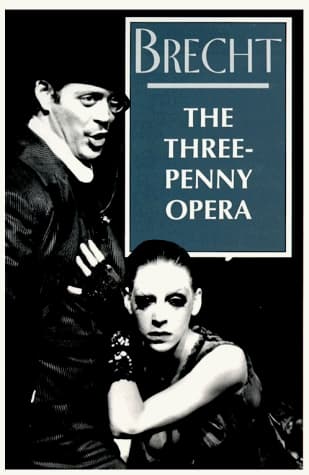
Synopsis
Covers the whole plot, including the ending.
- Difficulty
- Medium
- Pacing
- Moderate
- Mood
- Satirical, Cynical, Darkly Humorous, Provocative
- Read it if
- You enjoy biting social satire, dark humor, and plays that challenge conventional morality.
- Skip it if
- You prefer straightforward narratives with clear heroes and villains, or dislike cynical portrayals of society.
The Threepenny Opera Plot Summary
Covers the whole plot, including the ending.
The Ballad of Mack the Knife
The play starts in the busy streets of Soho, London, just before Queen Victoria's coronation. A street singer introduces the gangster Macheath, 'Mack the Knife,' with a chilling ballad. The song lists his crimes, from murder to arson, and his dangerous charm. Meanwhile, Mr. J.J. Peachum, the 'King of the Beggars,' and his wife, Mrs. Peachum, prepare their beggars for the day's profitable spots. They show the hypocrisy of the middle class, using the poor for money while appearing respectable. The ballad warns the audience and establishes Macheath's presence before he appears.
Polly's Elopement and Peachum's Outrage
Polly Peachum, the innocent-looking daughter of Mr. and Mrs. Peachum, has secretly fallen in love with and married Macheath. The wedding happens in a stable, a crude event attended by Macheath's gang, who bring stolen furniture and food. When Polly comes home and admits her marriage, her parents are angry, not because of her safety, but because Macheath is a criminal who will upset their plans and take from their profits. They see the marriage as a business mistake and immediately plot to have Macheath arrested and hanged, believing this will restore their family's standing and money.
Peachum's Plan and Polly's Warning
Mr. Peachum, wanting Macheath brought to justice, goes to Chief of Police Tiger Brown, Macheath's old army friend, to demand his arrest. Brown, however, is corrupt and secretly friends with Macheath, making him unwilling to act. Polly, knowing her parents' plan, warns Macheath he is in danger. She tells him to leave London, but Macheath, confident in his connections and charm, at first ignores her. This scene shows the deep corruption in the legal system and Macheath's overconfidence.
Macheath's Capture and Lucy's Intervention
Despite Polly's warning, Macheath is captured at a brothel, thanks to a tip from one of Peachum's spies. He is imprisoned. Lucy Brown, Tiger Brown's daughter and Macheath's former lover, visits him in jail. Jealous of Polly, Lucy helps Macheath escape by pretending to be pregnant and tricking the guards. This escape adds to the tangled relationships and shows Macheath's ability to charm and use women, even in bad situations.
Polly and Lucy's Confrontation
After Macheath's escape, Polly and Lucy face each other at the jail. Both women say they are Macheath's true wife, leading to a heated argument with accusations. Each tries to show she is more important and has a better claim to Macheath. The scene is a dark parody of romantic love, showing how relationships in this world are about deals and how the women fight for status through their link to Macheath, who is not there but causes their rivalry.
Peachum's Threat to Brown
Mr. Peachum, angry about Macheath's escape and wanting him hanged, threatens Tiger Brown. He reveals he knows about Brown's corrupt actions and his friendship with Macheath. Peachum uses his control over the city's beggars, threatening to disrupt the coronation parade with a large protest of 'disabled' beggars. This would embarrass the Queen and risk Brown's career, unless Macheath is arrested again. Brown, fearing for his job, agrees to search harder for Macheath, showing Peachum's power over even the Chief of Police.
Macheath's Second Capture and Impending Execution
Under pressure from Peachum, Tiger Brown's forces search harder, and Macheath is captured again at another brothel. He is betrayed by Jenny Diver, a prostitute with a complicated past with him. He is sentenced to death by hanging. In prison, Macheath regrets his fate and thinks about his past. His gang members visit him, showing loyalty but unable to help. The scene is a grim picture of his coming death, without his usual boldness, showing a moment of weakness.
The Beggars' Parade and Brown's Dilemma
As Macheath's execution nears, Peachum gathers his beggars, ready to march on the coronation parade if Macheath is not hanged. The large number and planned misery of the beggars threaten public order and Brown's career. Brown is caught between his loyalty to Macheath and the bad political results of Peachum's planned protest. This scene highlights the power dynamics, where using public opinion and social order becomes a weapon for the seemingly respectable Peachum.
The Last-Minute Reprieve
Just as Macheath is led to the gallows, a sudden and unlikely reprieve arrives. A messenger from the Queen announces that Macheath has been pardoned and made a peer, given a castle, and a pension. This sudden intervention is a cynical comment on justice and power. It suggests that in this society, true justice matters less than random acts of mercy and keeping social order, even if it means rewarding criminals. The sudden turn of events highlights the play's anti-middle-class message.
The Moral of the Story
The play ends with a final song that summarizes its cynical view. It says that morality is a luxury the poor cannot afford, and that survival often requires criminal behavior. The ending, with Macheath's absurd pardon, reinforces that the lines between criminals and respectable citizens are unclear. Society often rewards the ruthless and well-connected, regardless of their ethics. Brecht uses this ending to criticize the capitalist system and the hypocrisy of middle-class values, making the audience think about the real nature of justice and morality.
The Threepenny Opera Characters
Macheath (Mack the Knife)
Protagonist/Antagonist
A charismatic and ruthless gangster, the titular 'Mack the Knife'.
Macheath is a charming, cunning, and violent criminal who operates with a sense of entitlement and impunity. He is a leader of a gang of thieves and murderers, yet he maintains a public facade of respectability. His allure lies in his dangerous charisma, which he uses to manipulate women and maintain his connections with corrupt authorities like Tiger Brown. Despite his criminal activities, he often sees himself as a businessman, mirroring the bourgeois society he satirizes. He is driven by self-preservation, pleasure, and maintaining his status.
Relationships: Polly Peachum (Wife, though his commitment is questionable); Lucy Brown (Former lover, daughter of Tiger Brown); Tiger Brown (Old army comrade and corrupt police chief); Jenny Diver (Former lover and prostitute who betrays him)
Polly Peachum
Supporting
The seemingly naive daughter of the 'King of the Beggars', who marries Macheath.
Polly initially appears as an innocent, romantic young woman who falls genuinely in love with Macheath. However, as the play progresses, she quickly adapts to the criminal underworld, demonstrating a surprising shrewdness and business acumen, particularly when she takes over Macheath's gang. She is a product of her environment, quickly shedding her naiveté to survive and thrive within the amoral society. Her transformation reflects the play's theme that everyone, regardless of initial disposition, is capable of adapting to and benefiting from corruption.
Relationships: Macheath (Husband); Mr. Peachum (Father); Mrs. Peachum (Mother); Lucy Brown (Rival for Macheath's affection)
Mr. J.J. Peachum
Antagonist
The cynical 'King of the Beggars' who profits from human misery.
Mr. Peachum is a master manipulator and a ruthless businessman who runs a corporation of beggars, equipping them with costumes and stories in exchange for a share of their earnings. He embodies the hypocrisy of the bourgeois class, outwardly moralistic while inwardly utterly corrupt and driven by profit. He views his daughter's marriage to Macheath as a business threat rather than a personal tragedy, and his relentless pursuit of Macheath is motivated by financial gain and social standing. He represents the systemic exploitation inherent in the society.
Relationships: Mrs. Peachum (Wife and business partner); Polly Peachum (Daughter, whom he sees as property); Macheath (Son-in-law and business rival); Tiger Brown (Corrupt police chief whom he blackmails)
Mrs. Peachum
Supporting
Peachum's equally cynical and calculating wife.
Mrs. Peachum is Mr. Peachum's sharp-tongued and equally calculating partner in their 'beggar business.' She shares her husband's cynical worldview and his desire for social climbing and financial security. She is instrumental in plotting Macheath's downfall and is fiercely protective of her family's perceived reputation and wealth. Her character reinforces the play's critique of bourgeois values, showing a woman who is just as ruthless and opportunistic as her male counterparts.
Relationships: Mr. Peachum (Husband and business partner); Polly Peachum (Daughter, whom she attempts to control)
Tiger Brown
Supporting
The corrupt Chief of Police and Macheath's old war comrade.
Tiger Brown is the Chief of Police in Soho, a figure of authority who is deeply entrenched in corruption. He has a long-standing, secret friendship with Macheath, stemming from their time together in the army. This relationship makes him complicit in Macheath's crimes, as he often turns a blind eye to them. Brown is torn between his duty, his friendship with Macheath, and the pressure from Mr. Peachum. He represents the pervasive corruption within the institutions of power, where personal loyalties and self-preservation often outweigh justice.
Relationships: Macheath (Old army comrade and secret friend); Lucy Brown (Daughter); Mr. Peachum (Blackmailer); Jenny Diver (Has a past with her)
Lucy Brown
Supporting
Tiger Brown's jealous daughter and Macheath's former lover.
Lucy Brown is Macheath's former lover and the daughter of Chief of Police Tiger Brown. She is fiercely possessive and jealous, particularly of Polly Peachum, whom she views as a rival for Macheath's affection. Lucy's actions are often driven by emotional turmoil and a desire to reclaim Macheath. She embodies the destructive nature of unrequited love and jealousy in the play's amoral world, ultimately aiding Macheath's escape from prison out of spite and a desperate hope to win him back.
Relationships: Macheath (Former lover); Tiger Brown (Father); Polly Peachum (Rival for Macheath's affection)
Jenny Diver
Supporting
A prostitute and former lover of Macheath, who ultimately betrays him.
Jenny Diver is a prostitute and one of Macheath's many former lovers. Her relationship with Macheath is complex, marked by a history of exploitation and resentment. She initially appears loyal to him but ultimately betrays him for a reward from the Peachums. Jenny represents the plight of women in this society who are forced to make difficult choices for survival, and her betrayal underscores the transactional nature of all relationships in the play, even those tinged with past affection.
Relationships: Macheath (Former lover); Mr. Peachum (Employer/contact for betrayal); Tiger Brown (Has a past with him)
Filch
Supporting
A young beggar working for the Peachums.
Filch is a young, impoverished man who works for Mr. Peachum, collecting clothes and information. He is a minor character but serves to illustrate the oppressive system that Peachum runs, showing the desperation of those who fall under his control. Filch is a pawn in Peachum's schemes, highlighting the exploitation of the truly poor by those who profit from their misery. He is a symbol of the lower rung of the societal ladder.
Relationships: Mr. Peachum (Employer); Mrs. Peachum (Employer)
The Threepenny Opera Themes
Hypocrisy of the Bourgeoisie
The play satirizes the moral hypocrisy of the middle class, shown by the Peachums. They preach morality and respectability while secretly running an exploitative and corrupt business. Mr. Peachum, the 'King of the Beggars,' carefully creates poverty for profit, mirroring how he believes legitimate businesses use the working class. This theme appears in their anger over Polly's marriage to Macheath—not because he's a criminal, but because his criminal business threatens their own 'respectable' criminal business and social standing. The entire society, from the police chief to the 'beggar king,' operates on self-interest and moral compromise, blurring the lines between criminal and respectable citizen.
“What is a picklock to a bank share? What is a murder of a man to the employment of a man?”
Corruption of Institutions
The Threepenny Opera shows the deep corruption within society's institutions, especially the police and legal system. Chief of Police Tiger Brown, a figure of law and order, is Macheath's old army friend and secret ally, ignoring his crimes. This relationship shows that power structures are not fair but are often compromised by personal loyalties and secret deals. The sudden, last-minute royal pardon for Macheath, making him a peer, further shows how justice is not about fairness or morality, but about random power, political convenience, and keeping a superficial social order. The system itself is as criminal as the individuals it claims to control.
“First feed the face, then talk right and wrong.”
Love and Betrayal as Transaction
Relationships in the play, whether romantic or family, are always shown as transactional and self-serving, not based on real affection or loyalty. Polly's parents react to her marriage to Macheath with financial calculations, not parental concern. Macheath uses the affections of Polly, Lucy Brown, and Jenny Diver for his own gain, and Jenny eventually betrays him for money. The fight between Polly and Lucy over Macheath is a struggle for ownership and status, not a display of deep emotional connection. This theme highlights how a capitalist society makes people less human, reducing even the closest bonds to matters of profit and loss, power, and strategic advantage.
“The world is poor, and man is bad.”
The Nature of Justice and Morality
Brecht challenges traditional ideas of justice and morality, suggesting they are relative and often set by one's social standing and economic power. The play asks who the 'real' criminals are: Macheath, the gangster, or Mr. Peachum, the 'King of Beggars' who uses the poor while appearing respectable? The final, absurd pardon of Macheath, where he is not only spared but rewarded, strongly criticizes a system where crime, when done on a large enough scale or with the right connections, is not only allowed but celebrated. The play argues that in a corrupt society, survival often requires immoral actions, and the difference between a 'good' person and a 'bad' person is just about opportunity and social view.
“What keeps a man alive? He lives on others. He likes to eat them out of house and home.”
Critique of Capitalism
At its heart, The Threepenny Opera criticizes capitalism and its contradictions. The play compares the methods of gangsters and prostitutes with those of 'respectable' businessmen, suggesting that both operate on exploitation, self-interest, and seeking profit at any cost. Mr. Peachum's beggar business is a direct parody of capitalist ventures, organizing and selling human suffering for money. The main message is that society itself, under capitalism, is a criminal enterprise, where the powerful prey on the weak, and morality is a luxury only the privileged can pretend to have. The play argues that the system itself creates the very criminality it claims to condemn.
“What is the robbing of a bank compared with the founding of a bank?”
Plot Devices & Literary Techniques
Verfremdungseffekt (Alienation Effect)
Brecht's theatrical technique to distance the audience and encourage critical thought.
The alienation effect is central to Brecht's epic theatre, employed to prevent emotional immersion and encourage the audience to critically analyze the social issues presented. This is achieved through various means: characters directly addressing the audience, visible stage machinery, placards displaying scene titles, and songs that comment on the action rather than advance the plot. For example, the 'Ballad of Mack the Knife' is sung by a street singer at the beginning, introducing Macheath's notorious reputation before he even appears, immediately establishing a critical distance. The exaggerated, often grotesque characters and the improbable happy ending (Macheath's royal pardon) also serve to remind the audience that they are watching a play, not reality, prompting them to question the societal structures being satirized rather than simply empathizing with the characters.
Songs and Ballads
Musical numbers that interrupt the narrative to offer commentary and analysis.
The songs, with Kurt Weill's distinctive music, are not merely decorative but serve as crucial plot devices in Brecht's work. They function as 'interruptions' that comment on the action, reveal character motivations, or deliver thematic statements, often directly addressing the audience. For instance, 'The Ballad of Mack the Knife' sets the tone and establishes Macheath's reputation. 'The Song of the Futility of Human Endeavour' (also known as 'The Threepenny Finale') explicitly states the play's cynical worldview. These songs prevent emotional identification with the characters and instead prompt intellectual engagement with the play's social and political critiques, aligning with the Verfremdungseffekt.
Deus ex Machina
An improbable, last-minute intervention that resolves the plot in an unexpected way.
The play famously employs a deus ex machina in its final act, where Macheath, moments from being hanged, receives a royal pardon, a castle, and a pension. This device is not used to provide a satisfying, conventional happy ending. Instead, it serves as a highly ironic and cynical commentary on the arbitrary nature of justice and power. Brecht uses this improbable intervention to highlight how the powerful can manipulate outcomes, rewarding criminals who are well-connected or whose continued existence serves a larger, often corrupt, social or political purpose. It underscores the play's message that justice is not blind, but rather a tool of the ruling class, further alienating the audience from a sense of realism and forcing critical reflection.
Satire and Parody
The use of humor, irony, and exaggeration to expose and criticize societal flaws.
The Threepenny Opera is a profound work of satire, using humor and parody to expose the hypocrisy and corruption of bourgeois society. It parodies the conventions of romantic opera and Victorian melodrama, presenting a 'love story' that is deeply cynical and transactional. The Peachums, with their 'beggar's business,' are a grotesque parody of respectable capitalists, while Macheath, the criminal, often speaks with the logic of a ruthless businessman. This satirical approach allows Brecht to critique social injustices and the capitalist system indirectly, making the harsh realities more palatable while simultaneously sharpening their critical edge. The absurdity of the characters and situations serves to highlight the inherent absurdities of the society being depicted.
The Threepenny Opera Quotes
“What is a bank robbery compared with the founding of a bank?”
“First, feed the face, then talk right and wrong.”
“The world is poor, and man is bad.”
“The law was made for one thing alone, for the exploitation of those who do not understand it, or who have no need to understand it.”
“Behind every great fortune there is a crime.”
“Man lives by his head, his head does not suffice.”
“What keeps a man alive? He lives on others.”
“The world's a whore, and we're her pimps.”
“The poor man has no choice but to be good.”
“It is not enough to demand justice. One must create it.”
“When the rich get richer, the poor get children.”
“Marriage is a contract, not a sacrament.”
“The world is not enough, and the world is too much.”
“Pity is something you can buy.”
“The moon over Soho is cold and cruel.”
Quiz
10 questions on the plot and the characters. Each answer comes with a short explanation.
Question 1
Which historical work is 'The Threepenny Opera' based on?
- William Shakespeare's 'Hamlet'
- John Gay's 'The Beggar's Opera'
- Charles Dickens' 'Oliver Twist'
- Jonathan Swift's 'Gulliver's Travels'
Show answer
B. John Gay's 'The Beggar's Opera' 'The Threepenny Opera' is explicitly stated to be based on John Gay's eighteenth-century 'Beggar's Opera'.
Question 2
In what city and historical period is 'The Threepenny Opera' primarily set?
- Paris, Belle Époque
- London, Elizabethan Era
- Victorian England's Soho
- Berlin, Weimar Republic
Show answer
C. Victorian England's Soho The play is set in Victorian England's Soho, although it satirizes the Weimar Republic.
Question 3
Who is the composer of the music for 'The Threepenny Opera'?
- Bertolt Brecht
- Stephen Sondheim
- Kurt Weill
- George Gershwin
Show answer
C. Kurt Weill Kurt Weill's music is noted as one of the earliest and most successful attempts to introduce jazz into the theater for the play.
Question 4
What is the primary thematic purpose of setting 'The Threepenny Opera' in Victorian England's Soho while satirizing the Weimar Republic?
- To provide a historically accurate depiction of Victorian London's criminal underworld.
- To create a sense of timelessness, suggesting that societal issues are universal.
- To use a historical setting as a critical lens to comment on contemporary bourgeois society in Germany.
- To avoid censorship by distancing the satire from its immediate political target.
Show answer
C. To use a historical setting as a critical lens to comment on contemporary bourgeois society in Germany. The play is set in Victorian England's Soho but specifically states it 'satirizes the bourgeois society of the Weimar Republic,' indicating a critical commentary on contemporary society through a historical proxy.
Question 5
Who are the central romantic figures in 'The Threepenny Opera'?
- Mr. and Mrs. Peachum
- Polly Peachum and 'Mack the Knife' Macheath
- Tiger Brown and Lucy Brown
- Jenny Diver and Macheath
Show answer
B. Polly Peachum and 'Mack the Knife' Macheath The synopsis describes the play as a 'wry love story of Polly Peachum and 'Mack the Knife' Macheath.'
Question 6
What significant musical innovation is attributed to Kurt Weill's score for 'The Threepenny Opera'?
- The first use of a full symphony orchestra in a stage production.
- One of the earliest and most successful attempts to introduce jazz into the theater.
- The invention of the leitmotif in musical theater.
- Pioneering the use of electronic instruments on stage.
Show answer
B. One of the earliest and most successful attempts to introduce jazz into the theater. The description highlights Kurt Weill's music as 'one of the earliest and most successful attempts to introduce jazz into the theater.'
Question 7
What is the significance of the Ralph Manheim and John Willett translation mentioned in the text?
- It was the original German translation commissioned by Brecht himself.
- It is the definitive English edition, authorized by the Brecht estate, and includes editorial commentary.
- It is a simplified version intended for amateur theater groups.
- It is a musical adaptation rather than a direct translation of the play's text.
Show answer
B. It is the definitive English edition, authorized by the Brecht estate, and includes editorial commentary. The text states that Arcade's definitive edition 'contains the acclaimed translation by Ralph Manheim and John Willett' which was 'Commissioned and authorized by the Brecht estate,' and that they 'also provide Brecht's own notes and discarded songs, as well as extensive editorial commentary.'
Question 8
How does 'The Threepenny Opera' function as a critique of bourgeois society, despite its setting?
- By explicitly showing the poverty of the working class in Victorian England, contrasting it with the wealth of the bourgeoisie.
- By portraying criminals with traits typically associated with respectable businessmen, blurring the lines between the two.
- By having characters directly address the audience and denounce bourgeois values.
- By presenting a utopian vision of a society without social classes or economic disparity.
Show answer
B. By portraying criminals with traits typically associated with respectable businessmen, blurring the lines between the two. The text states the play 'satirizes the bourgeois society of the Weimar Republic through its wry love story of Polly Peachum and 'Mack the Knife' Macheath.' Brecht often used criminal figures to expose the hypocrisy and underlying ruthlessness of 'respectable' society, suggesting that criminals merely operate by the same principles as businessmen, but without the veneer of legality.
Question 9
What is implied about the lasting appeal and significance of 'The Threepenny Opera'?
- It is a historical curiosity, primarily studied for its connection to 'The Beggar's Opera'.
- Its popularity is limited to academic circles due to its complex political satire.
- It achieved significant commercial and critical success globally and remains frequently performed.
- Its influence is mainly confined to the German theater scene of the early 20th century.
Show answer
C. It achieved significant commercial and critical success globally and remains frequently performed. The text describes it as Brecht's 'first and greatest commercial success' and states it 'remains one of his best-loved and most-performed plays,' becoming a 'popular hit throughout the Western world.'
Question 10
How do Willett and Manheim contribute to the understanding of Brecht's work beyond just translation?
- They rewrote significant portions of the play to update it for modern audiences.
- They composed new music to replace Kurt Weill's original score.
- As editors of Brecht's complete dramatic work, they provide extensive commentary, notes, and discarded materials.
- They directed the first major English-language production of the play.
Show answer
C. As editors of Brecht's complete dramatic work, they provide extensive commentary, notes, and discarded materials. Willett and Manheim are described as 'joint editors of Brecht's complete dramatic work in English,' and they 'also provide Brecht's own notes and discarded songs, as well as extensive editorial commentary on the genesis of his play.' This goes beyond simple translation.
The Threepenny Opera FAQ
What is the core premise of 'The Threepenny Opera'?
'The Threepenny Opera' is a satirical musical play set in Victorian London's Soho, following the illicit marriage between the notorious gangster Macheath, also known as 'Mack the Knife,' and Polly Peachum, the daughter of the 'King of the Beggars,' Jonathan Peachum. This union ignites a fierce conflict between Macheath and Peachum, who seeks to exploit or destroy the marriage for his own profit, all while satirizing bourgeois morality and capitalist society.
Who are the main characters and what are their primary roles in the plot?
The main characters include Macheath, the charming but ruthless gangster; Polly Peachum, Macheath's naive yet cunning wife; Jonathan Peachum, the corrupt boss of London's beggars; Celia Peachum, his equally manipulative wife; and Tiger Brown, the Chief of Police and Macheath's old army friend. Lucy Brown, Tiger Brown's daughter, also plays a significant role as Macheath's former lover, creating a love triangle.
How does the play satirize bourgeois society, despite being set in Victorian England?
Brecht uses the setting of Victorian England as a thin veil to critique the capitalist society and hypocritical morality of the Weimar Republic. The play exposes the similarities between the criminal underworld and legitimate business, showing how both operate on principles of exploitation, greed, and the pursuit of profit, blurring the lines between 'respectable' citizens and 'criminals.'
What is the significance of Kurt Weill's music in 'The Threepenny Opera'?
Kurt Weill's music is integral to the play's impact, blending elements of jazz, cabaret, and traditional opera to create a distinctive, often dissonant sound. His compositions, like 'Mack the Knife,' are not merely background but actively comment on the action, using a 'song-as-commentary' style that disrupts traditional musical theater conventions and enhances Brecht's alienation effect.
What is the 'alienation effect' (Verfremdungseffekt) and how is it used in the play?
The alienation effect is a theatrical technique designed to prevent the audience from empathizing too closely with characters or becoming too absorbed in the plot, instead encouraging critical observation. In 'The Threepenny Opera,' this is achieved through direct address to the audience, visible stage mechanics, songs that interrupt the narrative, and characters who embody types rather than fully fleshed-out individuals, forcing viewers to analyze the social issues presented.
How does Brecht subvert the traditional 'happy ending' in the play?
Brecht notoriously subverts the traditional happy ending by introducing a deus ex machina in the form of a messenger from the King, who pardons Macheath and grants him a castle and a pension just as he is about to be hanged. This utterly improbable and cynical resolution highlights the arbitrary nature of justice and the corrupting influence of power, rather than offering genuine closure or moral triumph.
What is the connection between 'The Threepenny Opera' and John Gay's 'The Beggar's Opera'?
'The Threepenny Opera' is a direct adaptation and modernization of John Gay's 18th-century 'The Beggar's Opera.' Brecht and Weill retained the core plot of a highwayman marrying a beggar king's daughter and the subsequent conflict, but updated the setting, language, and musical style to reflect contemporary societal critiques, transforming Gay's ballad opera into a biting social commentary for the Weimar era.
Are there any specific historical or political references embedded in the characters or plot?
While not explicitly stated, the characters and their actions are deeply steeped in the political and economic anxieties of the Weimar Republic. Jonathan Peachum's organized begging enterprise reflects the exploitation of the poor by those in power, while Macheath's connections with Chief of Police Tiger Brown symbolize the blurring of lines between legitimate authority and organized crime, a common critique of corruption in post-WWI Germany.
How does Macheath's character embody a critique of masculinity and power?
Macheath, despite his charming facade and undeniable charisma, ultimately represents a critique of a predatory, self-serving masculinity. He is a gangster who exploits women, maintains multiple mistresses, and relies on violence and intimidation to maintain his power. His eventual 'redemption' by royal decree doesn't absolve him but rather underscores how power and connections, not moral rectitude, dictate one's fate in his world.
Analyze Polly Peachum's psychological journey throughout the play.
Polly begins as seemingly innocent and naive, falling genuinely in love with Macheath. However, she quickly adapts to his criminal world, demonstrating a surprising shrewdness and ambition. Her transformation reveals a pragmatic and ruthless streak, mirroring her parents' calculating nature, suggesting that even the seemingly pure can be corrupted or molded by their environment and the pursuit of power and security.
What psychological motivations drive Jonathan Peachum's actions against Macheath?
Jonathan Peachum is driven by a potent mix of greed, possessiveness, and a desire for control. He views his daughter, Polly, as property and her marriage to Macheath as a threat to his established 'business' and reputation. His relentless pursuit of Macheath is less about moral outrage and more about eliminating a rival and reasserting his dominance over his family and his illicit empire.
How do the relationships between the female characters (Polly, Lucy, Jenny) reflect the social status of women?
The female characters, Polly, Lucy Brown, and Jenny Diver, are all, in different ways, victims and perpetrators within a patriarchal system. They are often defined by their relationships to men, vying for Macheath's affection or loyalty, and their agency is frequently tied to manipulation or their ability to navigate a world dominated by male power. Their struggles highlight the limited options and inherent vulnerabilities faced by women in this societal structure.
Is the play ultimately pessimistic or does it offer any hope for social change?
The play is overwhelmingly pessimistic, offering little to no hope for genuine social change. The cynical ending, where Macheath is arbitrarily pardoned, reinforces the idea that justice is a farce and that the corrupt powerful always prevail. Brecht's intent was not to offer solutions but to expose the systemic flaws and contradictions of society, prompting the audience to critically examine their own world.
How does the ending, with the messenger from the King, contribute to the play's overall message?
The highly improbable and arbitrary 'happy ending' where Macheath is saved by a royal pardon is a deliberate Brechtian device to highlight the absurdity and injustice of the world depicted. It underscores the play's central thesis that moral rectitude is irrelevant; power, privilege, and luck dictate outcomes, demonstrating that justice is not blind but rather influenced by external, often corrupt, forces.
Is Macheath truly a villain, or is he a product of his environment?
Macheath is undeniably a villain in his actions—he is a murderer, philanderer, and exploiter. However, Brecht also presents him as a product of his environment, a man who operates according to the ruthless capitalist principles that permeate all levels of society, from the criminal underworld to 'legitimate' business. The play suggests that the system itself breeds such figures, making him both individually culpable and symbolically representative of a corrupt society.
What is Brecht's view on morality as depicted in 'The Threepenny Opera'?
Brecht's view on morality in the play is deeply cynical; he suggests that traditional morality is a luxury that the poor cannot afford and a hypocrisy embraced by the powerful. The lines between 'good' and 'evil' are blurred, with the 'criminals' often acting with the same motivations and methods as the 'respectable' citizens. Morality, for Brecht, is presented as a construct used to maintain social order and often serves the interests of the dominant class.
How does the character of Tiger Brown complicate the audience's understanding of law and order?
Tiger Brown, as Chief of Police and Macheath's old friend, completely complicates the notion of law and order by demonstrating its inherent corruption and complicity with crime. His personal loyalty to Macheath overrides his professional duty, showing that justice is not impartial but negotiable, dependent on personal connections and power dynamics. This blurs the lines between law enforcement and the criminal underworld, suggesting they are two sides of the same coin.
What role does poverty play in shaping the characters' choices and the play's themes?
Poverty is a foundational element shaping the characters' choices and the play's themes, driving many to desperate measures and highlighting the brutal realities of economic survival. Jonathan Peachum's entire business model relies on exploiting the destitute, while the characters' constant struggle for money underscores how economic necessity often dictates morality and fuels the cycle of crime and exploitation, rather than any inherent evil.
About the author
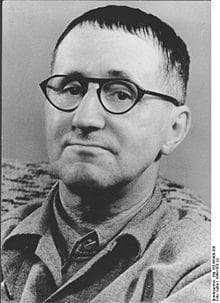
Bertolt Brecht was a highly influential German playwright, poet, and theatre director. He is best known for his epic theatre style, which aimed to provoke critical thought rather than emotional identification. His notable works include "The Threepenny Opera," "Mother Courage and Her Children," and "The Good Woman of Setzuan."
Similar books
- Animal Farm
George Orwell
4.0 (2.7M) average on GoodreadsPoliticsA satirical allegory that critiques societal power structures and corruption, much like Brecht's work.
- Waiting for Godot
Samuel Beckett
3.8 (160k) average on GoodreadsPhilosophyBoth The Threepenny Opera and Waiting for Godot (1953) challenge traditional dramatic structure and audience expectations, but they do so for different philosophical ends. Brecht's play aims to provoke social and political critique through an episodic, non-naturalistic narrative that exposes societal ills. Beckett's work, a cornerstone of Absurdist theatre, focuses on existential themes of meaninglessness, futility, and the human condition in a world devoid of inherent purpose. While Brecht wants the audience to act on their understanding of social injustice, Beckett invites contemplation on the nature of existence itself. Brecht's characters are agents (albeit flawed ones) within a corrupt system; Beckett's characters are largely passive, waiting for an external force that never arrives.
- Nineteen Eighty-Four
George Orwell
4.2 (5.5M) average on GoodreadsFictionWinston Smith dreams of truth and rebellion in a world where Big Brother watches all, but he confronts the terrifying power of a regime that controls not just actions, but thoughts.
- The Frozen River
Ariel Lawhon
4.4 (600k) average on GoodreadsFictionIn 1789 Maine, a heroic midwife's diary helps her expose a murder and get justice in a town that wants to silence her.
- A Man Called Ove
Fredrik Backman
4.4 (569k) average on GoodreadsFictionA stubborn widower, who lives by strict rules, finds his quiet world changed by a lively new family next door, making him face his past and find happiness in human connection.
- The Art of Racing in the Rain
Garth Stein
4.2 (452k) average on GoodreadsFictionThrough the eyes of Enzo, a wise and observant dog, a race car driver's family navigates a journey of love, loss, and resilience, learning that life's most important lessons often come in the curves, not just on the straightaways.





Enjoyed the summary?
A summary gives you the shape of the book. The book itself has the detail, the examples and the voice.
Find The Threepenny Opera on AmazonAs an Amazon Associate, BookBrief earns from qualifying purchases. How we're funded