
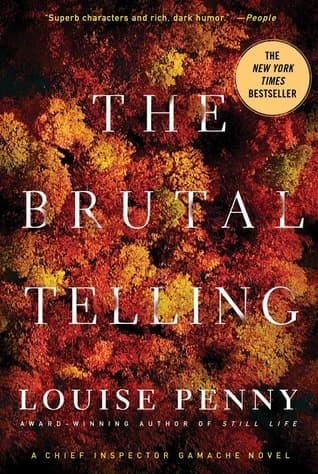
Synopsis
Covers the whole plot, including the ending.
- Difficulty
- Medium
- Pacing
- Moderate
- Mood
- Atmospheric, Suspenseful, Melancholy, Introspective
- Read it if
- You enjoy character-driven mysteries with a strong sense of place, exploring themes of hidden pasts, loyalty, and the darkness beneath a seemingly perfect surface.
- Skip it if
- You prefer fast-paced, action-oriented thrillers or mysteries without deep dives into character psychology and village dynamics.
The Brutal Telling Plot Summary
Covers the whole plot, including the ending.
A Stranger in Three Pines
The quiet village of Three Pines is disturbed when a stranger's body is found in the loft above Olivier's Bistro and B&B. The victim, later identified as a hermit, was sitting at a table with a copy of Charlotte's Web, a half-eaten meal, and a black feather. Chief Inspector Armand Gamache and his team, Jean-Guy Beauvoir and Isabelle Lacoste, investigate. Olivier and Gabri, the bistro owners, say they never saw the man, even though the body was found in their business. The villagers are shocked, and not knowing who the victim is deepens the mystery.
Unraveling the Hermit's Identity and Past
The investigation quickly shows the victim is Paul Fresne, a well-known rare book collector who disappeared years ago. Evidence suggests Fresne lived secretly in a remote, organized cabin in the woods near Three Pines. The cabin held an extraordinary collection of first edition books, including a valuable Charlotte's Web. Gamache learns Fresne was careful and solitary. His cabin, though appearing empty, holds secrets about his past and possible connections to the villagers. A unique spider web with 'WOE' woven into it in the cabin adds more mystery.
Olivier Becomes the Prime Suspect
As Gamache investigates, Olivier's story has problems. It turns out Olivier bought the bistro and B&B from Paul Fresne years ago, which goes against his first claim of not knowing the victim. Financial records show Olivier paid too much for the property. Also, a secret room is found in the bistro, containing rare books like those in Fresne's cabin. This suggests a hidden connection between the two men. Olivier's behavior becomes more erratic and he avoids questions, making him the main suspect in Fresne's murder and worrying his friends in Three Pines.
The Brutal Truth of Olivier's Past
Gamache's look into Olivier's past leads to a sad discovery: Olivier's mother, Adele, was a brilliant but troubled woman who forged rare books. She had severe mental illness and was institutionalized. Paul Fresne, a respected book collector, used Adele's talent to forge valuable first editions, which he then sold for a lot of money. Adele, in her illness, wove spider webs with words like 'WOE' and 'HELP,' a detail Gamache recognized from Fresne's cabin. This shows Olivier's sad childhood, marked by his mother's use and later institutionalization, and Fresne's part in it.
The Forged Library and a Hidden Child
It becomes clear that Fresne not only used Adele but also kept her confined and alone, using her forging skills for years. During this time, Adele had another child, a daughter, who was taken from her and adopted. This daughter is Clara Morrow, the artist and a close friend of Olivier, who did not know her true parents. The rare books in Fresne's cabin and Olivier's secret room are confirmed to be Adele's forgeries, showing her sad talent and Fresne's exploitation of her. This discovery adds an emotional part to the mystery, connecting several villagers in an unexpected way.
The Confession and the Real Killer
Olivier, feeling overwhelmed by the evidence and the truths about his mother and Fresne, confesses to killing Paul Fresne. He says he confronted Fresne about his mother's use, which led to a fight and Fresne's death. However, Gamache sees problems in Olivier's confession and believes he is protecting someone. The Chief Inspector realizes Olivier's story of the fight does not match the evidence. He continues to push, sure that the whole truth has not been told, and that Olivier is covering for someone else.
Gabri's Desperate Act
Finally, Gabri Dubeau, Olivier's partner, confesses to the murder. He says he confronted Fresne, angry about the years of exploitation and suffering Fresne caused Adele and Olivier. Gabri admits he delivered the fatal blow, not Olivier. He then set the scene to make it look like Olivier did it, believing he could protect his partner. Gabri's confession makes the events clear, showing his deep love and loyalty for Olivier, and how far he would go to protect him from the painful past.
The Aftermath and Lingering Wounds
With Gabri's confession, the truth of Paul Fresne's murder is fully known. Gabri is arrested, leaving Olivier devastated and the village of Three Pines in shock. Clara Morrow deals with the news that Adele was her birth mother, and her life changes. The community of Three Pines processes the truths that have emerged, especially the exploitation of Adele and her sad life. The murder is solved, but the emotional pain from the past affects everyone, making them face the darker side of human nature even in their village.
Principal Figures
Chief Inspector Armand Gamache
Protagonist
Head of the Sûreté du Québec homicide department, renowned for his wisdom and empathy.
Gamache is a deeply empathetic and insightful detective, known for his ability to see beyond the obvious and understand the complex motivations of people. He is a man of integrity, driven by a desire for truth and justice, but also by compassion. In 'The Brutal Telling,' he meticulously unravels the layers of deceit surrounding Paul Fresne's murder, focusing not just on who committed the crime, but why. He exhibits profound patience and wisdom, particularly in dealing with Olivier and Gabri, and in uncovering the tragic story of Adele. His leadership is calm and reassuring, even in the face of chaos.
Relationships: Jean-Guy Beauvoir (Son-in-law and trusted second-in-command); Isabelle Lacoste (Dedicated and observant team member); Reine-Marie Gamache (Wife and confidante); Olivier Brulé (Friend and initial prime suspect)
Olivier Brulé
Supporting
Co-owner of the Three Pines bistro and B&B, initially the prime suspect.
Olivier is a flamboyant and theatrical character, known for his love of fine food and his dramatic flair. He co-owns the popular bistro with his partner, Gabri. In this novel, Olivier is thrust into the spotlight as the body of Paul Fresne is found in his establishment. He initially denies knowing Fresne, but as Gamache uncovers his hidden past, Olivier becomes increasingly agitated and defensive. His character arc involves confronting the traumatic legacy of his mother, Adele, and the exploitation she suffered at Fresne's hands, which he had suppressed for years. He is deeply loyal to Gabri and his friends.
Relationships: Gabri Dubeau (Life partner and business co-owner); Armand Gamache (Friend and investigator); Clara Morrow (Close friend and unknowingly, his half-sister); Paul Fresne (Victim, and his mother's exploiter)
Gabri Dubeau
Supporting
Co-owner of the Three Pines bistro and Olivier's partner, the true murderer.
Gabri is the quieter, more grounded partner to Olivier's extravagance. He is deeply devoted to Olivier and fiercely protective of him. Throughout the investigation, Gabri tries to support Olivier, but his own pain and anger over Olivier's past and his mother's suffering simmer beneath the surface. He is driven by a profound love and loyalty, which ultimately leads him to commit murder to avenge Adele and protect Olivier from the truth, and then to confess to spare Olivier. His actions are born out of a desperate desire to protect the man he loves from further pain.
Relationships: Olivier Brulé (Life partner and business co-owner); Armand Gamache (Investigator)
Paul Fresne ('The Hermit')
Victim
The murdered recluse, a renowned rare book collector with a dark past.
Paul Fresne is initially discovered as an unidentified 'hermit' living in the woods, but is soon revealed to be a once-renowned, but now disgraced, rare book collector. He is the central figure around whom the mystery revolves. Fresne is portrayed as a cunning and exploitative individual who preyed on Adele's artistic genius for his own financial gain, keeping her captive and isolated. His cabin, filled with rare books and peculiar spider webs, provides crucial clues to his identity and his connection to the villagers. His death unearths a long-buried history of exploitation and suffering.
Relationships: Adele Brulé (Victim of his exploitation, mother of Olivier and Clara); Olivier Brulé (Son of Adele, whom he exploited); Clara Morrow (Daughter of Adele, whom he exploited)
Clara Morrow
Supporting
An acclaimed artist living in Three Pines, unknowingly Olivier's half-sister.
Clara is a vibrant and passionate artist, a central figure in the Three Pines community and a close friend to Olivier. She is known for her expressive paintings and her deep friendships. In 'The Brutal Telling,' Clara's life is irrevocably altered when Gamache uncovers the truth about her parentage: she is the daughter of Adele Brulé and therefore Olivier's half-sister. This revelation forces her to confront a hidden family history and a mother she never knew, bringing a profound sense of identity crisis and sorrow. Her artistic sensibility often helps her process the emotional weight of these discoveries.
Relationships: Peter Morrow (Husband, also an artist); Olivier Brulé (Close friend and half-brother); Adele Brulé (Birth mother)
Adele Brulé
Mentioned
Olivier and Clara's mother, a brilliant forger exploited by Paul Fresne.
Adele Brulé is a pivotal character, though she is only present through the revelations of her tragic past. She was a woman of extraordinary artistic talent, a master forger of rare books, but also suffered from severe mental illness. Exploited by Paul Fresne, she was kept isolated and used for her skills, eventually giving birth to two children, Olivier and Clara, under tragic circumstances. Her unique spider web creations with words like 'WOE' and 'HELP' become crucial clues in the investigation. Her story is one of profound suffering, artistic genius, and exploitation, forming the emotional core of the novel.
Relationships: Olivier Brulé (Son); Clara Morrow (Daughter); Paul Fresne (Exploiter)
Jean-Guy Beauvoir
Supporting
Chief Inspector Gamache's son-in-law and trusted second-in-command.
Jean-Guy is a dedicated and loyal member of Gamache's team, often acting as his foil. He is methodical and pragmatic, sometimes more prone to cynicism than Gamache, but deeply respects and admires his father-in-law. In 'The Brutal Telling,' he assists Gamache in piecing together the complex puzzle of Fresne's past and Olivier's involvement, often providing a practical perspective to Gamache's more intuitive approach. He is fiercely protective of Gamache and committed to solving the case.
Relationships: Armand Gamache (Father-in-law and mentor); Annie Gamache (Wife)
Isabelle Lacoste
Supporting
A sharp and observant member of Gamache's homicide team.
Isabelle Lacoste is a competent and intelligent detective on Gamache's team. She is astute, pays close attention to detail, and often picks up on subtle clues that others miss. In 'The Brutal Telling,' she plays a crucial role in the forensic aspects of the investigation and in interviewing witnesses, providing valuable insights and helping to establish timelines and connections. She is a reliable and steady presence, contributing significantly to the team's progress.
Relationships: Armand Gamache (Superior officer and mentor); Jean-Guy Beauvoir (Colleague)
Themes & Insights
The Brutality of Truth and Lies
The main theme of the book looks at how both lies and truth can be harsh. Olivier's initial lies about knowing Paul Fresne make the suspicion last longer, while the truth of Adele's exploitation and Clara's parentage breaks lives and relationships. Gamache balances finding the whole truth and the harm it can cause. The book suggests that truth is important, but revealing it can bring great pain, forcing characters to face difficult facts about themselves and those they love, as seen with Clara learning about her birth mother.
“Chaos is coming, old son.”
Exploitation and Artistic Genius
The novel deeply examines the exploitation of artistic talent, especially through Adele Brulé's sad story. Her talent as a forger was not praised but used by Paul Fresne for his greed. This theme shows how vulnerable artists are and how corrupt those who profit from their gifts without caring for their well-being can be. Adele's mental illness made her especially open to this, and her creations, like the spider webs with words, show her suffering and her cries for help, which were ignored until Gamache found her story.
“He took her genius and he twisted it into something vile. He took her life and he made it a living hell.”
Identity and Belonging
The theme of identity is explored through several characters. Olivier deals with his hidden past and his mother's suffering, which makes him face who he really is beyond his outward personality. Clara learning about her birth mother, Adele, changes her understanding of her own identity and her place in the world, challenging her sense of self and family. The villagers of Three Pines, though a close community, also deal with belonging when a stranger disrupts their peace and reveals hidden histories in their village. The book suggests that true identity often means facing one's past.
“She was a brilliant artist, a master forger. And a mother.”
Love, Loyalty, and Sacrifice
Strong bonds of love and loyalty drive many characters' actions, especially Gabri's. His deep love for Olivier makes him kill Paul Fresne, getting revenge for Adele and protecting Olivier from the painful truth. This act, though criminal, is shown as a deep sacrifice. Olivier's first false confession is also an act of loyalty, trying to shield Gabri. The theme looks at how complex and sometimes destructive strong devotion can be, and how far people will go for those they love. It shows that sacrifice can be both good and devastating, leading to great personal cost.
“I did it for him. For Olivier. For his mother. For everything he lost.”
Plot Devices & Literary Techniques
The Spider Web with Words
A unique, symbolic clue woven by Adele Brulé.
Adele Brulé, in her madness, wove spider webs with specific words like 'WOE' and 'HELP' into them. These webs are found in Paul Fresne's cabin and become a crucial, highly symbolic clue for Gamache. They represent Adele's artistic genius, her mental anguish, and her desperate, unheard cries for help during her exploitation. The webs are a unique narrative device that connects the victim to the true nature of his crimes and ultimately leads Gamache to uncover Adele's tragic story and the identity of Clara's birth mother. They serve as a silent, brutal telling of her suffering.
First Edition of 'Charlotte's Web'
A recurring motif symbolizing innocence, friendship, and the 'brutal telling' of truth.
A first edition copy of 'Charlotte's Web' is found with Paul Fresne's body and is a significant object throughout the novel. The book itself, with its themes of friendship, life, death, and the power of words, subtly mirrors the novel's plot. The rarity and value of the first edition highlight Fresne's world of rare books and forgery, while the story's 'brutal telling' (Wilbur's fate) resonates with the painful truths uncovered in Three Pines. It acts as both a literal clue and a symbolic commentary on the narrative's central themes of truth, innocence lost, and the impact of words.
The Secret Room
A hidden space in Olivier's bistro containing forged rare books.
The discovery of a secret room in Olivier's bistro, filled with a collection of rare books identical to those in Fresne's cabin, is a key plot device. This hidden space immediately raises suspicion about Olivier's honesty and his connection to Fresne. It physically embodies the 'buried secrets' of Olivier's past and the extent of Fresne's exploitation of Adele. The room serves as a tangible link between the victim, Olivier, and Adele's forging activities, propelling Gamache deeper into the investigation and ultimately leading to the unraveling of the entire truth.
The Hermit's Cabin
A meticulously organized, isolated dwelling holding clues to the victim's identity and past.
The Hermit's cabin, found deep in the woods, is a crucial setting and plot device. Its meticulous organization, despite its remote location, and its contents—especially the rare books and the distinctive spider webs—provide vital clues to Paul Fresne's identity and his hidden life. The cabin acts as a physical representation of Fresne's reclusiveness and the secrets he guarded. It's a place where Gamache can piece together fragments of Fresne's past, leading him to the larger conspiracy of exploitation involving Adele Brulé and the rare book forging world.
The Brutal Telling Quotes
“The past is never dead. It's not even past.”
“Evil is not a monster, it's a choice.”
“The truth is rarely pure and never simple.”
“In the woods, the trees whisper secrets.”
“We are all capable of terrible things, given the right circumstances.”
“A village is not just a place, it's a collection of stories.”
“Silence can be more telling than words.”
“The heart has its reasons which reason knows nothing of.”
“Every murder begins with a lie.”
“Art reveals what we try to hide.”
“Fear is a poison that clouds judgment.”
“In the end, we are all responsible for our own ghosts.”
“The simplest answer is often the most brutal.”
“Home is where the truth waits, no matter how long.”
Quiz
10 questions on the plot and the characters. Each answer comes with a short explanation.
Question 1
Where is the murdered stranger discovered in Three Pines?
- In the village church
- In the bistro and antiques store
- In the woods near the village
- At Olivier's private residence
Show answer
B. In the bistro and antiques store The stranger's body is found in the village bistro and antiques store, which is owned by Olivier, setting off the central mystery of the novel.
Question 2
Who is the primary suspect as the investigation progresses?
- Chief Inspector Gamache
- A summer tourist
- Olivier, the bistro owner
- The victim's family member
Show answer
C. Olivier, the bistro owner Olivier becomes the main suspect because every lead in the murder investigation seems to point back to him, raising questions about his past and business success.
Question 3
What is woven into a spider web as a clue in the investigation?
- The word 'CHAOS'
- The word 'WOE'
- The initials 'O.B.'
- A map of Three Pines
Show answer
B. The word 'WOE' A spider web with the word 'WOE' woven into it is one of the eerie clues that Gamache encounters, hinting at themes of sorrow and hidden truths.
Question 4
What literary works are mentioned as treasures among the clues?
- First editions of 'Charlotte's Web' and 'Jane Eyre'
- Original manuscripts of Shakespeare's plays
- Signed copies of Agatha Christie novels
- Ancient Greek texts
Show answer
A. First editions of 'Charlotte's Web' and 'Jane Eyre' First editions of 'Charlotte's Web' and 'Jane Eyre' are part of the trail of clues and treasures that lead Gamache in his investigation, reflecting the novel's themes of storytelling and hidden value.
Question 5
Why does Olivier's past become a focal point of the investigation?
- He was previously convicted of a crime
- He inherited wealth from unknown sources
- He left behind a mysterious past and buried himself in Three Pines
- He is related to the murdered stranger
Show answer
C. He left behind a mysterious past and buried himself in Three Pines Olivier's hidden past and reasons for settling in Three Pines are scrutinized as clues connect him to the murder, suggesting he may be concealing secrets.
Question 6
How does the investigation impact the village of Three Pines?
- It shatters the peace and exposes buried secrets
- It leads to the village being abandoned
- It results in economic prosperity for all
Show answer
B. It shatters the peace and exposes buried secrets The murder investigation disrupts the tranquility of Three Pines, stripping back layers of lies and revealing both treasures and rancid secrets hidden in the community.
Question 7
What broader locations does Gamache's investigation lead him to?
- Only within Three Pines
- Deep into the woods and across the continent
- Exclusively to urban centers in Canada
- To Europe and Asia
Show answer
B. Deep into the woods and across the continent Gamache follows clues from the woods around Three Pines to locations across the continent, indicating the far-reaching implications of the mystery.
Question 8
What is the significance of the phrase 'the brutal telling' in the novel's context?
- It refers to a violent confession by the murderer
- It describes the harsh weather in Three Pines
- It symbolizes the final, painful revelation of truth
- It is the title of a book found in the bistro
Show answer
C. It symbolizes the final, painful revelation of truth 'The brutal telling' represents the climax where hidden truths are painfully uncovered, forcing characters and the village to confront reality, as hinted in the book's description.
Question 9
How does Olivier's emotional state change as the investigation unfolds?
- He becomes more confident and defiant
- He remains calm and cooperative throughout
- He grows more frantic and desperate
- He becomes indifferent to the proceedings
Show answer
C. He grows more frantic and desperate As evidence mounts against him, Olivier's anxiety increases, making him more frantic, which adds tension and depth to his character and the plot.
Question 10
What overarching theme is highlighted by the contrast between treasures and rancid secrets in the story?
- The simplicity of rural life
- The duality of appearance versus reality
- The importance of economic success
- The inevitability of chaos in nature
Show answer
B. The duality of appearance versus reality The novel explores how outward treasures and success can mask deeper, darker secrets, emphasizing the theme that things are not always as they seem in Three Pines.
The Brutal Telling FAQ
What is 'The Brutal Telling' about?
The novel centers on the murder of a stranger in the bistro and antiques store of Three Pines, a peaceful Quebec village. Chief Inspector Armand Gamache investigates, uncovering secrets that increasingly implicate Olivier, the bistro owner, through clues like rare books and a mysterious spider web.
Why should I read 'The Brutal Telling'?
It's a compelling mystery that delves into themes of hidden pasts and community secrets, with rich character development, especially for Olivier. The atmospheric setting of Three Pines and Gamache's methodical investigation create a tense, emotionally resonant story.
What is the background/setting of 'The Brutal Telling'?
The story is set in the fictional village of Three Pines in Quebec, during the transition from summer to fall. The rural, close-knit community serves as a backdrop where the murder disrupts the peace, highlighting contrasts between surface tranquility and underlying secrets.
What are the most memorable quotes?
Key quotes include 'Chaos is coming, old son,' which opens the novel and foreshadows the turmoil, and references to 'the final, brutal telling' that emphasize the painful truth-telling at the story's climax. Olivier's frantic declarations about his past also stand out.
What writing style does the author use?
Louise Penny employs a descriptive, atmospheric style with a slow-burn pace, blending mystery with psychological depth. She uses vivid imagery, such as the spider web with 'WOE,' and introspective dialogue to explore character motivations and village dynamics.
What minor details add significant meaning?
The spider web with 'WOE' woven into it symbolizes impending doom and guilt, while first editions of 'Charlotte's Web' and 'Jane Eyre' hint at themes of innocence lost and hidden truths. These objects serve as subtle clues that deepen the mystery.
What are some subtle foreshadowing moments?
Early mentions of Olivier's unexplained wealth and his evasiveness about his past foreshadow his central role in the murder. The phrase 'Chaos is coming' at the start subtly predicts the village's unraveling and Olivier's increasing desperation.
What unexpected character connections exist?
The murdered stranger is linked to Olivier through a shared, buried past involving treasure hunting and betrayal. Other villagers, like the Hermit in the woods, have hidden ties to both Olivier and the victim, revealing a web of connections that Gamache uncovers.
What are unspoken character motivations?
Olivier is driven by a deep-seated fear of his past being exposed, which motivates his lies and frantic behavior. Gamache is motivated by a commitment to truth and justice, often balancing empathy with investigative rigor, especially as he grapples with Olivier's complexity.
What psychological complexities do characters exhibit?
Olivier shows a mix of charm and deceit, struggling with guilt and self-preservation. Gamache demonstrates psychological insight, patiently unraveling lies while showing compassion. The villagers exhibit collective denial and protectiveness, reflecting the tension between community loyalty and moral ambiguity.
What are the major emotional turning points?
Key moments include Olivier's breakdown as evidence mounts against him, Gamache's realization of Olivier's deep involvement, and the climax where the truth about the murder and Olivier's past is brutally revealed, causing emotional fallout in Three Pines.
How do relationship dynamics evolve?
Olivier's relationship with the village deteriorates as suspicion grows, shifting from trusted friend to suspect. Gamache's interactions with Olivier become more confrontational yet nuanced, while village alliances are tested, revealing fractures beneath the surface harmony.
Which parts remain ambiguous or open-ended?
The full extent of Olivier's past actions and his moral culpability are left somewhat ambiguous, inviting reader interpretation. The aftermath of the 'brutal telling' on Three Pines' community is not fully resolved, leaving questions about forgiveness and recovery.
What are controversial scenes or decisions?
Olivier's decision to conceal his past and potentially obstruct the investigation sparks debate about his morality. Gamache's handling of the case, balancing justice with mercy for Olivier, is controversial, as some readers may question his final judgments.
'The Brutal Telling' ending explained: how it ends & what it means
The ending reveals Olivier's involvement in the murder tied to greed and past betrayals, leading to his exposure and the village's shock. It signifies the destructive power of secrets and the painful necessity of truth, leaving Three Pines forever changed by the 'brutal telling.'
About the author

Louise Penny is a Canadian author known for her mystery novels set in the fictional village of Three Pines. Her notable works include A Fatal Grace, The Cruelest Month, and Bury Your Dead, among others. Penny's writing has received significant recognition, including multiple awards for her contributions to the genre.
Similar books
- Still Life
Louise Penny
3.9 (2k) average on GoodreadsLiterary FictionFirst book in the Chief Inspector Gamache series, establishing the characters and setting of Three Pines.
- The Cuckoo's Calling
Robert Galbraith
3.9 (482k) average on GoodreadsThrillerFeatures a detective solving a murder in a tightly-knit community with complex character backstories.
- Gaudy Night
Dorothy L. Sayers
4.2 (23k) average on GoodreadsHistorical FictionClassic mystery with a focus on psychological depth, character relationships, and a gradual unraveling of secrets in an academic setting.
- Angels & Demons
Dan Brown
3.9 (2.7M) average on GoodreadsThrillerA Harvard symbologist races through Rome's ancient sites, deciphering cryptic clues to unmask the Illuminati and stop a vengeful plot to destroy the Vatican with a stolen antimatter weapon.
- Gone Girl
Gillian Flynn
4.1 (2.3M) average on GoodreadsThrillerA wife's sudden disappearance on her fifth anniversary reveals a web of lies and psychological warfare, exposing the secrets within a seemingly perfect marriage.
- The Girl on the Train
Paula Hawkins
3.9 (2.1M) average on GoodreadsThrillerA woman’s fascination with a seemingly perfect couple she watches from her daily train commute leads her into a dark investigation when she witnesses something that shatters their idyllic image.




Enjoyed the summary?
A summary gives you the shape of the book. The book itself has the detail, the examples and the voice.
Find The Brutal Telling on AmazonAs an Amazon Associate, BookBrief earns from qualifying purchases. How we're funded