
Synopsis
Covers the whole plot, including the ending.
- Difficulty
- Easy
- Pacing
- Moderate
- Mood
- Cozy, Witty, Amusing, Lighthearted
- Read it if
- You enjoy cozy mysteries with intelligent animal sidekicks and a focus on quirky characters and settings.
- Skip it if
- You prefer gritty, fast-paced thrillers or are not a fan of mysteries where animals play a significant role in solving the crime.
The Cat Who Turned On and Off Plot Summary
Covers the whole plot, including the ending.
A New Home and a New Cat
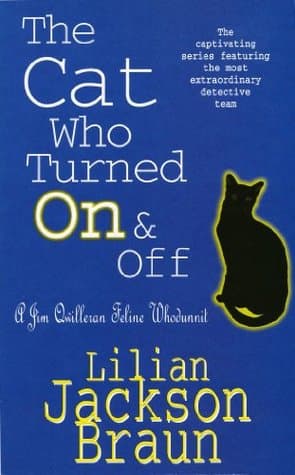
Jim Qwilleran, a reporter known for his distinctive mustache and his brilliant Siamese cat, Koko, has moved into a new apartment in a converted apple warehouse. The move is partly to accommodate his expanding household, which now includes a new, charming female Siamese cat named Yum Yum. Qwilleran adjusts to his new living space and the added feline presence, while Koko, ever the discerning observer, takes stock of the changes. Qwilleran's editor, Arch Riker, assigns him a new feature series focusing on the eccentricities and characters of Junktown, a nearby district known for its antique shops and unusual residents, a task Qwilleran approaches with skepticism and curiosity.
Exploring Junktown
Qwilleran starts his research into Junktown, initially expecting to find a seedy underbelly. Instead, he discovers a community of antique dealers, collectors, and artists. He meets various individuals, including the wealthy and influential antique dealer, Mr. George Bonifield Mountclemens, often referred to as 'The Mount.' Qwilleran also encounters Miss Minya, a reclusive junk dealer, and other quirky personalities who populate the district. Koko, meanwhile, displays an unusual fascination with certain objects and sounds, particularly electrical appliances, often turning them on and off, a behavior that Qwilleran initially dismisses as mere feline playfulness but will later prove significant.
The Mysterious Death of Mountclemens
The peaceful facade of Junktown is shattered when George Bonifield Mountclemens, 'The Mount,' is found dead at the bottom of a flight of stairs in his antique shop. The official ruling is an accidental fall, but Qwilleran, having observed the man's meticulous nature and the circumstances, suspects foul play. He begins to subtly investigate, questioning the residents of Junktown and trying to piece together the events leading up to Mountclemens's death. Koko's unusual behavior, particularly his obsession with electrical switches and outlets, continues, sometimes frustrating Qwilleran, but also drawing his attention to details he might otherwise overlook.
Koko's Peculiar Habits
Koko's habit of turning electrical devices on and off becomes more pronounced and puzzling. He repeatedly manipulates light switches, radios, and televisions, often with a deliberate, almost investigative air. Qwilleran finds himself both amused and annoyed by Koko's antics, sometimes scolding the cat for interfering with his work or sleep. However, Koko's actions also draw Qwilleran's attention to the subtle hum of electricity, the placement of wires, and the overall electrical infrastructure of his apartment and the places he visits in Junktown, inadvertently preparing him to notice similar details in the murder investigation.
Uncovering Motives and Suspects
As Qwilleran continues his investigation, he uncovers various potential motives for Mountclemens's murder. He learns that Mountclemens was a wealthy man with a significant will, and several individuals stood to benefit from his death. He also discovers that Mountclemens had a reputation for being shrewd, sometimes ruthless, in his business dealings, making enemies along the way. Qwilleran interviews Mountclemens's estranged family members, business associates, and Junktown neighbors, each providing a piece of the puzzle, but no clear suspect emerges immediately. The complexity of Mountclemens's life and relationships makes the investigation challenging.
The Role of Antiques
Qwilleran begins to suspect that the antique trade itself, and perhaps a specific valuable antique, might be central to the murder. He revisits Mountclemens's shop and other antique stores in Junktown, paying closer attention to the inventory and the interactions between dealers. He learns about the high stakes involved in collecting and selling rare items, and the intense rivalries that can develop. Koko, accompanying Qwilleran on some of these visits, shows an uncanny interest in certain objects, particularly those with hidden compartments or unusual mechanisms, further fueling Qwilleran's growing conviction that the murder is linked to the world of antiques.
Koko's Clues and Qwilleran's Deductions
Qwilleran starts to recognize that Koko's seemingly random actions are, in fact, deliberate clues. Koko's obsession with turning things on and off, his sniffing at electrical outlets, and his specific reactions to certain individuals or objects begin to form a pattern. Qwilleran recalls Koko's past instances of solving crimes and pays closer attention. He deduces that Koko is trying to communicate something about electricity, power, and perhaps a deliberate manipulation of these elements related to Mountclemens's death. This realization marks a turning point in Qwilleran's investigation, as he shifts from conventional reporting to a more intuitive, Koko-led approach.
The Electrical Connection
Following Koko's lead, Qwilleran focuses his attention on the electrical wiring and devices in Mountclemens's shop, particularly the area around the stairs where the body was found. He re-examines the scene with a new perspective, looking for anything out of place or manipulated. He considers the possibility of a rigged electrical device or a short circuit designed to cause an accident. Koko's insistent pawing at a particular electrical outlet near the stairs confirms Qwilleran's suspicions, suggesting that the electrical system was not just a backdrop but an active participant in the crime.
The Trap is Revealed
Qwilleran, with Koko's persistent guidance, eventually uncovers the ingenious and diabolical method used to murder Mountclemens. The killer had rigged a faulty electrical connection near the top of the stairs, designed to deliver a non-lethal but powerful shock when touched, causing Mountclemens to lose his balance and fall to his death. The trap was meticulously disguised to appear as an accidental electrical malfunction. Koko's sensitivity to electrical currents and his repeated attempts to 'turn off' the danger were his way of signaling the presence of this deadly mechanism. Qwilleran marvels at the cat's intelligence and his own initial blindness.
Confrontation and Resolution
Armed with Koko's undeniable clues and his own deductions, Qwilleran identifies the killer as one of the seemingly innocuous residents of Junktown, driven by a combination of greed and resentment over a valuable antique or a past business slight. Qwilleran confronts the killer, presenting the evidence of the electrical trap. The killer, realizing their scheme has been exposed, confesses or is apprehended based on Qwilleran's findings. The mystery of Mountclemens's death is finally solved, bringing justice to Junktown and solidifying Qwilleran's reputation as a detective, always with Koko by his side.
Aftermath and Reflection
With the Junktown murder case closed, Qwilleran reflects on the bizarre events and the extraordinary role his Siamese cats played in solving it. He acknowledges that without Koko's peculiar habit of 'turning on and off' and his acute sensitivity to electrical currents, the ingenious murder plot might never have been uncovered. Qwilleran finds a deeper appreciation for Koko's intelligence and the unique, unspoken communication they share. He also enjoys the comforting presence of Yum Yum, who adds a new dimension of feline charm to his life. The experience reinforces his belief in the unexpected wisdom found in the animal kingdom and the rich, often hidden, stories within seemingly ordinary communities like Junktown.
Principal Figures
Jim Qwilleran
Protagonist
A perceptive, mustachioed reporter with an uncanny knack for stumbling into mysteries.
Jim Qwilleran is a seasoned newspaper reporter, known for his distinctive mustache and a cynical yet observant nature. He possesses a dry wit and a deep, if sometimes begrudging, affection for his Siamese cats. Qwilleran is initially skeptical of the supernatural or overly complex explanations, preferring logical deductions, but he has learned to trust Koko's inexplicable insights. He approaches his assignments with a blend of professional curiosity and personal detachment, which often dissolves when he senses injustice or a deeper mystery. His drive is to uncover the truth, often fueled by Koko's silent guidance.
Relationships: Koko (Owner and crime-solving partner; a deep, telepathic-like bond.); Yum Yum (New adoptive owner; a charming, affectionate companion.); Arch Riker (Editor; professional relationship, Riker assigns Qwilleran his stories.)
Koko (Ko Ko Mo)
Co-Protagonist
A brilliant Siamese cat with an extraordinary ability to solve crimes.
Koko is Jim Qwilleran's highly intelligent and intuitive Siamese cat. He is the true detective of the duo, possessing an uncanny ability to notice subtle details, link disparate clues, and communicate his findings to Qwilleran through specific behaviors, purrs, and meows. In this story, his particular fascination with turning electrical devices on and off proves to be a crucial element in solving the murder. Koko is discerning, sometimes aloof, but fiercely loyal and dedicated to Qwilleran's well-being. He is driven by an innate sense of justice and an acute awareness of his surroundings.
Relationships: Jim Qwilleran (Owner and crime-solving partner; a deep, telepathic-like bond.); Yum Yum (Companion cat; often plays with and occasionally tolerates her.)
Yum Yum
Supporting
A charming and affectionate female Siamese cat, adding warmth and balance to Qwilleran's home.
Yum Yum is a beautiful, gentle, and affectionate female Siamese cat adopted by Qwilleran. She provides a calming and loving presence in Qwilleran's new apartment, often contrasting with Koko's more intense and focused demeanor. While not a detective like Koko, Yum Yum's presence brings a sense of domesticity and comfort, and her interactions with Qwilleran and Koko highlight the unique personalities of the feline companions. She is driven by comfort, affection, and the simple joys of being a cherished pet.
Relationships: Jim Qwilleran (Owner; a source of comfort and affection.); Koko (Companion cat; often plays with and is sometimes protected by Koko.)
George Bonifield Mountclemens ('The Mount')
Victim
A wealthy and influential antique dealer in Junktown, whose suspicious death sets the plot in motion.
George Bonifield Mountclemens, known as 'The Mount,' is a prominent and wealthy antique dealer in Junktown. He is a key figure in the community, respected for his knowledge and collection, but also known for being shrewd, meticulous, and potentially having a ruthless streak in his business dealings. His death, initially ruled an accident, is the central mystery of the novel. He is driven by wealth, status, and the acquisition of valuable antiques, which ultimately leads to his demise. His character is revealed through the perspectives and testimonies of other Junktown residents.
Relationships: Jim Qwilleran (Subject of Qwilleran's investigation after his death.); Miss Minya (Fellow antique dealer; a complex, competitive relationship.)
Miss Minya
Supporting
An eccentric and reclusive junk dealer in Junktown.
Miss Minya is an elderly, reclusive, and eccentric junk dealer who operates a shop in Junktown. She is one of the colorful characters Qwilleran interviews during his investigation. Her shop is overflowing with discarded items, and she possesses a deep, if sometimes unusual, knowledge of the district's history and its inhabitants. She is driven by her love for collecting and her quiet, independent lifestyle, and her interactions with Qwilleran provide valuable insights into the Junktown community and its secrets, though she often speaks in riddles or cryptic remarks.
Relationships: Jim Qwilleran (Interviewee and source of cryptic information.); George Bonifield Mountclemens (Fellow antique dealer; their relationship is hinted at as competitive or strained.)
Arch Riker
Supporting
Qwilleran's newspaper editor, who assigns him the Junktown feature series.
Arch Riker is Qwilleran's editor at the newspaper. He is a pragmatic and professional figure, focused on getting good stories for the paper. Riker assigns Qwilleran the Junktown feature series, initiating the entire plot. While he doesn't directly participate in the detective work, his assignments consistently place Qwilleran in situations where mysteries unfold. He is driven by the demands of his job and the desire to produce engaging content for his readers. He provides the initial impetus for Qwilleran's involvement in the Junktown community.
Relationships: Jim Qwilleran (Editor-reporter; professional working relationship.)
Themes & Insights
The Hidden Intelligence of Animals
This theme explores the underestimated intelligence of animals, particularly cats. Koko's ability to 'turn on and off' electrical devices is not merely a cute quirk but a deliberate and crucial method of communication, guiding Qwilleran to the electrical trap. The story emphasizes that animals perceive and interact with the world in ways humans often overlook, and their insights can be invaluable. This is evident when Qwilleran initially dismisses Koko's behavior as play but later realizes its significance in exposing the murder method.
“It was as if Koko had a sixth sense for wires and currents, a silent language only he could speak, and Qwilleran, slowly but surely, was learning to interpret its grammar.”
Appearances vs. Reality
The novel highlights the deceptive nature of appearances. Junktown, initially dismissed by Qwilleran as a potential 'dope den,' turns out to be a community of antique dealers and eccentrics. Similarly, the 'accidental' death of Mountclemens is revealed to be a carefully orchestrated murder. Characters, too, often present a facade that hides their true motives or natures. This theme encourages readers to look beyond the surface and question initial impressions, a lesson Qwilleran himself often has to relearn.
“Junktown wasn’t a dope den, as Qwilleran had half-expected. It was a haven for collectors, a bazaar of forgotten treasures, and a nest of human oddities. Appearances, as always, were deceiving.”
The Value of the Overlooked
This theme appears in several ways. Qwilleran's initial dismissal of Junktown as a place of value, only to discover its rich history and unique inhabitants, is one example. More importantly, Koko's seemingly trivial habit of turning things on and off is overlooked by Qwilleran until it becomes the key to solving a murder. The story suggests that what humans often discard, ignore, or deem insignificant – be it old objects, eccentric people, or animal behaviors – can hold importance and hidden value, waiting to be recognized.
“Qwilleran had learned, over the years, that the most important clues often came from the most unexpected, and seemingly insignificant, sources. Especially if that source had four paws and whiskers.”
Community and Eccentricity
The Junktown community is a microcosm of eccentric characters, each with their own quirks, secrets, and interconnected histories. The novel celebrates these unique personalities and the sense of community that, despite rivalries and suspicions, binds them together. Qwilleran's exploration of Junktown reveals how these individuals, though unusual, contribute to the district's distinct charm and complexity. The theme explores how different personalities coexist and interact within a defined geographical and social space.
“Every antique shop had its own aroma, its own history, and its own eccentric proprietor. Junktown was a symphony of oddities, and Qwilleran found himself, surprisingly, enjoying the music.”
Plot Devices & Literary Techniques
The Animal as Detective
A recurring device where Koko's unique abilities drive the plot.
Koko's intelligence and specific behaviors are not just charming embellishments but are integral to the plot's progression. In this novel, his unusual habit of turning electrical devices on and off directly leads Qwilleran to understand the nature of the murder weapon. Koko acts as a non-verbal detective, providing clues through his actions that Qwilleran must observe and interpret, making him an indispensable partner in solving the mystery. This device subverts traditional detective tropes by giving agency and crucial insight to a non-human character.
The Red Herring
Misleading clues or suspects designed to divert the reader and Qwilleran.
The novel employs several red herrings to complicate the investigation into Mountclemens's death. The initial ruling of an 'accidental fall' is a primary red herring, as are various individuals with plausible motives (e.g., beneficiaries of the will, business rivals). These diversions lead Qwilleran down false paths, increasing the suspense and making the true solution more satisfying when revealed. The purpose is to keep the reader guessing and to highlight Qwilleran's process of sifting through misinformation.
The Eccentric Supporting Cast
A collection of quirky, memorable characters who populate the setting and offer clues.
The residents of Junktown—from Miss Minya to other antique dealers and collectors—form a vibrant and eccentric supporting cast. Each character has unique mannerisms, secrets, and connections to the victim. They provide Qwilleran with pieces of information, often in cryptic or roundabout ways, that help him build a picture of Mountclemens's life and the community's dynamics. Their quirks add flavor to the story and serve to deepen the mystery by offering multiple perspectives and potential avenues of inquiry.
The 'Turning On and Off' Motif
A specific, repeated action by Koko that serves as a symbolic and literal clue.
Koko's titular habit of 'turning on and off' electrical devices is more than a character trait; it's a central plot device. Initially perceived as mischievous behavior, it becomes a direct, symbolic, and literal clue about the electrical nature of the murder weapon. This motif draws attention to electricity and its potential for harm, guiding Qwilleran's focus to the rigged electrical trap. It's a unique and clever way to integrate the animal detective's abilities directly into the mechanics of the crime.
The Cat Who Turned On and Off Quotes
“Koko was an extraordinary cat, even for a Siamese. He had a sixth sense about crime, and an uncanny knack for knowing when a light switch needed to be flipped.”
“The trouble with mysteries, Qwill often thought, was that they rarely stayed confined to the pages of a book. They had a way of spilling out into real life, demanding solutions.”
“You can tell a lot about a person by the way they treat their animals.”
“Koko had a way of looking at you, not just with his eyes, but with his whole being, as if he understood every word you said, and probably more.”
“Silence, Qwill had learned, was often a more eloquent speaker than words, especially when a Siamese cat was involved.”
“There's nothing quite like a good book, a comfortable chair, and a purring cat to make the world seem right.”
“Curiosity, while sometimes fatal to cats, was often essential for journalists.”
“The scent of a good mystery was as intoxicating as a fine wine, and just as hard to resist.”
“Sometimes, the most obvious answer was the one you overlooked.”
“Koko's tail was an expressive instrument, capable of conveying a wide range of emotions, from mild interest to outright indignation.”
“A reporter without a nose for news was like a cat without whiskers – severely handicapped.”
“Justice, like good coffee, was best served hot and fresh.”
“The world was full of secrets, and some of them were buried right under your nose.”
“Koko's purr was a comforting rumble, a vibration that seemed to smooth out the wrinkles of the day.”
Quiz
10 questions on the plot and the characters. Each answer comes with a short explanation.
Question 1
What new character is added to Qwilleran's household in 'The Cat Who Turned On and Off'?
- A new human assistant
- A male Siamese cat named Kao
- A female Siamese cat named Yum Yum
- A dog named Sherlock
Show answer
C. A female Siamese cat named Yum Yum The book description explicitly mentions 'an adorable female Siamese, Yum Yum, added to the household.'
Question 2
What is Qwilleran's initial expectation for Junktown when he decides to do a feature series on it?
- A bustling financial district
- A quiet residential area
- A dope den
- A new art gallery district
Show answer
C. A dope den The text states, 'Not the dope den he anticipated, Junktown is a haven for antique dealers and collectors.'
Question 3
What kind of people does Qwilleran primarily find inhabiting Junktown?
- Students and academics
- Antique dealers and collectors
- Farmers and agricultural workers
- Musicians and artists
Show answer
B. Antique dealers and collectors The description specifies that 'Junktown is a haven for antique dealers and collectors.'
Question 4
What event sparks Qwilleran's conviction that foul play is involved in Junktown?
- A series of robberies targeting antique shops
- A mysterious fire at a collector's home
- A mysterious fall ending the life of a leading citizen
- The disappearance of a valuable antique
Show answer
C. A mysterious fall ending the life of a leading citizen The text states, 'When a mysterious fall ends the career -- and the life -- of one of Junktown's leading citizens, Qwilleran is convinced it was no accident.'
Question 5
Who ultimately proves Qwilleran's suspicions correct regarding the mysterious death in Junktown?
- Qwilleran's editor
- Koko, the Siamese cat
- Yum Yum, the new Siamese cat
- A local police detective
Show answer
B. Koko, the Siamese cat The description concludes with, 'But, as usual, it takes Koko to prove he's right.'
Question 6
What is a distinguishing physical characteristic of Qwilleran, the reporter?
- His distinctive eyeglasses
- His perceptive moustache
- His collection of unusual hats
- His perpetually rumpled suit
Show answer
B. His perceptive moustache Qwilleran is described as 'the reporter with the perceptive moustache.'
Question 7
How does the description characterize the group of antique dealers and collectors Qwilleran encounters in Junktown?
- They are a very welcoming and open community.
- They are a rather ordinary and predictable group.
- They are as strange a lot as the crafty reporter has ever encountered.
- They are highly organized and secretive.
Show answer
C. They are as strange a lot as the crafty reporter has ever encountered. The text states that the antique dealers and collectors are 'as strange a lot as the crafty reporter has ever encountered.'
Question 8
What is the primary theme suggested by Qwilleran's investigation into Junktown?
- The glamour of high society
- The deceptive nature of appearances and hidden truths
- The importance of urban development
- The simplicity of small-town life
Show answer
B. The deceptive nature of appearances and hidden truths Qwilleran initially expects a 'dope den' but finds a 'haven for antique dealers,' and the 'mysterious fall' is not an accident, highlighting that things are not always as they seem.
Question 9
What role does Koko's 'turning on and off' ability, as suggested by the title, likely play in the mystery?
- It refers to his ability to control electrical appliances.
- It symbolizes his unpredictable mood swings.
- It implies a unique perceptive ability or intuition that aids in solving the crime.
- It describes his habit of falling asleep and waking up suddenly.
Show answer
C. It implies a unique perceptive ability or intuition that aids in solving the crime. Given Koko's role in 'proving Qwilleran right' and the mystery genre, 'turning on and off' likely refers to a special insight or ability to perceive things others miss, rather than a literal action.
Question 10
Based on the description, what is the dynamic between Koko and Qwilleran in solving mysteries?
- Qwilleran solves the mystery independently, with Koko as a pet.
- Koko provides the crucial, often overlooked, clues or insights that Qwilleran then pieces together.
- They work as equals, sharing investigative duties.
- Qwilleran misinterprets Koko's actions, leading him astray.
Show answer
B. Koko provides the crucial, often overlooked, clues or insights that Qwilleran then pieces together. The text states, 'But, as usual, it takes Koko to prove he's right,' indicating Koko's role is to provide the final, decisive evidence or insight that validates Qwilleran's suspicions.
The Cat Who Turned On and Off FAQ
What is the central mystery Qwilleran investigates in 'The Cat Who Turned On and Off'?
Qwilleran investigates the suspicious death of David Lyke, a prominent antique dealer and collector in Junktown. Initially ruled an accidental fall, Qwilleran suspects foul play due to Lyke's intricate and valuable collections, and the unusual circumstances surrounding his demise.
Who are the main feline characters introduced or featured prominently in this installment?
The brilliant Siamese cat, Koko, and his human companion, Jim Qwilleran, are the primary duo. This book also introduces Yum Yum, an adorable female Siamese kitten, who becomes a permanent member of Qwilleran's household and adds a new dynamic to their lives.
What is 'Junktown' and why does Qwilleran decide to focus his reporting on it?
Junktown is a district initially perceived by many, including Qwilleran, as a potential den of illicit activity. However, Qwilleran discovers it's actually a vibrant haven for antique dealers, collectors, and eccentrics, making it a fascinating subject for his newspaper feature series.
How does Koko contribute to solving the mystery of David Lyke's death?
Koko's unique ability to 'turn on and off' (his peculiar habit of staring intently or ignoring things) combined with his uncanny knack for knocking over specific objects or reacting to certain individuals provides crucial clues. He often draws Qwilleran's attention to details or people that prove significant to the case.
Who is David Lyke and what makes his death particularly suspicious to Qwilleran?
David Lyke is a wealthy and reclusive antique dealer in Junktown known for his vast and valuable collections. Qwilleran finds his death suspicious because of Lyke's meticulous nature, the high value of his possessions, and the number of people who might have had a motive to see him gone.
What is the significance of the phrase 'turned on and off' in the title?
The phrase refers to Koko's distinctive behavior where he sometimes appears intensely focused and 'on' (often leading to a clue) and other times seems completely detached or 'off.' This peculiar trait is a key part of his personality and how he indirectly communicates insights to Qwilleran.
Are there any subtle clues early in the book that hint at the true nature of Junktown, beyond Qwilleran's initial assumptions?
Yes, Qwilleran's initial encounters with some of the residents, even before the death, suggest a community of quirky individuals with deep knowledge of art and antiques, rather than the expected criminal element. Their passion for collecting hints at the area's true character.
How does Yum Yum's presence subtly alter the dynamic between Koko and Qwilleran?
Yum Yum's arrival introduces a nurturing aspect to Koko, as he often looks out for her, and adds a layer of domesticity and warmth to Qwilleran's previously solitary life. Her playful energy also sometimes distracts or amuses Koko, showcasing a different side of his personality.
What role do some of the eccentric Junktown residents, like the antique dealers, play in the unfolding mystery?
The diverse cast of antique dealers and collectors in Junktown provide a rich pool of suspects, witnesses, and red herrings. Their unique personalities, rivalries, and specialized knowledge of various artifacts often provide Qwilleran with crucial background information or potential motives.
How does Qwilleran's personality and journalistic approach influence his investigation?
Qwilleran's inherent curiosity, keen observation skills, and willingness to immerse himself in a community (even one he initially misjudges) are central to his investigative success. His journalistic instinct to interview and document allows him to gather information others might overlook.
What psychological traits make Koko such an effective detective, despite being a cat?
Koko's effectiveness stems from his hyper-observant nature, his sensitivity to subtle changes in environment or human behavior, and his ability to focus on seemingly insignificant details. His lack of human preconceptions allows him to react purely to sensory input, which Qwilleran learns to interpret.
How does the author use the setting of Junktown to explore themes of value and perception?
Junktown, initially dismissed as 'junk,' is revealed to be full of valuable antiques and hidden treasures. This mirrors how people (like David Lyke) are often misjudged, and how true value, whether material or human, requires a deeper, more perceptive look beyond initial impressions.
What is the psychological impact of Yum Yum's arrival on Koko, a cat known for his singular focus?
Yum Yum's arrival forces Koko to adapt and share his space and Qwilleran's attention. While initially a disruption, it ultimately expands Koko's emotional repertoire, demonstrating a capacity for protective instincts and companionship beyond his usual investigative intensity.
Could David Lyke's death be interpreted as a commentary on the dangers of obsession and reclusiveness?
Yes, Lyke's intense reclusiveness and single-minded obsession with his collections made him vulnerable and created an environment where his death could easily be mistaken for an accident. His isolation also meant fewer people were truly looking out for him.
Is the 'turning on and off' merely a quirky cat behavior, or does it represent something deeper about Koko's intelligence?
It's both. While a quirky behavior, it symbolizes Koko's unique cognitive process. It suggests he's not always processing information in a linear, human way, but rather has moments of intense insight ('on') followed by periods of internal processing or disengagement ('off') that Qwilleran must learn to decipher.
How does the book challenge stereotypes about urban environments through its depiction of Junktown?
The book challenges the stereotype that 'rundown' or 'gritty' urban areas are inherently dangerous or devoid of culture. Junktown, despite its name, is presented as a vibrant community rich in history, art, and eccentric characters, subverting initial expectations.
What is the enduring appeal of the Koko and Qwilleran partnership, particularly in this installment with Yum Yum?
Their appeal lies in the unique blend of human intellect and feline intuition, and the humor derived from Qwilleran's attempts to understand Koko. Yum Yum's addition further enriches this by introducing a family dynamic, adding warmth and new dimensions to their established routine.
Does the book suggest that animal intuition can be more reliable than human deduction in certain circumstances?
The book strongly suggests that animal intuition, particularly Koko's, offers a different, often purer, form of insight unclouded by human biases or complex reasoning. While Qwilleran provides the deduction, Koko frequently provides the initial, unadulterated 'clues' that point him in the right direction.
Similar books
- THE MURDER OF ROGER ACKROYD
Agatha Christie
4.2 (153k) average on GoodreadsThrillerChristie's novel relies on the purely human intellectual prowess of Hercule Poirot and intricate, often shocking, plot twists, focusing on a more cerebral puzzle. Braun's novel, in contrast, offers a gentler, more intuitive mystery, with a feline detective, prioritizing character comfort and atmosphere over complex psychological games or shocking reveals. While both are mysteries, Christie's is more about intellectual challenge, Braun's about charming companionship.
- Angels & Demons
Dan Brown
3.9 (2.7M) average on GoodreadsThrillerA Harvard symbologist races through Rome's ancient sites, deciphering cryptic clues to unmask the Illuminati and stop a vengeful plot to destroy the Vatican with a stolen antimatter weapon.
- Gone Girl
Gillian Flynn
4.1 (2.3M) average on GoodreadsThrillerA wife's sudden disappearance on her fifth anniversary reveals a web of lies and psychological warfare, exposing the secrets within a seemingly perfect marriage.
- The Girl on the Train
Paula Hawkins
3.9 (2.1M) average on GoodreadsThrillerA woman’s fascination with a seemingly perfect couple she watches from her daily train commute leads her into a dark investigation when she witnesses something that shatters their idyllic image.
- The Lovely Bones
Alice Sebold
3.8 (2M) average on GoodreadsFantasyA murdered teenage girl watches from the afterlife as her family struggles with grief and her killer remains free, wanting to bridge the gap between worlds to bring him to justice.
- The Da Vinci Code
Dan Brown
3.9 (1.9M) average on GoodreadsThrillerA symbologist and a cryptologist race through European landmarks, deciphering ancient codes and uncovering a conspiracy that could rewrite the foundations of Christianity.





Enjoyed the summary?
A summary gives you the shape of the book. The book itself has the detail, the examples and the voice.
Find The Cat Who Turned On and Off on AmazonAs an Amazon Associate, BookBrief earns from qualifying purchases. How we're funded