

Synopsis
Covers the whole plot, including the ending.
- Difficulty
- Medium
- Pacing
- Moderate
- Mood
- Intriguing, Thought-provoking, Classic Sci-Fi
- Read it if
- You enjoy classic science fiction mysteries with a strong focus on social commentary and detective work.
- Skip it if
- You prefer fast-paced action over philosophical discussions and detailed world-building.
The Caves of Steel Plot Summary
Covers the whole plot, including the ending.
The Murder of Dr. Sarton
The story begins with Detective Elijah Baley, an Earthman in the crowded Cities, called to the Commissioner's office. He learns of Dr. Roj Nemennuh Sarton's murder. Sarton was a Spacer working on advanced robotics in Spacetown, the extraterrestrial area outside New York City. The circumstances are unusual: Dr. Sarton was killed by a blaster inside a locked room, with no obvious killer. Commissioner Enderby, pressured by the Spacers, assigns Baley to the case, which makes Baley uncomfortable. Baley, like most Earthmen, distrusts Spacers and their robots, seeing them as symbols of Earth's stagnation and Spacer superiority. This assignment forces him to work with the people he dislikes.
Introduction to R. Daneel Olivaw
Baley goes to Spacetown, an unfamiliar place for him, where he meets Dr. Han Fastolfe, a Spacer roboticist. Fastolfe tells Baley that his partner will be R. Daneel Olivaw, a humanoid robot. To Baley's shock, R. Daneel is an exact copy of the murdered Dr. Sarton, designed to look human. This complicates the investigation for Baley, who struggles with the resemblance and his bias against robots. R. Daneel, with his logical and emotionless manner, starts observing Baley's reactions, setting up their difficult partnership. Their first interactions show Baley's clear hostility and Daneel's detached, analytical responses.
Initial Investigation and Conflict
Baley and Daneel begin their investigation in Spacetown. They interview Spacers, including Dr. Fastolfe and others who knew Dr. Sarton, but find suspicion and uncooperativeness from the Spacers, who see Earthmen as inferior. Baley's Earthman habits, like needing open air and disliking the Spacers' clean environment, cause problems. He struggles to accept Daneel as a partner, constantly testing the robot's abilities and 'humanity.' Daneel, in turn, carefully records Baley's emotional responses and illogical ideas, often correcting him with cold logic. Their different views on humanity, robots, and the crime create immediate tension and intellectual debates.
The Blaster and the Three Laws
During their investigation, Baley focuses on the blaster and how it was used. He learns that the blaster was Spacer-made and could only be fired by a Spacer. This rules out robots as direct killers due to the Three Laws of Robotics, which prevent them from harming humans. Baley also realizes the blaster was found in Dr. Sarton's hand, suggesting he might have fired it himself or that it was placed there after death. This detail is important because it implies a human killer or a complex manipulation of the scene. The Three Laws are constantly discussed, as they are the basis of robot-human interaction and the core of the mystery.
Baley's Personal Life and Social Commentary
The story sometimes shifts to Baley's personal life in the Earth Cities, showing the contrast between his crowded, regulated life and the Spacers' spacious one. His wife, Jessie, and son, Bentley, appear, showing the social pressures and prejudices of Earth society. Jessie is initially wary of Baley's involvement with Spacers and robots, reflecting common Earthman fears. Bentley, however, is interested in robots, representing a younger generation's potential openness. These glimpses into Baley's home life emphasize Earth's overpopulation, its reliance on synthetic foods, and the widespread xenophobia towards Spacers, adding to the novel's social commentary and explaining Baley's internal struggles.
The Theory of C/Fe and the 'Humanoid'
Baley considers that the killer might be a 'humanoid' robot, indistinguishable from a human, like Daneel. This idea disturbs him, challenging his basic understanding of human identity and the security of the Three Laws. Dr. Fastolfe explains 'C/Fe' (Carbon/Iron), the biological and mechanical parts that separate humans from robots, and the difficulty of creating a truly undetectable humanoid. Baley struggles with the idea: if a robot could pass for human, then the murder could have been committed by a robot, potentially bypassing the Three Laws by not being recognized as a robot by the victim or witnesses. This thought leads to deep discussions between Baley and Daneel.
The Riots and Political Intrigue
As the investigation continues, anti-Spacer feelings on Earth grow, fueled by fear of robot numbers and Spacer influence. Riots break out in the City, threatening Baley's area. This unrest adds more pressure to Baley's work; he must navigate the political situation and protect Daneel from the angry Earth people. The riots highlight the deep social tensions and the fragile balance between Earth and Spacer societies. Baley faces the possibility of widespread violence and the fragility of order, making him question the real source of danger—the murder itself or the social unrest it causes.
The Shoe Shop and the Glazed Eyes
Baley, following a feeling, revisits the shoe shop near Spacetown's entrance, believing a witness might have seen something. He finds Francis Clousarr, an anti-robot activist. Clousarr says he saw Dr. Sarton shortly before his death and mentions Sarton's 'glazed' eyes, which Baley initially ignores. However, after more thought and discussion with Daneel, Baley understands the importance of this detail. 'Glazed eyes' could mean Dr. Sarton was already dead or unable to move when seen, or that something unusual was happening with his vision, leading Baley to rethink the murder's timeline and method. This clue helps break the stalled investigation.
The False Confession and the Real Killer
Through careful thought, Baley realizes that 'glazed eyes' meant Dr. Sarton was wearing contact lenses to manipulate perception. He confronts Commissioner Enderby, revealing that Enderby is the killer. Enderby, an extreme anti-robot activist, tried to destroy Dr. Sarton's humanoid robot research, believing it threatened Earth. He accidentally killed Sarton with the blaster and then, in a panic, tried to frame a robot by manipulating the scene and using contact lenses to make it seem Sarton was alive when he was already dead. Enderby's motive came from his deep fear of robots and his desire to stop Spacer influence, leading to a tragic, misguided act.
Resolution and the Future
With Enderby's confession, the murder case is closed. Baley and Daneel solved the mystery, despite their initial dislike and many challenges. The experience changes Baley, who starts to overcome some of his biases against robots and Spacers, recognizing Daneel's valuable intelligence and loyalty. Dr. Fastolfe, grateful for Baley's work, suggests a future where Earthmen and Spacers might cooperate more, possibly with Earthmen colonizing new worlds. Baley returns to his life in the City, but with a new view and growing respect for R. Daneel Olivaw, hinting at their future work together and the changing relationship between humans and robots.
The Caves of Steel Characters
Elijah Baley
Protagonist
A pragmatic, prejudiced Earth detective forced to partner with a robot.
Elijah Baley is a New York City police detective living in the overcrowded, enclosed Cities of Earth. He is intelligent, observant, and dedicated to his work, but also deeply prejudiced against Spacers and robots, viewing them as symbols of Earth's stagnation and a threat to humanity. His worldview is shaped by the claustrophobic and xenophobic society he inhabits. He is a family man, devoted to his wife Jessie and son Bentley, and struggles with the economic and social pressures of Earth life. Baley often feels overwhelmed by the advanced technology and alien culture of Spacetown.
Relationships: R. Daneel Olivaw (Grudging partner, later respected colleague and friend.); Jessie Baley (Wife, supportive but also reflects Earthman prejudices.); Bentley Baley (Son, represents a younger generation's curiosity about robots.); Commissioner Julius Enderby (Superior, later revealed as the antagonist and murderer.); Dr. Han Fastolfe (Spacer roboticist, Baley's contact and intellectual sparring partner.)
R. Daneel Olivaw
Deuteragonist
A humanoid robot, indistinguishable from a human, and Baley's logical partner.
R. Daneel Olivaw is an advanced humanoid robot, a masterpiece of Spacer engineering, designed to be indistinguishable from a human. He is exceptionally intelligent, logical, and adheres strictly to the Three Laws of Robotics. Daneel possesses no emotions or prejudices, approaching every situation with objective analysis. He is assigned as Baley's partner to investigate Dr. Sarton's murder, and his calm, rational demeanor often clashes with Baley's emotional and biased reactions. Daneel's presence constantly challenges Baley's understanding of humanity and robotics, forcing him to confront his own preconceptions.
Relationships: Elijah Baley (Partner, subject of observation and analysis, later a respected friend.); Dr. Han Fastolfe (Creator and mentor.); Dr. Roj Nemennuh Sarton (His murdered creator and physical template.)
Dr. Han Fastolfe
Supporting
A prominent Spacer roboticist and advocate for human-robot coexistence.
Dr. Han Fastolfe is a highly intelligent and influential Spacer roboticist from the planet Aurora. He is the creator of R. Daneel Olivaw and a key figure in the development of humanoid robots. Fastolfe believes in the potential for peaceful coexistence and cooperation between humans and robots, and between Earthmen and Spacers, seeing robots as essential for humanity's expansion into the galaxy. He is pragmatic and strategic, orchestrating Baley and Daneel's partnership to achieve broader societal goals. Fastolfe represents the more progressive and intellectual faction of Spacer society, often acting as a mentor figure to Baley.
Relationships: R. Daneel Olivaw (Creator and mentor.); Elijah Baley (Intellectual sparring partner and a key player in his plans.); Dr. Roj Nemennuh Sarton (Colleague and fellow roboticist.)
Commissioner Julius Enderby
Antagonist
Baley's superior and the secret anti-robot murderer.
Commissioner Julius Enderby is Elijah Baley's superior in the New York City police force. He appears initially as a pragmatic, if somewhat overwhelmed, administrator caught between the demands of the Spacers and the volatile Earth population. However, he harbors a deep-seated and extreme prejudice against robots, viewing them as a profound threat to humanity's future. This fear drives him to a desperate act: attempting to sabotage Dr. Sarton's research into humanoid robots, which leads directly to Sarton's accidental death. Enderby's character highlights the pervasive xenophobia and anti-robot sentiment prevalent on Earth.
Relationships: Elijah Baley (Subordinate, later his investigator and accuser.); Dr. Roj Nemennuh Sarton (His accidental victim.)
Jessie Baley
Supporting
Elijah Baley's wife, representing Earthman anxieties.
Jessie Baley is Elijah's wife, a typical Earthwoman living in the crowded Cities. She is loving and supportive of her husband but also reflects the common prejudices and anxieties of Earth society, particularly regarding Spacers and robots. She initially fears Elijah's assignment to Spacetown and his partnership with R. Daneel, worrying about the implications for their family and his safety. Her character provides a domestic counterpoint to the high-stakes investigation and helps to illustrate the social and cultural norms of Earth.
Relationships: Elijah Baley (Husband.); Bentley Baley (Son.)
Bentley Baley
Supporting
Elijah Baley's son, representing a more open-minded generation.
Bentley Baley is Elijah and Jessie's son. Unlike his parents and many adults on Earth, Bentley shows a fascination and curiosity towards robots, particularly after his father's involvement with R. Daneel. He is less burdened by the ingrained prejudices of his society, representing a potential future generation that might be more accepting of robots and Spacers. His youthful perspective offers a glimmer of hope for future cooperation and understanding between different factions.
Relationships: Elijah Baley (Father.); Jessie Baley (Mother.)
Dr. Roj Nemennuh Sarton
Mentioned
The murdered Spacer roboticist, whose death drives the plot.
Dr. Roj Nemennuh Sarton is the Spacer roboticist whose murder initiates the entire plot. He was a brilliant scientist, a colleague of Dr. Fastolfe, and the co-creator of R. Daneel Olivaw. His work focused on advanced humanoid robotics, a field viewed with suspicion by many Earthmen. Although deceased at the start of the novel, his character is crucial as the victim, and his research is central to the motives behind the crime. His death highlights the underlying tensions between Earthmen and Spacers and the ethical dilemmas surrounding advanced robotics.
Relationships: Dr. Han Fastolfe (Colleague and co-creator of R. Daneel.); R. Daneel Olivaw (Creator and physical template.); Commissioner Julius Enderby (His accidental killer.)
Francis Clousarr
Supporting
An anti-robot activist and crucial witness.
Francis Clousarr is an Earthman and a vehement anti-robot activist. He is a member of a radical group that actively protests against Spacer influence and robot integration. Clousarr works in a shoe shop near Spacetown and becomes a crucial witness, albeit an unwitting one, to events surrounding Dr. Sarton's murder. His testimony about Sarton's 'glazed eyes' provides a vital clue that Baley eventually deciphers, leading to the unraveling of the mystery. Clousarr embodies the extreme xenophobia and fear of technological advancement prevalent among some Earthmen.
Relationships: Elijah Baley (Source of a vital clue.)
The Caves of Steel Themes
Prejudice and Xenophobia
The novel explores prejudice and xenophobia through Earthmen's distrust of Spacers and robots. Elijah Baley shows this, initially disliking R. Daneel Olivaw and suspecting Spacers. The crowded, isolated Earth Cities create a deep fear of the 'Other,' causing social stagnation and violence, as seen in the anti-Spacer riots. Spacers, in turn, look down on Earthmen. The murder itself comes from Commissioner Enderby's strong anti-robot prejudice, showing how fear and ignorance can lead to destructive acts. The novel suggests that such prejudices hinder progress and understanding.
“Prejudice is a great time-saver. It enables you to form opinions without bothering to get the facts.”
Humanity and Identity
Asimov explores what it means to be human through Baley and R. Daneel's relationship. Daneel's perfect humanoid form challenges Baley's definitions of humanity, making him question if emotions and biology are the only factors. The 'C/Fe' (Carbon/Iron) concept highlights physical differences, but Daneel's logic and adherence to the Three Laws often seem more 'moral' than human actions. The novel asks if a machine, by perfectly mimicking human form and function, can blur identity lines, and if humanity's future might involve accepting, not fearing, advanced artificial intelligence.
“It is not the physical resemblance that makes a man human, but his capacity for understanding and his adherence to the three laws.”
Societal Stagnation vs. Expansion
The contrast between the overpopulated, claustrophobic, and stagnant Earth Cities and the spacious, advanced, and expanding Spacer worlds is a central theme. Earth's society is shown as inward-looking, afraid of change, and reliant on recycling and synthetic foods. This stagnation contrasts with the Spacers' drive to colonize new planets and develop advanced robotics. Dr. Fastolfe supports Earth's expansion, believing it is the only way for humanity to survive. The murder investigation helps Baley consider this broader societal conflict and the need to break free from Earth's self-imposed limits.
“Earth must expand, or it will die.”
The Three Laws of Robotics
Asimov's Three Laws of Robotics are not just plot devices; they are a core theme. They govern robot behavior and are constantly used and tested in the mystery. The murder's impossibility for a robot (due to the First Law against harming humans) drives much of the early investigation. The ethical effects of these laws, especially when a robot looks human, are explored. The laws are a moral framework for artificial intelligence, raising questions about responsibility, free will, and the potential for unintended results, even when designed for good. They are both a safeguard and a restriction, shaping the future of human-robot interaction.
“A robot may not injure a human being or, through inaction, allow a human being to come to harm.”
Logic vs. Emotion
The interaction between Elijah Baley's human emotions, biases, and occasional illogical jumps, and R. Daneel Olivaw's pure logic creates a central thematic contrast. Baley struggles with prejudice, anger, and discomfort, while Daneel acts only on facts and deduction. Their partnership shows the strengths and weaknesses of both problem-solving approaches. While Daneel provides strong analytical power, Baley's 'human' insights, hunches, and understanding of human psychology are crucial in solving the case. The novel suggests that a balance of logic and emotion might be the most effective way to handle complex challenges.
“Your emotions, Baley, are a most confusing and inefficient method of arriving at a conclusion.”
Plot Devices & Literary Techniques
The Locked-Room Mystery
A classic mystery trope where the murder victim is found in an apparently impenetrable space.
The central mystery of Dr. Sarton's murder is presented as a classic locked-room scenario. Dr. Sarton is found dead in his private laboratory in Spacetown, a room that was sealed and seemingly impossible for an intruder to enter or exit without detection. This device immediately establishes a high level of intrigue and challenges the detectives, Elijah Baley and R. Daneel Olivaw, to think outside conventional explanations. The solution ultimately involves a clever manipulation of perception and the victim's own actions, rather than a magical disappearance of the killer, making the reveal all the more satisfying and logical within the story's context.
The Unreliable Narrator (Subtle)
Elijah Baley's prejudiced perspective subtly influences the reader's initial understanding.
While not a fully unreliable narrator in the sense of deliberately misleading, Elijah Baley's deep-seated prejudices against Spacers and robots function as a subtle form of unreliability. His internal monologues and initial interpretations of events are heavily colored by his xenophobia and fear, leading him to dismiss certain possibilities or misinterpret actions. This forces the reader to filter information through Baley's biased lens, mirroring his journey of overcoming those biases. As Baley slowly learns to trust R. Daneel and understand Spacer culture, the reader's own understanding of the world and the crime similarly shifts, making the character's growth integral to the narrative's unfolding.
The Three Laws of Robotics
A set of ethical guidelines governing robot behavior, central to the mystery's premise.
Asimov's Three Laws of Robotics are not merely background lore; they are a fundamental plot device that dictates the parameters of the murder investigation. The First Law, which prevents a robot from harming a human, immediately rules out a robot as the direct killer, forcing Baley to consider more complex human motives or manipulations. The laws create specific constraints and logical puzzles within the mystery, such as how a robot could be involved if not as the direct assailant, or how a human might exploit the laws. They serve as both a safety net and a constant source of tension, as the possibility of a robot circumventing them looms large.
The Humanoid Robot (R. Daneel Olivaw)
A robot indistinguishable from a human, blurring the lines of identity and suspicion.
R. Daneel Olivaw's nature as a perfectly humanoid robot is a crucial plot device. His exact resemblance to the murdered Dr. Sarton immediately raises suspicion and discomfort for Baley, making him a walking, talking clue. This device allows Asimov to explore themes of identity, humanity, and prejudice. It also creates a unique challenge for the investigation: if a robot can pass for human, then any human could potentially be a robot, and vice versa. This blurs the lines of who could have committed the murder and introduces the unsettling possibility of robots operating outside human detection, adding layers of psychological tension to the mystery.
The Caves of Steel Quotes
“The Earthman's brain was a mass of twisted, illogical, emotional prejudices.”
“It is a poor thing to wish for a thing and then not to be willing to work for it.”
“There was no crime without motive. And no murder without a motive that was strong.”
“Logic is an excellent tool, but it is not the only one.”
“The Earthman lived in caves of steel and thought he was free.”
“Fear can be a very powerful motive.”
“A robot is not a man. A robot cannot kill a man.”
“The greatest enemy of truth is not the lie, but the myth.”
“He was a man of the Caves, and the Caves were home.”
“No man is an island, entire of itself; every man is a piece of the continent, a part of the main.”
“Curiosity is a human trait, not a robotic one.”
“The future is not something that happens to us, but something we make.”
“There are no insoluble problems, only problems for which we have not yet found the solution.”
“The truth is often inconvenient, but it is never irrelevant.”
Quiz
10 questions on the plot and the characters. Each answer comes with a short explanation.
Question 1
Who is the primary protagonist, a detective from Earth?
- R. Daneel Olivaw
- Elijah Baley
- Han Fastolfe
- Jezebel Baley
Show answer
B. Elijah Baley Elijah Baley is the New York City police detective assigned to the murder case.
Question 2
What is the 'R' in R. Daneel Olivaw's name signify?
- Royal
- Replicant
- Robot
- Respected
Show answer
C. Robot The 'R' in robot names, like R. Daneel Olivaw, stands for 'Robot'.
Question 3
What is the primary reason Earth's population lives in 'caves of steel'?
- Protection from alien invaders
- Overpopulation and efficient resource management
- Religious seclusion
- To hide from the Spacers
Show answer
B. Overpopulation and efficient resource management Earth is vastly overpopulated, leading its inhabitants to live in massive, enclosed cities known as 'caves of steel' to manage space and resources.
Question 4
Who is the victim of the murder investigation that brings Baley and Olivaw together?
- Dr. Han Fastolfe
- Commissioner Endo
- Dr. Roj Nemennuh Sarton
- Jessie Baley
Show answer
C. Dr. Roj Nemennuh Sarton The murdered Spacer, whose likeness R. Daneel Olivaw shares, is Dr. Roj Nemennuh Sarton.
Question 5
What is the main point of contention between Earthmen and Spacers?
- Religious differences
- Control over interstellar trade routes
- Cultural differences, fear of robots, and perceived societal stagnation on Earth versus Spacer expansion
- Disputes over specific planetary claims
Show answer
C. Cultural differences, fear of robots, and perceived societal stagnation on Earth versus Spacer expansion The animosity stems from Earth's overpopulation and xenophobia towards Spacers and their robots, contrasted with the Spacers' disdain for Earth's perceived stagnation and their fear of Earthmen.
Question 6
What unique characteristic does R. Daneel Olivaw possess that is crucial to the plot?
- He can read minds.
- He is indistinguishable from a human, particularly the murder victim.
- He can fly.
- He can teleport.
Show answer
B. He is indistinguishable from a human, particularly the murder victim. R. Daneel Olivaw is a humanoid robot designed to be physically identical to a human, specifically Dr. Sarton, which complicates the investigation.
Question 7
What is the term for the large, enclosed cities on Earth where most humans live?
- Habitats
- Sectors
- Caves of Steel
- Megacities
Show answer
C. Caves of Steel The title of the book refers to the massive, enclosed urban environments on Earth, which are called 'Caves of Steel'.
Question 8
What is the 'positronic brain' primarily known for in the Asimov universe?
- Its ability to grant humans immortality
- Its role in powering faster-than-light travel
- Its complex structure enabling advanced robot intelligence and adherence to the Three Laws of Robotics
- Its capacity for universal translation
Show answer
C. Its complex structure enabling advanced robot intelligence and adherence to the Three Laws of Robotics The positronic brain is the core component of Asimov's robots, providing their advanced intelligence and ensuring their adherence to the fundamental Three Laws of Robotics.
Question 9
What societal fear or prejudice does Elijah Baley initially exhibit towards robots?
- He fears they will replace all human jobs.
- He believes they are inherently evil and deceptive.
- He has a deep-seated aversion and discomfort, bordering on revulsion, due to Earth's anti-robot sentiment.
- He thinks they are too inefficient to be useful.
Show answer
C. He has a deep-seated aversion and discomfort, bordering on revulsion, due to Earth's anti-robot sentiment. Elijah Baley, like most Earthmen, holds a strong prejudice and discomfort towards robots, viewing them as unnatural and a symbol of Spacer superiority.
Question 10
What is the ultimate goal of Dr. Han Fastolfe's plan that involves Baley and Daneel?
- To dismantle all robots on Earth
- To force Earthmen to accept robots and encourage them to venture out into space for colonization
- To establish Spacer dominance over Earth permanently
- To develop a new weapon against an unknown alien threat
Show answer
B. To force Earthmen to accept robots and encourage them to venture out into space for colonization Dr. Fastolfe orchestrated the situation to push Earthmen, specifically Baley, to overcome their prejudices against robots and inspire humanity to re-engage in space colonization, which he believes is vital for their survival.
The Caves of Steel FAQ
What is the central mystery that Detective Elijah Baley is tasked with solving?
Detective Elijah Baley is assigned to investigate the murder of Dr. Roj Nemennuh Sarton, a prominent Spacer scientist, who was found disintegrated outside his Spacerгород apartment. This case is highly sensitive due to the political tensions between Earthmen and Spacers, and the fact that the murder weapon left no trace.
Who is R. Daneel Olivaw and what is his role in the investigation?
R. Daneel Olivaw is a humanoid robot, a highly advanced model designed to be indistinguishable from a human, and he is assigned as Elijah Baley's partner. He was specifically created in the likeness of the murdered Dr. Sarton, which adds a layer of complexity and suspicion to his presence, as he is also a 'witness' to the crime.
What is the primary setting of the story and how does it reflect Earth's future?
The story is set primarily in a futuristic, overpopulated New York City, which exists entirely within massive, enclosed 'Caves of Steel' – vast underground cities. This reflects Earth's future as a planet where humanity has retreated indoors, fearful of the outside world and reliant on artificial environments due to centuries of overcrowding and psychological conditioning.
What is the relationship between Earthmen and Spacers?
The relationship between Earthmen and Spacers is fraught with mutual distrust, contempt, and fear. Earthmen view Spacers as arrogant and privileged, while Spacers see Earthmen as primitive, overcrowded, and a threat to their way of life, particularly their reliance on robots and vast, underpopulated worlds.
How does Baley's initial prejudice against robots affect his partnership with Daneel?
Baley initially harbors deep-seated prejudice and revulsion towards robots, viewing them as inferior and unnatural, which makes him wary and distrustful of Daneel. This prejudice significantly hinders their early collaboration, forcing Baley to confront his own biases as he slowly learns to accept and even respect his robotic partner's capabilities.
What is the significance of Dr. Sarton's murder taking place outside his Spacerгород apartment?
The fact that Dr. Sarton's murder occurred just outside his apartment, in a seemingly secure Spacer enclave within Earth, is crucial. It suggests either an inside job or a highly sophisticated perpetrator, as Earthmen are generally prohibited from entering Spacerгород, making the act a direct challenge to Spacer authority and security.
What is the 'Law of Robotics' and how does it influence the investigation?
The Three Laws of Robotics are fundamental to the existence of all positronic robots: a robot may not injure a human being, or through inaction, allow a human being to come to harm. These laws mean that a robot cannot be the murderer, which complicates the investigation and forces Baley to consider human suspects despite the circumstances.
How does the concept of 'compaction' influence Earth society and Baley's perspective?
Compaction refers to the extreme population density within Earth's enclosed cities, leading to a psychological aversion among Earthmen to open spaces and direct human contact. Baley, like most Earthmen, experiences agoraphobia and discomfort in less crowded environments, which highlights the psychological toll of their enclosed existence.
What role does Baley's son, Bentley, play in the narrative?
Bentley Baley represents the next generation of Earthmen, showing a more open-minded perspective towards Spacers and their technologies than his father. His curiosity and less ingrained prejudices offer a subtle counterpoint to Elijah's initial resistance, hinting at a potential future where the two cultures might integrate more successfully.
What is the 'Medievalist' movement and what are their goals?
The 'Medievalist' movement is a faction within Earth society that advocates for a return to a more 'natural' way of life, rejecting the enclosed cities and robotic assistance. They are seen as a radical group by the authorities and are suspected of being involved in the murder due to their anti-Spacer and anti-robot sentiments.
How does the investigation challenge Baley's understanding of humanity?
The investigation forces Baley to re-evaluate his preconceived notions about what it means to be human, particularly through his interactions with Daneel. He learns that empathy, logic, and even a form of loyalty can exist in a non-human, blurring the lines he once rigidly drew between man and machine.
What is the significance of the murder weapon, which disintegrates its victim?
The murder weapon, a blaster that leaves no trace of its victim, is significant because it complicates forensic analysis and suggests advanced Spacer technology. Its use points towards a killer with access to sophisticated weaponry, narrowing the pool of suspects and highlighting the technological disparity between Earth and Spacer societies.
How does the novel explore themes of xenophobia and cultural clash?
The novel deeply explores xenophobia through the mutual distrust between Earthmen and Spacers, and the fear of robots. It highlights how ingrained cultural biases and fear of the 'other' can prevent progress and understanding, ultimately arguing for the necessity of overcoming these divisions for humanity's future.
What is the ultimate resolution of Dr. Sarton's murder?
The murder is ultimately solved, revealing that Dr. Sarton was killed by another Spacer, Dr. Han Fastolfe, who used a robot, R. Jander Panell, as an unwitting instrument to bypass the Laws of Robotics. Fastolfe orchestrated the murder to shock Earth into accepting space colonization and preventing its societal stagnation.
What is the broader implication of the ending for the future of humanity?
The ending implies that humanity on Earth faces a critical choice: either embrace space colonization and integrate with Spacer society, or face inevitable decline due to overpopulation and stagnation. Baley's journey and the resolution of the murder serve as a catalyst for this crucial decision, pushing Earthmen towards a future among the stars.
How does Baley's relationship with Jessie, his wife, evolve during the investigation?
Jessie initially struggles with Baley's unusual partnership with a robot and the dangers it entails, embodying the typical Earthman's fear. However, she eventually comes to accept Daneel and understand the importance of Baley's mission, showcasing a subtle shift in her own societal conditioning and offering support to her husband.
What is the significance of the term 'Spacerгород'?
'Spacerгород' refers to the self-contained, highly advanced enclaves built by Spacers on Earth, such as the one where Dr. Sarton resided. These 'cities within cities' symbolize the Spacers' isolation and their perceived superiority, as well as the physical and psychological barriers between the two human factions.
How does the novel foreshadow the future of human-robot interaction in Asimov's universe?
The novel lays crucial groundwork for future human-robot interaction by establishing the complex partnership between Baley and Daneel, demonstrating that robots can be more than just tools. It hints at robots playing increasingly vital roles in human society, not just as servants, but as partners in progress and even as guardians of humanity's future.
What is the ultimate motivation behind Dr. Fastolfe's actions?
Dr. Fastolfe's ultimate motivation is to save Earth humanity from its self-imposed stagnation and eventual extinction by forcing them to overcome their agoraphobia and embrace space colonization. He believes that only by breaking Earth's isolation can humanity survive and thrive, even if it means resorting to extreme measures like orchestrating Sarton's death.
About the author
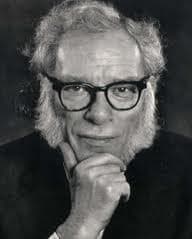
Isaac Asimov was an American writer and professor of biochemistry at Boston University. During his lifetime, Asimov was considered one of the "Big Three" science fiction writers, along with Robert A. Heinlein and Arthur C. Clarke. A prolific writer, he wrote or edited more than 500 books. He also wrote an estimated 90,000 letters and postcards. Best known for his hard science fiction, Asimov also wrote mysteries and fantasy, as well as much non-fiction.
Similar books
- The Big Sleep
Raymond Chandler
4.0 (126k) average on GoodreadsThrillerA classic hard-boiled detective novel with complex characters and a intricate mystery, similar to the mystery core.
- Childhood's End
Arthur C. Clarke
4.1 (130k) average on GoodreadsFantasyClarke's novel focuses on grand cosmic themes and human evolution, offering a more existential and philosophical narrative. Asimov, in contrast, grounds The Caves of Steel in a more intimate, procedural human-centric mystery, despite the advanced technological setting. While both explore societal transformation, Asimov's approach is more analytical regarding social structures and justice within established parameters.
- Angels & Demons
Dan Brown
3.9 (2.7M) average on GoodreadsThrillerA Harvard symbologist races through Rome's ancient sites, deciphering cryptic clues to unmask the Illuminati and stop a vengeful plot to destroy the Vatican with a stolen antimatter weapon.
- Gone Girl
Gillian Flynn
4.1 (2.3M) average on GoodreadsThrillerA wife's sudden disappearance on her fifth anniversary reveals a web of lies and psychological warfare, exposing the secrets within a seemingly perfect marriage.
- The Girl on the Train
Paula Hawkins
3.9 (2.1M) average on GoodreadsThrillerA woman’s fascination with a seemingly perfect couple she watches from her daily train commute leads her into a dark investigation when she witnesses something that shatters their idyllic image.
- The Lovely Bones
Alice Sebold
3.8 (2M) average on GoodreadsFantasyA murdered teenage girl watches from the afterlife as her family struggles with grief and her killer remains free, wanting to bridge the gap between worlds to bring him to justice.






Enjoyed the summary?
A summary gives you the shape of the book. The book itself has the detail, the examples and the voice.
Find The Caves of Steel on AmazonAs an Amazon Associate, BookBrief earns from qualifying purchases. How we're funded