
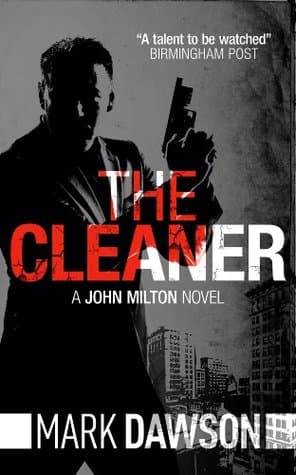
Synopsis
Covers the whole plot, including the ending.
- Difficulty
- Easy
- Pacing
- Fast
- Mood
- Gritty, Suspenseful, Action-packed, Dark
- Read it if
- You enjoy fast-paced thrillers with a morally complex protagonist, high stakes, and a blend of street-level crime and government intrigue.
- Skip it if
- You prefer gentle mysteries or stories without violence, or find the idea of a 'good' assassin unappealing.
The Cleaner Plot Summary
Covers the whole plot, including the ending.
The Last Target
John Milton, a highly effective but morally conflicted government assassin, kills his latest target, a corrupt politician in Brussels. Despite the successful mission, Milton is plagued by nightmares and the weight of his violent career. He decides this will be his last job, resolving to leave the shadowy agency known as 'Group' and seek atonement. He knows leaving such an organization will be difficult, but his desire for a normal life outweighs the risks. He begins to prepare for his exit, aware of the dangerous implications.
A Mother's Despair
Milton returns to London, seeking anonymity. While walking through the city, he encounters Sharon Warriner, a single mother in the East End, about to take her own life. Her son, Marcus, has joined a notorious local gang called the 'Bloods,' leaving her feeling helpless. Milton, driven by a growing desire to make amends for his past, intervenes and stops her suicide. He offers to help her find Marcus and get him out of the gang, a promise that pulls him back into a world of violence, but with a different purpose.
The Bloods and King K
Milton begins investigating the 'Bloods' gang, quickly learning about their ruthless operations and their leader, a rapper named King K. King K, whose real name is Kevin Kincaid, uses his music and influence to recruit vulnerable youths like Marcus into his criminal enterprise. Milton observes the gang's activities, gathering information about their hierarchy, drug dealing, and their control over the community. He realizes that talking to King K will be useless and that a more direct approach will be necessary to retrieve Marcus, putting him on a collision course with the gang.
Initial Confrontation
Milton tries to approach Marcus directly, but the boy is deeply involved in the gang and distrusts outsiders. This leads to an initial confrontation with several 'Bloods' members protecting Marcus. Milton, despite wanting to avoid violence, uses his combat skills to incapacitate them without killing them. This incident alerts King K to Milton's presence, escalating the conflict. Marcus, seeing Milton's abilities, is both terrified and intrigued, but remains loyal to the gang for now, fearing consequences if he leaves.
London Riots Erupt
As Milton continues his efforts to extract Marcus, London is engulfed in widespread riots, sparked by social unrest and police brutality. The city descends into chaos, with looting, arson, and street battles. This chaotic environment, while dangerous, gives Milton cover and opportunities. The police are overwhelmed, and the gang's operations are both disrupted and emboldened by the lack of law enforcement. Milton uses the confusion to his advantage, moving through the city relatively unnoticed, but also facing increased unpredictability and danger from both rioters and the gang.
The Hunter Becomes the Hunted
Milton's former employer, 'Group,' learns of his unsanctioned activities and his clear intention to leave. Viewing him as a rogue asset and a potential liability, they send another skilled agent, Ben, to track him down and eliminate him. Ben is a former colleague and friend, making the pursuit personal and complex for both men. Milton realizes he is now the hunted, forced to evade his past while trying to save Marcus. This adds immense pressure, as he must now contend with threats from both the gang and his former employers.
A Deadly Game of Cat and Mouse
Milton engages in a dangerous game of cat and mouse with Ben across the riot-torn streets of London. He uses his extensive training in surveillance, evasion, and counter-surveillance to stay ahead, always aware that Ben knows his methods and weaknesses. Despite the constant threat, Milton refuses to abandon Marcus. He continues to track the boy, using the riots as a smokescreen to approach gang strongholds. He also leaves subtle clues for Ben, a silent communication between former partners, hinting at his intentions and perhaps a plea for understanding.
Showdown with King K
Milton finally corners King K and his inner circle in a tense confrontation. The encounter is brutal, with Milton using his lethal skills to neutralize the gang members protecting King K, but again, he tries to avoid fatal force. During the chaos, Marcus is caught in the crossfire, witnessing the true brutality of the gang and the lengths Milton will go to protect him. King K, cornered, reveals his manipulative nature. Milton incapacitates King K, dismantling his control over the gang and freeing Marcus from his influence.
Marcus's Choice
After the confrontation with King K, Marcus faces a critical choice. Having witnessed the violence and the manipulative nature of the gang firsthand, and seeing Milton's determination to save him, he finally understands the true cost of his involvement. He rejects the gang lifestyle and expresses a desire to return to his mother. Milton ensures his safety, helping him reunite with Sharon, who is overwhelmed with relief. This reunion is a key moment for Milton, a step toward the atonement he seeks, proving that his actions can lead to positive outcomes.
The Final Confrontation with Ben
Milton's path crosses with Ben's for a final confrontation. The battle is less about physical prowess and more about their shared history and the moral dilemma of their profession. Milton tries to reason with Ben, explaining his motivations and his desire for a different life, but Ben is bound by his orders. The fight is intense and emotionally charged, as neither truly wants to kill the other. Ultimately, Milton outmaneuvers Ben, incapacitating him without lethal force. He makes it clear that he will not return to 'Group' and disappears, leaving Ben to report his failure, severing his ties once and for all.
A New Path
Having saved Marcus and evaded 'Group,' Milton truly begins his new life. He understands that atonement is not a single act but a continuous journey. He leaves London, adopting a new identity and dedicating himself to helping others in similar desperate situations. He knows his past will always be a part of him, but he finds purpose in using his unique skills for good, rather than for state-sanctioned murder. The nightmares may persist, but now they are tempered by the knowledge that he is actively working to balance the scales, becoming a protector rather than a destroyer.
Principal Figures
John Milton
Protagonist
A highly skilled government assassin seeking redemption.
John Milton is a former elite operative for a clandestine government agency, 'Group,' known for his ruthless efficiency and unparalleled combat skills. Despite his lethal profession, he is deeply conflicted, haunted by the countless lives he's taken. He possesses a strong moral compass that has been suppressed, but is now resurfacing, driving him to seek atonement. He is intelligent, resourceful, and incredibly resilient, with a deep understanding of human nature and a quiet intensity.
Relationships: Sharon Warriner (Protector/Benefactor); Marcus Warriner (Protector/Mentor); Ben (Former colleague and current adversary); Group (Former employer, now antagonist)
Sharon Warriner
Supporting
A desperate single mother whose son is entangled in a gang.
Sharon is a working-class single mother living in the East End of London. She is overwhelmed by fear and despair over her son Marcus's involvement with a dangerous street gang. Initially suicidal, she finds a flicker of hope and strength through Milton's intervention. She represents the innocent victims caught in the crossfire of urban crime and the profound love a mother has for her child, driving her to extreme desperation.
Relationships: John Milton (Recipient of his help and protection); Marcus Warriner (Mother-son relationship)
Marcus Warriner
Supporting
A young boy drawn into a dangerous street gang.
Marcus is Sharon's teenage son, vulnerable and impressionable, who has been lured into the 'Bloods' gang by the promise of belonging, power, and respect. He is initially defiant and loyal to the gang, fearing the consequences of leaving. He represents the lost youth in urban environments, easily manipulated but ultimately capable of recognizing right from wrong when faced with stark choices. His journey is one of disillusionment and eventual escape.
Relationships: Sharon Warriner (Son-mother relationship); John Milton (Recipient of his help and protection); King K (Gang leader, manipulative figure)
King K (Kevin Kincaid)
Antagonist
The charismatic and ruthless leader of the 'Bloods' gang.
King K, whose real name is Kevin Kincaid, is a local rapper who leverages his music and persona to control the 'Bloods' gang. He is manipulative, intelligent, and utterly ruthless, using fear and false promises to recruit and maintain loyalty among his young members. He views his gang as an empire and himself as its undisputed ruler, showing no remorse for the damage he inflicts on the community or his recruits. He is a formidable adversary due to his influence and his network.
Relationships: Marcus Warriner (Gang leader/recruiter); John Milton (Primary antagonist)
Ben
Antagonist/Supporting
A former colleague of Milton, tasked with hunting him down.
Ben is another highly trained operative for 'Group,' dispatched to eliminate Milton. He is Milton's former colleague and friend, making his mission personally complicated. Ben is loyal to 'Group' and its ideology, believing in the necessity of their work, but he also respects Milton's skills and perhaps understands his motivations on some level. He is as skilled and relentless as Milton, representing the inescapable reach of their former employers.
Relationships: John Milton (Former colleague, now hunter/hunted)
Group
Mentioned/Antagonist
The shadowy government agency Milton formerly worked for.
'Group' is a clandestine organization that employs highly skilled assassins like Milton to carry out state-sanctioned killings. Their methods are ruthless, and they operate outside conventional legal frameworks. They view their operatives as assets, not individuals, and do not tolerate dissent or defection. They serve as the overarching antagonist, representing the past Milton is trying to escape and the pervasive nature of power and control.
Relationships: John Milton (Former employer/asset); Ben (Current employer/asset)
Themes & Insights
Redemption and Atonement
The central theme of the novel is John Milton's quest for redemption. Haunted by his past as a government assassin, he seeks to atone for his sins by helping innocent people. This is shown when he saves Sharon Warriner from suicide and commits to rescuing her son, Marcus, from the gang. His actions, often violent but always aimed at a just outcome, are driven by his desire to balance his life, showing that even those with dark pasts can seek a path toward good.
“There's blood on his hands and he wants out. Trouble is, this job is not one you can just walk away from.”
The Cost of Violence
The novel explores the psychological and moral cost of a life dedicated to violence. Milton experiences nightmares and internal conflict, showing the heavy burden of his profession. Even when his violence is justified, it leaves lasting scars. The story also shows the devastating impact of gang violence on communities, families like the Warriners, and the young people drawn into it, highlighting the cycle of destruction it creates.
“A career of state-sanctioned murder has taken its toll. Milton is troubled by nightmares, a long line of ghosts who torment his dreams.”
Social Decay and Urban Crime
The London riots and the gang culture in the East End are a key theme, reflecting social decay and the struggles of urban environments. The novel portrays how economic hardship, lack of opportunity, and systemic issues push vulnerable youths like Marcus into criminal enterprises. King K's manipulation of these circumstances highlights the exploitation of social unrest for personal gain, and the riots themselves symbolize a society on the brink, struggling with its own conflicts and inequalities.
“As London burns through summer riots, Milton finds himself in unfamiliar territory, dealing with an unfamiliar foe.”
Identity and Escape
Milton's struggle to leave 'Group' and create a new identity is a core theme. He tries to shed his past, but his skills and the organization's reach make true escape difficult. Ben's pursuit shows that one's past, especially in a profession like Milton's, is inescapable. His journey is about redefining who he is, moving beyond the identity of 'the Cleaner' to someone who uses his abilities for a different, more moral purpose, even if it means constantly looking over his shoulder.
“He goes on the run, seeking atonement for his sins by helping the people he meets along the way. But his past cannot be easily forgotten and before long it is Milton who is hunted, and not the hunter.”
Plot Devices & Literary Techniques
The Haunted Protagonist
Milton's past actions manifest as recurring nightmares and internal conflict.
This device is used to establish Milton's moral struggle and his motivation for seeking redemption. His nightmares are not just a psychological symptom but a constant reminder of the lives he's taken, making his quest for atonement more urgent and believable. It humanizes a character who is otherwise a highly efficient killing machine, providing insight into his internal world and making him more relatable despite his violent profession. This internal conflict drives much of his decision-making.
The Unstoppable Force vs. Immovable Object
Milton's determination against 'Group' and the gang's entrenched power.
This device creates tension and highlights Milton's formidable will. He is an unstoppable force in his resolve to help Marcus and escape 'Group,' while the gang's power and 'Group's' relentless pursuit act as immovable objects. This dynamic is particularly evident in his confrontations with King K and Ben, where his personal mission clashes with established criminal and governmental structures, emphasizing the odds stacked against him and making his eventual success more impactful.
The London Riots as Backdrop
Widespread social unrest provides a chaotic and dangerous setting.
The London riots serve as more than just a setting; they are a catalyst and a complicating factor. The chaos provides both cover and increased danger for Milton, allowing him to operate outside normal law enforcement scrutiny while also presenting unpredictable threats. The riots mirror the internal turmoil Milton experiences and the societal breakdown that allows gangs like the 'Bloods' to thrive. It elevates the stakes and adds a layer of gritty realism to the narrative, making the urban environment a character in itself.
The Mentor/Protector Figure
Milton adopts a protective role towards Sharon and Marcus.
This device is crucial for Milton's redemptive arc. By becoming a protector for Sharon and Marcus, he actively works against his former role as a destroyer. His interactions with them allow him to display empathy and a desire to do good, directly contrasting his past. This role also provides a tangible goal for his dangerous mission, giving his actions a moral weight beyond mere survival. It allows the reader to see the 'cleaner' become a 'savior'.
The Cleaner Quotes
“He didn't kill people because he hated them. He killed them because it was his job.”
“The past was a relentless beast, always nipping at your heels.”
“Some lines, once crossed, could never be uncrossed.”
“In his world, trust was a luxury he could rarely afford.”
“He was a ghost, moving through the lives of others, leaving no trace.”
“The world was full of monsters, and sometimes, you had to be one to fight them.”
“Every job left a scar, even if no one else could see it.”
“He wasn't looking for redemption, just a moment of peace.”
“The truth was a weapon, and like any weapon, it could cut both ways.”
“You could run from your past, but you could never truly escape it.”
“He was good at what he did, terrifyingly good.”
“Sometimes the greatest threats came from within.”
“He understood the language of violence better than any other.”
“The silence was his oldest friend, and his most loyal companion.”
Quiz
10 questions on the plot and the characters. Each answer comes with a short explanation.
Question 1
What is John Milton's profession before he decides to leave it?
- A private detective
- A government assassin
- A police officer
- A security consultant
Show answer
B. A government assassin The text explicitly states Milton is 'the man the government sends after you' and his 'trade is murder,' identifying him as a government assassin.
Question 2
Why does John Milton decide to leave his profession?
- He wants to start a family.
- He is injured and can no longer perform his duties.
- He is troubled by his actions and seeks atonement.
- He is offered a better job elsewhere.
Show answer
C. He is troubled by his actions and seeks atonement. The synopsis states, 'he's had enough - there's blood on his hands and he wants out,' and 'seeking atonement for his sins.'
Question 3
What is the specific type of trouble Sharon Warriner is facing when Milton encounters her?
- She is being blackmailed by a former associate.
- She is suicidal with fear over her son joining a gang.
- She is being targeted by a rival criminal organization.
- She has lost her job and is facing eviction.
Show answer
B. She is suicidal with fear over her son joining a gang. The text states Sharon is 'suicidal with fear that she's lost her young son to a life in the gangs.'
Question 4
How does Milton initially become involved with Sharon Warriner?
- She hires him for protection.
- He witnesses her being attacked.
- He saves her life.
- They meet through a mutual acquaintance.
Show answer
C. He saves her life. The text explicitly states, 'After Milton saves her life, he promises to help.'
Question 5
What is the general setting for the events involving Sharon Warriner and the gang?
- The West End of London during a heatwave.
- The East End of London during summer riots.
- A rural town outside of London.
- An industrial district in Northern England.
Show answer
B. The East End of London during summer riots. The text mentions Sharon is 'a single mother in the East End of London' and 'As London burns through summer riots.'
Question 6
What is the primary challenge Milton faces when trying to help Sharon with her son?
- The police are uncooperative.
- The gang and its leader are uncooperative.
- Sharon's son refuses to leave the gang.
- Milton lacks the necessary resources.
Show answer
B. The gang and its leader are uncooperative. The text states, 'But the gang, and the charismatic rapper who leads it, is not about to cooperate with him.'
Question 7
What is described as haunting Milton's dreams?
- Visions of his own death.
- Financial anxieties.
- Nightmares of the people he has killed.
- Memories of a lost love.
Show answer
C. Nightmares of the people he has killed. The text states Milton is 'troubled by nightmares, a long line of ghosts who torment his dreams.' These 'ghosts' refer to his victims.
Question 8
What is implied about the nature of Milton's former job, making it difficult to leave?
- He signed a lifetime contract.
- He owes a large debt to his employer.
- It's not a job 'you can just walk away from,' leading to him being hunted.
- His skills are too specialized to find other work.
Show answer
C. It's not a job 'you can just walk away from,' leading to him being hunted. The synopsis explicitly states, 'Trouble is, this job is not one you can just walk away from. He goes on the run... But his past cannot be easily forgotten and before long it is Milton who is hunted, and not the hunter.'
Question 9
What additional obstacle does Milton face while trying to help Sharon and her son?
- He is framed for a crime he didn't commit.
- His former employer sends another agent after him.
- He runs out of money and resources.
- Sharon's son betrays him to the gang.
Show answer
B. His former employer sends another agent after him. The text states, 'And when his employer sends another agent after him, the odds against him are stacked even higher.'
Question 10
What is the central theme that drives John Milton's actions after leaving his profession?
- Revenge against his former employer.
- Seeking wealth and a peaceful retirement.
- Atonement and making amends for his past actions.
- Establishing a new criminal enterprise.
Show answer
C. Atonement and making amends for his past actions. The text mentions he is 'seeking atonement for his sins by helping the people he meets along the way' and 'perhaps, he can start to make amends for everything that he has done.'
The Cleaner FAQ
What is John Milton's primary motivation for wanting to leave 'The Group' at the beginning of the book?
John Milton is deeply troubled by the cumulative toll of his decade-long career as a government assassin. He experiences recurring nightmares, haunted by the 'ghosts' of those he's killed, indicating a profound psychological burden and a desire for atonement for his past actions.
Who is Sharon Warriner and how does she become involved with John Milton?
Sharon Warriner is a single mother from East London, driven to despair and suicidal thoughts due to her young son's involvement with a local gang. Milton encounters her when he saves her life, and subsequently promises to help her retrieve her son from the gang, pulling him into her world.
What is the primary conflict Milton faces in East London, aside from his former employers?
Milton confronts a powerful and dangerous street gang in East London, led by a charismatic rapper, who has ensnared Sharon's son. This conflict forces him into unfamiliar territory, dealing with a different kind of adversary than his usual state-sanctioned targets, amidst the backdrop of summer riots.
How does 'The Group' react to Milton's attempt to leave his position?
The Group, Milton's former employers, do not permit agents to simply walk away from their deadly line of work. They dispatch another highly skilled agent to hunt Milton down, indicating that once an operative is in, they are in for life, making him the hunted instead of the hunter.
What role do the London summer riots play in the narrative?
The London summer riots serve as a chaotic and volatile backdrop to Milton's efforts to help Sharon and confront the gang. This widespread civil unrest provides cover and complicates his mission, making it harder for both him and his pursuers to operate discreetly.
Are there any subtle clues about Milton's past operations or his true identity before he goes on the run?
While the book emphasizes his anonymity, Milton's internal monologues often hint at the breadth and brutality of his past assignments, referring to a 'long line of ghosts' and a 'career of state-sanctioned murder.' These brief allusions suggest a history spanning multiple countries and complex targets.
What is the significance of Milton considering himself an 'artisan' or 'craftsman' of murder?
This self-description reveals Milton's initial detachment and professionalism, viewing his work with a cold, almost artistic precision. It highlights his mastery of his deadly trade, but also sets up the contrast with his later desire for atonement, showing how his perspective has shifted from professional pride to moral burden.
How does the 'charismatic rapper' leader of the gang serve as a foil to John Milton?
The rapper, with his public persona and influence over impressionable youth, contrasts sharply with Milton's anonymous, solitary existence. While both command loyalty and fear, the rapper operates in the open, exploiting social unrest, whereas Milton works in the shadows, now seeking to undo the damage of similar, albeit state-sanctioned, power.
What does Milton's promise to help Sharon Warriner reveal about his internal struggle?
Milton's unsolicited promise to Sharon is a tangible manifestation of his desire for atonement. Instead of simply escaping, he actively seeks to right a wrong, even at great personal risk, demonstrating his commitment to making amends and finding a new purpose beyond his former life.
How does Milton's experience as a government assassin prepare him for dealing with a street gang, or does it hinder him?
Milton's skills in planning, combat, and psychological manipulation are invaluable, but his usual targets are often high-level, organized figures. Dealing with a chaotic street gang and navigating the social dynamics of East London's youth culture presents new challenges, forcing him to adapt his methods and operate outside his typical parameters.
What psychological impact do the 'nightmares' and 'ghosts' have on Milton's decision-making?
The nightmares are a direct manifestation of Milton's guilt and trauma, driving his desperate need for change and atonement. They compel him to seek redemption, influencing his decision to help Sharon and creating an urgency to escape his past that overrides his usual cold logic and self-preservation instincts.
How does Milton's internal conflict between his past identity as 'The Cleaner' and his new desire for redemption manifest?
Milton constantly battles between his ingrained, ruthless efficiency as an assassin and his burgeoning moral compass. He finds himself using his deadly skills for what he perceives as a 'good' cause, but the methods are still violent, creating an ongoing tension between his old self and the person he strives to become.
Is 'The Group' purely evil, or is there an argument to be made for their necessary existence in the world of the book?
The book portrays 'The Group' as ruthless and amoral, prioritizing state interests above individual lives. While their methods are extreme, one could argue, from a certain perspective, that they exist to handle threats that conventional means cannot, occupying a morally grey area of 'necessary' evils for national security.
Does Milton truly believe he can achieve 'atonement,' or is his quest more about finding peace?
Milton's quest for atonement is likely a deeply personal and perhaps unattainable goal, given the scope of his past actions. It's less about formal forgiveness and more about finding internal peace and purpose by dedicating his skills to protecting the innocent, thereby mitigating the overwhelming guilt that plagues him.
What is the broader commentary on government secrecy and accountability implied by 'The Group's' operations?
The existence of 'The Group' implicitly critiques unchecked government power and the lack of accountability for clandestine operations. It suggests a hidden layer of state control where moral boundaries are blurred, and individuals like Milton are disposable tools for maintaining an opaque agenda.
How does the author use the setting of East London and the riots to enhance the themes of the novel?
The East London setting, with its social issues and gang culture, provides a gritty, realistic backdrop, grounding Milton's high-stakes world in everyday struggles. The riots amplify the sense of lawlessness and chaos, mirroring Milton's internal turmoil and the breakdown of order he's experiencing both personally and professionally.
Is the new agent sent after Milton a reflection of his past self, or a distinct character?
The new agent serves as a stark reflection of Milton's past self: ruthless, efficient, and fully committed to 'The Group's' directives without the moral qualms that now plague Milton. This character highlights the path Milton chose to abandon and underscores the dangerous nature of his former life.
Similar books
- The Gray Man
Mark Greaney
4.2 (52k) average on GoodreadsFictionFeatures a highly skilled, rogue operative with a dark past on the run from former employers.
- I Am Pilgrim
Terry Hayes
4.3 (126k) average on GoodreadsThrillerA high-stakes international thriller with a former intelligence agent facing a complex threat.
- Killing Floor
Lee Child
4.0 (249k) average on GoodreadsThrillerBoth introduce a highly capable, lone protagonist. Child's 'Killing Floor' often delves deeper into Reacher's internal thoughts and philosophical musings, offering a more introspective character, whereas Dawson's 'The Cleaner' is more direct and action-oriented in its approach to Milton.
- Orphan X
Gregg Hurwitz
4.1 (34k) average on GoodreadsThrillerBoth feature highly trained operatives trying to navigate a new path. Hurwitz's 'Orphan X' often presents a more intricately detailed world-building and a deeper exploration of the psychological toll of the protagonist's past and present life, making 'The Cleaner' feel slightly less complex in comparison.
- Angels & Demons
Dan Brown
3.9 (2.7M) average on GoodreadsThrillerA Harvard symbologist races through Rome's ancient sites, deciphering cryptic clues to unmask the Illuminati and stop a vengeful plot to destroy the Vatican with a stolen antimatter weapon.
- Gone Girl
Gillian Flynn
4.1 (2.3M) average on GoodreadsThrillerA wife's sudden disappearance on her fifth anniversary reveals a web of lies and psychological warfare, exposing the secrets within a seemingly perfect marriage.




Enjoyed the summary?
A summary gives you the shape of the book. The book itself has the detail, the examples and the voice.
Find The Cleaner on AmazonAs an Amazon Associate, BookBrief earns from qualifying purchases. How we're funded